Wednesday, 21 May 2014

'BOGG': History Of An Irreverent Poetry Magazine

'Bogg no.10'

‘BOGG’: 
‘POETRY AT YOUR CONVENIENCE’ 

‘Bogg’ was an anarchic poetry magazine 
that defined the irreverent attitudes of the 1970’s 
yet thrived and survived into the 2000’s. 

Bogg is a quagmire, a fen, a mire, a swamp, a marshland. That it’s also slang for toilet is entirely appropriate. That was a deliberate part of the plan when George Cairncross launched ‘Bogg’ as a poetry magazine. Those lavatorial inferences, of poems ‘flushed down the bogg’, were part of its irreverent humour. The cover of no.12 makes this meaning unmistakably clear, with Joe Hirst cartoon-art showing the inside of a toilet-cubicle, seen from the pedestal perspective, with the uncoiling reel of tissue-paper to the right, and graffiti on the door warning ‘Beware Of Limbo Dancers’. ‘Bogg’ was also one of the first underground arts magazines I encountered. There were lots of serious, pompously stern journals with titles such as ‘Poetry’, ‘Poetry Today’, ‘Poets And Poetry’ which took a reverent attitude to verse and the implications of verse. ‘Bogg’ made it fun. ‘Bogg’ was part of an attitude that saw poets and poetry as part of an extended and extending party.

By a series of uncertain but enthusiastic steps I’d first discovered a magazine called ‘Sad Traffic’ which was published by students from Bretton Hall college in Barnsley. I immediately loaded everything I owned into my battered auto, drove down the motorway, and moved in with them. They were in the process of launching a full underground newspaper called ‘Styng’. I knew something about print-layout and design. I started hanging out there as issues were coming together. Word about ‘Styng’ got around the global counterculture network, and review copies, trade issues and salutations were soon deluging in from every place. I sat there, read them, made notes. In a kind of proto-internet each publication carried the address details of others with similar mindsets and attitudes. These in turn led to yet others. They came from everywhere. I sent out my writing. Some of it vanished. Some was picked up and used. I soon had poems included in ‘Headland’, ‘Viewpoints’… and ‘Bogg’.


'Bogg no.12'

But more importantly, the connection with George Cairncross and the motley crew of disreputable contributors to his ‘Fiasco’ venture involved a sense of loosely playful community, a rough and tumble shared vision that was battered, a little unseemly, and with a definite awkwardness to all things arts-establishment. Each issue was a riotous dialogue of voices. George was ‘Zack’, or ‘Kapitan Mog’, the impish Lord of Misrule around whom the revels revolved. He was ‘the only loony on the East Coast able to go in a pub penniless and come out blind drunk.’ He claimed anarchism as the guiding ethos, and where there was unused space at the foot of pages, he’d insert inflammatory quotes from Pierre-Joseph Proudhon, Mikhail Bakunin, Peter Kropotkin or whoever came to hand. Sometimes it might equally be thoughts snatched from graffiti, or Pop culture. But largely it was contrarian for the sake of being contrary. Which is not to say there were not serious points to be made. Irreverence is a valid ideology in itself. One that chimed with the counterculture, with underground arts and poetry, with the populist movement of the times that sought to radically uptilt elitism and literary art-for-art’s-sake ivory towers. Fun can be a tool of insurrection too.

‘Bogg’ began in 1968, no.1 consisting of ‘work by our insane selves under our own names and pseudonyms’, the early issues assuming strange pre-A4 shapes. They were spirit-duplicated, a now long-obsolete lovingly hand-cranked Fordigrapher office-technology using alcohol-based ink solvents that resulted in distinctive mauve print (aniline). The copy was typed onto a two-ply master in George’s distinctive Remington typewriter face, familiar over the decade from successive issues, as well as from his chatty entertaining letters with gossipy news updates about contributors, spin-off projects and the artworks he stashed in his studio. But it was a reproduction-format with its own built-in obsolescence, the master soon deteriorated and then disintegrated, determining that every number was a limited-edition. Mailed out in hand-written envelopes, individually stamped.


31 Belle Vue Street, Filey

Fiasco Publications, as it was styled, operated from no.31 Belle Vue Street, above George’s parents shop in the sleepy resort of Filey, on the East Yorkshire coast. It’s fair to say that none of his customers, the day-tripping tourists or the elderly locals, suspected that this was also a subversive hub disseminating smut and outrage. Although Joe Hirst’s art, recurring in each issue, has the robust ribald quality of a Donald McGill seaside postcard, with a four-frame ‘Fanny Makes The Trip’ recounting how the Big Bad Wolf chases the Red Riding Hood look-alike’s nude granny through the woods. He created ‘Pans Scrubbers’ in response to TV’s Pans People. And the lavatorial covers continue, no.24 shows the dilemma of a bog-seated man with no toilet-paper, torn between using either a postage stamp, or a pound note.

The colophon extends a welcome for fresh input with ‘Wanted: Poems, articles, short stories, cartoons, humour, reviews, Butch Cassidy & the Sundance Kid’. Extending the list to ‘anything printable, or otherwise’, plus ‘the bloke who nicked Captain Mog’s trousers when he was out swimming in the sea on New Year’s Day’. Writers include Liverpool’s David Ward (‘I learnt my sex from dirty jokes / and you / were the dirtiest joke of them all’), the hyper-prolific Steve Sneyd from Huddersfield, the cerebral William Oxley, Gina Gregory, Eddie ‘Everard’ Flintoff and Opal L Nations, as well as such American links as John Elsberg.

 There’s a poem “Tribute To Jimi Hendrix” by John Freeman of Doncaster, and a Pop Art take on the second coming by Clifford Nicholas from Kings Lynn, ‘will you take the Tribune when you come / and smoke pot / or join the Monday club / and that lot / Will you protest with CND / or be a coward like me…’. There’s no argument when double-issue no.10/11 advocates the breathless immediacy of ‘one must write for now, not posterity’ – apart from the slightly formal ‘one’. Derrick Buttress catches the attitude when he asserts ‘I don’t know whether it’s a poem or not, and I don’t think it’s important, what is important is that it’s original and true to a real experience.’ While Eddie Flintoff sets the bar by adding ‘I wish I could write one poem, half as witty and at the same time sad, as these graffiti.’ When Robert Webb writes “On The Pleasure Of Farting” at least he adds an escape-clause dedication to Salvador Dali.


'Bogg no.16'

Sure, there’s a hard-core of familiar names, so each new issue is a virtual meeting-up with a regular bunch of amusing friends down the local, swapping and competing their latest poem-form anecdotes. As Mark Williams writes, ‘warm toilet seat / shared lives’. There are requests to locate rare copies of Andy Roberts ‘Home Grown’ or Roger McGough’s ‘A Summer With Monica’ LP’s. But there’s always space for sharp newcomers too. The ‘contributions wanted’ notices for new mags – ‘Ostrich’, ‘Pink Peace’ or ‘Sandwiches’, and for the free-for-postage booklets described as ‘the most important publication since the Martian State Papers were released’. I first read Tina Fulker’s amazing razor-edged minimal lines in ‘Bogg’, and she launched her own ‘Moonshine’ – its first issue (August 1971) printed on cut-up rolls of wallpaper, from its contact-listings. Other significant incomers included Pete Faulkner’s rich mix of Beat symbolism and picaresque bohemia, Dave Wright with his working-class Western epics and Nottingham’s Derrick Buttress, writing tense compressed mythopoetica resembling incidents plucked from some greater broken-narrative.

If groups such as Scaffold, the Liverpool Scene or the more scatologically-confrontational Fugs formed a kind of working model, along with the ‘Mersey Poets’ and the anti-establishment names of the celebrated 1965 Albert Hall ‘International Poetry Incarnation’ – Adrian Mitchell, Spike Hawkins and Michael Horovitz, then the other aspect of that event – Allen Ginsberg, Greg Corso and Lawrence Ferlinghetti, formed its complementary pole. Decades before Amazon, elusive Beat texts, available only from hard-to-find specialist bookshops, circulated in well-thumbed novels, anthologies and American magazines, while their energetic stylistic and thematic freedoms fuelled the arsenal of techniques seized upon and adapted into new forms by ‘Bogg’ writers. The hallucinogenic machinations of Dada-shock and Surrealism’s malleability were present too, even when possibly channelled through Bob Dylan’s lysergic lens.


'Bogg no.24'

Pete Faulkner thumbed down from Dundee. We hitchhiked across to the east coast, slept overnight on Dave Wright’s front-room floor in Bridlington, then hopped up-coast to visit George in Filey. Piles of Pop-Art collages were strewn and stacked about his studio. A Billie Holiday LP was playing. And there was a huge keg of beer, ‘if I open it, we’re going to have to finish it.’ He opened it. We finished it. George as fast-talking as ever, a rapid cascade of anecdotes about his three-year art-school days at the James Graham College in Leeds, where the seeds of ‘Bogg’ were planted. ‘The campuses, back streets and pubs were awash with such literature, everyone who had access to a duplicator was setting up his own magazine.’

 It began in performance poetry with the Exploding Umbrella group, George with Trevor Greenley and sound-poet Jim ‘write yer sod’ McGowan. ‘We of the piss-taking brotherhood didn’t really take anything seriously, and were rather pleased to have a go at anything.’ Joe Hirst, a few years older, shared the same studio with George. He became the other centre around which the ‘Bogg’ identity was forged, the ‘only person to have appeared in every issue to date.’ Around the same month I was chinwagging with George, I also visited Joe in his stone-built terraced house outside Denby Dale. His gift of instant intimacy drawing me into his enthusiastic unpretentious creativity.

When pagination increased beyond the straining limits of side-stapling, George shifted the reviews into a separate section, variously called ‘Lazy Lob’ or ‘Sucking’ (no.23). Beyond all reasonable expectations the magazine thrived, and even when forced to ditch its aging duplicator for print-form, and increasingly became ‘A Journal of Anglo-American Writing’ as John Elsberg assumed greater editorial input, the Joe Hirst feature-cartoons lent continuity, along with a turn-over of new and familiar names, from Ron Androla to Tina Fulker, from Belinda Subraman to Cheryl Townsend and John Yamrus.

 John Elsberg, a fine American poet, had been studying for his Ph.D in Cambridge when Gerald England ‘visited him unannounced in September 1970’, as Gerald recalls. The following year John and his partner Connie visited Yorkshire and Gerald took them across to Filey to meet George. They became friends and collaborators, until the more George withdrew from ‘Bogg’ through the late-seventies, the more John assumed a greater share of contents, as ‘Bogger-in-Chief’. Meanwhile, there was anniversary hoopla in Filey, with a tribal gathering of the extended family. I remember Andy Robson, Graham Sykes and others. A hyperactive George presiding. Anecdotes were exchanged. Beer was consumed at the Foords Hotel, on Filey’s Queen Street. ‘It will be a sad day for ‘Bogg’ if ever it is struck down by sanity’ quoth George.


Me, George Cairncross & Graham Sykes in Filey

Andy Robson ('Krax'), Me & George Cairncross in Filey

Although, since ‘it moved to America in 1980’ (from no.44), the title was safe in John’s hands, and began to build steady credibility (my letter in no.48 laments ‘the infiltration of politeness in the review section’ while missing ‘the roaring thunder of abrasive rhetoric’), maybe there are indications that George retained a hankering for older more disreputable days. He produced two spin-off titles, two issues of ‘Renegade’ with Eddie Harriman collages and poetry from Bryn Fortey (of ‘Target’), Geoff Stevens (of ‘Purple Patch’) as well as Pete Faulkner and Steve Sneyd, plus five defiantly-duplicated issues of ‘pirate child’ ‘Boggers All’ (from October 1993 to December 1997) under the guise of Demijohn O’Rhubarb, with Joe Hirst at his most saucily provocative and a ‘motley collection of old Boggers’, all the usual suspects – Derrick Buttress, Dave Wright, Steve Sneyd, Gerald England, Geoff Stevens, Andy Robson, Pete Faulkner… and me. Kapitan Mog reiterates that ‘yes, dear readers, poetry should be fun, not locked up in the Universities and Colleges, to be dissected by the Profs and students; it should be writ large on street hoardings, scrawled across pavements, recited at madcap parties, given free with cornflakes, printed on bogg-rolls; in fact it should be everywhere to be enjoyed and laughed over by everyone. It is not a serious business as some would have us believe nor a clever and intellectual exercise. Leave that to the pseuds.’ Which is pretty much where we came in.


'Bogg no.47'

‘As always, editing is a subjective affair’ insists no.47, ‘and we publish what takes our fancy.’ Through the 1980’s – typeset A5 from no.60 (1988), it was possible to detect a growing editorial schizophrenia infiltrating the issues, John Elsberg pushing his half relentlessly upmarket with real literate reviews, interviews and artistic credibility, while George – equally determinedly, continued cranking up the lunacy ratchet with his aggressively mimeo-mindset silly names and daft limericks (with a glancing-backwards ‘Old Boggs’ reprint page). Yet the fierce independence is a constant, for real strength and energy came from their artful collusion. They never applied for, and never received any kind of grant-aid. Joe Hirst catches the transatlantic split by satirising Margaret Thatcher as a flirty 1944 Grantham schoolgirl soliciting gum and nylons from passing GI’s, then as a skirt-billowing Marilyn Monroe (no.64 carries George’s obituary to Joe).

As George steps down, John concedes that ‘Bogg’ has ‘evolved in various ways over the years, but we have always tried to stay true to its essential character and ‘tone’.’ Yes, but perhaps this second-phase Anglo-American ‘Bogg’ deserves its own, separate feature. To be written some other time, with a slightly skewed perspective on what had come before. One in which Gerald Locklin, Kit & Arthur Knight, Jim Watson-Gove and AD Winans are the names to look out for. With Lyn Lifshin (an interview in no.60), Ann Menebroker (‘Bogg’ chapbook with no.62), Todd Moore (featured poet no.64), and Ruth Moon Kempher (featured poet no.71). But Billy Childish and Charles Bukowski are in there too. Richard Peabody writes of the “Guitar Player” whose ‘fingers know secrets, that eyes can’t understand’. Maybe that’s true of a poet’s pen, typewriter or laptop too. For it’s also all one, because ‘that identity in turn is clearly rooted in George Cairncross’ original intent.’ By 1992 the issue numbering was climbing into the upper-sixties, each one announced by that solid thump of the envelope erupting through the mail-slot and whumping down into the welcome-mat beneath. Until a double-issue ‘Journal Of Contemporary Writing’ no.73/74 came in two parts, dated 2006. And although issues had become more wide-spaced, it was only John Elsberg’s death in 27 July 2012 that finally brought the ‘Bogg’ adventure to an end. It had been a great party.


Tuesday, 20 May 2014

SF Classic: 'Man Of Two Worlds' by Raymond F Jones


RAYMOND F JONES: 
MAN OF MANY WORLDS 

Book Review of: 
‘MAN OF TWO WORLDS’ 
 by RAYMOND F JONES 

(1944 as ‘Renaissance!’, 1951 Gnome Press, 
as ‘Man Of Two Worlds’, Pyramid Books November 1963) 

 ‘It is the Mystery of existence, the 
Mystery of life that I would Seek out…’ 

This is a strange book, even by the standards of its time. There’s some unconscious humour which, almost comically absurd now, must surely have had the nudge-nudge factor even then. One of the ‘Mysteries’ that Ketan seeks to understand is, where do babies come from? New citizens emerge fully-formed, but sterile, from the ‘Temple of Birth’ with no memory of what came before. He has only hints and clues to base his enquiries on. Yet in this disturbingly odd conundrum he has unwitting companions within the Science Fiction continuum. In Arthur C Clarke’s ‘The City And The Stars’ (1956) Alvin is a ‘unique’ in far-future Diaspar, in which new citizens are created by the controlling central computer. Some time before Alvin, but in a similar way, Ketan comes to awareness in Kronweld, another closed community with a mighty computer-system called the Karildex. It is located on a world of two suns. Beyond the city in one direction lies the inhospitable Dark Land ‘where glowing firebursts lit the sky’ from the volcanic radioactive Fire Land. And in the other direction lies the impenetrable ‘Edge’, an ‘infinite curtain of blackness… a vast wall of negative existence that stretched from positive to negative infinity.’

Ketan is a Seeker who – like Alvin, is a discontented subversive, a member of the underground ‘Unregistered’ who secretly conspire to challenge the repressive secrecy of his society and penetrate its mysteries, demanding ‘the Mystery of the Temple of Birth, the Mystery of the great Edge, the Mystery of Fire Land. These things should not be closed to us.’ The Karildex constitutes a citywide internet making it ‘thus the law and the government’. So he breaks the seals on the master control board – what we’d now term ‘hacking into’ the ‘memory-circuits’ restricted to the First Group, searching for ‘the origin of human life’. He’s determined to provoke a confrontation with Teacher Daran that will precipitate a reprimand, and so enable a full public hearing, allowing him the opportunity of stating his case. But first, he has an unsettling encounter with an aged crazy-woman – ‘an old and withered husk’, who tells him of the Statists – agents of destruction infiltrating from beyond Kronweld, and of deaths to come. He realises that, ‘surging beneath the surface of Kronweld were strange, unknown forces of which he had never conceived. Forces that were merciless and swift.’

This is when the novel becomes decidedly odd. He’s pledged to ‘make companionship’ with the lovely Elta. In keeping with the scanty female garb of 1940’s Pulp Magazine cover-art, he finds ‘her slim brown body clad only in the universal fashion of brief, white harness that served necessary convenience and protection.’ But when Elta enters the female-only Temple, Ketan determines to follow her. So he uses a kind of ‘elastic moulding plastine’ to remould himself into female guise.

 He then enters the temple by using a harpoon and grapple-line to scale up onto its flat-roof where he overpowers one of its Ladies, and orders her to undress, so that he can use her diaphanous gown to further his masquerade. ‘Out of your clothes, quickly now’ he demands, ‘I must exchange with you.’ When she refuses ‘he loosed one hand and tore the fastening loose at her throat and removed her robe.’ There’s no sexual element to this assault. He simply uses it to maintain the transgender identity for long enough to become involved in the bizarre politics of the enclosed order. There’s a coup. Aging Matra – the original crazy-woman of his earlier encounter, is murdered, replaced as matriarch by the ambitious Anetel. And he finds his answer. Infants emerge through a dimensional portal, opening out through the ‘Edge’. The fact that, throughout this lengthy sequence the reader has to hold in mind the unsettling image of him as a kind of remoulded Ladyboy tends to undermine its speculative gravity.


Surely all of this must have struck even its original readers as odd, when the novel was serialised in four parts as “Renaissance” in John W Campell’s ‘Astounding Science Fiction’? The first instalment appeared in the July 1944 issue, which not only also included Clifford D Simak’s “Huddling Place” – part of his ‘City’ story-cycle, but another Raymond F Jones story – “Utility”, published under the alias ‘David Anderson’. The serial continued through the August and September issues, to finish in the October issue with artwork by Paul Orban, alongside contributions from George O Smith, Lester del Rey and Isaac Asimov’s “Wedge” from his ‘Foundation’ cycle. The four episodes were first collected into book form in 1951 – as ‘Renaissance: A Science Fiction Novel Of Two Human Worlds’ by Gnome Press in an edition of 4,000 copies with cover-art by David Kyle graphically showing two colliding planets. Then the Pyramid paperback edition arrived in November 1963 as ‘Man Of Two Worlds’ – announcing it ‘a dazzling tale of adventure in the infinite future, a superhero’s quest for the forbidden, ultimate knowledge – the secret of all life!’

P Schuyler Miller describes the novel accurately as ‘a strangely moving book, overcoming its lack of characterisation and other traditional shortcomings by drive and sweep of imagination’ (in ‘Astounding SF’, December 1951). He’s correct in asserting that Ketan would be considered a narrow cipher within mainstream Lit-fiction, but that misses the point. His deep-cored restlessness is one acutely attuned to the mindset of its target readership. Like Arthur C Clarke’s Alvin, Ketan’s attitudes and stance perfectly snag the mood of petulant juvenile yearning, and the SF genre at that time was predominantly a male adolescent one. Ketan is impatient for change, frustrated by the tired complacency, the ‘slow dying senility’ and dull closed minds of those in power over him, just as the 1950’s ‘Rebel Without A Cause’ Beatniks would be, and in anticipation of the great upsurge of 1960’s counter-culture insurrection.


At Ketan’s interrogation by the Seekers Council in the House of Control, he is denounced for blasphemy as he defiantly argues his defence, proclaiming ‘I know enough to be sure that this is the only way progress can be made against superstition and blindness. You’ve got to smash through it and batter it down – or else live in its smothering encirclement.’ Yet Raymond F Jones makes for an odd subversive. He condemns his Statists as witch-burning Puritans. Yet he was born a Mormon (in Salt Lake City, Utah in 15 November 1915).


He first read HG Wells ‘War Of The Worlds’ when ‘Amazing Stories’ republished it in 1927, alongside the ‘wonderful aura’ of writers such as Ray Cummings, A Hyatt Verill, and Ralph Milne Farley who inspired him to write. He began his own SF career with short story “Test Of The Gods” in the ‘Astounding SF’ issue dated September 1941, but was soon contributing to other titles such as ‘Planet Stories’, ‘Super Science Stories’ and ‘Galaxy’ too. Some of his short stories were later collected into ‘The Non-Statistical Man’ (May 1964, Belmont), blurbed ‘one man’s mind spins a taut and eerie arc from the dark past into the distant future, and suddenly the world looks different!’, and ‘The Toymaker’ (1951, Fantasy Publishing) – which includes the pseudonymous “Utility” and “The Children’s Room”. The latter tale, about a protégé child, was adapted from ‘Fantastic Adventures’ (September 1947) into a TV episode of the ‘Tales Of Tomorrow’ (29 February 1952) anthology-series, while “Divided We Fall” – from ‘Amazing Stories’ (December 1950) became an episode of the British ABC-TV’s ‘Out Of This World’ (25 August 1962). Set in the year 2033, in grainy black-and-white, it portrays an omnipotent computer called Eddy which claims to have detected synthetic alien infiltrators called ‘Syns’, but scientist Dr Arthur Bailey (played by Bernard Horsfall) – fresh from two years on planet Cyprian, distrusts Eddy and is sceptical of the Syn’s existence. Jones also contributed to the ‘juvenile’ genre with the authorised spin-off from TV’s ‘Voyage To The Bottom Of The Sea’ (1956, Whitman Publishing), and his popular ‘Son Of The Stars’ novel-series featuring his interplanetary hero ‘Ron Barron’.

But it’s for the classic SF film ‘This Island Earth’ (Universal-International, 1955) that he’s best remembered. The story, in which visiting aliens recruit human scientists into their ‘Peace Engineers’ to assist their struggle against a stellar enemy, is based on a three-part Jones’ ‘Thrilling Wonder Stories’ serial, collected into a novel which Forrest J Ackerman’s literary agency placed with Shasta Books (1952). Selected for inclusion by two book clubs, it was published by Boardman in the UK and announced as ‘one of the truly memorable science fiction experiences of 1955. It combines a sense of social responsibility and thrilling action within the framework of a cosmic struggle to maintain a barrier against an incredible invasion. This book will appeal to everyone who has ever stopped on a starry night to gaze in wonder at the vastness of the universe, and to ponder the place in infinity of This Island Earth.’ Shatteringly well-filmed for its time, with eye-rippingly impressive technicolor visual extravagance, the screenplay is less than true to Jones’ plot.


Carl Meacham (Rex Reason) is contacted through ‘interocitor’ by white-haired Exeter (Jeff Morrow) – ‘Jorgasnovara’ in the novel, visualised by Virgil Finlay for its original magazine appearance. But these aliens are not intent on conquest, but on seeking help. The abducted scientists are taken ‘many galaxies away’ by saucer to an underground city on the devastated planet Metaluna, besieged by their Zahgonian aggressors. ‘Considerable money seems to have been spent on its production’ reports Forrest J Ackerman, ‘a reported $17,000 alone having been spent on the manufacture of the Mutant… a bulbous-brained beauty, head approximately four times normal size’ with ‘built-up shoulder muscles and arms twice normal length which terminate in ugly pincers’ (in ‘Nebula SF’ no.12, April 1955). 

Metaluna is destroyed by targeted meteorite-strike, ‘intense heat is turning Metaluna into a radioactive sun. Temperature must be... thousands of degrees by now. A lifeless planet. And yet... yet still serving a useful purpose, I hope. Yes, a sun. Warming the surface of some other world. Giving light to those who may need it.’ Hokum, of course, but delivered with impressively straightfaced gravitas. Helping them escape back to Earth, a visionary Exeter explains ‘our universe is vast – full of wonders, while the ship has energy to fly, I will explore…’ Ludicrous, scientifically hopeless, yet speculating on which is the best science fiction film of all time, critics David Miller & Mark Gatiss decide that ‘for spectacle, mystery and the sheer joy of a journey to outer space, it has to be ‘This Island Earth’’ (in ‘They Came From Outer Space!’, Visual Imagination, 1996).


Meanwhile Ketan is discovered, and exiled through the ‘reaches of space and eternity’ to emerge from the other side of the portal into a new unfamiliar place. The Man of Two Worlds finds himself within the medieval forests of Earth, where people breed and sometimes die. It’s only now, commencing across the arid desert on a quest to find the Pinnacle of his earlier dream-vision with a new companion, the ill-kempt William Douglas, that he emerges from his female guise! And when he reaches the Pinnacle its long-dead interactive holo-guardians finally explain. Of course, Jones doesn’t call them ‘holograms’, but that’s what they are. Archimedes, Aristotle, Descartes, Michael Faraday, Newton and Einstein are all there, ‘men who tried to raise a world up to the stars’, alongside a kind of ‘Project Gutenberg’ archive of digital books.

With sombre Cold War prescience Ketan’s virtual hosts divulge that a thousand years ago global scientific warfare reduced civilisation to stone-age savagery, dividing society into science and anti-science factions. The planting of Crown World (Kronweld) in a parallel dimension was intended to create a sealed repository to preserve wisdom ‘before darkness closed in’, a ‘Foundation’ against centuries of barbarism, until it can re-emerge and impose an enlightened benevolent utopian rule upon the home world. There’s a kind of suspect elitism at work here as eugenic selection creams off the finest brains for Kronweld, leaving only the drudges to muddle through Earth’s gradual decline. Except that neither world has worked out as intended. Kronweld has degenerated into stultifying inertia, while the anti-science Statists plot across both worlds to frustrate its liberating destiny. Ketan requisitions the Pinnacle’s handy spaceship to take him to the ‘malignant intellectual hierarchy’ of the Statist city of Danfer, ruled by their ‘Director’, who turns out to be a ‘human mechanism’. But his mission to unite the two worlds is complicated by Elta’s implacable opposition. Fearing reunification will lead only to mutual annihilation, the woman he loves uses all of her spirited and determined energies to keep the two worlds apart.

And Ketan’s epic adventures are far from over. Switching dimensions with increasing ease, there are fast-action plot twists, unsuspected connections and new threads aplenty for him to unravel. Fire Land and Dark Land have been present as part of the novel’s outer landscape from the start. Now – escaping a Kronweld death-sentence, Ketan endures the hazardous extremes of both to reach a hidden valley-settlement founded by cybernetic immortal Igon – whose journey predicted Ketan’s own, and whose ghost-presence went before him. Conveniently there’s a heavily weaponised force already assembled there to counter imminent Statist incursions, leading the novel into its explosive climax. If the super-science clash of battle-machines has a distinctly 1940’s flavour, that’s exactly the quality George Lucas was purposefully recreating for his ‘Star Wars’ franchise. And in a closing Luke-Darth Vader moment it’s revealed that Matra was his grandmother, and Igon, his grandfather – ‘son of my son’, and that his destiny has been nudged and shaped all along by unsuspected forces. The apocalyptic destruction of the Kronweld planet, destabilised by the immense power of the energy-weapons unleashed by both sides, forces the two-world reunification. Ketan, with Elta by his side, will assist the healing, and thereby discover their own future together.

John Clute commends the novel’s ‘exciting narrative’ and its ‘lively variations on a number of favourite SF themes,’ judging this ‘long complicated parallel-worlds adventure’ as ‘probably his best’ (‘The Encyclopedia Of Science Fiction’). Reviewing the Pyramid paperback edition in ‘New Worlds’ (no.144, September-October 1964), ‘James Colvin’ – a Michael Moorcock alias, concedes that ‘the plot moves along well’ and is ‘good value, in spite of slightly dated style’ but is less impressed, ‘this must have been fairly original when it first appeared, but there’ve been a lot like it since, some better.’ Although it’s difficult to see how Jones could be held responsible for the flaws of books written later, it’s tempting to include Arthur C Clarke’s ‘The City And The Stars’ among them, with Ketan’s rebellion against the numb changelessness of Kronweld as a direct precursor to Alvin chafing at the frustrating restrictions of Diaspar.


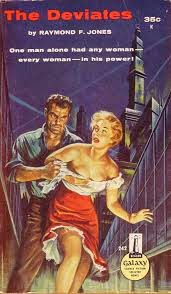
Raymond F Jones went on to write some fifteen other novels, among them are ‘The Alien’ (1951, as ‘Galaxy SF Novel #6’, World Editions), about an entombed extraterrestrial body discovered within the asteroid belt, ‘The Secret People’ (aka ‘The Deviates’, 1956 Avalon Books) about persecuted telepathic mutants populating a post-apocalypse world, and ‘The Cybernetic Brains’ (expanded from a 1950 ‘Startling Stories’ story, 1962, Avalon Books) which rewires human brains into computer-circuits, updating Eando Binder’s 1934 idea of ‘Enslaved Brains’ via cybernetics.

After being comparatively inactive through much of the sixties he returned to the field later with ‘such less interesting novels as ‘Syn’ (1969) and ‘The River And The Dream’ (1977).’ Although ‘not generally an innovator in the field’ according to John Clute, he nevertheless ‘produced solid, well-crafted hard-SF adventures’. Raymond F Jones died aged 78 in Sandy, in Salt Lake County, Utah in 24 January 1994.

Thursday, 15 May 2014

Book: 'DON'T CALL ME NIGGER, WHITEY: SLY STONE & BLACK POWER'


‘SLY STONE: 
THE LONG 
JOURNEY BACK…’


Inter-racial. Inter-gender. Into drugs. What is it… this thing called Sly & The Family Stone?

It’s about time. It’s about space. It’s about the ups and downs of Funk, Psychedelic Soul and R&B. But more than anything else, it’s about music and it’s about people who are obsessed by music.

In the first-ever full-length biography of Sylvester ‘Sly Stone’ Stewart, music-writer Andrew Darlington (‘I Was Elvis Presley’s Bastard Love-Child’) exhaustively details the story, while adding new slants. Relating the hits – “Dance To The Music”, “Stand”, “Family Affair” and the seismic album ‘There’s A Riot Goin’ On’, to the Civil Rights protests, the Black Power radicals and the insurrectionary counter-culture politics of their turbulent time. This is the true story of a music legend and the events that shaped the music.

Sylvester Stewart was an outrageously talented musical prodigy who started out as part of a mixed-race high-school doo-wop group called the Viscaynes. But consider this, what if they’d scored a massive hit with one of their catchy 1962 singles – “Heavenly Angel” or “Long Time Alone”? By the mid-seventies the man who became Sly Stone might have been touring the Golden Oldie circuit, still performing that same old song. But wait – there are other possibilities to speculate about.

After the Viscaynes, Sylvester – as he still was, became a radio DJ for KSOL, playing ‘integration records’, everything from the Beatles, Ray Charles, and the Rolling Stones, to the Kinks. ‘I was into everyone’s records’ he explained, ‘I’d play Dylan, Hendrix, James Brown, back-to-back, so I didn’t get stuck in any one groove. Every night I tried something else. Everything was just on instinct’. Around the same time, he was acting as songwriter/producer, creating R&B dance hits for Bobby Freeman, as well as white psychedelic chart-Pop for the Beau Brummels, the Mojo Men and Grace Slick’s pre-Jefferson Airplane group Great Society. If Sly Stone’s own chart career had happened then – say, the early years of the sixties rather than the decade’s second half, it’s not difficult to imagine him churning out simple catchy Bobby Freeman-style Disco hits. Are you with me so far?

Instead, we all know the real story. The arc of Sly’s career happened when racial issues in America were becoming increasingly polarised and forced into extremes. Sly & The Family Stone’s contagious breakthrough single “Dance To The Music” (1967) led to even greater success with four straight US no.1’s – “Everyday People” (1968), “Hot Fun In The Summertime” (1969), “Thank You (Falettinme Be Mice Elf Agin)” (1970) and “Family Affair” (1971). On “Everyday People” he is singing ‘I am no better and neither are you, we are the same whatever we do’, but there were those on both sides of the racial divide who found such a simplification unacceptable. White rednecks who felt threatened by its uppity ideas of egalitarianism, to whom the integrated black/white male/female Family Stone membership constituted a full-bodied all-singing all-dancing provocation. And black militants who considered Sly wasn’t taking it far enough. The Panthers had already called into question the Family Stone’s racial ‘compromise’, demanding Sly replace white band-members Gregg Errico and Jerry Martini with black musicians, and urged him to drop their white Jewish manager David Kapralik too – ‘get rid of whitey, get rid of the devil.’ Sly stood out against them all.

He never allowed colour to dictate his friendships, or define his music. To have to deal with it was an annoying downside. Sure, ‘in order to get to it, you’ve got to go through it’ Sly told TV chat-show host Dick Cavett, ‘that’s really the truth.’ At first he dealt by example. Look – this works. This is good. How can something this much fun be threatening? ‘I can understand frustration’ he explained, ‘I can understand how confusion creates back illusion.’ How could it be any other way? ‘I understand the proclamation, we dig emancipation.’ And his songs treat the centrality of racial oppression – and how it was provoking mass radicalisation, head-on with ridiculing humour and sharp intelligence. Less as weapons of struggle, more as personal expressions created in response to the times. He was comfortable in his own skin. Racism was a hindrance. An irritation. A distraction.

Yet his music couldn’t help but be exactly synchronised to the escalating tensions of the moment it was produced – for those issues demanded his response. And it was at the precise moment that race-riots were tearing American cities apart, caught up in its unique configuration of optimisms and betrayals, hopes and dreams, that Sly creating his most edgy, relevant and dangerous work. Issued on the 20th November 1971, ‘There’s A Riot Goin’ On’ was a landmark album – as violent and disturbing as the world it was created in. The ghouls he released helped him create great music. But they also conspired to destroy him. Without the forceful provocation of extreme incidents things would have been different. Or they might not have happened at all.

He’d started out with the Viscaynes, as DJ and studio mixer, then he had huge hit singles, played Woodstock, and sold millions of albums, but by the late-seventies, following a string of disappointing solo albums, this driven once-genius succumbed to his addictions, and there was only a long day’s journey into night ahead. That the same pressures that made him excel were the same that pressured him intolerably into extremes of excess, were part of the deal. Caught up in an immaculate cliché, he gained the world, only to lose his soul. Where there’d been joy and rebellion, there was resignation. He’d hit the pinnacle, and was free-falling, retreating further into a cocoon of cocaine and brooding introspection. But if it seems that the story ends there, it doesn’t. Sly was still only in his early thirties. As many decades of his life would follow as had already elapsed. It’s just that they would not be as well-documented. When you live out your life like fiction, some amount of imprecision can be anticipated, to bedevil those attempting to chart its details.

Choosing the ‘Soundtrack Of My Life’ Boy George chose Sly’s “If You Want Me To Stay” (1973), commenting ‘it’s just a great song, fantastic falsetto vocals. It’s got the best bass line ever, and it’s Sly Stone at his peak; it’s just a great, emotional piece of music’ (in ‘The Observer’ 26 January 2014). And during his lost decades Sly’s songs were sampled and reinterpreted across the evolution of hip-hop, Rap and Urban. Yet for their creator, the music still itches…

--- 0 --- 


After the final fateful break-up of the Family Stone in 1975, Sly’s guitarist brother Freddie Stewart ordained as a minister and found a new niche as Pastor of the Vallejo, California ‘Evangelist Temple Fellowship Center’. Sister Rose Stone immediately commenced a solo career, cutting an eponymous album under her married name ‘Rose Banks’ for Motown in 1976. But by the time of the Family Stone’s induction to the 1993 ‘Rock ‘n’ Roll Hall Of Fame’ Sly himself had totally disappeared from public view. On that occasion he amazed everyone by turning up to receive his award. He delivered a hasty speech – promising ‘see you soon’, before vanishing back to wherever he’d come from. At the time, few took the promise seriously. They were wrong.

Sly’s parents, Daddy KC and Momma Alpha, died within eighteen months of each other, he in 2001, she following in 2003. Sly was at the funeral. Sly’s ‘Little Sister’ Vet Stewart was there too, ‘they both died in my arms’ she recalls, but before they died she promised them ‘that she would once again make the rest of the world a safe place for her big brother to function in.’ Her resolve to fulfil that promise never wavered, or for one moment weakened. ‘I was persistent. I prayed a lot.’ And at Vet’s instigation, there was more to come. With her unstinting motivating efforts providing the momentum, the ‘Phunk Phamily Affair’ was launched across the Easter weekend 2004 at the Frisco Broadway Studios. They soon renamed themselves ‘Sly’s Family Stone’ – at Sly’s instigation, and by 2005 there were excited internet rumours that they were working on tracks for an album with Sly himself. He was even said to be contributing new material.

Meanwhile, Sly-sightings persisted… and became mythic, the subject of internet-driven debate and analysis. One example, on Monday 15th August 2005 Sly was positively identified driving Vet from Beverly Hills on his custom four-wheel Harley motorcycle to the LA ‘Knitting Factory’, a club at 7021 Hollywood Blvd, where the ten-piece Phunk Phamily were performing a benefit. Advertised as an evening of ‘Songs And Original Members Of Sly & The Family Stone’, Sly declined to participate, but he did hang around on the balcony long enough to watch the set. He was described as sporting an extravagantly-braided Bootsy Collins-esque blonde Mohawk. But the ‘Soul-Patrol’ website disagreed, arguing he was wearing a white outfit, with hat and dark shades. Others insisted he’d kept his shiny biker helmet firmly in place throughout, like an astronaut. No-one provided absolute confirmation.


Yet fan diligence was rewarded when ‘Reclusive legend Sly Stone’ made a surprise showing at the ‘48th Grammy Awards’ in LA on Wednesday 8th February 2006 – his first genuinely authenticated public performance since the brief ‘Rock ‘n’ Roll Hall Of Fame’ debacle. Assembled as a full Family Stone reunion by Nile Rodgers – with five of the original six members, and Rusty Allen filling in for original bassist Larry Graham – and, hope-against-hope, Sly himself, the appearance was preceded by weeks of conjecture. Would Sly show? it didn’t matter what he played, just for him to show up was enough. ‘Rolling Stone’ circulated amusing gossip about security turning away this figure ‘in a sort of Unabomber camouflage get-up that hid his face’ because they assumed he was a homeless vagrant. So swaddled, layered, shaded, hatted and scarved as to be unrecognisable. In fact, when Sly did turn up, his right hand was encased in a cast, his damaged tendon the result of a motorcycle mishap. But the fact that he showed up at all for off-site rehearsals augured well. Sure, his attire – a tattered hoodie entirely obscuring his face, was the cause for some concern – as did the damaged infirmity of his rehearsal performance, the old swagger replaced by a fumbling vulnerability so vague that Rodgers decided to ‘pre-record’ a version of “I Want To Take You Higher” to cover anticipated imperfections.

On the night there was much talk of severe stage-fright, and of Sly’s nervous vomiting. Ken Ehrlich elaborated to the ‘Chicago Sun-Times’ about how he ‘refused to leave his hotel room until he was given a police escort to the show and then waited in his car until the performance began.’ Then, the cameras zoned in, and yes, Sly was there in an extravagant blonde Mohawk, opaque oversize Dior shades, a purple-lined silver lamé greatcoat, and pants cinched with the signature ‘S-L-Y’ belt-buckle. But he appeared stooped, head bowed, as though in pain. He barely managed eye contact with the celebrity audience. But yes, against all expectations, his impressionistic vagueness still proved mesmerising. Just as they powered into the climax of “I Want To Take You Higher”, Sly got up and sauntered to the front of the stage, rasped a verse, waved in the general direction of the audience, then wandered off-set before the last chorus was over.

He kept walking, not stopping until he was outside the building, where ‘he went up the ramp, got on a motorcycle and took off’, scorching tyre-rubber in his haste to escape. Nile was reportedly ‘disappointed’, he’d hoped for more. But Sly had shown up, and aged 62, proved that some of the magic remained. Nile did everything he could to hold it together. But people had been trying to hold Sly Stone together for four decades, and what the Grammys got was probably all they were going to get… for now.

Then, on Sunday 13th January 2007 ‘Sly’s Family Stone’ appeared at the Anaheim CA ‘House Of Blues’ – adjacent to Disneyland, starting off the year with a celebration of Dr Martin Luther King’s birthday. And it proved to be a wonderfully surprising show, all the way from the opening blasts of “Dance To The Music”. Vet took a commanding lead in a white leather outfit, alongside Lisa (Rose Stone’s daughter), and original horn-players Cynthia Robinson and saxophonist Pat Rizzo. Eventually Sly himself briefly took the stage, at first a fragile and slouched figure, but smiling like a doting father at a school concert as he introduced his daughters Phunne and Novi, then niece Toddy – Vet’s daughter. They all closed by rolling out “Thank You (Faletinme Be Mice Elf Agin)”, Sly flashing peace-signs while stabbing keyboards, before a “I Want To Take You Higher” encore.

The only thing harder than quitting the limelight, is venturing back out into its glare. But, after staring so perilously into the abyss for so long, it seems Sly was in the process of using this ‘Family Stone’ vehicle as a kind of Trojan Virus to incrementally infiltrate gradual awareness of his renewed musical involvements. 31st March 2007 saw the group playing Las Vegas, and – although deliberately low-key, the ‘Flamingo Hotel Showroom’ date was significant in that Sly himself was included as a named part of the package. Around midnight stand-up comedian George Wallace introduced the set with the ironic quip ‘April Fools! Sly Stone showed up!’ But after the band led in with a four-song medley, Sly himself sauntered on stage to join them on Korg synth for a thirty-minute sequence of “Stand!”, “Family Affair”, “Thank You (Falettinme Be Mice Elf Again)”, “If You Want Me To Stay” and the usual climax of “I Want To Take You Higher”, during which he moved out to the edge of the stage to greet fans and shake hands. The spectacle was repeated when the band headlined the San Jose Arena Park’s ‘Back In The Day Summerfest’ – a non-profit ‘Benefit for Orphans’, held late on the sunny Saturday of 7th July (7/7/07!), with huge video-screens streaming original ‘Woodstock’ Sly-footage. The band again jammed for some thirty minutes until Sly – head-down in a white-hooded sweat-shirt and radio-mic, baggy pants, gold chains and a baseball cap, positioned himself hunched behind the keyboard. Although initially flawed with unforgivable sound-problems, the event proved a success, and it tied in with Sly’s first major published interview in over twenty years.


For the prestigious spread in ‘Vanity Fair’ (cover-dated August), Sly was photographed riding his three-wheeled chopper in the extensive grounds of an impressive home in the country sparseness of Napa Valley. With an appointment to meet Sly at ‘Chopper Guys Biker Products Inc’, a Vallejo custom-motorcycle specialist, journalist David Kamp endured all the usual doubts about it ever taking place. Yet against the odds, Sly arrives a mere ten minutes late, on a flamboyantly customised banana-yellow trike, and in good shape, for ‘a 64-year-old man’. Warily, elusively, he claims to have got serious about ‘cleaning up’ some fifteen years earlier. ‘I just looked around one day, and it was cleaned up. Just hardly was nothing there. Just… certain people were not around’. And now ‘I’m pretty cool. I drink now and then, a little bit – beer. And I smoke butts sometimes’. Is he indestructible? – no, only ‘washable and rinseable’.

When asked why he’d chosen to return now, he merely grins, ‘cause it’s kind of boring at home sometimes.’ There’s not, in truth, a great deal of dialogue. What little there is of it is generously inflated with exposition and recapitulated history. Kamp concludes that ‘Sly relishes this sort of opaqueness – letting people in just enough to intrigue and confound them.’ Yet it closes on an upbeat note. Throughout their face-to-facing, Sly had worn shades. Kamp asks ‘can I see your eyes, Sly?’ ‘Yeah,’ he says, pulling down the sunglasses, revealing healthily white whites and a remarkably unlined face, the same face from ‘Woodstock’, ‘Cavett’, and the cover of ‘Fresh’. It really is Sly Stone’. The interview also marked the kick-off point for a full ten-date European tour, including British dates – all performed under the full ‘Sly & The Family Stone’ heading.

Can it really be said to be Sly & The Family Stone? Of course it can never be exactly what it was. People change, times change, fracturing and disrupting meanings and relevancies. As John Mulvey of ‘Uncut’ magazine points out, ‘the edge of those old records is missing, that precarious mix of tension and euphoria,’ instead, the pleasures of seeing Sly & The Family Stone now ‘are less complicated, those of a party band, not a blazing collective with a revolutionary subtext.’

The tour commenced at the open-air ‘Arena Santa Giuliana’ in Perugia, Italy (Thursday, 12th July) following a full-on Solomon Burke set. They crossed to the sold-out Montreaux Jazz Festival (13th), the Belgian ‘Blue Note Jazz Festival’ (14th), the ‘North Sea Jazz Festival’ in Rotterdam (15th), the ‘Nice Jazz Festival’ (19th), and the Finnish ‘Pori Jazz Festival’ (20th). Headlining at London’s drizzling inner-city ‘Love Box Weekender’ (21st), the Family followed Blondie on-stage at around 21:50, with Sly wandering on to contribute two songs, then getting up for two more. Later – with Sly in an Afro and headband, they played what was reportedly the finest set of the tour at the Paris ‘Olympia’ (23rd), then the ‘Jazz Aldea’ in Spain (27th), before finally climaxing at the modest Bournemouth ‘Opera House’ (28th July).

By now the general shape of the events were refining into shape. With the band book-ending the set – starting off with “Dance To The Music”, progressing through a varied mix of “Everyday People”, “Hot Fun In The Summertime”, taking in a slow sensual “Somebody’s Watching You”, and Sly joining for four or five mid-point numbers, usually soloing a strongly distinctive “If You Want Me To Stay”, and closing with a rallying “I Want To Take You Higher”. But although persistent promises of a ‘new song’ remained unconfirmed, as the tour progressed the presentation seemed to gain in confidence. Despite Sly’s protestation that ‘when waking up this morning he realised he was old, so he needed to take a break’, the man who began the tour as a ‘broken marionette, barely moving’ was visibly loosening up, rocking to and fro behind keyboards he didn’t actually play, dancing in a kind of shadowboxing slouch around the stage, yet showing more obvious pleasure both in the performance itself, and the reception he was receiving. Venturing out front, and finally – at the closing date in Bournemouth, leaping down off-stage to mingle with the audience as he chanted and danced to “I Want To Take You Higher”.

Is this a postscript, a happy coda… or a new beginning? Whatever, shows continue. During the first week of December (2007) Sly played a series of dates at ‘The BB King Blues Club & Grill’ on New York’s 42nd Street, with audiences stumping up $103.35 per ticket. Before taking the stage the atmosphere was hushed and weirdly nervy, so hushed Sly’s voice could be detected croaking over the sound-system ‘Is the show starting? hold up, hold up’. Then, seemingly to an assistant, ‘I don’t want to fall.’ And when he finally emerged he shuffled to the microphone, although he later managed to throw in some playful choreography. During lulls in the show there was some dialogue. A shouted question from the crowd asked ‘how you doing, Sly?’ provoking the witty response ‘eh…’ Someone else enquired had Mr Stone ever been arrested? ‘I’ve been arrested for armed robbery’ he jibed back. The Family Stone – included Jerry Martini and Cynthia Robinson with Lisa Stone, meticulously ticked-off the roll-call of hits, continuing even when Sly momentarily vanished ‘to take a piss’. He returned to deliver some tantalising unaccompanied rap verses – ‘you can’t face a noun so you’re straight adverbing it, / had an argument at home, and you had to have the last word in it.’ Yet if there were those in the audience ghoulishly anticipating a ‘train-wreck’ performance, it’s fair to say that few others were disappointed.

Sly’s ‘one-world’ concept of music still retains relevance, even if the more specific political references have become dulled. Soon after, Sly, with George Clinton, was re-making another connection, joining the musicians on-stage for a brief and amazing appearance together at California’s ‘Voices Of Latin Rock’ Show in January 2008. They ran through versions of “Thank You (Falettinme Be Mice Elf Again)” and “I Want To Take You Higher” memorable more for their shambling joy than their technical perfection. The pair didn’t stay long. Oddly, Sal Valentino was also there, performing his Beau Brummels’ hit “Laugh Laugh” – which Sly had produced. Another link in the story. But by the time he took to the stage, Sly was gone.

Some bands survive longer than others, it’s counted out in the unique DNA-configuration that brings it all together in the first place. Sly & The Family Stone survive longer, and leave more of enduring value than most. Their legacy remains audible and visible. We should be grateful for that, rather than asking for more. ‘From the womb to the tomb’ joked Sly, ‘and that’s it, baby. I checked it out’.


(This is an edited, re-written revision of excerpts from the book)

‘DON'T CALL ME NIGGER, WHITEY’
SLY STONE & BLACK POWER 
by ANDREW DARLINGTON
(Leaky Boot Press) http://www.leakyboot.com/ 

Available From Amazon now:
http://www.amazon.co.uk/Dont-Call-Me-Nigger-Whitey/dp/1909849057/ref=sr_1_1?ie=UTF8&qid=1399582948&sr=8-1&keywords=Andrew+Darlington


Tuesday, 29 April 2014

Poem: "Holy Man: Poem Written To An Earlier Self (As I Was Aged Twenty)"


HOLY MAN
:POEM WRITTEN ACROSS TIME 
TO AN EARLIER SELF (AS 
I WAS AGED TWENTY) 

(*Based on the Dostoevsky character featured in 
‘THE BROTHERS KARAMAZOV'


as the machines go down
you read Dostoevsky
in factory calm,
writing a poem to
Father Zossima in
the sweat of oil
and anger…

“Holy Man, spirit of murdered ages,
how do your ikons speak to you now,
with the new definition of freedom
bought at such a terrible cost?
Holy Man, zeitgeist of Russia’s past,
does your Mater Dolorosa still smile
the beatific smile of unreasoned faith,
the faith which opiated the masses
who now pass by your place
with no flicker of recognition?
Holy Man, speak across the short
but distant and cruel century where your
faith was destroyed, rebuilt by the new
architects of truth to a different plan.
Holy Man, speak from the shadow-crawled
folds of the cowl which dance to the fire
illuming the ripples of your ancient face.
Holy Man, where now is your god?
why do you remain so silent...?” 

as the machines go down
you read Dostoevsky and
aim lines at Lit-mags,
while all around you
in steel and dreams
are the real poems
of your life…


Original version published in:
‘ZIMRI’ (UK)
‘SUCCESS no.37’ (UK)
‘NEW AGE POETRY MAGAZINE’ (UK)
‘TWEED vol.4 no.4’ (Australia - July 1976)
‘PAPYRUS CACAMA no.16’ (Germany - December 1978)
‘OCARINA: THE JAPONICA SINGS ISSUE’ (India - December 1979)
‘PERIAKTOS no.7’ (UK - March 1993)
‘CHRONICLES OF DISORDER no.4’ (UK - November 1996)

This version:
‘OUTLAW no.10: Spring’ (UK – March 2005)

Live: Simon & Garfunkel at the Manchester 'Free Trade Hall', 1967


ALL THE SOUNDS OF SILENCE… 

SIMON AND GARFUNKEL 
at ‘The Free Trade Hall’, 
Manchester (Monday 20th March 1967) 

After the intermission (yes, there’s an intermission), Paul Simon comes back on stage wearing a deliberately skewed Beatle-wig and hip-twitches through the opening bars of “Wild Thang”. Art Garfunkel playing at paparazzi by aiming a flash-camera at him. At the time it seemed a patronising put-down of a simpler, more mindless music form, a smugly condescending joke neatly counterpointed by Garfunkel explaining the cerebral rigours and creative turmoil behind the duo’s own latest single – “The Dangling Conversation”, replete with its artful analysis of a suspended relationship and its cultural name-drops to Robert Frost and Emily Dickenson. But it also defines something of their odd relationship. First time I heard the line in “Homeward Bound” about the ‘poet and a one-man band’ I’d naively assumed that maybe Simon was the poet, and Garfunkel the one-man band, a kind of equal axis. I was soon disabused of that. Simon fulfils both roles, centre-stage. Art Garfunkel’s part – apart from sweet harmony embellishments, is more the psychological back-up. He’s the prop who aims the camera-attention that focuses on the creative element incarnate. As George Michael needed the supportive-strength of Andrew Ridgley to become Wham!, so Paul needed Art for equally nebulous reasons.

Paul Simon tells a story. Walking the hard New York street he unexpectedly catches his own reflection in a storefront glass window, and thinks hey, you’re looking good, you’re looking cool. He preens a little, poses some… then this sparrow way above poops on his head, neatly puncturing his moment of self-regarding pretention. It gets an informed laugh, and leads neatly enough into their “Sparrow” from the 1964 ‘Wednesday Morning, 3am’ album – ‘Exciting New Sounds In The Folk Tradition’ (edited down to an EP in the UK). It’s a sweet anthropomorphic fable about pity. Verse by verse the appeals of the starving sparrow ‘who’s travelled far and cries for rest’ are rejected by the Oak Tree, the Swan and the Golden Wheat, until the Earth itself agrees to write her eulogy, ‘for all I’ve created returns unto me, from dust were ye made and dust ye shall be.’ A vaguely Biblical solution to the question of social exclusion.


At this time, they were still more cult than they were Pop Stars. The electrified remake of “The Sound Of Silence” may have hit no.1 in US, but it was covered by the appalling Bachelors here in a way that ironically captured the blandness that Simon was railing against. So the original languished unheard. But I was on it in a flash. It had all the jingle-jangle Byrds Folk-Rock poetic elements that made it irresistible, smart lyrics – ‘I turned my collar to the cold and damp, when my eyes were stabbed by the flash of a neon light’ which still sounds good, and the teasing comment on superficial blandness and shallow inconsequence to give it social relevance. Soon I had all three versions, the acoustic duo original, then producer Tom Wilson’s overdubbed hit, plus the solo singer-songwriter take on the ‘Paul Simon Songbook’ (August 1965) album recorded during Paul’s London sojourn.

“I Am A Rock” on that LP ignited a kind of Morrissey-moment. For the socially dysfunctional teenage misfit I saw myself as, it contextualised my life entirely. ‘I’ve built walls, a fortress deep and mighty, that none may penetrate’, surely no-one can write a lyric that perceptive if they’ve not already been there? ‘I have my books and my poetry to protect me, I am shielded in my armour’ – yes, check. “Homeward Bound” took them into the UK Top Ten. But already by the time they’d added the Simon & Garfunkel Folk-Rock brand to “I Am A Rock” as their third straight American hit single the ‘New Musical Express’ cartoonist was performing an electric Bob Dylan ‘Judas’ deconstruction on it as ‘I Am A Rock (‘n’ Roll Singer)’.

I drive cross-Pennines from Hull to Manchester on my Honda motorcycle, and stay at the YMCA, leaving the bike on the street outside overnight. For this is less a Rock gig as a sub-cultural experience. Even the imposing ‘Free Trade Hall’ itself has history. Sister Rosetta Tharpe, Gerry Mulligan, Dave Brubeck and Ray Charles had played here. And the Halle Orchestra called it home too. Dylan’s ‘Judas’ tipping-point into legend had happened here. But this night it was a hall reduced down to a Folk Club, rather than a Folk Club inflated to hall-size. Polite applause. The duo dressed down in roll-neck sweaters and jeans. Short hair. Artie stands with right hand across his chest gripping his left arm. A single guitar. Two voices. ‘The Graduate’, and “Bridge Of Troubled Water” still lying far in the future.


And Paul Simon is very much aware of their intellectual elitist appeal. He describes the debilitating ‘writer’s block’ that froze his output, brought about through the changes following their first run of hits. And about how – driving over the Queensboro fifty-ninth street bridge, his first new song in too long takes shape in his head. But no, Simon & Garfunkel can’t be seen to be associated with a title as trendily simple as ‘Feelin’ Groovy’, so he re-titles it more pretentiously “The Fifty-Ninth Street Bridge Song”. Harpers Bizarre score an American hit with the track, lifting it from the ‘Parsley, Sage, Rosemary And Thyme’ (October 1966) album. But tonight, Simon & Garfunkel come back on-stage to do an unplanned encore. Not something they were wont to do. Paul picks out figures on guitar and announces a new song, one he’s still working on, an uncompleted first verse awaiting middle-eight and development. It starts ‘wish I was a Kellogg’s cornflake’, to amused reaction. The song would become “Punky’s Dilemma” on side two of their next album, ‘Bookends’ (April 1968), which would accompany their major breakthrough with “Mrs Robinson”.

Cult no more…


Saturday, 26 April 2014

Jasper Johns: Proto And Post-Pop In Leeds


JASPER JOHNS: 
PROTO AND 
POST-POP IN LEEDS 

Jasper Johns was the man who made Pop Art ‘probable’, 
 but what does that mean thirty years later – in 1996? 
An exhibition overview of 700 words…


The toilets.

Male left. Female right.

And the Jasper Johns gallery straight between, and through the centre.

It’s Leeds, 1996. And I’m looking through Jasper’s spectacles. But replacing the eyes beyond the lenses are twin mouths. With lips that are wide-parted, teeth-rims visible. The mouths are talking endlessly, in silence. The piece is called ‘THE CRITIC SEES’ from 1964. An assemblage of sculpmetal and glass embedded in plaster. A witty comment on art columnists. These eyes, it says, neither SEE nor FEEL. These eyes speak. These eyes mouth off first, and think later.

Perhaps he was thinking of Herbert Read who described Pop Art as ‘a descent into the eternal funfair which is neither funny or fair, but an inferno’? Actually Johns is not exactly Pop, and Pop Art is actually very often fun. Look at these shoes with mirrored toe-caps. Or the homage to Frank O’Hara, with its opened drawers of sand, each one indent-contoured by a footprint from a plaster-cast sole. Presumably Frank’s.

Of course the ideas had been done before. Teasing subversive Marcel Duchamp had been doing ‘Found Art’ and ‘Ready-Mades’ since the outrage of Dada. But that was done as confrontational art statement aimed at the art establishment. Pop shoved it all to New York, took on consumerism, and made it spectacle (and sometimes spectacles!). Jasper’s panels of overlaid blended 0-9 numbers are a discrete countdown to it all.

I’m in the Henry Moore Gallery in Leeds, 1996. And it’s an irony of sorts. I wasn’t really around for Pop Art. For this selection dates from 1958 to 1964, the pre-Beatles time of Sputniks, black & white TV’s, and John Kennedy. But to me, Pop wasn’t about galleries. It was the cornflake pack on your breakfast table. The comic-book war story on the news-stand. The ad for Hoover vacuum cleaners or Charles Atlas bodybuilding courses in the glossy magazine you’re reading. It was Elvis. It was sex.

Here at Leeds it’s still possible to taste those elements in Jasper Johns’ 1959 painted bronze beer cans. Ballantine Ale. He made this twin-cylindered, neatly hand-lettered object (exhibited three years before Warhol’s soup cans) in reply to De Kooning’s jest about Gallery owner Leo Castelli’s ability to sell anything – even beer cans. And its frothy comic fizz crosses all the decades to now. Elsewhere, in some ways, that element seems to have got lost. Art now is installations and assemblages that again relate art to art. Damien Hirst makes a video for Blur. Gilbert & George cross over into mainstream awareness. Tabloid-speak gets dutifully outraged every now and then, usually at price tags. But interaction with life seldom seem quite as tactile.

Jasper Johns was the first of the Million Dollar Modernists. Of course, he wasn’t exactly Pop. All name tags are vague. But, born in 1930 in Augusta and a former window-display designer for the Tiffany’s store, his 20 January 1958 first New York exhibition of archery targets, letters of the alphabet, and American flags, made Pop Art ‘probable’. He derives from elements of Surrealism, and yet his collisions of the familiar with the banal, his appetite for raw media feedback and Fast Food Art in series, anticipates Pop’s themes and preoccupations. Never shying from close image recycling – one stencilled Arabic 0-9 following another 0-9, one flag following another flag. His sculptural strategy, ‘take an object. Do something to it. Do something else to it’ says it all. Invention. Spontaneity. Improvisation. Fun.

When he makes a ‘FLASHLIGHT (1960) of bronze and glass, or a light-bulb with ripped wires, the bulb’s brief shelf-life fragility is inverted into dulled long-term solidity by being cast in metal. Familiarity given a twist of strangeness.

Jasper Johns is pre/proto-Pop. In 1996 he’s also post/ or ‘art will eat itself’ Pop. And I’m here talking through my contact lenses about flat flags and a three-dimensional quip of a Savarin can with his used brushes impaled in it.

The ‘eternal funfair’ continues…

Thursday, 24 April 2014

Book: 'Lucifer's Dragon' by Jon Courtenay Grimwood


Book Review of 
‘LUCIFER’S DRAGON’ 
by JON COURTENAY GRIMWOOD 
(NEL, 1998 - £6.99 - ISBN 0-340-67473-3) 


‘Sperm Futures were up 129 points on Dow Jones...’ Sometimes tomorrows go down so fast you miss the echo. We all did that hard-sharp-fast Mirror-Shades thing. We’ve all got neat nasal-bridge skin-welts from Mirrorshade OD. All those bright shiny postmodern surfaces, those technofutures stitched in with cutting edge buzzword IT product placements (meta-Nationals, Fuji, Versace, Toshiba, Sony). And WOW – wasn’t it cool? Now the major practitioners have not so much moved out as evolved that text mainframe onto other distinct gaming levels. And all that swirly fractel-stuff is looking as out-of-phase as an old Shamen CD, and who gives a shit about THAT anymore? Well, actually, Maltese-born Jon Courtenay Grimwood does. His is a fast-fiction hypertext netscape of logos and glitches with all the moral complexity of a Pot Noodle. Prose that glimmers with the edgy lustre of a de-tuned flatscreen TV. As narcotically-literate and as MDMA-programmed as Irvine Welch, while simultaneously S&M-primed with enough testicle-gouging, twisting and squeezing to make a grown man wince. He did ‘Neo-Addix’ (1997). He writes for ‘SFX’ and ‘Focus’. This is his most high-profile shot to date. And it’s pretty in-tense!

Grimwood’s Twenty-Second Century is relentlessly unpleasant with a ‘morality so relative it’s quantum’. There’s rising male infertility, hence the trade in Sperm Futures, and the unique ‘Fuck-Baby’ status of naturally conceived and nurtured progeny. There’s genetic Vampyres, Kinderwhores, Edgar Allen Goths, and programmed killware, including a DNA-coded hyena primed to self-detonate on contact with its target. There’s also silver-skinned and usually naked Razz who gets her guts blown out, wakes up in a new younger body, then gets superglued to the floor and raped. There’s Count Ryuchi who owns the CySat media conglomerate dealing customised global Tri-Soaps, MTVids and Religious Holo-Porn. He microwaves his wife into a glutinous gel. Alex, a Living God with the Church of Christ Geneticist who work towards cloning the Messiah’s DNA. His augmented brain works at 97.5% neural level (yours and mine struggle to achieve 25%). Then there’s the good Cop. A gene-splice bio-chip composite made up of elements from Judge Dredd and a hard-wired Clint Eastwood Dirty Harry. The kind of Cop who sees the case through despite deliberate obfuscation from corrupt Power-Conspiracies and a society purposefully flushing itself down the pan. There’s lots of subplots too. Each minor character, from the random murder victim to the hire-pilot with vat-grown artificial eyes, have their full histories.

The plot centres on New Venice, like Old Venice – but created in mid-Pacific by the ‘dusted-out bulimic daughter of a West Coast Crime Boss’ to be an ‘island of elective morality in a sea of dissolution’. It’s furnished with high-tech anachronisms, a Neo-Venetian elite decked out as Doge-this or Count-that, and the Levels – sleaze-zones due for imminent amputation. Once intended to be ‘Serendipity written as code’, it’s now a city rapidly peaking towards overload. ‘Lucifer’s Dragon’ is high-density stuff. And it’s self-consciously nasty. It strives for effect There’s brutal sex. It’s crammed with sharp prose (‘office buildings like endless lines of bar codes’) and flashy prose-devices. It post-modernises postmodernism and gives Mirror-Shades a sudden retro hard-sharp-fast appeal. And in among the teeming cultural references there’s one to Leeds-based multi-culture band Black Star Liner, one to a ‘dub electro / Japmix’ of Motorhead (!) and one to the Sisters of Perpetual Indulgence. Last time I saw this outrageous order of transvestite Nuns they were playing live on stage with Chumbawamba at the ‘T&C’. Now there’s an echo worth catching.


Published in:
‘GIG CENTRAL Vol.5 No.12: June’ 
(UK - June 1998)