Friday, 29 October 2021

Retro CDs: SOFT MACHINE & ROBERT WYATT


BEYOND THE SOFT MACHINE 


Album review of: 
‘LIVE AT THE PROMS: 1970’ 
by SOFT MACHINE 
(August 1988, Reckless Records RECK 5) 


Fan-Bloody-Tastic! 

In-Bloody-Credible! 

With the Sixties slopping messily over into the Seventies, the serious music buzz-words are ‘improvisation’ and ‘progression’. But if any one group can provide justification for those pretentions it’s the Softs. Starting out as sub-Floydian psycho-Poppers with a sales-friendly single “Love Makes Sweet Music”, and two in-house Syd Barrett-wacko clones in the figures of Kevin Ayers and Daevid Allen – within the three years it takes them to reach this Albert Hall ‘Henry Wood’s Proms’ one-off they’ve mutated out of all recognition. Even now, with this concert finally side-stepping onto vinyl after eighteen years of Radio Three legend and cult memory it still comes at you as unexpectedly as the soundtrack to a surrealist movie. By then composed and deconstructed into Hugh Hopper (bass), Mike Ratledge (keyboards), Elton Dean (sax), and Robert Wyatt – on his penultimate album as Softs drummer, they run through scripts from their albums ‘Third’ (1970) with Hopper’s “Facelift” and Ratledge’s “Out-Bloody-Rageous”, and ‘Volume Two’ (1969) – with just a taster for what was to come on the ‘Triple Echo’ (1977) compilation and ‘Fifth’ (1972) drawn into the five segments making up side two’s long “Esther’s Nosejob” which moves from 7/8 time into outer space through an asteroid-storm of electronics and Wyatt’s eerily resonant scat interjections. 


Yet from the opening dissonant moans of Ratledge ‘kick-starting’ his organ this is very much a human music produced by people making it up as they go along. Compact exploratory solos are housed in angular time-signatures, complex interplays lurk inside partially structured structures that defy classification. There’s a scampering of Hot Rats here, a judicious stirring of the Bitch’s Brew there, all orbiting a Nucleus of Elastic Rock, but the Softs were – and would stay, so well into their own continuum that comparisons become a nonsense. This release formed Soft Machine’s first-ever CD, and it’s made up of music spontaneously assembled, free music played before such concepts were digitalised out of existence. 

Su-Bloody-Perb! 

A-Bloody-Mazing! 


Recorded live by the BBC at the Royal Albert Hall (13 August 1970), this album was later reissued as a ‘bonus disc’ within the 2007 CD expanded edition of ‘Third’. 

Track Listing: 
1. ‘Out-Bloody-Rageous’ (Ratledge) 11:54 
2. ‘Facelift’ (Hopper) 11:22 
3. ‘Esther’s Nose Job’ 15:39 made up of: 
(a) ‘Pig’ (Ratledge) 
(b) ‘Orange Skin Food’ (Ratledge) 
(c) ‘A Door Opens And Closes’ (Ratledge) 
(d) ‘Pigling Bland’ (Ratledge) 
(e) ’10:30 Returns To The Bedroom’ (Ratledge)


Album review of: 
‘DONDESTAN’ 
by ROBERT WYATT 
(1991, Rough Trade R274) 

At the time of this album’s original release there was a joke going around, ‘what’s the difference between Russia and Britain?’ – in Britain you can still belong to the Communist Party! As indeed did Robert Wyatt at the time. In the political credibility ‘are you or have you ever been’ stakes, Wyatt is a shoo-in. Physically he cuts an impressive figure; as shock-bearded as a pre-revolutionary anarchist bomber, as grizzled as some Tolstoyan guru jammed to the not-inconsiderable seams with opinions, righteous rage and esoteric wisdoms. But Wyatt – the ex-Soft Machine drummer, is an artist whose ideologically Left right-on-isms you respect, rather than whose music you enjoy. His finest post-Softs moment thus far was Elvis Costello’s “Shipbuilding”, a song about the Malvinas Argy-Bargy, incidents now as irrelevant and as time-lost as Suez. 

And ‘Dondestan’ – following six years of vinyl silence, is just as odd as his history would lead you to expect. Largely co-written from his wife-partner Alfreda Benge’s lyrics, recorded and multi-tracked as a solo musical project – apart from fellow Soft Machine Hugh Hopper’s contribution to “Lisp Service”, it’s a dense and uneasy work that goes by turns from monotone repetition to unexpectedly striking within the space of a single track. The five sets of lyrics crafted by ‘Alfie’ – originally penned as poems during an off-season Spanish sojourn, have a reflective depth of imagery that decisively rejects agit-prop in favour of a more ambiguous sensitivity. They read with the narrative detail and subtlety of poems, they humanise the album invaluably, Wyatt’s melancholic and frequently tuneless elaborations delivered over haunting washes of layered synths, investing them with an attractively hard cutting edge.


“Catholic Architecture” is about a ‘hand-painted Saint’ in the grounds of a white house, glimpsed over a high perimeter wall which is spiked with broken glass to deter the uninvited; the Saint daring outsiders ‘to intrude, and receive his loving blessing,/ in lovingly lacerated, hands,’ Lines laid with the sparse precision of haiku. “Worship” paints another intensely visual Spanish vignette of ‘two Nuns, on the sea shore,’ so real you could touch them, propriety permitting. 

The sleeve painting – also by Alfreda, shows the Wyatt’s at home. Robert in green armchair, with headphones. A carpet crawled with cats. A folded newspaper that betrays the hammer-&-sickle symbol masthead. In Britain – post coup, you can still belong to the C.P., but shared sympathies aside, an immaculately liberal conscience alone fine music doth not make. Title-track “Dondestan” itself is a Wyatt solo composition designed to be chanted jingle-style, taking in the refugees of Palestinian, Kurdish and origins beyond; while his “Left On Man” – ‘what we call freedom in the north,/ means our freedom to, use you,’ also tends to the well-intended but over-simplistic statement of the obvious. 

‘Out-Bloody-Rageous’ though the inequalities are – political, artistic AND personal, Wyatt remains an artist whose ideological left-on-isms earn him respect, rather than whose music spreads enjoyment. On that score he’s highly rated by just about everyone in the industry, except possibly by his accountant. 

Track Listing: 
1. ‘Costa’ (Robert Wyatt with Alfreda Benge) 4:39 
2. ‘The Sight Of The Wind’ (Robert Wyatt with Alfreda Benge) 4:58 
3. ‘Catholic Architecture’ (Robert Wyatt with Alfreda Benge) 5:10 
4. ‘Worship’ (Robert Wyatt with Alfreda Benge) 4:50 
5. ‘Shrinkrap’ (Robert Wyatt with Alfreda Benge) 3:52 
6. ‘CP Jeebies’ (Robert Wyatt) 4:04 
7. ‘Left On Man’ (Robert Wyatt) 3:31 
8. ‘Lisp Service’ (Robert Wyatt with Hugh Hopper) 2:10 
9. ‘N.I.O (New Information Order)’ (Robert Wyatt) 6:35 
10. ‘Dondestan’ (Robert Wyatt) 4:49 


Album review of: 
‘CUCKOOLAND’ 
by ROBERT WYATT 
(October 2003, Hannibal Ryko HNCD1468)
 
To recap. Soft Machine, after misfiring with the sweetly psychedelic-Pop “Love Makes Sweet Music”, became just about the most invigorating jazz-fusion band of that strange lost time-coded period. Not through supernaturally flawless un-human Weather Report virtuosity. But by adding a more robust raw-edge to their angular spontaneity and technical incandescence. Then drummer Wyatt falls out of a window at a party, and loses his mobility. And his voice, on subsequent recordings is a stranger more uneasy instrument. Some say haunting, dreamy, others languorous, meandering. 

All this preamble is relevant, because – with ‘Cuckooland’, his first album in six years, Wyatt sets his pained vocals into a free-music context led by Annie Whitehead’s sinuous trombone and Yaron Stavi’s resonant walking double-bass, Karen Mantler’s subtly looped vocal samples and her three compositions, plus drop-in visits from a tastefully restrained Paul Weller, Dave Gilmour, Phil Manzanera, and Brian Eno. Sixteen new tracks neatly divided, vinyl twelve-inch style by a thirty-second ‘suitable place for those with tired ears to pause and resume listening later’. A useful consideration. To recap. “Shipbuilding” was a fine Falklands-relevant equation, with Elvis Costello’s perceptive lyric balancing the evil of foreign war with the benefits it brings to a more regional working class. Some see it as Wyatt’s finest moment, even though his monotone whine fails to rise to Elvis’ own interpretive power. 

Yet here Wyatt is never less than hand-wringingly unreconstructed retro ‘Old Labour’, with a ‘Guardian’ slant on the Iraq invasion (“Lullaby For Hamza”), on Roma asylum-seekers (“Forest”), no-nukes (“Foreign Accents”), and right-on nods to World Music (“La Ahada Yalam” from an Arabic original by Amal Murkus). But there’s more. The melancholy samba of Antonio Carlos Jobim’s “Insensatez”, beatnik-cool references to Juliette Greco falling in love with Miles Davis in Paris – with a bonus Jean-Paul Sartre name-check for additional cultural weight (“Old World”), plus a voiceless piano-take on Buddy Holly’s “Raining In My Heart”. An unwieldy mix to intellectualise on paper, but oddly involving coming at you through upwardly spiralling soprano sax, straining ghost horns and a descending mist of voices. Those smooth electro-slipstreams and carefully-structured cool-jazz cadences envelop and make a nonsense of such apparent contradictions. The End of an Ear? Far from it. Love – even at its most defiantly abstract, left-field and left-wing, still makes sweet music. 


Track Listing: 
Part One: Neither Here… 
1. ‘Just A Bit’ (Robert Wyatt) dedicated to Richard Dawkins 5:09 
2. ‘Old Europe’ (Robert Wyatt with Alfreda Benge) 4:15 
3. ‘Tom Hay’s Fox’ (Robert Wyatt) 3:33 
4. ‘Forest’ (Robert Wyatt with Alfreda Benge) features David Gilmour guitar 7:55 
5. ‘Beware’ (Karen Mantler) 5:09 
6. ‘Cuckoo Madame’ (Robert Wyatt with Alfreda Benge) 5:20 
7. ‘Raining In My Heart’ (Felice & Boudleaux Bryant) 2:42 
8. ‘Lullaby For Hamza/ Silence’ (Robert Wyatt with Alfreda Benge) 5:00 
Thirty-second pause. 
Part Two: …Nor There 
9. ‘Trickle Down’ (Robert Wyatt) double bass by Yaron Stavi 6:47 
10. ‘Insensatez’ (Vinicius de Moraes with Antônio Carlos Jobim) 4:24 
11. ‘Mister E’ (Karen Mantler) 4:20 
12. ‘Lullaloop’ (Alfreda Benge) features Paul Weller guitar 2:59 
13. ‘Life Is Sheep’ (Karen Mantler) 4:14 
14. ‘Foreign Accents’ (Robert Wyatt) 3:48 
15. ‘Brian The Fox’ (Robert Wyatt) 5:31 
16. ‘La Ahada Yalam (No-One Knows)’ (Nizar Zreik) instrumental 4:16 


Published in: 
‘SONGBOOK no.1’ (October 2003 – UK) 
‘MONOMYTH no.12’ (February 2004 – UK)


Wednesday, 27 October 2021

Classic Sci-Fi Movie: 'THE MIND OF MR SOAMES'


THE STAMP OF 

THE MAN-CHILD

 
‘THE MIND OF MR SOAMES’ 
(1969) Amicus Productions. 
Directed by: Alan Cooke. Produced by 
Max Rosenberg & Milton Subotsky. 
Written by John Hale & Edward Simpson 
from the novel by Charles Eric Maine. 
With Terence Stamp, Nigel Davenport 
and Robert Vaughn. 
DVD and Blu-ray edition from 
Powerhouse Films, 2018. 1:38-minutes


He’s the man with the child in his eyes. The sign says ‘Cold Tank Room: No Admittance’. Dr Maitland (Nigel Davenport) is making his tour of inspection. They have white coats and clipboards, while Dr Joe Allan (Donal Donnelly) watches squiggles of light on the monitor screens. There’s a bearded naked man lying comatose in the tank. Meanwhile Dr Michael Bergen (Robert Vaughn) flies in from Los Angeles, to arrive at a snowy ‘Midland Institute of Neurophysiological Research’. 

The simultaneous arrival of the ‘Probe’ investigative TV crew, who are to document a procedure ‘unique in the history of medicine,’ offers the convenient opportunity to explain some back-story. John Soames is ‘a hibernating animal,’ who has been in a coma due to brain damage since birth. ‘He remain very deeply asleep’ explains Maitland, yet ‘in a strange way Mr Soames is very fit.’ The cigar-smoking Bergen is here to wake him. With the theatre staff wearing green brain-surgery outfits, an electrode is inserted into Soames’ shaved skull to stimulate his dormant consciousness… ‘six volts, one minute.’ Afterwards the bandaged man-child is on a drip as John Williams acoustic guitar plays pensively. 

His eyes open, he sees only blurred unfocused visions and cries in distress. ‘Don’t frighten him. He can see.’ He hears a jumble of disconnected noises from distorted conversations around him. ‘Welcome to the human race, John’ says Bergen, ‘it was never easy being born.’ He has awakened live on TV into a world he can’t comprehend, to be exploited as a living curiosity. Maitland offers Bergen a glass of neat vodka, as their two approaches polarise. ‘Soames is thirty years old. He hasn’t the time a child has to learn all the skills he’s going to need.’ So disciplinarian Maitland has worked out a rigid programme. ‘You won’t be teaching control’ argues Bergen, ‘you’ll be imposing it.’


Mr Soames is sympathetically animated by Terence Stamp, one of the iconic faces of the decade. It was widely assumed that he, alongside Julie Christie, were the ‘Terry and Julie’ figures in the Kinks “Waterloo Sunset”, despite Ray Davies’ denial. He’s charismatic as the socially-awkward Freddie in the psycho-thriller ‘The Collector’ (1965), with Samantha Eggar as his kidnapped victim, and as the feckless likeable rogue Dave opposite Carol White in the kitchen-sink classic ‘Poor Cow’ (1967), he achieved major-league stardom with costume drama ‘Far From The Madding Crowd’ (1967) with Julie Christie. Yet he plays John Soames in an understated restrained manner. He jigs up and down like an excited child as an orderly feeds him. ‘Alice’s Crazy Tea Party’ quips the TV voice-over. Yet he never loses sight of the character’s credibility as a blank slate upon which the world draws its own designs. 

The film’s depiction of reality television and prurient media turpitude is prescient, as, under constant TV-camera surveillance, Soames has Speak & Spell tuition… ‘Fish. Fire.’ He slots mauve plastic shapes into yellow spaces. Daubs and tastes coloured paints. He has an abacus. A toy farm. Sums on a chalkboard. A Ladybird ‘Book of London’. Then he’s assisted to take his first steps using a red suspended tinkling sphere as a lure. Maitland goads him to ‘stand up. Now, walk Soames!’ Maitland controls, Bergen encourages. ‘Very good, we’re on our way.’ Soames gets petulant and angry. ‘Soames, stop sulking’ barks Maitland, ‘all children have tantrums.’ He grabs Maitland by the hair – and only releases him when Bergen throws a Union Jack ball in a throw-game. Then he crawls and sits in the corner, refuses to eat and fails to respond. Is he sinking back into a coma-state? He stares, unseeing as Bergen brings him a green toy train, a Space Crawler, a Scalextric. As critic David Pringle points out, ‘the core of the movie is the fact that a child’s ignorant mind resides inside an adult body’ a ‘tabula rasa at the age of thirty’ (in ‘The Ultimate Encyclopedia Of Science Fiction’, 1997). 

For their low-budget British productions Max Rosenberg & Milton Subotsky always work on the principle that they need one American name on the cast-list in order for the film to be considered marketable on the U.S. circuit. This time they’re fortunate in obtaining the services of Robert Vaughn who already boasted an impressive roster of TV roles for much-loved Westerns ‘Gunsmoke’, ‘Wagon Train’ and ‘Bronco’ as well as movies, starting out with a minor role in Roger Corman’s exploitational ‘Teenage Cave Man’ (1958) before success in ‘The Magnificent Seven’ (1960) and achieving cult ubiquity as the smooth Bond-alike agent in the tongue-in-cheek Spy-Spoof series ‘The Man From U.N.C.L.E’. Bergen is the laid-back academic with the touchy-feely L.A. attitude, but this is an ensemble production, there’s no grandstanding, the cast slot collaboratively in around each other, with equally strong performances from TV and movie regular Nigel Davenport – usually cast as authoritarian figures, who had been a detective in ‘Peeping Tom’ (1960) and a Police Inspector in ‘Bitter Harvest’ (1963) as well as character parts in ‘The Saint’ and ‘The Avengers’. Irish actor Donal Donnelly, who also appeared in ‘The Avengers’ as well as ‘Z Cars’ and later opposite Liza Goddard in the ITV sitcom ‘Yes Honestly’, also provides convincingly strong support. 


Through barred windows Soames gazes out over the garden grounds where birds sing and a dog barks. He traps a white butterfly, but accidentally crushes it. He observes as the orderly locks the door, imprisoning him. Until, one misty morning, the orderly discovers that he’s not there. Bergen has released him and is following him outside, observing his reactions. Soames swings in a tree-branch and spins in circles, arms wide. He runs and watches snowdrops. He eats a snowdrop. In childlike delight he discovers water in the ornamental pool. And a frog. He submerges his head in the water in order to experience ‘Water’. 

Only for the staff to pursue and capture him. ‘Take him inside’ barks Maitland. He has ‘rebellious energy’ explains Bergen. But is he prisoner or patient? How long will he be here? When Bergen suggests six months, Soames asks ‘how long is six months?’ Instead the man-child seizes the opportunity of a more immediate break. He smashes a chair over the orderly’s head, leaving him concussed, and escapes wearing a pale pink zip-up onesie. This time he’s more focussed, he climbs the perimeter wall and out through the forest beyond. 

The police are called in to hunt ‘a runaway child.’ ‘What will they do with him?’ asks Bergen. ‘That depends on what he does between now and then’ says Maitland. The escaper awakes after spending the night rough-sleeping beside a river. As he investigates the hurtling traffic on a motorway a red mini pulls up and he’s offered a lift by a plastic cups-&-saucers salesman. An innocent abroad, he’s caught in a sequence of encounters both humorous and appealing, he enters a pub where he helps himself to a sandwich from beneath a display case, spits out the beer he’s offered, then runs off in bewilderment when they demand 4s 11d payment. He joins a school playground football game, until a Teacher challenges him and he lopes away. Running along a suburban street he steals a coat from a parked car… but then is struck violently by another car and tossed into the verge. 


The novelist known as Charles Eric Maine – the pseudonym of David McIlwain, was not unfamiliar with media cross-overs. He’d seen service in the RAF during World War II, after which he took up television engineering, his income supported by writing technical features about TV and radio. His debut novel – ‘Spaceways’ (1953) was not only astutely adapted from his own radio play, but became a moderately successful film from the Hammer studio directed by Terence Fisher. A further novel, ‘The Isotope Man’ (1957) became a BBC-TV play broadcast live 25 November 1953, then a film called ‘Timeslip’ (1955). But critic John Clute calls ‘The Mind of Mr Soames’ (1961) ‘his finest novel’ in which ‘the moral issues are dealt with quite sensitively.’ And, featuring luminous cinematography by the wonderful Billy Williams (‘Women In Love’ 1969, ‘The Wind And The Lion’, 1975, ‘Gandhi’, 1982), this might just about be his most accomplished big-screen outing too, which Clute concedes ‘despite its clichés, the film remains thoughtful’ (in ‘Science Fiction: The Illustrated Encyclopedia’, 1995). 

Soames wakes into a plush bedroom. He’d been hit by the Bannerman’s car, wife Jenny (Judy Parfitt) suggests taking the unconscious runaway to hospital, but husband Richard (Scott Forbes) was scared of being found guilty of drink-driving, so they take him to their imposing detached home instead. She explains to him that they’d found him lying beside the roadside. He eats the boiled eggs and toast she makes for him. So far, he’s not been exposed to the female sex. And it seems that Richard is less than an attentive lover. She glimpses the headline in the ‘Daily Mirror’ – ‘CAN THIS BABY KILL?’, and recognises his photo. But as he strokes her hair she suggests that he stays, for a few days, until she can take him safely back to the institute. 

Bannerman tips off the police, and Soames slips away as their car pulls up outside. He reaches the rail station, and recognises the ‘London’ destination from the Ladybird book. Fortunately there happens to be enough for the fare – fifteen shillings and a penny, in the pocket of his stolen jacket. As the police car screeches to a halt at the station, he’s already on the train. It’s an old-fashioned compartment carriage, which means that he finds himself alone in the confined space with a music student fellow passenger. He innocently lifts an apple from her bag and bites into it. He attempts conversation – ‘London is the capital of England’ he tells her. ‘I am going to London. My name is John Soames.’ She warily tells him her name – Melanie, which he pronounces carefully, as she looks intently at the Communication Chord. She screams. The train judders to a stop. Panicked, he jumps out and rolls down the steep embankment, twisting his ankle. He staggers and lurches across a field, through a barbed-wire fence and across a field of grazing cows. 

The police track him with dogs and torches, to where he’s hiding inside a derelict barn. Bergen and the TV crew hurry to what will be the final dénouement. In falling rain, Maitland uses a loudhailer to peremptorily address Soames from the yard outside. Predictably, Bergen tries a more conciliatory approach, and enters the barn. ‘Do you think he can make him come out?’ enquires a Cop. ‘He won’t try to make him do anything’ says the orderly. 

‘You must decide for yourself’ Bergen tells Soames, ‘it’s up to you. It’s your decision.’ Soames stands up, using a pitchfork to steady himself. But as he emerges, the TV crew flip the switch and drench the scene in floodlights. In startled confusion Soames whirls the pitchfork and hits Bergen. In an American version of the film the police would open fire and Soames would die in a hail of bullets. Instead he’s lifted onto a stretcher and carried off. As the ambulance carries him back towards the institute, the man with the child in his eyes clasps the hand of the orderly for reassurance.


‘THIS BABY KILLS…!’ 

‘THE MIND OF MR SOAMES’ (1969 UK, 12 October 1970, USA) Amicus Productions, through Columbia Pictures. Directed by: Alan Cooke. Produced by Max J Rosenberg & Milton Subotsky. Written by John Hale & Edward Simpson from the 1961 novel by Charles Eric Maine. Lighting Cameraman: Billy Williams. With Terence Stamp (as John Soames), Nigel Davenport (as Doctor Maitland), Robert Vaughn (as Doctor Michael Bergen), Donal Donnelly (as Dr Joe Allan), Christian Roberts (as Thomas Fleming), Norman Jones (as Davis), Dan Jackson (as Nicholls), Vickery Turner (as Naomi), Joe Gladwin (Old Man In Car), Judy Parfitt (as Jenny Bannerman), Scott Forbes (as Richard Bannerman), Joe McPartland (as Inspector Moore), Billy Cornelius (as Sergeant Clifford), Pamela Moiseiwitsch (as Melanie Parks, Girl on Train). Music conducted by Michael Dress, with The Vesuvius Ensemble featuring John Williams (guitar). DVD and Blu-ray edition from Powerhouse Films, 2018. 1hr 38-minutes


Wednesday, 29 September 2021

Poem: 'Voices/ The Man With The Flexible Conscience'


VOICES/ THE MAN 

WITH THE 

FLEXIBLE CONSCIENCE 


the house is old, 
silence falls from the ceiling 
to fill cracked cups, as 
sunseeds seep in neat parcels 
through frost-glass windows 
to collide in soft detonation 
across the sink, 
I am alone… 

from 
somewhere beneath me 
disembodied tentacle voices 
squirm through the walls, 
snakes of syllables and 
crawls of consonants 
meander up the stairwell, 
to echo the light escaping 
beneath a ground-floor door, 
words blend smoothly into 
unevenly painted woodwork and 
slide gently along emulsion walls 
to fall and congeal into pools 
in odd corners of the hallway, 
occasional laughter hastens 
up the stairs, step by step, 
as talk dances and whores 
to disguise its banality, it swings 
euphoric from the light-bulb 
when it discovers a clever phrase, 
taps on the grease-encrusted stove 
to discover its depth, and 
echoes itself from the mirror, 
the house is old, 
I am alone…


Originally published in:
'DURANGO-CORTEZ HERALD'
(USA, July 1975)

Tuesday, 28 September 2021

Fifties Pop: CRAIG DOUGLAS


CRAIG DOUGLAS: 

 HIS FAVOURITE MELODIES 


Way back in the late-1950s UK Rock stars had names that denoted rebellious excitement, they were Wilde (Marty), Fury (Billy), Eager (Vince), and Power (Duffy). Craig Douglas was never like that. He had two given names… the first one carries just a suggestion of American mystique, because ‘Craig’ was rare and exotic back then. And while others curl their lip in mock Presley-sneers or strike sultry James Dean poses, Craig Douglas had a pleasant friendly smile. He was never a Rock star. He was never dangerous. Never threatening. He was the mild Pop Star pin-up that a teenage girl could imagine bringing home to meet Mum. Mum was sure to approve. But hey, we can’t all be mean and moody. The full spectrum of Pop needs a couple of token nice guys too. And Craig Douglas fits that role exactly. 

Born a twin, in Newport 13 August 1941, ‘in a family of eight, boasting three sets of twins’, he’d started out as an Isle of Wight milkman called Terence Perkins. The story goes that he entered and won a talent contest, by singing Harry Belafonte’s “Mary’s Boy Child”. The story could well be true. He came to the attention of Bunny Lewis, who became his manager, and who gave him the name Craig Douglas. This proved a lucrative move, and Craig never had to tramp his milk-round again. Ruthless impresario Larry Parnes famously had his stable of pretty-boy Pop stars who he saddled with their outrageous monikers.


Bunny Lewis was different. Not only was he a songwriter in his own right – he’d pseudonymously co-penned and produced David Whitfield’s massive semi-operatic hit “Cara Mia” – which became a surprise US hit for Jay & The Americans in 1965, but he went on to write songs for Helen Shapiro and Cliff Richard’s movie-song “A Voice In The Wilderness”. And as a manager, Bunny Lewis was selective, he signed Doug Sheldon who scored a minor hit with a respectable cover of Kenny Dino’s US single “Your Ma Said You Cried In Your Sleep Last Night” – a song later revived by Robert Plant. And he signed Terry Perkins, who became Craig Douglas. 

Cover versions were very much the currency of the time. When Rock ‘n’ Roll exploded across the United States the British music scene was caught unprepared, and was incapable of formulating an adequate response. Tommy Steele’s first few singles, “Rock With The Caveman” c/w “Rock Around The Town” and “Doomsday Rock” c/w “Elevator Rock” were penned by or with Lionel Bart, or by Steele himself, establishing his presence, but it was only when he covered Guy Mitchell’s “Singing The Blues” that he scored his first domestic no.1. Marty Wilde started out with a cover of Jimmy Rodgers “Honeycomb”, until his big commercial breakthrough came with his cover of Jody Reynolds “Endless Sleep”. The idea was to snatch a song that was happening big in the States, before it was released in the UK. There was usually a time-lag involved, sufficient for a hasty version to be replicated around the original arrangement, using a convenient local artist. The added advantage of a strategic promotional slot on one of the few TV music shows, Jack Good’s ‘Oh Boy!’ or the BBC reviews show ‘Juke Box Jury’, or even a play on Brian Matthews Light Programme radio ‘Saturday Club’ was enough to give the cover an edge over the original. Is there a patriotic duty to ‘Buy British’ and support the familiar known quantity, or the more esoteric task of hunting out the difficult-to-find American original? It was a problematic choice, even for those aware that the question existed in the first place. 

‘New Musical Express’ still printed a Sheet Music chart alongside its listing of Pop singles. For songwriting was still considered a separate professional skill carried out by songwriters. So there’s an argument that the interpretation of the song is down to the singer and the musicians involved, regardless of the song’s history or provenance. Marty Wilde certainly invests a greater doomy intensity to his “Endless Sleep” than Jody Reynolds manages. But Marty’s next hit took “Donna”, written and first recorded by a teenage Ritchie Valens, who would benefit from songwriter royalties, but was robbed of the opportunity of charting in his own right. Although Cliff Richard cut his own album version of “Donna”, significantly his own run of hits was largely achieved through original songs, from Ian Samwell’s “Move It”, “High Class Baby” and “Mean Streak”, through to Lionel Bart’s “Living Doll” arranged by Bruce Welch – a song which Marty Wilde had first option on, but had turned down. 

Following a fortuitous appearance on BBC-TVs ‘Six-Five Special’ Craig Douglas was given a try-out shot with the Decca label for whom he released a couple of singles, first taking an uncharacteristic Rocker in the shape of Eddie Fontaine’s “Nothin’ Shakin’ (But The Leaves On The Trees)”, but giving it a smooth big-band swing treatment, flipped with the whistle-along “Sitting In A Tree House” (August 1958, Decca 45F-11055). Then Jimmie Rodgers’ “Are You Really Mine” c/w Jerry Vale’s “Go Chase A Moonbeam” (October 1958, Decca 45F-11075), issued on a big old 78rpm single, after which he followed producer Dick Rowe in switching to the newly-launched Top Rank records. “Come Softly To Me” was a charming ‘Billboard’ no.1 by the Fleetwoods, a trio playing innocent male and female voices back-and-forth, Craig’s competent solo version c/w “Golden Girl” (April 1959, Top Rank 45JAR-110), opens with a virtually a-capella ‘dum-dum, dummy-doo-dum, a-doobie-doo’, singing both sides of the dialogue – but it misses out to a more high-profile version with old Vaudeville hoofer Frankie Vaughan doing the ‘doobie-doo’ as a drunken scat against the Kaye Sisters counter-harmonies. It’s their version that climbs to no.9. Next was a romantic string-laden song by the Platters’ Buck Ram, “Wish It Were Me” flipped with a finger-clicking brushed-drum and plucked stand-up bass “The Riddle Of Love” (Top Rank International 45-JAR-204), with novelty lyric and playful musical quotes. The pattern was already set. These are wholesome adult-acceptable mainstream Pop records with only a slight tilt at the teen-market… and no trace of that confrontational bratty Rock ‘n’ Roll fad. 


Things only really begin to hot up with a three-way battle for “A Teenager In Love”. Written by the masterful duo of Doc Pomus & Mort Shuman the definitive version was obviously recorded by Bronx hoodlums Dion & The Belmonts, an immaculate slice of fifties street-punk at its pristine finest, emoting the anguished doubts and pain of adolescent love. Marty Wilde was first off the block with his cover, which entered the ‘New Musical Express’ chart at no.26 (6 June 1959), leaping to no.8 the following week, as Craig’s version enters the race at no.24 (c/w Tony Hatch’s “The Thirty-Nine Steps”, JAR133). By 20 June Marty is up to no.4 with Craig trailing him at no.14, the following week the Dion & The Belmonts original joins them at no.28. 

With backing from Wildcats Big Jim Sullivan (lead guitar), Tony Belcher (rhythm guitar), Brian Locking (bass guitar) and Brian Bennett (drums) the song eventually takes Marty Wilde – father of high-charting Kim, to his highest-ever placing at no.2. Craig and Marty found themselves touring the UK as part of the same ‘package’ bill, and amicably agree to sing “Teenage In Love” on alternate nights! Decades later Marty would recreate this signature hit as part of a TV ‘Candid Camera’ sketch in which backing singers have supposedly failed to turn up, so he invites a trio of elderly ladies who happen to be passing, to coo ‘I’m a teenager’ behind his vocals. Meanwhile Craig Douglas, who had stalled at no.13 (no.12 on the rival ‘Record Mirror’ chart), was undaunted. The song had opened doors for him. 

Picking up on another song from the American charts, “Only Sixteen” had supplied Sam Cooke with his eighth American hit, where it peaked just outside the ‘Billboard’ Top 20. And let’s be honest, no-one could ever equal Sam’s melodious honeyed tones – no-one. In Britain it gave Cooke his second of eight hits, four of which eventually reached the Top 10, but “Only Sixteen” was not one of them, mainly because of the local competition. This time it was the Craig Douglas cover that climbs all the way to the no.1 for four straight weeks – from 11 September 1959 (five weeks on ‘Record Mirror’) unseating Cliff Richard’s “Living Doll” in turn to be replaced at the summit by Jerry Keller’s “Here Comes Summer”, an apex from where he could gaze down on both local rival Al Saxon, as well as Sam Cooke’s original recordings far below. Recorded at EMI’s Abbey Road studios, with Bunny Lewis taking producer credits for a Harry Robinson jog-along arrangement, with jaunty whistling added by Mike Sammes – of the Mike Sammes Singers, Craig’s clean enunciation tipped half-a-million sales, easily outselling Sam’s version in the UK (c/w “My First Love Affair” JAR159).


Craig sings the lyric in a clear uncomplicated way that exactly catches the song’s gauche mood, allowing for no agenda or subtext. The theme of adolescent – and possibly under the age of consent unrequited stirrings, passed without comment. It would recur in Lovin’ Spoonful’s wistful sinful “Younger Girl” and Jefferson Airplane’s “Come Up The Years”, to reach its apotheosis in Union Gap’s lascivious “Young Girl” in which Gary Puckett attempts to resist the sexual allure of ‘just a baby in disguise.’ “Only Sixteen” was never seen in that way, even when it was revived into the charts by Dr Hook. ‘I was a mere lad of sixteen, I’ve aged a year since then’ remains unimpeachably above suspicion. Craig Douglas had arrived in a big way, closing the year by being voted ‘Best New Disc Or TV Singer’ in the 1959 ‘New Musical Express’ poll. He went on to record eight cover versions of former American hit songs, in a total of nine Top 40 UK singles, with the unique distinction of having four consecutive no.9 placings in one particular UK charts! 

His take on the US Steve Lawrence hit, “Pretty Blue Eyes” (c/w “Sandy”, JAR268) entered the chart at a modest no.28 (23 January 1960) but swiftly climbs to a high of no.4 (27 February). Falling for the new girl next door, with angelic voices swooning in the background, it makes the obvious sequel to “Only Sixteen”, and while the arrangement does not stray too far from the template, Craig dispenses with Lawrence’s dual-tracking, a simplification that invests his reading with a greater vocal clarity. Although just twenty-five, crooner Steve Lawrence makes for an unconvincing dewy-eyed teenager. At nineteen, Craig Douglas does. Although next time, for the first and only time in his chart career, “The Heart Of A Teenage Girl” (c/w “New Boy”, JAR340) is an original composition credited to Bill Crompton-Morgan Jones (?), with the Bob Sharples orchestration giving it something of a saccharine overkill. As a romantic balladeer Craig could get away with the sentimental lyric about ‘the heart of a girl who is only seventeen’ – her age rising to eighteen, then nineteen in the ensuing verses, and he was duly rewarded with a no.10 hit. 

Of course, there were others competing for the same Teen Idol market, using similar strategies to target the disposable income of the fickle teenage female demographic. Mark Wynter (Terence Sidney Lewis), born in Woking 19 January 1943 and educated at Forest Hill Comprehensive School, had the same easy pin-up charm, and scored with 1962 cover versions of Jimmy Clanton’s “Venus In Blue Jeans” (no.4) – penned by Howie Greenfield with Jack Keller, and then with Steve Lawrence’s “Go Away Little Girl” (no.6) from the Gerry Goffin-Carole King team. Although some might prefer his lively earlier “Kickin’ Up The Leaves” written for him in 1960 by Lionel Bart. And then there was Jess Conrad (Gerald Arthur James) who squeezed into the bottom end of the chart with his cover of Skip & Flip’s “Cherry Pie” (no.39 in 1960). He came closer when he guested in ‘The Flip-Side Man’, the second episode of Herbert Lom’s ITV psychiatry drama ‘The Human Jungle’ (6 April 1963), his role as troubled singer Danny Pace offered him the chance of performing the catchy “It’s About Time” onscreen. But despite the exposure, it failed to sell. He’d already appeared as ‘Teddy Boy’ in Cliff Richard’s debut movie ‘Serious Charge’ (1959), and further cameo acting parts came along as diverse as the BBC Department-store comedy ‘Are You Being Served’, to the Sex Pistols ‘The Great Rock ‘n’ Roll Swindle’ (1980), by which time he’d discovered a talent for send-up self-mockery. Ironically, he appears as Larry Parnes in the excellent ‘Telstar: The Joe Meek Story’ (2009) in which his tongue-in-cheek anecdotal charm is given full reign. 

While Craig Douglas was experiencing a minor career glitch. He’d expanded into twelve-inch territory, and his LP ‘Craig Douglas’ (Top Rank BUY049) – largely made up of previously issued singles and flipsides plus “Come Be My Love” and his take on Adam Faith’s “What Do You Want?”, rode the album chart as high as no.17. According to the liner notes, ‘the rise to stardom of Craig Douglas, the farmer’s boy from the Isle of Wight who has become one of the most consistently successful popular vocalists in the country, must surely rank among the most gratifying of last year’s crop of Show Business success stories.’ While a vaguely gospel-tinged ‘Lordy Lordy Lordy’ single “Oh! What A Day” (August 1960, c/w “Why Why Why”, JAR406) failed to get higher than no.43. Another sweetly inconsequential single, “Where’s The Girl (I Never Met)” c/w “My Hour Of Love”, JAR515) vanished without trace. He entered the ‘Song For Europe’ contest – the early ‘Eurovision’, with “The Girl Next Door” with plucked strings and a catchy whistle to recall “Only Sixteen”. He sings it as part of a guest spot in the early Michael Winner musical-comedy movie ‘Climb Up The Wall’ (1960). Popular piano-player Russ Conway was also cast-listed, alongside Mike Preston (who’d had a November 1959 hit single with “Mr Blue”) and organist Cherry Wainer from the ‘Oh Boy’ show. But the single fails to chart (March 1961, c/w “Hey Mister Conscience”, JAR543). 

He goes on to co-star in the mild exploitation movie ‘It’s Trad Dad!’ (March 1962) – ‘Entertainment With A Beat… For The Young… And The Young At Heart!!!’, with Helen Shapiro, establishing the basis of a working relationship that would survive for many years, until the two share a billing on what was announced as Helen’s 2002 ‘Farewell Tour’ with Craig as ‘Special Guest’. Produced by Milton Subotsky for Amicus Pictures – a company better-known for supernatural horror in the ‘Hammer’ vein, the film also constitutes Richard Lester’s directorial debut (he would go on to do ‘A Hard Day’s Night’ as well as many others). To make such films marketable in the States it was necessary to sign at least one recognisable American name into the cast, so they’d acquired Del Shannon, Chubby Checker – and, significantly, Gene McDaniels who were all strung together around a flimsy excuse for a plot concerning unlikely teenage rebels Craig and Helen organising a protest concert against the Town Mayor’s anti-music policy. Craig sings two songs written by the film’s MD Norrie Paramor with Bunny Lewis, “Rainbows” and “Ring-A-Ding”, included on the soundtrack album that climbs to no.3 (April 1962, Columbia 33SX-1412). 


Craig also returned to the Top Ten in a big way. Kansas City-born Gene McDaniels – who sings “Another Tear Falls” in the movie, was unfortunate in that his headline US hits were all stolen by UK covers. Written by Burt Bacharach with Bob Hilliard, “Tower Of Strength” was a major ‘Billboard’ hit for Gene that was covered by Paul Raven – who would later become ‘Gary Glitter’, but it was Frankie Vaughan who took the song to no.1 across three weeks of the Christmas 1961 period. “A Hundred Pounds Of Clay” was another, a no.3 million-seller for Gene in the States, which took Craig Douglas comfortably back up to no.9 (no.8 on the ‘NME’ chart 6 May 1961), although there were some initial problems with accusations of blasphemy from the ultra-sensitive BBC. The song’s vaguely Biblical Adam & Eve theme was seen as offensive by radio programmers, so an initial pressing was hastily withdrawn and replaced by one with more acceptable lyrics revised by Bunny Lewis (c/w “Hello Spring”, JAR555 and JAR556). ‘He created a woman and a-lots of lovin’ for a man’ was rewritten into ‘he created old Adam, then he made a woman for the man.’ ‘For every kiss you’re givin’’ was amended to ‘for all the joy he’s given.’ ‘For the arms that are holdin’ me tight’ become ‘for my world full of beauty and life.’ ‘Doin’ just what he should do’ was changed to ‘makin’ land and sky and sea,’ and ‘to make a livin’ dream like you’ becomes ‘and doin’ it all for you and me.’ While the changes do seem to de-gender the woman, they do dispel the idea that she was simply created for a man to love.


It was followed by “Time” (c/w “After All”, JAR569), one of Craig’s stronger records, with his smooth melodic enunciation enhanced by Harry Robinson’s plucked pizzicato strings and the Mike Sammes Singers backing voices. It climbed to no.8 (19 August 1961), while several rungs higher in the same week’s chart “You Don’t Know” was giving Helen Shapiro her second major hit and first chart-topper. There were a couple of chart no-shows with “No Greater Love” c/w “We’ll Have A Lot To Tell The Children” (JAR589) and “A Change Of Heart” (JAR603) – while the Norrie Paramor-composed B-side “Another You” was sung by Craig in ‘The Painted Smile’ (1962) crime-thriller movie starring Liz Fraser. Then the magic of yet another three-way cover battle saw Craig back at ‘NME’ no.13 competing for Goffin-King’s “When My Little Girl Is Smiling” (c/w “Ring-A-Ding”, JAR610) with the Drifters original (at ‘NME’ no.17) – Ben E King was long-gone but with Charlie Thomas taking lead vocals the Drifters were still a formidable vocal group. But the winning version was by Jimmy Justice (no.3). Again – of course, there was variation depending on which music paper chart you happen to be reading, over at ‘Record Mirror’ the Drifters manage only a no.31, with both Jimmy and Craig tying at no.9.


Meanwhile, there were changes in the air. Craig closed out his Top Rank contract with a curious tie-in EP ‘Craig Sings For Roxy’ (JKR8033), packaging “A Teenager In Love”, “The Thirty-Nine Steps”, “Come Softly To Me” and “Golden Girl” in the magazine’s love-story-in-pictures sleeve design. He re-signs to Columbia for a one-off “Our Favourite Melodies” (June 1962, DB 4854, c/w “Rainbows”) that peaks at no.9. The song cleverly uses phrases the singer hears on the radio or as he passes the record store, songs that remind him of his lost love, Ray Charles (“Hit The Road, Jack”), Del Shannon (“Hey Little Girl”) and Bobby Vee (“Take Good Care Of My Baby” and “Run To Him”). Journalist Jon Savage calls this ‘a perfect slice of Paramor Pop and Douglas’s best record. The production nears kitsch but is rescued by some prominent drumming and the conceptual fascination of the life-as-song-title lyric… an early realisation of how far Pop had already invaded everyone’s subconscious’ (‘Mojo’ magazine). To call it post-modern would be to overstate the case, but the playfully aware lyric was certainly evidence of the Pop Will Eat Itself self-referential process. 

After which there’s a return to Decca for a retread of Don Gibson’s “Oh Lonesome Me” (c/w “Please Don’t Take My Heart”, F11523), produced by Bunny Lewis, which became his last Top Twenty hit at no.14 (‘NME’, 24 November 1962). Always professional, never less than tuneful, Craig had a single vocal setting, regardless of the material, and there’s a clip of him wearing tie and sensible cardigan, smiling – despite the heartbreak lyric, and Twisting the song on TVs ‘Pops And Lenny’, introduced by Terry Hall’s puppet Lenny The Lion (9 November 1962). While, glance over at the music press, and the Beatles “Love Me Do” was already making inroads.


When Craig appears on a Brian Epstein-promoted bill at the Liverpool Empire headed by Little Richard (Sunday 28 October 1962), it’s the Beatles who provide his onstage back-up! It’s difficult to conjecture how the raw Beatles could possibly have replicated the full arrangements of Craig’s hits… unless audience screams made the flaws inaudible? It was one of their first major stage shows, but the Fab’s emergence ultimately spells the end of Douglas’s chart adventure. They shift the emphasis decisively away from slavishly aping American Pop in favour of artists originating their own material. Did any of the cover hits of earlier years better the original versions, or even radically reinterpret them? I think not. Of course, covers continued to be made, back and forth now, with American artists quick to cover new Beat Boom UK hits – Del Shannon is the first to chart in the US with “From Me To You”. And even “Twist And Shout” was technically a Beatles cover of an Isley Brothers record, with its own rival versions on the chart, but no-one could seriously accuse the Fab Four of sly theft. The golden age of the easy-option fallback position of covers was over, and with it – Craig’s hit-making career.


Craig’s final chart entry came in February 1963, when “Town Crier” (Decca F11575, c/w “I’d Be Smiling Now”) crawls up to a modest no.36. From the Howie Greenfield pen, it opens with a ringing bell and the cry of ‘Oh-Yez Oh-Yez’, before the singer announces to the world how he’s been dumped by his girlfriend. Arguably it has crisper cleaner production values than Tommy Roe’s original, and if the very English concept of the Town Crier confused Tommy’s American audience, the Paul Revere reference would confuse Craig’s UK counterparts. It was around this time that Craig took his chance at musical comedy, the production of ‘No, No, Nanette’ was intended to run six months but worked so well it was extended to eight. 

He continued to release less visible singles through various labels, from Pye to Bunny Lewis’ own label Ritz Records, including the movie theme “From Russia With Love” (1963, Decca F11763), a Chris Andrews song “Come Closer” c/w “She’s Smiling At Me” with the Tridents (June 1964, Fontana TF475), a retread of Little Anthony & The Imperials “I’m On The Outside Looking In” c/w “Knock On Any Door” (1966, Fontana Ritz Records TF690), and a revival of the Connie Francis biggie “Who’s Sorry Now?” c/w “From Both Sides Now” accompanied by the ‘Dougettes’ (August 1976, Cube Records BUG72). As late as April 2011, when the Tony Hatch-produced “Don’t Mind If I Cry” – previously B-side of his version of the much-recorded “Raindrops Keep Fallin’ On My Head” (1969, Pye 7N863), was given a limited seven-inch vinyl reissue on Spoke Records. 

Craig signed to voice-over TV commercials for a well-known brand of detergent, while tracks licensed to various ‘Hits Of The Sixties’ albums ensured his music remained in circulation. Compilation ‘Only Sixteen’ (See For Miles SEED34) gathers his hits, including both takes of “A Hundred Pounds Of Clay” – the original, and the revised lyric version. ‘The Best Of The EMI Years’ (EMI CDEMS1494) compiles thirty-two remastered tracks, adding “Five Foot Two, Eyes Of Blue” and “Walking My Baby Back Home”. In 1965 he was playing Robin Hood in the Barnsley pantomime ‘Babes In The Wood’. While in another strand, dramatist Dennis Potter’s final work for TV – ‘Karaoke’, features Albert Finney and the recurring theme of Craig’s “Teenager In Love” (broadcast on BBC 28 April 1996), intended to evoke the bitter-sweet lost innocence of teenage dreams. And a 2011 album, ‘The Craig Douglas Project’, includes his interpretations of Chris Rea’s “Auberge”, “If I Were A Carpenter”, “Beautiful Noise” and a bizarre revision of Radiohead’s “Creep”! 


Meanwhile, he continued to perform, with nightclub bookings, cabaret and on cruise ships. He toured venues across the UK as part of ‘Solid Silver Sixties’ shows, including the Medina Theatre in his native Isle of Wight, until 2010 when a rare condition affecting his legs forced him into retirement. He appeared at a benefit event held for him at the Amersham Rock ‘n’ Roll Club on 11 December 2010, with Jet Harris among other celebrities attending, as well as John Leyton, Mike Berry & The Flames taking part. Craig sang three songs from his wheelchair at the close of the concert. Sky News filmed the event. 

If the full spectrum of Pop needs a couple of token nice guys, Craig Douglas always fits that role exactly. And during that strange and frequently neglected period of pre-Beatles British Pop, he was a star.


Sunday, 26 September 2021

BEN BOVA: Three SF Novels


BEN BOVA:
 
THREE NOVELS BY…


‘KINSMAN’ 
by BEN BOVA 
(Quartet - £1.25 – 280pp – ISBN 0-7088-8058-4) 
(1979, republished as ‘The Kinsman Saga’ 
with sequel ‘Millennium’ 1987)


Not a book to be lightly dismissed. A book to be hurled aside with the greatest vehemence. Picked up that quote from the Sunday heavies and have been longing to use it ever since. ‘Kinsman’, at last, is a book worthy of such condemnation. The turgidity commences with the cover, and a ‘Science Fiction’ blurb doing Bova a disservice because the story inside is no more SF than the last James Bond movie. Bova follows in the long-defunct Campbellian tradition that one would expect from his ‘Analog’ connections, ignoring the fact that mere space technology is no longer – in itself, innovative. The Science Fiction content is nil, a projected lunar colony, after all, must now be considered merely a grandiose engineering project on par with, say, raising the ‘Titanic’ – or building the Humber Bridge. It is science fact or even, according to point of view, history. 

Bova’s genealogy as Hugo-winning editor of ‘Analog’ and ‘Omni’ should not be allowed to muddy the issue, the novel should be marketed at the audience it deserves. Why inflict it on us? It might seem churlish to labour the point, except that when you removes the ‘novelty’ of ‘SF’ from ‘Kinsman’ there’s very little story left. Patrick Moore used to write science popularisations on ‘The Domes Of Mars’ (1956), a factoid scenario of Martian colonisation, and I recall a plethora of school library SF about the training of Space Cadets. ‘Kinsman’ can be slotted into such a category – albeit twenty years too late. You know the plot – eager young pilot trains as astronaut, first orbital hops, routine exclamations of wonder at infinite cosmos, walking on the moon. It all happened decades back if I recall right, I even stayed up late to watch it live on TV. The biog is fattened out with an Eighties formulaic component-listing of token black, token feminist, punctuations of expletives like ‘shit’, put-downs of the trendy wet-liberal American radical sub-culture, all topped off by the added attraction of a first space fuck! 

A knowing vocabulary assembled like a Lego-bricks all-purpose edifice with nothing much to back it up. A sprawling vacuity that bores and bores for the obligatory blockbuster 280-pages. The central character – insofar as he has a character, is distastefully elitist. A solid citizen. His one discernible attribute being an exaggerated ‘outward urge’, itself a defensive escapism, an exteriorised introversion (?). Space as escape into self, a severance from social responsibility, a catatonic’s reaction. Space seen not as the ‘high frontier’, but as a place to hide. Did Bova intend these inescapable conclusions? Through all the monotonous pages of political wrangling, petty cocktail small-talk, and lobbying for the lunar base (still unconstructed at the novel’s close) we are forced to conclude that he did not. 

Any such cerebral content must be purely incidental, in the same way that the political philosophy is as frighteningly two-dimensional. A naïve jingoistic xenophobia which sees US Air Force intervention in the Middle East as ‘the visible show of American determination to stabilize the area…’ with ‘a squadron of MiG-28’s symbolising the Soviet determination to counter the American efforts.’ Like the Americans ‘stabilised’ Allende’s Chile, or Sihanouk’s Cambodia? A novel for the New Conservatism. Does Bova really believe this idiot-speak? How come mindless stuff like this escapes into print when magnificent material like Barrington J Bayley’s ‘Star Winds’ still searches for a UK publisher? It doesn’t make sense. ‘Kinsman’ will probably be highly successful. Don’t waste your money on it…


‘RETURN TO MARS’ 
by BEN BOVA 
(1999, sequel to ‘Mars’ 1992) 
(New English Library, £6.99 ISBN 0-340-70796-8) 


We need a traffic-control policy on Mars. Because ever since Arthur C Clarke was knee-high to one of those room-sized computers, the Red Planet has become over-congested with a tourist-influx of writers. And anyone remotely SF-literate is now more intimate with the terrain of Mars than they know... say, Norfolk. Edgar Rice Burroughs and HG Wells kicked it all off early last century, and through its 1950’s high-point of Ray Bradbury, Robert Heinlein, EC Tubb and ‘Dan Dare’, Mars-dust has acquired more fictional-footprints than just about any other supra-terrestrial location. Anticipating such familiarity Bova’s protagonists even joke about seeing Burroughs’ Green Four-Armed Tars Tarkas lurking behind Mars-rocks. And sure, it was only the downbeat Viking-lander findings that temporarily killed off such extravagant species of speculation. 

‘The impact of reality limits our dreams’ concedes Bova. Yet even more recently there’s been Kim Stanley Robinson’s three-colour ‘Mars’ trilogy creating new Martians through terraforming (‘Red Mars’ 1992, ‘Green Mars’ 1993, ‘Blue Mars’ 1996). And now Ben Bova re-uses an already over-used title – Capt WE Johns is one of many to claim previous ownership of ‘Return To Mars’ (1955), for the central book of his on-going Martian trilogy. Mission Two comes six years after Mission One. It also constitutes Navaho native-American Jamie Waterman’s second trip. Only now Bova’s ‘Chacotay’-figure is head of a privatised eight-person expedition. But apart from the detailed topography… where’s the new stuff? Even the novel’s central idea – the interaction of Terran-Martian biospheres has already been heavily trailored on the tabloid news pages. Remember all those meteorite-bugs from Mars stories?


Because, yes, where Kim Stanley Robinson fudges the issue of indigenous alien life along the lines of if micro-organisms had existed, they’d most likely been stomped-on by incoming Earthian variants, Bova winds his SF-clock back to lichen in Tithonium Chasma, and – just possibly, more. Unfortunately, compelled to over-write by the blockbuster imperative, interminable pages pass in which nothing of real consequence occurs – a sand-storm, a saboteur, some bantering sexual coupling, until Jamie is allowed to investigate possible architectural structures he glimpsed back in book one. This doesn’t get to happen until page 393, where belatedly the pace picks up to speculate on related global extinctions and the like. While as a concession to cutting-edge modernity Bova’s international crew – the Russian Dezhurova, Japanese Mitsuo Fuchida, and a cellular biologist called Trudy who you just know is English through her tendency to utter ‘Crikey’ in moments of high excitement, are shadowed by 28-million Virtual Reality internet-voyeurs back on Earth who, at $10 a hit, are part-funding the trip. 

Yet despite such hard-science digital add-ons and hard-wired peripherals there’s a deja-vu I’ve-been-through-this-Movie-before-feel to the entire novel. It seems strangely dated, like watching the ‘Apollo 13’ DVD while telling yourself no – this isn’t tacky old Sci-Fi, this really happened. Perhaps we need Government action to rationalise our severely over-populated fiction-congested Mars-scapes? Or then again, no. Perhaps not. 


Published in: 
‘ESSENTIAL SF no.5’ 
(UK - July 2000)


‘VENUS’ 
by BEN BOVA
(2,000, New English Library,
£6.99 - ISBN 0-340-72847-7) 

‘Nova’-Bova, his books boldly re-colonising the solar system, world-hopping where previous generations of SFantsists have already gone before, the only novel element is that his fictional imaginings now get rebooted by digital bursts of NASA probe-data and new planetary theory direct from astrophysics central. Hence the ‘bafflegab’ trickle-down factor. Bova’s is a ‘Venus In New Genes’, not the jungle-world of hazardous oceans thronged with Jurassic beasties of golden oldie-dom. No – it’s blowtorch hot, and nastier than nasty. A real Hades-world. But for Bova, it’s also a metaphor for the greenhouse effect devastating his near-future Earth, tick-tocking it inexorably towards Venus 2. Melting polar caps. Flooded London. LA tidal barriers. Lost Mediterranean beaches. Lethal storms. While global industrialists maximise profits by totalitarianising space in a future less ‘Starship Enterprise’, more extinction-event free enterprise, with neat side-swipes at the (Bill) Gates Foundation and (Steven) Spielberg-funded space exploration. A future where the warning voices of militant green activists get marginalised, demonised and drowned out as inconvenient ‘subversives’ who are merely impeding the supremacy of triumphalist capitalism.


But where Bova’s Mars novels centre on the purely technical problems of planetary colonisation, this added political edge provides tensions sufficient to up-gear his Venus venture by added dimensions. The action opens on Bova’s other recent fictional location, ‘Selene’ Moon City. Here he introduces Van Humphries, the low-esteem anaemic family runt of a domineering tycoon father. Soon he’s expeditioning to retrieve green-sympathising brother Alex, whose ship lies wrecked beneath the dense Venusian sulphur-clouds. But he’s driven there not only by his (supposed) father’s derision – but also by that resented ill-gotten financial muscle too. Once there, as on the Mars forays there’s some flirtation about grave-robbing early-Space Age artefacts, this time they detect the Venera-probe. And there’s some resurrection of the extraterrestrial life-form equation too, now it’s metal-munching aerobacteria and tentacular silicates. And if you wonder is it really reasonable to expect micro-organisms in a Venusian meteorological vision of Milton’s ‘glowing hell’? then hey – ‘absence of proof is not proof of absence’ he argues, as Van Humphries’ crew are rescued at the point of crack-up by asteroidal Rock-Rat Lars Fuchs, a brooding vintage Space Pirate-figure, who accomplishes the link-up with a ludicrous ease that eluded the logistically far-simpler salvation of those Russian sailors entombed aboard the stricken submarine Kursk some recent years earlier. For sure, Bova’s nova-‘Venus’ is less the stuff of visionary mind-expansion, more a kind of hard science thriller. But not a bad one at that. 


Published in: 
‘BUSSWARBLE no.80’ 
(February 2004 – Australia)

Music Book: 'The Race Of Sound'


Book Review of: 
‘THE RACE OF SOUND’ 
by NINA SUN EIDSHEIM 
(DUKE UNIVERSITY PRESS) 
ISBN 9-780822-368687. Softback. 268pp 


Can Blue Men Sing The Whites? The issue of authenticity is one that’s teased music clear across the twentieth century, and beyond. To what extent is the human voice a product of race, gender and ethnicity? Has white Eurocentric male music been engaged in a century-long war of cultural appropriation? Or, in our increasingly homogenised world, are economic divisions greater signifiers than racial identity? There’s a fascinating thesis to be written here. Unfortunately – subtitled ‘Listening, Timbre And Vocality In African American Music’, this ain’t it. Nina Sun Eidsheim seems more intent on emphasising her own academic credentials, with mass footnotes and appendix, rather than being accessible… or even comprehensible. ‘The logic that seems to be underpinning the acousmatic question in certain rare instances holds that the visual representation does not match a response to the acousmatic question.’ Show of hands please, agree or disagree? In ‘the Question of Black Timbral Masculinity’ she analyses the ‘neutered’ music of ambiguously-gendered jazzer Jimmy Scott, then she’s good on ‘The Inimitable, Imitated Billie Holiday’, while quoting Angela Davis. ‘The collective projection of the naturalized idea of’ LadyDay casts spells, where these threads most intricately entwine. Can drag tribute act Joey Arias channel those emotional roots through a different set of social traumas? With photos, graphs, and a quagmire of verbosity, Eidsheim more obscures than illuminates these fascinating issues.  

Published in: 
‘RNR Vol.2 Issue.80 March-April’ 
(UK – March 2020)

Saturday, 25 September 2021

DVD: 'They Came From Beyond Space'


THEY CAME FROM 

BEYOND THE MOON

 
Movie review of:
‘THEY CAME FROM BEYOND SPACE’ 
With Robert Hutton, Jennifer Jayne, Zia Mohyeddin 
 Director: Freddie Francis. Producer: Max Rosenberg 
& Milton Subotsky. Original Release: Amicus Productions, 
1 May 1967 Blu-Ray: StudioCanal, March 2021


There’s been a degree of irreverent speculation concerning the movie title. In what sense can it be said that they come from ‘beyond’ space? What does that actually mean? It’s as though the title ‘They Came From Space’ was considered inadequate, it needs more. Adding ‘Beyond’ provides an extra incentive to suggest an even more extreme dimension of terror, a bonus lure to stand out on the lettering of the marquee sign above the cinema foyer. But, without investing a degree of seriousness that this silly movie does not really deserve, perhaps there can be another reading. The titular aliens originate on the planet Zan, in the Leporis system. It just so happens that they are marooned on Earth’s moon. So they come from beyond lunar space, beyond the solar system. Does that make sense? 

There’s an infectious jazzy sway to the soundtrack music behind the credits, and at intervals throughout the film, walking bass-lines, chiming vibraphone and horns. Scored by James Stevens, born in Hackney and imprisoned as a conscientious objector when he was ‘called up’ for National Service, he’s the perfect musical choice for this essentially pacifist movie. This is 1967, after all, and it’s musical tone is clearly informed by the swinging vibe of ‘The Avengers’ – no, not THAT Avengers! The real 1960s ‘Avengers’ from which hero Curtis Temple (New Yorker Robert Hutton) borrows Steed’s green Bentley sports car. 
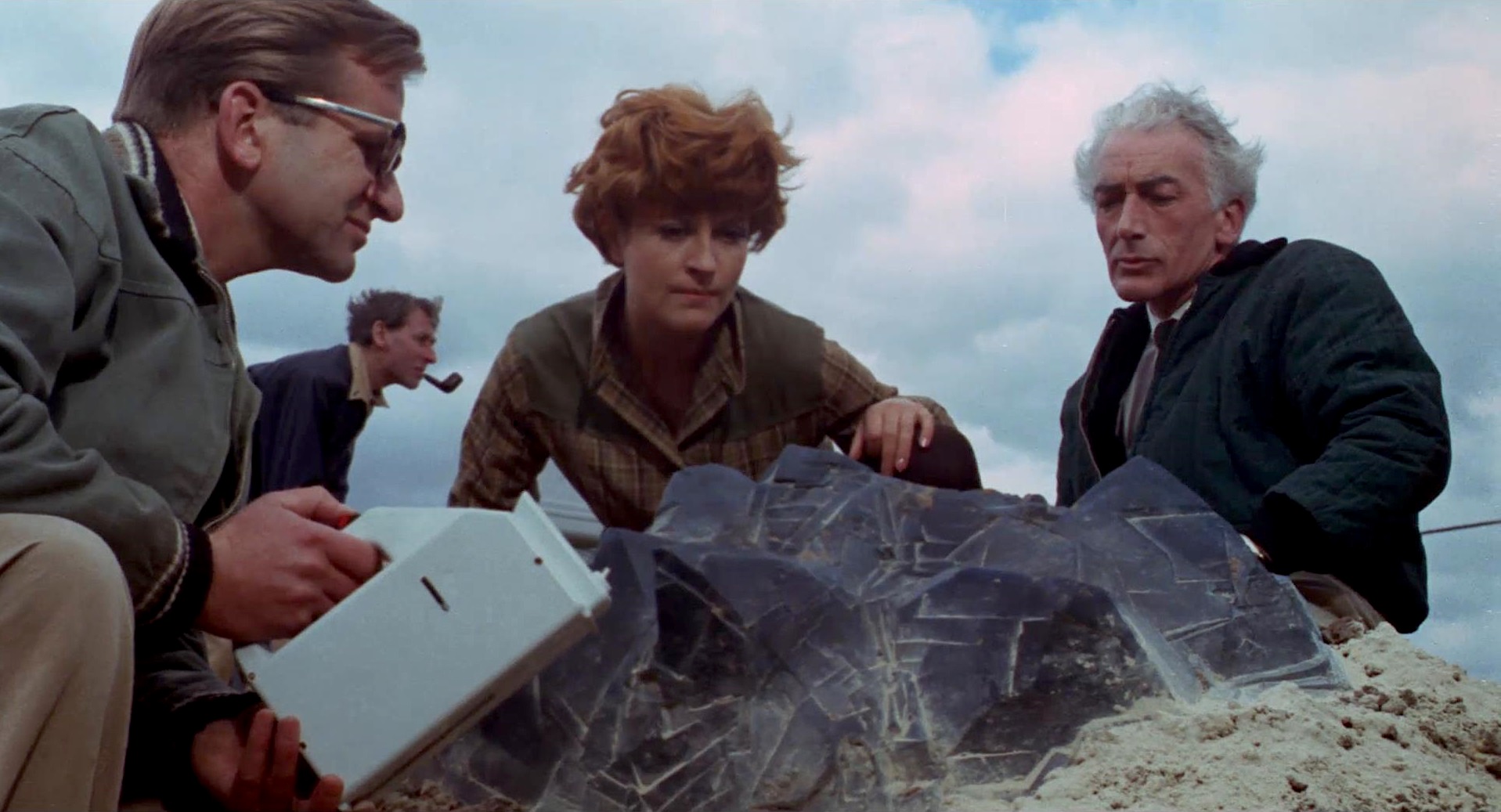


The drama opens with the Roberts farmhouse in Cornwall as trees sway in the eerie breeze, and a ‘v’-formation of nine ‘shooting stars’ descend, accompanied by appropriate electronic sounds. Then it switches to Jodrell Bank with a solar diagram flared across the floor. The Ministry of Space Research wants a team to fly down and investigate the strange meteors. Dr Curtis Temple (Robert Hutton), warns that ‘they may have been guided here by creatures, intelligent creatures,’ but although he’s considered an expert on ‘life on other planets’, and has written two books on the subject, he’s forbidden from going due to a silver plate embedded in his head as the result of a recent vintage car accident. So Miss Lee Mason (Jennifer Jayne) heads the team instead, after all, she’s ‘the brains behind the outfit’ anyway. 

The meteors are crinkly silver aluminium shapes. And when a geologist strikes one with a hammer they emit a series of shock screeches and trippy flashing lights. Inevitably the team’s minds are taken over by sinister ‘pure energy’ alien entities. ‘The brains of these primitives seem quite suitable for our purposes’ says one. ‘Connections completed and quite satisfactory’ says the one inhabiting Miss Mason, ‘we can now proceed with the next part of our plan,’ which includes driving into the local village – which in reality is Cookham High Street, and withdrawing a million pounds from Lloyds Bank after taking over the manager. 


Meanwhile Temple’s silent assistant Alan Mullane (Geoffrey Wallace) backtracks the meteor’s path to the moon – before he’s kidnapped. While Temple becomes increasingly suspicious when all the lines are down and he can’t contact Lee, who is also his lover. And when he discovers there have been financial irregularities and bizarre weapons purchases he drives down in his green open-top car, pausing only to flirt with the girl petrol attendant at the ‘Barn Garage’. He discovers that construction work is transforming the meteor site with armed guards and an electrified fence. Lee sends him away, despite his declaration of love for her. He’s machine-gunned at the perimeter barrier. Williams of Internal Security (Michael Hawkins) tells him to quit and go back to his telescope. When he attempts to pursue Lee’s Land Rover she shoots him with a ray-gun which emits more spiral pink effects, and he wakes back at the Barn Garage cared for by the attentive blonde attendant (Luanshya Greer), but warned away by two heavies. 

Meanwhile there are other, more scary developments. As he makes a report from a red phone booth Agent Stillwell (Maurice Good) breaks out in red spots, a doctor who comes to his aid is tainted, and passersby begin to collapse with the same blotchy rash, the mystery malady that they term the Crimson Plague spreads alarmingly. Observing through binoculars Temple sees a gantry rise from the farm pond, which launches a rocket into the night sky. Shorting the electrified fence he breaks into the fortified compound and the derelict farmhouse, with furious soundtrack percussion as he fights henchmen through to a bee-striped black-&-yellow cylinder dropshaft that takes him down into a James Bond Dr Evil-style subterranean scientific complex where the frozen bodies of plague victims – including the garage girl, are being transported by rocketship to the moon on an impossible twenty-four-hour turnaround schedule. He reaches Lee in the control room, and knocks her out in order to rescue her, loads her into the Land Rover through swirling mist and crashes out through the perimeter barrier.


With colleague Farge (Zia Mohyeddin, who had already appeared in TV episodes of ‘Danger Man’, ‘The Avengers’ and ‘Adam Adamant Lives!’) they attempt to evict ‘the thing that’s taken over her body.’ After subjecting her to various tests using close-up lighting effects they replicate the alien’s cosmic ultraviolet ray-gun and use it on her. She’s cured. Deciding that Temple himself is protected from predatory mind-invasion by the silver plate in his head, they melt down Farge’s trophies to create an insulating helmet for him, which ludicrously resembles a bowl-shaped colander! Lee is able to bluff their way back into the compound – they think she’s still alien, and using helmets and ray-guns the trio fight their way back into the complex in order to stow away on the next rocket, launching towards a rather unconvincing moon. 

‘It is films like this that give British science fiction a bad name’ says David Miller & Mark Gattiss (in their excellent ‘They Came From Outer Space!: Alien Encounters In The Movies’, Visual Imagination, 1996). Although Freddie Francis excels as cinematographer – with ‘Sons And Lovers’ (1960) and ‘The Elephant Man’ (1980), the Hammer and Amicus films he directs ‘have an air of tattiness about them.’ Even the lunar sets are said to be recycled from the Amicus ‘Daleks’ Invasion Earth 2150AD’ (1966). They do their best to contort their faces with G-effect as they accelerate into hyper-drive, although there’s no low-grav when they arrive at ‘The Master of the Moon’s lunar base. Of course, the brightly-cloaked colour-coded super-minds could have induced artificial gravity? Or is that to overthink it, to invest a degree of seriousness that this silly movie does not really deserve? After all, ‘the ultimate evolutionary forms’ have evolved beyond physical bodies into pure mental energy, but faced with extinction they seek to return to their home world in order to die. They need slave-workers – the revived plague-victims, to reconstruct their ship. Strapped to a star ‘Flash Gordon’-style, Temple is threatened with having his silver plate surgically removed, allowing a mind-takeover, but Farge escapes and urges a slave’s revolt. 

In the film’s final sad moments the hapless Michael Gough – in the thankless role of alien Mastermind, concedes defeat, now ‘we will die on a strange planet in a strange galaxy.’ Not so, says Temple. ‘We would have helped you.’ Not through force. But willingly. Which is the tagged-on pacifist message. 

Does it work? As an amusing Sci-Fi curio, there are a number of stools, and it falls between most of them, above and beyond a degree of irreverent speculation concerning the title.


‘CONQUERORS FROM A 

DYING WORLD INVADE EARTH!’ 


THEY CAME FROM BEYOND SPACE Original Release: Amicus Productions, through Embassy Pictures Corporation, 1 May 1967. Directed by Freddie Francis, at Twickenham Studios. Produced by Milton Subotsky & Max J Rosenberg. Written by Milton Subotsky based on the novel ‘The Gods Hate Kansas’ by Joseph Millard. Edited by Peter Musgrave. Special Effects by Bowie Films. With Robert Hutton (as Dr Curtis Temple), Jennifer Jayne (as Lee Mason), Zia Mohyeddin (as Farge), Bernard Kay (Richard Arden), Michael Gough (Arnold Grey, Monj ‘Master of the Moon’), Geoffrey Wallace (Alan Mullane), Maurice Good (Agent Stillwell), Luanshya Greer (Garage Attendant), John Harvey (Bill Trethowan), Diana King (Mrs Trethowan), Kenneth Kendall (TV newsreader), Frank Forsyth (Mr Blake). Music by James Stevens, conducted by Philip Martell. 85-minutes. Blu-Ray, StudioCanal, March 2021