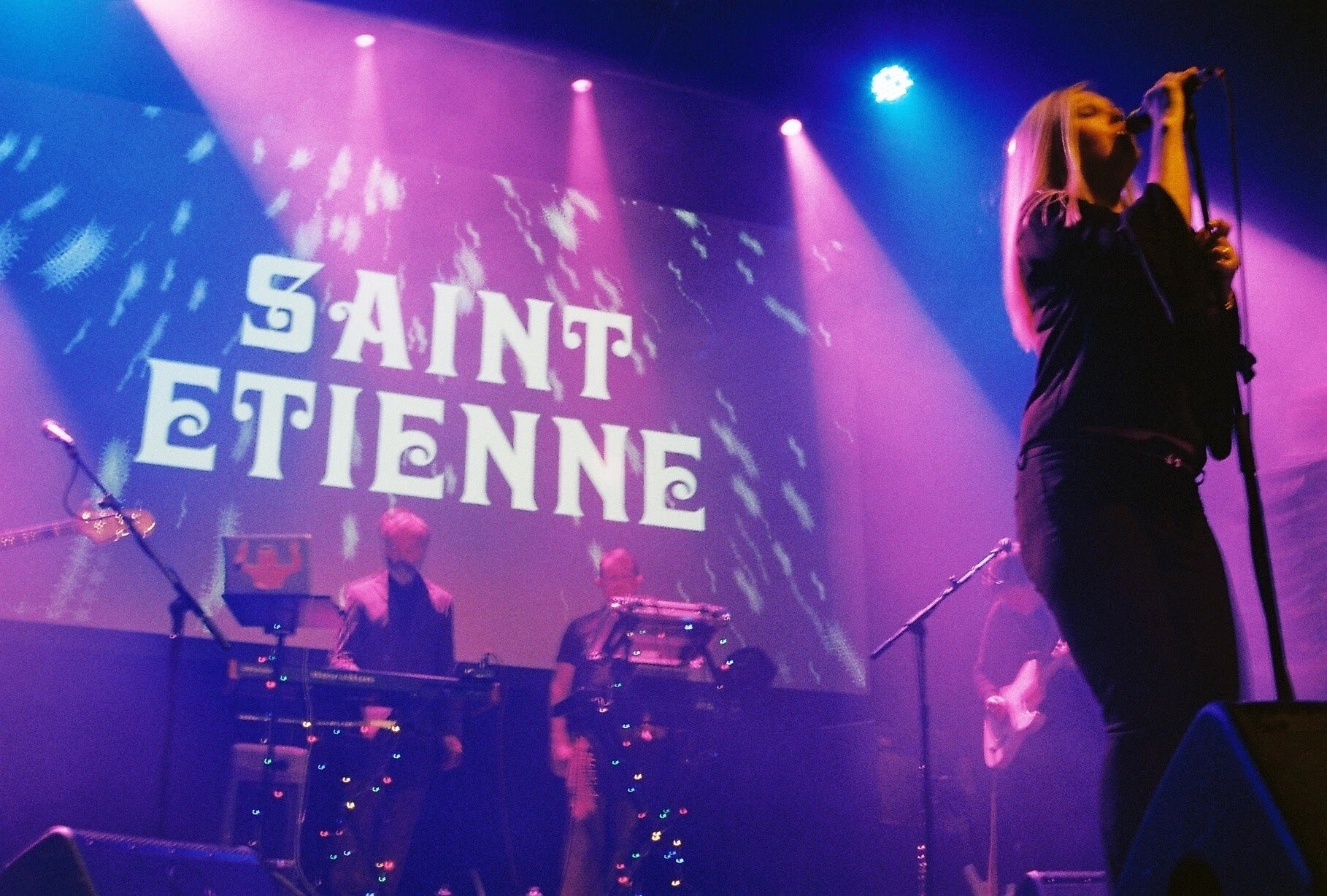
SAINT ETIENNE:
BEYOND ‘THE HEART OF DARKNESS’
… INTO ‘PALE MOVIES’
Sarah Cracknell is the starlet of Saint Etienne.
But are they just smooth Retro plagiarists? And would
they smash their guitars in a remake of ‘Blow-Up’?
You out there, reading this webpage, come closer. Closer. Now prepare yourself for a shock. When Sarah Cracknell swears, you tend to notice.
‘I’m really into the film ‘Apocalypse Now’ (1979). That’s one of my favourite films, and it’s based on Joseph Conrad’s book’ she explains brightly. ‘The funny thing is, when I opted to read it on Radio One I didn’t realise how difficult it is to actually read out loud. It’s just m-a-s-s-i-v-e sentences with loads of commas. And you’re trying to find out what the point of the sentence is, in the sentence-structure, while you’re reading it. You end up just going BLUUUURGH. It ended up with me going ‘yes, and blah blah blah – SHIT! BOLLOCKS!!!,’ and they had to edit it out.’
She giggles delightfully. Sarah has a fractured innocence you last encountered in a Swinging London movie, where ‘bad language’ still tests out the boundaries of what is daring and what is permissible. She’s explaining how she got to read Joseph Conrad’s ‘The Heart Of Darkness’ (1899) on Mark Radcliffe’s radio culture-vulture slot.
So why choose Conrad? Why not John Braine’s ‘Room At The Top’ (1957) or Shelagh Delaney’s ‘A Taste Of Honey’ (1958), or at least Jack Kerouac’s ‘On The Road’ (1957)? Something more evocative of the image Saint Etienne tend to evoke.
‘We’re deeper than we seem’ says Pete Wiggs darkly. Then ‘if I’d done it I would have chosen the ‘Mr Men’ books. I could just about manage those.’
It’s almost like the lyrics of “Pale Movies” – ‘he’s so dark and moody, she’s a sunshine girl.’
We’re in the dressing room. Leeds Metropolitan University. The gig was a breathtaking movie of sequenced chart contenders, with Sarah in the lead role. The focal point. She’s still wearing the silver-grey mini-skirt and black leather boots she wore on stage. At her throat is a pink heart choker.
Saint Etienne are named after a French football team. Sarah’s co-conspirators are Bob Stanley, and the aforesaid Pete Wiggs. Together they write knowing and affectionate, engaging and clever love-notes to Pop’s back-catalogue. They are English Popstrels with Euro-kitsch embellishments. Tone, pace, style, and dance-friendly bass-lines.
She jokes lightly about getting psyched up for the gig. But seems effortlessly at ease on stage. As though it’s her natural environment.
‘It is’ says Pete.
‘It is my natural environment’ agrees Sarah with another throwaway giggle. ‘I love live gigs. No, I don’t get nervous. I wasn’t nervous tonight. But I was worried because my voice has been really hoarse. I thought it was – like, going, and I was worried it was just going to pack up altogether.’ A smile of secret intimacy. ‘And I made the fatal mistake of apologising for not having my voice – two songs in, and then thought ‘why did I do that?’’
A little gruffness adds a sexy edge to the voice.
‘Ye-eh’ she concedes. ‘Yeah, when it’s sort-of s-l-o-w.’ Like she’s imagining Barry White doing it. ‘But some of the songs we do are very high and very intricate. Like “Avenue” (a seven-minute track from ‘So Tough’). That’s really one of the difficult ones. But then, I’ve got Debsey and Siobahn to help me out on that.’ Debsey and Siobahn Brookes nod enthusiastically. They wear, by turn – a Sonic the Hedgehog T-shirt, and a sequinned ‘Miss America’ tank-top. But glitter ye not…
--- 0 ---
Sarah on the rigours of touring:
‘Actually we’ve got quite a plush
tour coach. With a video’
‘Call me old-fashioned, but I’m a little nervous about the future’ sez Carter USM. ‘Modern Life Is Rubbish’ agree Blur. What’s the answer? A retreat into the past?
Saint Etienne’s show leads in on tapes of Kathy Kirby and Dusty Springfield. Their first album – ‘Fox-Base Alpha’ (1991) opens out into a booklet of liner pin-ups of Marianne Faithful, Monkee Micky Dolenz, and Billy Fury. A year later they sample the film soundtrack from ‘Billy Liar’ (1963) on their second LP ‘So Tough’ (February 1993), ‘…a man could lose himself in London…’ Then they quote Brian Clough as a ‘Folk Hero’ on the sleeve of their compilation ‘You Need A Mess Of Help To Stand Alone’ (November 1993). Meanwhile, the B-side of their no.1 Indie single duet with Charlatan’s Tim Burgess is a cover of Billy Fury’s “My Christmas Prayer”.
And someone mentions noticing the Small Faces in their set tonight.
‘The Small Faces were in HERE tonight?’ goggles Pete.
No. Not in HERE! In one of the slides used in the stage backdrop.
‘Yes. They were on the slides’ confirms Sarah. ‘There’s a few of those slides which I’ve forgotten about. That’s why I’m sometimes standing with my back to the audience – I’m watching our slides. I was a bit worried tonight though when I was watching the slides. They’d put the word ‘EASY’ above my head. It’s a slide from the ‘Easy Rider’ (1969) movie, but I turned round and, there it was. ‘EASY’ written above my head! That’s not very nice, is it?’
‘It’s awful when the truth comes out’ gags Pete.
Pete initially pacted with Bob Stanley in 1988. Bob was a music journalist whose review of the Lightning Seeds ‘Cloud Cuckooland’ once graced the pages of a leading music paper with the initials ‘MM’. Their first single together, “Only Love Can Break Your Heart”, was a cover of a Neil Young song, with Moira Lambert contributing guest vocals. It was followed by “Kiss And Make Up”, again a cover version – this time from obscure Indie band Field Mice. The vocalist is Donna Savage. It’s not until the third single – in May 1991, that the Ett’s third vital ingredient falls into place. “Nothing Can Stop Us” c/w “Speedwell” is an original Stanley-Wiggs song, even though it samples Dusty Springfield (“I Can’t Wait Until I See My Baby’s Face”). Sarah Cracknell is the voice, breathy, fragile and pure.
How many French bands are there named after English football teams?
‘About twenty’ deadpans Pete.
Wolverhampton Wanderers? Leeds United? …Chelsea?
‘Ah – yeah’ joins in Sarah. ‘Don’t dare mention Chelsea. Not in this vicinity.’ She nods at Debsey and Siobahn. ‘I’ll get my scarf out,’
‘She’s their no.1 fan!’
‘There IS a band called Chelsea’ chips in one of the posse.
But I know that. It was a joke.
‘Tiger Bay’ (February 1994), issued in CD, vinyl LP, cassette and digital formats, is Saint Etienne’s best-received album to date. Haunting melodies. Opulent orchestral embellishments. Less scope for the usual press swipes about assorted pastiches and the suspicion of tongues not entirely dislodged from stylish cheeks. The album spin-offs also include a David Holmes dance-floor mix of their Disco-friendly “Like A Motorway”, and a Kris Needs Techno remastering of the “Pale Movie” single – quintessential La-La-La Pop with Spanish guitars and tactile-to-the-touch lyrics about a girl with ‘the softness of cinema seats.’
But Saint Etienne are still a ‘concept’ band.
‘In a way. But that’s because we were all Pop fans. Because we were all into the musical heritage, as it were. We like things that are good from certain periods. And we incorporate them into our music. We don’t go all the way. We don’t want to be a seventies group. Or a sixties group. But there’s certain things about those periods that were really cool. And we can adapt them to modern usage. I think most bands are probably the same to different degrees. Everyone always has. The Rolling Stones – they were using Blues. You use things you like. You try to get elements of what you like into it. We get criticised a bit more than others for that. Just ‘cos we’re not a traditional four-piece group. In the old days it was just guitars and drums. But now – with the technology, it’s more easy to replicate things. Now you can ape things really easily. Rather than just incorporating ideas you can end up copying things totally, perfectly. But we’re never going to do that. We’re just taking certain elements from each particular style.’
‘In a way it makes me laugh that the Press has had a bit of a ‘pop’ about how we’re retro and how we’re post-this and post-that’ smiles Sarah. ‘Yet now they’re heralding the New Wave Of The New Wave, and that’s the best thing since sliced bread. I mean – you can’t get more retro than that. But that’s what they’re into at the moment. The Music Papers today. They love all that.’
--- 0 ---
Pete Wiggs on why Saint Etienne have yet to
tour America: ‘Lack of support from our American
record company. They’re a bit crap.’
Sarah: ‘They’re very crap.’
Live, Saint Etienne do “Nothing Can Stop Us Now”. An anthemic declaration of intent. Think Positive – ‘there’s gonna be a storm soon, get ready, ‘cos we’re coming through.’ Then there’s material from ‘Tiger Bay’ – Sarah’s compositions “Marble Lions” and the Poppy seventies-flavoured “Hug My Soul”. She says ‘thank you, you are too kind.’
It’s a smooth, flawlessly textured set, opening with the scene-setting instrumental “Urban Clearway”, a track that ‘Q’ magazine describes as ‘wordless sub-techno soundscapes (of) mythical late-nite London’ (April 1994). There’s “Cool Kids Of Death”, a title that’s allegedly a typing error for ‘Cool Kinds Of Death’. But one of the most fascinating titles – “Western Wind”, is a kind of medieval poetry set to (what ‘Select’ calls) an ‘ambient trance Folk ballad.’ Stephen Duffy – of Lilac Time, shares the vocals with Sarah. Then there’s orchestral follies of oboes and cellos chiming with electric guitars of “Former Lover”, a Paul Simon-esque ballad with intriguingly oblique lyrics about ‘Milan, when I was a kitten.’ And there’s more. “On The Shore” has Shara Nelson returning a favour; the Ett’s collaborated on her hit “One Goodbye In Ten”, she sings back-up on ‘Tiger Bay’.
Coming off stage Sarah confesses ‘I tried to mention everyone in the band tonight. But I didn’t get everybody.’ As we settle into the dressing room, the omission seems to bother her. Because ‘everybody in the band are friends, ultimately. They begin as friends. And then they end up playing guitar or keyboards.’
We talk more movies. Antonioni’s surreal ‘England Swings’ classic ‘Blow-Up’ (1966). ‘It’s kind of pretentious towards the end’ judges Pete. ‘Though it’s still very good. I like the Yardbirds sequence, where Jeff Beck is smashing the guitar in that Club scene.’
Could you see Saint Etienne doing that? ‘What? Smashing our guitars?’
No, playing in a film sequence of that nature? ‘It’d be great. If there was a movie sequence in a film in the same vein, I’d love for us to do it. But smashing your guitar is a bit corny in a way now, isn’t it? Although back then, in ‘Blow-Up’, it was still a curiosity. Paul did smash his guitar after one of our gigs. And regretted it ever since.’
‘Yes’ enthuses Sarah. ‘Instead of being all Rock ‘n’ Roll about it, he was ‘EEEEK, look what I’ve done!!!’
‘He burst into tears, ‘WAAAAAAH, what have I done? WHY?’
But talking futures, some Saint Etienne pieces sound exactly like music for unmade movies. “Highgate Road Incident” would not sound out of place on the ‘Blow-Up’ soundtrack. Would they like to work in that direction? ‘Yeh’ from Sarah, ‘We’re just waiting for somebody to ask us.’
So does she see Saint Etienne as a long-term project? ‘Until we run out ideas. Until we become boring old buggers.’
When Sarah Cracknell swears, she does it delightfully…
Pete Wiggs on Kim & Kelley Deal’s band, the Breeders:
‘They’re a bit more of a traditional Rock band, aren’t they?
I think we’re a bit more like accountants.’
Sarah: ‘STEADY…!’
ST ETIENNE:
RETURN TO ‘FOXBASE ALPHA’
To mark its eighteenth anniversary on September 2009, Heavenly Records issued a ‘Deluxe Edition’ of the ‘Foxbase Alpha’ album, proving that it remains one of the most dewy-fresh debut albums ever made. Back then, newly located from suburban Croydon to Tufnell Park, north London, school-friends Bob Stanley and Pete Wiggs set about making what Stanley has since described as ‘a time capsule of our lives in that year’. ‘Foxbase Alpha’ was named after a childhood in-joke about a place filled with gorgeous people, via an esoteric reference to TV’s ‘Space 1999’. And it is both retro and modern, a love letter and a scrapbook, a compendium of private passions from Dusty Springfield to King Tubby, David Mamet to footfall, C86 to ambient house, and London, always London. The packaging, from its cover placard-carrying gentle-protester with the album name carried as its declaration, to its Jon Savage sleevenotes and Smiths-inspired gallery of sixties icons, is gorgeous. An eclectic bonus CD of singles, ‘B’-sides and offcuts enhances the sense of joyous adventure. The effect is to invite the listener into a world slightly warmer, brighter and more exciting than the real one. And despite its many American influences, its Swinging London romanticism anticipated Britpop. The Balearic reinvention of Neil Young’s “Only Love Can Break Your Heart” may be its most celebrated moment but “London Belongs To Me” – a NW1 fantasia, is the album’s awestruck heart. To Dorian Lynskey, reviewing the package in the ‘Observer Music Monthly (May 2009)’ ‘Sarah Cracknell coos the opening line ‘took a tube to Camden Town’ like she’s Alice passing through the looking glass.’
THE SAINT ETIENNE HIT-FILE
18 May 1991 – ‘Nothing Can Stop Us’ c/w ‘Speedwell’ (Heavenly HVN009) reaches no.54
7 September 1991 – ‘Only Love Can Break Your Heart’ c/w ‘Filthy’ (Heavenly HVN12) reaches no.39
16 September 1991 – ‘Foxbase Alpha’ (Heavenly HVNLP1CD)
(1) ‘This Is Radio Etienne’ (0:43, Bob Stanley-Pete Wiggs)
(2) ‘Only Love Can Break Your Heart’ (4:29, Neil Young) Moira Lambert vocals
(3) ‘Wilson’ (1:59, Stanley-Wiggs) based on a Wilson Pickett ‘Hey Jude’ sample
(4) ‘Carn’t Sleep’ (4:43, Stanley-Wiggs)
(5) ‘Girl VII’ (3:46, Stanley-Wiggs)
(6) ‘Spring’ (3:44, Stanley-Wiggs)
(7) ‘She’s The One’ (3:07, Stanley-Wiggs)
(8) ‘Stoned To Say The Least’ (7:42, Stanley-Wiggs)
(9) ‘Nothing Can Stop Us’ (4:21, Stanley-Wiggs) includes Dusty Springfield sample from ‘I Can’t Wait To See My Baby’s Face’
(10) ‘Etienne Gonna Die’ (1:32, Stanley-Wiggs) sampled dialogue from ‘House Of Games’
(11) ‘London Belongs To Me’ (3:56, Stanley-Wiggs)
(12) ‘Like The Swallow’ (7:41, Stanley-Wiggs)
(13) ‘Dilworth’s Theme’ (0:39, Stanley-Wiggs)
Plus bonus disc on Deluxe Edition:
(1) ‘Kiss And Make Up’ (6:20 extended mix) cover of Field Mice record, Donna Savage vocals, written by Wratten-Hiscock
(2) ‘Filthy’ (5:35, Stanley-Wiggs-Mais) Q-Tee vocals
(3) ‘Chase HQ’ (3:32, Stanley-Wiggs)
(4) ‘Sally Space’ (5:06, Stanley-Wiggs)
(5) ‘The Reckoning’ (1:31, Stanley-Wiggs)
(6) ‘Speedwell’ (6:33, Stanley-Wiggs)
(7) ‘Parliament Hill’ (2:38, Stanley-Wiggs) guitar by Harvey Williams
(8) ‘People Get Real’ (4:45, Stanley-Wiggs)
(9) ‘Sweet Pea’ (4:49, Stanley-Wiggs)
(10) ‘Winter In America’ (5:53) Gil Scott-Heron song sung by Donna Savage
(11) ‘Fake 88’ (5:03, Stanley-Wiggs) spoken vocals by Stephen Duffy
(12) ‘Studio Kinda Filthy’ (4:58, Stanley-Wiggs-Mais) vocals by Q-Tee
(13) ‘Kiss And Make Up (USA version’ (5:16) Sarah Cracknell version
(14) ‘Sky’s Dead’ (7:26, Stanley-Wiggs)
16 May 1992 – ‘Join Our Club’ c/w ‘People Get Real’ (Heavenly HVN15) reaches no.21
17 October 1992 – ‘Avenue’ (Heavenly HVN2312) reaches no.40
13 February 1993 – ‘You’re In A Bad Way’ (Heavenly HVN25CD) reaches no.12
18 December 1993 – ‘I Was Born On Christmas Day’ (Heavenly HVN36CD) reaches no.37
19 February 1994 – ‘Pale Movie’ (Heavenly HVN37CD) reaches no.28
28 May 1994 – ‘Like A Motorway’ (Heavenly HVN40CD) reaches no.47
1 October 1994 – ‘Hug My Soul’ (Heavenly HVN42CD) reaches no.32
11 November 1995 – ‘He’s On The Phone’ (Heavenly HVN50CD) reaches no.11
7 February 1998 – ‘Sylvie’ (Creation CRESCD279) reaches no.12
2 May 1998 – ‘The Bad Photographer’ (Creation CRESCD290) reaches no.27
--- 0 ---
Gig Review of:
SAINT ETIENNE
At ‘Leeds Metropolitan University’, Yorkshire
Jane Fonda in ‘Barbarella’. And the Smallfaces.
Hayley Mills in ‘Whistle Down The Wind’. And the Jam.
But Sarah Cracknell, in white feather-boa, silver-grey mini-skirt, pink heart choker, and kinky boots, is tonight’s REAL Starlet. Watch her ooze ‘we think you’re gorgeous. You really are,’ blowing sweet kiss-ettes to the assembled glitterati and fashion victims. And you know that Sarah is Venus In New Genes.
Saint Etienne are a timeless party. Of the Sixties. But not Sixties. Of Seventies Disco. But not Seventies either. More a Soda-Pop Dance Inferno fine-tuned for the Nineties. Sharply dark Pete Wiggs and Bob Stanley are the wizards of twiddly as the Bridget Riley ‘Time Tunnel’ spiral revolves on the backdrop behind them. Siobahn Brooke and Debsey Wykes stand stage-right in leather Hot-Pants, ‘Miss America’ sequinned top, and ‘Sonic’ T-shirt, doing a neat Supremes dance routine – ‘STOP, in the name of love’ to 1993 mini-hit “Who Do You Think You Are?” (it reached no.23). Five males and three girls on stage at any given time, plus the style-referencing slides – Sonny Bono to Jean Luc Godard and beyond.
There’s a smooth opening instrumental Movie soundtrack punctuated with melodica, ‘Hawaii Five-O’ quotes hinting at the diversity to come. And Saint Etienne shift across a wider range of sounds than I’ve seen on stage for a long time. Irresistibly straight La-La-La Pop like “Pale Movie” (no.24 in February 1994), the acoustic strum of “Former Lover” (from their ‘Tiger Bay’ 1994 album, with lyrics that go ‘Milan, when I was a kitten…’), and then into a Kraftwerk autobahn detour for “Like A Motorway” – by way of trad-Folk anthem ‘Silver Dagger’ but decked out with authentic synth-drums… and Presley’s electro-redesigned “We’re Coming In Loaded” (from his 1962 ‘Girls Girls Girls’ movie). ‘Do you like Elvis Presley? – good’ purrs Sarah, twirling her party frock.
She’s most impressive on “Don’t Forget To Catch Me”, laced with touchingly slow keyboards and a lethally incisive guitar solo. ‘You are tooooo kind’ she drools in appreciation.
Visually it’s a trip. Sonically it’s a complete edition of ‘Top Of The Pops’ when it was good. “People Get Real” is rousing Girlie-Pop to tear your face off. “You’re In A Bad Way” is a chart single to die for (their biggest hit, no.12 in February 1993). ‘We don’t normally do this’ oozes Sarah through shimmers of blonde hair, ‘encores are a big no-no. But just for you…’
And they close with “No No No”. A cover of Nancy Nova.
But me, I ran out of goose-bumps long before that.


%20Xmas%20Tree.jpeg)