Thursday, 19 June 2008

‘3 A.M.’ by WYCKHAM PORTEOUS
(Cordova Bay CBR-0352)

We all know the story, how Paul McCartney intended “Please Please Me” as a maudlin Roy Orbison-inspired ballad, but how George Martin thought different. He got them to speed it up, then speed it up some more, until it became the catchy spring-loaded Pop-anthem we know today. What Victoria DC-born singer-songwriter Wyckham Porteous does is rewind the tape. Slow it back down to their original Orbisong blueprint, his rasping drawl emphasised by the melancholy whine of John Ellis’ pedal steel, with the resonance of Steven Drake’s sitar to reference a later Beatles phase. And it works remarkably well, so well that it grabbed immediate listener-response when Bob Harris gave it a spin on Radio Two. Oddly so, because this is the same Wyckham who once said ‘it’s easier for me to create than to copy’ by way of explaining his early aversion to covers. In fact, he’s been around awhile with an already impressive rap-sheet of original songs, think ‘sexanddrinking’ (2001), and the original “3am” on ‘Looking For Ground’ (1996) produced by Austin-based Jimmy LaFave for the Bohemia Beat label. Yet each stand-out cover here is matched to original songs that shift around, nudging and colliding with each other like atoms in some diverse molecular structure. Songs awash with out-of-sync time-shifted narratives – ‘it’s 3am by your clock, and it’s midnight by mine’ which, in the hands of lesser lyricists might sound indulgent and angsty, a tone that starts from the opening words - ‘if you look around tonight, you see the world is not alright’, augmented by Angela Harris’ background voice and Ellis’ banjo. And after a while, just when you feel his pained vocals might start to grate, he pulls out a new take on Springsteen’s “Hungry Heart”, or Ben E King’s “Spanish Harlem” that sends you back to admire the lyric-sheet afresh. It’s difficult not to draw analogies – “Deep In The Water” has an early Cat Stevens “Father And Son” feel to it, the stand-out “Ancient Highway” is a Kerouac narrative come adrift from ‘Blood On The Tracks’ (“Shelter From The Storm” perhaps?), and the compelling “Young Man Walking” is ripped from the Leonard Cohen songbook. But, like he sings it, ‘there is truth in contradiction’, and his battered alt.country croon draws those well-worn roads together into thematic unity. Working towards this end there’s Immediate-veteran Andrew Loog Oldham out-back of the production desk, although he’s ditched the London ‘wall of sound’ that was once his specialty, in favour of a stripped-down predominantly acoustic set-up, 39:17-minutes laid down virtually live in three December days, with sympathetic additions input by a pool of well-honed musicians. We all know these stories, but a great tale is worth re-telling…

REVIEW BY ANDREW DARLINGTON

www.wyckhamporteous.org
www.cordovabay.com
www.indiscreetpr.com
More details from:
Indiscreet PR, PO Box 48683, London NW8 1AT Tel: 07813 290474
Email: alan@indiscreetpr.com
lesley@indiscreetpr.com

Wednesday, 18 June 2008

SMOKEY ROBINSON:
QUIET STORM…
BY
ANDREW DARLINGTON

I was... almost there to get the details.
In preparation for a scheduled interview I did the research,
re-listened to all the familiar tracks, re-read the bulging clipping
files and books. Until, when the interview was cancelled
at the last minute, why waste all that work?
Why not visualise an imaginary Virtual Interview…?

‘When Smokey sings, I hear violins…’
(“When Smokey Sings” by ABC)

Hull is a long way from Detroit. But late-winter 1966 I drive my Honda 305cc clear across from one side of Hull to the other, deep into the fringe-hazardous dockland old town, because the jukebox in the ‘Queens Head’ back-bar has the Miracles “Going To A Go-Go” on it, and we play it on repeat. Smokey Robinson wears many faces. He’s done this interview-thing before. How do you break through the fact that he’s talked to more journalists than are recommended for your mental health, and been asked every question you could possibly invent, plus countless more than you couldn’t? Only connect, perhaps by starting with a personal memory like that one? Check out the cuttings of old interviews. He tends to talk softly, politely. His voice is high and melodic, what more would you expect? When the mood takes him, he can provide answers that are way-briefer than the questions. ‘Yes’. ‘No’. Sometimes less. A nod of the head, stylishly of course, or a dismissive ‘uh-uh’. He’s been through this before. For you, this is the one-off you never thought you’d get to. He’s sitting down opposite you. Taller – at six foot, and neater, than you’d anticipated. Take a good look at his face. Light-skinned, light-green eyes. Unexpected, despite watching all that immaculate old TV concert-footage. The sharpest suits. The finest hooks. Film-clips and choruses that flash-flood you down nostalgia boulevard.
So, another tour, more dates, don’t the attractions of performance ever get tedious? ‘Never, never, never, man. There’s always something left to do in show business. Another song, better than the last one. Another record. I love live work, it’s a big part of my life. The challenge goes on and keeps me feeling good. Retire? It would kill me!’
The Miracles were Motown’s debut signing. William ‘Smokey’ Robinson was only seventeen, still scoring excellent grades at high school, when he first met Berry Gordy Jrn. Smokey had already written over a hundred songs, neatly typed into a school notebook, ‘and they were all rhymed up pretty good’. It was 1957. It was Smokey who suggested that ex-Boxer Gordy should use his songwriting royalties from hits by Jackie Wilson to set up and distribute his own records. So Gordy quit his day-job in the Ford factory, borrowed $600, and the Miracles dancey “Way Over There” became the first release on his upstart Tamla label at the very dawn of the sixties. Then “Shop Around” broke both group and label nationally – an R&B chart no.1, climbing to no.2 on the Pop chart, although it was issued on the distinctive black/silver London records for its UK debut. Gordy had struck multi-platinum, and the young Detroit North Ender went on to provide him with a multitude of hits. The Beatles’ second album features a stand-out version of Smokey’s “You’ve Really Got A Hold Of Me”, a song of addictive masochistic-dependency. Yet even before that, schoolgirl Popstrel Helen Shapiro had covered “Shop Around” on the old green Columbia label. Then the Rolling Stones did “My Girl”, before Otis Redding got around to it. The Stones also later covered “Going To A Go-Go” as well. It must have been bizarre for Smokey, in far-off Detroit, to suddenly discover his songs were being fanatically collected, performed, and recorded by long-haired beat groups somewhere on the far side of the Atlantic. When did he first become aware that there were foreign audiences devoted to his music? Stranger still, that as Motown was sophisticating black music into a slick radio-friendly Hitsville USA – a calculatedly vanilla ‘Sound Of Young America’, the Rolling Stones and their blue-eyed Soul ilk were breaking back through onto the American charts with a rawness directly derived from Motown’s older discredited Chess rivals in Chicago.
When I saw the Beatles at the Hull ABC they’d deliberately selected Mary Wells as their guest support. The Fabs were big Motown-fans. And Mary Wells was Motown’s biggest star. She was the first Motown artist to chart in the UK, with “My Guy” – one of a number of songs Smokey wrote for her (“Two Lovers” was another). It must have been weirdly disconcerting for the other members of the Miracles to see Smokey giving away his finest songs to other artists. How did they react? He wrote hits clear across the Motown stable, from the Temptations (on the first volume of their ‘Greatest Hits’ eight of the twelve tracks are Smokey songs, including “The Way You Do The Things You Do”) to Marvin Gaye (“Ain’t That Peculiar”), from the Marvelettes (“Don’t Mess With Bill”), Four Tops (“Still Water (Love)”), and the Contours to The Jackson Five. Then artists beyond Motown began recording his songs too, Linda Ronstadt (“Ooo Baby Baby”), Elvis Costello (“Head To Toe”), Bryan Ferry (“Tracks Of My Tears”), Aretha and Otis, and much more of the same, and that’s no shame. Someone estimated around four-thousand songs in total. So how did that operate? Did he specifically set out with a brief to script a hit for a specific artist, or did he write what came to mind, and then farm them out later as he deemed appropriate? After all, Motown operated on conveyor-belt principles replicated from Detroit’s auto-industry. He’s spoken of writing “My Guy”, then calculatedly gender-switching the formula to craft “My Girl”. Can genius arrive by equation? ‘Some people say they write from experience. Not me’ he commented. ‘I write songs no matter what mood I’m in. It’s my work, dig? When I write a sad song, it isn’t consciously because of some personal experience. I’ve never consciously written a song from personal experience. You see, I can just feel it. I just feel it, you dig? I can’t force myself to write about things that don’t naturally occur to me.’ Can creativity work to a schedule? ‘You can never tell in this business’ shaking his head ruefully, ‘I only wish I could.’
‘Not a day goes by that I don’t write something’ he told journalist Yvonne Roberts (‘Observer’ 2nd February 1992). ‘I’m not a moody songwriter, I don’t need to go to the Caribbean to produce. It’s a gift from god, it just comes. Matter of fact, you could say a phrase right now that might inspire me to write a song.’ He elaborates, out buying pearls with a friend, he told the sales assistant ‘I just hope the wife likes them’. ‘I second that emotion’ said the friend. A slip of the tongue, and the superfine “I Second That Emotion” became a hit in 1967 (no.27). And an even bigger hit two years later for Diana Ross & The Supremes with The Temptations (no.18). Startled to hear a new riff improvised by Miracles’ guitarist Marv Tarplin, who he’s worked with some thirty years, he found himself thinking ‘I’ll be doggone’. And the bitter-sweet “I’ll Be Doggone” was a hit for Marvin Gaye in 1965. ‘I hate to hear haphazard songs where it says one thing in one verse and then something else in the next’ he rationalises. ‘That’s a drag. Or a song which doesn’t mean anything at all and it’s a hit. You see a lot of those. They’re nothing, and they’re a hit. Very bad. For myself though, I’ve always believed in sticking to the basic thing that will never die, and by that I mean the relationship between man and woman. When that’s over, everything’s over. We have no new words or chords or notes. You’ve just to take the same tools and express them differently. Forget the moon in June, and never press the same buttons.’
Way back then, we grooved to the Miracles. But they weren’t really up there with the Temptations, or Wilson Pickett, or James Brown. It was possible to lose a Miracles’ record in the blizzard of more muscular punching soul. Yet oddly, as the years accumulated into decades, in retrospect, my appreciation of the craft and beauty of Smokey’s songs has only escalated. His writing skill. His melodies. His instantly-recognisable spun-sugar honeyed vocals woven into the swooping interplay of voices. Of course, there’s schmaltz and sentimentality, but we listen to Smokey where we wouldn’t listen to the bloated bombast of Alexander O’Neal, Luther Vandross, or even Barry White because there’s a vulnerability, a sensitivity behind even the most saccharine Smokey. The real hidden voice of soul. Mods and Soul-boys revered him from the start. They watched avidly as the Miracles did “Mickey’s Monkey” on the 1965 ‘Ready Steady Go’ Motown TV-special, a show guest-hosted by a gushing Dusty Springfield. They might even have made it to the groundbreaking – if poorly attended ‘Motown Revue’ tour, appearing through dismal March 1965 dates at ABC movie-theatres alongside The Supremes, Stevie Wonder and special guest star Georgie Fame. But it was only with “Tracks Of My Tears” – as late as May 1969, that the Miracles finally cracked the UK Top Ten. He’s told the story any number of times. ‘I was dealing with a sad story, a cat who’d been cut deep, hurt by heartache. I knew my man was suffering strong. What I lacked though, was a chorus…’ So what if you cried so hard that it etched channels into your face? That’s the way he described it. Like… yes, but surely it’s also a metaphor for other, more narcotic forms of addiction than love? Isn’t that what track-marks are about? And the seductive ache, the hurt you can touch?
Then there’s the superlative “The Love I Saw In You Was Just A Mirage” which – even after playing it across years, is still one of the few songs that has the ability to literally choke me up. No-one can break a heart like Smokey does, effortlessly falling just the right side of over-sentimentality. If there’s a more desolately beautiful song of hurt than “The Love I Saw In You”, I’ve yet to hear it. As the verses unfold and he stretches out the clever internal rhymes, her ‘untrue kisses’ lured him on ‘just like the desert shows a thirsty man / a green oasis where there’s only sand’. Her illusion of sweetness is used to rhyme ‘mirage’ with both ‘heartache’s camouflage’, and ‘the way you wrecked my life was like sabotage’, more ludicrous – yet more perfectly apt images are impossible to imagine. He dextrously springs the most unpredictable metaphor and simile, a writing process that’s quite unconscious if you accept the clues he trails to tease inquisitive interviewers. It was crusty old Ezra Pound who said that ‘every popular song has at least one line or sentence that is perfectly clear – the line that fits the music’. Smokey fits more than just about anyone else
Bob Dylan’s most provocative and repeated quote named Smokey ‘America’s greatest living poet’. Beyond anything else, the claim was intended as a teasingly calculated smart-ass stab away from the pretensions of literary academia into an alignment with street-Pop. But that’s not to imply it was also insincere. Smokey rhymes like no-one else in music, combining the honed writing-to-demand sparkle of the Brill Building with an ear for polished melody to challenge the best of Bacharach, Jim Webb or Lennon/McCartney. Only a handful of writers have ever fused the eloquent to the populist the way Smokey does on “Tracks Of My Tears” with ‘just like Pagliacci did, I try to keep my sadness hid’, or turn such marvellous economy as the couplet from “If You Can Want” that goes ‘just like ‘push’ can turn to ‘shove’, ‘like’ can turn to ‘love’…’. But has anyone ever asked Smokey about his favourite poet? There’s something about his current set that suggests he might nominate George Gershwin. Relating more to the traditional crafts of lyric-writing. As though he feels he’s parascended above R&B, or black music, and evolved into the more rarefied air of the ‘classic’ Great American Songbook Pop. Where the clever rhyme and lyric-fit reached its purest expression.
Packaged as a 2-CD ‘50th Anniversary Edition’ (2006) Smokey’s ‘Definitive Collection’ now comes bound-in with his thirteen-track ‘Timeless Love’ – interpreting velvety jazz and big-band Swing items from the decades before Soul existed. Taking knowing melodic liberties with Sammy Cahn’s “Time After Time” and Cole Porter’s “Night And Day”, the orchestra expansive and perfectly rehearsed for Sinatra’s “Fly Me To The Moon”, plus songs by Kurt Weill and Gershwin. ‘Cats like Cole Porter were really writing songs. When you heard a song it meant something,’ he explains. He oozes new silky phrasings into the oh-so-familiar “I’ve Got You Under My Skin”, emotes “You Go To My Head” and even transmutes “Tea For Two” into some kind of contemporary relevance. And sure, he does them immaculately… of course he does, you’d expect nothing less. While such studies are redirecting his own energies, to become more intimate than before, more personal. ‘I want to take my time now, and try to write standards, songs that will live for decades...’ But what about Jackie Wilson, Frankie Lymon, Sam Cooke…
 
‘The slyest rhymes, the sharpest suits,
in miracles made real…’
(“When Smokey Sings” by ABC)

When and why was he first called ‘Smokey’? Did his mother really advise him to “Shop Around”? ‘I was loved when I was a child’ he concedes, ‘I mean really loved. Perhaps that’s why I came through’. Influences? – ‘there were a group of things, but it boils down to one thing – the music we grew up with. The Spaniels, the Dells, Hank Ballard & The Midnighters, Clyde McPhatter & The Drifters, oh, and Frankie Lymon & The Teenagers. Not only them, but the Five Quills, which is a group maybe you never heard of… because they were a group in our neighbourhood. And we wanted to sing better than them. There were ten-thousand groups in our neighbourhood, and we’d have parties, try to shoot them down, see who’s best.’ So who was best? ‘The Four Tops’ after only the slightest moment of hesitation. ‘That wasn’t even their name, Motown gave them that name. But they were the most dynamite group. They could really sing, they had harmonies together. They were the feared group.’
Smokey’s own purest doo-wop high falsetto bothered him at first. ‘Should a cat like me be singing like a chick?’ But soon it became his trademark sound. At nineteen he married fellow-Miracle Claudette Rogers. They stayed together twenty-seven years. But in his autobiography he admits ‘my heart was changing, my soul rearranging. It’s the man thing. The wandering eyes. I just can’t help it.’ A musician to his finger-tips, even his prose chimes like a lyric. Just as the closely-woven matrix of the Miracles harmonies enhanced his signature ‘sound’.
A wrinkle in time ago, a Chinn/Chapman group called Smokey emerged from Bradford. It was mid-1975. They were advised to change their name to Smokie to avoid litigation from Motown. By then the label was enjoying a $40-million turn-over. And Motown was evolving, well advanced in the process of splitting its acts in two. It began by adding ‘Diana Ross &’ to the Supremes credits. Then it was Martha ‘Reeves’ & The Vandellas. Soon, it was ‘Smokey Robinson &’ the Miracles too. The next step was divorce, and twice the chart acts. The Supremes had hits. So did Diana Ross. Smokey had hits (starting with “Just My Soul Responding” in 1974). So – briefly, did the Miracles, with replacement frontman William Griffin (remember “Love Machine” in 1976?). Was that the plan all along? Was it part of a corporate policy over which he had little control? Or was it merely… inevitable? In fact, as he’s pointed out, the separation would have come earlier. Instead, a guy called John Marshall of UK Motown intervened, he lifted a previously overlooked four-year-old album-track, “Tears Of A Clown”, and issued it as a single in September 1970, giving the Miracles their only UK no.1. A success that was rapidly repeated in America, revitalising the group and extending their career for a few years more.
Smokey rode every aspect of the sixties, writing and producing, harmonising and performing, while also working as vice-president within the administrative structure of the company, the architect of some of its finest moments. There’s got to be a million stories there. But where to start? Yet it was only later that he developed dependence problems with cocaine. Perhaps that was due to Motown’s relocation from the hard industrial disciplines of chilly Detroit to the laid-back hedonism of Los Angeles? But no, says Smokey. Los Angeles? ‘I adore the place. It has so many celebrities, I don’t have to allow my life to be a prison. I can run, play golf, meet people, act normal.’ Perhaps it was the changing times, the loss of the corporate ‘family’ vibe as Stevie Wonder, Marvin Gaye, Diana Ross, and Smokey spun-off into their own separate star-continuums. And as the politics got harder. After all, Smokey was changing tack too, and was soon contributing some pretty uncompromising tracks himself. “Just My Soul Responding” is based around a Native American tribal chant performed by Navajho singer Tom Bee, emphasising a more direct lyric-content than anything he’d attempted before. Starting ‘I was born and raised in the ghetto, my skin is black’ it then questions the on-going Vietnam conflict with ‘don’t try to tell me I’m unpatriotic, I deserve an explanation’. But no. Apparently the coke thing was nothing as profound as that. ‘I got into cocaine’ he admits, ‘ninety-nine percent who get off on drugs get off having fun with their friends. And I mean fun. Then, one day, they look up, and the fun is killing them. I was doing nothing but sitting at home alone, listening to my answering-machine and taking this stuff. My head would be pounding, veins bulging, heart going on, cold sweats, shortness of breath and still I’d be taking the stuff…’ Until he found Jesus. But all the while, despite some flawed moments and lack-lustre albums, there were more major landmark hits such as 1979’s feel-good “Cruisin’”, the smoky-hued no.1 “Being With You” (1981) and the infectious “Just To See Her” (1987) to re-establish his credentials as a poet of the close-up zone while proving beyond doubt he’s still more than capable of doing the do.
Now, he’s vegetarian, teetotal, and he works out. How does he set about selecting a set-list to perform from such a wealth of back-catalogue? Are there songs he particularly enjoys singing, and – conversely, are there songs that are now too difficult for him to perform? He’s spoken of deliberately lowering the pitch of his ethereal falsetto to a counter-tenor, adjusting it to accommodate the changing range of his age. What other preparations does he undertake for a tour? Does he have regrets – ‘no’. A smile delivered with all the confidence that four decades of success can bring, ‘if they’d given me a questionnaire the day before I was born asking what I might like to be, I’d fill it out exactly the way I’m living…’

‘I believe in miracles,
if you can dream it, it can be done…’
(“Sweet Harmony” on the album ‘Smokey’ Motown, 1973)

VIRTUAL INTERVIEW BY ANDREW DARLINGTON

Quotes sampled and mix/matched from ‘SMOKEY: INSIDE MY LIFE’ by Smokey Robinson (Headline Books £14.95), references also lifted from John Laycock (‘Melody Maker’ 5th February 1972), Yvonne Roberts (‘Observer’ 2nd February 1992), Jacoba Atlas (‘Melody Maker’ 15th September 1973), Jane Ennis, Richard Williams and many others, to whom respect and grateful thanks are extended.

‘DIDDLEY DADDY…’

And people say ‘Andy, over some forty years of
gig-going, which is the greatest gig you’ve ever been to?’
And there’s a hell of a lot, Bob Dylan, Beatles, Flamin’ Groovies,
Ramones, Rolling Stones, Who, Cabaret Voltaire, Kinks, Prodigy…
but there’s one name I keep returning to – the amazing Bo Diddley.
So the best gig I’ve ever attended? - it was in the music lounge of a pub
in Leeds, which has now been closed down because of its drug notoriety. 
I wrote about it twice, for two different magazines,
under two different aliases. Both of them are here.
Bo Diddley died on Monday, June 2nd 2008.

BO DIDDLEY and OFFSPRING
at ‘Fforde Green’, Leeds

In 1963 he toured with the Rolling Stones. In 1979 he toured with Clash. Tonight he does a fifties rap back to when ‘some of you wasn’t even born – BUT YOU WAS BEIN’ DISCUSSED!’ An allusion of names he’s worked with on boards and plastic over a slow growling bass figure, ‘Muddy Waters, John Lee Hooker, Jimmy Reed, Willie Dixon, Chuck Berry, the magnificent Elvis Presley’. He jive-wires the tremelo on his custom-made angular oblong Kinman, adds some Doo-wop vocal effects in the style of his antique “I’m Sorry”, then cranks up to ‘Carl Perkins, Eddie Cochran, Gene Vincent, the Rolling Stones – I’VE SEEN ‘EM ALL. I’ve been on stage with ‘em all!’ He’s indisputable proof of his macho bragging, but he ain’t no mere aspic-preserved artefact, no walking repository of Rock’s vintage violence. Some things get meaner as they get older, and the Diddler’s the 1950’s last delinquent, his Diddleybeat developed so heavy it needs an HGV license, and it’s all lit up by a big avuncular grin like a fluorescent Wurlitzer jukebox cram-full of hits. ‘The line I shoot / will never miss’, a gaudy earthy earthquake, a stumbling, lurching, shuddering, juddering, reverberating, beatific beat that crawls up inside your skull and plays your eyelids like drums. It’s a synthesis, a copulatory coupling of the hypnotically ponderous naïve with the cunning, shell-shocked complexity in all directions and dimensions simultaneously, like a rhythmic Jackson Pollock chromatic explosion. He might not have actually invented the riff that bears his name – some claim to detect its spoor all the way back to African drum-choir slave-chants, but its chrome’s not even tarnished, and it’s good for some considerable mileage yet. He runs through “Mona” (which the Stone’s mis-track list as “I Need You Baby” on their premier album), “Roadrunner” with its slide quivering in glissando glide-paths up and down the pleasure-centres of your spine, and “Hey, Bo Diddley” which extends its booming shuffling primeval rhythm for ever, and is never one microsecond too long. And that’s his survival strategy these twenty-eight years, and still fresh, each number (from the first chord instantly recognisable) is spun out over the low burn of the Diddley Daddies’ extemporising into such incessant compulsions that the actual token verse ploughed in there arbitrarily along its vapour trail is just punctuation, a reference point to orientate by. The rest is immediate, no fade-off, no drop-out, just famous axe in place, famous feathered bejewelled hat on head. “I’m A Man” becomes an entire theatre of effects and humour, musical talking guitar conversation with Stuff Smith (Fender Stratocaster), and ball-bouncing pitch and toss on the bass-strings with Brother Ron (Fender Jazz Bass). This is his regular American band, all blacks-&-reds with headset radio-mics, their sound moulded tight as traps forcing Big Bad Bo to new highs of lethal natural electricity. No pick-up musicians they, there’s Terri McDaniel sensuously programming a Rhodes Opus 3 Moog, and Bo’s other daughter – Tammi, deliciously flagellating the Pearl drum-kit while feeding in soulful vocals. As Offspring they are a first-division force in their own right as their warm-up set proves, a Funk mutation of eighties R&B, street-hard on “Not Alone” and “Hard Times”, outstanding with “Why Do Fools Fall In Love” making connections that by-pass the fey Diana Ross version and plugging directly into the socket of Frankie Lymon’s bratty original. And with the Daddy Diddley they’re more than just background ornamentation, but a superb foil to his ageless Diddleyitus, his key jungle-rhythms, his Chicago-blues based energy, raw and throbbing as an open wound. From the intro to the outro it’s peak experience with the ‘Fforde Green’ Music Lounge sweat-dripping crush-full, the epicentre of aural storm, the whole room megaton-trembling and shaking in seismic stun-waves from floor to ceiling with every tribal denomination in attendance, Skins, Punks, Teds, Hippies, Angels and Rockabilly Rebels – and all attentions fixed on the paunchy gunslinger. That’s exactly how it should be, and no-one can do it like Bo Diddley do it. Mr Diddley is 53 years old. His biggest British hit – “Pretty Thing”, reached no.34 on the chart in October 1963.

BY ANDREW DARLINGTON
Published in:-
‘HOT PRESS Vol.6 No.12’ (Ireland – July 1982)


BO DIDDLEY and ONE O’CLOCK JUMP
at ‘Fforde Green’, Leeds

Bo Diddley might have opened the door for Beatdom legions, but he was sho’ ‘nuff left holding the handle! In the 1940’s it was white Benny Goodman who was ‘King Of Swing’, not Duke Ellington or Count Basie. Just as Elvis Presley was ‘King Of Rock ‘n’ Roll’, not Chuck Berry or Bo Diddley. Just as the Rolling Stones became ‘Kings of R&B’ in the 1960’s, rather than Howlin Wolf, John Lee Hooker, Jimmy Reed… or Bo Diddley. The process is identical. So now Mick Jagger sells out the Roundhay Park arena, while Bo Diddley crams out the Music Lounge of a downtown Leeds pub a little way down the road apiece. He ain’t ‘bout to complain, ‘I wanna thank you Ladies and Gennlemen’ he booms, ‘for my survival through the Rock ‘n’ Roll crisis’ – he might’ve been using that same line at least since 1971, but he sure as hell means it. ‘Indeed he-deed he-do.’ We’re talking Titans here, I’ve got to confess, from the first riffling shimmering chords of “Bo Diddley” all critical faculties get bludgeoned and we’re into a totally submissive situation, it’s like five-hundred bands I must have seen thus far into 1982, and this gig destroys them all effortlessly, obliterates ‘em with a grin, stomps ‘em into derisive mush. Bo’s the self-bragged ‘Original Originator’, the ‘Gunslinger’ with the .38 pistol on his hip and the rose on his chest, the Roadrunner, the Grand Diddley Daddy of ‘em all, the man who is five-hundred percent M-A-N! Flamboyant, unsubtle, a raucously dirty urban thunder that’s an undiluted amalgam of heavily accentuated backbeats so primitive, so instinctive, they’re practically antediluvian, in combination with a tremulous muzzy distorted sophistication and technical skill. A shaman rhythm pattern set to the pulse of his near-phonetic soubriquet. But setting stage we first got some ‘Chicken-Shack-Fleetwood-Mac-John-Mayall-Can’t-Fail’ Blues from Leeds five-piece One O’Clock Jump, a carefully observed blend of sweaty rhythm ‘n’ booze with all the right inputs. From Louis Jordan’s “Saturday Night Fish Fry”, to “How Blue Can You Get?” stood out on Chris Davis’ honking sax, a band to see, but a taster this night. Ellas ‘Bo’ McDaniel’s prime-time Golden Decade stuff might’ve been cut at Chess (2120 South Michigan Avenue, Chicago) a quarter-century back, but there’s still sweet nuthin’ to touch it. After his autobiographical vinyl-debut – “Bo Diddley” from 1955, comes “Roadrunner” with resonating Exocet runs up and down the fret, a groove-talking jive-dancing golden crazy argot full of exuberant celebrations of his own self-mythology, the “I’m A Man” riff leading into a glorious ten-minute work-out of self-sabotaging humour, musical ingenuity, mock guitar conversations and sharp tricks. With all the natural pacing and energy theatrics that come with twenty-eight years of touring. A feast of incandescence channelled thru Turbo five-speed oblong guitar punched in over his paunch. His pink two-piece suit with glitter seams and deeper pink two-shade shirt with balloon sleeves rapidly getting sweat-stuck to his solid totem-like body. A guru of Rock ‘n’ Rhythm from feather-brimmed voodoo hat down to sensible black-tie shoes. ‘Are you serious – about Rock ‘n’ Roll?’ he demands of the audience, as his tight family band – the Offspring, quiz him back, ‘Are you serious – Bo?’ Daughters Terri (on keyboards, crescent tambourine, and bump ‘n’ grind Duchess dance) and Tammi (on drums and back-up vocals). ‘Brother’ Ron on bass and send-ups, and ‘Stuff’ Smith on second lead. A group fully-wired and miked-up, supporting, driving and revving Diddley in a way that, for e.g., Chuck Berry’s last-minute tour pick-up bands never can. They provoke comparisons with the vinyl originals - recorded with Jerome Green, Frank Kirkland, Billy Boy Arnold and half-sister the ‘Duchess’, and in every way such uneven parallels prove complimentary. This could be Bo’s best-ever live band, and his performance / rapport is inspired, fired on stoking internal combustion. Through “Hold On”, “Mona”, “Let Me See You Rock ‘n’ Roll”, “Fifties Rap”, and “Hey, Bo Diddley” every one’s a stone killer, the seminal bantering riffs become long chugging launch pads to stratosphere-high R&B eternities. But the encore he plays exclusively for Mike and Maggie who just got wed. On stage he greets them, and advises – with a furtive glance at his band, ‘I don’t wanna put no bad luck on you – but, GO FORTH AND MULTIPLY!!!’ They ask for “Diddleyitus” which comes at full-tilt on guitar distortion, then Bo doubling with Tammi on drums in a percussive jungle that not only shows up Bow Wow Wow’s “I Want Candy” as derivative (and even THAT is second-hand Strangeloves!), but shows ‘em the door, handle and all, politely but firmly. Diddley’s the original, but the original is STILL THE GREATEST!

BY A DAILING-TONE
Published in:-
‘MUSICIANS WEEKLY 3rd July 1982’ (UK – July 1982)


PSALM

Don’t need no god.
Don’t need no eternal paternal god.
Don’t need no reassuringly protective
good and evil in perspective god.
Don’t need no imported distorted,
inflated updated,
holy roller, save your soul, or
anaesthetisingly opiate gods.
Don’t need no “all creatures that on Earth do dwell”
be good or you go to Hell god.
Don’t need no Hare Krishna Hare Krishna,
Hail Mary, Hail Mary god.
Got no yen for zen, Baghavad-Gita or Gurdjieff.
No Mormon, Methodist, Seventh Day Adventist god,
no absolutes beyond refute,
no reverential preferential Judaic Messianic god.
No Bibles, no Mahayanas, Delai Lhama
instant dharma gods.
Don’t need no spiritual suicide or
prefrontal lobotomising god.
Don’t need no stoic sexless
anticeptic god.
Don’t need no neon crucifix,
no jade Buddhas, no Vedas or Upanishads,
no camels or needles or Papal decrees,
no mail-order ikons, Koran’s or Mandala’s,
no Sri Chimnoys, Meha Baba’s, or Ayatollah’s,
no Guatama’s, no Manitou, Ouspensky or Marx,
no yin/yang, no tao, no tarot or incense,
no sacred mushrooms
no dianetics,
no Tibetan prayer mats
no “Immortal invisible gods only wise”.
Don’t need no televised circumcised
incessant incandescent god.
Don’t need no god.
I need human beings.
I need some kind
of love.
I need
you.

From my collection
‘SUBVERSIVE ART AT POPULAR PRICES’
(Purple Heather Publications, UK – January 1988),
also on ‘LEEDS ALTERNATIVE CABARET: THE CASSETTE’
(UK – June 1988), and on the telephone
‘DIAL-A-POEM’ (Liverpool 27th November 1980),
also on the vinyl album
‘NO SONGS TOMORROW’ by U.V. Pop (Flowmotion LP, UK – April 1984)
U.V. Pop track played 'a couple of times' on ‘Radio Aire’ by Len Liggins on his
‘alternative/ Indie’ spot.

Sunday, 4 May 2008

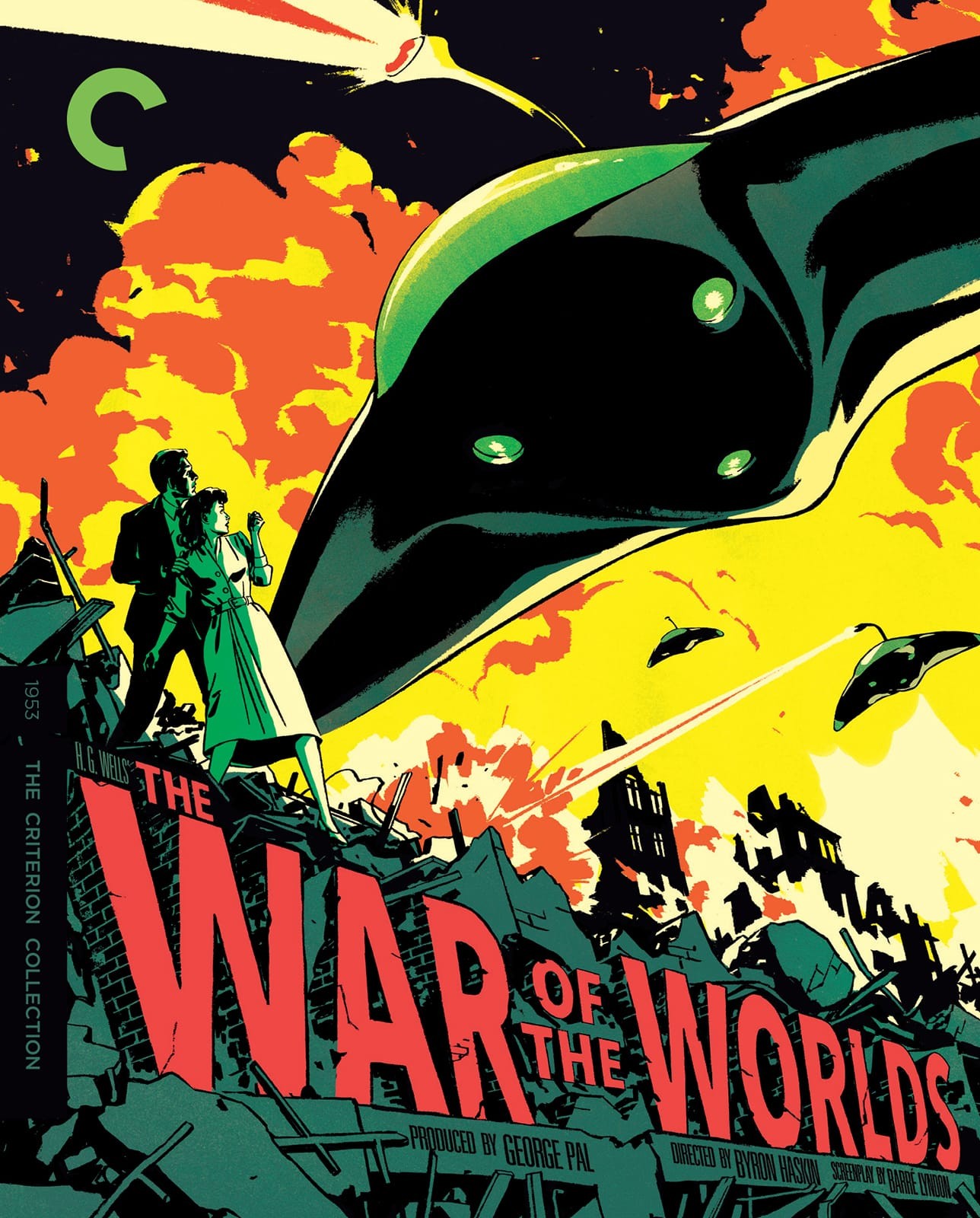
Movie Review: HG WELLS 'WAR OF THE WORLDS'


‘THE ORIGINAL INVASION:
A MIGHTY PANORAMA
OF EARTH-SHAKING FURY…!’


DVD review of:- 
  ‘WAR OF THE WORLDS’

Starring Gene Barry (as Dr Clayton Forrester), Ann Robinson
(as Sylvia Van Buren), Lewis Martin (as Pastor Matthew Collins),
Les Tremayne, Robert Cornthwaite, Vittorio Cramer (the narrator).
Produced by George Pal, Directed by Bryon Haskin,
Music by Leith Stephens, Special effects by Gordon Jennings,
Screenplay by Barre Lyndon, based on the novel by HG Wells
(1952 – 85 minutes – DVD 4 July 2005
Paramount PHE 8028 + Theatrical Trailer)


“…and now, fought with the terrible weapons of super-science,
menacing all mankind and every creature on the Earth,
comes the War Of The Worlds…”
(opening voice-over by Paul Frees)


There’s an interesting exchange in the letter column of ‘Book & Magazine Collector no.258’ (August 2005). John Clute, well-respected authority on all matters science fictional has ‘a few problems’ with equally prestigious Chris Griffiths’ description of HG Wells as a writer of Sci-Fi. He points out that when Wells was writing the genre was actually known as ‘Scientific Romance’. The term Science Fiction did not come into general usage until much later, ‘from around 1931’. While Sci-Fi is generally accepted as a term for SF spin-offery, TV, movies, comic-strips and beyond, what Clute dismissively junks as ‘SF as product’. Of course he’s entirely correct in just about every detail. And yet, and yet. Think about it. Wells was writing way before Sci-Fi even existed. But he’s sure as hell made up lost ground since. In fact, in strictly Sci-Fi terms, he’s got to be one of the most prolific product originators of all time. Gene Roddenberry eat your heart out! 

When Steven Spielberg remade George Pal’s 1952 version of ‘War Of The Worlds’ with Tom Cruise as the dishevelled action hero, he was also drawing on Orson Welles’ October 1938 radio-play version of the same text. While, apart from the ‘Classics Illustrated’ comic-book adaptations of the novel, hard-core viewers will no doubt hold an affection for the 43 episodes of the ‘War Of The Worlds’ TV series based on the premise that the 1952 invasion had actually happened, but had been hushed up (US TV premiere October 1988). There are also two movie versions of ‘The Time Machine’ (the first, and hugely superior one also directed by George Pal, in 1960), complicated by any number of variations on the time-travel conundrum all the way to the ‘Back To The Future’ trilogy. There are at least three filmic takes on ‘The Island Of Doctor Moreau’ (from the 1932 ‘The Island Of Lost Souls’, through a 1996 Marlon Brando, and on), and ‘The First Men In The Moon’ (from Nigel Kneale’s weakly amusing romp in 1964). And that’s before we even start on movies and TV series based on ‘The Invisible Man’ (from James Whale’s Universal film of 1933, and its many sequels). See what I mean? 


In Clute’s words, ‘the question of what term it is best to use can lead one into a fractal swamp.’ Before we move on, there’s also a media sub-genre in which HG Wells actually appears as an on-screen character, from a Michael Moorcock novel walk-on part, to amiably guesting in ‘The New Adventures Of Superman’, to even taking the star role of hunting Jack The Ripper through the engaging ‘Time After Time’ movie (in 1979, by Nicholas Meyer from Karl Alexander’s highly readable novel). And lest we forget, HG himself actively collaborated with the great pioneer Alexander Korda on one of the very first SF-based movies, the wonderful ‘Things To Come’ (1936), with its stunning vision of eternal world war resulting in regression to a new feudalism, and the aerial fleets of giant propeller-driven aircraft flying over the devastation of 1960’s England. 

I first saw this original big-screen ‘War Of The Worlds’ at the after-school film club, and yes, it was a revelation, so gripping I got a bollocking for arriving late for my paper-round afterwards. It was well-worth it. Of course I’d read the novel, I knew they’d taken outrageous liberties with the plot. But the opening sequence alone, voiced-over (like Jeff Wayne’s horrendous musical) by Wells’ own words about ‘intellects vast and cool and unsympathetic’ regarding our Earth with envious eyes, and ‘slowly and surely drawing their plans against us’, recited over artfully replicated Martian landscapes drawn directly from the fantastically beautiful imaginings of Chesley Bonestell, justified the price of admission alone. But absolute veracity to the book has seldom been an issue. Spielberg merely shifted the action from America’s west coast to east, while Hungarian-born director George Pal took it all the way across the Atlantic from Wells’ late-Victorian London to California. Spielberg reverted to something almost like Wells’ original towering tripod war-machines, while here they are sinister swan-necked manta-rays levitating on magnetic-flux, with pulsing lights, thrumming electronic drones, and projecting lethal heat-rays that crisp you to a pile of glowing ash. HG would have his work cut out even recognising them. 


But the movie build-up is very effectively handled, with escalating menace as the meteoric projectiles impact, gradually cooling as cornball locals enjoy a square-dance hoedown, with just three hicks there to observe the hatch unscrewing slowly – ‘wait a minute, bombs don’t unscrew!’, and they watch… whatever is to emerge. Then, despite their mocked-up flag of truce - ‘everbody understands when you wave the white flag you want to be friends’, they’re atomised. These relentlessly predatory invaders come from Mars too, not just vaguely out there ‘someplace else’ as Tom Cruise’s Ray Farrier eloquently phrases it - and his slacker son Robbie (Justin Chatwin) adds ‘what, you mean… Europe?’ While – unlike Spielberg’s relentless zap-bang-pow cataclysm and exploding hazards, there’s a broader scope, a variety of sub-themes and tone here to expand the scope. Hero Clayton Forrester (Gene Barry) is unfeasibly strong-jawed and clean-cut, and he has the ever-smiling red-sweatered red-headed Sylvia Van Buren (Ann Robinson) as a suitably terrified scream-queen there to make the coffee and be rescued. Which is what women mainly did in fifties action-movies. While, because this is the Cold War 1950’s the USAF use nuclear weapons in a last desperate attempt to halt the mechanised invaders, with bunkered troops watching the results – just like at the White Sands trials, only to see the dread machines emerge intact from the swirling nuclear holocaust. Global devastation follows, spliced in with World War 2 stock-footage, riots and end-of-the-world looting. Six days to extinction. 

As some kind of reference trade-off Tom Cruise’s encounter with the snakey triple-lensed probe in the derelict farmhouse building is lifted directly from a sequence in this 1952 movie. The creepiest part of either, or both films, in which you get your only tantalising glimpse of the Martians themselves. Until that red prehensile three-suckered foot becomes visible through the opening hatch of the expiring war-machine in the film’s end-phase. Certainly the atheistic Wells would have cringed at the final reverently pious voice-over, and the war-machine symbolically zapping through stained glass into the Los Angeles church where the worshippers hymn for salvation. His viral defeat of the invasion is purely down to separate evolutionary chance not divine intervention, but we can discretely pass over that. Billed as ‘The Original Invasion’ you can snigger at its now-dated SFX, its stilted seriousness, its caricatured acting, but – SF, Sci-Fi, or ‘Scientific Romance’, you can’t deny its relentless power. And you wonder, how HG Wells would react if he could have foreseen that one day his extravagant fictions would shimmer into life from shiny laser-ignited discs…?

“…it was the beginning of the rout of civilisation,
the massacre of humanity…”
(voice-over by Sir Cedric Hardwicke)


If you’re interested, further films derived from HG Wells’ non-SF work include...

The Invisible Thief’ (1909) a silent version of ‘The Invisible Man’ by French Pathé

The First Men In The Moon’ (1919) a silent Gaumont Film Company production by JVL Leigh

The Island Of Lost Souls’ (1932) Paramount, featuring Charles Laughton & Bela Lugosi based in ‘The Island Of Dr Moreau’

The Invible Man’ (1932) Universal, directed by James Whale

The Man Who Could Work Miracles’ (1935) a Korda production , Wells’ script was published in the UK the same year

Things To Come’ (1936) Alexander Korda production, directed by William Cameron Menzies, with Raymond Massey & Ralph Richardson

Kipps’ (1941), Carol Reed’s production with Michael Redgrave, the HG Wells novel was adapted into a theatrical music comedy as ‘Half A Sixpence’ in 1963, then 1965, which was filmed in 1967 starring Tommy Steele from the stage presentation. More recently it was staged in 2008

The History Of Mr Polly’ (1949) directed by Anthony Pelissier. An engaging social comedy based on the Wells’ novel, with John Mills as Mr Polly, the shop assistant who breaks free from his humdrum existence to go on a series of romantic adventures. This is charming stuff, about a dreamer who dares to make his dreams reality, although it can’t match the book’s naughtiness and slapstick spirit. A good cast includes Sally ann Howes, Megs Jenkins and Finlay Currie.

The Passionate Friends’ (1949) HG Wells’ 1913 novel adapted by Eric Ambler into David Lean’s film with Claude Rains, Trevor Howard and Lean’s then-wife Ann Todd

The War Of The Worlds’ (1952) a Paramount updating of the novel set in California

The Door In The Wall’ (1953) an experimental Associated British and Pathé production

Rear Window’ (1954) Alfred Hitchcock’s film starring James Stewart & Grace Kelly is – according to Philip French, ‘clearly derived from HG Wells’ tale “Through A Window”.

The Time Machine’ (1960) an MGM production directed by George Pal

The First Men In The Moon’ (1964) Nigel Kneale introduces ‘Katherine Callender’ (actress Martha Hyer) as love-interest, and genius stop-motion effects-animator Ray Harryhausen to visualise Moon Cows and Prime Lunar, with actor Lionel Jeffries as ‘Professor Joseph Cavor’. Remade by Mark Gatiss as a TV-movie (2010) with Professor Cavor (Mark Gatiss) and excitable businessman Mr Bedford (played by Rory Kinnear)

The Island Of Doctor Moreau’ (1977) Burt Lancaster became Moreau for this version under Wells’ title, with Richard Basehart. Remade in 1996 with Marlon Brando as Moreau, and Val Kilmer, with airplane crash upgrades and DNA injections replacing crude vivisection. 


  Published in: 
‘THIS WAY UP no.16’ (UK – February 2006)
‘THE SUPPLEMENT issue 39’ (UK – March 2008) 
on website: 
‘THE ZONE / SCREEN SCENE’ (UK – June 2006)
ROBERT PLANT: 
HEAVY PLANT CROSSING

by

ANDREW DARLINGTON


Now he's done the LED ZEPPELIN re-union one-off at the O2 arena,
and he's getting all the critical kudos for his Alison Krauss collaboration
album 'RAISING SAND' - but when I did this interview with ROBERT PLANT
he was on a promotion schedule for a solo album called 'MANIC NIRVANA'... and I still have the promo vinyl copy...!


“Hey there Mama, said the way you move
gonna make you sweat, gonna make you groove ...”
(from “Black Dog” on ‘LED ZEPPELIN 4’, and
“Your Ma Said You Cried In Your Sleep Last Night” on ‘MANIC NIRVANA’)

In through the out door. It has to be...
London splurged with the blizzard-white light of early spring greenhoused into heatwave. And from its slow dazzle I go into the huge silent gloom of a Hotel silted with dignified ritual and polite establishment observances as calm and grandiloquent as psalms. But I go in through the out door, in ritual observance of some other cultural tradition.
Then a sound, distant at first, but growing startlingly fast. Like the planet Saturn coughing out moons of phlegm, until it roars and resonates and shakes the foundations atremble like an amplified Krakatoa at maximum throttle. And K-E-R-R-A-N-G, splattering ferns and exploding potted plants into shrapnel the jet black ‘n’ chrome-gleaming machine comes hurtling, jouncing and growling through the plush-piled corridors, down the richly carpeted stairs, and banshee-screeching into the foyer. Juddering and throbbing to a halt that rips Axminster fibre, revving down, comes the huge 10,000cc Harley Davison with quad exhausts. A Romano-Celtic Warlord sits astride its power-glide metallic sheen. He wears a python around his throat and a naked woman draped across the pillion. Her long dark hair is threaded with chrysanthemums, and there’s a daisy woven into her pubic bush. Strutted up against the shocked Reception Desk, unleaded gas-fumes dancing in contrails of dry-ice, he dismounts shaking sweat-matted ringlets of golden hair from his piercing blue eyes, brocade jacket open over glistening bare chest.
He grins, bounds up to me and pumps my hand. “Hi Andy, I’m Robert Plant…”
Except it doesn’t happen quite like that.
“Hi, Robert Plant here” says the voice flooding through the ‘phone. “I’m speaking from a little office by the side of the rehearsal place that we’re working in right now. Yeah, Devon, that’s correct.” Interviews courtesy of British Telecom are NOT ideal. “No, they’re not. Where are you? Where are ya. You’re in Wakefield…!”
Led Zeppelin - still over the hills and far away.

‘MANIC NIRVANA...’

But this is March 1990. And Robert Plant has no time for 1970’s Heavy Metal Dinosaurs any more, he has no musical corpses or Rock Behemoths to drag around either. Heavy Plant is crossing over into the new decade, and that’s his main preoccupation now. The current band. The current album ‘MANIC NIRVANA’ (- “fast bliss”). “WE’VE GOT A BAND. A BIG POSITIVE WORKFORCE. And people have got the ticket now. The reviews have been very positive, very up. They’ve really kinda given great credence to the job we’re trying to do. They understand what’s going on. FINALLY, now, I’m allowed to get on with my own career. AND THIS MUSIC IS THAT STRONG. It’s undeniably another phase of my life. Which means I don’t have to keep on dipping back into the past all the time. And REFERENCES to the past are becoming less and less necessary…” Despite the quote from “Black Dog” on side two track two? “Yes, this band is a very positive work environment. We’d just come back from an American tour after playing to slightly under a million people, and we came back wanting to make our next statement together. It was a case of ‘let’s make this record’, and my young chums were pushing and encouraging me and saying ‘YEAH, LET’S GO, LET’S GO, C’MON’. I would have it no other way than that.”
Fact is ‘MANIC NIRVANA’ IS an album worth gloating about. It’s ten years since Plant sloughed off the stale Zep skin. And it’s been a decade of false starts and half-realised projects. His retro revivalist Honeydrippers group, a belated Top Twenty single with “Big Log” (Plant’s first ever UK chart hit - no.11 in July 1983), and a series of flawed and only occasionally impressive LP’s - ‘PICTURES AT ELEVEN’ (July 1982), ‘THE PRINCIPLE OF MOMENTS’ (July 1983) which features “Big Log” and “Messin’ With The Mekon”, ‘SHAKEN ‘N’ STIRRED’ (May 1985) featuring guest harmonies from Kirsty MacColl, and ‘NOW AND ZEN’ (February 1988). ‘MANIC NIRVANA’ easily bests them all, fusing the finest aspects of his heritage with what the ‘New Musical Express’ calls “an eagle eye fixed on the nineties”. “Yes” he concedes, “and it’s a lot of fun as well!”
Here and now, in this rehearsal suite, he introduces me around the band. Doug Boyle is his best, flashiest and most incendiary guitarist since - it has to be said, since Jimmy Page. Chris Blackwell his best, solidest, and most inventive drummer since, yeah, John Bonham. “Chris also plays guitar on the “Tie-Dye On The Highway” track. He plays drums, and he plays keyboards, he thinks he writes songs, he smiles, he plays straight. He’s a musician. An all-round musician. He’s not just a drummer, and yet he’s a great drummer. But that’s only one string to his bow.” He neglects to add that this is a band that also works together as smoothly as a finely-tuned 10,000cc Harley at maximum throttle - Plant, Boyle, Blackwell, Phil Johnstone (keyboards) and Charlie Jones (bass). A solid unit formed for ‘NOW AND ZEN’, honed in by touring, and now kicked well into its stride, making their ‘MANIC NIRVANA’ an oddly disconcerting mix of the expected and the destabilising. Like rambling through a strange, unfamiliar and fantastically haunted forest, but glancing up through the tree-tops to glimpse the same reassuringly familiar old constellations in the same starry firmament.
“Doug Boyle? How did I meet Doug Boyle? Through Chris Blackwell. Track record? He hasn’t got one really, yet. He’s played in pubs, playing jazz basically. In fact that’s what he’s doing over there now, the bastard - while I’m over here doing this. You can hear him warbling on like... I dunno, like Steve Reich’s Dad. And yes - if I sound a bit dopey at this time it’s because somebody else is here trying to recreate the Sixties about ten feet away from me...” He delivers this line to general laughter.
But the album doesn’t try to recreate the Sixties - it samples it direct from the ‘WOODSTOCK’ soundtrack (on “Tie-Dye On The Highway”, a track ‘that’s just saluting the glorious days of my adolescence’). For continuity and innovation don’t necessarily conflict. Here they co-exist. The song might remain the same, but at least this is very much today’s remix. He quotes “Black Dog”, samples from ‘WOODSTOCK’, and goes even further back - on the set’s only non-band composition. ‘The surface noise is unavoidable’ says the sleeve-notes. “Oh yeah, you mean the drum-track on “Your Ma Said You Cried”? The rhythm track is a bass-drum sampled from the original record. It was a great song done first by Kenny Dino. Doug Sheldon had the English version, on Decca (F 11416 - fact fans!). But the one we sampled from was the American version. I read in one review that it got to no.34. I thought it did a little better than that.” (He’s right - of course. Kenny Dino charted 12 April 1961 and reached no.24 on US ‘Billboard’. Doug Sheldon entered 4 January 1961 and hit no.29 in the UK ‘Record Retailer’ chart - trivia buffs!)
Are there other antique Rock ‘n’ Roll / R&B tracks you intend covering in the future? “No. Not really. I tend to write ‘em. I mean - that’s what I was saying about ‘MANIC NIRVANA’, it’s panoramic Rockabilly. That’s what IT IS. It’s just contemporised a little bit. It doesn’t pretend to be anything other than that. It’s basically extended Rockabilly. It is - yeah.” There’s an obvious continuity with the Honeydrippers project. “Well, I think that with things like the tracks “Nirvana” and “Hurting Kind” you’ve got a continuation of the Honeydrippers there. I see “Nirvana” having little smacks of things I was trying to do on the ‘SHAKEN ‘N’ STIRRED’ album, where you try to make a piece of music into almost a Detective theme from the Sixties. You know? A kind of ‘The Unwritten Detective Movie’. And you start getting that kind of wacky sinister edge to things. So yeah - I think “Nirvana” and “Hurting Kind” are really where the Honeydrippers should have gone...”
Conversation rambles on in this disjointed manner, until “OK Andy, I’m getting the nod. I’ve got about another two minutes, ‘cos the whole rehearsal has ground to a halt.” So - let’s dip back into the past just a little. How about some quick ‘Hammer Of The Gods’ salacious tour stories before I have to go, Robert? “I’ve got no ‘Hammer Of The Gods’ salacious tour stories.” Curt, sharp, and with obvious irritation. “And I can’t BELIEVE that anybody wants that shit. TELL THEM TO FUCK OFF...!!! ”

“Carry me back, carry me back, carry me back
Baby, to where I came from ...” 
(from “Rock ‘n’ Roll” on ‘LED ZEPPELIN 4’)

Even in an industry based on hyperbole the Led Zeppelin statistics are stunning. Between 1969 and 1982 they shift enough vinyl product to plug the hole in the ozone layer. Make enough money to bail out the Russian economy. Travel more tour-miles than the Voyager-2 space probe. And play to more people in a month than the Pope (even with U2 in the support slot) could manage in a year. They played at punishing volume, and with as much adrenaline as a riot.
In one of his final interviews John Lennon said ‘I am still a Beatles fan’. So is Robert Plant still a Led Zeppelin fan? Is he happy with his legacy? “Yes. I am. I’m very much a Led Zeppelin fan. I wouldn’t be a fan of Led Zeppelin now. But I’m a fan of what they did - ‘what they did’? ...” he corrects himself, “what we did then. It was reasonably honest. And it was certainly very inspired at times.”
Robert Anthony Plant was born 20th August 1948 in West Bromwich, Staffordshire. Is Kenny Dino the kind of music the pubescent ‘Percy’ used to listen to? “...when I was a kid? Yes, in a sense. But my taste was a bit, I don’t know... left of centre I guess. I used to listen to anything that was enticing, alluring. I liked material that made me shudder, and that kind of Wild American Pop used to really seduce me. I’ve always tried to put some of that sound into what I do. To make my music seductive, without being stupid, you know? I really used to enjoy Gene Vincent. Yeah - his early stuff. In fact I’ve always enjoyed his voice. Even up until his death he was singing beautifully, even if the material was sometimes a bit questionable. And at the moment I’m trying to collect Joe Meek stuff if I can. And er... yes, there’s other stuff, like rare Ral Donner’s material...” Perhaps Donner’s Presley sound-alike ‘You Don’t Know What You’ve Got (Until You Lose It)’ I suggest. “Well, that was his big hit. But I had to wait three years to get an even rarer Ral Donner track on the Red Bird label!”
The early ‘60’s saw Plant sucked into the burgeoning Birmingham Blues Scene, “…er, it was the Black Country, actually. Not just Birmingham.” As later, Zeppelin would draw exhaustively on roots music too, most obviously the Blues. It is the Blues that validates and gives organic inputs to what they created together. The Blues roots that make Zep more REAL. They double-headed a bill with John Lee Hooker at the ‘Roundhouse’ in 1969. And perhaps sometimes they were even too Blues rooted! After all, didn’t Willie Dixon have grounds for serving writs over his “You Need Love” (written for Muddy Waters), which forms the basis for “Whole Lotta Love”? (a situation rectified by the CD reissue of ‘LED ZEPPELIN 2’ which adds Dixon’s name to the composer-credits). But nevertheless, Blues gave Zep music some kind of solid foundation. Whereas subsequent more contemporary bands - like Guns ‘n’ Roses, Bush or Therapy, draw only on secondary sources. On sources like Led Zeppelin themselves. “Exactly. It’s lost its plop really. It’s a little neutered. It’s just a bit of a drag.”
Yet Robert Plant’s own first 45rpm single was recorded with a band called Listen. “Oh yeah... ‘You Better Run’.” His vinyl debut coming in the form of a 1966 cover of an American Young Rascals hit. “That’s right. I put it out the same week as a version by a band called the Inbetweens. And of course, later those same Inbetweens turned into Slade. We were all from the same part of the Black Country, so it was quite funny really. We probably only sold about 800 copies each.” Two solo singles followed - “Our Song” c/w “Laughing, Crying, Laughing” and “Long Time Coming” c/w “I’ve Got A Secret”, both for CBS. Both now extremely rare and collectible, people are prepared to pay incredible amounts for such obscure early sides. Are you aware of the collector’s value of your first single? “About £80 in’it? Yeah, well - I pay money for records if I really want to get something, y’know? So I can understand that.”
He left the Midlands with just his rail fare in his jeans, following up an invitation to join ‘The New Yardbirds’ for a Scandinavian tour... the band’s contractual final tour before its name-switch to Led Zeppelin. Then Zeppelin vamped the media on a learning curve. It was already a band made up of entire fanzines full of muso trivia, a 21st Century Bible of ‘60’s vinyl even before they’d played their first collective gig at Surrey University, 15th October 1968. Jimmy Page’s session pedigree is breathtaking. It’s his note-bending guitar you hear on Dave Berry’s “The Crying Game”. He plays on the Rolling Stones’ ‘THEIR SATANIC MAJESTIES REQUEST’. He plays on the Jet Harris & Tony Meehan no.1 “Diamonds”, the Who’s ‘MY GENERATION’ album, Kinks, Pretty Things, Them, Paul Anka, and Cliff Richard records. He first evolved his notorious violin-bowing guitar technique (used to such devastating effect in the Madison Square Gardens film during Zep’s “Dazed And Confused” sequence) while helping out on the ‘PAINTER MAN’ LP recorded by flamboyant Pop-Art band Creation. Then, as a Yardbird, he appears alongside Jeff Beck’s petulant amp-trashing sequence in Antonioni’s quintessential ‘BLOW UP’ movie. And on and on.
As more-or-less simultaneously the young John Paul Jones was acting as a Mickie Most staff producer, and sessioneer for the likes of Herman’s Hermits, Lulu, Cat Stevens, Donovan’s ‘SUNSHINE SUPERMAN’ album, the controversial Downliner Sect, and on and on...
And - coming full circle, ‘MANIC NIRVANA’ was recorded at Olympia studios, where ‘LED ZEPPELIN 1’ was cut, in thirty-six hours. “Yes, that’s true. Was the ghost still there? Yeah, the ghost was still there. The ghost was there alive and well - and laughing at me. I managed to get my best vocal performance for such a long time. I think that was partly to do with the ghost of all that wildness.”
From the start Led Zeppelin cultivated class via mystique. A ruthlessly protected exclusivity. Peter Grant, their carnivorous manager, determined their policy of no British singles and no TV shots, ensuring their status as cult gods. There were no sugar-coated bullets of radio-friendly noise from the Zeps, only rhythms broad-brushed with an awesome power, guitar-breaks machined to within one-thousandth of an inch, and there - beneath the sonic machinery, the wet velvet rub of soft human sex. But image is more than just logo, and Zeppelin had the power to flesh out the myth. Album by album their music edged forward along the rim of a precipice. Their sound developing like a shiny spring uncoiling in gut-tightening curves, flashing shoot-to-kill riffs at audio health-hazard volume.
On a day-trip to Calais I once smuggled home a secret stash of a French single coupling “Communication Breakdown” c/w “Good Times, Bad Times” for massively marked-up resale to other fourth-formers, and impeccably cool personal credibility (in fact I wound up keeping it, and still have it). More recently I lurched in (through the out door) of a local HMV shop where they were playing “Good Times, Bad Times” cranked up really loud. For a millisecond it doesn’t really connect who it is, the synapses don’t close, registering only the hard sharp fast guitar grenade-fragmentation. It sounds remarkable contemporary. Until it clicked that I was listening to a record made over twenty years earlier! Plant laughs as I retell the anecdote, “I know. Makes you think dun’it? What next?”

‘LED ZEPPELIN: AN UNNATURAL HISTORY -THE SEVENTIES’
 
The Beatles in pieces. The Rolling Stones quality-control plummeting. Led Zeppelin the world’s uncontested no.1 band. Metal at its densest, its heaviest, its most speed-crazed and inventive. But never just metal. The electronic techno is always there too - from the swirling theramin vortex running (vinyl) rings around the chaos in the mid-section of “Whole Lotta Love”, to “In The Light” which fades in with an insect’s hollow drone, shifts into a vivid crimson whooosh, leads into an arc of purple curves through red surrounds going scarlet with animation. Slash its veins - it bleeds ice and lava. Just as their range is wide enough to encompass traditional songs, from as early as “Babe I’m Gonna Leave You” on ‘LED ZEPPELIN 1’, through “Gallows Pole” and on to the 11:08 minute “In My Time Of Dying” on ‘PHYSICAL GRAFFITI’, as well as absorbing Folk elements from the likes of Sandy Denny and Roy Harper.
Is it fair to assume that the electronic side of Zeppelin was down to Jimmy Page - coming on like a sound-sculpting audio developer from Sirius. While the acoustic whimsy is due to Plant’s influence? “No. The electronic side would be from whatever was going on at the time. And whoever you could see at the time who would encourage you into doing things in certain directions. But the acoustic side, no, I think that was everybody too. Y’know? - I mean, the more extreme of the extremes came from Pagey - sonically. Then John Paul was also there with his early use of synthesisers on things like “Celebration”. He was always one step ahead of everyone else. He had the first Yamaha G1 - even before Stevie Wonder got his ! Which Bonzo just lifted off the ground once when he was a bit drunk, it was so heavy he dropped it about three inches - and totally wrecked the thing.” Plant dissolves into tides of laughter, before resuming, “of course, he was only doing it for a bit of a joke...”
Ten albums, plus batches of after-the-event digitally remastered compilations. ‘LED ZEPPELIN’ and ‘LED ZEPPELIN 2’ (both in 1969, March and October), ‘LED ZEPPELIN 3’ (in October 1970), ‘FOUR SYMBOLS’ (November 1971) featuring “Stairway To Heaven” and guest Folkie Sandy Denny, ‘HOUSES OF THE HOLY’ (April 1973), the ‘PHYSICAL GRAFFITI’ double set (March 1975) featuring “Kashmir”, ‘PRESENCE’ (April 1976) and the ‘THE SONG REMAINS THE SAME’ soundtrack double-set (October 1976), ‘IN THROUGH THE OUT DOOR’ (August 1979) - and the posthumous ‘CODA’ (November 1982). Plus six American Top 40 singles, from “Whole Lotta Love” (no.4 in 1969) to “Fool In The Rain” (no.8 in 1980). Yet unlike the evolution of comparable-status bands like the Rolling Stones or Queen, which are almost excessively documented by film-clips and promo video compilations, pretty much the only visual legacy left by Led Zeppelin is their 127-minute self-indulgent performance + fantasy sequence movie ‘THE SONG REMAINS THE SAME’ (Warner Video).
Does Robert regret the decision not to do TV or to make singles for the British market? “Naw. Not at all. I think, in a way, it’s better that the records speak for themselves. You haven’t got to see the sort of aping and glamour too much. It’s just fine the way it is. Any more of it and it would have become an industry.” In the movie there’s Peter Grant doing his Gangster chic, John Bonham drag-racing, Jimmy Page on a mystic quest to self-realisation - and Robert Plant doing the otherworldly rural Hippie idyll, riding horseback, children frisking in the stream, the full Pre-Raphaelite deal. Is that really the way the members of the band saw themselves at that point in their lives? “Well, I don’t think I saw myself as a Romano-Celtic Warlord, not really! But I do still see that the countryside was beautiful. And I did like the evocative imagery of the place in which I was living. I was there on the Welsh border surrounded by all that incredible past, all the history of conflict between the Saxons and Celts. That sort of thing. And sure, it was wishy-washy. A bit sloppy. Romantic. A pre-Mary Whitehouse ramble. But yeah, I’d do it again.”
Filmed live from a camera positioned in the second row of Madison Square Gardens the movie captures “Black Dog”, “Stairway To Heaven”, and a manic “Dazed And Confused” - with Plant roaring in his full sex-god persona, projecting the erotic stage and lyrical satyr doppleganger that’s continually attracted attacks for sexist offensiveness and shallow phallocentric posturing. Yet Feminist par excellence Germaine Greer provides as escape clause by describing him as ‘the sexiest man in the world’ (in her notorious ‘Playboy’ interview). “Good Lord...”, he’s momentarily thrown off balance. “Yes, but if I’m being levelled as sexist because of the lyrics on these records then, the thing is, none of it is developed around male dominance, or around the use of the female as being some kind of subservient being. Occasionally it can actually be fun to have people who are attractive to one’s desires. Rock ‘n’ Roll and Rockabilly was built on that. I’m no ‘Brain of Britain’ but I like to think that I’m aware of different aspects of what I like. And these things are particularly funny.”
Do you get pissed off with people making these accusations? “No. I don’t care. It doesn’t matter. It is what it is. Ultimately all the waffling in the world doesn’t make it any different. I like it. And it sounds good. It makes sense. It’s non-offensive. It’s only offensive to people who are looking for things to be offended by.”
The Led Zeppelin entry in the Phil Hardy / Dave Laing ‘Encyclopaedia of Rock’ (Panther) identifies the humour and spoof elements of Plant’s performance. They find him ‘a golden ringleted Adonis marvellously parodying the sexual superstar while singing in a voice of limitless power’. “Exactly” he concurs. “How serious can you be? The songs are OK. The records are made of steel, you know? And they’re made by men who are, if you like, craftsmen. And anything else that goes off is just downright repetition. To play a role every night is a bit of a joke - however, it’s much better that watching television. And I really like to do it. I like to sing. So yes, parody does come into it. And when it comes down to basics, ask anyone about anything - it’s all repetition. There’s not many times in your life when you can go ‘GOD, THIS IS ABSOLUTELY NEW, THIS NEW GESTURE OF MINE...’”.
Led Zeppelin made perhaps more original gestures than most. Their tour performances repeating those moments more often, and to more people than most. Their tours remain legendary in their scale, their cash-generating potential, their excess... but first, I’ve got to ask this...
“Why have you GOT to ask?”
Because I’m interested. He laughs indulgently. “So ask.” Plant’s long-time infatuation with Elvis Presley is evidenced by Zeppelin soundchecks and encores of “A Mess Of Blues” or “Don’t Be Cruel”. The Honeydrippers continue the obsession by revamping Presley’s retread of Ray Charles’ “I Gotta Woman”. While even now he’s contributing to the charity compilation ‘THE LAST TEMPTATION OF ELVIS’.
So is it true you met and played for Elvis at the Los Angeles ‘Forum’? “We didn’t exactly play for him. But we met him, yes” he concedes. “The circumstances were that we were both represented by the same agent. He wanted to meet us, and we met him. We were all in a circle in the middle of the room, which was full of people who’d come to fawn over him. And yes, it was a very nice experience. We talked for about an hour and a half about... EVERY SINGLE THING you could imagine. It was remarkable. He was definitely loose, and he was very lucid as well. It was great fun. We were inseparable, the five of us. He wasn’t particularly aware of whatever was that contemporary at the time, unless he was exposed to it by accident. He didn’t even know who Elton John was, which was quite funny - ‘cos neither do we ! Jimmy told Elvis that all I ever did was sing his songs at soundchecks. So that later, on the way out of the room he asked me which was my favourite song, and I said “Anyway You Want Me”, - oh no, it was “Love Me”, which is a big ballad that goes ‘te-reat me like a fool / treat me mean and cruel, / but lu-u-ove me...’. And as I left and we were walking down the corridor going ‘WHAT A NICE GUY’, he stuck his head round the door and said ‘Robert’, and he started going ‘te-reat me like a fooool’ - and so I sang back to him ‘treat me mean and cru-u-ole’. And we became the buddies that we always were. Two rampant sexists!”
Yet when Presley met the Beatles a few years previous it seems to have been a tensely formal and awkward situation. “Yeah,” dismissively. “I guess you’ve just gotta catch people right, y’know.”
So what about some more SALACIOUS tour stories now Robert? The sex ‘n’ sleaze stuff served up by Stephen Davis in his fuck ‘n’ tell book ‘HAMMER OF THE GODS’? “I’ve got no salacious tour stories. The salacious stories of the past are not what I deal in right now. Tell them to read the book if they REALLY want to!”
Then just tell me about one incident. Tell me about the 1973 John Bonham Birthday Party where you drove motorcycles down the corridors of the ‘Sunset Strip’ Hotel, and threw George Harrison into the Swimming Pool. “Well... yeah... but that’s, that wasn’t Bonzo’s Birthday Party. That was another OUTRAGEOUS time! But yes, we used to rent small motorbikes, but they were only circus bikes. And I couldn’t ride mine very well anyway because I had a python round my neck, and a naked woman on my face, and so on... and so on...”
In a decade when the critical rotweilers snarled but seldom savaged, when most bands could be bought (and judging by their subsequent product can’t have come too expensive), Led Zeppelin stood aside in their own immaculate game. No full metal jack-offs they...
But we are not here to praise the myth. We are here to build new ones...

“It’s a New World rising,
from the ashes of the old,
if we can just join hands
... that’s all it takes”
(“The Rover” on ‘PHYSICAL GRAFFITI’)

Despite all this alleged excess and posturing, Robert Plant’s demeanour in this rehearsal studio webbed with cables and instrument leads, is remarkable unaffected. He comes across relaxed, totally without pretensions, no artistic affectations, hang-ups or side. He’s matey. He’s ‘I’d love to spend more time with you because I can tell that you’re quite a historian’. He’s ‘oh, well, have a good life’. Perhaps part of that is due to the uninhibitting effects of the ‘somebody trying to recreate the Sixties about ten feet away’ from us. I can smell the sweet heady aroma from here, where I’m sat. But no, it’s there in the grooves too. His music says ‘stop patronising the public’. It says ‘no wonder rock is sinking into apathy’. It says ‘let the heads, the good times and the cameras roll’. Apathy is still a crime. Can anyone seriously justify anything other than full-on attack in 1990?
Listen to “Watching You”. Classic spiky Rock spraying World Music across the mix. It samples the Arabic chant of Siddi Makain Mushkin in much the same way that the Rolling Stones “Continental Drift” (on their ‘STEEL WHEELS’ album) incorporates the Moroccan Master Musicians of Jajouka. “I suppose the whole writing of that track took about eight minutes. Until recently I was living near Monmouth, and I had a house with a room where we had a little mixing desk, and we could set everything up and play around the desk. And it happened like that. It was Chris (Blackwell) and Phil (Johnstone) together. It was just a case of guitar, keyboards, and a drum-loop that Chris had already developed. So, I just wanted to get some kind of vocalising that swirled right across the top of everything, rather than keeping with the strict metre of the track. And - um, it’s a bit pompous you know. It’s a bit overly grand. But I was listening to the Mission for about half-an-hour that morning. Giggling at “Tower Of Strength” (their attempt at replicating Led Zep’s “Kashmir”) and hearing that sort of mock-grandeur. So the melodic input began from that angle. And then became more focused later on. “Watching you” - yeah, it’s great, because it’s like there’s a lot of torment in the song. And I’m not a stranger to that.”
Torment. Yes. It’s not always been so UP. It must have been difficult following the demise of Led Zeppelin. The sudden crash from whizz-kids to was-kids. The going back to square one and reconstructing a career from the ground up. “Yeah, well. Basically I hate careers. I hate the idea of it being a career. I just wanna SING. It’s what goes with it to be able to do that reasonably successfully that makes it problematical. But it’s been an ‘interesting’ struggle. I’ve learned how short-tempered I am. And how impatient.”
Following the final implosion made irrevocable by John Bonham’s death (on 25th September 1980), Zeppelin fragments spun off into sometimes improbable orbits. Perhaps most bizarre of all being John Paul Jones exploits in production knob-twiddling for metal upstarts the Mission. And in particular their afore-mentioned “Tower Of Strength” - which, as already observed, blatantly reconstructs and rewrites “Kashmir” (long before Puff Daddy would sample Zep’s sublime epic original for his inclusion on the ‘GODZILLA’ movie soundtrack). “Yes. I know. Crazy in’it? I’ve said a coupla daft things when people have asked me about it. Somebody in an interview said ‘what about John Paul Jones?’. And I said ‘I think he’s a double-glazing salesman now’. Because basically YOU CAN SEE RIGHT THE WAY THROUGH THAT PIECE OF MUSIC. You have to be really a fool to buy it. Or at least a fool to buy it EMOTIONALLY. It surprised me. It’s as if I were producing sessions for a band like... um, Kingdom Come. But for what it was it wasn’t bad. It’s just that it’s a bit negative to have to take that into account. When I see it I want to like it. I really want to embrace it. And I want it to be more than just a hollow gesture. Mission played with us for quite a while in America. They supported us on the Non-Stop-Go tour in 1988. And they were good. But I was waiting for the skies to open... and they didn’t...”
Following the final Zeppelin product - ‘CODA’, a compilation of previously unissued studio out-takes from earlier albums, Jimmy Page hooked up with Bad Company’s Paul Rodgers for dodgy supergroup The Firm. And found time to score the soundtrack album for Michael Winner’s ever dodgier ‘DEATHWISH TWO’ movie. But connections remain. Page, Plant, and Jones reformed (with Phil Collins on drums) for their forgettable Philadelphia ‘Live Aid’ slot. They re-reformed (with Jason Bonham drumming) for a one-off bash celebrating Atlantic Records Fortieth Anniversary. Then Plant guests on Jimmy Page’s surprisingly lacklustre ‘OUTRIDER’ solo LP, while Page contributes to Plant’s ‘NOW AND ZEN’.
So there’s a continuing Plant / Page association? “Well, it hasn’t continued now! I don’t know about later. Then it was just the right time to develop and keep the friendship going, y’know? But this time, for this album, I was concentrating so much on the music I was doing that it just seemed inappropriate to ring him up and say ‘hey, come on, come on over and have a play’. Jimmy’s presence on this album would have created a talking point. But it probably wouldn’t have been the best way of cementing the future of the band in people’s imagination...”
Whereas the remaining Led Zeppelin connection - the drum chair vacated by John Bonham, whose relationship with Plant extends clear back to their pre-Zep Birmingham group Band of Joy, was more difficult to fill. Plant’s first solo venture - ‘PICTURES AT ELEVEN’, ran through a battery of drummers, Phil Collins, Cozy Powell, and ex-Jethro Tull Barriemore Barlow. “Yeah, drummers are usually a cranky breed. Cozy didn’t really want to get involved too much with the technology of drumming, or the technology of creating rhythm tracks. It was more like ‘I’m the drummer, and I play drums’. When really, when you’re going out to try to create moods and textures, there’s a lot more to it than just that. Particularly now, when there’s so much technology there to expand on ideas. Tracks like “Watching You” could never have even come to life at all if that was the attitude of the crew on board ! Phil Collins was as busy as ever. He’s great fun and a hellishly eager guy. Very very positive, a great encourager. But obviously he has his own career, so there could be nothing full-time about that. Barriemore Barlow - his contribution was “Reckless Love” and “Stranger Here And Over There”, which are tremendous. I think they’re two of the best solo tracks I’ve ever done. Especially “Reckless Love”. Then I also worked with Ritchie Hayward of Little Feat, he was technically excellent, but at that time everything seemed to happen at once. So when Chris Blackwell came along...”
Led Zeppelin was a democracy. Now it’s Plant’s band. He’s the leader. “Yes. That’s true. But democracy is gaining. We now have free elections here. I’m not so much the leader, as just the petulant lunatic vocalist. And from time to time - like now, I have to sit over here in the corner while somebody else takes over. But that’s good. I would have it no other way.”
And the future? “There’s a track coming out on some CD thing, called “Oompah”-brackets-“Watery Bint”, which is about a relationship with a woman. A relationship which is always very questionable because her hands are so cold, and her skin’s always wet. And basically - what it is, the guy is trying to figure out what it’s all about. And why he’s so quizzical about it. Until he realises that she - in fact, lives underwater. That she might even be descended from ‘The Lady Of The Lake’. This ridiculous song burbles along, and then suddenly - at the end, it goes into something that sounds like a cross between Cozy Cole’s ‘Big Noise From Winnetkah’ meets... goodness knows what! And it’s that sort of wacky unwritten theme music again. It’s funny. It’s a funny track - ‘oh porous love, what can I do / but drift forever in a sea of you’. That’s how it goes...”
Then, “OK, I’m getting the nod. I gotta go.” An audible hesitation hangs in the air between us, and then “...tell them to forget about ‘HAMMER OF THE GODS’. The - erm, salacious stories of the past are not what I deal in right now. Or make it up. Just put anything you like. MAKE IT UP. That’s what usually happens anyway...!!!!”

‘PRESENCE...’

So, OK Robert.
In through the out door. It has to be...
London splurged with the blizzard-white light of early spring greenhoused into heatwave. And from its slow dazzle I go into the huge silent gloom of a Hotel silted with dignified ritual and polite establishment observances as calm and grandiloquent as psalms. But I go in through the out door, in ritual observance of some other cultural tradition.
Then a sound, distant at first...

INTERVIEW BY ANDREW DARLINGTON

Original version published in:-
‘HOT PRESS’
Published in a slightly revised form in:-
‘I WAS ELVIS PRESLEY’S BASTARD LOVE-CHILD’
(Headpress / Critical Vision - UK - December 2001)


EUROSHIMA MON AMOUR


“EUROSHIMΑ MON AMOUR”
by 
ANDREW DARLINGTON

‘POEMS FROM THE INNER MIND TO THE OUTER LIMITS’

“... poetry from a twisted mind ...” (‘NEW MUSICAL EXPRESS’)
“ ... an incisive direct style that owes more to a Stanley Knife than to a pen ...” (‘SEPIA’)
“... step inside and sample the delights of a new dimension in entertainment ...” (‘KNAVE’)
“... one of the brightest underground UK Bardic stars ...” (‘GLOBAL TAPESTRY’)

32 poems brought together for the first time - including “Beautiful Pagan”, “Beyond The Contraverse Intersection”, “Mars Is A District Of Sheffield”, “M. Charles Baudelaire’s Quantum Singularity”, “The Wave-Particle Paradox”, and “Hannibal Deathridge: His Journeys In Strange Subterranean Lands, To The Pendant World & Beyond”. ‘EUROSHIMA MON AMOUR’ is a truly extraordinary work by a visionary poet with the ability to see two worlds at once - today’s turbulent existence in the cities of his native Yorkshire, and worlds of soaring wonders beyond the future seen in dark explorations of jewelled catastrophes. Flavoured by a fascination for mix ‘n’ match culture, here is poetry that achieves (to quote K.V. Bailey’s foreword) ‘immaculate structuring ... accomplished musicality’ and above all, the energy and sense of wonder that brings back startling revelations from the intersection of two planes of outstanding vision (STEVE SNEYD)

Available NOW from HILLTOP PRESS 
4 Nowell Place, Almondbury, Huddersfield, W. Yorks HD5 8PB, ENGLAND
ISBN 0-905262-27-1 £3.99 / $8.00

Coming Shortly from the same author
‘BEAST OF THE COMING DARKNESS’ a dark Far-Future Science Fantasy novel of visionary scope, in the tradition of Jack Vance’s ‘DYING EARTH’, Leigh Brackett’s Martian fantasies, Robert Silverberg’s ‘MAJIPOOR CHRONICLES’, and Moorcock’s ELRIC sagas

Still Available from the same author
‘I WAS ELVIS PRESLEY’S BASTARD LOVE-CHILD’ anthology of 20 years of Music journalism, featuring interviews with The Kinks, The Byrds, Fleetwood Mac, Kraftwerk, Grace Slick, Stone Roses, Can, Cabaret Voltaire, Siouxsie, Led Zeppelin and many others