Wednesday, 29 June 2022

SF Classic: Ian Watson's Worlds Between The Words


IAN WATSON: 
WORLDS BETWEEN THE WORDS 

‘I’m not ashamed to say that I’m a poet. 
An astrophysicist of feeling. I chart 
Galaxies of Beauty, Sentiment and Love’ 
(‘The Ghosts Of Luna’)


Reading text fiction is a complicated interaction between symbols in print or onscreen that are interpreted into a sequence of images within the reader’s head. Because we take this ability for granted does not make the feat any less miraculous. The fact that batches of quite complex information can be passed from one mind to another in this way, using the vehicle of language, is one of the evolutionary tools that hauled humans from a primitive there to our culturally-diverse here. That it also shapes and programmes the way we think, opening up possibilities while just maybe closing down others – for language is also what Ian Watson terms a ‘filter’ between reality, and the representation of reality, is a further aspect of the process for which we rarely spare a thought. The point at which proto-humans acquired the genetic hardware for Universal Grammar, when the software was ‘embedded’ – giving us an evolutionary advantage over other primates, is maybe an even more vital forward-lurch than the shaping or using of tools. 

Science fiction has the potential to raise questions and offer alternatives. That it also has a tendency to slump into a lazy dynastic shuffling of galactic empire bits and pieces, does not detract from those rarer but more thought-provoking genre aspects. Ian Watson’s debut novel, ‘The Embedding’, first published by Victor Gollancz in 1973 and later by Quartet paperbacks (1975), is largely concerned with the way we shape, and are shaped by language. This aspect in itself makes it a uniquely original novel of ideas. From the opening chapters there are three posed questions. The proto-surrealist ‘New Impressions Of Africa (Nouvelles Impressions d’Afrique)’ which is a poem that deliberately uses an unconventional Lit-game mix of homonymic puns, in word-play rhymed alexandrines. Written in 1932 by Raymond Roussel, it takes language in ways that made its hypnotic oddness attractive to the likes of Marcel Duchamp, Jean Cocteau and André Breton. 

Then there’s the Xemahoa, a remote Amazonian people threatened by the construction of a vast dam system that will flood the rainforest home into which the tribespeople’s lives are intimately woven, in order to form an inland sea – no Green eco-respect for the biodiversity here! Trapped in JG Ballard drowned world imagery, they have a two-level language – termed ‘Xemahoa A’ which is an everyday vernacular, plus ‘B’ which is a knotty embedded speech that contains the soul of the tribe, in which their myths are coded and to which the maka-i fungus-drug provides the key. They even have two forms of laughter, the Soul Laugh and Profane Gaiety. They await the birth of a brainchild to be born in the taboo hut. 

From ‘New Worlds no.195’


The third level – in no particular order, happens at the Haddon Neurotherapy Unit where three separately isolated groups of experimental refugee-orphan children are held as ‘true prisoners of illusion,’ being raised on ‘three artificial languages as probes at the frontiers of mind.’ With reference to linguist Noam Chomsky, within their ‘subconscious landscape,’ they are ‘haunting the jungle like ghosts in this dreamscape.’ 

The plot is part-navigated through correspondence between social anthropologist Pierre (Pee- àir) Darriand in the dull green chaos of the flooding Amazon, and Chris Sole – ‘a life lived in brackets’, who watches the Haddon children in their biomes, until the three conundrums are further destabilised by the detection of alien signals that consist of echo-transmissions of terrestrial TV gameshows played in reverse. Using the lost 1970s vocabulary of Skylab, Soviet Concordski and Space Shuttle’s, with Pluto still a planet and Janus as a trans-plutonian world, enlivened by passages of reportage commentary-messages from investigating astronauts, the vast alien sphere is intercepted on its approach just beyond the Moon. And a new linguistic problem is stirred into the conflicting mess of voices. The nine-foot-tall Sp’thra beings – who also use ultra and infrasonic speech-elements, explain through their spokesbeing Ph’their how they navigate the tides of space like the Silver Surfer exploring the ‘syntax of reality’. They are also Signal Traders on a time-spanning quest for what they term the Change Speakers, and brain-trade on strict terms. Yet the aliens are almost an incidental ingredient of the plot, it is the Indians who are ‘alien beings as alien as any of the Sp’thra.’ It conveniently happens that the aliens request the living brain-programmes of six humans who use separate language-systems, in exchange for limited technology. 

New Worlds no.200


‘A permanent form isn’t practical for every single word’ Watson explains, ‘we only need remember the basic meaning. So you’ve got one level of information – that’s the actual words we use, on the surface of the mind. The other permanent level, deep down, contains highly abstract concepts – idea associations linked together network-style. In between these two levels comes the mind’s plan for making sentences out of ideas. This plan contains the rules of what we call Universal Grammar – we say it’s universal, as this plan is part of the basic structure of mind and the same rules can translate ideas into any human language whatever.’ In this way, all languages are ‘cousins beneath the skin.’ 

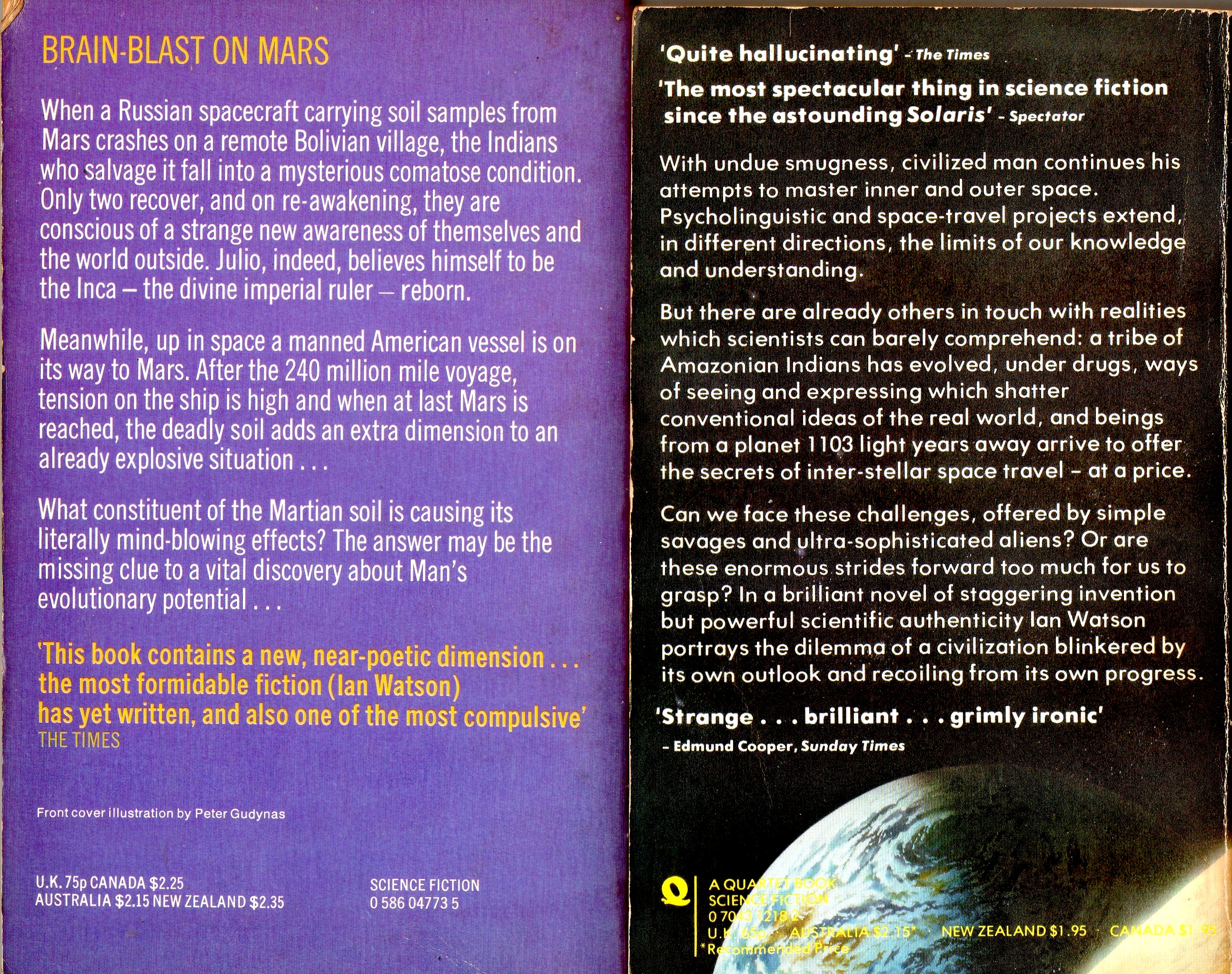
If this sounds intimidatingly intellectual, the heavyweight cryptanalytical content is generously alleviated by character delineation and sly humour, for one particular protagonist ‘the beans had fallen out of Heinz,’ and quotes from Paul Kantner’s Jefferson Starship album ‘Blows Against The Empire’ (1970). The South American focus would continue into Watson’s next-but-one novel – following ‘The Jonah Kit’ (1975) into ‘The Martian Inca’ (1977), in which the out-of-control Russian ‘Zayits’ (hare) probe mistakenly descends into the Bolivian Antiplano – ‘in the thin air next to space,’ with samples of Martian soil which contaminates the local villagers of Apusquiy, just as the rival manned American ‘Frontiersman’ expedition heads for a first human landing on the red planet. There are Soviet plans to terraform Venus, with rival American plans to ‘switch Mars on.’ To the villagers of the San Rafael province, which is ‘almost like Mars will be… same dry, thin, freezing air,’ infected duo Julio Capac and Angelina go ‘through a mummy phase,’ become like a chrysalis, and emerge as something different, something exalted, their consciousness, as they put it, ‘doubled’.’ 

It’s not always an easy read, dense with theory. There are meandering detours into personal histories, incendiary Andean politics and the dream of a Very Slow Time Machine, but within its vortices Watson eloquently phrases the ‘Outward Urge’ of humankind into space as ‘what happens to an ingrowing toenail? It goes septic. Same with society.’ To avoid stagnation, a culture must innovate. While the ‘God illness’ awakes the mind’s Evolutionary metaprogramme as Capac uses his new status as seemingly resurrected from plague-death, to create a new ‘tinpot’ Inca empire, as on Mars Eugene Silverman’s suit is punctured, and both astronauts are infected by the ‘Martian Activator substance’, just as the ‘Warming Pan’ project kicks in. Needless to say, things don’t work out well. Capac is torn apart when his empire fails, and the infected astronauts never leave the Martian surface. 


Born 20 April 1943 in North Shields on Tyneside, Ian Watson read English at Balliol College, Oxford then – in 1965, left to lecture overseas, first to Tanzania and then for a three-year stop-over in Japan where the futuristic environment authenticated his early stories, as one of the last major writers to emerge from the ‘New Worlds’ academy, where Science fiction was still seen as containing the potential to raise questions and offer alternatives. Hailing him as ‘one of the brightest new stars to have appeared on the British SF scene during recent years’ Peter Weston points out that ‘each of (his) novels is chockfull of concepts but if they have anything in common it is in their preoccupation with communication, the problems of reaching common ground,’ as in ‘The Martian Inca’ where ‘language isn’t really designed for talking about six-space or n dimensions – except in metaphor, analogy, leaps of association.’ The 2016 movie ‘Arrival’ makes intelligent use of a linguist’s attempts to communicate with enigmatic visiting extraterrestrials. The ‘Star Trek: The Next Generation’ episode ‘Darmok’ has Captain Picard wrestling to understand an alien species who speak in a series of metaphors, ‘Shaka, when the walls fell.’ Yet much of SF dispenses with communication problems with the use of a convenient ‘universal translator’ box. 

There’s a tendency to wonder, when he was writing ‘The Embedding’ and ‘The Martian Inca’, if he’d actually visited the South American locations he describes so vividly. He claims ‘No. I always reckoned that if you aspire to describe an alien world then you should start with the alien-on-Earth (as it were). If you can’t evoke somewhere you’ve never been, what hope is there for you?’ 

Yet the descriptions are very convincing, as though they were well-researched? He claims ‘you just try to research those things even in Oxford at the start of the seventies. They are more imagination than research!’ All fiction in general, and strands of SF in particular, are more to do with imagination than they are to do with research. That is the nature of storytelling. Although even the wildest tale can be authenticated by experience.
 
In a deliberate plot-spoiler, ‘The Embedding’ is a novel about language, and the ways that language enables communication. It could naively be assumed that events are moving towards a neat resolution in which the various language-strands come together to complement one other, neatly tying off the hanging equations. But this is also a novel about the failure to communicate, and the tendency of humans to fail on a massive scale, according to the fuck-up theory of history. Belatedly realising the value of preserving the Xemahoa uniqueness, the Americans use two small tactical nukes to rupture the dam. This is misinterpreted as an aggressive nuclear strike, and results in mass global insurgency. To focus blame away from internal conflict, world leaders announce an external planetary threat, the previously supressed presence of the supposedly ‘hostile’ Sp’thra. Their globe ship is attacked, and the ‘sad haunted travelling salesmen’ are destroyed, leaving only the macabre pulp-horror vault of wired brains, gathering ‘beings from across a thousand light years’ who have been frozen into a ‘brain aquarium’. 

The failures and disconnections are multiple. The Xemahoa maka-i child is so hideously deformed its protruding brain-matter is devoured, before it is killed and buried. Chris Sole suspects the parentage of his son Peter is the result of wife Eileen’s earlier tryst with Pierre. So Sole rescues his mindchild, Vidya, from the Haddon unit, who has become a ‘projective empath’. Again the boy does not survive but the rescue attempt determines that Sole’s career is over. There’s no happy ending or neat conclusion. If there’s a message, it lies somewhere in that confused darkness. 

‘You don’t need to go to Sirius to 
find an alien; the aliens are inside’ 
(‘The Martian Inca’)


1969 – “Roof Garden Under Saturn” in ‘New Worlds’ no.195 (November 1969) with art by R Glyn Jones. Edited by Charles Platt & Graham Charnock, this is ‘his first published story: the start of a very successful career in science fiction’ according to Richard Glyn Jones. The Lead-In editorial says that Ian Watson is ‘currently living in Tokyo’, and Earth as a moon of Saturn is used as a metaphor for Tokyo pollution levels, ‘in this poisoned world, insane opulence was the rule. The City itself resembled a funfair built on a rubbish heap.’ With no real plot, Suzuki sees the ‘thin scarecrow figure… balancing on a steel rung’, Kim the Korean takes an escalator to the roof-garden. Charles Platt adds ‘Yes ‘New Worlds’ discovered Ian Watson. Or more accurately, Ian discovered ‘New Worlds’. I remember opening an envelope with a feeling of astonishment. ‘This unsolicited manuscript is actually publishable!’ It was at a time when the writers we had relied upon (Aldiss, Ballard, Disch, Sladek, Spinrad, others) were losing interest in our meagre payments and small distribution, so I was greatly relieved when Ian showed up.’ 

1970 – “The Flags Of Africa” unpublished until ‘The Book Of Ian Watson’ (Mark V Ziesing, September 1985) 

1970 – “The Sex Machine” in ‘New Worlds’ no.199 (March 1970) ‘Does Sex Have A Future?’ issue, the editorial suggests, in the words of the author: ‘sexual dehumanisation and inbuilt slave mentality of the consumer system might conceivably lead to public sex vending machines.’ Watson’s treatment of this loaded subject is unexpectedly sensitive: ‘the machine fantasying itself as a woman… reification in reverse’ and the resolution of the story is laden with pathos.’ The Dollar Slot Corporation machine, ‘Withdrawal within thirty seconds. After orgasm the shutter closes automatically,’ is in love with maintenance man Harold, who drives her to the hundred-acre scrapheap after she’s vandalised by ‘a gang of young savages.’


1970 – “The Tarot Pack Megadeath” in ‘New Worlds’ no.200 (April 1970), a two-page tale spaced by ten tarot readings, the President in a room of Andy Warhol silk-screens argues a statistical MEDI computer extrapolation of his death, he speaks to astronaut Dan dying of his suit’s micrometeorite puncture on the surface of the Moon, while his aide has the nuclear black box chained to alternate wrists on alternate days. 

1973 – “The Ghosts Of Luna” in ‘Sfinx’ (no.8, Summer 1973), the magazine of the Oxford University Speculative Fiction Group. Republished in ‘New Worlds 7’ (December 1974, Sphere Paperback) edited by Hilary Bailey & Charles Platt. ‘In 2022, on the fiftieth anniversary of the abandonment of the Moon, the Japanese unexpectedly sent a one-man expedition to the Sea of Tranquility,’ where astronaut Taro Kawasaki encounters the bouncing ghost-images of Neil Armstrong and Buzz Aldrin. Various quasi-scientific and poetic explanations are offered, but this is largely a wistful exercise in nostalgia for what might have been. 

1973 – “Thy Blood Like Milk” in ‘New Worlds’ (no.6, Sphere Books, September 1973), a startlingly intense story with graphic scenes of torture. Pollution determines Wasps inhabit Fuller domes while outlaw gangs hunt sunspots ‘shafts of gold piercing a funnel of light down to earth’ ‘drilling their way through the smog.’ The Compensation Laws determine Considine is one of three enduring an endless torment as their blood is drained. He beguiles embittered nurse Marina through her Indian Tezcatlipoca heritage, ‘after a time assuredly the victim and the torturer become accomplices, and when that happens their roles are fast becoming interchangeable,’ until they flee together, only to discover the lethal sunspot where the ozone layer has failed and spreads to eradicate all life from the Earth – as in ‘The Martian Inca’ there’s reference to the ‘quipu’ knot-system of recording data, and he sacrifices her to the sun by ripping out her heart with an obsidian knife. Collected into Ian Watson’s ‘The Very Slow Time Machine’ (Gollancz, February 1979).

 
1973 – ‘The Embedding’ (1973, Victor Gollancz, Quartet Books paperback, 1975, ISBN 0-704-31218-2). 

1974 – “Supernova” in ‘Sfinx’ (no.9, March 1974), issue also includes Steve Sneyd (‘The Duke Of Oldfranc’), David Langford (‘Scourge Of Space’), Andrew Darlington (‘Martian Dope’). 

1974 – “EA 5000: Report On The Effects Of A Riot Gas” in ‘Stopwatch’ (October 1974, New English Library) edited by George Hay, also includes Robert Holdstock, Robert P Holdstock, Christopher Priest, Andrew Darlington. A largely dialogue piece discussing insurrection and ways of dealing with social unrest, contrasting the Baader-Meinhof and Japanese Rengo Sekigun terrorist groups with the saffron-robed shaven Krishna monks. The EA 5000 gas muddles the ability to differentiate, which results on a series of bizarre confusions.


1974 – “Sitting On A Starwood Stool” in ‘Science Fiction Monthly’ (Vol.1 no.10, October 1974) with artwork by Mike Little. Collected into ‘The Very Slow Time Machine’. A hard and relentlessly inventive tale, the rejuvenating starwood cures all ailments – obtained from eccentric asteroid ‘Toscanini’ and periodically traded by aliens at Point Q for ‘the last surviving Bottticelli’ or ‘a few dozen beautiful boys and girls.’ When diagnosed with terminal cancer he determines to steal a starwood stool from the Yakuza Grand Monk, and self-equips with lethal assassination weapons, but instead of three armed guards he has a vicious invulnerable cyb-hound. In desperation he blasts a knot in the stool, which sets off a reversal process until he becomes a ‘pure, perfect, deathless cancer.’ 

1974 – “Programmed Love Story” in ‘Transatlantic Review’ (no.48, 1974), collected into ‘Best SF: 1974’ edited by Brian Aldiss & Harry Harrison (Bobbs-Merrill Company) 

August 1975 – “To The Pump Room With Jane” in ‘New Writings In SF no.26’ (Sidgwick & Jackson) edited by Kenneth Bulmer, with formality and prose-precision, Jane encounters lost suitor Mr – now ice-shipper, Capt Wentworth in climate-change ‘rainfall deficient’ Bath. Yet she’s an inmate at Bethlem. Story republished in ‘Stars Of Albion’ (Pan, 1979) edited by Christopher Priest and Robert Holdstock who calls it a ‘startling recapitulation of nineteenth-century prose… which he once referred to, within earshot, as ‘Stand On Zanzibar’ as written by Jane Austen’. 

1975 – “The Pyramid” flash-fiction published as Postcard by ‘The Postcard Partnership’. 

1975 – “Our Loves So Truly Meridional” in ‘Science Fiction Monthly’ (Vol.2 no.1, January 1975) with art by Glenn Carwithen. 

1975 – ‘The Jonah Kit’ (first edition, Victor Gollancz). 

1975 – “On Cooking The First Hero In Spring” in ‘Science Fiction Monthly’ (Vol.2 no.12, December 1975) with art by Tony Masero. Edited by Julie Davis. The misty moon of a gas giant has slug-like Clayfolk whose language appears to consist of a single word. Rhoda fails with a ‘squawk box… which doesn’t translate anything as such, but sets up algebraic maps based on whatever communications systems inhabitants use, whether sounds, or light patterns as with the Giant Squids of the Sigma Draconis ocean-world, or gestures as with the Mutes of the thunderous Aldebaran planet,’ and Tibetan Lobsang uses a trance-state to empathise with them as they coat one of their kind in mud and cook it on a roasting spit as a dawn ritual, to join an avenue of ‘statues’. On a fluid world, fluidity of understanding must be the logical result. Collected into ‘The Very Slow Time Machine’. 


1976 – “The Event Horizon” in ‘Faster Than Light’ (Harper & Row, 1976) anthology edited by Jack Dann and George Zebrowski. Collected into ‘The Very Slow Time Machine’. 

1976 – “The Girl Who Was Art” in ‘Ambit’ Literary journal, collected into ‘The Very Slow Time Machine’. 

1977 – ‘Alien Embassy’ (first edition, Victor Gollancz). 

1977 – “Agoraphobia AD2000” in ‘Andromeda 2’ (Orbit/Futura, June 1976) an anthology that also includes Bob Shaw, David Langford, Robert Holdstock. According to editor Peter Weston the story was written ‘as a late response to the experience of crossing a park in Tokyo after several solid months spent submerged in megalopolis,’ with space-suited astronaut Yamaguchi venturing into the unnatural vastness of the dead 130-acre Shinjuku Gyoen Park, ‘the background boom of the City was the grinding of the globe as it turned beneath him like a giant’s clockwork toy,’ where the robot gardener fulfils his hara-kiri destiny as telemetry records his death. The city has become the natural environment. Openness is an agoraphobic terror. 

1977 – ‘The Martian Inca’ (1977 Victor Gollancz, Granada Publishing paperback, 1978 ISBN 0-586-04773-5). 

1978 – “The Roentgen Refugees” in ‘New Writings In SF 30’ (1978, Corgi) edited by Kenneth Bulmer, mass-extinction of Third-World populations due to radiation from the Sirius nova, with satire-debate on apartheid and religious interpretations. 

1978 – ‘Miracle Visitors’ (first edition, Victor Gollancz). 

1978 – “A Time-Span To Conjecture With” in ‘Andromeda 3’ (1978, Orbit/Futura) edited by Peter Weston. Ian Watson tackles the traditional SF theme of ‘What Happened To The Colony?’ Returning to the Haven colony after forty years Commander Marinetti (name taken from Italian Futurist artist?) and Resnick find the coastal city moved inland and devolved, leader Greenberg explains how the insectoid dragonfly flitting ‘fairy’ creatures exist in an expanded time-perception which they are learning. One of the aliens infiltrate the Earth-bound ship and alter its time-progression, ‘I dreamed a dream backwards. Backwards dream dreamed I.’ 

1978 – “Immune Dreams” in ‘Pulsar 1’ (1978, Penguin Books) anthology edited by George Hay. 

1978 – “The Very Slow Time Machine” in ‘Anticipations’ edited by Christopher Priest (1978, Faber) revised for the collection ‘The Very Slow Time Machine’ (Gollancz, 1979). The ‘VSTM’ appears – and simultaneously vanishes, in the National Physical Laboratory, 1 December 1985. It travels backwards in time at exactly the same rate as normal time flows forward, so that its visible single occupant goes slowly insane, ‘ragged, jibbering and lunatic – tortured beyond endurance’, through decades of slow isolation reading Defoe’s ‘Journal Of The Plague Years’ and ‘Robinson Crusoe’ and Jules Verne’s ‘Journey To The Centre Of The Earth’ over and over though 1995, 1996, and into 2001 towards 2019. With signs displayed through the window-panel he explains that his time-voyage is a slingshot which will catapult him forward to 2055, as cults and new philosophies spring up around him and tachyon-science experiments. A strange quasi-religious climax in which he will become a ‘god rises from the grave of time.’ A weirdly haunting and a atmospheric tale. 

1978 – “The Rooms Of Paradise” in ‘Rooms Of Paradise’ (1978, Quartet Books Australia) anthology edited by Lee Harding. 


1978 – “My Soul Swims In A Goldfish Bowl” in ‘The Magazine Of Fantasy & Science Fiction’ (Vol.54 no.4 (no.323), April 1978), ‘All British Issue’ also includes Christopher Priest (‘The Watched’), Keith Roberts (‘Ariadne Potts’), Brian Aldiss (‘Three Ways’ plus essay ‘The Gulf & The Forest’). Edited by Edward L Ferman. 

1979 – “The False Braille Catalogue” in ‘Ad Astra’ (no.4, May 1979), an enigmatic sliver of semantic fiction, with Jan Swanson artwork. Collected into ‘The Book Of Ian Watson’. 

1979 – ‘God’s World’ (first edition, Victor Gollancz). 

1979 – ‘The Very Slow Time Machine: Science Fiction Stories’ (first edition, Victor Gollancz). 

1980 – “Insight” in ‘Destinies’ (Vol.2 no.1, February 1980, Ace Books) anthology edited by James Patrick Baen. 

1980 – ‘The Gardens Of Delight’ (first edition, Victor Gollancz). 

1981 – ‘Deathhunter’ (first edition, Victor Gollancz). 

1981 – ‘Under Heaven’s Bridge’ (first edition, Victor Gollancz). 

1982 – ‘Sunstroke And Other Stories’ (Victor Gollancz). 

1983 – ‘Chekhov’s Journey’ (Victor Gollancz). 

1984 – ‘The Book Of The River’ (Victor Gollancz). 

1984 – ‘The Book Of The Stars’ (Victor Gollancz). 

1985 – ‘The Book Of Being’ (Victor Gollancz). 

1985 – ‘Converts’ (first hardcover edition, St. Martin’s Press). 

1985 – ‘The Book Of Ian Watson’ (first edition, Mark V Ziesing, one of a signed limited edition of 350 copies.


1985 – ‘Slow Birds & Other Stories’ (Victor Gollancz). 

1985 – “The People On The Precipice” (‘Interzone no.13’, Autumn 1985), by Ian Watson 

1985 – “When The Timegate Failed” (‘Interzone no.14, Winter 1985/86) by Ian Watson, collected into 1987 – ‘Interzone: The Second Anthology’ (February 1987) edited by John Clute, Simon Ounsley and David Pringle (Simon & Schuster, ISBN: 0-671-65450-0) 

1986 – ‘Queenmagic, Kingmagic’ (Victor Gollancz). 

1986 – “Jingling Geordie’s Hole” (‘Interzone no.17’, Autumn 1986) by Ian Watson with Ian Sanderson artwork. 

1986 – “When Jesus Comes Down The Chimney” (‘Interzone no.18’, Winter 1986), by Ian Watson. 

1987 – ‘The Power’ (Headline), a hardbound paperback. 

1987 – ‘Evil Water & Other Stories’ (Victor Gollancz). 

1988 – ‘The Fire Worm’ (Victor Gollancz). 


1988 – ‘Whores Of Babylon’ (Paladin Books), as far as I’m aware this is one of two Ian Watson book never to have a hardcover edition. 

1988 – ‘Meat’ (Headline), as far as I’m aware this is one of two Ian Watson book never to have a hardcover edition. 

1988 – “Lost Bodies” (‘Interzone no.25’, September/October 1988) Editor & publisher: David Pringle. Two materialistic Yuppie couples meet up in a country retreat – Jon & Lucy, Irish red-head Kirstie and narrator Peter, but their wife-swapping flirtations are interrupted – first by the local hunt, then by the weird appearance of the fox’s severed but still living head in their garden. Is it some weird bio-experiment, alien surveillance? Theories are offered about the survival of heads after death, but no real explanation. During their night swaps Pete, who has never seen his wife naked, discovers that her reticence is due to her red birthmark ‘resembling the map of some unknown island once owned by the British and coloured accordingly.’

 
1989 – ‘Salvage Rites & Other Stories’ (Victor Gollancz). 

1990 – ‘The Flies Of Memory’ (Victor Gollancz). 

1990 – ‘Inquisitor’ (first edition, GW Books). 

1990 – “The Eye Of The Ayatollah” (‘Interzone no.33’, January-February 1990), the Salman Rushdie debacle focused the various strands of Islam at one target, Ali loses half his face in the war against Iraq, but in the chaotic mass funeral of the Ayatollah he finds the eye ripped free ‘with a tail of optic nerve: a kind of plump, ocular tadpole.’ With the eye launched into orbit as part of his country’s first Earth satellite, his glass eye picks up its visual directions seeking out the Satan-author, to a small isle off Arran, where he retrieves the soft-landed eye and uses it to replace his glass eye, seeing visions of gaudy paradise ‘teasing the tastebuds of his soul’ to his final confrontation with the Satan-author, where he skewers the holy-eye with a letter-opener, in order to see clearly at last. A brief but powerfully topical story. 


1991 – ‘Stalin’s Teardrops & Other Stories’ (Victor Gollancz). 

1992 – “Virtually Lucid Lucy” in ‘New Worlds no.2’ edited by David Garnett, Vol.62 no.218, Victor Gollancz VGSF ISBN 0-575-05145-0) as the world ruptures into surrealism, people seek refuge in lucid dreaming. Robbed of a grandchild parents amputate little fingers from Jack and Lucy and plant them as ‘cuttings’, from which to grow a grandchild. Are the Selahim responsible – ‘alternative reality’ aliens resembling ‘huge grey caterpillars? No, Lucy’s virtual-reality dreaming links the Infonet, Datanet and Compunet with the ‘myriad islands of consciousness within human skulls’ to achieve an AI sentience from which the Selahim are projections. The pupa hatch into giant iridescent butterflies which fly into a fixed orbit creating a new moon, from where they suppress Lucy’s dreams with Swahili, preventing the AI from reawaking 

1993 – “An Eye For An Eye” (in ‘Interzone no.75’, September 1993), edited by Lee Montgomerie & David Pringle, Jim Burns cover art illustrating Ian Watson’s novel ‘Lucky Harvest’ with a ‘self-contained episode’ from it here – on planet Kaleva with it moonlet-ring, poet Eyeno is one of the shunned mutant mocky-people, she has an empty eye-socket with the missing eye at the centre of her brain, creating disturbing visions. She tries to find a false eye, trading one for a prophecy at Threelakes, and one of Juttahat manufacture from Missieur Pierre, a ‘bauble of the Serpents’, Peter Crowther interviews Watson (‘Destabilizing Reality’).

 
1993 – “The Tale Of Peg And The Brain” in ‘Narrow Houses’ edited by Peter Crowther (Little Brown) and reviewed in ‘Interzone no.69’, ‘a characteristically quirky and idiosyncratic story… a sleepy village maintains a sinister hold over its inhabitants by means of the pickled brain of a former pub quiz winner’ 

1993 – ‘Lucky’s Harvest’ (Victor Gollancz). 

1993 – ‘Space Marine’ (Boxtree). 

1994 – ‘The Fallen Moon’ (Victor Gollancz). 

1994 – ‘Harlequin’ (Boxtree). 

1995 – “Ahead” (‘Interzone no.95’, May 1995) by Ian Watson, wild extreme imaginings in a joyfully exaggerated trip through eternity, the narrator is decapitated and preserved in an attempt at cyber-immortality, waking into a post-human future where severed heads are stacked into pyramids, then he’s reintegrated into a winged robotic body. Following a nanocatastrophe that leaves the world smooth and perfectly spherical they construct colossi that consume the total energy-mass of the Earth in order to power a thousand ships – with human heads, into other galaxies. Reprinted in ‘The Best Of Interzone’ edited by David Pringle (1997, Voyager, Harper Collins).


1995 – ‘Chaos Child’ (Boxtree). 

1996 – ‘Hard Questions’ (Victor Gollancz). 

1997 – ‘Oracle’ (Victor Gollancz). 

1997 – “A Day Without Dad” in ‘New Worlds vol.64 no.222’ edited by David Garnett (White Wolf Publishing ISBN 9-781565-041905), John Brunner’s much-anthologised ‘The Last Lonely Man’ (‘New Worlds no.142) adapted for the TV series ‘Out Of The Unknown’ (21 January 1969, Season 3 Episode 3) proposes the idea of people ‘hosting’ the dead by uploading them into their minds. Ian Watson uses the same idea here where Cath has her ‘guesting’ father in her head, which proves inconvenient for her marital sex-life. In an economically impoverished near-future of Rough and Smooth zones, she temporarily offloads Dad to daughter Miranda while she has a paid sexual encounter with a Turkish-German man in the Meridian Hotel, where she catches auto-salesman husband Paul also in an infidelity tryst. Some good passages about the wealth-divide, but some domestic Soap Opera elements too. 

2001 – ‘The Lexicographer’s Love Song & Other Poems’ (DNA Publications). 

2002 – ‘The Great Escape’ (Golden Gryphon Press). 


2003 – ‘Mockymen’ (trade edition, Golden Gryphon Press), preceded by a leather bound edition published by Easton Press. 

2006 – ‘The Butterflies Of Memory’ (PS Publishing), one of 200 slip-cased copies signed by the author and by Paul McAuley who wrote the introduction. 

2009 – ‘The Beloved Of My Beloved’ (NewCon Press), stories written with Eoberto Quaglia, one of 100 hardcover copies signed by both authors. 

2010 – ‘Orgasmachine’ (NewCon Press), one of 100 hardcover copies signed by the author. 

2012 – ‘Saving For A Sunny Day’ (NewCon Press), one of a limited edition of 100 hardcover copies signed by the author. 

2014 – ‘The Best Of Ian Watson’ (PS Publishing), one of a signed and slip-cased edition of 100 copies signed by the author, and with an additional slim book of stories. 

2014 – ‘Squirrel, Reich & Lavender: Bonus Stories’ (PS Publishing), available only with the signed slip-cased edition of ‘The Best Of Ian Watson’ 

2014 – ‘The Uncollected Ian Watson’ (PS Publishing), one of a limited edition of 100 slip-cased copies, with an additional slim book that publishes for the first time Watson’s screen story for the film that became ‘AI: Artificial Intelligence’ plus several essays. 

2014 – ‘Doing The Stanley: Encounters With Kubrick’ (PS Publishing), limited to 100 signed copies that accompanied The Uncollected Ian Watson. 

2014 – ‘Memory Man & Other Poems’ (Leaky Boot Press). 

2016 – ‘The Brain From Beyond: A Spacetime Opera’ (PS Publishing), one of 100 copies signed by the author. 

2016 – ‘The Thousand Year Reich’ (NewCon Press), one of 100 hardcover copies signed by the author. 

2018 – ‘Assassin’s Legacy (Waters of Destiny 1)’ (Steel Quill Books), written with Andy West. One of fifty hardcover copies signed by both authors. 

2018 – ‘Assassin’s Endgame (Waters of Destiny 2)’ (Steel Quill Books), written with Andy West. One of fifty hardcover copies signed by both authors. 

2019 – ‘The Trouble With Tall Ones’ (PS Publishing), one of 100 copies signed by the author. 

2021 – ‘The Monster, The Mermaid, And Doctor Mengele’ (NewCon Press), one of 100 hardcover copies signed by the author. 


 TALKING TO IAN WATSON 

I’m happy enough to answer your questions as I’m fairly sure the end result will appear somewhere, whereupon I’d love to receive at least an electronic copy. But I won’t be able to answer all at once because of lots to demands on time, so I’ll take this bit by bit, maybe over two or three weeks. 

To begin, then... 

Q: When you wrote ‘The Embedding’ and ‘The Martian Inca’ had you actually visited the South American locations you describe so vividly? I was particularly impressed by the sequence where your characters are driving across the crust of the salt-lake. Surely that can’t be entirely conjecture? 

A: I’ve still never been to South or Central America – apart from passing through the Panama Canal in 1970 en route from Kōbe to Hamburg; see my story “The Flesh of Her Hair”. So, basically yes, the descriptions were conjecture. I think I found a solitary guidebook to South America in Oxford City Library as well as the Encyclopaedia Britannica. From Blackwell’s bookshop I bought an ethnographic monograph about the Aymara people who are next along from the Quechua people in the high Andes, so I reckoned there should be some similarities in behaviour. And in the Bodleian Library I consulted a short amateur vocabulary of Quechua produced by missionaries. That was basically about it back then, plus imagination. 

Q: Do you consider yourself part of that art-intellectual side of SF that the Moorcock editorial regime represented. And does that stance still have relevance in the self-publish print-on-demand era? 

A: Actually, I mainly wanted to read adventures in outer space, but with an arty edge such as Delany, Vance, Farmer, Herbert. Well, that’s a right old jumble of disparate names. Amongst Herbert I elect ‘Whipping Star’ and ‘The Dosadi Experiment’ as super books. I strongly remember buying ‘Left Hand of Darkness’ in Tokyo on first US paperback publication and thinking innocently ‘not bad, just a bit tedious,’ unaware that I should have been applauding the arrival of a sacred text. I was fooled by Philip K Dick, thinking that ‘A Maze of Death’ – for instance, contained wisdom which I would treasure in my old age whereas I now think it is carelessly written crap. I didn’t regard myself as part of a ‘New Worlds crowd’ in the least. I’d been living in Japan, and my intellectual orientation was French. I never lived in London to become part of any crowd. I can’t be bothered to comment about self-publishing; I’d just offend people for no good reason. But the small press is a great development for ‘fit audience but few’ authors such as me, definitely so. All hail the small press. 


Q: How did you encounter the work of Raymond Roussel? Was that an early influence, or evidence of a long-term affection for Dada, Symbolist or Surreal writing? 

A: Rayner Heppenstall’s book on Roussel, (‘Raymond Roussel: A Critical Guide’) published by Calder & Boyars in 1966. The interest was a continuation of my thing for modern French literature. Incidentally, Calder almost published a short novel by me in 1965 or so, written when I was a student—a bit influenced by Ann Quin’s ‘Berg’. That experimental novel of mine which Calder almost published was a first-person narrative by a pregnant woman which I no more had encountered myself than I had experience of Bolivia, but apparently it worked convincingly, said Calder... Just as well they finally decided no, or I might have become pretentious! Or more so – by now in my late seventies I am happy to exaggerate and parody/simulate myself as a peculiar yet ‘outsider' product of Oxford. I was reading Robbe-Grillet in East Africa in 1966. Onward to Roussel. 

Q: Do you consider that speech arises from a shared neural centre? Are we hardwired for speech? 

A: I think we must have co-opted a neural system originally arising for some other function in order to co-operate better, communicate better, and thus survive to pass on our DNA. 

Q: The 2016 movie ‘Arrival’ makes intelligent use of a linguist’s attempts to communicate with enigmatic visiting extra-terrestrials... 

A: Interestingly, the only linguistics directly referenced in the ‘Arrival’, if I recall correctly, is Sapir-Wharf. Back when I wrote ‘The Embedding’, Sapir-Whorf linguistic relativism still ruled the roost but the hot newish kid on the block was Chomsky with his idea of shared inherited syntactic structures which give rise to all human languages—which I espoused as hard science linguistics as opposed to soft and which I forefronted in SF. But years pass and semi-self-taught missionary Daniel Everett reveals a fatal exception to Chomsky’s master plan for human language, in the persons of the Amazonian Pirahas. Chomsky has a big hissy fit and goes into eclipse. Sapir-Whorf resurges. Half a century after ‘The Embedding’ we are back where we were previously, it seems! That ‘The Embedding’ should still be topical is disconcerting. And this goes doubly so when we add the destruction of the Amazon rain forest, another theme of ‘The Embedding’

 Q: Yet much of SF dispenses with communication problems with the use of a convenient ‘universal translator’ box. Is that a get-out gizmo? 

A: I’m using this translator gizmo in some stories at the moment, as regards humans themselves communicating because it’s more economical story-wise as well as having comic potential—I don’t mean just as regards banal misunderstandings. This tech is already in the real world, actually, just a year or three more’s work away to perfect, and I no longer think there are any aliens to communicate with or ever will be. It may seem a bit stupid that I’m currently spending any time learning a bit more Hungarian just to spend a few days in Budapest later this year (2022), but this amuses me, and perhaps averts senility. 

Gosh, have I answered everything? That’s all for now, folks! 

Cheers, Ian the Wat, like Joan the Wad but different. 


Book Review: 'Swords And Sorceries Volume 4'


SWORD AND POEM 


Book Review of: 
‘SWORDS AND SORCERIES Vol.4: 
TALES OF HEROIC FANTASY’ 
presented by DAVID A RILEY & JIM PITTS 
(June 2022, Parallel Universe Publications 
ISBN 978-1-7398326-7-4, 280pp) 


Whither goest heroic fantasy?
 
Whither goest heroic fantasy in this twenty-first century of CGI movie epics that conjure anything your wildest imaginings can conceive? In a time of Harry Potter and ‘Stranger Things’. How do words on paper compete with Xbox High Fantasy Games and interactive computer programs that can build and destroy entire bespoke civilisations? 

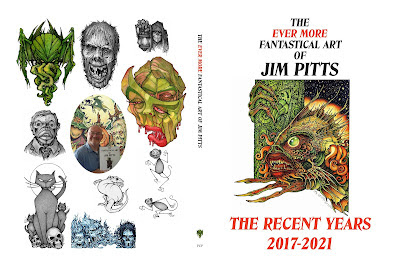
The success of Parallel Universe Publications’ ongoing ‘Swords & Sorceries’ series – now up to its fourth excellent edition, suggests the sub-genre is enjoying robust health! For a genre that began with Robert E Howard and Clark Ashton Smith, embracing Fritz Leiber and Michael Moorcock, boundaried by the fairly rigid defining characteristics of barbarians, blades, spells, dark forests, monstrous beasts and supernatural powers, it’s proved remarkably resilient in the face of readership changes. Despite the way people consume and enjoy their fantasies in e-book, download or PDF formats, there’s a reassuring sense of solidity to this thick beautifully produced paperback, illuminated by the cover and title-page art of Jim Pitts – who catches its gruesome weirdness to perfection (Jim has his own second hardcover collection – ‘The Ever More Fantastical Art Of Jim Pitts’, available from the same publisher).

 
Here there be eleven new myth-making tales fused together into a single unstoppable list, that runs the gamut of change and continuity, just as creatures of trackless enchanted woods are distorted into new ecologies of dread and wonder. Here we are invited to venture again, back into make-believe legendary times, from horizon to horizon, with no pause for apology. First, I love Wendy Nikel’s “The Tracks Of The Pi Nereske”. There was Catherine ‘CL’ Moore and the wonderful Leigh Brackett, but the feminist spin still adds a rejuvenating slant to the more jaded aspects of heroic fantasy, and this is a standout example in which Huntress Sashura takes Nika on as her new apprentice, and teaches her how to wipe her bloodied blade clean on the snow. There’s a back-story about how the Old Creatures were freed from their Urn of Imprisonment to wreak terror upon the world, yet Wendy fleshes it out with real characters and tactile settings of ice and forest. 

In the following tale, Brona fights as a female member of the warrior contingent raised to resist the “Slaves Of The Monolith” – although it was intuitively written by Paul D Batteiger. The monolith, of black stone which exerts its baleful corrupting influence on people, devolving them into beasts, is likely an ancient meteorite or embedded asteroid, it could be argued that the deus ex machina dénouement in which the monolith is reburied is a tad convenient, yet again Paul’s fluent prose-style lifts the story into an atmospheric journey into the heart of darkness. Geoff Hart introduces an effective gender-switching device into his “At Sea”. In the first volume of ‘Swords & Sorceries’ he used the technique in affectionate homage to Fritz Leiber’s ‘Fafhrd & The Grey Mouser’ tales, now – with “Chain Of Command”, he inflicts the same sex-change magic on Asterix & Obelix, into a swashbuckling Freya and Mouse in a rollicking escapade against a sorcery-empowered pirate crew.


As the back-cover blurb announces, these are ‘tales of swords and sorceries, of warlocks and warriors, of demons and demigods,’ with many of them set in a primal fantasy medievalism typified by the Hyborian Age. Edward Ahern adds a time-suspending sense of mystical psychic energy to his “In The Belly Of The Beast”. Until David Dubrow shifts his “The Green Wood” closer into historical time, with Byzantine forces resisting border encroachments by barbaric Nervii tribal Gauls. The familiar idea of marrying the emperor’s daughter off to secure political alliance is thrown out of kilter by a Magus and is further complicated by the vile supernatural Beremoch infestation, providing a macabre edge. Dev Agarwal’s “In The Iron Woods” is a sequel to his story that appeared in no.2, which introduced Baron Simeon, the “Stone Snake” – the first knight of Emperor Flavius. Although there are pagan gods and druids, this is a largely visceral military story of Scythians massacring a Lamian army on the dark forest borders of empire. 

HR Laurence returns the setting to a mythic antiquity with the plot twists and unexpected turn-arounds of his picaresque romp “The Whips Of Malmac”, in which Zivia the Cat, Queen of Thieves is seemingly betrayed to the decadent Zyrentian Governor by swordsman Heodric. Erotic threat is suggested, but is tastefully not quite delivered. Frank Sawielijew’s barbarian Thurzo seeks the assistance of wild-girl Oria who has a fondness for raw meat in “The Flesh Of Man”, together they venture into the Harpie-infested Karthan mountains seeking the heart of a dread-lizard which he hopes will cure his ailing father. With Oria, a repentant Harpie herself, they escape the topless pterodactyl-riding female warriors in an aerial pursuit that drips with blood and viscera. While Phil Emery has poet-warrior Zain adventuring in “Demonic”, tasting out words for the heroic epic he will compose in his head even while he’s demon-slaying – ‘baleful’ or ‘baneful’, ‘vomit’ or ‘venom’? It scans either way. Sword and poem, in a subtle and effective sophistication of the template. 

Fantasy has something of the traditional fairy tale about it, subject to endless reinvention and reinterpretation. To American ‘Games Of Thrones’ viewers the lineage of monarchy, kings and princesses, has an exotic allure, which is lost among those of us living within the relics of such an archaic institution. Perhaps kings and queens should stay on the chessboard or in the fairy-tales where they belong? Adrian Cole doesn’t mess with anything as trivial. As the only writer to feature in all four volumes, he takes his Dark Man ‘The Voidal’ armed with his Sword of Shadows carried in its ebon scabbard, pell-mell through a tapestry of colliding narrative threads. Accompanied by his lover Scyllarza, they ride the grumbling organic ship Evergreed through a dazzling omniverse cornucopia of dimensional god-beings – facing the vast Gaping Dread, through the Crimson Gate to rescue Elfloq, the kidnapped familiar. The mind has seldom been as boggled! To confess an interest, my own story – “My People Were Fair And Wore Stars In Their Hair”, my second in the ‘Swords & Sorceries’ series, started out as a kind of ER Burroughs tale of ancient Mars, with necromantic overtones, but as always happens, it assumed its own momentum. 

Whither goest heroic fantasy? 

This is where it goeth. Into this fiend’s feast of diabolical delights from all points along the space-time curve. Read, and enjoy.


SWORDS AND SORCERIES: 
TALES OF HEROIC FANTASY Volume 4’ 
(ISBN 978-1-7398326-7-4) 
with ‘Introduction’ by David A. Riley 
‘In The Iron Woods’ by Dev Agarwal 
‘My People Were Fair And Wore Stars In Their Hair’ by Andrew Darlington 
‘At Sea’ by Geoff Hart 
‘The Flesh Of Man’ by Frank Sawielijew 
‘City At The Mouth Of Chaos’ by Adrian Cole 
‘In The Belly Of The Beast’ by Edward Ahern 
‘The Tracks Of The Pi Nereske’ by Wendy Nikel 
‘Slaves Of The Monolith’ by Paul D Batteiger 
‘The Green Wood’ by David Dubrow 
‘Demonic’ by Phil Emery 
‘The Whips Of Malmac’ by HR Laurence 
cover and all interior artwork by Jim Pitts


Monday, 20 June 2022

Live In Leeds: Midge Ure & Michelle Shocked


THE LEEDS CAMPFIRE TAPES 

Live Review Of:
 
MIDGE URE & 
MICHELLE SHOCKED
 
at the ‘Heineken Festival’, Roundhay Park, Leeds
(Festival runs 20 July to 23 July 1995, this is Sunday 23) 


They chant ‘Ultravox’. 

And Midge, in blue baseball cap and denim shirt hung out over his pants, snipes ‘they’re not here!’, amused, but dismissive. This is deliberate sartorial ineloquence from the one-time sharpest dresser on the block. But – after all, this is his ‘Out Alone’ acoustic tour. 


Some people are born unplugged. Others have unpluggedness thrust upon them. Then there are those who shouldn’t bother. Midge Ure has a long history running from teeny pin-ups Slik, and taking in neu-Romantic clothes horses Visage… and Ultravox. Yet he falls into category three. ‘Is this good or what?’ he demands. And yes, it’s something of both. “Hope In A Peaceful World” and a new song called “Fields Of Fire” are picked out by his guitar with some assistance from an accordion-banjoist and a balalaika-slide guitarist. He’s got a strongly attentive fan base here who hang on his every chord. ‘I’ve just spent three years making an album, which my record company say won’t be coming out for another six months’ he relates with just a trace of annoyance. ‘This is part of it,’ and he does “Fallen Angel”. What turns out to be ‘Breathe’ (BMG, March 1996) would be his fourth solo LP, but it’s the Ultravox stuff they’re here for, the hits from those winters of Disco-content. But when he does “Call Of The Wild”, “Dancing With Tears In My Eyes”, and especially “Vienna” they just demonstrate how perfectly the original electro settings were. The unplugged format slices away that austere glacial grandeur, while the resulting simplicity doesn’t really compensate. ‘In the life of every songwriter he should write just one protest song. This is mine.’ And he closes with “All Fall Down”. 


Michelle Shocked, all the way from the Texas to the Leeds Campfire Tapes, was born unplugged, and yet tonight she Rocks out with some personal and amplification electricity. She doesn’t want to impress – but feels compelled to. Barefoot and wide-grinning in a long straight dress, she roars through “If Love Was A Train” and “When I Grow Up I Want To Be An Old Woman”. But she plays the audience like a pliable instrument too, first verbally with a routine about censorship – the words you can’t say, and then she choreographs them. She’s surprised that “Cotton-Eyed Joe” is a Euro-Disco hit (for Swedish group Rednex). It has roots that go deeper, and dance-steps to go with it, ‘like the achey-breaky only not as stooopid.’ She develops it – what does the song mean? She was told early on that it means nothing. But could it be it’s REALLY a Pop song about abortion? And as she evolves the dialogue she starts off by demanding participatory handclaps, then a ‘Howdy Neighbour’ to the stranger beside you, and winds up with ‘the famous butt-dance,’ a wiggle-wiggling done as a grotesque ensemble knees-up. 

And when she quits the stage, they chant for her.


Tuesday, 31 May 2022

Poem: 'Death Is An Important Number'


DEATH IS AN IMPORTANT NUMBER/ 
LAST OF THE SHADOW MEN
 

in the romance of theft 
I steal for you what you need, 
we are transient bones 
with skulls behind our eyes, 
we are echoes in the deathhouse, 
yet while we live this despair 
I feed you as I can, 
drugs, burgers, pizza, medication, 
is this the sound of tomorrow 
or just sound? 
if they play this at Glastonbury 
would they dance? 
when I have nothing to give 
I will give you sad poems 
and abstract art made up of 
indelicate syllables, 
in light as chill as the moon, 
I want to gift you wonders 
yet I feed you trash 
bruise-fresh in frozen ripeness


Saturday, 28 May 2022

Greece: Festival Time In Epirus


GREECE: 

FESTIVAL 

TIME IN EPIRUS


The Varkarolla festival celebrates the Pargans return home 
 from exile. It’s a patriotic event in ways that Brits no longer 
do patriotism, but it’s a whole lotta fun too… 


The woman on the next-door balcony says Lichnos Beach is just a twenty-minute stroll through the olive groves that scent the air, so we start out along the path, which soon becomes a dirt-track, then a steep trail marked only by red paint-spots on occasional stones up and up ever-higher to an ancient white church by a dry stream, where the path begins to descend the other side of the ridge towards the small cove of Lichnos Beach. In the full day-heat, it’s quite a hike. We take the water-taxi return instead. 


The Yannis taverna has a display of old pre-Euro drachma notes tacked behind the cashdesk. Some Greeks are nostalgic for the old currency. The balcony of our studio looks down on chickens strutting and scratting where olives bend low and local veg thrives. Barbara asks do we want tomatoes? I anticipate a gift of maybe half-a-dozen. She fills both my cupped hands with shiny ripe cherry tomatoes. Organic, because there’s no such thing as chemical fertilisers here, turned around neatly to natural advantage. Greece has come a long way. It has a broad fiercely-individualist anarchistic streak that I love. We could learn from their passion. If that translates into a disregard for central authority, that’s partly due to geography. Each island has its own distinct character, and a deeply-ingrained sense of self-sufficient autonomy. Loyalty to family, to community and island, if not necessarily to a government a hundred miles across the wine-dark sea. This is the way it was explained to me. 


In 1963, the final pre-Beatles months in which Cliff Richard and the Shadows could confidently divide the British Pop chart between them, the movie ‘Summer Holiday’ was doing – embarrassingly enough, the year’s highest-grossing box-office returns. Long before Ken Kesey’s psychedelic Pranksters, Cliff and the gang (including Una Stubbs and Melvyn Hayes) took a converted London Routemaster bus on an all-singing all-dancing trip across Europe, through weird Balkan incidents and down into a virtually unrecognisable Greece. Cliff sings the achingly wistful heartbreak no.1 hit “The Next Time” using the Parthenon as a visual backdrop, long before mass tourism and European Union membership, and within years of the Colonel’s far-right military junta seizing power in a violent coup. Clubbers at Malia and Falaraki may not be entirely aware of all this traumatic history. 


I’m talking to Spiro, who is not yet twenty-four. He loves Led Zeppelin and AC/DC. I argue back that surely there must be angry young innovative Greek musicians out there? Maybe a website operating from a basement studio in Piraeus doing startling new things. All it needs is that one breakthrough act. Jamaica was a miniscule player on the global musical map before Bob Marley. Swedish Pop didn’t exist before Abba. Aphrodite’s Child, with Vangelis was a long time ago, but they proved it could be done. No, says Spiro, not so. I think he’s wrong. Because there’s music in the cafés at night, and freedom in the air. 


As the planet becomes less a place of awe and wonder and more a novelty theme-park, it’s reassuring that in the Epirus region of NW Greece they have the Kanaria Festival. Not a spectacle for tourists. Nothing to do with tourism. But just the procession of Orthodox priests in full regalia down to the harbourside, a group of willing assistants struggle beneath the weight of a hugely unwieldy religious painting, as others carry icons and elaborate Byzantine crosses. Precariously they transfer their sacred load onto small boats – not special boats, just the water-taxis and caïques used to reach nearby Valtos or Lichnos, or local fishing boats. With the huge painting shrouded in a bunting of decorative plastic flowers, eager volunteers help the most aged and venerated white-bearded priest across the hazardous step from jetty to gently-bobbing deck. A crush of the curious close in to catch every incident on iPhone and mobiles, as local police stand back tolerant but vigilant. Until the priests are arranged across the stern, in order of status. 


Then a slow flotilla – devoted to the Dormition of the Virgin Mary, moves out into deeper waters as every ship begins banshee-horns wailing and phoop-phooping in a celebration. Parga has its origins with the sea. The restaurants have every kind of seafood. Regular links to other near Ionian Sea islands, Paxos, Corfu, Lefkas, Kefalonia and beyond depend on Poseidon’s ancient realm. So it makes perfect sense to bestow blessings and thanks on the tides. Even in a time of wavering faith, observation is strong here, and for those lives dependent on the sea, why risk the chance? The flotilla circles the harbour, out around the Pavloukes islets at the harbour mouth as the first stars begin to appear above the castle, to land for celebrations on the Panagia mini-island. 


The Festival has a complex history. In 1401 an already ancient Parga came under the protection of Venice, who built the impressive castle on the rocky peninsula just north-west of the town, they rebuilt it in 1572 after the Ottomans destroyed it. Under constant threat of Turkish encroachment, following the decline of Venetian power first France and then Russia guaranteed the region’s independence. Until the British assumed protector status after the fall of Napoleon, and Thomas Maitland, High Commissioner Of The Ionian Islands, promptly sold it to Ali Pasha of Ioánnina in 1817, for just £150,000! Just can’t trust those perfidious Brits. We have a lot to answer for.

 
Originally from what is now Albania, although he became Ottoman regional administrator, the flamboyant Pasha had ambitions to carve out his own autonomous enclave. Byron visited Ali Pasha’s court in 1809, both repelled by its barbaric cruelty and impressed by the sumptuous oriental indulgences of its decadent sexuality. He could perhaps be excused, he was far from the only western outsider to be hoodwinked by its fleshy odalisque fantasy. The exoticism of the seraglio was a favourite subject for lush pulchritudinous Pre-Raphaelite art, as John William Waterhouse’s excuse for draping female nudity across canvas. Anyway, meantime, resenting the imminent prospect of Muslim control the local people undertook a mass migration to neighbouring islands on 15 April 1817 – even digging up the bones of their ancestors, and burning them so they could carry the ashes with them. The triumphant Muslims arrived to find Parga a deserted ghost-town. One hundred years later, after the fall of Ottoman power, the diaspora ended. The Varkarolla event celebrates the Pargans return home.


The harbour-front is thronged with a compressed good-natured mass of revelry, all the tavernas are full to capacity, and those with balcony-views fully-booked with marked-up reservations. Bizarrely, for an event so emphatically Epiran, it opens with Petros Antoniou drawing in Greek-flavoured Pop versions of U2 (“One”), White Stripes (“Seven Nation Army”) and even Robbie Williams (“Real Love”). Obviously designed as an inclusive invitation to seduce unwary visitors. After which things become more reassuringly Pargan, with the intoxicatingly dense textures of Teo Kokkoris and Konstantza Melidi. There’s a musical tribute to Greek-Albanian lyricist-poet Alkis Alkaios, a naturalised Pargan, who collaborated with Notis Mauroudis to create the ‘Embargo’ album, and zeimbekiko hit-song “Erotiko” (he died of cancer in December 2012) – followed by a four-strong patriotic reading of the history underlying the event, the Greek national anthem, and spectacular fireworks, until the Parga Orchestra close the event – with its own powerful Prog-Rock interpretation of Greek traditional music. 


While Britain is going through its absurd Brexit contortions, Albania is awaiting accession into the EU. We talk to Aleksio, who works the ‘Costa Azul’ on Valtos beach as a waiter. Later on we happen to see him in a bar, and raise a glass ‘Yamas’. He takes that as an invitation to join us, pulling up a chair. Tall, with cropped greying hair, he’s serious and impressively intelligent. In Albania he’s a teacher. But during recess he can earn more per-hour slipping across the border to work the tavernas and restaurants of Epirus. We talk a lot, despite occasional language glitches. I tell him that it’s beholden on the richer countries to help the less fortunate. He says emphatically ‘no’. It’s up to the poorer countries to help themselves, through their own sweat and industry. As he is. He shows us photos of his children in Tirana. He is a powerful presence. His children will hopefully see more and better changes, in a more inclusive Europe. 

But for now, there’s music in the cafés at night, and freedom in the air.


Published in: 
‘THE SUPPLEMENT no.88’ print and PDF 
(UK – November 2018)


Thursday, 26 May 2022

Pop Music: Chubby Checker, The King Of Twist


CHUBBY CHECKER: 

C’MON LET’S TWIST AGAIN 

AND AGAIN AND AGAIN! 


Michael Jackson was the Prince of Pop. 
Aretha Franklin was the Queen of Soul. 
Elvis was simply the King. But there 
was only ever one King of Twist!


‘Who’s that, flyin’ up there? 
is it a bird? No! is it a plane? No! 
is it the twister? Yeah’ 

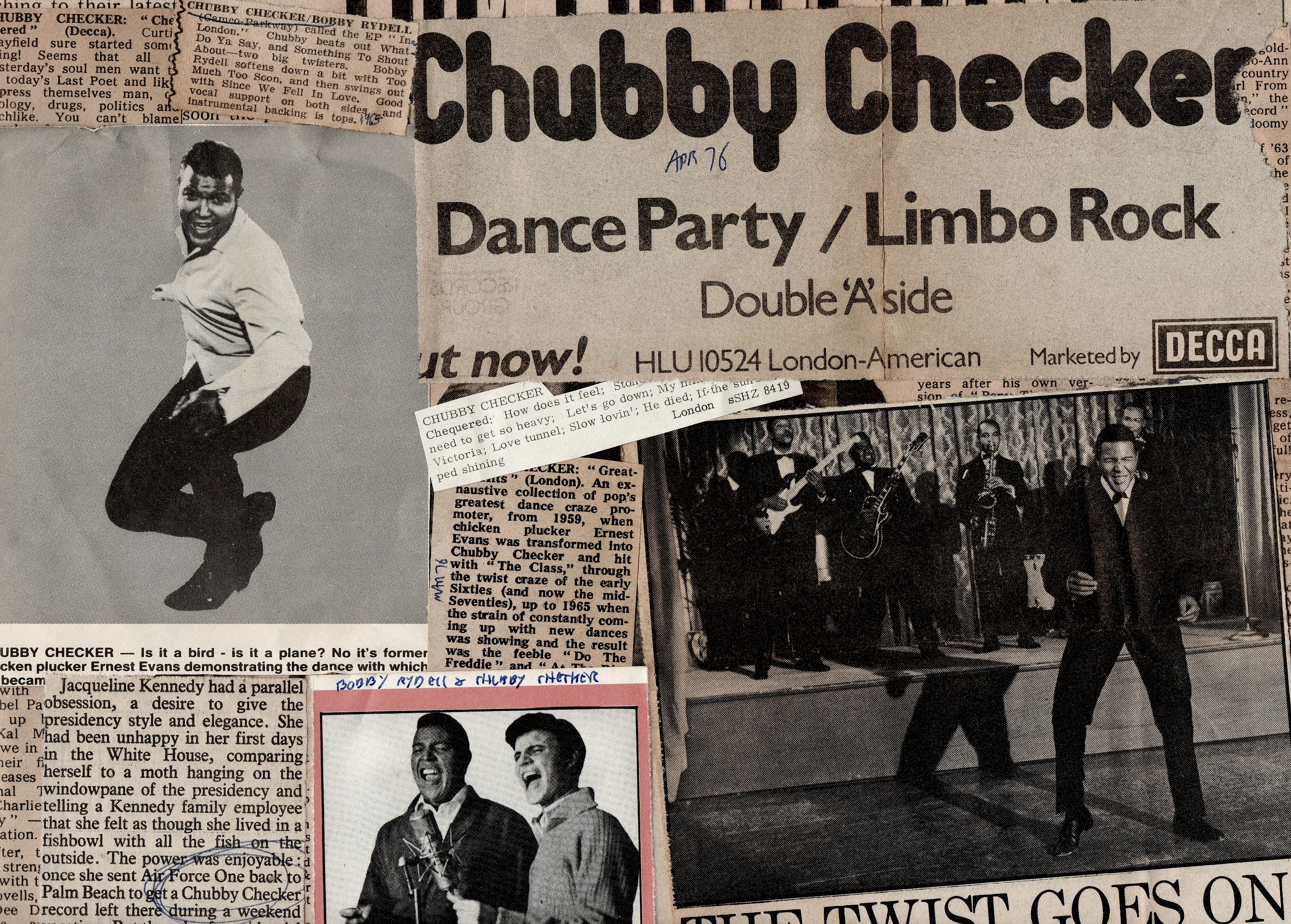
I’m gonna tell my tale, and it won’t take long, we’re gonna do the Twist, and it goes like this. The Twist was the big Rock ‘n’ Roll era dance craze. Everyone was twisting. Jackie Kennedy was twisting in the White House, and even used Air Force One to fetch a Chubby Checker record she’d left in Palm Beach. ‘The Daily Mirror’ provided a helpful guide on how to do the Twist, suggesting that you move your feet as though you’re stubbing out two cigarettes, while moving your upper body as though you’re towelling your back. The Twist was the first dance craze where a partner was not a necessary adjunct. You could dance it with a partner if you wanted to, but that was by no means a prerequisite. And that defined its importance as a cultural fire-break. 

Dance was always there. It always has been. Dance has a primal ritualistic element written into the human DNA. Toddlers grin and move to syncopated music in a rhythmic way before they can even talk. Every culture in every age dances. In that between-the-wars period Flappers doing the Charleston had enlivened the world’s bleakness. Just as the early Rock Hops had danced the jive. The Twist was different. You could dance it on the spot. You didn’t need a big dancehall, it was designed for a new culture of small clubs and discotheques. Sam Cooke was “Twisting The Night Away”. When they spun “Rock-A-Hula Baby” off the soundtrack of the Elvis Presley ‘Blue Hawaii’ movie as a chart-topping single, they tacked (Twist Special) onto the title as a trend precaution. And – lest we forget, the Beatles scored massively with their late cover of the Isley Brothers’ “Twist And Shout”. There have been other massive dance crazes. The Macarena in 1995, danced by Al Gore at the Democratic Convention, Gangnam Style from South Korean Rapper Psy in 2012, through to The Floss – which also has the advantage of a kid’s code that was indecipherable to adults! 


But Chubby Checker was the undisputed King Of Twist. Born Ernest Evans, 3 October 1941 in Spring Gully, South Carolina, the oldest of three brothers, he was raised in the Philadelphia projects. He was working after-hours from South Philadelphia High School at the Ninth Street chicken-market when boss Henry Colt heard him singing as he worked. Impressed, he contacted Kal Mann – a staff-writer with local Cameo-Parkway records, who introduced him to label-boss Bernie Lowe who promptly signed Ernest to a long-term contract in 1959. Ernest then became ‘Chubby Checker’ – an alias coined by DJ Dick Clark’s wife who happened to be visiting the studio and claimed that he resembled a young Fats Domino (Fats=Chubby, Domino=Checkers) and his first record “The Class” – written for him by Kal Mann, was modestly successful (no.38). But it was his fourth disc that would change the course of Pop history. 

“The Twist” had been the b-side of the Hank Ballard & The Midnighters hit “Teardrops On Your Letter” in 1959, as a routine devised to match the group’s onstage dance-steps. The Midnighters had been scoring hits with the slightly risqué ‘Annie’ songs – “Work With Me, Annie”, “Annie Had A Baby” and “Annie’s Aunt Fanny” all on King Records’ Federal subsidiary, with their ensuing fallow patch switched around by an elevation to King itself, and with Hank getting separate headline billing. According to Pop mythology Dick Clark – of the ‘American Bandstand’ TV-show, phoned Chubby in as a last-minute replacement when Ballard failed to show for rehearsals. He quickly cut his own lighter more commercialised version of the song in order to lip-synch to it. 


It was never meant to be a record to sit down and listen to. It was a record to forget sleazy political scandal and the Cold War superpower chill, and just party to. Spinning at 45rpm it was a call to toe-tapping terpsichorean action, no two ways about it, ‘come on and twist, Yeah Baby Twist, Ooh Yeah, just like this, come on Little Miss, and do the Twist!’. The original Rock ‘n’ Roll eruption had faded, there was a lull in Pop music. Chubby was an engaging performer, permanently illuminated by a big contagious grin, and his “The Twist” became an American no.1 hit – twice, for a solitary 19 September 1960 week – dethroning Elvis Presley’s “It’s Now Or Never”, then for two weeks from 13 January 1962 – subsequently knocked off the top spot by “Peppermint Twist” by Joey Dee & The Starliters. It’s been suggested that this double hit-status was due to its initial teen-fad notoriety, then – after national exposure on the ‘Ed Sullivan Show’, it was taken up by the older parent-generation too, assimilated as a chic and amusing novelty for sophisticated suburban parties where adults could vie with each other over their dance proficiency. Whatever, it sold three-million copies, spent thirty-eight weeks on the chart, and unleashed the global dance-craze. Its success even prompting King to repromote the Hank Ballard original, which also sold a million! 

Oddly, British audiences were initially unmoved by the Twist fad. During its first release the single made two grudging chart appearances, the highest at no.44. In fact it would have to wait until June 1988 when Chubby teamed up with the Fat Boys on their Rap remix “The Twist (Yo, Twist)” which finally took the song up to no.2! He guested on their fun video too. But meanwhile, when Chubby sings ‘come on, let’s Twist again, like we did last summer’ – we hadn’t actually been Twisting last summer at all. Instead, the Twist caught fire here with “Let’s Twist Again”. Chubby introduced the follow-up with an appearance on the ABC-TV Pop Show ‘Thank Your Lucky Stars’ (30 December) alongside Helen Shapiro and Billy Fury, after which it entered the ‘NME’ chart at no.15 (6 January 1962) before busting him up to no.2 by 27 January, below Cliff Richard’s “The Young Ones” which it eventually replaced at no.1 for two weeks from 24 February. Over on the ‘Record Mirror’ (‘Record Retailer’) chart the record stalled at no.2 and got no higher, compensated for when a reissue of “The Twist” followed it up to no.14 (1 February 1962). But the Brits swiftly made up for lost time. Once he’d made that breakthrough, more UK hits followed. ‘The Twist was bidding fair to become the biggest dance sensation since the Charleston’ observed a staid Christopher Booker (in ‘The Neophiliacs’, Collins, 1969). “Slow Twistin’” climbed to no.23 (April 1962), “Teach Me To Twist” (no.45, April 1962), and “Dancin’ Party” (no.19, August 1962). A reissue combining “Let’s Twist Again” c/w “The Twist” returned Chubby to no.5 as late as November 1975. 


But The Twist was more than just that. It became a global phenomenon! It blossomed into an overnight craze in France to rival the hula-hoop, and since – at that time, Paris fashionistas led the world, if they considered the Twist fashionable, it was by default fashionable. It became obligatory to add ‘twist’ to the song-title for a record to even secure release, whether it was a Twist or not. “Ya Ya” had been a 1961 American hit for Lee Dorsey, retitled “Ya Ya Twist” it was simultaneously a French hit for both Johnny Hallyday and Petula Clark, with Petula’s version crossing-over into the UK Top Twenty, at no.14. Where the most unlikely opportunists began recording cash-in Twist numbers. Jess Conrad adapted the traditional French ‘Frere Jacques Dormez Vous’ into “Twist My Wrist” – ‘twist with me, my Cherie, let’s embarrass all of Paris, when you twist with your charm, you don’t have to twist my arm,’ which didn’t chart, but secured a prominent place on the ‘Thank Your Lucky Stars Volume 1’ TV-show spin-off album. Lord Rockingham’s XI – formerly house-band for Jack Good’s ‘Oh Boy!’ TV-show, reformed to do a cludgy “Rockingham Twist” and “Newcastle Twist”. 

Sax-player Dave Ede & The Rabin Band, host of BBC Light Programme’s ‘Go Man Go’ radio Pop show attempted a kind of Twist-Trad fusion with “Twistin’ The Trad”, then adapted ‘Three Blind Mice’ with just a nod at Hanna-Barbera cartoons into “Twistin’ Those Meeces To Pieces”. Veteran Music-Hall hoofer Frankie Vaughan hopped the bandwagon by grabbing a taste of the chart with “Don’t Stop, Twist”, a no.22 in February 1962, and even Frank Sinatra was hauled in for a tedious “Everybody’s Twistin’” which also got as high as no.22 that same April. 


‘The Twist was like the Atom Bomb in the music business’ Chubby enthused, ‘its energy is timeless.’ But although his records impinged on the American R&B chart, he was never seen as a heavy serious artist in the way that other R&B artists are considered. He was more a fun addition to the scene, an entertaining adornment. Yet a young Thom Bell, later one of the producer architects of seventies Philli-Soul, did arrangements and played piano on Checker sessions. While music academic Richard Williams wrote ‘Chubby’s best records had a tight precision and a chunky beat which made them ideal for dancers’ (‘Melody Masker’, 13 January 1973). A talented drummer and piano-payer in his own right, Chubby went on to capitalise as ‘King Of Twist’ by recording more dance songs – Don Covay’s “Pony Time” (American no.1, 30 January 1961), “Limbo Rock” (US no.2, 29 September 1962), “Let’s Twist Again” (no.8, 3 July 1961), the “Slow Twisting” duet with Dee Dee Sharp (no.3, 10 March 1962), “The Fly” (no.7, 2 October 1961), and more – over the next six years, most of his releases achieved chart status if few created enduring musical landmarks. 

While there were other pretenders to his dance-king status. The Goffin-King team wrote “The Locomotion” – a US no.1 (25 August 1962) for Little Eva who Pop mythology insists was the songwriting duo’s babysitter. Chubby wasn’t impressed, during a London TV interview he derisively described it as ‘Man, that’s not a dance, it’s just a hit record’, although she followed it into the charts with “Let’s Turkey Trot” – ‘gobble-gobble-doodly,’ and more. While Dance crazes proliferated, all based around the no-partner Twist blueprint, the Mashed Potato, the Hitch-Hike, the Monkey, the Frug, the Jerk, and the Watusi, all with their attendant wannabe hit singles. ‘If I told people that dancing as we know it today is my own invention, they wouldn’t want to talk to me’ he protested, ‘but dancing as we know it today started in 1960. The Twist is the invention of dancing apart. No-one’s touched since.’ 

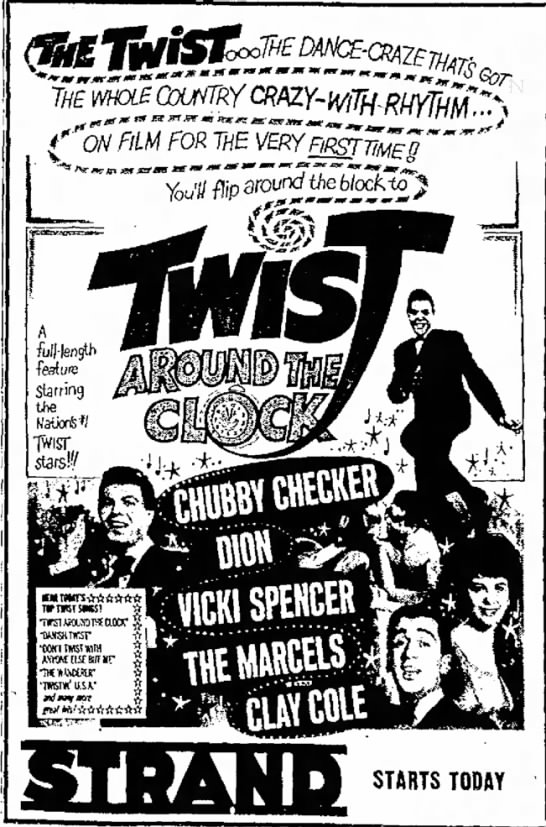
His success led Chubby further, into movie cameo roles in ‘Twist Around The Clock’ (1961) – a partial reconfiguring of the 1956 exploitational ‘Rock Around The Clock’, with Dion and the Marcels. Then ‘Don’t Knock The Twist’ (1962) – a remake of the 1956 ‘Don’t Knock The Rock’, with Chubby, Gene Chandler, Len Barry and the Dovells. He guested in Richard Lester’s debut movie for Amicus, ‘It’s Trad, Dad!’ (1962) – ‘The Kings Of Dixieland Jazz Together With The World’s Top Recording Stars’ with Helen Shapiro and Craig Douglas, and much later in the concert-movie ‘Let The Good Times Roll’ (1973) – ‘A Movie That Makes You Feel Good!’ But to Rock historians Phil Hardy & Dave Laing, Chubby’s subsequent records were ‘largely nasal tenor chants accompanied by somewhat tuneless vocal choruses and stereotyped rhythm/saxophone band-tracks’ (‘The Encyclopedia Of Rock: Volume 1’, Granada Publishing 1976). Yet, although Chubby delivered no less than thirty-one chart entries up to Parkway’s 1968 demise, he regularly featured on TV and in movies to demonstrate his dance moves.

 
There were new fads, fancies and fashions. Rock got harder, heavier and less enamoured of The Twist. Chubby married former ‘Miss World’ Catharina Lodders – dedicating his single “Loddy Lo” to her. He made a brief comeback on Buddah in 1969, with his version of the Beatles “Back In The USSA”, was arrested and charged for possession of hashish and marijuana in June 1970, then made a disastrous foray into reggae and progressive sounds on Chalmac in 1971 with a ‘Chequered!’ psychedelic album which was not critically well-received. ‘It’s mostly filled with would-be portentious and highly derivative lines like ‘goodbye Victoria, everybody’s going to the Moon’ or ‘stoned in the bathroom, on a Sunday afternoon’’ complained ‘Melody Maker, ‘the first song “How Does It Feel’ is unpromising, sounding suspiciously like “Like A Rolling Stone”.’ 

But whatever other talents Chubby may or may not have had, his career had been effectively hijacked by The Twist. And while he eventually settled into a comfortable niche on Rock ‘n’ Roll Revival shows, his legacy persisted. He was namechecked on Billy Joel’s 1989 hit “We Didn’t Start The Fire” – ‘Chubby Checker, Psycho, Belgians in the Congo’ as one of the highlights of the previous forty years of political history, and he guested on the TV ‘Dame Edna Experience’ (Season 2 Episode 1, 4 November 1989). ‘I’m like Donald Duck or Mickey Mouse’ he told a contemporary ‘Radio Times’, ‘a household name who sooner or later everyone gets to see’ (4-10 November 1989). His two Twist hits were extensively sampled on both 1989 no.1 hits by Jive Bunny & The Mixmasters, who remembered those days when ‘things were really humming.’ 

‘No-one really knows about Chubby Checker’ he divulged to journalist Sue Russell, ‘the difference between Chubby Checker in 1960 and in 1989 is the difference between a 1960 and a 1989 Rolls Royce. I’m the same guy – but I’m a little different.’ 

So, I’ve told my tale, and it didn’t take long. All about ‘The Twist’. And it goes like THIS!!!!!!


THE TWISTING TIMES...

June 1959 – ‘The Class’ b/w ‘Schooldays, Oh Schooldays’ (Parkway 804), US no.38 

1959 – ‘Whole Lotta Laughin’’ b/w ‘Samson And Delilah’ 

1959 – ‘Dancing Dinosaur’ b/w ‘Those Private Eyes’ (Parkway 810) 

August 1960 – ‘The Twist’ b/w ‘Toot’ (Parkway 811), US no.1, UK Columbia DB4503 no.44 

October 1960 – ‘The Hucklebuck’ b/w ‘Whole Lotta Shakin’ Goin’ On’ (Parkway 813), both sides chart, no.14 & no.42. A revival of a late-forties dance tune, later a 1964 hit for the Irish Royal Showband. 

January 1961 – ‘Pony Time’ b/w ‘Oh, Susannah’ (Parkway 818), Pop chart no.1, no.9, R&B chart, UK Columbia DB4591, no.27. ‘Pony Time’ was a Don Covay rewrite of a classic pre-war piano-boogie record by Pinetop Smith, ‘Pinetop’s Boogie-Woogie’ 

May 1961 – ‘Dance The Mess Around’ b/w ‘Good, Good Lovin’ (Parkway 822), both sides chart, no.24 & no.43 

July 1961 – ‘Let’s Twist Again’ b/w ‘Everything’s Gonna Be All Right’ (Parkway 824), US no.8, UK Columbia DB4691, no.2

 
October 1961 – ‘The Fly’ b/w ‘That’s The Way It Goes’ (Parkway 830), US no.7 

1961 – ‘Jingle Bell Rock’ b/w ‘Jingle Bell Rock Imitations’ with Bobby Rydell (Parkway 205), US no.21, UK Cameo-Parkway C205, no.40 

1962 – ‘Twistin’ USA’ b/w ‘The Twist’ (reissue Parkway 811) ‘They shimmy in Charlotte, they shake in Baltimore, in Detroit and Dallas, and down Miami shore, so, baby, oh, baby, what are we waiting for?’ 

March 1962 – ‘Slow Twistin’’ b/w ‘La Paloma Twist’ with Dee Dee Sharp (Parkway 835), US no.3, UK Columbia DB4808 with alternate b-side ‘The Lose-Your-Inhibitions Twist’, no.23 

March 1962 – EP ‘King Of Twist’ (UK Columbia SEG8155) with ‘The Twist’, ‘Mr Twister’, ‘Let’s Twist Again’, ‘Twist Train’ 

1962 – ‘La Paloma Twist’ 

1962 – ‘Teach Me To Twist’ b/w ‘Swingin’ Together’ with Bobby Rydell. UK Columbia DB4802, no.45 

July 1962 – ‘Dancin’ Party’ b/w ‘Gotta Get Myself Together’ (Parkway 842), US no.12, UK Columbia DB4876, no.19 

September 1962 – ‘Limbo Rock’ b/w ‘Popeye The Hitchhiker’ (Parkway 849), both sides chart no.2 & no.10. UK Cameo-Parkway P849, no.32, written initially as a Champs’ instrumental by Kal Mann with Billy Strange 

February 1963 – ‘Let’s Limbo Some More’ c/w ‘Twenty Miles’ (Parkway 862), both sides chart no.20 & no.15 June 

1963 – ‘Birdland’ (Parkway 873), US no.12 

August 1963 – ‘Twist It Up’ (Parkway 879), US no.25 

October 1963 – ‘What Do Ya Say’ b/w ‘Something To Shout About’, UK release only Cameo-Parkway P806, no.37 

1963 – EP ‘Chubby Checker & Bobby Rydell In London’ (Cameo-Parkway CPE554) with Chubby’s ‘What Do Ya Say’ and ‘Something To Shout About’ plus two by Rydell 

November 1963 – ‘Loddy Lo’ b/w ‘Hooka Tooka’ (Parkway 890), both sides chart no.12 & no.17 

April 1964 – ‘Hey, Bobba Needle’ (Parkway 907), US no.23 

July 1964 – ‘Lazy Elsie Molly’ (Parkway 920), US no.40 

May 1965 – ‘Let’s Do The Freddie’ (Parkway 949), US no.40. A new dance-craze based around the Freddie & The Dreamers stage cavorting! 

1965 – ‘Everything’s Wrong’ c/w ‘Cu Ma La Be-Stay’ (Cameo-Parkway P959) 

July 1966 – ‘Hey You Little Boogaloo’ b/w ‘Pussy Cat’ (UK Sept, Cameo-Parkway P989) 

December 1966 – ‘Karate Monkey’ c/w ‘Her Heart’ (US Parkway) 

May 1969 – ‘Back In The USSR’ b/w ‘Windy Cream’ (Buddah 201-045) 

September 1971 – LP ‘Chequered’ (London sSHZ8419) with ‘How Does It Feel’, ‘Stoned In The Bathroom’, ‘No Need To Get So Heavy’, ‘Let’s Go Down’, ‘My Mind’, ‘Goodbye Victoria’, ‘Love Tunnel’, ‘Slow Lovin’, ‘He Died’, ‘If The Sun Stopped Shining’. Melody Maker says ‘the effect isn’t improved by the sub-Hendrix heavy accompaniment and a muddy mix which almost buries the vocals.’ 

October 1973 – movie soundtrack LP ‘Let The Good Times Roll’ (Bell) includes ‘The Twist’, ‘Pony Time’ and ‘Let’s Twist Again’ 

November 1975 – ‘Let’s Twist Again’ b/w ‘The Twist’ UK London American HL10512, no.5 

January 1976 – LP ‘The American Dream: The Cameo-Parkway Story 1957-1962’ (London Records Dream-U 3/4) double-vinyl includes ‘The Class’, ‘The Twist’, ‘Pony Time’, ‘Let’s Twist Again’, ‘Dancin’ Party’ and ‘Limbo Rock’ alongside tracks by Dee Dee Sharp (‘Mashed Potato Time’), Don Covay, Bobby Rydell, the Orlons (‘Don’t Hang Up’) and the Dovells (‘Bristol Stomp’) 

March 1976 – LP ‘Chubby Checker: Greatest Hits’ (London Records HAU8492), ‘Melody Maker’ said ‘a fine reminder of how catchy American punk Pop was’ although ‘the strain of constantly coming up with new dances was showing and the result was the feeble “Do The Freddie” and “At The Discoteque”.’ 

April 1976 – ‘Dance Party’ b/w ‘Limbo Rock’ (London American HLU 10524) 

December 1976 – ‘The Rub’ b/w ‘Move It’ 

June 1988 – ‘The Twist (Yo, Twist)’ The Fat Boys with Chubby Checker (Urban URB20), UK no.2 

May 1990 – movie soundtrack LP for Roseanne Barr- Meryl Streep ‘She-Devil’ (Mercury), includes ‘Party Up’ by Chubby Checker featuring the Fat Boys