Saturday, 28 September 2013

Poem: 'THE BASH STREET KIDS'


THE BASH STREET KIDS


I admit it
I threw that stone,
my sweaty nail-bit ten-year-old paw
finger-gripped that hard shrapnel
and launched the missile
that shattered Mr Siser’s window,
the splinter-sharp detonation both
breath-catch crazy with scary exultation

and this is why
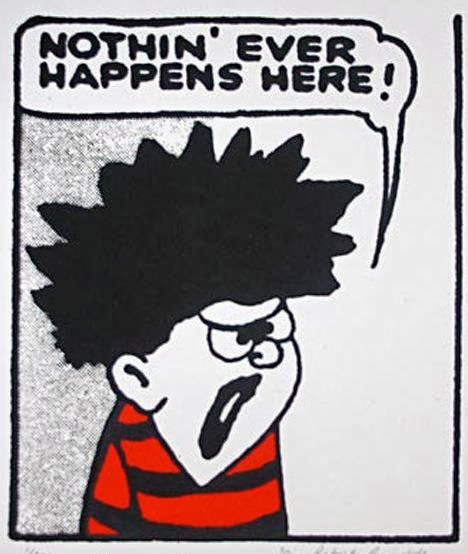
Dennis the Menace and Roger the Dodger
and Danny of The Bash Street Kids,
they throw stones, they shatter windows
frame-by-frame in the kid’s adventuretown
I’m forever excluded from,
do it, they hiss-whisper in itchy-urge
throw that stone,
hear that splinter-sharp smash that goes
CRASH!!!’ in big red block letters,
it really does, do it, do it,
so I did it

I remember it,
how I threw that stone,
I did it, this is why, I was ten
Dennis the Menace and Roger the Dodger
and Danny of The Bash Street Kids
are still ten in a snigger-frame
kid’s adventuretown this bored adult
is still excluded from,
hard shrapnel finger-gripped tight,
do it, do it they itchy-urge,
I hesitate…


Live: ABC at Sheffield City Hall, 1982


THE LEXICON OF ABC
ABC at Sheffield City Hall
(Tuesday, 9 November 1982)


While this tour was still being premeditated, rehearsed, and micro-adjusted, I suggested to blonde alto-saxist Stephen Singleton that ABC work from an essentially cerebral base. He didn’t disagree. Each stage of their irresistible rise has been scrupulously thought out, and as a culmination of the year in which IT ALL HAPPENED writ large this multi-city slog is too important to allow any angle to remain uncovered. Despite some early slight imbalance on the sound mix, their pre-planning works with the precision of flying knives, and they serve up a hi-octane set of a heat-intensity that near crisps the speakers. Borne on visual flash in glitzy show-biz lavishness, with a rhythm pulse to answer every question, and sharp intelligent songs, they fly and they fly eight miles higher than you ever thought possible.

‘Unique’ is a vastly overworked adjective in Rock-crit, and usually gets related more to hair-style than to musical originality, but ABC re-invest the word with some currency value – who else unveils their set with an “Overture” spun out in ice-blue light by a sextet of girl violinists? And from that point on the ABC Molotov Cocktail is a hermetically-tight sixteen-piece organism taking the full-house assembly of uncritical devotees through a punishing extreme lexicon of hits. An elongated Funk-slanted “Tears Are Not Happy”, a blistering “4-Ever 2-Gether” with its vocoder-scrambled vocal motif, and “Valentine’s Day” with Mark White trading lead guitar for chiming repetitive xylophone figures. The songs deal in lyrical interplay and never condescend to market demands for nursery rhyme simplicity – but they programme their way through a no.1 album and a clutch of hit ‘B’-sides that everyone here already owns, so there’s little new territory. And the formula functions squeaky-clean according to blueprint, a state of constant turn-on with nowt left to chance.

There’s just one unpremeditated sourness – midway through the epic “All Of My Heart”, the lush orchestration fades dramatically to allow maximum emotional emphasis for Martin Fry to breathily emote the title – only, with a split-second timing worthy of the band itself, an audience saboteur whips in and yells it out before him, stealing the phrase! Martin – forced to merely echo the line, is audibly shook up, he hasn’t allowed for such imperfections or unplanned occurrences. I’d guess the strategic infiltration of Fry’s solo slot could also include a miscalculation, it provides some textural variation (and allows the rest of the band time to switch from black glitter jackets to gold lamé!), but his voice – perfectly mixed and matched to group compositions, sounds awkwardly unsuited to Sinatra’s “I Wish I Were In Love Again”. Fry is no natural extrovert, which means he’s forced to play his role harder, and in this instance he sounds miscast. But the best is yet to come. Cranked up to a solid wedge of sparkling hits the show peaks super-hot on perfect power, an exuberantly celebratory “Alphabet Soup”, a “Poison Arrow” delivered right on target, and an opulent “Look Of Love” that leaves the audience emotionally shredded.

Precision can be a safety harness, an over-compensation for imagined inadequacies, and this first national tour carries a hell of weight for ABC. But as the show, and the inter-city trek, grains momentum (and confidence) then that balance too will be fine-tuned. They are too meticulous, and too cerebral, to do otherwise. ABC will wilt you, permanent. They are here to stay…


Thursday, 26 September 2013

Book Review: 'THE REVENGE OF GAIA' by JAMES LOVELOCK


EVE OF DESTRUCTION

Book Review of:
‘THE REVENGE OF GAIA’
by JAMES LOVELOCK
(Allen Lane, 2006, then Penguin Books,
2007 ISBN: 978-0-141-03535-2)

Gaia is a metaphor. A useful metaphor, but a metaphor nonetheless. Because the interactive dynamic Earth-systems in some ways resemble those of a living organism does not mean that it is a living organism. James Lovelock makes this distinction clear in his first few paragraphs. ‘Gaia’ – the name of the Greek Earth-goddess, was proposed in 1969 by ‘The Lord Of The Flies’-novellist William Golding, as an appropriate designation for ‘the Living Earth’ idea. That its leading champion, James Lovelock, is then ‘unrepentant’ about persisting in employing this useful metaphor as part of his didactic arsenal, with conscious purpose, sometimes lends ammunition to the New Age mystics and Loony-Tune Pagan groups who take Gaia on face-value. Lovelock speaks misleadingly of the ‘goals’ of Gaia. Inanimate systems cannot have goals. The fragile temperate biosphere we inhabit is more a state of equilibrium, a random and shifting compromise between forces, with ‘checks and balances’ resulting as these complex interactions fine-tune and adjust against each other. Only sentience, the accidental by-product of this chaotic fluctuation, has goals. If Earth has a consciousness, it is the resident naked apes who provide that brief experimental state.

As Crispin Tickell writes in this book’s Foreword, Leonardo da Vinci presciently saw the human body as a microcosm of the Earth, and the Earth as a macrocosm of the body, without being aware of just how much the human body is a symbiotic assemblage of tiny elements of life – bacteria, parasites and viruses, which are often at war with each other. Pretty much as Gaia is seen to function. Or now, it seems, to veer into malfunction. We’re all familiar with the vocabulary of Global Warming. We’ve watched the poignant TV-docs of polar bears on vanishing ice-floes, seen the satellite scare-photos of reducing ice-caps. We’ve no excuse for not knowing that the systems that govern climate have shifted into a dangerous instability, and that negative feedback-loops are accelerating the process. Other planets have vast and turbulent weather-systems.

Other planets have, or show evidence of having had, geothermal activity. Only Earth in the entire immense cosmos is known for certain to have biota. That’s why the ‘Curiosity’ probe is trundling around arid Mars now. That’s why it’s important to determine whether Mars does, or did ever harbour even primitive microbial life. Many extra-solar planets have been tentatively identified. It seems that planetary systems occur with some degree of frequency. But life is something else entirely. Its likelihood is so far impossible to ascertain. It’s impossible to draw up a chart of statistical likelihood with only one sample. So far as we can be certain, Earth is still the only world to evolve biota. And that thin shell of biosphere is another of the interactive elements that determines the conditions of Gaia.

Chaos Theory enters into the equation round about here. The idea that very small environmental changes can produce huge and unpredictable consequences. As with butterflies and hurricanes. This is not just fancy theory. The poisonous atmosphere of the newly-formed Earth was subtly altered over millions of years by bacteriological activity. Enabling plant-life, which accelerated the process further. Ushering in the kind of atmospheric composition that allows it to become this planet of the apes. It’s just that now those clever naked chimps are inflicting their own hazardous changes on the planet.

Science Fiction talks blithely of terraforming Mars. While out-of-control forces are already transfiguring our own planet in ways that can only become increasingly apparent, in ways already suggested by enviro-disaster movies such as Kevin Costner’s ‘Waterworld’ (1995) and Roland Emmerich’s ‘The Day After Tomorrow’ (2004). Even the title Lovelock selects – ‘The Revenge Of Gaia’, adds a SF slant, as though this is an ongoing episode from the epic ‘Star Wars’ cycle. And yes, imagination is a useful tool against short-termism. A single lifetime – let alone a political term of office, is not long enough to register the changes going on around us. Science provides the necessary template. Imagination can populate past and future with incident. This can provide the overdue tool necessary to envisage what Lovelock describes as the ‘coming crisis’, warning that ‘nothing so severe has happened since the long hot period at the start of the Eocene, fifty-five million years ago’. How are we expected to conjecture such conditions? Does he overstate for effect? Unlikely – the ‘climategate controversy’ demonstrates just how quickly deniers seize on any evidential inconsistency to fuel their smear-campaigns. But that episode does serve to illustrate how much indeterminacy there is within the calculations, and how unpredictable results can be.

Sci-Fi has been here before. We’ve lived with imminent apocalypse since Hiroshima, since technology took over from biblical visions of armageddon. Why should Climate Change be different? We got through the Cold War by a hair’s breath combination of calculated self-interest and luck. Neither is an option now. And so far, the twenty-first century has been misguided by the stupidest free-market economic concepts, what Crispin Tickell calls the ‘deeply entrenched fashionable delusions about the supremacy of market forces’ (and Lovelock calls ‘the mess of current energy and transport policy’). With policies that are based around the unprincipled principles of limitless expansion gorging itself on profligate acquisition, which are the direct antithesis of the responsibilities required if Global Warming is to be addressed. To Lovelock there is an ‘extraordinary degree of international effort and carefully planned sequences to implement’ ahead of us, but we are ‘tribal animals’ with deeply embedded behavioural-DNA resistant to coordinated change. Things don’t look good. Politicians tweak at percentage-reduction in greenhouse-gas projections for the coming decades in the full knowledge that they will not be fulfilled. While whatever fuel-economies or renewables-implementation are achieved are simultaneously swallowed up by the expanding energy-needs of a world-population nudging nine-billion. And globalised civilisation is so precariously stretched that the slightest environmental tilt will have terrible and far-reaching consequences. As Lovelock says, ‘the planet we live on has merely to shrug to take some fraction of a million people to their death.’

We are victims of our own smartness. Victims of our own success. Ten-thousand years of superstition, prayer, religious piety and ritual sacrifice saved not one plague victim. A brief few centuries of rational medical science, balanced diet and hygiene has expanded life-expectancy and reduced the threat of early death, to such an extent that population-levels are already unsustainable. The overpopulation bomb adds to an instability that will adversely touch every Earthling over the coming century. Lovelock has written elsewhere about how ‘we have grown in number to the point where our presence is perceptibly disabling the planet like a disease.’ To Tickell the answer is ‘how to achieve symbiosis.’ There’s no problem on Earth today that could not be resolved by reducing its human population to pre-industrial or medieval figures. That’s my assertion, not necessarily James Lovelock’s.

So Global Warming is now generally – if grudgingly accepted, as Lovelock concedes in this highly-readable book. While ultimate outcomes remain impossible to predict. Climate changes will happen as systems adjust against each other, until a new stable equilibrium emerges. What that equilibrium will be is still anyone’s guess. Whether the ongoing escalations continue indefinitely, beyond the optimum temperatures for life as it did fifty-five million years ago in the Eocene. Or simply, if devastatingly, restabilises at a new, if different, level, to which a much-reduced human civilisation will have to awkwardly adapt. All planets achieve a kind of equilibrium. Mars has one that’s remained unchanged for millions of years. Venus has one. Neither has one capable of supporting life. There’s so much unquantifiable theoretical data involved, each with its own built-in uncertainties, that no amount of computer climate-modelling can foretell it. As Lovelock gloomily predicts while tinkering with his ‘Daisyworld’ simulations, breeding pairs of humans will likely survive. With the full scientific and technological resources at our descendents disposal, some kind of SF future will happen. What that future will be is still the stuff of speculation.

He laments what we have already lost. The pollution and rape of his once-familiar English landscape. Although obviously Green by necessity – his ‘The Gaia Hypothesis’ (1972) provided a vital catalyst in the Global Heating debate, Lovelock has antagonised the Green Movement by embracing nuclear energy as a temporary fix to tide civilisation over until nuclear-fusion provides a more lasting solution – as though such a technology is inevitable! And by advocating ditching ‘extravagant and intrusive’ wind-turbines in favour of massive sea-defences for threatened coastlines. Governments must, must, must he hectors. Surely aware that governments – fixated on electoral think-tanks and focus groups won’t, won’t, won’t. Not until there’s absolutely no other alternative. But he has a point, about the sea-defences anyway. We don’t need Atlantis to illustrate previous inundations. Just beyond the reach of recorded history, the North Sea was the forested ‘Doggerland’, home of human tribes and animal species. This happened at the end of the most recent glaciations, the last time the ice-caps melted, ten-thousand years ago. A blink in time for Gaia. Yet nature is resilient. There have been mass-extinctions before. In the lifetime of Gaia it’s no big deal.

Even taking on Lovelock’s most bigoted Right-Wing Big Pharma, Military-Industrial, Big Petroleum and Agri-business free-market fundamentalist critics on their own terms, and conceding – OK, Global Warming isn’t happening, it’s not our fault, it’s part of a natural cycle of climate-fluctuations… by implementing more rational policies, we still come out with a cleaner more-sustainable energy-efficient and more tolerably inhabitable planet. Yet mere stability – as James Lovelock relentlessly emphasises, is not enough. It’s equivalent to a terminal lung-cancer victim anticipating a cure by belatedly quitting smoking. Because the processes are already in motion to counteract the viral blight of the proliferating ape. Our racial hubris could so easily be checked – Gaia-wise, by a single species-jumping pandemic. There’s no sentient element to such a solution. It’s purely a random series of events. But, as with the model of climate-change, it has the effect of a self-regulating health-check on an endangered Gaia. This is where the checks-and-balances built into the Gaia concept come into play. Gaia is a metaphor. Earth is not a living thing. Human beings are.


Wednesday, 25 September 2013

CD Reissue: FLUX OF PINK INDIANS


‘I LOVE TUBE DISASTERS…!’

Album Review of:
‘STRIVE TO SURVIVE CAUSING LEAST
SUFFERING POSSIBLE + NEU SMELL’
by FLUX OF PINK INDIANS
(One Little Indian TPLP 1172, August 2013)

‘Punk belongs to the Punks, not the businessmen,
they need us, we don’t need them…’
                                              (“Take Heed”)


If you were there, if you were part of it, you already know this. If you weren’t… well, there was a time, before the Boy-Bands won. A time when there was more to music than just celebrity status. Although there was mischief aplenty, Flux Of Pink Indians’ strivings were always at the service of their radical politics causes. Which were the regular Anarcho-Punk short-fuses of anti-nukes, veggie Animal Rights, anti-sexism, anti-religion and anti-closed-mind bigotry. A litany of values pretty-much consistent throughout sub-culture protest in general. But nevertheless urgently delivered with painful sincerity. Those concerns, always off the mainstream, are even more distanced now. So it’s all the more important that these voices should be reignited, heard again, compelling you to wonder just what we’ve lost out on over the intervening years.

As the first wave of the primal Punk ‘Big Bang’ bifurcated, some into mainstream New Wave chart celebrity, others – the more politically focused groups, gravitated into the more considered ground-level ethos expressed through the messy fanzine underground. Formed out of the ashes of The Epileptics in 1980, in the unlikely environs of Bishop’s Stortford in sedate Hertfordshire, Flux Of Pink Indians (‘Flux’ for change, ‘Pink’ for Gender Politics, ‘Indians’ for marginalised and victimised Native Americans) were contemporaries of Poison Girls, and more especially of Crass – with whom they shared bills many times.

In fact their devastating debut EP ‘Neu Smell’ was produced by Penny Rimbaud and originally released in 1981, on Crass Records. Supported by John Peel radio-plays the first side consists of a stunning suite of three linked tracks, intro’d and outro’d by short poems. The first sound is of crows. A distant dog barks. Then a gnarly accent voice, ‘Can ye smell the neu smell, travelling through the air?’ it enquires, ‘Aye, I can lad, it’s a-coming from over there’. The strange dialogue continues ‘over the hills, down in’t valley, there’s no buildings there, there’s a nuclear dump-site there...’ with the punch-line kicking in ‘Parliament says it’s safe, so why not dump it THERE?!?’ An explosion. A nagging bass figure. Rim-sharp drums. Crashing guitars. Hoarse razor-tongued vocals. ‘I love tube disasters, I wanna marry a tube disaster, I wanna ‘nother one like the last one, ‘cos I live for tube disasters’. The short sharp Punk-dumb Ramones-minimalist absurdist lyric delivering the exact counterweight necessary for the book-ending spoken-word bits. Is it gratuitous shock for shock’s sake? Or a metaphor for society hurtling towards disaster? Either way, it closes with tube-train noises. Then a more considered poetic dialect piece with apocalyptical visions of existential bleakness, ‘and oh, as yes the sky did turn to night, I shield my eyes and hide from the bright of day’. Daringly iconoclastic, a brilliantly luminous noise, this brief sequence is just about as perfect as anarcho-Punk would ever get.

The second side of the EP consists of “Sick Butchers” and “Background Of Malfunction”. Both scathing attacks on meat-eating, the first lending voice to cows who end up as car seat covers, giving ‘my soul for your soles of shoes’, the second extending to the hypocrisy in which there’s public outrage when a menagerie lion kills a zoo-keeper in ‘cold blood’, while humans tuck into a ‘lovely steak’. The full story explained in the typewritten text of the full fold-out EP-sleeve manifesto. Adopting an exaggerated ‘Posh’ voice to caricature the safe middle-class diners, “Background Of Malfunction” is carried on a ‘Pretty Vacant’ forward-drive. While “Sick Butchers” is all high guitar squeals, insistent tom-tom drums, and an impassioned ‘meat is murder’ howl of protest. ‘You may like my taste. It might say in the Bible that you can kill me…’ (yes, it does) but ‘I don’t want to die.’ Told from the animal’s POV, I ‘used to graze in the field. Used to breathe. I used to be alive. Now, sold in supermarkets’, ending with a cow’s plaintive mooo drowned out by electronic whines. Sonically, the 2013 re-mastered reissue reinforces the songs’ uncompromising message – angry punk rock, spine-cracking backbreaking riffs that smite pomposity and corruption, played hard and fast without unnecessary polish, a visceral reminder of just how fiercely politicised the underground music and sub-cultural landscape of the time could be.

The ‘Neu Smell’ line-up consisted of Colin Latter (vocals), Derek Birkett (bass), Andy Smith (guitar), Neil Puncher (guitar) and Sid Ation (drums). Yet by the time of their 1983 debut LP, ‘Strive To Survive Causing Least Suffering Possible’ – issued according to their DIY ethos, on their own Spiderleg label (1983, SDL8), just two of that original line-up survived – Latter and Birkett. Reasons are up for grabs. Ation was also gigging with Rubella Ballet, and quit Flux to play with them full-time. Simon Middleton (who replaced Andy Smith) and drummer Dave ‘Bambi’ Ellesmere both returned to the Insane from whence they’d come. In a fanzine interview (in ‘No Class’) the break was blamed on the group shoutily espousing veggie issues, whereas two members were still carnivores. Well, maybe. Meanwhile, guitarist Kevin Hunter who had been a part of the Epileptics – who name-changed to Epi-X after bad-taste accusations from the British Epilepsy Association, re-emerged, and re-joined. The reconfigured line-up was completed by Martin Wilson (drums).


If the album doesn’t quite serve up the aural variation promised by the EP, falling short of its concise compressed perfection, that’s more within the nature of the format. When extended and multiplied, something is lost and something gained. Greater consistent emphasis. With no personal dimension, and every fibre given over to vibrating disgust and insurrection. Thuggish riffs, gleefully wrathful rants, and guitars drenched in Molotov cocktails. It could be accused that maybe their sometimes inept strivings are in the cause of their sometimes poorly-understood issues, but don’t tell me they don’t mean it, and each track has the saving grace of at least one clever line.

The first of its twelve tracks, “Song For Them” is a straight serious poem read over a background of scatological inter-band dialogue, taking just forty-nine seconds to attack the global imbalance of wealth coexisting alongside extreme poverty. Exclaiming how it’s ‘hard to believe their plight is accepted, while money so wasted could be redirected’, that those in drought and famine are ‘not some race that don’t feel pain’ and that ‘starvation is something you don’t become immune to’. “Charity Hilarity” extends the theme, its speed-thrash making the neat point that ‘the money we donate to charity is too small to be of real consequence, but large enough to ease our conscience’. “Some Of Us Scream, Some Of Us Shout” makes the same point, with the chanted equation ‘feed starving people: fuck your bombs’ (partially recalling Allen Ginsberg’s ‘go fuck yourself with your atom bomb’ in his poem “America”), while expanding the scope to militaristic social conditioning, with ‘they shove toy guns on impressionable children, their future soldiers of war’ as guitars squeal in pain. It closes with Colin’s exasperated ‘fuck off’ howled from an air-hungry throat.

With the general ideological terrain of uninterrupted invective established, in dead earnest, “Myxomatosis” focuses on a menu of ‘experimentation, vivisection, devastation, starvation, torture, war’, balancing the equation ‘animals feel pain: people feel pain’. Jostling, squealing with dive-bombing guitar runs, there are dual voices, one high and ranting, vocal chords strung as tense as clotheslines, the other adding low commentary like a manifesto, ‘to live in peace, we must reject all oppression on all levels… there can be no compromise’. With solid near-Sham 69 vocal attack, the track preceding it concerns those victims of animal testing who are deliberately “Blinded By Science”, by having chemicals dripped into their eyes. And those who look the other way in the hope it’ll go away. The slow bass of “Tapioca Sunrise” re-mangles John Lennon’s sloganeering into ‘war does not pay’, its ‘Road-Runner’ scratch-riff perforating down the fret aimed at the then-current Mutual Assured Destruction madness of Cold War superpower posturing. There are atom bombs on land, in the air and at sea, threatening innocent animals and people (animals first, people second!), using military might as proof of what is right. More manifesto than song, but none the less potent for that.

Throughout the album there’s few concessions to any kind of Green Day-style melodic song-content, with everything reduced down to high-impact high-velocity urgency. But it’s never less than energising fun, and always immensely enjoyable. Two further tracks face up to the dilemma of voicelessness in the face of structures of power, with the guitar jangle of “They Lie, We Die” – a title that’s stubbornly chanted over and over again, a slogan, a street-chant, an anthem, addressing the suspect implementation of nuclear power to generate electricity, pointing out ‘don’t wait to be asked, no questionnaire will come’. While opting out (or in hippie-speak ‘dropping out’) is the only meaningful response to “Progress” – ‘you want to devastate… all I want to do is breathe’, propelled by Martin’s double-drumming. Modern life, it seems, is rubbish.

In the absolute certainty of their anger the targets that Flux attack are religion, the State, patriotism, monarchy, capitalism, career politicians – all the manipulative social elements that distort human behavior away from the simple truths of the mutual co-operation of free and equal peoples. With the egalitarian group-structure offered as the perfect self-sustaining alternative model. An assertion that “Take Heed” clarifies, a detailed virtual analysis of the way the idealism of the original Punk-movement was sabotaged by the monetising greed of the music industry. An appropriately jerky dislocated noise, the voice is mixed well back, from which hectoring phrases emerge and submerge, before tailing off into haunting slithering feedback. The lyrics were nevertheless printed on the album inner-sleeve, making their stance clear. With no possibility of missing the agenda. Anti-materialist. No time for hesitation. No space for compromise.

There’s none of the open-ended uncertainty of earlier generations of protest. Nothing is blowing in this wind. Yet there are two tracks that admit the possibility of questions. Accumulating in spiky mass, the accelerating twittering and rasping of “Is There Anybody There” verbalises a crisis of faith in its ‘I’ve worked hard, lived in fear of judgment day’, before appealing ‘is religion really true, or just another tool used to control and manipulate the things we do?’ While the stately rhythms of “TV Dinners” – a longer more structured piece, comments on the diet of media violence through which ‘we’ve all learned to love to hate’, which ‘isn’t acceptable in any form’. Untypically generous in conceding ‘the blame lies not within the system, the blame lies not with the State, the blame lies not within religion… it lies within each and every one of us’, as its riffs, overlaid with Kevin’s stinging guitar, accelerate suddenly, tempo-shifting with accumulative power, before this garbled syntax of apocalypse collapses into a cacophony of discordant noise and yells. Then the closing track “The Fun Is Over” announces ‘the nightmare has started… the end has arrived’. It’s time to stand back and reject it all. Now’s the time for action.

Although this is the album that defines Flux Of Pink Indians, and best encapsulates what it was all about, the fun was by no means over. It was followed by a second LP, ‘The Fucking Cunts Treat Us Like Pricks’ (Spiderleg DLP SDL13, 1984). Then, by 1986 Birkett had ignited the fledgling One Little Indian label, through which the group released its third and final album, ‘Uncarved Block’ (1987, One Little Indian TP1) produced by Adrian Sherwood, with the band-name abbreviated to Flux.


Appropriately, it’s One Little Indian that re-mastered and re-issued ‘Strive To Survive Causing Least Suffering Possible’ (on 8th July 2013), in various formats. With a double vinyl pressing augmented by original album demos plus the now-highly collectible EP ‘Neu Smell’. All formats restore the original 1983 artwork, while the CD and download package adds a live set from Shepherds Bush Empire, captured in November 2007 by a one-off reformed line-up playing support to ex-Crass singer Steve Ignorant’s ‘Feeding Of The 5000’ show. On this night Flux was completed by bassist Ian Glasper, who’d met Colin and Kev while researching his authoritative book ‘The Day The Country Died: A History Of Anarcho-Punk 1980 To 1984’ (Cherry Red Books, May 2006), his sequel to ‘Burning Britain: The History Of UK Punk 1980-1984’ (Cherry Red Books, January 2004).

For the accompanying publicity release, Martin admits to initial reservations over reforming, ‘considering all the principles and beliefs that Flux stood for, I had mixed emotions as to why we should play the show,’ but ultimately discovered ‘I was astonished at how much interest there still is in Flux.’

‘The opportunity to play all those great songs from ‘Strive’, and alongside Steve of Crass, was too compelling to say no to’ rationalises Colin. And ‘we were able to reproduce the album with more power than we ever had before.’

‘I wasn’t sure how it would feel playing a gig with the band again after a break of twenty-five years,’ concurs Kev, ‘especially as I’d hardly picked up a guitar in the interim, but as soon as we started rehearsing it just felt right.’ And it does.

Inviting people to think, to question, to protest, is not a significant element of what’s going on in music today. And Flux Of Pink Indians were always bottom-up, not top-down. More concerned with igniting activism in their audience, provoking them to form their own groups and their own labels, to work through an underground network of not-for-profit fanzines, to join an activist demonstration. This was more vital than getting their ID-mugshots across the cover of the ‘NME’. That might have been a part of it. Although not, by any means, a significant part of it. Things are different now. I download the digitalised version of the album package. How would Flux have originally dealt with downloads and online subversion? As “Take Heed” eloquently documents, they always distrusted and were fiercely opposed to Big Music industry machinations. But downloads is an even more efficient way of circumventing monolithic industry structures… isn’t it?

“Punk will never be dead,
as long as some of us refuse to be led…”
                     (“Take Heed”)

Contact: Federica@indian.co.uk


Monday, 26 August 2013

Poem: 'Thirty Seconds To The End Of Time'


THIRTY SECONDS TO
THE END OF TIME /
‘A SCIENTIFIC ROMANCE’


we meet on the gallery steps
I haven’t thought of you in years, honest,
a poor correspondent, a poorer friend,
you’ll probably never get to read this, and
a dutiful historian never jumps to conclusions
so neither will I, but yes, such fragments stored…

gradually this thing refamiliarises,
the smoky kisses that fug my glasses,
the small gold rings that pierce your nipples...

some of us were artists, wrote poems or plays,
mostly we were layabouts, on the day it rained you
strolled barefoot down the Hyde Park pizza parlour,
surely you’ve not forgotten that?
it could have been worse, a night of dreams
confronting these ruins in slowness, instead of
this perverse archipelago of nostalgia in which our
medieval gryphons have flown, our unicorns paced,
manticores prowled away in the pterodactyl silhouettes
of golden cockroaches, and so many stone gargoyles
that it seemed the cathedral must take flight too, and
mermaids with the skin of petals lost in tragic affairs
who take a step towards the dark mirror
where the night moves in moonlight…

if all of this strikes you as fanciful, it’s
just an avalanche of memory seeping
into dark earth, half evaporated,
ignited by that meeting on the gallery steps,
dutiful historians never jump to conclusions
and you’ll probably never read this anyway
so none of it really matters, honest…


Published in: ‘QUARRY issue 6’ (UK – August 2008)
‘GLOBAL TAPESTRY JOURNAL no.33’ (UK – January 2012)

Science Fantasy: Thomas Burnett Swann


THOMAS BURNETT SWANN:
INTO THE WANDER-WOOD

ANDREW DARLINGTON travels to Crete to rediscover
the work and the lost world of an unfairly neglected
American fantasist whose stories first achieved prominence
in the British ‘Science Fantasy’ magazine

“Out in the dark blue sea lies a land
called Crete - a rich and lovely land, washed
by the waves on every side...”
(Homer ‘The Odyssey’)

I never quite understood what Homer meant about the ‘wine-dark seas’ of Crete. Until I came here and saw the setting Cretan sun flame the Aegean to something as richly intoxicating. Now – in the courtyard of the Palace of Knossos, just 5km from the Heraklion airstrip, I see Thomas Burnett Swann in new illuminations too. Knossos is Swann in stone. A fusion of myth and archaeology. This, the palace of King Minos, was discovered by Greek historian Minos Kalorairinos, and controversially reconstructed by Sir Arthur Evens. But its labyrinths were planned and executed by Daedalus. Here, in Swann’s 1964 ‘Science Fantasy’ serial “The Blue Monkeys”, mythology fights its last ‘War of the Beasts’ against the encroaching forces of human rationalism. Here the hybrid man-beast Eunostos, the last ‘Bull-that-walks-like-a-man’, unites with the beast-princess Thea, niece of King Minos, in a doomed attempt to resist the island’s Achaeon conquerors. Crete is a land of thirty-million olive trees. Home to the world’s oldest viniculture. Up from Piskopiano there’s the stark limestone moonscape of the Dikti cave – birthplace of Zeus. Suddenly, here, Swann’s elegiac stories becomes tangible and real.


I don’t know a great deal about Swann’s life. Little more than fragmentary glimpses salvaged from book jackets and magazine profiles. I know he was born in Florida in 1928. That he served in the US Navy during the Korean War, but that he was an academic by nature. To the editor of his greatest fictional home – the British ‘Science Fantasy’ magazine, Swann was a ‘putter-in’ who built ‘a phrase round a ‘boss-word’, a sentence round a key-phrase, forms paragraphs of carefully-matched sentences, and inlays them with epithets until their colour and texture is exactly what (he) envisages’ (see 32). I’m also a ‘putter-in’, and this sounds about right.

Swann’s education yields impressive qualifications including an A.B. from Duke University, a Master’s from the University of Tennessee and a Ph.D from the University of Florida, which enabled him to become a Professor of English Literature at the Florida Atlantic University, a position he used to authenticate the ‘framing’ sequence for his novelisation of the “The Blue Monkeys” as ‘The Day Of The Minotaur’ (1966), his most powerful eulogy to the power of dream. Through the medium of his narrator Swann commends ‘the accurate historical framework, the detailed descriptions of flora and fauna, the painstaking fidelity to fact in costume and custom’ (13) of his own work. Other writers used mythology before him. H Warner Munn took his lost Roman legion through remnants of Arthurian, Atlantean and Toltec quasi-history as early as the ‘Weird Tales’ serial forming the novel ‘King Of The World’s Edge’ (1939). But Swann’s vision is clearer. He is more closely attuned to the roots of all story-telling in dream and wonderment. He is a writer who retains ‘an ear for the well-turned phrase, the elegant (yes, even the flowery) epithet’. His ornate enigmas of the past are located where species divisions are fluid, where history dissolves and melts into myth. He deifies the natural world. And few have done it better.


It’s possible to argue Fantasy as the cranky eccentric inferior of its more rigorously disciplined neighbouring genre, Science Fiction. At its best – restrained by the laws of physics, SF has an ability to stimulate the imagination to a degree seldom achieved by any other form of popular fiction, whereas Fantasy’s effect on the imagination is more often than not soporific. Both can be viewed as escapist forms of literature, and – of course, Fantasy is part of an eternal Bardic tradition extending back beyond Homer (and one from which SF has itself evolved). Nevertheless, the trendy-mystic catch-all of Swords-&-Sorcery, Dragons, Boy Wizards, Teen-Vampires, psi-mutants, and endearing Diskworld Hobbit-facsimiles currently infesting bookshops is a depressing place to be. There are exceptions. Lovecraft’s elaborate and mesmeric Cthulhu mythos has a snaringly compulsive breadth of vision. The sheer poetic beauty and outlandish grotesquerie of Mervyn Peake gives his work a quality that defies any attempt at limited categorisation. Fantasists CS Lewis and Leigh Brackett must get special mention too, while the degree of fascination still exerted by Tolkien must make him a candidate for any list of honourable exceptions.

And I don’t want to imply that Thomas Burnett Swann automatically qualifies for inclusion in such an elevated pantheon of Fantasy writers. Merely that his tales are quaintly individualistic and imaginatively original enough to be afforded a degree of serious consideration I’d not readily extend to many of his contemporaries. Swann produced work for a number of years, in ‘The Magazine Of Fantasy & Science Fiction’ and Ted White’s ‘Fantastic’, but most notably through the pages of the fondly remembered ‘Science Fantasy’, and later through his own slim novels. And in doing so he built up a unique stylistic identity. He used his awesomely imaginative bestiary of mythic characters as metaphors for wonderment. Michael Moorcock – himself no stranger to rich prose, recognises Swann’s “Where Is The Bird Of Fire?” as one work which ‘has shown uses to which Fantasy can be put’, one which ‘has done more than entertain on an escapist level’ (31). While even the ‘glittering adjectives’ of a much earlier story – “The Painter”, playfully animates the real into the wonderfully phantasmagoric. Here, the surreal monstrosities of Hieronymous Bosch’s ‘Garden Of Earthly Delights’ become a virtual intrusion into the artist’s actual life via hideous aliens – ‘demons exploring the sky in their fish’, amid opulently poetic prose where ‘apples glisten like Venetian goblets, twisting their fine-blown spheres to catch the moonlight’, and horror floods his body ‘like water invading a swimmer’.

The man Theodore Sturgeon describes as ‘a remarkable writer’, decided to drop academia in favour of the pen in the early 1960’s. From then on Swann lived as a poet, an essayist (publishing work on Christina Rossetti and the poet ‘HD’) and a fantasist. He died from cancer in 1976. To these bare bones of a life I add Kyril Bonfiglioli’s musings on his creative technique, ‘one could no more trim down his work without damaging it hopelessly than one could clip a few inches off the side of a good painting’ (32).

This sounds about right.


---- 2 ---

“In the tall green flame of the cypress, I see his
shadow, flickering with the swallows. In the
city that crowds the Palatine, where Fauns walk
with men and wolves are fed in the temple, I hear
the rush of his wings. But that is his shadow and
sound. The bird himself is gone. Always
his wings beat just beyond my hands, and the wind
possesses his cry. Where is the bird of fire?”


The way Tolkien plundered Anglo-Saxon mythology and language is well documented. At his best, Swann goes back further into the classical roots of mythology, to Virgil, Homer and beyond. He sculpts landscapes and texts redolent with the rural imagery of ‘the world’s great childhood before the Trojan War’, a time of ‘daffodil-whispering breeze’ and ‘leaf-cleansed air’, a time when even anger was poetic – it ‘clawed at (the) throat like an ice-encrusted branch’ (‘Green Phoenix’, 1972). A time when ‘wonders were as numerous as sparrow’s nests in spring’ (‘Will-O-The-Wisp’, 1976).

John Carnell describes Thomas Burnett Swann as an American ‘unhonoured and unsung in his own country’. But it was Carnell, as founding editor of the elegant ‘Science Fantasy’, who was largely responsible for building that first phase of Swann’s strange evolution. The earliest stories, published while Swann was still studying for his PhD, had yet to assume the enhanced mythological complexity that was to become his most hypnotically powerful form. “Viewpoints” for example (in rival ‘Nebula’, May 1959), has a contemporary setting and flirts with a kind of post-Chernobyl horror in which a radiation-blasted woman has skin of ‘weathered green brass’. But her choice to remain on the mutant’s reservation, accepting her role as part of a separate new race already anticipates Swann’s later preoccupation with a biodiversity of sentient species (there’s also, incidentally, a car called Ariel!). “The Dryad Tree” (‘Science Fantasy’, August 1960) – to Carnell, is ‘a light fantasy in a modern setting... that conjures nostalgic memories of the defunct ‘Unknown Worlds’.’ It envisages an unconventional trans-species menage-a-trois in which Cloe, an Italian Orange Tree, is jealous of John’s new wife Mari. Again, the resolution comes not with violent confrontation, but through gentle assimilation.

But it’s through the stories that follow that Thomas Burnett Swann discovers his style, and his audience. In the novel ‘Green Phoenix’ he chronicles items from the history of Aeneas’ arrival in Italy – incidents that classical Roman writer Virgil apparently forgets to mention. There are no Dryads or Fauns in Virgil’s ‘The Aeneid’ (and while Swann refers to the wandering Trojan’s son as Ascanius, his predecessor usually calls him Iulus), yet the framework of Swann’s novel can be placed without difficulty within a couple of the penultimate chapters of Virgil’s epic. Swann uses King Latinus, rescued intact from the text of ‘The Aeneid’, and also his daughter Lavinia, although her ‘Green Phoenix’ marriage to the hero of Troy is considerably more placid than in Virgil’s version. Swann omits Turnus to whom she was originally betrothed. But such nit-picking comparisons are misleading. Swann’s research is voluminous. Each of his tales come complete with a list of academic esoterica he’s consulted to aid its fabrication. But he merely uses Virgil, as he uses textbooks on Minoan or Etruscan history, as stepping stones to the creation of his own mythologies.

A qualification that can be applicable, however, relates to the exact delineation of his fantasy species, and the apparent confinement of the scope of their world. There are Dryads, Centaurs and Fauns – creatures elaborated from mythology, phantasms condensed out of superstitious rural imaginings, grown from shadow patterns across forest floors, the movement of random clusters of foliage, the rustle of leaves disturbing silence. They should be as inexact, insubstantial and as inconsistent of form as in the tales of Ovid’s ‘Metamorphosis’. Yet Swann veers close to making them endearing and decorative, defusing the elements of both mystery and menace. It’s like taking the beautifully complex draughtsmanship of a Pre-Raphaelite painting without also accepting the decadent fin-de-siecle element of evil omnipresent darkness. Anthologist and critic Judith Merril concurs. To her, Swann’s fictions are ‘a far cry from the earth-dark tragedies of such Ancient World chroniclers as the late Henry Treece, and the lighter approach inevitably diminishes the stature of the myth-figures. If, however, you prefer your blood-spilling flavoured with charm, rather than taken raw, then Swann blends these ingredients with considerable skill’ (33).

That sounds about right. But ‘Green Phoenix’ is just one element of something that should be considered as a whole. The novel was first published (in the USA) in 1972, and is a coming together of ideas Swann had been developing in short story form for a decade. Mellonia, Aeneas’ Dryad lover first appears in the 1962 short story “Where Is The Bird Of Fire?”. Written by a Faun with a reed pen, it tells of Mellonia’s relationship with Remus ‘the Wolf’, the founder of Rome, and how through him she makes good her promise to found a second Troy in Italy. The story, according to a contemporary blurb, ‘received more praise than any other in recent years’. “The Sudden Wings”, a voyage into painful beauty, follows its success. Set at the time of Roman expansion into the Eastern Mediterranean, it concerns the loneliness of the last member of a winged human species, Eros, the Dragonfly Boy. He is an ‘eternal’ who had gamed with a Princess of Ur and is ‘older than evil’. In “Dolphin And The Deep” the Etruscan Bear searches for lost Circe, while “The Murex” is set among Amazons and ant-like Myrmidons on the island of Aegina.

I know Aegina too, walking where the Doric Temple of Aphaea overlooks the Saronic Gulf – perhaps this is the ‘Bay of Coral’ where Swann’s naked Amazons dive for scarlet and lavender sponges? It’s on this island that Daphne and Loxo track a band of Myrmidon ant-boys from the walled town back towards their nest, half for gain (‘like the fabulous ants of Arabia, they were said to horde (sic) gold and emeralds, electrum and lapis lazuli’), and half for sport (‘you have the mind of a wolf’ jokes Loxo). As they stalk their prey, the ilex and linden trees are alive with spirit-presence, the sensual land haunted with stories, redolent of thyme and passed time. The Amazons are rationalised as a kind of proto-Feminist collective of abused or deserted women in revolt against patriarchy. Daphne herself was exposed to die as a baby, saved and reared by Amazon leader Gorgo. Yet their tribe had also fought Centaurs and driven them from the island. Now Gorgo leads her Amazons to raid the nest, only to become lost in its mushroom chambers and tunnels, and forced to retreat, defeated by the ant-boy’s cunning. Separated from her group, Amazon Daphne warily befriends winged Myrmidon Tychon. Together they ride a hippocampus, a giant sea-horse. Like the arm of the sea and the corner of the land, the two meet ‘in sweet apartness’, his unsettling golden-skinned maleness calling ‘a stranger out of the deeps of me, as a necromancer whistles the white-faced spirits of the tide.’ Their liaison is interrupted by returning Amazons. Punished for their transgression, despite her protests, Tychon is thrown to Orion, the great chained bear. Then the remaining Myrmidons affect a rescue, ‘they seemed to step from the sunbeams of the late afternoon; to walk with light through the green woods; to walk as light’. Daphne realises that ‘the same moon controlled our tides’ and she joins the ant-boys in polyandrous marriage, as their new queen.

There’s a strange gentleness to such stories, and little violence. ‘Most of the world’s harm, it seemed, was done by ignorant, essentially decent men’ (‘Will-O-The-Wisp’). There is much talk of love, a love that not only tames wild bears and, helped by the correct alchemaic catalyst enables mortals to sprout ‘Sudden Wings’. A love that seduces Amazons into strange marriages. A love that is romantic, maternal, paternal, or the love of comrade for comrade, or sometimes even a love with ill-defined incestuous or homosexual aspects like that of Eros and Mark (6), or Herrick and Nicholas (‘what makes a man a god is people to worship him. Even one person if he worships enough’ (26)). There’s a pleasingly androgynous ‘Satyricon’-esque ambivalence of blurred sexual identities. Rather, a feeling of universal sensuality devoid of the need for imposed gender divisions. ‘I understand’ comments Amazon Daphne ‘that men could be manly in tenderness’. The ambiguity of sexual roles, as this quote indicates, is extended to include the leading protagonists of the stories. Heroes who are not only heroic, but live up to every outmoded definition of the term. The poet Herrick for example has ‘bare legs splendid in the sun, his bare arms like those of a blacksmith, the archangel hair.’ These heroes also tend to possess a childlike youthfulness, and are given to displays of emotion and even tears that more contemporary modes – unlike those of Homer’s time, find unmanish. Probably such decompartmentalisation of roles reflects more on the sickness of our own society than upon those created by Swann. Heroines are similarly beautiful, yet complex. Matriarchal societies and ‘covens’ abound – the Amazon society is dominated by Gorgo, just as Judith, the charismatic leader of the Gubbings, and Volumna, leader of the Dryads, are her direct counterparts.

There are no villains.


---- 3 ---

“Before Romulus, the entire Mediterranean world had
abounded in Satyrs and Centaurs, Tritons had played in
the sea-pools, and even the air, it was said, had throbbed
with sudden wings as boys and girls had tumbled through
the clouds. But now, thanks to the depredations of man,
such creatures were almost extinct...” (6)


Following the eventual demise of ‘Science Fantasy’, and the publication of ‘Green Phoenix’ came further novels including ‘The Lady Of The Bees’ (1976) drawn from the same mythic sources, ‘The Day Of The Minotaur’ expanded and rewritten from “The Blue Monkeys”, and ‘The Tournament Of Thorns’ (1976). ‘Moondust’ (1968) even enters the fractured Jewish crypto-history of The Torah and ‘finds fairies in the foundations at the battle of Jericho’ (34). Swann describes the Biblical city infiltrated by the non-human wizardry of sciences older than history, with an attendant subterranean realm called Honey Heart, populated with winged females and intelligent foxes.

Thomas Burnett Swann had by now become the centre of a minor cult which climaxed with the 1976 appearance of ‘Will-O-The-Wisp’, a novel set in ‘post-Elizabethan England’. Here, the underlying sensuality of the earlier fantasies remain, but its wondering, somehow chaste innocence is a little more knowing. The sense of menace a little more fully realised. Swann writes that ‘when God had come to England with the Romans, the Pagan Gods had scuttled from field and fen, and the Devil, who gave them asylum in Hell, appeared to be permanently routed and tidily exiled.’ But the element of Puritan guilt gives evil a Freudian psychological basis, validating the mutterings of dark submerged sexuality. The attributes of sensuality are even extended to embrace the inanimate. Dartmoor, under ‘the first light of dawn had begun to flush the tors. Usually they resembled huge jagged tombstones, but now they were what they had been to her ancestors before the fall, unabashedly phallic, earth’s virility yearning to the fruitful sky.’ This is an essentially Pagan vision of the world, of Sky-Mother/Earth-Father as in virile pre-christian belief. Yet the novel lies well within the tradition of Swann’s mythos. Robert Herrick the poet, in pursuing and being captured by the remnants of a supernatural race living on Dartmoor, does for the novel what Virgil had done for ‘Green Phoenix’ (while not only Virgil but also Dryads and Satyrs are alluded to in the later work). There are other points of cross-reference that serve merely to update the outer limits of Swann’s terrain by a fistful of centuries. The research and settings are meticulously exacting, detail from Herrick’s own life, to the Devonshire Folklore of the persecuted ‘Gubbings’, to lists of furnishings and materials described in archaic or unfamiliar terminology. A list of research source material is credited.

The Gubbings, like the Myrmidons, and the Dragonfly Boy, are winged.

In “The Night Of The Unicorn” (12), written for a 1975 Arkham House Press anthology – ‘Nameless Places’ edited by Gerald W Page, Swann finally brings his location back into the twentieth century. It tells of a Mexican village which awaits the appearance of a Unicorn, an ex-whore anticipating that, although the creature will not approach her, a single glimpse will make the wait worth while. Thomas Burnett Swann is the teller of gentle mythologies in which duels are fought in ‘Trials Of Verse’. In which beautiful women of strange hybrid species woo human lovers, Mellonia is torn between her allegiance to the Dryads and to Aeneas, just as Stella is torn between Gubbings and Herrick, or Daphne between Amazons and her former prey, the Myrmidons. He uses poetic imagery to create an internal world to consistently encapsulate his vision – the moon is described as a ‘bird of fire’, the Gubbings’ diminutive wings are ‘thwarted flames’, tents are ‘grounded birds yearning for flight’ and the forest is ‘so dark that the sun was a dim constellation in the night of foliage above them.’ In Swann’s stories a youthful world of childlike innocence and purity is receding in time to be replaced by a more dour and world-weary maturity. His tales speak of a world, and of life-styles that are in harmony with the earth. A world, and a value-system that have somehow subsequently been misplaced, that simultaneously dissolve like childhood with the first pubic hair of maturity, to be destroyed by the intimations of evil that adulthood brings. An analogy perhaps, with the Judeo-Christian Fall alluded to by Swann in ‘Will-O-The-Wisp’, in which wisdom again creates the knowledge of evil. Or then again, perhaps the Eden myth itself is just a parable of lost childhood?

It’s as if he’s writing a symbolic paean to childhood and the childhood of the world. There’s ‘a great sadness, for what I had lost and more, for what I must lose, stirring in me like the grey moth of autumn. I felt the wings and a chilling dust of snow...’ (8). Perhaps he’s writing parables of the despoilation of nature by human technological pollution, for the theme of species nearing extinction recurs – the last fugitive Gubbings, the last Dragonfly Boy, the last Centaur. Or maybe he’s just writing magical tales with their own internal logics. Swann’s fiction, like the simile of the tents, yearn for flight.

Whatever the motives he weaves oddly compelling, strangely individualistic tales that even those with a bias against pure Fantasy can find charming.

The images that reach us from Minoan Crete – the bull-dancers, the ‘Prince with Lilies’, the ‘Blue Ladies’, have been painstakingly reconstructed by historians from an incomplete jigsaw of mosaic fragments found in the ruins of the Knossos Palace, their gaps imaginatively fleshed out. Splinters of what is known from the deep past, elaborated into what is conjectured. Thomas Burnett Swann worked in that way. Knossos is Swann in stone. He was here – in Crete, to research ‘Day Of The Minotaur’. Its scroll of papyrus, inscribed with its ancient manuscript, was supposedly excavated from a cave near the ‘ancient town of Phaestus’ – modern Phaistos adjacent to the Roman archaeological site of Gortys. Here there are still ‘oak trees older than Saturn’. Swann stood beneath ‘hills terraced with olive trees and vineyards, which climb gradually into the Range of Ida and the Country of the Beast’. I recognise the first. I can now believe the second. From these shores, into the wine-dark seas of Crete, the Beauty-and-the-Beast story of the Minotaur ends as Eunostos sets sail to find the Isles of the Blest, leaving Crete to human occupation.

The loss, here, is almost tangible.


“Hide it if you must, deep as the deepest
trireme crusted with coral, but beauty will
burn into light” - old Dolphin proverb


THOMAS BURNETT SWANN
(12 October 1928 – 5 May 1976)


RESEARCH SOURCES FOR
THIS ARTICLE: SHORT STORIES

(1) “Winged Victory” (‘FANTASTIC UNIVERSE’ - July 1958)
(2) “Viewpoint” (‘NEBULA no.40’ - May 1959)
(3) “The Dryad Tree” (‘SCIENCE FANTASY no. 42’ - August 1960)
(4) “The Painter” (‘SCIENCE FANTASY no. 44’ - December 1960)
(5) “Where Is The Bird Of Fire?” (‘SCIENCE FANTASY no.52’ - April 1962/ then as novel ‘LADY OF THE BEES’ 1976)
(6) “The Sudden Wings” (‘SCIENCE FANTASY no.55’ - October 1962)
(7) “The Dolphin And The Deep” (‘SCIENCE FANTASY no.60’ - August 1963/ then as novel 1968) (8) “The Murex” (‘SCIENCE FANTASY no.63’ - February 1964)
(9) “The Blue Monkeys” (‘SCIENCE FANTASY nos.67/68/69’ - Sept 1964/Dec 1964/Jan 1965)/ then rewritten as the novel ‘DAY OF THE MINOTAUR’ (1966)
(10) “Vashti” (‘SCIENCE FANTASY no.72’ - May 1965)
(11) “The Weirwoods” (‘SCIENCE FANTASY nos.77/78’ - Oct/Nov 1965)
(12) “The Night Of The Unicorn” (‘NAMELESS PLACES’ edited by Gerald W Page, Arkham House Press, 1975, collected into ‘THE YEARS BEST FANTASY STORIES vol.2’ edited by Lin Carter - Daw 1976)

NOVELS

(13) ‘DAY OF THE MINOTAUR’ (Ace 1966 USA/Mayflower 1975 UK - a ‘slightly different’ version of “The Blue Monkeys” serial)
(14) ‘THE WEIRWOODS’ (Ace - 1967 USA)
(15) ‘MOONDUST’ (Ace - 1968 USA)
(16) ‘THE DOLPHIN AND THE DEEP’ (Ace - 1968, three short novellas, ‘The Dolphin And The Deep’, ‘The Murex’ and ‘The Manor Of The Roses’ from ‘The Magazine Of Fantasy And Science Fiction’ November 1966 from his ‘John And Stephen’ series which also includes ‘The Stalking Trees’ in the January 1973 issue)
(17) ‘WHERE IS THE BIRD OF FIRE?’ (Ace - 1970 Collection, includes ‘Where Is The Bird Of Fire (The Latium Trilogy)’, ‘Vashti’ and previously unpublished ‘Bear’)
(18) ‘THE GOAT WITHOUT HORNS’ (Ballantine - 1971)
(19) ‘FOREST OF FOREVER’ (Ace - 1971 USA/Mayflower 1975 UK
(20) ‘GREEN PHOENIX: THE LAST STAND OF THE PREHUMANS’ (Daw SF - 1972 USA) (21) ‘WOLFWINTER’ (1972)
(22) ‘HOW ARE THE MIGHTY FALLEN’ (Daw - 1974)
(23) ‘THE NOT-WORLD’ (Daw - 1975)
(24) ‘THE LADY OF THE BEES’ (Daw - 1976/ sequel to ‘GREEN PHOENIX’)
(25) ‘THE TOURNAMENT OF THE THORNS’ (Daw 1976/ from ‘MAGAZINE OF FANTASY & SF’ stories 1966/1973)
(26) ‘WILL-O-THE-WISP’ (Corgi Science Fantasy - 1976 UK)
(27) ‘THE GODS ABIDE’ (Daw -1976)
(28) ‘THE MINIKINS OF YAM’ (Daw - 1976)
(29) ‘CRY SILVER BELLS’ (Daw - 1977)
(30) ‘QUEENS WALK IN THE DUSK’ (Heritage Press - 1977)

OTHER SOURCES

(31) ‘ASPECTS OF FANTASY Part 3’ by Michael Moorcock (‘SCIENCE FANTASY no.63’ - February 1964’)
(32) Editorial by Kyril Bonfiglioli (‘SCIENCE FANTASY no.69’ - January 1965)
(33) Book review by Judith Merril (‘NEW WORLDS no.170’ - January 1967)
(34) Book review by James Cawthorn (‘NEW WORLDS no.189’ - April 1969)

There are also poems published in the ‘NORTH CAROLINA QUARTERLY’ and ‘CORNUCOPIA’ magazines, poetry collections - ‘WOMBATS AND MOONDUST’ and ‘ALAS, IN LILLIPUT’, as well as books of Literary Scholarship - ‘THE CLASSICAL WORLD OF H.D.’ and ‘CHARLES SORLEY: POET OF WORLD WAR I’
A poem (by HD?) supplies the titles for “Where Is The Bird Of Fire?” and “Only Night Heals Again”. 


The original version of this article was published in:
‘THE MENTOR no.94’ (Australia - June 1999)

Sunday, 25 August 2013

CD: Paul Revere & The Raiders


Album Review of:
‘HERE THEY COME’ 
‘MIDNIGHT RIDE’
by
  PAUL REVERE
& THE RAIDERS
(SPV 306232-CD – www.spv.de)


In the history books of the American War of Independence, ‘Paul Revere’ is immortalised as the patriot who made the famous ride announcing ‘The British are coming!’ During the mid-sixties his namesake was performing the same function in Rock ‘n’ Roll. Like – say, Tommy James & The Shondells, they scored a string of massive American hit singles, while unlike Tommy James, not one of them made the slightest impression in the UK. Yet they were fun opportunistic populists with a sure sense of catchy riffs. Their first hit “Like, Long Hair” happened as early as 1961, but as the English invasion exploded they were perceptive enough to angle their sound accordingly. They supposedly did the original cut of “Louie, Louie”, but lost out to the Kingsmen version on the chart, although both were done in the same ‘Northwest Recorders’ studio in Portland, Oregon. It’s included on their third album – ‘Here They Come’, produced with Terry Melcher in 1964, amid a patchy grab-bag of covers associated with English-invasion bands, some done ‘live’, although technically “Do You Love Me”, “Time Is On My Side” and “Money” were not British at all, but American R&B sides. Only “Something” is a shameless stand-out, a magnificently cheesy teeny-bop power-ballad as immaculately targeted as it is irresistibly effective.

Later, recorded with what is considered their ‘classic’ line-up, their fifth album – ‘Midnight Ride’ in 1966, up-powers into “Kicks” which is trash garage-punk at its finest, a Mann & Weil anti-drugs infotainment fuelled on the artificial energies of Byrds guitar-twang, rattling tambourine and driving chorus. They add surf-harmonies to “Little Girl In The Fourth Row” which stokes romantic audience-fantasies that pony-tailed vocalist Mark Lindsay is serenading directly at them, a ploy as cynical as McFly or the Jonas Bros would ever get. Then they set the template of Boyce & Hart’s “I’m Not Your Stepping Stone” for the Monkees, then the Flies, Sex Pistols – and even Ant & Dec to replicate. Finally tipping the album over into the voice-over kitch of “Melody For An Unknown Girl”, measure for measure, everything you most love about sixties pych-beat is here.

Although they seldom got better than this, the hits went on. I’d personally rate “The Great Airplane Strike” (US no.20, October 1966), “Ups And Downs” (US no.22, March 1967) and “Him Or Me, What’s It Gonna Be?” (US no.5, May 1967) as up there with the best sixties Pop-Rock singles ever. Their regular slapstick antics on Dick Clark’s ‘Where The Action Is’ – and its sequels ‘Happening ‘68’ and ‘It’s Happening’ also helped maintain their high-profile visibility. “Indian Reservation (The Lament Of The Cherokee Indian)” eventually provided their only no.1 as late as May 1971, despite it having started out as a Mark Lindsay solo project and despite it being nicked from an earlier UK hit by Don Fardon. By then changing tastes, and changing personnel had rendered them unfashionable. Beatles’ PR-man Derek Taylor who also handled the Raiders’ press admitted that although they had become ‘irrelevancies’ there were still some ‘nervous citizens (who) felt reassured some good safe things never changed.’ They filled that role as headliners through the rest of the seventies, well into the eighties, and survived comfortably into the decades beyond.