Wednesday, 31 August 2022


‘THE ACCEPTED CONVENTIONS 
 OF SPACE, TIME & REALITY’ 
(with thanks to Ian Lee) 


the scatter-winds of February 
redistribute last week’s garbage 
from there to here in a cascade 
of a hundred yesterdays, until 
I no longer know if JF Kennedy, Buddy Holly 
and Monica Lewinsky are history or myth, 
there are reality shows where Thai girls endure 
 cosmetic surgery to become Shakira, or Barbi dolls, 
there are political theorists to explain how Watergate 
was perpetrated by Dustin Hoffman and Robert Redford, 
ethical issues have become a Freeview gameshow with 
trick questions to catch out the unwary, such as whether 
HG Wells made the first moon landing or if it was a CBS 
telecast, contestants get a five second countdown to decide, 
Martin Amis puts characters called Martin Amis 
in his novels, but swears they’re not him, 
I no longer know if Jupiter is really the size we 
see it in data from the James Webb Space Telescope 
or if fortune is simply a poem by another name
 

Featured online at: 
‘IT: INTERNATIONAL TIMES’ (12 March 2022) 


Sunday, 28 August 2022

Gene Clark: Two Albums


‘FIERY RAIN AND RUBIES, 
COOLING SUN…’ 

Album Review of: 
‘NO OTHER (DELUXE EDITION)’ 
 by GENE CLARK 
(4AD 0070 CDX) www.4ad.com 


Those perceptive enough to catch the exquisite ‘The Byrd Who Flew Alone’ on BBC-4 TV, will know the complex story and provenance of this mythically flawed great lost album. First released in Spring 1974, and already remastered in an Expanded 2003 Asylum reissue, this beautiful 2CD package adds a further two tracks – session-outtakes of “The True One” and a contrasting take on the majestic rococo “Strength Of Strings”, with a learned new Johnny Rogan essay, a studio photo gallery and John Einarson musician notes to create the definitive edition. Despite star sidemen Russ Kunkel (of The Section) and Joe Lala (of Blues Image) on drums, Jesse Ed Davis and Danny Kortchmar on guitars, and the Ventures Jerry McGhee on “Lady Of The North” (written with Doug Dillard), it’s never less than Gene Clark’s album. Here, he’s perfectly at ease working with seasoned technically-slick LA musicians who are exactly attuned and in sympathy with Gene’s aspirations. And it’s a mature work, no more striving through the tyro Byrds Dylan-Beatlesist prism, but with a deeper appeal not always quite so immediate, yielding more to repeated plays. And oh, to have been at those sessions and seen those tracks evolving from songwriter demos through their production stages, through the relegated studio-takes into the final full album. At least we now have some aural glimpses. To misquote Gene himself, ‘our ears are hearing twice.’


The opening track “Life Greatest Fool” was issued as the album’s second single in March 1975, with Michael Utley’s keyboard taking a classic Floyd Cramer piano-styling, while Ben Keith’s uncredited dobro adds curling steel guitar to its country-loser weariness. Just the correct side of the Maudlin County Line, the Gospel back-up voices are missing from the 30 April alternate take, leaving the catchy jog-along rhythm more starkly contrasting around its ‘stoned numb and drifting’ lyric. Soaring into the rising acoustic swell of the sharply visionary “Silver Raven”, ‘have you seen the old world dying, which was once what new world’s seem.’ At 4:54-minutes, the outtake rips it apart only to reassemble it into an extended 6:35-minutes of a more murky electric gravity that Sid Griffin’s song-notes term ‘Dr John funk’. Gene’s voice slurs ‘the changing windows’ line and lifts into near falsetto as the raven’s wings ‘they barely gleam’ and the ‘sea begins to cry.’ The long fade resolves into a choppy soul stew. Sly Stone is said to have dropped in on the sessions. If so, his influence ghost-permeates the groove. Just as Gene was said to be in awe of Stevie Wonder’s densely-textured ‘Innervisions’ (August 1973), he works and reworks material with perfectionist producer Thomas Jefferson Kaye, beyond what would otherwise be considered entirely acceptable, towards higher and yet-higher planes of expression, with scant regard for budgetary restrictions. 


The title-track, spun-off as the album’s first single in January 1975, opens with lightly-deployed sprinkles of percussion and guitar, building with supporting back-up harmonies. It seems to be a lyrical argument against the ‘Lord is love’ – in favour of the more humanist ‘all alone we must be part of one another,’ with only ‘the pilot of the mind’ to determine our true course. Although Gene provides a more convoluted explanation, involving untraceable signals from an alien outer-space intruder. There are electric keyboard shimmers leading into the 8 April outtake, with scat vocals seemingly improvised over the lengthy shuffling rhythm interplay play-out, and a false close that rebuilds effectively. Then another stand-out track, “Strength Of Strings” with glistening ascending sweeps that ‘roll on winds, with swirling wings.’ A pause. A resumption, transcendental in its soaring eulogy to the soul-soothing power of music, rephrasing what Albert Ayler had already termed ‘the healing force of the universe.’ The heavier, slightly less ethereal 15 May outtake, with acoustic guitar break, remains as breathtakingly moving. 


Chris Hillman’s mandolin features on “From A Silver Phial”, following a surging piano play-in, with striding stirring guitar solos, and Gene’s most elaborate metaphorical imagery since “Echoes”, in sense, and evocative abstract non-sense poetry, each alliterative mystical syllable speaks in an impressionistic sonic sorcery of ‘the sword of sorrow sunken in the sands of searching souls.’ Its literal meaning is anyone’s guess. The 25 April alternate take is more acoustic, with the emotive vocal mixed even more clearly to the fore. At eight-minutes, “Some Misunderstanding” has the weary acoustic yearning of Dylan’s “I Shall Be Released”, from its strummed country opening to the aching guitar solo and end-sequence. Gene’s broken voice struggles to articulate how ‘we all have soul’ but ‘nobody knows just how much it takes… to’ with a three-syllable ‘fly-yi-yi’. ‘We all need a fix, at a time like this, but doesn’t it feel good to stay alive’ delivered with eerie intensity.


For the direct melodic country pacing of “The True One” he assumes the older and wiser role, ‘in the end, the loser is the one who does deceive.’ The simple truths are the ones that matter. As far as regrets are concerned there’s a teasing reference, maybe, to that first Byrds album for which his writer credits resulted in his higher royalty revenue, ‘I used to treat my friends like I was more than a millionaire, spendin’ those big ones like I could afford them.’ A thoughtful David Crosby later recalls how the group were ‘five different people, five very different people’, and how Gene’s sudden affluence provoked an early rift. That the wonder was not that the Byrds broke up when they did, but that they endured for so long. The eighth track, “Lady Of The North” full-circles the album into the redemptive powers of love, its gentle interplay repeating the motif of flight, haunted by the bitter-sweet memory of loss and passing time. Richard Greene’s bluegrass violin saws in around Gene’s baritone intensity. Written for wife Carlie, he selects strong natural organic touchstone key-words ‘seasons’, ‘wind’, ‘mountain’ and ‘ocean’ rooting the imagery firmly in the real. Yet dissolving into an album-closing strangeness of strings.


There’s a bonus slower “Train Leaves Here This Morning”, its strong melody narrating the great American locomotive symbol for movement and new tomorrows beyond open horizons. Already done with light banjo-driven mandolin on Gene’s ‘The Fantastic Expedition Of Dillard And Clark’ (October 1968), and later by its co-writer, Bernie Leadon, taken sweeter and blander for the Eagles megabuck cooing harmonies (on debut LP ‘Eagles’, June 1972). Recorded 29 April, early in the sessions but omitted from the album, this is a gritty stronger interpretation that plays in with moody electric keyboards. If it was intended as a throw-away studio warm-up piece, it shows the level of musicianship operating. And oh, to have been at those sessions. 

After uneven periods of substance abuse and uncertainty, this was to be the definitive statement. Restlessly imaginative, songs of hurt, losing and deception, mixed in with the metaphors for flight, it is a stately atmospheric album that hangs melody like paintings in sumptuously rich arrangements. Yet it was commercially doomed by the original Mr Tambourine Man’s tragically self-destructive nature, by its eight-track running time, and by Gene’s refusal to play David Geffen’s promotion games. ‘They say there’s a price you pay for going out too far’ he sings on “The True One”. This is the evidence. If through the course of his career Gene had, and blew so many opportunities through his ornery contrariness, this was his best shot. Yet it was left to subsequent generations of musicians, critics and fans to rediscover and rightly acclaim ‘No Other’


Published in: 
‘RNR Vol.2 Issue.80 March-April’ 
(UK – March 2020)


Album Review of: 
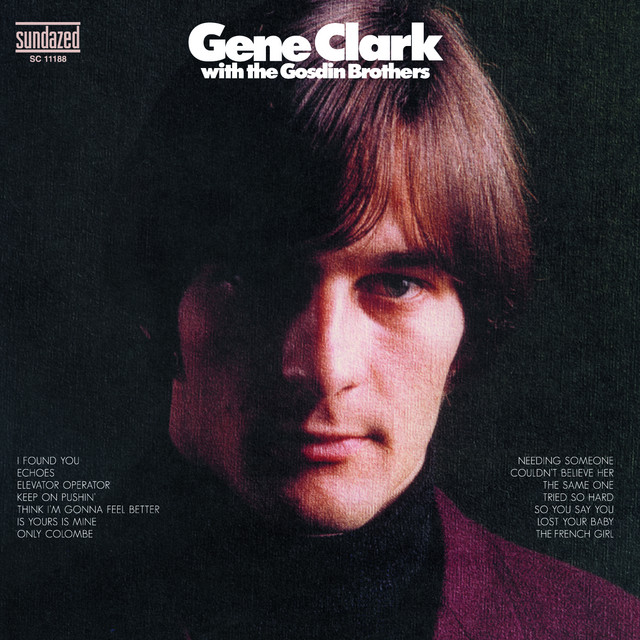
‘GENE CLARK WITH THE GOSDIN BROTHERS’ 
by GENE CLARK WITH THE GOSDIN BROTHERS 

The first Byrds songwriter was not Roger McGuinn, and certainly not David Crosby. Check out the credits on those first three albums and it was Gene Clark’s name attached to “Eight Miles High”, “Feel A Whole Lot Better” and “Set You Free This Time”. He was also the first Byrd to quit, ‘me and my friends got on a plane, one of my friends got off again’ as Croz tells the tale. Gene’s debut solo set from February 1967 has been variously reissued in different forms and mixes ever since, the 1991 Columbia Legacy edition boasting a full twenty tracks, and retitled after the exquisite “Echoes” scored with dancing Leon Russell strings, quite unlike anything else he ever recorded, and worth the price of admission alone. Now returned to its original moody sleeve-photo the album then backtracks to the Beatles-harmonies of “Is Yours Is Mine”, retaining Michael Clarke (drums) and Chris Hillman (bass), before lurching off with Vern and Rex Gosdin onto rusty country trails that the Byrds themselves would eventually follow. There’s a diverse spread of directions across the fourteen tracks, with Doug Dillard’s electric banjo (on “Keep On Pushin’”) and Clarence White’s B-Bender bluegrass guitar. Gene Clark was stubbornly uncompromising, ignoring chart hits and commerce in favour of chasing his own vision. But that vision still shines. 


Published in: 
‘R’N’R: ROCK ‘N’ REEL’ 
 Vol.2 Issue 76 July-August 
(UK – July 2019)


Saturday, 27 August 2022

Gene Clark Live In Wakefield


GENE CLARK: 
EIGHT MILES HIGHER 


GENE CLARK, founder member and main songwriter of the original 
BYRDS, toured Britain for the last time in 1985, during which this 
interview was taped. He died 24th May 1991, after his return to the States. 
This – then, is possibly the text of the last British interview he ever gave... 


It’s the trend-blending factor, the mix ‘n’ match motif. With contemporary musics reducing down to one conceptual digital sampler synthesising and liquidising all our Back Pages, it’s inevitable that consumers are going to sniff out something ROOTSIER, something more REAL. So they’re already digging out lost examples of the successful and now highly collectable re-issue labels like Ace and Kent (delivering Soul), Charly and BGO (Blues and 1960s Beat Groups), Blue Note (Jazz) – and Edsel (psychedelia and beyond). Because the incandescence of their collective roster illuminates today’s shadows the way that only first statements can. And let’s leave TV-advertised compilations out of this, OK? 

Gene Clark made more first statements than most, and it was only fitting that Edsel should have block re-released four of his albums in a shiny promotional mid-1980s package to meet a groundswell of interest in – and increased demand for his work. A set that seems even more essential today, now that Gene is no longer around. On the early Byrds album sleeves, in promo stills and on ‘Ready Steady Go’ he’s there – basin-cut hair, sharp angular profile, gaunt haunted eyes. A founder member of the band whose rarified stratospheric harmonies and janglipop guitars opened the Dayglo floodgates to all things West Coast esoteric and ultra-Hip.


Gene Clark died in 1991. And I well remember the last time I saw him alive. He was playing a supernaturally inspiring gig in the prosperously plush Working Man’s Club atmosphere of the ‘Pussycat’ in Wakefield, Yorkshire. Oddly slotted in as a support spot on a Lindisfarne tour. Backstage the unforgiving white light betrays the odd character-lines, the visible reminders of a quarter-century on the road, but he’s fleshed-out healthy and in good shape. And he’s in a speed-jive motor-mouthing mood, derailing one topic into another, anecdotes to drool over, name-dropping Bob (Dylan), Rick (Danko), Roger (McGuinn), leaving me to pick up the connections like they’re too obvious too explain. Telling me how he got to write the quintessential “Eight Miles High” (a song later revived by as diverse names as Roxy Music and Husker Du). He begins ‘it was me and Brian Jones sitting in a Hotel room on the road when we were touring with the Stones...’ 

And how come, with Roger McGuinn always the accredited leader of the Byrds, Gene got to write the majority of the original material on the first two Byrds albums? Classics like “Feel A Whole Lot Better” (revamped on single by the Flamin’ Groovies, and then again by Tom Petty) and “Set You Free This Time”. He ducks the opportunity to re-write history by McGuinn-sniping, and explains ‘there’s always been streaks that I have in my life where I’ll write a whole bunch of stuff within – like, two weeks. Waking up in the middle of the night just scribbling stuff down, grabbing my guitar, putting it on tape. Then I might not write anything for ages...’ He’s adept at deflecting compliments too, when I tell him the Byrds are acknowledged as one of the first names to ‘intellectualise’ Rock he dismisses it with ‘a lot of that had to do with Dylan too y’know, and John Lennon...’ A likeable guy.


And talking first statements – the mid-1980s Edsel package consists of his solo ‘Roadmaster’ set, originally issued in 1972, and then available only in Holland, featuring sidesmen of the calibre of Sneaky Pete Kleinow and Clarence White. There’s also ‘So Rebellious A Lover’ (1987) recorded with Gene in duo with Textones vocalist Carla Olson, programming Woody Guthrie’s exquisite “Deportees” alongside Phil Ochs “Changes” and Gram Parsons’ “I’m Your Toy (Hot Burrito No.1)” plus the old Creedence Clearwater Revival gem “Almost Saturday Night”. Then there’s the two ‘Dillard & Clark’ albums which Gene cut with fellow-Missourian Doug Dillard in 1969 – ‘The Fantastic Expedition Of...’ (with contributions from Eagles’ Bernie Leadon), and ‘Through The Morning, Through The Night’ which Robert Plant perceptively raided in 2007 for his Alison Krauss collaboration ‘Raising Sand’. Original ground-breaking vinyl beautifully packaged THEN, the intervening years have only added an element of perspective from which they benefit. The first Byrd to quit the line-up ‘before the thing started to fall apart,’ the subsequent Dillard hook-up saw Gene blazing Blue-Grass trails that pioneered the Country-Rock vein later to be more commercially exploited by Leadon’s Eagles. And ironically by the remaining Byrds in a couple of albums time!


Gene attempts to unravel the complex genesis of the project. ‘Just about the time I left the Byrds, Gram Parsons came to town with a group called The Submarine Band’ he recalls. ‘I really loved them the first time I heard them. I loved his voice. I loved his songs. I loved everything. So consequently, when the spot was open in the Byrds they brought Gram into the group. Roger McGuinn had always been ‘Folksy’ anyway, so he dug the concept of doing a ‘Sweethearts Of The Rodeo’ (1968) album. At the same time they’d also approached Doug Dillard on hiring HIM for the Byrds, but Doug said something to the effect of ‘well, I’ve been playing with Bernie Leadon and Gene, and I really like what’s happening there, so I think we’ll follow through with it’. 

‘I had an existing deal with A&M records, and when I presented the ‘Fantastic Expedition Of...’ idea to them they liked it very much. They didn’t know what to DO with it, but they liked it! It was ‘what do you DO with contemporary Blue-Grass in 1968?’’ He breaks down in incredulous laughter at the very absurdity of the idea. ‘And we had a lot of bumps, I mean a LOT of troubles with it. We went down to Nashville and got literally booted outta there, y’know? And even though our record was played quite a bit when it finally came out we had a problem getting it across. It was a very closed door thing, totally unlike the situation today. These days, ANYTHING to do with the Byrds in that area is like – PHEWWW!!!! So it’s completely different today.’


By the mid-1980s, with the albums re-emerging on vinyl, there was a whole new Paisley Underground generation of Dayglo trend-blending mix ‘n’ match bands leeching from those first statements, fine bands like Syd Griffin’s Long Ryders (who Gene recorded with), Rain Parade, and – in case you’ve forgotten, a young REM too! It must have been gratifying for Gene that – having assumed near-legendary status by the mere accumulation of years, his albums were faring so well this second time around? ‘I don’t know’ he muses, more contemplatively. ‘Right now I’m seriously looking forward to the future, and what’s going on THERE.’ 

Unfortunately, although that future – for Gene, was to be limited, the albums are still available. And still well worth your ear-time. He was a hugely likeable guy.


Byrds Gene Clark: Book Review


‘TWO SIDES TO EVERY ECHO...’ 


Book Review of: 
‘MR TAMBOURINE MAN: THE LIFE AND 
LEGACY OF THE BYRDS’ GENE CLARK’ 
by JOHN EINARSON 
(Backbeat Books, April 2005, ISBN0879307935)


The Byrds, ah yes – Roger McGuinn. Except no, not quite. ‘In 1965 Gene Clark was the Byrds’ writes John Einarson in this excellent rigorously detailed biography. The strongest original songs on the first three Byrds albums – the finest debut trilogy in Rock, were by Harold Eugene Clark. McGuinn seems to agree. Talking at the Leeds ‘City Varieties’ he admits how ‘blessed’ the group was to have so fine a writer aboard. But Gene’s were slow-burn songs, initially relegated to ‘B’-sides in favour of Dylan or Pete Seeger covers, because they lacked radio immediacy, revealing their beauty only through repeated plays the airwaves couldn’t afford. But “Feel A Whole Lot Better” – later peerlessly covered by the Flamin’ Groovies, and by Tom Petty, “I Knew I’d Want You”, “Set You Free This Time” and the rest, are class compositions. Coming from a thirteen-kid Catholic family with Irish and Cree Native American blood, Gene was rugged and athletic, but also intense and wired. A complex, insecure, troubled man, prone to swings in temperament that Einarson’s investigations now interpret as evidence of a bipolar condition. His sister Bonnie recalls how his music began, ‘after Gene saw Elvis, all he wanted to be was a Rock star.’ 

During his fresher year he joined high-school band Joe Meyer & the Sharks, moving from there into the ‘Michael Row The Boat Ashore’ coffeehouse folk-thing with a doctored ID. By 12 August 1963 the eighteen-year-old Gene was recruited into the wholesome hit-making New Christy Minstrels alongside Barry McGuire. He cut records with them (the first called “Saturday Night”), and appeared on ‘The Andy Williams Show’. They did a special White House performance for new President Lyndon Johnson in January, but to Gene, the group’s cheerful family-friendly choreography was frustratingly ‘square’. At around the same time he heard the Beatles for the first time, on a jukebox in Norfolk, Virginia, and pumped nickels all night to hear them again. He was not only listening, but analysing their dynamics, how they did it, and why what they did worked so well. It was the catalyst he needed.

 
He quit the Christy’s – before he was fired and headed for LA, and fame with the Byrds. Two American no.1 singles with “Mr Tambourine Man” c/w Gene’s “I Knew I’d Want You” and “Turn! Turn! Turn!” c/w Gene’s “She Don’t Care About Time”, plus hit albums ‘Mr Tambourine Man’ (June 1965, CBS BPG62571), ‘Turn! Turn! Turn!’ (December 1965, CBS BPG62652) and ‘Fifth Dimension’ (July 1966, CBS BPG62783). Einarson clarifies the group’s fractious internal politics in ways that my reading of Johnny Rogan’s ‘Timeless Flight’ (Gullane, 1990) never quite did. Jim McGuinn and Gene Clark, with David Crosby were three strong-minded creative wills tied into uneasy compromise and permanent simmering contention. With McGuinn’s icy intellect, and David Crosby as the impish meddler, all complicated by their collective envy of Gene’s writer-royalty cheques. Until, unsettled by the sudden status afforded them – as the American Beatles, Gene was the first to quit, shortly after initiating their finest-ever record, “Eight Miles High”. He was the character in David Crosby’s “Psychodrama City” tale where the Byrds got on a plane, and ‘one of my friends got off again,’ Crosby adding ‘to this day I don’t know why.’ The reasons included tensions and group rivalries amplified by their stratospheric celebrity.

For Gene, ill at ease with stardom, there were to be a series of solo albums, groups, lost opportunities, and new beginnings. He went on to pioneer ventures into roots and country that would be more lucratively exploited by others. But he would forever be an ex-Byrd, living well on Byrds-royalties. His solo work was varied – from the textured density of ‘No Other’ (1974, Asylum 7E-1016), to the stripped-down ‘Two Sides To Every Story’ (February 1977, US RSO RS-1-3011), but nothing he did would produce a signature ‘Gene Clark sound’ strong enough to replace what had gone before. Never quite ‘in synch with his time,’ his albums tended to be overlooked, only to be subsequently recognised as influential and reclaimed by music historians later. 


As the Byrds ‘Younger Than Yesterday’ (February 1967, CBS BPG62988) LP emerged, its high-profile launch eclipsed Gene’s first solo work ‘Gene Clark With The Gosdin Brothers’ (February 1967, US Columbia CS9418) which includes his enchanting “Echoes”, and features sidesmen Clarence White and Doug Dillard. ‘The Fantastic Expeditions Of Dillard And Clark’ (October 1968, A&M SP4158) with Doug Dillard and Bernie Leadon met a similar fate, even though it premiered “Train Leaves Here This Morning” which co-writer Leadon would take forward onto the Eagles mega-selling debut LP (Gene’s jokey ‘B’-side version of Elvis Presley’s “Don’t Be Cruel” would be added to the 2001 Edsel-label CD reissue). The second Dillard And Clark album ‘Through The Morning, Through The Night’ (August 1969, A&M SP4203), recorded with an expanded line-up of Donna Washburn, Byron Berline, Sneaky Pete Kleinow, Chris Hillman and Michael Clarke contains no less than two hauntingly beautiful Gene Clark originals which would achieve acclaim as part of Robert Plant And Alison Krauss’ ‘Raising Sand’ album in 2008 (it also includes covers of Don Everly’s “So Sad” and John Lennon’s “Don’t Let Me Down”), yet at the time Gene’s reluctance to play the industry game, his unwillingness to tour, to do interviews and promo meant that such albums consistently failed to reach the audiences they deserved, and generated little more than critical respect. His initially stabilising marriage to Carlie, and the country-comforts of Mendocino ran aground. There was a damaging relationship with Terri Messina, and roaring lost months of booze and narcotic excess with Doug Dillard and Jerry Jeff Walker. While touring, their bar bills far exceeded their weekly takings. 

There was a shaky Byrds reformation in which old grudges, animosities, and antagonisms resurfaced, David Crosby – as the most commercially successful survivor of the ‘Mr Tambourine Man’ line-up, revelled in assuming production duties, mixing McGuinn’s jingle-jangle low and excluding all but two new Gene Clark songs. There were also contentious McGuinn, Clark And Hillman reunion dates, but the rigours of touring itself forced Gene back into chemical dependence. Contracts lapsed. There was litigation over the rights to the Byrds name itself, even as Gene was reduced to touring as a kind of Byrds tribute band. There was stomach surgery, then, when – for the final time, all five original Byrds were together for their induction into ‘The Rock ‘n’ Roll Hall Of Fame’ – 16 January 1991, there was a partial reconciliation, of sorts. Shortly after, during duo recording sessions with Carla Olson, Gene was finally found dead, aged forty-six. The coroner’s verdict was heart attack. But to Einarson, Gene Clark ‘had a fear of success and whenever it came close his self-destruct mechanism activated.’ ‘He couldn’t handle fame’ agrees McGuinn. But when I saw Gene at the Wakefield ‘Pussycat Club’ shortly before he died – playing support to Lindisfarne, he did the full version of “Mr Tambourine Man”. And it was mesmerising. This fine book is all you need to know about the ‘Life and Legacy of Mr Tambourine Man’. 

 
Published in: 
‘ROCK ‘N’ REEL Vol.2 No.11 (Sept/Oct)’ 
(UK – August 2008


Friday, 26 August 2022

Live in Leeds: Roger McGuinn


‘A FLIGHT THROUGH 
McGUINN’S BACK PAGES…’ 


LAST NIGHT A RECORD SAVED 
MY LIFE: ‘MR TAMBOURINE MAN’ 


All ‘Golden Ages’ are brief testosterone-powered interludes coinciding with awkward adolescent sproutings and accelerating biorhythms. Yet that opening startle of rippling jingle-jangle Rickenbacker still shocks. We knew it was Dylan, of course. That only increased its relevance. Dylan spoke in syllables dreadful strange. ‘Ancient empty streets too dead for dreaming,’ so he’d been to Hull? yet transfigured into allusive poetry on the edge of suggesting so much more. And by up-gearing the lyricism of Folk, while allying it to a Rock ‘n’ Roll backbeat it was side-shifting Pop’s vocabulary into new fifth-dimensions. Granting it the gift of literate articulacy. Into Rock. A metamorphosis begun with David Crosby emerging from ‘A Hard Days Night’ high on its energies, his life, his music transfigured too.


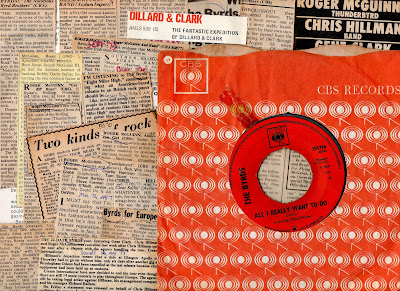
The Byrd’s aloof mystique, glimpsed from a single promo shot in ‘Record Mirror’, was immaculately impossibly hip. Razor-perfect Indie fringes emerging from ‘With The Beatles’-darkness. Inaccessibly West Coast. Naturally, on the other side of lake Atlantic, the Yardbirds were just as wonderfully strange, by that same distancing process. But that was there, this was here. A single orange-label 7” record (CBS 201765) in a matching orange CBS-logo’d sleeve. Hearing it once in the listening booth was enough, top floor of ‘Hammonds’ department store, that first hot week of June 1965. Pared down from Dylan’s densely-worded screed into radio-edit size – to chorus, single verse, chorus, until it crackles with futuristic electricity, and a stratospheric glide of alien harmonies. With only enough coins to either make the purchase, or bus-ride home, I slouch the four miles clutching it every pace, conscious of the pulse of vibes conducting up from black vinyl through my fingertips. Over the coming weeks it climbed the chart, to no.1 for a fortnight 22/29 July, before ceding the top slot to “Help”. 

I never got to see the Byrds while they were together. But later I’d get to see solo Gene Clark magically spin out the full Dylan verse-version, in a low-rent club in West Yorkshire. Then I saw David Crosby with Crosby, Stills & Nash. And I watch solo Roger McGuinn doing “Mr Tambourine Man”, sitting on a chair centre-stage at the Leeds ‘City Varieties’. Each time special. There were other life-changing 45’s. The Byrds themselves would do it again in a few years time with “Eight Miles High”, but “Mr Tambourine Man” would always encompass vistas of limitless possibilities unequalled before… or since. A testosterone-powered thing, a ‘golden age’ maybe, but one that happened at exactly the correct point in my precarious evolution. 


Concert review of 
ROGER McGUINN 
at ‘The City Varieties’, Leeds 
(Monday 24 June 2002) 

Leeds. The decorous ‘City Varieties’ Music Hall, home of TV’s retro-cult ‘Good Old Days’. Everything here is dark red, from the brocaded walls to the velvet upholstery. And – it must be said, it’s a venue with an intimacy that suits Roger McGuinn. Squinch your eyes, it’s almost a throwback to the Greenwich Village coffeehouse folkie scene where it all began. When he was still called ‘Jim’ McGuinn, and when he started mixing Beatles’-covers in with his traditional arrangements, to unsympathetic response from hard-core purists. Tonight has that kind of personal one-to-one feel with the audience. Except that now he has history. 

He opens with “My Back Pages” played on a white twelve-string. A song already wistfully nostalgic for changin’ times of political (un)certainties and abstract threats too noble to neglect. Dylan wrote it for his 1964 ‘Another Side Of…’ album, the Byrds version following a few years later, on their ‘Younger Than Yesterday’ (February 1967) album – which obliquely derives its title from the lyric. Roger replicates the pealing guitar-solo that catches its yearning melancholy so exquisitely. He wears a black hat, disciplined beard, glasses, and a black no-logo ‘T’-shirt. He sits on a high stool, stylishly toe-tapping, little more...


The evening began with the jazz-inflected vocal-style of Rebecca Hollweg, with gossip about her involvement soundtracking the short 16mm Sara Cox movie ‘The Bitterest Pill’ (1999). She’s good, but then McGuinn gets into relating how he got involved in a ‘low-budget motorcycle movie’, how Dylan wrote some lyrics on a napkin for Peter Fonda and told him ‘give these to McGuinn, he’ll know what to do with them.’ Then he plays the results – “The Ballad Of Easy Rider”, conjuring elegiac images of how it played out over the closing credits of that seminal counter-culture movie. From the same source Carole King’s “Wasn’t Born To Follow” originally came with the Byrds phased guitar cascading in light-bursts through ‘leaves of prisms’. It still works, even when pared down to McGuinn’s simple acoustic. 

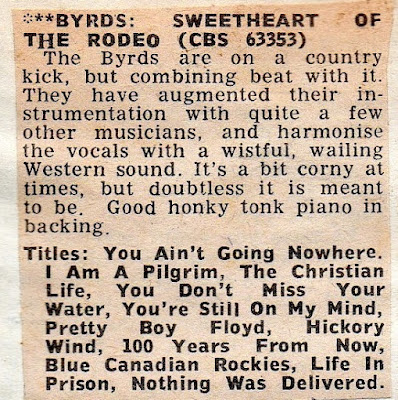
Of course, road-songs are a continuity in American culture, which he illustrates with a ‘contemporary folk song’ called “Driving High, Driving Low” made up of CB-radio dialogue. ‘I’ve always been a science and technology buff’ he admits, which provides a neat light-speed jump to introducing “Mr Spaceman”, that quirky appeal to strangers in saucer-shaped lights to take him star-tripping to CTA102 and beyond. He continues with ‘the first country-rock song I did’ – “You Ain’t Going Nowhere”, lifted from Dylan’s ‘Basement Tapes’ under Gram Parson’s influence as a trailer-single for the divisive ‘Sweethearts Of The Rodeo’ (August 1968) album which upset as many fans as it created new ones. Now, well beyond all the heated analysis, it sequences smoothly into the set’s contours. 

He’s sitting alone on stage, until he reaches to sip from a Volvic bottle, then he’s accompanied by three dark ghost-shadows imitating his actions behind him. All manner of metaphors could be strung out from that, about former colleagues, creative feuds, rifts and reconciliations, thefts and collaborations, but best not to. His voice is still as curiously high, driven by his instantly distinctive guitar-work. Rivers flow. That’s enough. With an effortlessly über-cool aloof persona – wasn’t that always the Byrds ‘unique selling point’? and still slightly detached, he nevertheless sparks ripples of warm connection that others… say, Paul Simon, can never achieve. An already self-confessed tech-geek, he now explains his ‘Treasures from the Folk Den’ project, through which – since around 1994, he’s been using http://mcguinn.com online resources to upload and archive the traditional songs he first encountered during his coffeehouse days, complete with lyrics, guitar tablature, and tales about the musical heroes he first found singing them. 

He illustrates with “Pretty Boy Floyd”, “Finnegan’s Wake” – as done with Tommy Makem on the first spin-off CD fuelled on something he describes as ‘the creature-whisky’, and “Fare Thee Well” from Pete Seeger & Josh White Jrn. And it’s evidence of the kind of new-old synthesis that created the Byrds in the first place, a growing-apart together, cultural opposites – yet alike. But should these esoteric new ventures prove distracting for Byrdmaniax he throws in “Chestnut Mare”, the group’s surprising final UK chart record (no.19 in February 1971). Then follows it with the complex guitar phrases of “King Of The Hill” from his 1990 solo album ‘Back From Rio’. He explains how he wrote it with Tom Petty, who’s own career – and especially “American Girl”, started out very much in McGuinn’s stylistic wake. Then his Cajun-flavoured “Lover Of The Bayou” from his 1975 ‘Roger McGuinn & His Band’ album, before returning to the Byrds via Pete Seeger’s “Bells Of Rhymney”, with the explanatory anecdote about how, after performing the song for nigh on twenty years, a Welsh fan finally corrected his pronunciation, so he now takes care to attempt a more authentic ‘Bells Of Rumney’, with fine acoustic interplay. 

Drawing things towards a Byrds-centred close he briefly tributes how the group was ‘blessed to have Gene Clark’ focussing the line-up of the first three albums, and does Gene’s “Feel A Whole Lot Better” between verses of “Mr Tambourine Man” and “Turn! Turn! Turn!”, playing both rhythm and lead guitar. After a tactful pause he returns for an encore that encompasses an amazing “Eight Miles High” replicating the record’s full mind-skewing guitar-fragmentations live and solo while throwing in ‘Ravi Shankar, just for fun’, a ‘scream-alonga-delica’ with “So You Wanna Be A Rock ‘n’ Roll Star”, then returning to ‘just get an acoustic guitar’ for the closing “5D (Fifth Dimension)”. Having defined and mapped the sound of the last half-century to the extent that generations of pale white jingle-jangle Indie guitar-bands breathe him as second nature, almost without realising it, here within the dark red brocade walls and velvet upholstery of the ‘City Varieties’, Roger McGuinn shows how tradition and technology can respect those roots, and yet still take them restlessly further, into yet newer incarnations…


Book Review: 'So You Want To Be A Rock 'n' Roll Star: The Byrds Day-By-Day 1965-1973'


SO YOU WANT TO BE A 
ROCK ‘N’ ROLL STAR...


Book Review of: 
‘SO YOU WANT TO BE A ROCK ‘N’ ROLL 
STAR: THE BYRDS DAY-BY-DAY 1965-1973’ 
by CHRISTOPHER HJORT 
(2008, Jawbone Books, ISBN 978-1-906002-15-2) 

It’s five decades since “Mr Tambourine Man”, but still the story resonates. Music is not an exact science, but this large-format book lavish with evocative clippings and memorabilia, covers the years 1965 to 1973, with a lead-in back-story and a follow-on ‘what happened next’ chapter, covering pretty much all of the terrain between. All successful long-term bands have a unique chemistry with a shifting hierarchal structure. For the Byrds that was never the case. They were never a garage-band. Nor were they ever school-friends. They all had separate careers, and recording histories, long before they even met. When they initially signed to CBS it was only Roger ‘Jim’ McGuinn, David Crosby and Gene Clark who inked the contract – they were officially the only real Byrds. And they were all singer-songwriter-guitarists with undefined overlapping group-roles, all jostling and competing for the centre ground. In such a light the surprise is not that the line-up fell apart so early, but that it survived as long as it did. Yet, within a matter of months, taking the pulse from the British invasion, but its romantic lyricism from Dylan, they hit massively on both sides of the Atlantic, with one of the decade’s most defining singles. And ‘Mr Tambourine Man’ (June 1965) was the first of their suite of pristine albums. If James Stewart once said that film actors give their audiences ‘pieces of time’, the same thing is equally true of recording artists. They give little two-and-a-half to three-minute singles-length pieces of time that indelibly freeze the moment, the event, the emotion, and that stay with the listener forever. The Byrds provided more pieces of time than most. After “Turn! Turn! Turn!” topped the chart, “Eight Miles High” set the advance tremors for psychedelia, and carried all the way into the San Francisco sub-culture. And more. These are stories that echo down through the years, and they’ve seldom been told better. 

Published in: 
‘ROCK ‘N’ REEL Vol.2 No.13 (Jan/Feb 2009)’ 
(UK – January 2009)


Saturday, 13 August 2022

Live: Martin Carthy in Wakefield (1981)


MARTIN CARTHY: 
JOUSTING WITH 
‘PRINCE HEATHEN’ 

Live Review Of: 
MARTIN CARTHY 
at the Labour Club, Wakefield 


Martin Carthy has hypersensitive fingers. He also has a CND earring that catches the light and throws it back in soundless chromatic explosions as he grimaces and rubber-faces degrees of intense expression. His tongue extends, then laps in hungry questing concentration, critically tasting each note he’s reeling and jigging out of his battered acoustic box, wincing in real physical pain at imagined imperfections that only he (and Segovia!) could detect. Back in the roaring ‘Prince Heathen’ days when he jousted the Fairport Convention’s Dave Swarbrick up and down each Club and Festival on the Old Albion circuit, and when he commandeered the Steeleye Span Trojan Horse as a vehicle for his own particularly pure brand of Folk-Rock, he held the long-distance guitar-tuning record. Now he’s not so much abandoned that claim as developed it into an ongoing situation with continual mid-course corrections to the chosen instrument of his profession and craft. 

In appearance he’s not much different to that impish Romany visage that grins genially out of the album-sleeve mugshots, his hair hacked short, but uncombed, his clothes uncontrived but ‘right’, lived-in, comfortable, same as the resonance of his corroded draught-bitter voice and his easy line in between-numbers humour. His set plunders each stage of his long career. “Skewbald”, the gambling song from his Steeleye repertoire, thefted onto so many ‘Best Of…’s and sampler compilations it must be in line for some sort of record itself. Then there’s the bawdy comic “John Blunt (Child 275)” from his early solo vinyl ‘Shearwater’ (1972), and “King Henry” from his mid-seventies ‘Sweet Wivelsfield’ (1974) album. His songs – researched with scrupulous care from largely traditional sources, demand your attention. Although strategically spaced with humour and double-entendre they more often depend on subtle nuance and an attuned ear for effect – but, particularly for the very haunting “Wind That Shakes The Barley” a little rigorous attention isn’t much to ask. 


At the intermission, slurping the half-pint of Theaksons I’ve just plied him with, he cheerfully regales how the ‘New Socialist’ magazine has consigned all of what it arbitrarily terms ‘pre-electronic’ music to the great dumper of non-relevance. Yet who with ears could fail to find lurking contemporary analogies in the magical “Village Lady” about racial cross-marriage, a song he confesses to be ‘my favourite’. Or in the unaccompanied booze-‘n’-riot epic that leaves ‘a carpet on the floor, of skin and hair’ – a lyric worthy of Punk-band Exploited at their most horrendous! And then again, how in techno-speak could you perpetrate such a lushly erotic contrivance as ‘I planted seeds in the grove, where grew no green,’ and that line in a song he claims to be based in ‘panic’. He glances down at my tape-machine and grins. ‘Are you intending to record this? I don’t think it’s going to work against all the background sound.’ Yes, I was intending to record our conversation. And he’s right, our voices are drowned in other other people’s conversations and clinking glasses. 

But Carthy – whose much-imitated vocal delivery, phrasing and song-selection, already imprints and bedrocks an entire generation of performers, will still be playing to sell-out audiences when those would-be trendies are out hunting yet more bandwagons to jump, chasing the next-but-several trend with increasing desperation and diminishing credibility. With just his two guitars, regularly switched and even more regularly tuned, and an uncluttered vocal architecture both as solid, and as full of character tales as Wakefield prison, he winds through the narrative “Lowlands Of Holland” about the press-gangs. Then into the sparse instrumental “Lord Byron”. He shuffles the running order at whim, and forgets titles until he’s well into third verses. 

He sings “Reynard The Fox”, a fox-hunting song seen ‘from the point of view of the fox,’ then a gipsy song called “Sheep Crook And Black Dog”, and follows it by delivering a hard political “Geordie”. Those with a bent for academic analysis could probably come up with some very profound interpretations of “The Siege Of Delhi”, a ‘beautiful song to commemorate an event of unbelievable ghastliness,’ they could also probably do a neat line in Carthy’s oeuvre sending down roots through the concrete and the asphalt, the glass and the steel, the apathy and the alienation, to plug into the ancient eternal machineries of human motivation, the continuities of sex, conflict, alcohol, jealousy, violence, death and the supernatural. But the songs say it all far more concisely. And the album he’s currently recording for the Topic label – ‘Out Of The Cut’ (1982), with fellow ex-Steeleye Spanner accordionist John Kirkpatrick, trumpeter Howard Evans and the mighty Richard Thompson, will bring it together far more enjoyably. 

With 1981 flying a whole fistful of sold-out Festivals, and Folkies such as Steve Ashley and Leon Rosselson leading the vocal side of the great CND revival, Martin Carthy could conceivably find himself once again coasting in on a minor, but most interesting wave. Not that that’s likely to worry him over-much…