Thursday, 26 February 2015

Travel - 'Crete 1992: Sex & Death On The Island That Time Never Forgot'


CRETE: 
SEX AND DEATH ON 
THE ISLAND THAT 
TIME NEVER FORGOT


 Crete, this magic is no myth. But in 1992, on nightly 
TV, death is a spectator sport. And grudges 
die hard on an island with a 5,000-year history


Outside it’s heat-blasting in the upper 90’s.

Here, the rippling shade of mauve bougainvillaea washes the TV colour into odd distortions. There’s some on-screen confusion blurred with a gibberish foreign commentary. Local men with spiky moustaches and George Michael eyes watch with heightening interest.

Outside, beat-up cars in the super-heated air orbit a traffic island. Beyond that, the beach.

Explosions of milling TV people throw stones. Some carry blue flags. Cops wield batons and perspex riot shields. There’s tear-gas, and there are shots. The locals begin stamping their feet and shouting at the screen. One of them yells to a friend in a passing cab. The taxi sags to a stop in half-orbit, the guy gets out. He’s built like Bluto from ‘Popeye’, but perhaps his Engelbert Humperdinck moustache is a mistake. He ambles leisurely across to the bar where he gets into the excited pointing, yelling, stamping and gesticulating.

Meanwhile, car horns blast as they veer in a Demolition Derby around the slewed and abandoned taxi, passing on the inside or the outside at whim.


Rethymnon, Crete. On TV, an incident from the Cyprus Green Line. Volatile divide and UN buffer-zone between Greek and Turkish zones of that divided neighbouring island. August. Solomos Solomou, a 26 year-old Greek Cypriot tried to climb a Turkish flagpole to rip down the flag. He was hit five times by Turkish gunfire and killed on prime-time TV. This happened during a massive protest demonstration following an earlier death when his cousin – Nationalist activist Tassos Isaac, had his head beaten to a bloody pulp with staves and crowbars by a Turkish mob. The burial rites needle an already flashpoint situation, becoming a deliberate provocations against the island’s 110-mile faultline partition. There are police and National Guard cordons with circling security helicopters.

The Greek Archbishop Chrysostomos, while making coded appeals for calm, praises the ‘Greek fighting spirit which leads’ the demonstrators, calling them the ‘descendants of heroes and martyrs’. Turkish Foreign Minister Tansu Ciller retaliates by adding ‘no-one lays a finger on the flag. If anybody has the nerve to do that, we will break their hands.’ Neither community admits the possibility of conciliation. The 22-year mutual intransigence is a fact of life. Earlier that year Greek and Turkish forces clash over the ownership of an uninhabited Aegean islet off the Turkish coast. This is cold war in a hot climate. Grudges die hard here. Its TV coverage is a spectator sport.

Crete is a time-sliding foray into multiple levels of pre and post history, from landing at Heraklion where runway flight-path lights are made up of blazing oil-drums direct from Fred Flintstone (‘YABBADABBADOO!’), to an apartment with regular power-cuts and irregular undrinkable water with the consistency of warm sand, where Greek narrow-gauge plumbing means don’t flush toilet paper – place it in the bin provided for collection later. And it’s still stunning. Beyond the balcony, goats, chickens and children scrat while semi-feral cats eat slim green lizards in the kind of picturesque squalor that the Aegean sun makes magical. Dry rusting Martian rocks hold the lean-to roofs in place, but they’re simultaneously drenched in vines and luminous pink oleanders.


At 250km Crete is the largest Greek island. And the most southern. Next stop that way is Egypt. That way to Libya. It has Hersonissos for Clubbers, where dedicated dancers can, with persistence, find the best Belgian House or Italian Techno, not quite at Balearic density, but enough bpm to sweat to. There’s Aghios Nikolaos for the family touristy thing. And in Arkadi they’ve got the naked skulls of nineteenth century martyrs leering out from the ossuary wall. But I’m in the outer rim of Rethymnon by the darkly romantic warrens of the Old Town. Behind the harbour is a small Roman amphitheatre from something-something BC. It’s still in occasional use for musical or theatrical events. Above the harbour there’s a Venetian Fortress from five hundred or so years later. And built into its highest point there’s a mosque from the Ottoman Turk occupation from 1669. Deliberately sited in a kind of bragging religio-cultural triumphalism, a Muslim monument surmounting a Christian bastion.

When they first brought civilisation north from the Nile towards barbarian Europe, Crete was its most obvious first landfall. Here is where Europe began. Its Egyptian matrix still conspicuous in the exclusively sideways facing figures on the wall mosaics at the Palace of Knossos. This most ancient of strongholds is a Conan fantasy of immense wood and stone. These are the labyrinths, already ancient when Rome and Athens were tribal settlements, where the monstrous man-eating bull-headed Minotaur was butchered by the heroic Theseus. It probably became a swords-&-sandals epic for late-night TV starring Steve Reeves and Minotaur-SFX by Ray Harryhausen. This is a place so old it’s where history dissolves into myth. It’s a Stone Age palace, built into the slope of a hill because they hadn’t yet mastered the architectural subtlety of constructing a second storey above the first. The modest throne room has a modest wooden throne. Something like four thousand years ago the neighbouring volcanic island of Santorini, black sand and white houses, blew itself to pieces – some say giving rise to the legend of Atlantis. Its subsequent volcanic nuclear winter hastened the collapse of Crete’s antique Minoan culture. They’re digging out similar structures on the crescent of what’s left of Santorini.


In the eucalyptus shade of Heraklion square, men wear expensive watches, but seldom glance at them. Menu displays outside the Tavernas are all identical, and bear little relation to the food on offer. By the Rimondi fountain just 5km from Knossos, there’s a Quinten Crisp look-alike heavy loaded with expensive gold jewellery. One of Crete’s last Stately Homo’s, he preens and struts with limp-wristed dignity, before taking a camp cappuccino like he’s holding court at some effete soiree. His story must be an equally intriguing one. But hey – the Greeks invented it, didn’t they? Explicit Man-2-Man love is there on the urns and wall-murals, still available in reproduction ‘museum’ copies in most tourist shops. It’s there in Plato’s ‘Symposium’ with Pausanias and Agathon, and in Aeschines prosecution of Timarchus in the fourth century BC. Well – no, they didn’t really invent it. Every culture on the planet did.

But Cretan sexual politics are still in uneasy flux. There are unreconstructed hominoids lounging outside every corner eaterie, strutting macho poses of the most neolithic pre-Feminist kind. And the boringly predictable Mediterranean stereotypes hang out in every bar, working their inexorable knicker-dropping sexual magnetism on English, German and Irish tourists from paler, colder climes. While the Cretan girls exist on an entirely more advanced evolutionary plane, smartly efficient and upwardly mobile. They weave on scooters through the medieval shadows of the Old Town past the leather shops and the luminous jewellers where they negotiate sales of ‘Museum Copy’ Octopus broaches, ear-rings made of Cretan Double-Headed Axes, figurines of the bare-breasted Minoan Snake Goddess, vases decorated with the vaulting bull-dancers of Knossos and priaptic Satyrs.


A woman from Wicklow, in her late forty-somethings, is on a menopausal ‘Shirley Valentine’ dream-trip, hunting her dark Tom Conti. A postcard home about it will cost her just 120 GRD (Greek Drachmas). She lounges on the beach showing enough bareable flesh to make several regular-size volleyballs. Her red mosquito-bitten tan defined in glistening strips of painfully successive exposure. She’s playfully tutoring Stefanos, the parasol attendant, in correct Wicklow pronunciations. He exudes athletic horniness, has chest-hair like black palm trees, cut-off jeans, and a cash-belt. He humours her patiently as she flirts ineptly. Then he shoves her lounger rental into his belt and stalks off. She smiles approvingly. He smiles knowingly.

Time only seems to fully up-gear from pre to post-history on the beach. Here there are liquid-dark girls in minimal clothes who make the ‘Baywatch Babes’ look well-overdressed, and enough bare breasts to emphatically prove that all women are not born equal. Just what is the fascination that these quivering protuberances of fleshy fat tissue exert on the vulnerable male psyche? Who knows? Just enjoy. They, the cheap wine, the Tzatziki Dip, the Xifias Swordfish, the veggie Kolokithea Tiganite , the Tsantalis Ouzo – and even the Demolition Derby traffic, all conspire to make new myths rich enough to drown in.


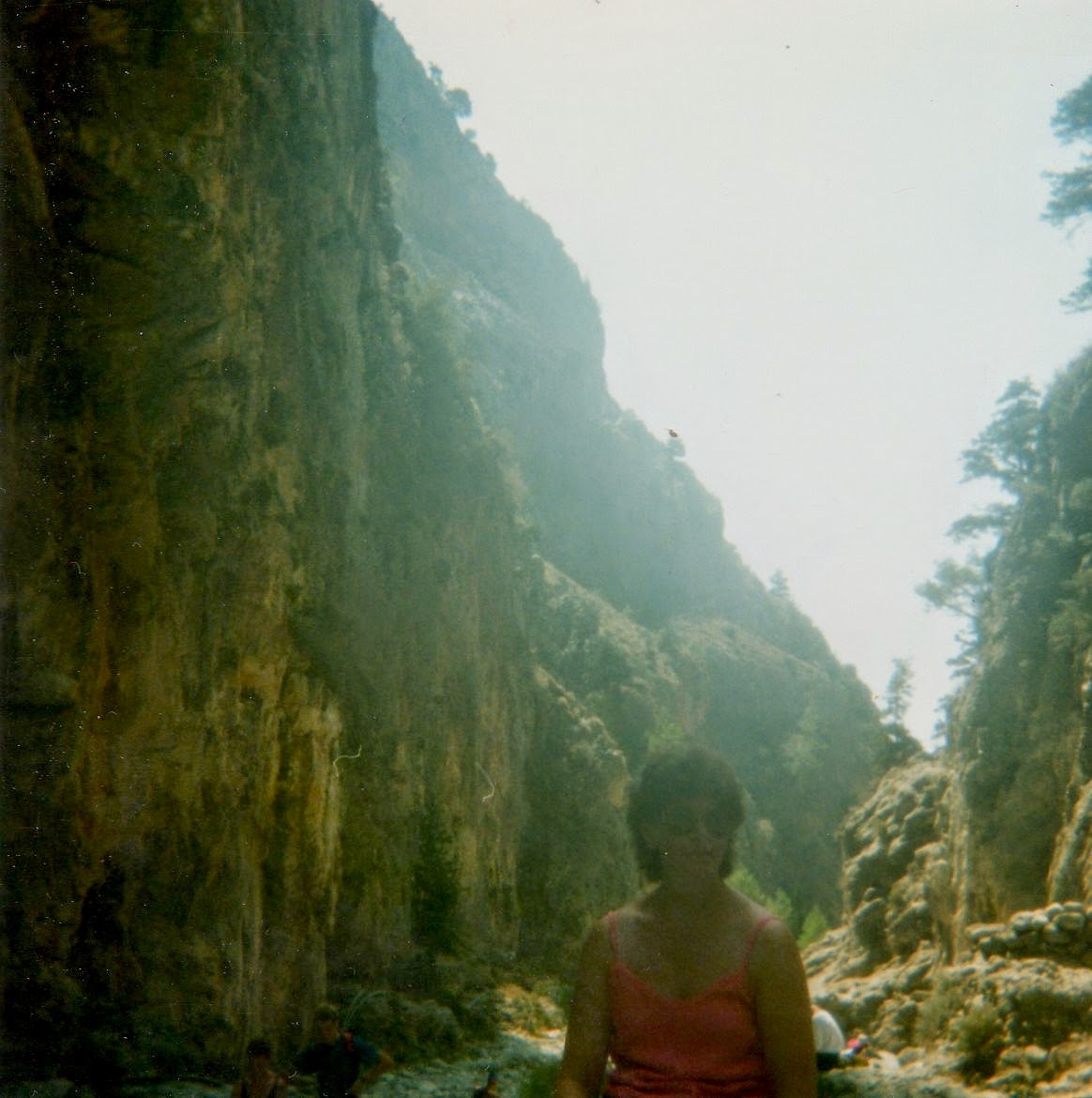
But in the meantime, this is the island that time never forgot. It is now exactly twenty-four hours since this time yesterday. A black crone shoo’s irritably at the German with the camcorder. This is good. She’s shrivelled-up, a wrinkled Mother Theresa with a moustache. He screws his eye harder into the view-finder and zeroes in on her. She sits on a wall of dry stones. There’s a leafless tree above her. And above that the sheer stratification of the Samaria Gorge, a vast Cathedral of Rock. Nature on acid. Here, geological ages are squashed one on top of the other. Scrawny Kri-Kri goats climb in the tree. The German with the camcorder focuses closer. She lops down off the wall to avoid him, hiding her face. She moves away between the goats. He follows her, video raping relentlessly. She scrunches up pebbles and hurls them inaccurately in his direction. This is even better. Action! It’ll look great back home in Düsseldorf.

The Samaria Gorge is 300 metres deep, and – at 18km is Europe’s longest. The hallucinogenic air is pine-scented. The freezing stream down its centre is fed from the flower-filled NW valleys and the rugged White Mountains, including Mount Ida which often stays snow-capped into early spring.


I watch the German video-raping the Cretan crone. The most recent invasion in Crete’s long history and prehistory of invasion (at least, prior to the Turkish attack on Cyprus in 1974 which established the Green Line enclave) was the German airborne assault and mass parachute-drop in May 1941. Grudges die hard here. I feel a strong compulsion to intervene, a kind of ‘hey, leave her alone can’t ya?’, but I don’t. Instead I go back to the apartment where ants crawl across the floor and stranger insects crick and whirr somewhere beyond the balcony, and I write this. Here’s-Backatcha-Kraut! From the balcony, as the sun sets, the dome of the Turkish mosque above the Greek harbour bites an exact curve from its red disc. Probably the alignment is deliberate.

Crete has five thousand years of history. Five millennia. But Greece and Turkey are now joint members of NATO, and may soon be partners in the European Union. Political faultlines and Cypriot Checkpoint Charlie’s may have to be resolved. The alternatives are already spectator sport on nightly prime-time TV.

Two days later, off the long-winded island-hopping ferry at Bodrum, the Turkish customs guy sees my Knossos T-shirt. ‘You like Greece?’ Then snorts a derisive laugh as I nod. ‘Turkey much better!’ Grudges die hard here.


Published in:
‘LATERAL MOVES no.21’ (UK - June 1998)

Tuesday, 24 February 2015

'Jeff Hawke: Titan Of The Spaceways'


JEFF HAWKE: 
‘TITAN OF THE 
SPACEWAYS’ 


The classic JEFF HAWKE science fiction picture-strip ran in 
the ‘Daily Express’ from 1954 to 1975. Now ‘Titan Books’ 
have produced two lavish collections of stories from the series. 
ANDREW DARLINGTON explores the books and examines 
the fascinating history behind them… 


My paper-round took me through the ‘Profumo Scandal’, ‘The Great Train Robbery’, and the early American Gemini space-shots – roughly 1961 to 1964. Reading door-to-door I got pretty-well genned up on such topical events while elsewhere, though I confess I also followed ‘Garth’ regularly in the pre-Maxwell ‘Daily Mirror’, my favourite daily picture-strip fix was ‘Jeff Hawke’ in the pre-tabloid ‘Daily Express’. Just three meticulously executed frames a day could rock my fervid adolescent imagination through dark infinities of space and vast eternities of time in the company of comicdom’s most intoxicatingly bizarre creations – Tallid The Reasonable Fish, Crab Creatures from the Crab Nebula, the mischievously evil Chalcedon, the nervously apologetic single-eyed Kolvorok, Ramedd-Flaa the ultra-entity – who contains the blueprint of all galactic life-forms, and much more – a querulous, bickering, bombastic, cowardly and ludicrous menagerie of beings with beautifully conceived biologies and irresistible characterizations.


‘Jeff Hawke is the best science fiction strip EVER’ opines Dave Gibbons – artist for ‘Doctor Who’, ‘Dan Dare’ and ‘Rogue Trooper’, ‘the rich complexity of its writing and artwork are unsurpassed.’ Of course, he’s correct. An alien sphinx that doubles as a starship? A kidnapped Loch Ness Monster abducted and taken to mate with a similarly endangered species on another world?, and always the fascinating overlap between ancient mysteries and future terrors. Hawke’s creator – Sydney Jordan, describes his favourite tale, “The Immortal Toys”, as one that shifts from a ‘Spielberg-like opening sequence, where the latest in Edwardian technology is set against a science infinitely older,’ to a storyline that moves ‘effortlessly forward in time, so that we are reminded how transient the term ‘latest’ can be when applied to scientific progress.’ Heavy stuff. Yet hugely readable.


Wing Commander Jeff Hawke was launched just four years after Dan Dare had exploded ‘Eagle’ into national mythology, and – like Dan Dare, sometimes used photogenic sessions posed by professional models for art reference. ‘The discerning may recognise, from my drawings of Hawke, that I used Hans Meyer as a model – he was later to be cast as the sympathetic Hauptmann Ullman in the BBC-TV series ‘Colditz’.’ Sydney Jordan, a skilled graduate of the Aeronautical Technical School in Reading, worked on ‘Dick Hercules: Sixth Form Muscle-Boy’, going on to invent and run Jeff Hawke, which he did from 15 February 1954 – with a story called “Space Rider”, until 1 November 1975, by which time syndication had spread its readership to the ‘Scottish Daily News’ and beyond, into foreign translations. Re-runs and reprints have continued across the years since, in – for example, the ‘Huddersfield Daily Examiner’, while two lavish eighty-eight-page collections ensure Jeff Hawke’s idiosyncratic exploits are now available to a new generation, alongside Titan Books more contemporary titles. And Jeff Hawke stands up to such comparisons remarkably well. 


If Jeff Hawke was blonde and sometimes wooden in the way 1950s Space Heroes were expected to be blonde and wooden, then it was the strong alien characters, and the sophisticated plotting skills – courtesy of Sydney Jordan and his most accomplished collaborator – the late Willie Patterson, that lifted the strip into overdrive. With a mixed target audience on up to adult ‘Daily Express’ readers, they could afford to pitch narratives at a number of levels, with each tale prefaced by playful dialogue from a Greek chorus of demonic commentators. ‘What you are going to see will be VAST’ promises Mephisto in one such prologue, ‘no trifling with the universe here. I will show you great ships and astonishing creatures… but that will be only the beginning.’


“Counsel For The Defence” satirically explores the labyrinthine legal codes practiced in Galactopolis, the planetwide city-hub of a star-spanning empire that is inventively visualised by Jordan’s ‘tight, technically claustrophobic’ art. While “Pastmaster” features Ap Tiryns, a meddling time-travelling interloper from 30,000AD who materialises into a 1989 Luna base. Tiryns is intent of restructuring history, but is himself pursued by ‘Time Guardians’ who eventually snatch him the moment BEFORE he first appeared on the Moon – so ensuring that the entire story is wiped clean and never happens! I’m not sure how I managed to digest stuff like THAT on a day-to-day door-to-door paper-round basis, which makes it so much better to have these stories in book form.

The detailed checklist in the second volume reveals that Harry Harrison – SF superstar creator of ‘The Stainless Steel Rat’, co-wrote a 1957 Jeff Hawke story called “Out Of Touch”, while ‘2000AD’s ‘Judge Dredd’ artist Brian Bolland inked for the series final syndicated adventure, “Heir Apparent”. But such intriguing connections fail to detract from the joint achievement of fellow Scots Sydney Jordan and Willie Patterson in creating and sustaining Jeff Hawke through the two fantastic decades these collections draw renewed and timely attention to (devotees can locate even more tales reprinted in lavish issues of ‘Jeff Hawke’s Cosmos’ through the excellent ‘Jeff Hawke Club’). Even in movie form the Profumo romp (‘Scandal’, 1989) and Great Train Robbery lark (‘Buster’, 1988) now appear seriously dated. While Jeff Hawke still looks as sharp and dangerous as tomorrow.


The collections are:
‘OVERLORD: JEFF HAWKE BOOK ONE’ by Sydney Jordan and Willie Patterson (1986, Titan Books - £4.95 – ISBN 0-907610-35-8) expanded hardback edition featuring ‘Overlord’, ‘Survival’, ‘Wondrous Lamp’ and ‘Counsel For The Defence’ published February 2008, ISBN 1-84576-597-4)

‘COUNSEL FOR THE DEFENCE: JEFF HAWKE BOOK TWO’ by Sydney Jordan and Willie Patterson (1986, Titan Books - £4.95 – ISBN 0-907610-35-7)

‘THE AMBASSADORS: JEFF HAWKE’ features ‘The Ambassadors’, ‘Pastmaster’, ‘The Immortal Toys’, ‘The Gamesman’ and ‘A Test Case’ published in July 2008, ISBN 1-84576-598-2)


Sunday, 22 February 2015

New Book: 'BRUNT BOGGART: A TAPESTRY OF TALES'


Book Review of: 
‘BRUNT BOGGART: 
A TAPESTRY OF TALES’ 
by DAVID GREYGOOSE 
(Hawkwood Books 2015, 
ISBN 978-1-908577-44-3, £8.99, 448-pages) 


Let me tell you. Let me tell you… Grimm’s Fairy Tales are sometimes grim. Not always kid’s stuff. There’s menace and nastiness that intimates an otherness about this world, through its fantasies of imagined quasi-worlds. ‘Brunt Boggart’ is not exactly like that. But there are similarities. The village exists in a removed reality, a kind of recognisable medievalism complete in itself, functioning according to its own laws of illogic. The boys-who-would-be-men are called Hamsparrow, Crossdogs, Bullbreath, Scatterlegs, Larkspittle, Scarum, Longskull and Shadowit. Posturing brave, yet scared uncertain. The girlen who dance entrancing rings around them are Riversong, Ravenhair, Dewdream, Silverwing, Moonpetal, Duskeye and Dawnflower. Teasing clever. Who knows what strangeness lies beyond their knowing? What ensorcelled fate lies in wait for the unwary?

Let me tell you… ‘David Greygoose’ sounds like he could be an alias, and yes, in other continuums, the writer is known as Liverpool poet Dave Ward. But neither is Greygoose entirely fictional either, he’s derived from David’s great grandmother’s maiden name. In much the same way that Brunt Boggart has reality overlaps via the rickety-rackety bridge into the netherworld. Here, ribbons night-black are sold for sprinkled secret songs. Dreams are embroidered into scarves of wondrous design. Even the rain is made up of falling stars. The Crow Dancers’ frantic dervish feet whirl to the beat of the drummer by the Fever Tree. The trickster Snizzleslide slithers from Old Mother Tidgewallop’s well as Thunderhead, in his cloak of feathers, counts the moons. And there are tales within tales of the cunning fox who sips hot nettle-tea from fine crockery, or the straw-doll Tom Tattifer who kisses Scallowflax as she sleeps. Nothing as unsubtle as magic, nothing more supernatural than the natural magic of turning seasons, and the ripening of bodies beneath the metaphor-moon of blood. But beautifully melancholy when sad and embittered Oakum Marlroot finds the lumpen stone that is his own crystallised sorrow, which shatters above the grave of his dead wife, releasing them both.

Let me tell you… Greychild – the feral boy they once mistook for a wolf, follows the winding Pedlar Man’s track beyond the village to Arleccra, the city-port he’d glimpsed in the eye of glass, on a quest to find his mother. For a quest is an essential genre device. He meets goose-girl Saffron who riddles sun to moon and moon to sun, the sister reflected in the water, and the enchanted sleepers. He’s trailed by Ravenhair, whose gold brocade shoes dance her to the house of the sea, and by Crossdogs who meets the Changeling Crow-Babe and sees to the edge of the world. But the city where nothing is ever what it seems holds only new hazards and strangeness to seize the reader’s head with dreams. Surreal and symbolist, myth and metaphor, tumbling over and over. It’s happening now, yet it happened long enough ago to forget what we want to remember, and to remember what we want to forget.

Each new skein begins ‘let me tell you, let me tell you’ in the way of confiding a confidence, spinning a tale, weaving a romance in the original sense of the word – to romance, to beguile with fabulous wonderment. A new-old folk-tale to be recited in the darkest midwinter around a log-fire where sparks dance and pirouette in captured constellations. With the rhythms, word-games and language-ticks of oral tradition. Of a romancer – and sometimes a grimmancer too, with troubadour-tellings that take one step beyond imagining. This storybook is a delicious medley of tales that taste as dark as thunder, as sharp as ginger, as tangy as cinnamon. As loaded with dream-stuff as the golden-brown poppy seed. The classification is ‘Young Adult /Adult’, which seems about right. For these are stories with the moon in their eyes and wind in their hair. Let me tell you, let me tell you…

Friday, 20 February 2015

New CD: PETER HOPE & THE EXPLODING MIND


Album Review of: 
‘HOT CROW ON 
THE WRONG HAND SIDE’ 
by 
PETER HOPE & THE EXPLODING MIND 
(Wrong Revolution) www.wrongrevolution.co.uk 

So, sometimes you despair. Sometimes you wonder where the next great soundwave is coming from. You listen around where fads flash and fade, rejoicing in the stupid things, and it’s not good. There’s some extreme confrontational electronics from eastern Europe which strives to reconfigure your faith in experiment, and some of it can be scarily powerful. What it lacks, let’s lay it down here, is vox. There’s lots of pale white angsty Ian Curtis alikes and some clean pure female vamps that adequately do what they’re supposed to do. But when it comes to VOICE, what it needs is Peter Hope. Those who delve into other lifetimes will recall Sheffield’s Box and know just how shattering he can be. At that time, critics strove for descriptive analogies through Captain Beefheart to Howlin’ Wolf, and sometimes yes, that’s undeniable. Even this CD title has a Van Vliet handful of magic beans flavour to it on your tongue. But it’s deceptive to merge reflections by wandering too far down that zigzag route. Peter is his own man, transcending deeper into sonic darknesses, into other modes of alien absurdity, pressing matters and sequencers.

Listen – “Red C” is grating biting-on-wire electricity, ‘she was ahead of her time’ or maybe a head of her time? Soldered into ear-corroding circuits where colours run and heat-throbs skitter. Originally a digital download with lost track “Parasites”, from Sheffield 2001, overlaid in Vienna 2012, ‘dirty deals and bad cocaine’ pulse in vocal bruises where breaking glass shatters in splinters. Ice-cream for the “Hot Crow” itself has a techno-tribal rawness, with the sound-texture depth of a field-recording where the wind blows forward, and the wind blows back. “Oh Death” shoves gothic voodoo intimations of mortality freighted with ghastly gospel visions. Lord his time ain’t long. 4:00-minutes to be exact, but hot-wired to eternity. “She Talks Wild” is a lurching steampunk machine with plasticine eyes screwed into the dash-flexure like winking valves ticking pulsing and talking blah-blah-blah. Then, an echoing terrorist mask erases identity, to lose face, keep faith, “Deface”, wearing it in, wearing it out. “Up From The Floor” is where the robots dance to post-apocalypse Kraftwerk, leaning forward to look back, fuelled on mutant bio-chemistry from the “Super Love Pharmacy”. These are songs to sing through broken teeth. These are transmissions picked up by NASA’s New Horizon Probe as it approaches the Pluto-Charon dwarf-planet system. From positive to “Negative” is paramilitary snap-beats with Cabaret Voltaire-style sampled ‘work hard’ voice. While the head-ripping talk-over 7:56-minute “Radio Hit” probably won’t be, but ‘try this little test, what’s the measure of your success?’ Radio-activity in the real world is a form of success too.

This Exploding Mind consist of Natascha Schampus (of Naum), DeafNoise anarcho-punk Luna Menta and Mahk Rumbae (who co-writes “Super Love Pharmacy”), recorded in Sheffield and Vienna with external inputs by Richard Barratt (Warp) and Ross Orton (with roots back to Add N to (X)). The nucleus of Hope, Menta and Schampus were there on the previous Exploding Mind product ‘Ex-Auge Gottes Kino’ (2012, Santos Productions), spaced in amongst Peter Hope’s other diverse electro-projects. But concentrate, this voice is not a bartered commodity, ‘Hot Crow On The Wrong Hand Side’ has deep back-brain reptilian roots. It’s a walk beneath starless existential nights closer yet to the perimeter. A moment’s reverent cacophony where pixels breathe and exhale.


Wednesday, 28 January 2015

Poem: SHELF LIFE


SHELF LIFE 
(For Stephen Singleton circa 
Vice Versa-Neutron Records) 


This is 
post-modernist po/ 
etry designed for use in 
hypermarkets, offices, 
telephone answering services, 
air-terminals, in-car systems, 
and pedestrian precincts. 
Functional poetry with 
stylistic malleability, 
angle-poise connotations and 
audio-visual connectivity. 
Conceptual poetry that 
is its own medium, 
modified and attuned to taste. 
This is post-modernist po/ 
etry with the appliance 
of science. 
Ideologically unsound sound 
for limited attention spans. 
Post-modernism is a 
synthesis placed at the 
correct cultural nexus, and has 
interchangeable/ mix and match 
influence components. 
It is shrink-wrapped 
and date-stamped for 
an ideal shelf life 
of three and a half minutes. 
This is post-modernist 
environment-specific poetry 
for subliminal subversion. 
Soundtrack jingles for discord 
imprinted on/ symptoms of 
rapid eye movement. 
Retinal shadow shows in 
hygienic cellophane packs, 
ready for use. 
This is 
post-modern po/ 
etry with a disposable 
bio-degradable 
shelf-life 
of the next 
three and a half minutes…


Published in:
‘TEMPUS FUGIT no.8’ (Belgium – December 1988)
‘WORKING TITLES no.2’ (UK – February 1990)
plus my collection:
‘POWER LINES’ (Unibird Publications) (UK – October 1988)
on cassette:
‘ULISES DOG NR.9’ (C60 Vec Audio) (Netherlands – July 1981)
‘L.P.G no.2’ (UK – July 1981)
my own cassette:
‘SLITS IN AEROSOL GREEN’ (Eight Miles Higher) (UK – January 1981)
and on:
‘DIAL-A-POEM’ telephone service (8 August 1980, Liverpool)

Tuesday, 27 January 2015

Sheffield Music Interview: VICE VERSA & CLOCK DVA


JAZZ VIOLENCE 
FROM SHEFFIELD - 
SHOCK REVELATIONS: 
VICE VERSA 
AND CLOCK DVA 


I’d interviewed Genesis P Orridge for the ‘Styng’ underground 
newspaper, defended Marc Bolan’s up-switch to electric guitar in 
‘Melody Maker’, and done a scattering of music-related features for 
various fanzines. But encountering ‘NEUTRON RECORDS’ and the 
Sheffield bands VICE VERSA and CLOCK DVA was a revelation 
 that shocked me around and altered the trajectory of my writing. 
 This is what I consider my first real piece of Music Journalism. 
This is what started it all for me. 
 Everything that followed, had its origins here…


Clock DVA has ten legs. It is lost behind a storm of strobes. From where I’m sitting at the ‘F-Club’ in Leeds, backed up against the amp stack, I get fragmented repetitive impressions of green luminous digitals set into the high-technology backdrop. A mangrove-bearded saxist shreds bits of John Coltrane into spacio-temporal dislocations. A guitarist in white pointed-toe boots (which I envy), plays with two broken strings. And a vocalist with a Tommy Steele quiff and bagged uniform pants rasps what remains of a tormented bow across a violin. Now seen in silhouette, now in stark white leprous light. Clock DVA is doing “Brigade”, a nuclear love song which is their contribution to a seven-inch 33-&-a-third rpm compilation EP of Sheffield bands called ‘1980: The First Fifteen Minutes’. It’s an industrial romance.

When the nukes start to fall, and the evening (of civilisation) is high, we will celebrate this way…!

It’s a strange night. Earlier, Genesis P Orridge, in military fatigues, supervised setting up Monte Cazazza’s equipment, synching the tapes, triggering soundcheck reverb careening over packed heads and poking holes in the smoke. Now, theirs is a two-piece fifteen-minutes of musique concrète white noise. A girl, who is probably Cosey Fanni Tutti in leather, sits engrossed in evoking discord from a guitar, while a guy with a synthesiser howls incomprehensible “Sperm Song” lyrics through voice distortion, then another about child-strangler “Mary Bell”. It’s cut-ups of sound like Pierre Boulez and Karlheinz Stockhausen used to construct in Paris arts-labs in the late-fifties, the kind of thing usually aimed at elitist modern classical audiences and critically deconstructed in ultra-serious arts magazines. A little more aggressive now perhaps, but here in Leeds, kids are bouncing up and down like it’s Blondie or something. Spontaneous reactions striking intuitively deep at unprepared brain-centres.

Lights around the stage event horizon drill upwards. As it gets hotter and the air gets more congested the lights get buried beneath mounds of discarded leather jackets. Internal combustion results in columns of toxic smoke drifting hazily across the snaking wires and control boxes. People stand around, watching like it’s Special-FX, Queen’s Dry-Ice or something. I’m watching, lager in hand – but at fifty-pence a pint I’m not about to offer to extinguish the imminent conflagration. Sound grates on. From the back of the stage Genesis P watches plumes of smoke gather and dissolve, and starts gesticulating like a refugee from Martha Graham’s Modern Dance, until Roadies slam to the front hurtling smouldering leather jackets – with button-badges of Throbbing Gristle/ Police/ Toyah, at odd trajectories into the crowd. A strange night.

Let’s take a CRUISE to oblivion, this time we’ll REALLY get high…!


Shift of location. Now Clock DVA is playing dates in Rotterdam, ‘Jazz Violence’ with label-mates Vice Versa. A venue that is a converted shipping refinery where Joy Division once played and William Burroughs read excerpts from his next novel. Vice Versa has six legs. It is a three-piece post-Modernist post-Rock band, which means they don’t use guitars, and have no drummer. What they do have is sharp intelligent songs fused through Punk-fuelled adrenalin-rush and processed by a daunting armoury of electronic noise. They have an EP – ‘Music 4’ (September 1979), on their own Neutron label (PX1092), which opens with “New Girls Neutrons” and “Science Fact”, then flips into a soundtrack sequence running “Riot Squad”/ “Camille”. A chillingly tactile threat cannibalising spoken inserts which fade into focus before being submerged in multi-layered incandescent electronics.

Vice Versa spout the regulation New Austerity spiel, their ‘product’, their ‘advertisers perception of truth’. Yet behind such cutesy relentless modernity they have the intellectual intensity to give it content, making it more than just a this-year’s-model stance. This is Rock with the appliance of science. They make all the correct cultural connections and write a mean Manifesto that arch-Futurist Filippo T Marinetti would smile on. When you buy Neutron, you buy a conceptual package deal. You buy the full corporate image, the whole shrink-wrapped, date-stamped philosophy. The music is not necessarily the product. It is the vehicle, the weapons-strike delivery system through which the product is targeted, channelled, and communicated.

“Modern As In Mary Quant” is an as-yet unrecorded song, their paean to consumerism. ‘Mary makes the most of your trash aesthetic, Mary is messiah of the trash aesthetic.’ It is contagious, it irradiates the stage with lethal hook-lines. I hear it once, and I can’t get it out of my head.

In the corner of a Sheffield pub some time before the gig, Mark White talks in fast humorous epithets. He is around twenty-one, and intends staying there, has freshly shorn dark hair he keeps irrigating obsessively with the fingers of both hands. He disclaims my tentative analogies with other synthesiser bands. ‘All the clichés are there now. It’s all become so stereotyped. You’re either Gary Numan or the Human League.’


So what about chart bands like, say, Cure or Orchestral Manoeuvres? ‘No. We work against that to produce a reaction. We do everything conceivable to discount this. Anti-feeling. In a way it’s negative, but it produces a positive thing.’

Martin Fry speaks more carefully, as though calculating effect. On stage he will later lead a between-numbers ‘Ommmm’ chant that will perplex the nouveau trendy, and rekindle memories of the Fugs and Allen Ginsberg in those who – like me, have been around long enough to remember. The most recent addition to Vice Versa, his effect on the trio’s direction has already been considerable. ‘I was always interested in synthesisers. It was such a stylistic revelation. We were into that kind of feeling. But we’ve already exhausted that form of synthesis.’


White punctuates and emphasises with infectious animation, a constant infusion of mainline energy that he will exorcise on stage in a ritual auto-destruction of his jacket. Each balletically-induced tear captured by the voyeuristic swoop of a video camera freezing the event for future scrutiny.

I suggest that the rigidity of the drum-machine works counter to improvisation, straight-jacketing (pun intended) spontaneity. ‘Yes, it does in a way, but that’s good because the improvisation then comes out vocally. We don’t stick religiously to it because then you’re just static. We are developing towards a kind of Funk Vision.’

Speed-reading their biographical-data print-out/ Manifesto – ‘Our methods involve seduction by cheap sexual fantasy, lies, appealing to the consumer’s greed and the implications of romantic blackness and modernity. The effect is of shrink-wrap beef burgers.


Vice Versa come from Sheffield and their motives are ‘Situationist or subversive, moral and Dada’. Only Stephen Singleton, insistent propagandist and some-time sax-player is missing, being interviewed by local Hallam Radio. Stage frontman and vocalist Mark White sits balanced on the edge of his chair, leaning forward to establish conversational territory. Percussionist and synth-player Martin Fry slouches back in the well-worn leather upholstery, a slur of blonde hair infiltrating his forehead, voice sometimes dropping beneath the level of background Pub inanities.

From them, I piece together genealogies. The band coalescing around 1977, drawing inspiration from Punk, but resisting the cliché of falling into the three-chord thrash, channelling it rather into more unorthodox forms. I list other possible influences for reaction.

David Bowie? ‘He’s offered a lot of blueprints.’


Sex Pistols? ‘There wouldn’t be a massive underground now if it wasn’t for the Pistols, the climate wouldn’t have existed where a whole underground could spring up.’ A calculated pause. ‘All right, it’s gone a bit sour, but a lot of things have come up which wouldn’t have happened otherwise, which EMI would not have supported, which CBS would have let die.’

The Dada anti-art movement? ‘The thing about Dada is that – whether they call it Dada or not, it’s a permanent force, a perpetual revolution. It’s a substitute word for Punk, I suppose. The original Cabaret Voltaire connection. Hugo Ball. Tristan Tzara.’

Chic, Giorgio Morodor? ‘Disco is an excellent vehicle.’

Acid Punk? ‘The Standells. Thirteenth Floor Elevators. The Electric Prunes “I Had Too Much To Dream Last Night”. I bought Lenny Kaye’s excellent ‘Nuggets: Original Artyfacts From The First Psychedelic Era’ (1972) double-album, ‘cos I was desperate to get hold of first statements.’


Early group experiments dispensed with the bulky human drummer in favour of rhythm-generator, and they took improvisation into the realm of formless aural mosaic. This direction was also curtailed as an incestuous self-indulgence. Masturbation limited in appeal to both listener and musician. The further disposal of guitars in favour of synths and a variety of prepared tape segments initiated a miniaturisation policy in preparation for the becoming the first attaché case commuter band.

Martin Fry originally came round to interview the band for his ‘Modern Drugs’ fanzine, and he never left.

So there’s still a chance for me? ‘We’re sizing you up!’

Martin redirects conversation to Neutron’s current preoccupations. ‘What interests us now is the speed of operation. Shelf-life for everything. Everything is marked ‘Sell by…’ Records should have a sticker on, ‘this will be out of fashion in three-and-a-half minutes’.’

Mark concurs. ‘And the way things are burning themselves up. We did a song – “Artists At War”, exposing the cyclical nature of fashion. Mods coming back – you didn’t think it had gone away, but it’s back! Gradually speeded up. A snowball effect. You can’t even see them they’re going so fast. Now you get one-hit Disco wonders, which is a true Andy Warhol fifteen minutes.’

Fry admits to ‘walking in a dead man’s shoes’ through his first months with Vice Versa (replacing founder-member David Sydenham). They toured with Cowboys International, treading the line between energy and experimentation, meeting and subduing-deflecting skinhead opposition at the Middlesborough ‘Rock Gardens’. They recorded “Genetic Warfare” for the ‘1980: The First Fifteen Minutes’ EP compilation (Neutron NT003), alongside Clock DVA, “Beautiful People” by the Stunt Kites, and “I Don’t Know” by I’m So Hollow, lovingly wrapped into a six-sided fold-out sleeve. Organisation of the record was done along democratic lines, each of the four bands allotted four minutes vinyl time and thirty-six square inches of art area within its lavish sleeve. Neutron pressed it up in successive tranches of one-thousand. It was voted ‘Best Package Of The Week’ by ‘Melody Maker’, and scored heavily on various alternative charts.


Meanwhile, Vice Versa supported the Beat at Sheffield’s ‘Top Rank’, played a series of half-hour sets in the local Virgin store interspersed with customer-relations chat, and performed a slot at the Leeds Queens Hall ‘Futurama 2 Festival’ (14 September) as part of a two-day bill with Clock DVA, Soft Cell, and Bill Nelson, headlined by Siouxsie & The Banshees.

But now it is 1980 – the next fifteen minutes…

‘The next THIRTY minutes’ asserts Martin Fry confidently.

The material that’s become manifest since he joined the trio provides evidence of a remarkable evolution. Three numbers – in particular, stand out. The aforementioned “Modern As In Mary Quant” and “Artists At War” – urging ‘slash your wrists!’, ‘always forward!’, ‘anti-age’, ‘be dynamic!’, plus “Jazz Drugs, Jazz Violence” – ‘jazz drugs, jazz look, jazz age, jazz mambo, jazz waltz, jazz damn thing to love...’ – the latter two available in cassette form as part of their Neutron C60 ‘Eight Aspects Of April ‘80’ (later retrospected – quoting this feature, at Julian Cope’s http://www.headheritage.co.uk/unsung/review/2026/ ).


‘On the earlier recorded material, the lyric were mine’ offers Mark. ‘Since then they’ve been a combination of the band. We did “Body Sculpture”, “Jazz Drugs”, and it was quite different. The sound is much denser. More dark, less erratic. We’ve pooled together more on these songs.’

Will this product be placed on vinyl? ‘At the moment we’re a bit disillusioned with the independent market. It’s just saturated with rubbish. We appreciate the Punk ethic – ‘do what you want, anybody can do it’. But it’s got no commitment. It’s manifesting itself in Rough Trade’s attitude. They are becoming more and more selective. With the independents you’re reaching a certain market. A certain ideology. We don’t want that, we want populism. You’ve probably heard this line before from bands. It’s a dangerous line between populism and crass commercialism. You tend to sacrifice one for the other’ (in fact, the full Vice Versa catalogue would not be re-mastered and issued on vinyl until November 2014 with the brilliant 4-LP Box Set ‘Vice Versa: Electrogenesis 1978-1980’, http://www.vinyl-on-demand.com/-1-402-507.htm ).


Shift of location. After the Continental tour they play home turf. At Sheffield City Hall, Vice Versa ride that dangerous line, and acquit themselves magnificently. And Clock DVA is a nihilistic Captain Beefheart with a black, black light show of repetitive verticals and pure monochrome Bridget Riley grids. A full frontal pandemonium shadow-show with deranged vocalist Adi Newton and mangrove-bearded saxist Charlie Collins as components in a tightly-controlled visual-audial spectacle. A full relief cerebral massage. They figure in all the correct mythologies. Tape-coaxer Adi was involved with the two founder members of the now-Human League in an enterprise called the Future. While DVA’s contribution to journalist Nigel Burnham’s North-Eastern compilation LP ‘Hicks From The Sticks’ (Rockburgh Records ROC 111, April 1980) – “You’re Without Sound”, was produced by Cabaret Voltaire at their Sheffield ‘Western Works’ studios.


Adi compounds the band’s mystique, contending that ‘your dislike is our wanted reaction.’ With ‘events too perverse to perform openly, too decadent for Sheffield by far.’

Clock DVA-tions? ‘From the very beginning our aim was to provoke, to gain adverse response, to create the perfect, pornographic, electronic violence. A wall sound that sweeps.’ It’s a devastating multi-purpose concept that they’re capable of translating into an all-encompassing sensory event, encapsulating on vinyl, or placing on film. Their movie ‘Genitals And Genosis’ features ‘pornographic surrealism’, splicing news-film of the Myra Hindley and Ian Brady trial with domestic scenes of Genesis P Orridge at home.


In performance the voice is treated as just another instrument, a device for generating sound and atmosphere rather than a conveyance medium for lyrics. It’s melded well down into the aural wash to be distorted into incomprehensibility. Even the two poems read at the City Hall, with their Cold War allusions, are treated as a sonic – rather than a literal, exercise. An ‘aural wallpaper’ using ‘unconventional music on conventional instruments, form and formless.’

It provides the demarcation line between the two units. For Vice Versa there is no such deliberate obscurantism. Their lyrics may be staccato, cut-up, and prevocational, but they’re also well-structured, and their importance to the band is not to be underestimated. I will remember this fistful of nights…

Shift of location. Shift of form. To misquote Chuck Berry, I look at Clock DVA, it’s a quarter past 1981, and THIS is the next fifteen minutes! The Genesis P Orridge connection has reached maturation in the Fetish-label album ‘Thirst’ (Fetish FR2002). You know the rest, you’ve read the reviews, been seduced by the superlatives, seen the Indie chart submit to the inevitable force of the year’s most ponderously hypnotic and intense album.


And for Vice Versa the Neutron first-year plan closes with the imminent release of a single – “Stilyagi” c/w “Eyes Of Christ” from Rotterdam’s Backstreet Backlash Records, a kind of Glitter Band backbeat over Eurasian shortwave Pop-pulse. Eulogising Russian Teddy-Boys as ‘we want to meet you, we are foreign as you,’ it uses a fizzy synthesis and hard-nose foot-stomping that takes technicoloured crayons and paints out all the grey. Ironically its release comes at a time when the group itself is undergoing metamorphosis. They are charting new assaults on shelf-life through a re-packaging of product. A remake remodel that mutates the Funk vision through a biological extension of drummer David Robinson and bass player Mark Lickley.

The new ID is ABC, a radical dance faction aimed at the world’s first swaying elite. They mean business. It is very much in your interest to stay tuned…


This piece was picked up by ‘Hot Press’ – the Dublin-based 
fortnightly paper which was then expanding its circulation 
into England. Unfortunately, by then, Vice Versa 
were in the process of rebranding themselves into ABC, 
and they made it quite clear to me that they no longer 
wanted an interview about Vice Versa to appear! I was 
in a desperate quandary. This was my chance to get a 
major feature published in a wide-circulation 
newsstand music paper, I didn’t want to lose that opportunity. 
So I was on the phone to ‘Hot Press’ then I was on the 
phone to Vice Versa. I hastily rewrote the last two 
paragraphs to update it, reading the amendments out 
aloud on the phone to Dublin. And eventually the 
group agreed to the interview going ahead, on the 
understanding that I’d then do a follow-up feature on ABC. 
Which duly happened. My twenty-year stint with ‘Hot Press’ 
was up and running. Incidentally, ‘New Musical Express’ 
had turned this interview down, but within months they 
were falling over themselves to get interviews with both ABC 
and the amazing Clock DVA…!


Published in:
‘WOOL CITY ROCKERS no.12’ (February 1981 – UK)
‘HOT PRESS Vol.5 No.4’ (Eire – March 1981)
‘ROCKERILLA no.9’ (January 1981 – Italy)

Thursday, 22 January 2015

HERBERT HUNCKE: Notes From The Beat Underground


HERBERT HUNCKE: 
EPITAPH FOR A DEAD BEAT 
(9th December 1915 - 8th August 1996)


‘Huncke, whom you’ll see on Times Square, somnolent and alert, 
sadsweet, dark, beat, just out of jail, martyred, tortured by 
 sidewalks, starved for sex and companionship, open to 
 anything, ready to introduce new worlds with a shrug’ 
                                        Jack Kerouac, “Now it’s Jazz” 
                                         (Desolation Angels, Chapter 77)


Herbie Huncke (rhymes with JUNKIE) is dead.

Who cares? A low-life hoodlum, shiftless thief, liar, Rent-Boy, Junkhead, he ‘lived in other people’s apartments all his life’ and ‘seldom got a habit unless someone else paid for it.’ But if the term elegantly wasted still has any currency value, then he embodies it.

J Edgar Hoover once called Beatniks the third greatest threat to the American way of life. And Huncke was the Godfather of Beat. The first hipster. He not only defined its curiously diseased attractions, but gave it its name. If, to William Burroughs ‘Junk is not, like alcohol or weed, a means to increased enjoyment of life. Junk is not a kick. It is a way of life,’ then he learned that ‘Junk Equation’ from Huncke’s Monkey. Allen Ginsberg uses Huncke’s hustler story-telling and Junkie jargon as poem rhythms and source material. And if Burroughs and Ginsberg become totally immersed in Huncke’s subterranean milieu, Jack Kerouac is only slightly more detached. He observes the corrupt romance of its decayed dissolution, and makes Huncke the devious nihilist outlaw of his novels. Even John Clellon Holmes uses Hunke, as ‘Ancke’, in his influential novel ‘Go’ (1952).


Huncke stays over with Burroughs in the squalor of ‘Naked Lunch’ Algiers, and steals the only thing of value there. A rug. He crashes over with Ginsberg and steals his phonograph. ‘The more anyone has done to help him, the more certain he is to steal from or otherwise take advantage of his benefactor’ Burroughs warns Ginsberg in a letter.

To Burroughs, Huncke is ‘small and very thin, his neck loose in the collar of his shirt. His complexion faded from brown to a mottled yellow... his mouth drawn down at the corners in a grimace of petulant annoyance’ (‘Junkie’). To Kerouac he’s a ‘dark, Arabic-looking man with an oval face and huge blue eyes that were lidded wearily always, with the huge lids of a mask. He moved about with the noiseless glide of an Arab, his expression always weary, indifferent, yet somehow astonished too, aware of everything. He had the look of a man who is sincerely miserable in the world’ (‘The Town And The Country’).

Hunke is a 42nd St Hustler for four years, turning tricks, doing blow-jobs, stealing from cars. Spends six months at sea trying to kick a heroin habit, second cook on a rusting tanker ferrying high-octane gas from New Jersey through the Panama Canal to Hawaii. But making an on-board connection he does the trip ‘in a morphine glow’. Later – January 1946, back in a low-rent New York Rooming House on Henry Street, under the Manhattan Bridge, Burroughs makes his first call. Already lured by fringe-criminal sleaze, and hoping to find an underworld connection to fence a stolen machine gun and some morphine syrettes, his first impression of Huncke is of ‘waves of hostility and suspicion (that) flow out from his large brown eyes like some form of television broadcast.’ Huncke’s paranoia has mistaken Burroughs for an FBI agent! But he’s soon hitting on him for ‘spare change’. Burroughs is fascinated by this cool parasite, and the inept bohemian black comedy growing from their collision is to become a bizarre 1940’s ‘Trainspotting’, soundtracked not by Underworld or Leftfield, but by the fragile beauty of Billie Holiday on a wind-up phonograph, or by the frantic Bebop of all-nite jazz dives. It will revolutionise and reverberate all the way through literary and anti-Lit America, igniting new confusions of incandescent possibility that have yet to be exhausted.

Burroughs – soon an ice-cold hipster in an anonymous suit locked into heroin dependency, introduces Ginsberg and Kerouac to the chemical compound ‘characters of the underworld’. Including Huncke, who not only anti-hero’s in Kerouac’s first novel as ‘Junky’, but gets first Beat Generation use of the word ‘Beat’ in print. A word plucked from Huncke’s real-life speech-patterns. United by (what Ted Morgan calls) links between ‘students and thieves, book-smart and street-smart’, and a mutual interest in recreational pharmacology, they share a 115th Street Crash Pad. The proto-Beats raging euphorically through sexual, narcotic and artistic conundrums, while finding their vocabulary through essential lifestyle-catalysts provided by Huncke, ‘always high on something – weed, benzedrine, or knocked out of his mind on ‘goof-balls’’.


He tour-guides eighteen-year-old Ginsberg around the nomadic floating population of Times Square, the meat-racks and dives where he scores drugs, makes mysterious connections and feeds his cellular needs with petty crime, then the bus terminal where he regularly steals suitcases. To Ginsberg the ‘utter sordidness of my NY’ becomes ‘A Vision Of Apocalypse’. While Kerouac, exploring ‘states of consciousness’ through benzedrine (even its suicidally depressive come-downs providing ‘brooding introspections useful to the writer’), gives Huncke further pivotal roles in the monumental ‘On The Road’ (as Elmo Hassel) and ‘Book Of Dreams’ (as Huck).

A second scene develops as drug busts and Rikers Island ‘cures’ take their toll. Burroughs sets up in New Waverly, a wasted run-down property in Texas where he intends growing marijuana. Huncke joins him, driving regularly into nearby Houston to score for them. Ginsberg and Neal Cassady (Kerouac’s ‘Dean Moriarty’) arrive. Huncke himself recording the ensuing chaos in his ‘The Evening Sky Turned Crimson’ (Cherry Valley Press, 1980), a minor – but sought-after Beat artifact.

Huncke’s own infrequent writing leaks scant and wilfully unreliable details of his own origins. Born in December 1915 in Greenfield Massachusetts he’d always been a deliberate misfit, rejecting the safe dull hypocrisy of a middle-class background to wander the lower depths of the Gay and narcotic underside of America, living on his wits and his sexual talent – ‘my Mother had gone west to California. I had nothing whatsoever to do with my father, and, finally, with my brother. As far as friends were concerned, those that I knew were a dime a dozen. I just didn’t want to be bothered with any of them. I had had one sort-of love affair, so I thought, with a young fellow from the University of Chicago. I had really hurt him, no getting around it, and he certainly didn’t want any more to do with me. I began to realize that I was a pretty insensitive sort of person, that I wasn’t nearly as smart as I thought I’d been, and that there were people doing things in life, and I was doing nothing’ (‘Guilty Of Everything’).


By the time he gravitated to the red-light subworld of New York he was ‘a beautiful kid’ recounts Burroughs’ character Bill Gains, ‘the trouble is, he lost his looks...’ Huncke’s extensive sexual history even attracts the attention of the Kinsey Institute For Research In Sex, Gender & Reproduction, who interview him – and measure his penis (soft and erect!) for the best-selling ‘Kinsey Report On Sexual Behavior In The Human Male’ (1948).

Through the final months of 1946 he’s in Bronx County Jail for possession. Then, released from a further stint on Rikers Island and warned off the Times Square zone by Police, he spends February 1949 wandering homeless, ‘sick dirty and more dead than alive,’ living on Benzedrine, coffee and doughnuts, walking ‘all night with (his) shoes full of blood on the snowbank docks waiting for a door in the East River to open to a room full of steamheat and opium’ as Ginsberg – at who’s door he eventually fetches up, recounts it later in the epochal ‘Howl’.

Ginsberg’s biographer Barry Miles knowingly observes that ‘under Huncke’s veneer of misery and impotence there was a calculating mind that would exploit Allen’s every weakness,’ and Ginsberg’s gullible generosity and sanctuary extends indefinitely. Not only is Hunke now living with Ginsberg in his New York 1401 York Avenue apartment, but he’s using it as a hot goods storage-space for stolen property; cameras, radios, pornographic books, clothes – and even a huge cigarette dispensing machine. The stay-over inevitably results in colourful disaster. Caught inadvertently in a car chase and autowrecked with two of Huncke’s accomplices Ginsberg desperately phones ahead to warn Huncke that the Cops are looking for him, imploring Hunke to ‘clean up the place’. Beat chronicler Ann Charters writing that as the Police arrive Huncke is laconically sweeping the floor oblivious to the mounds of contraband all around him!

Ginsberg gets sent down for psychiatric observation. Huncke gets five-years, emerging from Sing Sing in Fall 1959. By then the seismic publication of ‘Howl’ and ‘On The Road’ have ignited the Beat Generation into notorious celebrity. He recontacts Kerouac for a $25 loan. Kerouac turns him down. But already, to poet/artist Jeff Nuttall, Huncke’s become ‘half-legendary’, a shadowy but vital figure, and as Beat mythology complexifies increasingly into archivist obsession he’s tracked down with greater regularity.

The Beat relationships remain – if slightly more distanced, into the sixties (despite further arrests for methedrine). Ginsberg edits Huncke’s attempted fiction while interest in Beat minutiae gives him a fame by association to writers like Gerald Nicosia researching and publishing Beat histories. Diane Di Prima publishes ‘Huncke’s Journal’ (Poets Press) in 1965, a first collection of his fragmentary stories and prose. It’s followed by ‘Elsie John And Joey Martinez’ (1979) and ‘Guilty Of Everything’ (1991). Then, when Ginsberg organises his ‘Literary History Of The Beat Generation’ celebration at the University of Colorado in Summer 1982 Huncke (rhymes with JUNKIE) is there giving workshops alongside William Burroughs, Michael McClure, Timothy Leary, Greg Corso, Abbie Hoffman, Lawrence Ferlinghetti and the rest.

And then, August 1996, he’s dead. A ghost heroin-pale presence behind the guises of the century’s most hip writers. That’s no small achievement for a lowlife hoodlum, shiftless thief, Rent-Boy and Junkhead.


Published in:
‘THE SUPPLEMENT Issue.49’ (UK – March 2010)