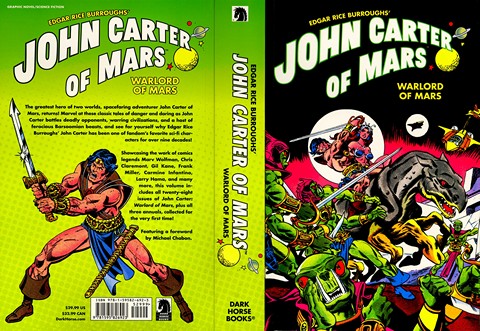
Thursday, 11 August 2016

DVD: EDGAR RICE BURROUGHS' 'JOHN CARTER'


DEJAH VIEW: 
BACKWARDS INTO 
THE FUTURE…? 

 Review of: 
‘JOHN CARTER’ 

With Taylor Kitsch, Lynn Collins and Samantha Morton. 
 Director: Andrew Stanton. Producer: Jim Morris, Colin Wilson and 
Lindsey Collins. Screenplay: Andrew Stanton, Mark Andrews and 
Michael Chabon from the novel ‘A Princess Of Mars’ by Edgar Rice 
Burroughs’. Original Release: Disney Pictures, March 2012. 
 DVD, Disney Studios Home Entertainment, July 2012


‘One-Hundred Years In The Making’ claims the bonus DVD making-of feature. And that’s part of the problem. Watching this epic movie you could be forgiven for thinking yes, ‘Star Wars’, and yes, ‘Flash Gordon’. Which is, in actuality, a total reversal of the true situation. Edgar Rice Burroughs’ ‘A Princess Of Mars’, the 1912 novel that introduced both worlds to John Carter, was immediately much-imitated. Generations of SF-writers have drawn on his vision of flashing-swords and derring-do heroics beneath the two moons of dying Mars, from Otis Adelbert Kline through Leigh Brackett and John Norman all the way to Michael Moorcock. Alex Raymond’s vivid ‘Flash Gordon’ series set on the planet Mongo – launched as a King Features newspaper-strip in 1934 is certainly part of that tradition. While when George Lucas was storyboarding the first installments of the ‘Star Wars’ cycle he had the movie-matinee ‘Flash Gordon’ cinema-serials vey much in mind, with the intention of recreating his own sense of adolescent wonder, with the added benefit of improved special-effects. So that by the time we get to Disney’s much-hyped ‘John Carter’ (2012), much of it already seems, by default, like overdone swords-and-sorcery cliché caught in a diminishing echo.

There’s an argument that – like Peter Jackson’s ‘Lord Of The Rings’ movie-trilogy, it was not technically possible to do justice to the wide-screen vision of ‘A Princess Of Mars’ before the advent of computer-generated imagery. It could, and has been, portrayed in garish magazine-art, astounding comic-strips and comic-book editions where artists were limited only by the constraints of their imagination and skill. During the 1930’s Warner Brothers animator Bob Clampett drew test-footage, which still survives, but the project was dropped largely because ERB’s bestiary of extravagant Martian creatures seemed impossible to represent on screen. How to film six-armed Tharks or the giant Thoat mounts they ride, and give them any semblance of life? How to convincingly animate the ten-legged Banths, Apts and huge ferocious White Apes? TV Sci-Fi and Creature-Feature Drive-In Shockers have always used prosthetics and strings, miniaturisations and puppetry to achieve their shoddy ends. Film-makers such as Jon Favreau and Guillermo Del Toro toyed with the idea of using such techniques, while John ‘Jim’ Morris – working with director John McTiernan during the pre-digital late-eighties, got as far as casting Tom Cruise in the ‘John Carter’ role. But they always stopped short of visualising Barsoom. Until now. The Disney tagline promises ‘Movies, Magic and More’. Whether it delivers for John Carter is still very much open to debate.


Burroughs was not a sophisticated writer. The making-of feature uses rare recordings of Burroughs’ own voice to narrate his life-story. About how, with his career in what scripter Michael Chabon describes as a state of ‘desperate existential despair’, he began ‘slumming-it for a pay-cheque’ (Jon Favreau). Reading a selection of pulp magazines he decides ‘I was sure I could write stories just as rotten as theirs.’ But when he did, he hit an immensely lucrative mythological nerve. So would he have enjoyed this movie? My guess is that he would. He was quick to license Tarzan for all manner of multiplatform projects, from comic-strips to films, and was equally happy for production crews to inflict their own interpretations onto his creations, no matter how outrageously preposterous.


And ‘John Carter’ is, for the most part, more faithful to the original text than could reasonably be anticipated. Not that it’s without its moments of self-awareness. ‘A Princess of Mars, how about that?’ exclaims Carter at one point, ‘a princess who ran away to avoid marriage. Is that all there is to this story?’ The princess, Dejah Thoris, always was a forceful character, as far back as Burroughs’ magazine serial “Under The Moons Of Mars” which began in ‘All-Story’ (February 1912). That she’s now a scientist-warrior action-hero is no real revelation. Yet underneath, the plotline could be reduced down to Carter’s quip. The pre-credit sequence shows an aerial war fought between Helium, the city-state precariously built on a tower of Martian rock, and the lumbering steam-punk many-legged walking predator-city of Zodanga. With its traditional long-term enemy assisted by the Ninth Ray energy-weapon provided by three ‘agents of the goddess’ (the Therns), it seems Helium must fall, unless its red-Martian Princess agrees to a political marriage that will end hostilities. Initially reluctant to intervene, a brooding hard-bitten Carter – a man without a cause, cynically points out that ‘everyone thinks their cause is virtuous.’

 Writing at a time when readerships were less familiar with exploits into the fantastic, Burroughs used framing-sequences as linking devices by which his characters were introduced to the bizarre. This film does the same thing. A stuttering awkwardly-uncertain Edgar Rice Burroughs himself is present, in the shape of actor Daryl Sabara. It’s he who investigates the ‘private journals’ of his late uncle, John Carter. Telling how in 1868, Carter is a Confederate misfit in post-Civil War Arizona, traumatised by loss and bereavement, attempting to make his way as a solitary gold prospector. Forcefully ‘invited’ to join the Seventh Cavalry in action against the Apache, he escapes and flees. Played on a short fuse by Taylor Kitsch this John Carter is a darkly truculent and largely inexpressive presence, although this is used to justify the tagline ‘Lost In Our World, Found In Another’. Seeking refuge in the inner recesses of a cave he stumbles upon a Thern medallion that instantaneously transports him into otherness. In the book his transition to Mars is achieved by a kind of astral projection, here ‘he’s telegraphed as a copy of himself’. 


It’s only later, through Dejah Thoris’ diagram of a nine-planet solar system scratched into Martian sand, that he learns he’s on Mars. And the planet they call Barsoom is an ancient world of devolved races and hideous sciences. Its ‘time of oceans’ long-since passed. ‘Mars, so you name it’ drones the voice-over, ‘but you do not know Mars.’ With real-life expectations of finding organisms on the red planet receding to microbial life-forms… if that, Mars is fast-falling out of favour with film-makers. Hence dropping the ‘…Of Mars’ from the film title. The Tom Cruise remake of ‘War Of The Worlds’ (2005) even edits the alien’s Martian origins out of the plot entirely. Yet robot probes now trundling across the Martian surface indicate that there was indeed a billions-years-back time of shallow seas. And by making Carter’s interplanetary projection also a time-shift back a million years, an edge of credibility could have been retrieved. But maybe that’s to take it all too seriously. Despite the cult that’s grown up around his work, Burroughs was essentially a trashy storyteller who required only that his readers had ‘a youthful and elastic mind’, and this film continues in the tradition of outlandish yarns that he established.

Carter falls into the barbaric green hands of savage Tharks, led by Tars Tarkus (Willem Dafoe), where his feats of superhuman agility and physical strength – enabled by the planet’s lesser gravity, earn him grudging respect. Due to an initial misunderstanding Tarkus calls him ‘Virginia’. The desolate desert Mars-scapes of ruined cities is an eye-ripping spectacle, impressively rendered as Carter rescues a fleeing Dejah Thoris (Lynn Collins) as her radium-powered ship comes under attack by a pursuing Zodangan warship under the control of her suitor Sab Than (Dominic West). She finds the lost Earthman’s tales of ocean-going ships as fantastic as he finds her ships that glide on light. Warily, Carter and Dejah Thoris, with Sola (Samantha Morton) and his faithful Woola – more of a cute slobbery reptilian-dog here than in the novels, quest along the sacred river Iss to locate a way back home. Then, taken to Helium itself he’s assisted by a personable Kantos Kan (James Purefoy). And through the ensuing knuckle-gobbling adventures the previously dour Carter not only finds love, but rediscovers the sense of purpose he’d lost on Earth. He ‘finds his true home.’ The climax scene in which he’s sentenced to battle two four-armed Great White Apes in the arena alongside a deposed Tars Tarkus, had unfortunately been trailored by a similar sequence in ‘Star Wars: Attack Of The Clones’ (2002), but is sufficiently generic to stand in its own right. Victorious, he erupts up through the monster corpse drenched in the White Ape’s blue blood. To lead the Thark horde in a spectacular battle against treacherous Zodanga even as the fatal marriage commences.


If ‘John Carter’ was intended to be the first of a movie-series, its poor box-office performance means this will not now happen. Despite the long-tail ongoing profits generated from Blu-ray/DVD-sales and endless small-screen reruns to come, in which it will surely be better-valued. That’s unfortunate because – as with the prematurely truncated ‘Narnia’ films, there are not only Barsoom books aplenty left to film, but a closing sequence of ‘A Princess Of Mars’ itself is excluded – relating to unlocking the atmosphere machine. Instead, the role of the controlling sapphire-eyed Therns is ramped up, explaining ‘we don’t cause the destruction of the world, Captain Carter, we simply manage it, feed off it, if you like.’ Their influence extending across the gulf of space to Earth, to where Carter is unwillingly returned.

Carter then narrates how he becomes a kind of Indiana Jones scouring ancient sites of the world for evidence of all-powerful Thern intervention in terrestrial history. The framing-sequence resumes as ER ‘Ned’ Burroughs opens up his uncle’s Poe-like tomb, to find it empty, and his faked death a ruse intended to lure the shape-shifting Therns out of disguise, enabling him to return to Dejah Thoris and resume his role as Warlord of Helium. The inscription above his tomb – ‘Inter Mundos’, translates as ‘between worlds’. And before returning to Mars, John Carter instructs his nervous nephew to document the ‘most wondrous stories’ of his full transplanetary trip, bringing it all full-circle. The tale we are watching onscreen is taken from the text he subsequently wrote. One hundred years after he wrote it. So, this is a film one-hundred years in the making. And maybe that’s part of the problem…?


‘JOHN CARTER: 
STAR WARS FOR 
A NEW GENERATION’

‘JOHN CARTER’ Walt Disney Pictures. Director: Andrew Stanton. Producer: Jim Morris, Colin Wilson, Lindsey Collins. Screenplay: Andrew Stanton, Mark Andrews and Michael Chabon from the novel ‘A Princess Of Mars’ by Edgar Rice Burroughs’. With Taylor Kitsch (as John Carter), Lynn Collins (as Dejah Thoris), Samantha Morton (as Sola), Willem Dafoe (as Tars Tarkas), Thomas Haden Church (as Tal Hajus), Mark Strong (as Matai Shang), Ciaran Hinds (as Tardos Mors), Dominic West (as Sab Than), James Purefoy (as Kantos Kan), Bryan Cranston (as Powell), Polly Walker (as Sarkoja), and Daryl Sabara (as Edgar Rice Burroughs). Music: Michael Giacchino. 127-minutes. ‘Dedicated to the memory of Steve Jobs.’ Original Release: Disney Pictures, 9 March 2012 (USA). DVD, Disney Studios Home Entertainment, July 2012

Published in:
‘THE SUPPLEMENT Issue 69’ (UK – April 2014)


Sunday, 7 August 2016

Edgar Rice Burroughs: 'PELLUCIDAR'


EDGAR RICE BURROUGHS: 
PELLUCIDAR, 
GORE AND DREAMS 


Fantastic landscapes exist 500 miles beneath 
our feet, in the ‘eternal minute of timeless Pellucidar’. 
With Edgar Rice Burroughs, the fictional amputation from 
 reality is absolute. But when he also provides access points 
into his realms of extravagant dream… 
 where exactly does the dream end?


 ‘in the first place please bear in mind 
that I do not expect you to believe this story...’ (1) 


My name is Andrew John Darlington. I grew through the usual turbulences of adolescence in the city of Hull on the North-East coast of Yorkshire. In those distant late-1950’s years Hull was a busy port thronging with the import and export of often exotic trade goods from all corners of what it was still possible to refer to as ‘the Empire’. And it was here, while apprenticed and undergoing tuition in the finer points of the Print and Reprographics Trade, that I first came into possession of the documents discussed below. I found them secreted in an almost casual and serendipitous manner within the confused arcania of an ancient bookshop, where they had no doubt been deposited by a previous initiate. And these texts were to lead me down eccentric pathways in a confusion of myth, adventure, and deliberate mystification, exerting a strange fascination on my juvenile mind. One that continues to engage my imagination years, and indeed decades later. Exploits that stretch the credulity to, and beyond the very limits of rational comprehension, yet which invite repeated excursions into the fantastical landscapes they depict…

...excuse my self-indulgence.

But Burroughs – Edgar Rice rather that William S, frequently avails himself of a ‘framing narrative’ device along the lines I’ve attempted to replicate here, to create a threshold into his extravagant fictions. They provide an introductory pre-credit sequence explaining how the manuscript he invites you to evaluate came into his possession. He might do it through his own persona, or at least through an ersatz-Burroughs posed as a fabricated self-portrait, or perhaps through the guise of an academic or an acquaintance of the narrative’s protagonist. Through this baffle of masks he can add confirming detail designed to reinforce the illusion that at least some elements of the story you are about to read, are real. 

In addition, they serve the extra purpose of velcroing Burroughs’ diverse worlds into some kind of attempted continuity, the framing details of ‘The Pirates Of Venus’ (1934), for example, name-drop David Innes and Pellucidar, as ‘The Moon Maid’ (1926) similarly links into the Martian story-cycle. The Edgar Rice Burroughs accredited on the book-jacket, the framing device says, is one of us. He’s a reader, a consumer, rather than a fantasist. He doesn’t construct these stories from the stuff of dreams. Nothing as simple as that. No – he is merely a ‘Middle Man’ in the fortunate position of acquiring this information on our behalf. He just opens the window onto these strange worlds, then passes the view on to us for our entertainment and edification.

Of course, readers of the early Twenty-First Century no longer need such elaborate preparation. We’re already pre-programmed to switch perspectives and immerse in fictional fantasias as easily as we hop TV channels from one unreality to another. So the framing device has largely fallen from favour among writers – unless used in the form of a deliberately archaic pastiche designed to create period ‘atmosphere’. But it was by no means unusual in Burroughs’ time. Used as an intermediate phase, a buffer zone, or an interface between the dull reality the reader is forced to inhabit, and the outrageously exotic worlds of deep subterranean Pellucidar, the arid plains of Barsoom lit by the pale moons of Mars, or the jungles that lie beneath the dense cloud layers of Venusian Amtor. A fictional departure lounge for flights into realms where the drag of rational morés no longer prevail. It’s a method of artful distancing by interposing the teasing concept that just possibly this is not mere fanciful fiction – but a retrieved document deserving at least some of our attention.


The ‘manuscript’ that comprises David Innes first trip to Pellucidar, ‘At The Earth’s Core’, was completed in February 1913. It was published soon after in the April 1914 issue of ‘All-Story’ magazine. But Walter Gillings, SF activist and editor of one of Britain’s pioneering SF pulps (‘Tales Of Wonder’), first discovered the primordial world at the hollow centre of the Earth in 1928, serialised in the two-penny weekly ‘Puck’ magazine, and ‘the notion of a primeval domain deep in the Earth’s interior where intelligent reptiles kept human beings enslaved, and even found them good eating, seized my ten-year-old imagination.’ Gillings experience is not untypical. Among SF myth-merchants Edgar Rice Burroughs holds a unique place as catalyst of dreams for probably more subsequent addicts than anyone else. And his domain beneath the Earth’s crust is a powerful lure.

‘Pellucidar, as every schoolboy knows, is a world within a world, lying, as it does, upon the inner surface of the hollow sphere which is the Earth’ (4), and because its geography conforms to the inner contours of the planet, Pellucidar’s horizon rises panoramically ever-upwards, rather than vanishing below the curve of vision as we experience it here, upon the dull limitations of the ‘outer crust’. But this ‘inner world’ has its own sun, and even a moon, the ‘Pendent World’ which casts a permanent twilight over an area known as the Land of Awful Shadow.

Innes, a thirty-year old Connecticut-born adventurer, is a regular Burroughs’ hero, capable of modestly boasting of a physique that has always ‘been the envy and despair of my fellows’. On Barsoom, John Carter uses his similarly impressive physical endowments to protect his Martian Princess, Dejah Thoris. Within that Inner World, David Innes discovers Dian the Beautiful of the tribe of Amoz, who dwell in the cliffs above the Darel Az, or Shallow Sea. And his missions to attain, protect, or return to her take him through savage countries of monsters, part invention and part-prehistoric. Here there be Dinosaurs, Sagoths, Mastodons, Tarags (sabre-toothed tigers), bull-like Bos, Dyals, and Thipdars (pterodactyls), a mix of evolutionary fossils and primitives.


But there’s also the ‘dominant race of Pellucidar’ the winged all-female Mahar who so repulse and intrigue the ten-year-old Walter Gillings. They are remnants of the ‘rhamphorhynchus of the Middle Olitic’ who communicate in a sixth-sense fourth-dimensional language, and who rule ‘all that walks or grows upon its (Pellucidar’s) surface, or creeps or burrows beneath, or swims within its lakes and oceans, or flies through its air.’ Abner Perry – ‘loveable old inventor and palaeontologist’ and Innes’ scientific companion, explains that these are all species which, ‘roamed the outer crust with the cave bear and the mammoth ages and ages ago. We have been carried back a million years, David, to the childhood of a planet – is it not wondrous?’ And yes, wondrous it is.

If Mars is Burroughs depiction of a cruel and decadent senility, antique and perverse, Pellucidar is his New World, untainted by the corruptions of experience, in which all future possibilities co-exist. He wrote seven books located there, from ‘At The Earth’ Core’ (1914) to the posthumously-published ‘Savage Pellucidar’ (1963). And they form what is probably his most beautifully outrageous and imaginatively ambitious story-cycle. Yet all seven happen in the same long Pellucidarian day, ‘the same day upon which I broke through the Earth’s crust from the outer world thirty-six years before... the same day and hour that this world was born, the same day and hour that would see its death, the eternal day, the eternal hour, the eternal minute of Pellucidar’ (6). For the sun does not move in the Pellucidar sky. Hence there is no succession of night and day. And because there’s no night and day, according to Burroughs’ rather dubious reasoning, there is no time. Although ‘time passed, as it must even in a timeless world’ time in its absolute sense is abolished, allowing all manner of odd temporal phenomena to occur. The least of which is David Innes’ immunity to the effects of ageing as he would have experienced it on the outer crust. Giving him virtual immortality.


There is nudity, and near-nakedness too. Dian the Beautiful is ‘naked, but for the most sketchy loin cloth’(6). While the other girls of Pellucidar are ‘slender, well-formed, and quite good-looking. Their only clothing consisting of scanty loin cloths’ (5). Jana, the Red Flower of Zoram is slightly more explicitly described, ‘her single soft garment... whipped about her naked legs, half revealing, half concealing the rounded charms of her girlish figure’ (4). These descriptions supply only the slightest of allusions to naked breasts proudly bared to the warm Pellucidarian air, but the mental image for a 1930’s youth must have been indelibly planted. As it was for me, in the 1950’s. Just as the perversely erotic image of Barsoomian maid Thuvia who spends fifteen years as the naked ‘plaything and slave’ of the White Martians in Burroughs’ John Carter story-cycle must have led to prurient adolescent imaginings of a more graphically salacious nature.

But casual nudity is all part of Burroughs’ idealisation of simpler life-styles, values he sees as untainted by the corrupting influence of intellect or suspect ‘civilising morality’. He claims ‘the principal difference between the people of the Old Stage Age and those of modern-day civilisation seem to lie in the matter of inhibition.’ Implying that in Pellucidar they don’t bother with such stultifying affectations. And are better for it. ‘The human race of the Outer Crust had deteriorated rather than improved with the march of the ages.’ Burroughs, through the eyes of David Innes and Abner Perry, compares ‘the standards of effete Twentieth-Century civilisation’ (1) unfavourably with the primitive nobility of Tarzan’s quasi-religious awe of nature. We, of the then-Twentieth Century are enveloped by ‘the thin veneer with which civilisation conceals but does not eradicate primal instincts’ (4).

And in Pellucidar David Innes is allowed to ‘slough practically the entire veneer of civilisation that it had taken generations to develop, and slip back perhaps a hundred thousand years...’(5)

Now he springs ‘like the beast of prey that man really is’


‘read it yourself and see if you, too, 
do not find food for frantic conjecture…’ 

There had been previous stories set in similar worlds underground. As a refuge for wild imaginings, the ground beneath our feet has unsurprisingly proved less enticing than what lies beyond the sky. And less so as the century has progressed. But there’s nevertheless a rich literary and pseudo-literary vein of ‘Chthonian’ fiction – that is, stories set within the Earth’s ‘bowels’. It’s possible to look back to Jules Verne’s ‘Voyage Au Centre De La Terre (Journey To The Centre Of The Earth)’ (1863), and to the fictional voyage of one Niels Klim for precedents. To sniff around suggestions made by Edgar Allen Poe about holes located at the Polar regions which give access to the Hollow Earth. Just as it’s possible to fast-forward into Barrington J Bayley’s mind-mulching novelette ‘The Radius Riders’ (in ‘SF Adventures no.27’, July 1962) resurrecting the long-neglected boring machine as well as Burroughs’ ideas about the time-distorting effects of subterranean travel. Or even Arthur C Clarke’s short story “The Fires Below” (1949) which imagines species and civilisations existing beneath the Earth’s crust. But it’s just as convenient to buy Brian Aldiss’ view of hard-pressed fantasists who, when ‘hard up for secret worlds... find them under the Earth, in a puddle, in an atom, up in the attic, down in the cellar, or in the left eyeball...’ Aldiss goes on to quote examples of each.

But tenacious adherents of the ‘Hollow Earth’ theory persist, surviving in obscure Fortean X-Files on the outer rim of extremist weirdness. Nineteenth Century American writer Captain John Cleves Symmes believed the Earth to be constructed of no less than five hollow concentric spheres with space between each, habitable on all of the resulting convex and concave surfaces. According to Symmes there are also countersunk holes at the top and bottom of the world amid ice-free polar seas, which allow access to these inner domains. Stranger still is the fact that Symmes’ petition to the US Congress to sanction a voyage testing out his theories received no less than twenty-five affirmative votes! Or that Adolf Hitler, fascinated by arcane Aryan mystic theories, mounted a Nazi expedition to also investigate its possibility.

Meanwhile, Captain Adam Seaborn (who may have been a Symmes alias) wrote ‘Symzonia: A Voyage Of Discovery’ in which he sails a ship through the South Polar opening in 1820 to discover a utilitarian utopia ruled by a ‘Best Man’ where poverty and greed are unknown. But even he’d been anticipated by Danish writer Baron Ludwig Holberg’s ‘The Subterranean Journey Of Niels Klim (The Journey Of Niels Klim To The World Underground)’ (1741) which out-fantasies Burroughs Pellucidar in depicting an entire planetary system – with a miniature sun orbited by miniature planets, located inside the hollow centre of the Earth. In this charming fantasy Holberg’s hero Nicholas Klimius is carried by a giant bird to the inner planet Nazar where he meets human-headed trees.

There are, inevitably, other tales of subterranean derring-do – both before and after Burroughs. Examples would have to include Bulwer Lytton’s ‘The Coming Race’ (1871), and William R Bradshaw’s ‘Atvatabar: Being The History Of The Interior World And Conquest Of Atvatabar’ (1892), through to A Hyatt Verrill’s ‘The Voice From The Inner World’ (1927) and Edmond Hamilton’s ‘The Hidden World’ (1929) which envisages exploits on an inhabited 3000-mile diameter sphere within the Earth’s outer shell. And they all happened before the Cavern-Worlds of the Shaver Mysteries which became major cult material through post-war issues of ‘Amazing Stories’. Then there’s the prolific John Russell Fearn who not only uses a mechanical mole, but even calls his 1938 story “Through the Earth’s Core”.


But Burroughs does form an important watershed in ‘Inner World’ fictions. Because ERB is not didactic. Unlike Captain Adam Seaborn and his other predecessors he doesn’t create loopy imaginary worlds as utopian blueprints for moral lessons. He writes for fun. Burroughs is not concerned with facts. And he has nothing whatsoever to do with realism. In his worlds, semi-naked women battle side-by-side with their mighty-thewed sword-wielding mates in domains of wonder, because that makes for entertaining escapism. Heroism may be difficult in the dreary everyday world. Not so Mars, Venus – or Pellucidar. His Inner World tales are ‘remarkable adventures which parallel fairly closely the crises, hairbreadth escapes, and cliff-hangers of (John) Carter and Tarzan. Only the cliffs are different’ as Brian Aldiss succinctly observes.

Another ERB-ian story-cycle is set within a hollow world located inside Earth’s moon. That could possibly relate to HG Wells’ similarly sub-Lunarian Selenites of ‘First Men In The Moon’ (1901), but more likely it’s just Burroughs transposing his penchant for Lost Valleys and Forgotten Civilisations into fresh locales. As though he’s working through a roster of potential venues. How long before John Carter discovers the inhabited interior of Barsoom? Or Carson Napier adventures to hidden civilisations beneath the crust of Venus? Perhaps all the worlds of the Solar System are not solid planetary bodies at all, but thin-skinned bubbles of double-sided habitation?


“the more civilised people become, the more deadly 
are the inventions with which they kill each other...” (7) 

Burroughs garish tales always offered themselves up for easy visual adaptation. As early as January 1929 Tarzan had become not only a Movie star but a newspaper comic-strip serial too. And Pellucidar was also destined to cross over into both media. ‘Hi-Spot Comics no.2’ (November 1940) features a ‘David Innes of Pellucidar’ picture-strip illustrated by ERB’s own youngest son John Coleman Burroughs. The cover misleadingly displays an Earth impaled by a ‘borer’ like an arrow through an apple! Later ‘Tarzan At The Earth’s Core’ is fairly accurately serialised in the British ‘Tarzan Adventures’ (Vol.8 No.44 in January 1959), a weekly comic edited by the teenage Michael Moorcock whose job it was to adapt and re-ink dialogue continuity for the frames, which originated in American newspaper strips.

An unpretentious and rather poor 1976 movie followed, starring the two-fisted Doug McLure and absent-minded Professor Peter Cushing, aided and abetted by Cy Grant and Caroline Munroe. But although based on ‘At The Earth’s Core’, it totally misses out on the sheer scale of Burroughs’ creation. Innes’ party, as Burroughs depicts, use an out-of-control ‘Mechanical Subterranean Prospector’ – a hundred-foot long ‘land submarine’ boring machine to penetrate five-hundred miles through the stratum of the Earth’s crust. Here they find themselves in huge subterranean grottoes menaced by, and eventually defeating the Mahars, scientific winged reptiles in ancient underground cities with their slave race, the ape-ish Sagoths.


But as Burroughs describes the ‘buried world of Pellucidar’ it is much much more than that. It is made up of no less than ‘one hundred and twenty-four million square miles of land surface’. And because the ratio of ocean to land is reversed, there is actually a greater surface area within the world than there is outside it. Similarly, the text used as base material for the movie covers only the first part of Innes’ epic adventures. For the scope for fantastic adventure is limitless. After a brief return to the surface at the climax of the novel, Innes re-emerges into Pellucidar far from his original location, and then has to find his way back to Sari where Dian the Beautiful and Abner Perry await him. And where, by the end of the second novel, Innes has become Emperor of Pellucidar.

As with the Martian cycle, once Burroughs has established the characters and basic premise with the initial novels (‘At The Earth’s Core’ and ‘Pellucidar’), he then shifts the focus away to other plotlines following secondary heroes and heroines. After a thirteen-year pause he resumes the Inner World mythology with the adventures of Tanar and Stellara whose travels bring them into conflict with the Cid, leader of the Korsar pirates, originally ‘Corsairs’ from the Outer world. Tanar’s story is picked up (through the ‘framing sequence’) by Jason Gridley – inventor of the ‘Gridley Wave’ communication system, through which he also discovers that David Innes is being held prisoner by those same vile Korsars. Gridley then determines to escape the restrictions of being a mere name in the prologue (of both Martian and Pellucidar novels), to become a protagonist in his own right. But not before first enlisting the aid of the mighty Tarzan himself!

‘Tarzan At The Earth’s Core’ is the consequence, originally available in Britain through Methuen’s ‘Sixpenny’ paperback series (no.22), with no cover illustration – just title, author, and blue-and-white Kingfisher logo. And it’s the first Burroughs’ novel to make use of Symmes idea, already alluded to by Poe, of Polar openings to the inner world. Burroughs gives more exact dimensions. The opening is 85 North latitude, 170 East longitude. And his fictional crew ‘fly out across the frozen polar wastes to the opening to Pellucidar’ using the 0.220, a 75 ton cigar-shaped airship, 997ft long and 150ft in diameter, buoyed up by vacuum-chambers made from Harbenite from the Wiramwazi Mountains. Burroughs ducks further explanation with a convenient ‘it is not my intention to weary you with a recital of the details of the organisation and equipment of the Pellucidarian expedition.’


But the crew consists of Tarzan, Jason Gridley of Tarzana, the incongruous warriors of the Waziri tribesmen, plus Captain Zuppner, Von Horst and Lieutenant Dorf from the German Imperial Air Force. Once within Pellucidar, in some of Burroughs’ most complex plotting, chapters alternate as Tarzan is captured by Sagoths who, he discovers, speak the universal ‘language of the apes’ of the outer crust. Burroughs seems to be suggesting that such creatures are ‘pioneers upon the frontiers of humanity’, a further evolutionary link between both inner and outer worlds.

While Gridley’s aeroplane flight is abruptly ended by a predatory pteranodon, after which he meets Jana, the Red Flower of Zoram with full use of Classical allusion – ‘Odysseus never met a more potent Circe’. The novel’s basic structure is typical of Burroughs’ simple plotting with regular encounters with Snake-men riding lizard mounts, a flying stegosaurus gliding on its spiny armour, and passage through the Forest of Death. But it is more fully and reflectively developed. Jana and Jason have the routine romantic misunderstanding, but Burroughs’ illustrates their social differences with wryly satiric sequences attacking the manners and pretensions of American womanhood. While Tarzan, eating raw meat, recalls a ‘fussy old nobleman with whom he had once dined at a London Club who almost suffered a stroke of apoplexy because his bird had been slightly underdone.’


As ‘Back To The Stone Age’ opens, Von Horst has been abandoned to his fate when Jason Gridley and the 0.220 return safely to the Outer Crust through the hole at the pole. A further sequence of adventures for the young German inevitably follows. He succeeds in rescuing Dangar from a Trodon’s nest by butchering one its fledgling young and cutting its reptilian skin into a ‘rope’. Then there’s an Androcles-&-The-Lion-variant in which ‘Old White’ the killer mammoth helps Von Horst to escape the Little Canyon arena of the Mammoth-Men after he’d earlier drawn stakes from its feet. An outcome hardly unexpected by the reader, and well-signalled by Burroughs. Von Horst also rescues Skruf from a hyaenodon. And similarly, with a name like ‘Skruf’ of the dubiously named Basti tribe you know in advance that deviousness is to be expected. Then there is Trog. A race of Minotaurs. The cannibalistic Gorbuses – fanged albino’s of limited memory-spans with their myths of coming from the ‘outer world’. And the Ganak Bison-Men. ‘In Pellucidar’ the hero muses ‘I shall never die of ennui.’ Innes, now free of the Korsars, last encounters Von Horst as the contented chief of the Lo-Har, with a predictably beautiful mate called La-Ja.

‘Land Of Terror’ – which uniquely appeared only in book form, and is consequently one of the rarest Burroughs novels, is narrated in the first person by David Innes. The Emperor of Pellucidar is now travelling home from Lo-Har, straight into a new series of strange encounters. He’s captured by Jukans – an odd race prone to unpredictable madness and equally sporadic memory lapses, an element that ERB captures well. However, Burroughs is himself perhaps afflicted by their qualities as his portrayal of their society grows and develops inconsistently, as though it expands to encompass the vagaries of Innes’ predicament. The Jukan settlement is first ‘a crudely palisaded village that stood in a small clearing’. He’s taken to the palace of King Meeza – ‘a low rambling crazy-looking structure’. Later, as Innes escapes and looks for a secret passage to the exterior the village has become ‘a city’, while the Palace is now ‘a village to itself’ which ‘must have covered several acres of ground’. While fictional unlikelihoods multiply all around him. Recaptured, Innes is locked into what he at first assumes to be a cell, but no, feeling around in the darkness he discovers... not only a corridor that first leads him to where Dian the Beautiful is held, but also the elusive secret exit to the exterior!


The final book in the ‘Inner World’ series, ‘Savage Pellucidar’, is a compilation of uncollected tales, including one published posthumously. But it goes some way towards redeeming the glaring inadequacies of the two preceding volumes. During David Innes’ absence Abner Perry has created the Sarian Navy to ‘spread civilisation and sudden death to an extent that amazed the natives.’ He then works on ‘trying to perfect poison gas’ which he claims will ‘do even more to bring civilisation to the Old Stone Age’(!). But despite Innes’ assurances that ‘Perry’s plans for slaughter were purely academic’, and that he was ‘a theoretician, pure and simple’, his morally suspect devices do succeed in becoming instrumental in the adventures of two of Burroughs’ most delightful creations. There’s the strong-willed resourceful O-aa, whose penchant for exaggeration propels her into increasingly bizarre predicaments, including being mistaken for the ‘Noada’ – or priestess of the bronze-age Tanga-tanga culture. And the cantankerous Ah-Gilak – ‘the old man from Cape Cod whose name was not Dolly Dorcas’, a shipwrecked Outer World Ancient Mariner, whose extreme survival methods have given him a cannibalistic taste for human flesh (especially Swedes!). His creepy intentions towards O-aa are less lustful, more culinary! Following Perry’s experiments with aircraft, and the hot-air balloon made of dinosaur-peritonea that transports O-aa into adventure, the Pellucidar saga closes with ‘already, mentally, he was inventing a submarine….’


‘There is no world within a world. Pellucidar is 
but a realm of your imagination. Nothing more’ (2) 

Jason Gridley begins as the passive recipient of messages from Barsoom and Pellucidar. But, learning of David Innes’ predicament, he crosses over to become an active protagonist in his rescue. Just as Ulysses Paxton first reads Edgar Rice Burroughs pulp novel ‘A Princess Of Mars’ (1912) as an ordinary consumer, just like you and I. ‘The story made a profound impression upon me, and while my better judgement assured me that it was but a highly imaginative piece of fiction, a suggestion of the veracity of it pervades my inner consciousness’ (framing narrative to ‘Master Mind Of Mars’, 1928). Paxton becomes fascinated by the book. Obsessed. So that later he’s able to travel to Mars by mystical means in conscious imitation of John Carter, and be subsumed into that same cascade of wonderful adventure. The subtext is obvious. Gridley and Paxton did it. So can you. Dream – if it’s done intensely enough, can be a powerful force. Burroughs even provides the fictional departure lounge…

But dream is also irrational. And sometimes dangerous. It’s unreasonable to expect such lavish confections to conform to current social etiquette, any more than – say, Burroughs Mars should relate to the real scientific Mars you can see through the telescope. Unfortunately, when Burroughs was writing, Political Correctness was a long long way in the future. He could hardly be expected to be guided its principles. And, as not only an unintellectual – but a relentlessly anti-intellectual writer, it would equally be highly unrealistic to expect him to anticipate modern social sensitivities. Anyway, things were different then, weren’t they? At least they seemed to be. And as a result, some of his racial caricatures now seem offensively distasteful.

Robert Jones is the black cook aboard the 0.220 airship who exclaims ‘Lawd niggah! you all suah done overslep yo’sef’ and ‘Dem niggahs is sho nuf hot babies’. Yet it could be argued that this black-face Negro patois is objectively no more offensive that Burroughs’ equally crude attempt at imitating Cockney speech-patterns in his Caprona trilogy. And, unless you argue that Tarzan himself is a White Supremacist symbol, then Burroughs treats his Waziri warriors as a noble and admirable people. Indeed it is the purity of their culture that is threatened by ‘the atrocities with which (white) man scars the face of nature.’

He’s on less sure footing with his regard to the treatment of women. Burroughs displays a typically pre-Feminist dualism in that he idealises them, yet simultaneously places them within a strictly defined social context. His are gender relationships that echo images of a more innocent age. In ‘Tarzan And The Ant Men’ (1924) the jungle-lord encounters the ape-like Alali, a matriarchal tribe where males are subjugated. Tarzan’s example provokes violent social change, after which the females not only become submissive and obedient to their mates, but prefer it that way! But Burroughs’ women, perhaps atypically of the time, can be warriors and active participants in the action. On Mars ‘when the necessity arises (women) fight with even greater intelligence and ferocity than the men.’ And Burroughs is capable of operating on a number of different levels where gender politics are debated.


‘Who is Jubal the Ugly? And why did you run away from him?’ asks David Innes. ‘Why DOES a woman run away from a man?’ answers Dian, in tones that to the sexual sensitivities of the 1990’s would imply the threat of rape and abuse.

But ‘they do not (run away) where I come from. Sometimes they run AFTER them’ replies Innes, shifting the issue into another perspective of predatory marriage-hungry women (1). An attitude he provocatively satirises later in a comment on women, and marriage customs on the Outer Crust – ‘marriage to them meant a struggle for supremacy. It was a 50-50 proposition of their own devising – they took fifty and demanded the other fifty’ (5). Then Innes is captured by the Terrible Bearded Warrior-Women of Oog. In ERB’s tradition of appropriate nomenclature, one of them is called Rhump! But this reversal of traditional gender-roles allows Burroughs to muse that ‘one of the sexes must rule; and man seems temperamentally better fitted for the job than women.’ The brutality of the Oog he sees as proof that ‘we should see that they (women) remain always subservient to men, whose overlordship is, more often than not, tempered by gentleness and sympathy’ (5).

In his defence – if defence is needed, Burroughs does write with savage eloquence castigating the rapacious environmental damage done by modern technological society, its part in the genocidal extermination of species, and eventually to global ecological disaster (particularly in ‘Tarzan At The Earth’s Core’). But that’s largely part of his romantic illusion of primitive virtue contrasted with the ‘weaknesses, vices, hypocrisies and little vanities’ of the civilised world. For in truth, with Edgar Rice Burroughs the reader is never seriously called upon to think. With Burroughs, the amputation from reality is absolute. His stories are fabulous. In the exact sense of that overworked word. To Sam Moskowitz, writing in ‘Science Fantasy no.41’, fantastic worlds such as Pellucidar are ‘literally a transcription on paper of daydreams engaged in by the author to divorce himself from the cold failures of his everyday life. Coupled with his born gift of story-telling, the same fantasies were to act as an opiate, to make more bearable the problems of others.’

Excuse my self-indulgence, but I’m inclined to agree.

‘That which has never come within the scope of our really pitifully 
 meagre world-experience cannot be – our finite minds cannot 
 grasp that which may not exist in accordance with the conditions 
 which obtain about us upon the outside of the insignificant grain 
 of dust which wends its tiny way among the boulders of the 
 universe – the speck of moist dirt we so proudly call the world…’ 


 EDGAR RICE BURROUGHS: 
PELLUCIDAR, GORE AND DREAMS 

(1) ‘AT THE EARTH’S CORE’ (‘All-Story Magazine’ 4 April to 25 April 1914, first book publication 1922)


(2) ‘PELLUCIDAR (BEING THE FURTHER ADVENTURES OF DAVID INNES IN THE LAND UNDERNEATH THE EARTH’S CRUST)’ (‘All-Story Cavalier’ 1 to 29 May 1915, first US book publication 1923, first UK edition 29 May 1924)

(3) ‘TANAR OF PELLUCIDAR’ (‘Blue Book’ March to August 1929, first hardback edition 1930, UK edition 19 January 1939)

(4) ‘TARZAN AT THE EARTH’S CORE’ (‘Blue Book’ Sept 1929 to March 1930, first hardback edition 1930)

(5) ‘BACK TO THE STONE AGE, A ROMANCE OF THE INNER WORLD’ (formerly ‘SEVEN WORLDS TO CONQUER) (‘Argosy’ 9 Jan to 13 Feb 1937, first hardback edition 1937)

(6) ‘LAND OF TERROR’ (First hardback edition 1944)


(7) ‘SAVAGE PELLUCIDAR’ consists of: ‘The Return of Pellucidar’ (‘Amazing Stories’ Feb 1942), ‘Men of the Bronze Age’ (‘Amazing Stories’ March 1942), ‘Tiger Girl’ (‘Amazing Stories’ April 1942), and ‘Savage Pellucidar’ (‘Amazing Stories’ November 1963), first hardback edition 1963, Ace paperback edition with art by Frank Frazetta 1963) All subsequently republished in various book editions from Tandem-Universal, Ace, Methuen, WH Allen-Pinnacle etc

Two subsequent novels were authorised by the Burroughs Estate and written by John Eric Holmes, ‘Mahars Of Pellucidar’ published in 1976, the second – ‘Red Axe Of Pellucidar’ was disputed, and independently published in 1993

 Other sources used while researching this feature include ‘EDGAR RICE BURROUGHS: THE MAN WHO CREATED TARZAN’ by IRWIN PORGES (Ballantine Books - 1975), ‘EDGAR RICE BURROUGHS: MASTER OF ADVENTURE’ by RICHARD A LUPOFF (Ace Books - 1965)

Saturday, 30 July 2016

Poem: 'THE NUMB GENERATION'


THE NUMB GENERATION/ 
THE ETERNITY GAME 


my grandfather marries in 1915
plants a son, goes to France
and never comes home…
Len grows up among doting women
who wipe his tears, care and cosset,
always there for his pleasure…
until after the second war
he meets my mother in 1947
to plant his own son…
no post-traumatic stress disorder
for his numbed generation
no support counseling in a
bewilderment of stunned peace,
becalmed in the unreal aftermath,
they just go for a pint at the Crown,
Yorkshire puddings with lots of gravy,
on Sunday hoe the allotment,
hear ‘Forces Favourites’ on the Light
and never talk crawling nightmare,
be Kenneth More or David Niven,
never betray the heroic narrative,
keep your silences to yourself
don’t betray your screaming dreams
with night-sweat horrors of the dead,
cry for Churchill, even though he
advocates shooting 1930s strikers,
as their darkest terrors retreat into
‘Dad’s Army’ and ‘Allo Allo’,
watching their longhaired lout
children dancing free love
drugs and revolution…


Thursday, 28 July 2016

TIM HARDIN: THE REAL BEAUTIFUL LOSER


TIM HARDIN: 
 THE REAL 
‘BEAUTIFUL LOSER’ 


The life, death, hard times and hits of the man 
who wrote “If I Were A Carpenter”


REASONS TO BELIEVE 

Tim Hardin had simplicity. Songs sparsely-worded, stripped down to haiku-like equations. Slight chord progressions, out of Blues, built up in neat clusters, the juxtaposition of phrases systematically and frugally rearranged as if by mathematical principles into different combinations, different songs, until the variation-possibilities were exhausted. Songs that, like all good Blues, were admirably suited to jazz improvisation.

Not for Tim Hardin the epic methedrine-scrambled ‘Desolation Row’ odysseys of a Bob Dylan. Not for Tim Hardin the artfully literate postures of a Leonard Cohen, or the agit-prop radicalism if a Phil Ochs. Not for Tim Hardin the fey art nouveau fairy tales of a Donovan. Like Michael Zwerin puts it in the liner-notes for ‘Tim Hardin 3’ (1968), ‘each version of “Misty Roses” is like alternate takes by Charlie Parker. Fresh and different.’

But if Tim Hardin was really ‘kissed by a fast-flying muse’ as ‘Q’ journalist John Bauldie suggests, that muse finally ran out 29 December 1980. Hardin died of an overdose in his Hollywood Orange Drive apartment just three weeks after the John Lennon shooting, leaving only a slender line of immaculate songs.


Tim Hardin was a descendent of the legendary ‘guiltless outlaw’ John Wesley Hardin about whom Bob Dylan created a mythology. He was born in Eugene, Oregon 23 December 1940, and began pursuing his music muse in earnest following his discharge from the US Marines in 1961, after seeing voluntary action in Vietnam, and picking up a taste for heroin there around 1958. He played in Boston Folk Clubs, studied acting for a while in New York, even taught guitar for a semester (a term) at Harvard. Inevitably, by 1964 he’d gravitated to bohemian Greenwich Village to play the legendary ‘Night Own Café’, then the melting pot of new styles and influences. The Mamas and the Papas retrospected its significance on their hit single “Creeque Alley”, and Lovin’ Spoonful named a searing Blues instrumental after the café.

Hardin’s music, a deft and personal fusion of Blue simplicity, Jazz eloquence and Folk purity, was showcased at the 1966 Newport Folk Festival which went some way towards establishing him as a performer and a writer of note. Tapes recorded and subsequently forgotten, made during this period, surfaced much later as the ‘This Is Tim Hardin’ (1967) LP – although there are claims they were actually made as early as 1963-64. The set shows him drawing heavily on traditional material, “Hoochie Coochie Man”, “Stagger Lee” and “House Of The Rising Sun”, but there are also four of his own early songs including “You Got To Have More Than One Woman”, and the much-recorded “Danville Dame” which has him reworking standard Beat Hobo imagery – ‘I’m riding a flat car, flat on my back…’, into a contagiously shuffling rhythmic pattern already idiosyncratic and uniquely Hardinesque. Both songs were later to become a standard part of his stage act. Yet at the same time he was also stockpiling a number of incandescent and startlingly original compositions for his first official album.

He made some demonstration tapes, which Charlie Koppleman hawked around US Columbia (CBS in England). They got him as far as working in the studio with a Columbia staff producer, but nothing came of the sessions and he took his tapes, instead, to Verve. Those initial demo’s were later used, according to Hardin, ‘in direct breach of contract’ by the label – but in the meantime he worked on tracks for his debut album.


‘Tim Hardin 1’ was issued in September 1966. It was, according to Rock Encyclopaedist Lillian Roxon, two years in the making – a reference to its inclusion of two early songs, but even if taken at face value, then not a second of that time can have been wasted. Decades later the simple insistence of songs like “Don’t Make Promises”, “Reason To Believe” and “Misty Roses” retain the power to amaze. Phil Hardy and Dave Laing comment that ‘his style was maturely formed, owing more to Jazz and Blues than Folk. He used his emotionally-charged voice as a musical instrument’ (‘Encyclopedia Of Rock Vol.2’). The voice is brittle, cracking in around the lines, the instrumentation sparse – although Gary Burton’s Jazz vibraphone adds tone and texture, as do John Sebastian’s harmonica and Felix Pappalardi (later a producer for Cream and member of Mountain). The strings were overdubbed without Hardin’s consent, and – it was later made clear, at his express displeasure. But occasionally, as on “Hang Onto A Dream”, the strings are quite within context and work a lot better than one could logically expect them to.

The sleeve is an unflatteringly realistic head-shot of Hardin taken in the garden of the ‘Castle’, a square-faced, solid figure. None of the overstated poetic contrivances of a Tim Buckley or a Bob Dylan ‘Blonde On Blonde’ shot. By contrast, Hardin could be a labourer, a stonemason – or a carpenter. He appears to be of the earth, unaffected and real.

In a later interview with Michael Watts, Hardin explains that the words for his songs come first, as poems – ‘the lyrics are the rhythmic scheme. The words make the line of the melody because I sing improvisationally’ (‘Melody Maker’ March 1972). And the voice, its conviction reinforcing rather than belying his appearance, is often apologetic, vulnerable. A voice at once containing melancholia and desolation through a naturally extemporised fluidity that never once resorts to any kind of unnecessary theatricality.


Barely nine months later, Hardin delivered the second instalment, ‘Tim Hardin 2’ (1967) which consolidated all the critical expectations. Here is “If I Were A Carpenter”, “Black Sheep Boy”, “Lady Came From Baltimore” and “You Upset The Grace Of living When You Lie”. If Hardin had never again set foot in the studio his stature would be assured by just these two records. Eric Jacobson, an ex-Folkie who later did production work for Sopwith Camel and Norman Greenbaum’s “Spirit In The Sky”, had produced ‘1’, and went on to arrange ‘2’, while Charlie Koppleman and Don Rubin take producer credits this second time round. In the guise of Kama Sutra records Jacobson, Rubin and Koppleman also launched and financed Lovin’ Spoonful.

But in the meantime, as well as being integrated albums in their own right, Hardin’s two sets of original songs quickly became the most successful ‘demo’ discs of the period. Seldom can so few songs have been covered by so many artists. Bobby Darin was the first. Apparently he’d been offered John Sebastian’s “Do You Believe In Magic?”, but turned it down as ‘too weird’. Following its immense chart success for the Spoonful, Darin was anxious to avoid repeating such an unfortunate choice, and agreed to accept and record whatever Folk-orientated material the agency next offered him. Hence he cut “If I Were A Carpenter” before the release of Hardin’s own version, tightening and sharpening the arrangement, but leaving the song’s essence admirably intact. His reading of the song so close to the original that an anguished Tim was reported as protesting ‘he’s stolen my voice!’ The single became a monster hit on both sides of the Atlantic, peaking in the States at no.8 and no.9 in Britain during November 1966.

‘If I were carpenter, and you were a lady, would you marry me anyway, would you have my baby.’ The lyric strips human relationships back to raw basics, relinquishing status and class, to the most fundamental man-woman bond. And it’s mature adult love, to do with family and procreation, not teeny Pop-fodder. If he was a miller ‘with the mill-wheel grinding’, or a tinker ‘carrying the pots I’d made’… true traditional craft-occupations with medieval roots into the hard-grit certainties of an almost lost reality. At a time of fierce revolutionary gender politics it could be argued the song cleaves to the ‘when Adam delved and Eve span’ archetype, he the artisan-provider, she the pregnant Earth-mother, but such a reduction carries its own prima truth. Each line is the purest romantic poetry, sparsely-worded statements, pared down to haiku-like equations, Tim Hardin had the gift of simplicity.


 Darin went on to record an impressive “Lady Came From Baltimore” too, as did Scott Walker and Joan Baez. Rod Stewart did a well-intentioned but clumsy “Reason To Believe”, his first-ever chart hit – no.19 in September 1971, Johnny Mathis also did a bland MOR version of the same song. “Hang Onto A Dream” was recorded by Cliff Richard and Keith Emerson’s Nice. “Don’t Make Promises” came via Lulu, a 1967 A-side from Timebox, and by the Sandpipers. “It’ll Never Happen Again” by Cilla Black… while further covers of “If I Were a Carpenter” appeared by the Four Tops – Top Ten in March 1968, and Johnny Cash. Hardin even had mild chart success with his own single of “Hang Onto A Dream” c/w “Reason To Believe” which reached no.38 on the UK ‘Disc’ chart (21 January 1967). First time I heard the song I was driving in my first mini, I slowed into the roadside to stop and listen until each note had faded, transfixed by its toe-curlingly delicate beauty. I bought the album that same week. 

The ripple climaxed the following July 17, when Tim sold out the Royal Albert Hall, playing to an audience that not only included Donovan, but various Beatles and Rolling Stones too.

It seems incredible that a talent capable of creating such stunning first statements would be unable to follow their success. All the best songs for both albums had been written during one eight-month period – according to a ‘Melody Maker’ interview (26 January 1974), and yet a later ‘Best Of Tim Hardin’ (1969) compilation was, with some justification, made up of material exclusively taken from just these two sets. It could be suggested that the impasse lay in the basic simplicity of the formula – that all its possible variations ha been exhausted.

It’s also true that later recordings became more structured in production terms, and that Hardin himself repeatedly downgraded his own skills as a writer – preferring to see himself as a performer and interpreter of material. Yet the fact of creative decline is escapable. There are mitigating personal problems, most immediately a bout of bad health that took him through a recuperation stay in Colorado. Throughout this time he suffered from bad respiratory ailments, from pleurisy, and other unfortunate effects of his heroin habit, which he temporarily kicked through a sleep cure in 1968 following an abortive British tour down-bill of Family.


There were also complications with Hardin’s contractual ties to Verve. He signed to CBS in 1968, but before being able to release original work through this new hook-up, his commitment to Verve had to be fulfilled. Hence a few ‘contract filler’ albums emerged. ‘Tim Hardin 3’ is in-concert material, but although largely a live hits collection, it remains a mesmerising performance, from the sleeve-notes revealing that ‘drummer (Donald) McDonald wore bells around his neck which, from time to time, can be heard on the album,’ right down to the performance of “Song For Lenny” written on hearing of Lenny Bruce’s death. Hardin had known the iconoclastic comedian in New York – and the song, poignantly stating ‘never again will we be together to die,’ was born immediately after Tim had returned from a Newport Festival gig to be told the news. Tim also contributes to the ‘Why Did Lenny Bruce Die?’ spoken-word album (1966, Capitol KAO 2630).

A further song tributes another tragic hero, Amerikana pioneer Hank Williams – ‘whisky took the heartbreak from too many broken dreams, and what pain wasn’t cured by whisky was cured by too much morphine’. Shot through with hurt, the song concludes prophetically ‘I didn’t know you, but I’ve been the places you’ve been.’ The album was recorded during a 10 April 1968 concert at the New York Town Hall, one of his first gigs to follow his Colorado recuperation. It also features his ‘perfect’ band – McDonald on drums, Warren Bernhardt doubling on piano and clarinet, Daniel Honkin on guitar, plus Eddie Gomez (bass) and Mike Manier (vibes).

‘Tim Hardin 4’ (February 1969) has a more complex history, made up of excerpts from the demonstration tapes recorded prior to the Verve contract, material – according to ‘ZigZag no.43’, dating from as early as 1963, and taken over by the label when they recruited Tim to their roster. A few of the items – “Ain’t Gonna Do Without” and “Smuggling Man” had already been plundered from these tapes and slipped onto ‘1’ without Hardin’s consent. The former is a retread of “Long Tall Shorty” personalised by the opening lines ‘they call me long tall Timmy’. Now “Airmobile” is a Chuck Berry-styled number, taken uncharacteristically up-tempo. The inclusion of “Bo Diddley” sees a second nod in the same direction, while “Whiskey, Whiskey” is an impromptu thing made up in the studio. The album’s inclusion of “House Of The Rising Sun” and “Danville Dame” is also something of an oddity, as versions of these songs were already available on the Atlantic-vintage set ‘This Is Tim Hardin’. The musicians on ‘4’ are Hardin’s back-up from his Night Owl dates – Felix Pappalardi on bass, Sticks Eglin on drums, Bill Chuff on piano, and John Sebastian on rhythm guitar and harmonica. The latter appearing just prior to forming Lovin Spoonful.


SIMPLE SONGS OF FREEDOM 

If 1968 had proved to be a confusing year, then 1969 starts out as though it might go some way towards providing an artistic vindication. But there are continuities too. The sleeve of ‘2’ shows Tim gazing moodily out of a window. Behind him stands his pregnant wife, while the storyline of the conman-thief “Lady Came From Baltimore” reveals that ‘the lady’s name was Susan Moore.’ The first album for CBS is the extended song-cycle ‘Suite For Susan Moore And Damion: We Are One, One, All Is One’. An idyll to domesticity and married love, it proved an ambitious, if occasionally unwieldy project, ‘so laid-back’ according to ‘Melody Maker’ that ‘it barely exists.’ But what it lacks in the directness and melodic simplicity of ‘1’ and ‘2’ it goes some small way towards compensating through its inclusion of poetry eulogising his love for his new child and actress wife (she was featured in the US daytime Soap ‘The Young Marrieds’).

Sessions took place in Nashville, and in Hardin’s own Woodstock house in New York state – ‘the most comprehensive studio in existence. It was a log-house, you could almost have called it a mansion. It wasn’t palatial, but it was very large, and was built of split logs (‘Melody Maker’ 26 January 1974). The playing time is separated into four distinct suites or ‘Implications’, the closing track – “Susan”, a recital on which he’s joined by his wife, while “A Question Of Birth” is about the onset of parenthood and its attendant responsibilities, which had started out as a poem printed on the reverse of ‘Tim Hardin 2’. The sleeve of the ‘Susan Moore’ package is an impressionistic orange-yellow painting quite at odds to the sparse and direct understatement of his earlier work. Reception was mixed. ‘New Musical Express’ opines that ‘gone is the simplicity – and in its place, a cynical sneer at life.’ Later, ultimately even Tim himself professed a sense of dissatisfaction with the set. ‘Maybe it was too soon, or maybe I did not have the right musical aggregation?’

1969 ended ironically with Hardin enjoying his only American chart single – a Bobby Darin penned “Simple Song Of Freedom”! A now-rare collector’s item it spent two weeks at no.50 on the ‘Cashbox’ lists. In some ways the song is self-parody and, on a wider scale, a pastiche of the whole Folk-Protest movement, clear down to the pseudo-PF Sloan inclusion of an irritating girlie chorus and the down-home philosophising of ‘we the people here, don’t want a war’. Tim carries the sentiment with broken sincerity, and makes the song his own.


Hardin was ‘bedevilled by ill-health and bad advice’, and with the collapse of his marriage, things did not get better. The album ‘Bird On A Wire’ in July 1971, largely consists of Hardin’s versions of other people’s songs. “Andre Johray” is original and impressive, and even ‘Melody Maker’ concedes that on the anguished title cut ‘Tim puts more feeling and personal significance into the song than even (its writer, Leonard) Cohen could muster.’ Such praise hardly mitigates the conspicuous lack of new material. “Bird On A Wire” itself starts with just electric keyboard, but builds to a big production job with chorus – Tim pointedly personalising the lyrics from ‘like a worm on the hook’ to ‘like a man on the hook’. The rest of the tracks develop into areas of textural sophistication that seem at odds with Hardin’s Folky roots. “Soft Summer Breeze” is vaguely funky – jazzers Joe Zawinul, Miroslav Vitous, Ralph Turner and Glenn Moore adding fusion flexibility to the sound. Bobby Hebb’s “A Satisfied Mind” is pleasant if unexceptional while the plaintive “Moonshiner” with its subtle convolutions works quite well. But the reading of Ray Charles’ “Georgia On My Mind” is occasionally embarrassing.

With this release it becomes apparent that expectations for new Hardin work can no longer be pitched as high as ‘1’ and ‘2’, and that this has become the new norm, not merely a bad career-patch. The somewhat doomy sleeve photo pictures Hardin heavily bearded and slouch-hatted, he also appears anaemically pale and unhealthy.

He later claimed he had yet to receive royalties for any of the many covers of his earlier songs – while new versions continue to mine that same slim vein. Cliff Aungier and Joan Baez record “Lady Came From Baltimore”, “Misty Roses” came from Johnny Mathis and Cilla Black, William E Kimber and Scott Walker cut versions of “Black Sheep Boy” while Ian Matthews chooses “Tribute To Hank Williams”. Nico’s exquisite ‘Chelsea Girl’ (1967) had already used Hardin’s “Eulogy To Lenny Bruce”, an association that led to a raucous and poorly-reviewed jam when Tim joins her on-stage at the LA ‘Whisky A Go Go’ in late June 1979.

Later, Wilson Phillips platinum debut album (1990) includes their close-harmony rendition of “Reason To Believe”, following a live cover of the same song done a year earlier by Billy Bragg (on a free flexi for ‘Catalogue’ magazine). The material is often handled with respect, but none can match the cracked melancholia of Hardin’s original – as emphasised when Verve reissue the first two albums as a double set, while simultaneously farming out the material onto compilations. “Misty Roses” oddly occurs on an Island sampler called ‘Windy Bama Winds’ (ILPS 9096)!


At the same time Tim began playing live British dates – including one at Tupholme Manor Park near Lincoln (24 July 1971) down-bill of the Byrds, and one at the ‘Rainbow’ with the Steve Miller Band (4 March 1972).

‘Painted Head’ (1973) became Tim’s last set for CBS. It was recorded at the Apple studios in London with Peter Frampton playing guitar, and Hardin displaying a strange mix of styles from the flawed R&B of “You Can’t Judge A Book By The Cover”, to the raucous rootsiness of the dance-orientated single “Do The Do”. Tim was obviously drawn by a long-term affinity to such Blues forays, but while strong voices-for-hire are useful, the ability to write a song as startling as “If I Were A Carpenter” is unique.

It was followed by ‘Nine’ (1973) – his last ever studio album, produced by Jimmy Horowitz for the British Indie GM label. A set that seems to be a culmination of directions signalled across the previous years – a steady move away from the Folk-Poet image, which he’d always repudiated anyway. As early as a March 1972 interview he’d told Michael Watts that he considers himself a singer rather than a songwriter. The Jazz-Blues roots had mellowed out into a kind of White Funk with Tim treated more as the group vocalist than a solo artist with support musicians. It seems an almost willed destruction of his own sensitivity, of his own ‘fast-flying muse’. ‘I should have been a tasteful Tom Jones’ he once confided – in a monumental misjudgement of his own potential, to Folk journalist Colin Irwin. The approach is accentuated – on “Person To Person”, by the chorus voices of Lesley Duncan and Madelaine Bell. Then, as if to stress the Blues continuity in his work, he reworks Fred Neil’s “Blues On The Ceiling”, first featured on ‘This Is Tim Hardin’.

Frampton is again in evidence on ‘Nine’, working with a band consisting of Dave Thompson on piano, Peter Dennis on bass, Jim Gannon on guitar and drummer Mike Driscoll. Alongside six self-penned songs Hardin selects material from Oscar Brown Jrn, and James Taylor’s “Fire And Rain” – a song singularly suited to both his interpretation and experience. There are meandering love songs, but the accent is decidedly against the lyrical, as distinct from the musical content, what ‘Q’ magazine describes as ‘aimless and shambolic – as indeed is most of the messy backing, Al Kooperesque organ, showband strings, crooning girls and all’ (John Bauldie, February 1991). But “Shiloh Town” – the most powerful of the new songs, catches something of his earlier stripped-back fire, on a humorous note with ‘it’s so cold in Shiloh Town, the birds can’t hardly sing, pretty girls are gonna leave the town, they won’t be back till spring’ – equating girls to migratory birds, then conflating Shiloh’s Civil War legacy with a hint at Vietnam, ‘the war has been won, they come back home, but they’re the one’s that lost, I see a man and a woman alone, was it worth the cost?’


The sleeve shows him looking more relaxed, clean-shaven, seen through a soft haze of cigar smoke. But Hardin was – by then, living and working in a ‘drug and booze haze’ (Bauldie) from a London address. To promote ‘Nine’ he toured with a four-piece group co-headlining with fellow GM artist Lesley Duncan, a tour that marked his first appearances in two years, apart from a guest spot at the Reading Festival. Later, in December 1975, he joined German experimentalists Can on stage at Drury Lane for a largely chaotic number – announcing him under the alias ‘Deacon James’.

There was also talk of a career link-up with Tim Rose, the man responsible for the late-sixties cult single “Morning Dew”, whose own once-promising career was also bottoming. They played a joint concert at London’s City University (7 November 1974), and although a qualified success, for those who truly cared about Tim Hardin, it was difficult to accept that he’d never again write songs of the calibre of those early gems. And although those first songs were still very much in circulation, still commanding respect, there was little but silence to come.

Leonard Cohen may have written a novel called ‘Beautiful Losers’ (1966), but it was Tim Hardin who lived the title.

Snatches of his personal and artistic decline can be glimpsed in snapshot images from the following years. Briefly Justin de Villeneuve – former Twiggy manipulator, became Hardin’s manager, retrospecting those days in his autobiography ‘An Affectionate Punch’ (1986, Sidgwick and Jackson). Reviews of the book speak of ‘the squalid junkie antics of a dying Tim Hardin’ (‘New Musical Express’, 23 August 1986). A similar picture of terminal addiction is caught with excruciating accuracy in the factional novel ‘Wonderland Avenue’ by Doors devotee and Rock PR ‘Wild Child’ Danny Sugerman (1989, Sidgwick and Jackson).

Then there’s the final album, appropriately called ‘The Homecoming Concert’ (1982), played live at the Community Center for the Performing Arts in Eugene, Oregon, and taped by former schoolfriend Phil Freeman. Hardin plays the concert solo. It’s sparse, naked, the cracks and bruises leaving his voice even more an instrument of desolate melancholy than it appeared doing the same songs on ‘Tim Hardin 3’. His twixt-song dialogues blur and wander disjointedly. It was 1980, the first time he’d played the town of his birth, and the last time he’d perform anywhere. There’s resignation in the inevitability of the song selection, drawing heavily from the first two albums, but a pride in the obvious strength of that material which he invests with compellingly stark dignity.

The opening number is “Black Sheep Boy”. The first line ‘here I am back home again, I’m here to rest…’


TIM HARDIN: REASONS TO BELIEVE 

July 1966 – ‘TIM HARDIN 1’ (Verve SVLP/VLP 5018, Verve Forecast FT/FTS 3004) with side one: ‘Don’t Make Promises’, ‘Green Rocky Road’, ‘Smugglin Man’, ‘How Long’, ‘While You’re On Your Way’, ‘It’ll Never Happen Again’. Side two: ‘Reason To Believe’, ‘Never Too Far’, ‘Part Of The Wind’, ‘Ain’t Gonna Do Without’, ‘Misty Roses’, ‘Hang Onto A Dream’. Producer: Erik Jacobsen

1966 – ‘Don’t Make Promises’ c/w ‘Smugglin Man’ (Verve Forecast VS 1516)

January 1967 – ‘Hang Onto A Dream’ c/w ‘Reason To Believe’ (Verve VS 1504) UK no.50

March 1967 – ‘Black Sheep Boy’ c/w ‘Misty Roses’ (USA, Verve Folkways KF 5048)

April 1967 – ‘TIM HARDIN 2’ (Verve VLP 6002, Verve Forecast FT/FTS 3022) with side one: ‘If I Were A Carpenter’, ‘Red Balloon’, ‘Black Sheep Boy’, ‘The Lady Came From Baltimore’, ‘Baby Close Its Eyes’. Side two: ‘You Upset The Grace Of Living When You Lie’, ‘Speak Like A Child’, ‘See Where You Are And Get Out’, ‘It’s Hard To Believe In Love For Long’, ‘Tribute To Hank Williams’. Original LP release has back-cover Tim Hardin poem ‘A Question Of Birth’. Producer: Charles Koppelman and Don Rubin

June 1967 – ‘Tribute To Hank Williams’ c/w ‘You Upset The Grace Of Living’ (Verve Forecast KF 5059)


September 1967 – ‘THIS IS TIM HARDIN’ (Atlantic 587082, ATCO 33-210) demos from 1963-1964 with side one: ‘I Can’t Slow Down’ (Tim Hardin), ‘Blues On The Ceiling’ (Fred Neil), ‘Stagger Lee’ (Trad), ‘(I’m Your) Hoochie Coochie Man’ (Willie Dixon), ‘I’ve Been Working On The Railroad’ (Trad). Side two: ‘House Of The Rising Sun’ (Trad), ‘Fast Freight’ (Hardin with Terry Gilkyson), ‘Cocaine Bill’ (Trad), ‘You Got To Have More Than One Woman’ (Hardin), ‘Danville Dame’ (Hardin with Steve Weber). Producer: Daniel N Flickinger. Reissued Edsel ED 309

November 1967 – ‘Lady Came From Baltimore’ c/w ‘Black Sheep Boy’ (Verve Forecast VS 1511)

November 1968 – ‘TIM HARDIN 3: LIVE IN CONCERT’ (Verve VLP 6010, Verve Forecast FTS 3049) with ‘Lady Came From Baltimore’, ‘Reason To Believe’, ‘You Upset The Grace Of Living’, ‘Misty Roses’, ‘Black Sheep Boy’, ‘Lenny’s Tune’, ‘Don’t Make Promises’, ‘Danville Dame’, ‘If I Were A Carpenter’, ‘Red Balloon’, ‘Tribute To Hank Williams’, ‘Smugglin Man’. Producer: Gary Klein. Reissued with bonus tracks ‘Turn The Page’, ‘If I Knew’, ‘Last Sweet Moment’ and ‘First Love Song’

February 1969 – ‘TIM HARDIN 4’ (Verve SVL 6016, Verve Forecast FTS 3064) recordings from May 1964, with ‘Airmobile’, ‘Whiskey Whiskey’, ‘Seventh Son’ (Willie Dixon), ‘How Long’, ‘Danville Dame’, ‘Ain’t Gonna Do Without: Parts 1 and 2’, ‘House Of The Rising Sun’ (Trad), ‘Bo Diddley’ (Bo Diddley), ‘I Can’t Slow Down’, ‘Hello Baby’. Producer: Erik Jacobsen


April 1969 – ‘SUITE FOR SUSAN MOORE AND DAMION: WE ARE ONE, ONE, ALL IN ONE’ (CBS 63571, Columbia CS 9787) with side one: Implication 1 ‘First Love Song’, ‘Everything Good Became More True’, Implication 2 ‘Question Of Birth’, ‘Once Touched By Flame’, ‘Last Sweet Moments’. Side two: Implication 3 ‘Magician’, ‘Loneliness She Knows’, End Of Implication ‘The Country I’m Living In’, ‘One, One, The Perfect Sum’, ‘Susan’. Producer: Gary Klein

September 1969 – ‘Simple Song Of Freedom’ c/w ‘Question Of Birth’ (Columbia 4-44920) US no.50

July 1971 – ‘BIRD ON A WIRE’ (CBS 64335, Columbia CK-30551) with side one: ‘Bird On The Wire’ (Cohen), ‘Moonshiner’ (Trad), ‘Southern Butterfly’, ‘A Satisfied Mind’ (Joe Hayes and Jack Rhodes), ‘Soft Summer Breeze’. Side two: ‘Hoboin’ (John Lee Hooker), ‘Georgia On My Mind’ (Hoagy Carmichael), ‘Andre Johray’, ‘If I Knew’, ‘Love Hymn’. Producer: Ed Freeman

January 1973 – ‘Do The Do’ c/w ‘Sweet Lady’ (CBS S 1016)


February 1973 – ‘PAINTED HEAD’ (CBS 65209, Columbia CK-31764) with side one: ‘You Can’t Judge A Book By The Cover’ (Willie Dixon), ‘Midnight Caller’ (Pete Ham), ‘Yankee Lady’ (Jesse Winchester), ‘Lonesome Valley’ (Trad), ‘Sweet Lady’ (Dino-Sembello). Side two: ‘Do the Do’ (Willie Dixon), ‘Perfection’ (Pete Ham), ‘Till We Meet Again’ (Neil Sheppard), ‘I’ll Be Home’ (Randy Newman), ‘Nobody Knows You When You’re Down And Out’ (Tony Cox). Producer: Tony Meehan

November 1973 – ‘NINE’ (GM GLM 1004, Antilles AN-7023) with side one: ‘Shiloh Town’, ‘Never Too Far’, ‘Rags And Old Iron’ (Oscar Brown-Norman Curtis), ‘Look Our Love Over’, ‘Person To Person’ (Hardin with Andy Brown). Side two: ‘Darling Girl’ (d’Albuquerque), ‘Blues On The Ceiling’, ‘Is There No Rest For The Weary’ (Troiano), ‘Fire And Rain’ (James Taylor), ‘While You’re On Your Way’ plus 1994 bonus track ‘Judge And Jury’ (1973 UK-only single). Producer: Jimmy Horowitz. Reissued Marquee Classic MQCLP 003

1981 – ‘UNFORGIVEN’ (San Francisco Sound SFS 10810), uncompleted studio recordings and home cassette demos from 1980, side one: ‘Unforgiven’, ‘Luna Cariba’, ‘Mercy Wind’, ‘If I Were Still With You’. Side two: ‘Judge And Jury’, ‘Partly Yours’, ‘Sweet Feeling’, ‘Secret’ with Nicky Hopkins (Piano), Ricky Fataar (drums), Johnny Lee (guitar) and producers Don and Caroline Rubin

April 1981– ‘THE HOMECOMING CONCERT’ (Kamera/ Line LLP 5124 AS, Line Germany LICD 9.00040) recorded 17 January 1980 with ‘Black Sheep Boy’, ‘Misty Roses’, ‘Reason To Believe’, ‘Lady Came From Baltimore’, ‘Old Blue Jeans’, ‘Hang Onto A Dream’, ‘If I Were A Carpenter’, ‘Tribute To Hank Williams’, ‘Smugglin Man’, ‘Speak Like A Child’, ‘Red Balloon’, ‘Amen’. Producer: Phil Freeman

Compilations:

September 1969 – ‘THE BEST OF TIM HARDIN’ (MGM 2317 003/ SVLP 6019, Verve Forecast FTS 3078) with side one: ‘Don’t Make Promises’, ‘It’ll Never Happen Again’, ‘Tribute To Hank Williams’, ‘Misty Roses’, ‘Hang Onto A Dream’. Side two: ‘If I Were A Carpenter’, ‘Reason To Believe’, ‘Black Sheep Boy’, ‘Red Balloon’, ‘Smugglin Man’, ‘Lady Came From Baltimore’

1981 – ‘THE TIM HARDIN MEMORIAL ALBUM’ (Polydor PD-1-6333)

August 1974 – ‘TIM HARDIN 1/ TIM HARDIN 2’ (Verve Double Album)

1981 – ‘TIM HARDIN: THE SHOCK OF GRACE’ (CBS Columbia PC 37164) compilation compiled by Bruce Dickenson from the three CBS albums

1989 – ‘TIM HARDIN: REASON TO BELIEVE’ (Polydor 833954) compilation compiled from ‘Tim Hardin 1’ and ‘Tim Hardin 2’

1990 – ‘READING FESTIVAL 1973’ (Marquee MQCCD001, SEECD 343), live album with just two Hardin tracks, ‘Hang Onto A Dream’ and ‘Person To Person’, plus the Faces (‘Losing You’, last ever Rod & Faces appearances), Lesley Duncan (‘Earth Mother’), Rory Gallagher (‘Hands Off’), Strider, Status Quo


Album Review of: 
‘REASON TO BELIEVE: 
THE SONGS OF TIM HARDIN’ 
by VARIOUS ARTISTS 
(Fulltime Hobby FTH100CD) 


Tim Hardin could do simple. And that’s difficult. Lots of folk can do complex. That’s more obvious. It was Tim’s gift of simplicity that makes his songs ideal for interpretation. As Barney Hoskyns’ excellent insert-notes point out, Hardin had ‘the shock of grace’. And everyone has already plundered that grace. From Bobby Darin and the Small Faces, through to Johnny Mathis and the appalling Rod Stewart. Yet these thirteen carefully thought-through new covers both choose less obvious titles from the back-catalogue, and add some unexpected soundscapes, from regular acoustic indie through to otherwise unfamiliar settings. Mark Lanegan’s “Red Balloon” doesn’t mess with the original and stays close to the blueprint, while Snorri Helgason and Alela Diane take both “Misty Roses” and “Hang Onto A Dream” pretty-much straight revealing the song’s clean purity. Unlike the Smoke Fairies’ dense massive attack on “If I Were A Carpenter” and the piercingly incisive Hannah Peel on the Lenny Bruce tribute (‘why after every last shot, was there always another’), or the Magentic North’s reinterpretation of “It’s Hard To Believe” taken in a way that drives you back to recheck the Hardin version. Elsewhere the Sand Band’s dobro-keening “Reason To Believe”, and “Shiloh Town” in the hands of Gavin Clark becomes a country-strum rising into anthemic heights. Most radical revision is (Sam Gender’s) Diagrams bleeping-reworking of “Part Of The Wind” and Pinkunoizu’s haunted electro-World “I Can’t Slow Down”. While the ensemble close-harmony Phoenix Foundation’s “Don’t Make Promises” would be a hit single in some kinder cleverer alternate reality. Thirteen new Reasons To Believe. A new dream to hang onto.

Published in:
‘R2: ROCK ‘N’ REEL Vol.2 Issue.39 May/June’
(UK – May 2013)