NEW WRITINGS IN SF:
‘MANY AND VARIED
EXCURSIONS
INTO
THE REALM OF PERHAPS...’
With British SF magazines entering a mid-sixties
period of retraction, John Carnell – editor of ‘New Worlds’
during its most high-circulation period, devised a new strategy,
a series of original anthologies of what he termed
‘speculative fiction’. ‘New Writings In SF’ survived
for some thirty editions, prospering even after Carnell
stepped down and Ken Bulmer replaced him.
But how far did the series go in achieving its original vision…?
WHAT JOHN CARNELL
DID NEXT
It must be the future already…
John Carnell, writing in May 1965, muses that ‘today, we are actually living in the science fiction age depicted by many authors only thirty years ago.’ Next, looking ahead to ‘the magic-sounding date of AD2000’ he asks ‘what will the world look like then as the exponential curve of our technology gathers momentum?’ The anthologies he produce supply future speculations involving hover-cars and moving walkways, card-operated computers, spaceships to colonised planets and lunar cities, but men still smoke pipes and women are 1950’s pre-liberation ciphers. It’s a sobering thought.

Edward ‘Ted’ John Carnell, who was born in 1912, knew what he was talking about when it came to Science Fiction – he’d been a devotee for as long as he could remember. To Michael Moorcock he was ‘dapper in his fashionable casuals, with a Ronald Colman moustache’ (in ‘The Whispering Swarm’, 2015). He was the SF enabler with a ruddy complexion, ‘editor… literary agent, publisher’s reader and adviser… founder member of nearly every club or society connected with SF… patron and counsellor to young writers… and friend to everyone’ (Diane Lloyd). The introduction to ‘New Writings In SF no.1’ (hardback, Dobson Books) is dated May 1964, but he uses it to flash back across the entire arc of the preceding years and decades of the genre’s evolution. Yet in doing so, he’s looking back over a mere forty years since Hugo Gernsback first launched the SF magazine itself as a distinct entity. It’s a sobering thought that an equal span of as many years have elapsed since he made those observations. Arguably less eventful, less productive decades for what Carnell calls ‘this fascinating literary medium.’
He explains that the ‘main platform’ of that forty-year evolution – through what Carnell calls ‘the machine-age of SF’, had been the short story. The genre’s most significant developments had occurred – not through novels, but within the garish covers of periodicals. The earliest anthologies that emerged – and there were many that are highly regarded, simply gathered stories that had first appeared in magazine editions. Indeed, Carnell had assembled his own examples – ‘No Place Like Earth’ (1952), ‘Gateway To Tomorrow’ (1954) which was a collection of British fiction issued in a ‘Science Fiction Club: Book Of The Future’ edition, and ‘Gateway To The Stars’ (1955) as well as a ‘Best From New Worlds Science Fiction’ (1955). But things were changing, and his next project was to break with this best-of reprint convention.
Also in May 1964, Roberts & Vinter’s ‘Compact SF’ took over Nova Publications, and Michael Moorcock was installed as the new editor on ‘New Worlds’. But Carnell was one jump ahead of events, and had already made arrangements with Corgi to produce a new regular quarterly book-series. The primary concern of ‘New Writings In SF’ would be to showcase… well, new writing. The series-title itself is carefully selected to assume the gravitas of literature – this would be ‘New Writings’, aimed at a serious critical audience, not ‘Startling Stories’ or ‘Tales Of Wonder’ destined for newsstand notoriety. Although he did occasionally bend the rules sufficient to include pre-loved tales – the reprints would be ‘stories which would not normally be seen by the vast majority of readers,’ culled from such unlikely sources as American ‘man’s-mags’ ‘Escapade’ or ‘Playboy’, magazines with the ‘broadest of broad policies devoted to masculine appeal.’

So why did the ‘New Writings’ anthology-series fail? Well, in one obvious sense, it self-evidently did not fail. It went on to produce more issues than any other original anthology series. It flourished for thirty issues spaced between 1964 and 1976. Yet re-reading through the series now, there’s more than a suspicion that the intention Carnell declares, of a radical departure in ‘original speculative fiction’, of ‘encouraging new methods and techniques of story-telling’ seems to have been better realised elsewhere. It seems that one planet is still not big enough for our collective dreams.
Among the five titles parcelled into the first volume, Australian writer Damien Broderick’s “The Sea’s Furthest End” involves a resurgent galactic empire with idealistic Prince Aylan using lethal ‘old empire’ technology to defeat both the Emperor and the malevolent ambitions of Duke Jon of Calais. Not only the most tedious form of Space Opera, but also what Michael Moorcock terms a ‘shaggy god’ story in that Count Milenn is revealed to be an eternal deity who created the universe and then dissolved himself into it. The tale closes with the sad biblical echo of ‘and, yet again, there was light’. The volume’s cover-emblazoned lead novelette – “Key To Chaos” by Edward Mackin, billed as a ‘zany story of two hard-up characters who invent a rejuvenating machine – and the satirical results,’ contains some mildly amusing exchanges but its id-scope scam scarcely justifies its length or status.
Probably Brian Aldiss’ grimly dystopian “Man On Bridge” comes closest to achieving Carnell’s stated intention, although its Balkans proletarian future in which intellectuals voluntarily confine themselves to concentration camps, is far from his best work. Douglas R Mason – sometime ‘Space 1999’ scribe, makes his first-ever fiction-sale writing as ‘John Rankine’ with “Two’s Company”, a slight tale of reconciliation in adversity, as Dag and Meryl must reach the safety of the dome before the freezing night of Omega falls. While American duo Joseph Green and James Webbert’s “Haggard Honeymoon” is a routine colony-mystery tale involving uranium-mining on Canopus-world McKeever, and its madness-inducing dwarf-inhabitants the Rilli.
With uncredited cover-art showing the planetary disc of Earth illuminated by a starlike light-burst, it was a first collection – sure, but it’s odd that Carnell, who’s address book must have bulged with the phone numbers of every genre writer then at work, should have selected such an uninspiring quintet of tales. Perhaps he saw it as a deliberate distancing strategy from what had gone before? ‘New material’ for the ‘new market’. A new beginning…? Or childhood’s end…?

--- 0 ---
‘Time will show if the series succeeds in fulfilling the function
of blowing fresh winds into the field, as I believe it can’
– James Colvin (‘New Worlds’ no.146, January 1965)
After the often chaotic but explosively virile growth of science fiction magazines during the austerity years immediately following World War II, things had settled down a little. Darwinian natural selection ensured that the worst trash-excesses had withered away and died, while the sturdier titles had consolidated and sophisticated. But by the early to mid-sixties even the hardiest examples of the species were not faring too well.
Things were changing. Perhaps it was TV? Perhaps the Space Race probes were proving the solar system to be a less gaudily populated realm than SF had promised it would be? Whatever the reason, Carnell observed that ‘the specialist magazines’ were lagging behind mainstream developments in the ‘expanding hard-cover publishing field and the mass-market paperback.’ In a genre based around the premise of innovation and change, an evolution was called for. His appetite for an upgrade even determined Science Fiction itself had become ‘an unwieldy and unattractive title which should more aptly be called Speculative Fiction’.
Yet among the ‘improbable probabilities’ he selects, John Rackham’s “Hell Planet” in ‘New Writings No.2’ tells how the Ursine Fah’een return to a previously explored system after twenty-thousand years, to find its evolving hominoid simians are broadcasting a TV network that they soon find addictive. The ‘Hell Planet’ – of course, is Earth, with echoes of the CS Lewis’ ‘Silent Planet’ theme of the human race cut off from some vast galactic dialogue. Further into the book, in Joseph Green’s “The Creators”, a multi-species cosmic-archaeology team learn that the vanished race they’re investigating, far from having died out, have evolved – into stars! – a similar concept to Olaf Stapledon’s mythologies. David Spencer’s “The Eternal Machine” might look forward to Charles Platt’s ‘Garbage World’ (1967), or perhaps even ‘Wall-E’ (2008) – but probably doesn’t. Rankine’s “Maiden Voyage” tests out a new ‘Dan Dare’ method of star-drive propulsion, and Dennis Etchinson’s “Odd Boy Out” tackles telepathic invasion, before Steve Hall closes the volume with little more than an extended anecdote.
Michael Moorcock – through his ‘James Colvin’ alias, reviews these volumes in ‘New Worlds’, pointing out perceptively that ‘a hard-cover collection of new SF stories is a revolutionary idea, but I can’t help feeling that the stories themselves ought to be somewhat revolutionary, too.’ It’s as though Carnell intellectually accepts the need for change – and indeed, had promoted the work of Aldiss and JG Ballard, but his personal preference is for the stories featuring spaceships and aliens, which remains his fiction default setting. He defines his critique as ‘I often select and publish stories which I know are good but do not necessarily appeal to me as a reader… many years ago, as a magazine editor, I quickly found out that the most any editor could hope to do was please half the readership half the time. Even that is an optimistic average.’
He loyally supports work from his established pantheon of ‘Nova Publications’ writers, with new stories by EC Tubb, Sydney J Bounds, Robert Presslie, Arthur Sellings, plus veterans Eric Frank Russell and William F Temple.
Yet among the writers he champions is Keith Roberts, ‘one of Britain’s most promising writers’. His “Manscarer” in no.7 is a playful counter-culture nonsense of disconnected weirdness set in a multi-level country-wide twenty-second-century London in which boho artist-colonies provide a ‘therapeutic force’ by erecting huge mobile sculptures. There are characters named Jed, Roley Stratford, the Witch of Endor, Whore Nonpareil, Bil-Bil, Oberon & Puck – names that could just as easily slot into Michael’s Moorcock’s ‘Dancers At The End Of Time’ mythology, caught up in a narrative that might just as easily have appeared in the ‘Oz’ counter-culture journal. Then his “Synth” (in no.8) approaches Carnell’s critique through a ‘type of plot’ that ‘even a few years ago would not have been published’, featuring a divorce trial in which portrait-artist Henry Aloysius Davenport is sued for his supposed adultery with Megan M.E.G. 19/02, a synthetic woman. Behind its comedic touches and sly innuendo – describing her being plugged into the power-sphincter for recharging!, the case hinges on the capacity of an AI-construct to become the object of the conflicting human emotions of desire and jealousy, and to feel emotion itself. To Carnell, this content is evidence of ‘the SF story at last becoming humanised.’
Then there’s James White, part of the talented Northern Ireland writer-scene responsible for highly-rated fanzines ‘Slant’ and ‘Hyphen’. He sold the first of his ‘Sector General’ tales to Carnell for the November 1957 edition of ‘New Worlds’, introducing readers to a multi-species medical station, a kind of cross between ‘Babylon Five’ and TV-soap ‘Casualty’, but on a yet-vaster scale. Primed by ‘Educator Tapes’ the surgeons treat a host of alien life-forms including the instectile Cinrusskin, Kelgians, and the six-legged elephantine Tralthans. White expands the idea into his ‘Hospital Station’ novel in 1962 – the first of twelve volumes set in the galactic facility spun out across his writing career until he died in his native Belfast in August 1999. Meanwhile, Carnell lured him back, to contribute one of ‘New Writings’ more popular series, with its five novelettes subsequently collected into the third novel of the cycle as ‘Major Operation’ (Ballantine, 1971).
Although White’s diverse alien species are imaginatively-conceived, the stories are essentially diverting problem-solving tales. In much the same way that ‘New Writings’ other major series – Colin Kapps ‘Unorthodox Engineers’ resolve techno-puzzles on alien worlds through uniquely inventive solutions. Fritz Van Noon and his team assume that ‘a limitation is a state of mind, not a question of fact’. In “The Subways Of Tazoo” (No.3) they apply their ingenuity to a two-million-year extinct species. The underlying logic being that, no matter how incomprehensibly alien they appear, their technology will be based around the same universal physical principles. More tales follow, five of them collected into Kapp’s ‘The Unorthodox Engineers’ (1979). In “The Pen & The Dark (No.8) Van Noon is faced with a column of alien dark on Ithica, surrounded by a penumbra of contra-terrene contra-energy with properties including contra-heat, contra-sound, contra-momentum, contra-radiation and contra-electrical loss. He penetrates the enigma by ramming a man-sized pipe through it, puncturing it until the opposing conditions – ‘the total reaction of mass with mass’ negates and annihilates each other, as the column and its secretive aliens disappear. Sense of wonder is never entirely absent, and there is considerable plot-ingenuity in the resolution of the issues both the Engineers, and the Sector General face. But both series are more clever variations within stock SF scenarios than they are innovative.
Among the ‘new writers’ Carnell champions is artist-author Vincent King whose first sale “Defence Mechanism” (No.9) charts a pursuit through collapsed urban dereliction starting in the disputed tribal heights of an immense city-block with hostile skies above and dwarfs, demons and Aliens below. Their trek through the unknown terrain of Dark Areas, the flooded great chamber and down broken corridors, to discover the truth about the ‘green’ surface is taut and innovative. It might be traditional adventure, but is spiked with what Carnell calls a ‘different sense of wonder’ New Wave settings. ‘Some authors are gifted with a sense of alien descriptiveness which makes us feel that they could possibly be right in their futuristic assumptions. Newcomer Vincent King is one such writer’ he enthuses about “The Wall To End The World” (in no.11) in ‘a city where legend is the cloak for government and the truth is far stranger that the legend.’ King continued to contribute ambitious stories that, even when their aspirations fail, are never less than challenging.

If any literature was designed to heal Snow’s cultural rift, surely it was SF – even its designation brings together the two supposedly conflicting elements of ‘science’ and ‘fiction’? Here, if anywhere, there should be consensus. Yet from its very origins that same polarisation had taken place within the genre. There is literary fiction that strays within the SF definition – HG Wells, Olaf Stapledon, Aldous Huxley, and John Wyndham, which is broadly accepted as ‘respectable’ by critics and academics. Then there’s the geek-science of pulp-magazines, bug-eyed aliens and mad inventors, which retains its bratty outsider status. The mid-sixties was a period in which that polarisation began to erode.
Mature ‘New Wave’ writers were adding experimental lit-theory to theoretical physics, with politics and social elements playing a greater part, with a new emphasis on character motivation resulting in a synthesis that would have dumbfounded CP Snow’s equation. As critics took note as never before, it seemed that SF novels and movies had finally escaped the genre ghetto to achieve mainstream recognition. It’s entirely possible that, although seldom a major player in the process, that ‘New Writings’ contributed to that shift. Even as editions succeeded each other across the vital years of change, some evidence of that evolution is detectable. From the hard-science and planetary-fiction pole, to the more reflective forays into ‘inner space’.

NEW WRITINGS:
EDITION BY EDITION
With three editions published during its first year, ‘New Writings…’ was appearing with magazine-regularity – the paperback format priced at a modest magazine-budget twenty-pence, while also serving its dual purpose as a book-series, a schedule that allowed – and maybe even ensured, its occasional lapses. But by no.3, things were coming together. James H Schmitz concisely compresses 14,000 years of future galactic civilisation. The genetic degradation of the eighty-two globular space cities, the Liot subversives escaping the city’s regressive totalitarianism, and the Tayun planetary neo-primitive rebirth project all revealed through the face-to-face dialogue of an Orwellian interrogation – after which the interrogator removes his own head! But anthologies are fickle creatures. Despite their teasing promise, they seldom transcend the sum of their parts. Perhaps that’s to be expected. The more fascinating the best of their components, the more frustrating the rest.
And no.4 is an anti-climax headed by a slight four-page Isaac Asimov trifle sufficient only to legitimise his star-name cover-billing. Carnell announces the inclusion of humour, proffering Dan Morgan’s comic short of the future-year 2009, with the world enjoying thirty years of conflict-free peace, and parking problems resolved by trans-dimensional lockers – which inconveniently turn out to be two-way! The collection is only saved, and the promise delivered by the clever down-at-heel double-bluff dialogue in which William Tenn’s ‘Bernie The Faust’ negotiates various outlandish sales – from the Golden Gate Bridge to ‘fishing rights on the moon’, in a hustle with what he assumes to be either an eccentric loser or a hidden-camera TV stunt. The brilliant plot closes with the realisation that he’s ‘the only guy in history who sold the whole goddam planet’ to a visiting alien. Ironically, as the book’s finest story – again lifted from ‘Playboy’, it’s one in which SF elements are most conspicuously absent, the genre element reduced down to speculation about the con-artist’s hypothetical extra-terrestrial origins, which are never satisfactorily confirmed, and might just as easily be explained as part of the scam, and could be seamlessly subsumed into a TV-episode of ‘Minder’. Conversely, it could be argued as supporting evidence of Carnell’s assertion that SF mythology had gone mainstream, seeping into everyday thought-processes as a valid plot ingredient.
No.5 features Joseph Green’s scintillating vision of the hunt for a firebird’s egg within the reproductive system of a wheeled seahorse creature in a silicon-based planetary ecological system. While Donald Malcolm’s character dream-communicates with computers, as dream-analyst Maxwell muses ‘do computers communicate with each other?’, unconsciously predicting the internet. The final story, “Sunout” by Eric C Williams is a ‘shall-we-tell-the-President?’ self-explanatory disaster that closes, in an echo of Arthur C Clarke’s “The Billion Names Of God” with ‘the Sun went out’.
Keith Roberts returns to lead off no.6 with the self-consciously poetic novelette “The Inner Wheel”, its prose straining for profundity, and almost achieving it as its troubled visitor discovers the too-perfect town of Harwell is controlled by a gestalt homo-superior hive-mind. Individual volumes were never intended to emphasise ‘themes’ says Carnell, yet inadvertently this one has ‘an underlying theme concerning mental powers’. William Spencer’s “Horizontal Man” and Ernest Hill’s “Atrophy” both deal with kinds of cyber-feely induced virtual fantasies, while Robert Presslie’s “The Day Before Never” crosses a devastated Europe subjugated by alien Barbarians, anticipating some elements of New Wave with its casual cruelty and sexual content. The story’s first-person narrator is betrayed and fails in his attempt to set up chain-reaction nuclear explosions along fault-lines that would cause alien-destroying vibrations, but his defiant resistance becomes – in itself, his dying triumph.
Falling between the two extremes, British-SF stalwart EC Tubb’s experienced story-telling skills effortlessly shrug off yet another inventive star-travel variant (“The Seekers”), with a crew collapsing into different kinds of madness, before locating a wish-fulfilment artefact meeting those needs, on an otherwise dead planet. Similarly, in John Rackham’s “Advantage”, Colonel Jack Barclay’s colonisation project on Oloron is succeeding due to Rikki Caddas’ ‘freakish talent for precognitive disaster-prediction’, until love dulls his ability, and his usefulness. Both satisfyingly novel twists on familiar plot ingredients.

Returning to stories ‘devoted mainly to Space’, according to Carnell, no.8 opens with Colin Kapp’s second ‘Unorthodox Engineers’ tale. Gerald W Page’s “Spacemen Live Forever” repeats the lonely crewman on a starship of suspended passengers scenario of Fred Pohl’s story in no.3, with a less impressive denouement in which the girl he wakens joins him in immortality and they redirect the ship towards another galaxy. RW Mackelworth offers one of the throw-away jokes Carnell uses to balance the contents, with a Master Race satire in which the ultimate species cannibalise the vanquished. The fact that one is named after AE Van Vogt’s ‘Slan’ is something of a give-away. ‘John Rackham’ envisages the psychodynamics of the crew of ‘Stellar One’ smashing through the Pauli-drive to the fifth world of Vega. But it’s crewman Grant Norris, the dysfunctional “Computer Mate” whose autism saves the perfect well-balanced couples from crystalline dust. John Baxter’s “Tryst” has lone Nicholas journeying from bleak rim-world Dismas into the vast abandoned Centre of the galactic Empire of Kings. Much is not explained. Where the population has gone, and why. But the haunting image of the robot-ship delivering a final cargo of rose-petals to Dismas is effectively poetic. Keith Roberts “Synth” novella rounds off the issue.
No.9 ‘deals mainly with different aspects of over-population’ suggests Carnell. John Rackham opens with the problem of the sixty-person crew living in ‘Poseidon’, a half-mile-long island base 860-yards below the ocean’s surface, in which the giant squid-attack is incidental. It’s more concerned with the psychosexual aspects of the arranged marriage between Sentry and ‘Tinker’ Belle. Technical rather than visionary, it could just as easily be set in a domed Luna colony. Arthur Sellings adds a touch of whimsical humour when Bryan Dudley and his wife Gwen find eight alloy cylinders in their New Town garden, followed by a glut of other multi-coloured inexplicable ‘gifts’. It seems that interdimensional beings are using Earth as a landfill, but what happens when they begin to dump their surplus population too? William Spencer’s “The Long Memory” features Harben in the subterranean records-archive of a total-surveillance world-city of ten-thousand-million people. Who is the suspected saboteur? Harben himself wipes all the records. Finally Carnell rescues a 1952 Eric Frank Russell tale of Arthur Jerrold returning after a 2000-year space-trip to find Earth decimated by a bacillus, and the godlike transcendental being who creates an Eve for him. Then there’s Vincent King whose New Wave adventure almost saves the volume.

The decade event-horizon marks a genre reconfiguration. Volume no.17 bears a dedication to Neil Armstrong, Edwin Aldrin and Michael Collins, the Apollo 11 crew, and the first human footprint on lunar dust, which renders an entire fictional theme redundant overnight. Space flight was no longer fiction, it’s there on TV-screens, challenging writers to a reconfiguration. ‘Change has come to science fiction’ harangues Harry Harrison in his introduction to ‘The Year’s Best Science Fiction no.4’ (Sphere), ‘as it does to all things, despite the pained cries of the simple at heart who wish to hold it back.’ He and Brian Aldiss compile an anthology of 1970-fiction unique in that it contains not a single traditional SF story, replaced by Robert Silverberg’s confrontational racial theme, arty lit-experiment and Eastern European writers. Carnell contents himself writing about ‘colour, the new dimension in television viewing,’ while selecting dull stories decked out with 1950s pedexpress and servomech SF accoutrements. In these volumes his approach remains that of a magazine editor rather than an anthologist, striving to present less a theme, and more a ‘balance’ of contents, with humour and satire to soften speculation and generic hard-SF. At this stage, he is a caterer rather than a genuine innovator.
There are SF ‘closed environment’ tales, all the way back at least to Charles R Tanner’s “Tumithak Of The Corridors” (in ‘Amazing Stories’, January 1932), concerning institutionalised communities living in post-nuclear war bunkers. Number 19 opens with Michael G Coney’s claustrophobic “The Mind Prison”, a fast-paced sexually-charged variant featuring regulation youngsters David and Jillie, with wise oldster Jeremiah whose mechanical pigeons function like Noah’s doves, in that they report on the renewed surface-world beyond ‘Festive’. But it’s an enjoyable and highly-readable tale. There’s a second ‘closed environment’ tale in another of Vincent King’s long involved novellas, with a character named only as ‘X’ using a stolen Luger to fight the Happiness Generator that controls life in the enclosed Capital… which again, is erroneously supposed to be alone in a post-holocaust wilderness. They’re balanced by the first ‘New Writings’ appearance by Kenneth Bulmer with a slickly-contrived tale in which the reanimated race-memories of Viking Ozuur Thorgeirsson face the Skraelings of Leaf Cove in Canada, by aligning with the present-day ‘new barbarians’, the ‘black leather skid kids’ of the Biker cult. Bulmer would return…

END OF THE
JOHN CARNELL ERA
No.21 is the final volume edited by John Carnell. He compiled the stories, but – as Corgi Science Fiction Editor Diane Lloyd relates, he did not live long enough to submit his promised editorial. Although his death on the 23 March 1972 marks the end of an era of British SF publishing, it did not mean the end of the ‘New Writings’ series. Dedicated ‘To the memory of Edward John Carnell 1912-1972’, no.22 is a blockbuster issue, edited by Kenneth Bulmer, and it leaves nothing to chance. Bespectacled Bulmer was a slickly-prolific SF-professional with an awe-inspiring productivity-rate of fiction under innumerable aliases. He was well-qualified to fill the vacant editorial chair.
Although the ‘memorial’ collection falls back on the safe ‘Sector General’ brand to provide reassuring continuity, with reliable EC Tubb and Sydney J Bounds on hand, it’s also headlined by star names Harry Harrison and Donald A Wollheim (Carnell’s close friend and business associate), and if the Arthur C Clarke sliver – the introduction to his 1973 ‘Rendezvous With Rama’ novel, seems like a devious strategy to load the volume’s sales appeal, then – in justification, Clarke ‘was one of John Carnell’s oldest friends and as an author feels a particular debt to him because, among many other things, John Carnell first published “The Sentinel”, the short story that was the germ of ‘2001: A Space Odyssey’.’
But better yet, the issue includes two groundbreakers. Brian Aldiss had written Carnell’s obituary for ‘The Times’, now he contributes the first of his “Three Enigmas” series, using the mythology of SF, (Donald) Wandrei and Frederik Pohl’s 1958 ‘Galaxy’ classic “I Plinglot, Who You”, as ingredients in a surreal explosion breathtakingly audacious in its scope. In this – and future ‘Enigmas’, he plunders the SF image-bank, flicking through frames, plucking this and matching it to that, decontextualising and polishing it into poetic prose that leaves you punchdrunk with wonder. Then the volume closes with the original novelette version of Christopher Priest’s acclaimed ‘The Inverted World’ (1974) novel, reissued in 2010 as part of the ‘SF Masterworks’ series. A genuinely stunning original concept that alone justifies the ‘New Writings’ remit, and still rewards revisiting due to its differences to the later expanded revision. Like Aldiss’ ‘Enigmas’, Priest will return to illuminate future volumes.
Stunning fiction by Barrington J Bayley is also set to debut under Bulmer’s sure editorial hand. And a raft of new writers destined to leave a variety of imprints across the less-hospitable coming decades, David Langford (editor of ‘Ansible’), Robert Holdstock (‘Mythago Wood’), Bryn Fortey (‘Merry-Go-Round’, 2014), Charles Partington (editor of ‘Something Else’) and New Zealand-based Cherry Wilder (the ‘Rulers Of Hylor’ series). Graham Charnock recalls that ‘Ken was a good and kind man and supportive of the young writers that we were. I sold him my story and he printed it (“The Observer” in no.27), but afterwards he confessed to me he didn’t have the foggiest idea what it was about. Well, that made two of us!’ While Roy Kettle (“The Great Plan” in no.28) adds ‘Ken was a very supportive editor. Very friendly too. He did a lot to bridge the gap between older and younger fans/writers.’

Yet ‘New Writings…’ became a successful brand, bringing much good fiction to a wide readership, despite the occasional fillers. Subsequent projects aimed at creating original fiction anthologies met with more muted receptions and abbreviated life-spans. As ‘New Writings’ drew to a close, editor Peter Weston launched the ‘Andromeda’ series through Futura, which lasts for three fine volumes – no.1 in 1976, with the likes of Brian Aldiss, Bob Shaw and Christopher Priest, no.2 (1977) with Ian Watson, Bob Shaw and Robert Holdstock, and no.3 (1978) with David Langford, Ian Watson and Chris Priest. And then there was George Hay who produced two editions of his ‘Pulsar’ series, the first in 1978, with David Langford, Ian Watson and Bob Shaw, and no.2 (1979) with EC Tubb, Robert Holdstock and Garry Kilworth.
When ‘New Worlds’ – the title John Carnell had helmed for so many years, fell under the editorial control of Michael Moorcock, with Hilary Bailey and additional inputs from the ‘New Wave’ pool of fellow-travellers, plus review features and quirky illustrations it could be argued that it went places that ‘New Writings’ promised, yet never quite achieved. Alongside Harlan Ellison’s ‘Dangerous Visions’ original fiction anthologies, the reformatting of ‘New Worlds’ into a Sphere paperback series was, in every sense, a success – in terms of ground-breaking fiction quality, as well as relative longevity. Although initially billed as ‘quarterly’ it never quite achieved that regularity, but managed ten issues between 1971 and 1976 in the guise of magazine no’s 202 – 211. But just as John Carnell created the original ‘New Worlds’ template and established the loyal readership and circulation figures that Moorcock was then able to use as a nucleus for further explorations, so ‘New Writings In SF’ went first, and survived longest…
As Harry Harrison once pointed out, Carnell ‘enjoys science fiction and, since he has made it his life’s work, he feels content with every passing day. His is an enviable position’ (in “EJ Carnell – A Quick Look” in ‘Science Fantasy no.68’). In the launch ‘New Writings’ foreword Carnell had looked backwards over the history of the genre he loved, then speculated into the future towards the magic-sounding year 2000AD. What he would have made of this new millennium he didn’t live long enough to see, is open to conjecture.
In Colin Kapp’s “The Imagination Trap” (no.10) his protagonist Brevis complains ‘you’ve just shattered my dream of the space age.’ His companion retorts ‘Except for a ruinously expensive exploration of the Solar System, it never was more than a dream.’
Maybe so. But ‘New Writings’ played more than its part in mapping that dream.

‘NEW WRITINGS:
EDITION BY EDITION…’
‘NEW WRITINGS IN SF no.1’ (Dobson Books, 1964, Corgi Paperback) with John Carnell (‘Foreword’, ‘we hope that you enjoy the journey’ dated May 1964)
Edward Mackin (‘Key To Chaos’), cover-billed ‘zany story of two hard-up characters who invent a rejuvenating machine – and the satirical results!’
Douglas R Mason aka ‘John Rankine’ (‘Two’s Company’, part of his ‘Dag Fletcher’ series), ‘a neat puzzle with two spaceship pilots stranded on an alien planet – a man and a woman!’
Brian W Aldiss (‘Man On Bridge’), ‘a dour 1984-ish cameo’
Joseph Green & James Webbert (‘Haggard Honeymoon’), ‘a colony world suffering from mass hallucinations’
Damien Broderick (‘The Sea’s Furthest End’), ‘a Galactic Empire spectacle’ by Australian writer born 22 April 1944
Reviewed by Michael Moorcock as ‘James Colvin’ in ‘New Worlds no.144’ (September 1964)
‘NEW WRITINGS IN SF no.2’ (Dobson Books, Corgi Paperback, 20p/4s) with John Carnell (‘Foreword’, ‘speculative fiction based upon known facts and extended into future possibilities’ dated August 1964). Corgi cover-art by George F Pollock
JT Phillifent as ‘John Rackham’ (‘Hell-Planet’), ‘presents an alien’s viewpoint to the barrage of radio and TV broadcasts put out from Earth every twenty-four hours’
Colin Kapp (‘The Night-Flame’) – ‘probably the best story in the collection’ according to James Colvin
Joseph Green (‘The Creators’), ‘man against a cosmic mystery’
GL Lack (‘Rogue Leonardo’), ‘a little matter of duplicating Old Master paintings’
Douglas R Mason aka ‘John Rankine’ (‘Maiden Voyage’, another ‘Dag Fletcher’ story), ‘new methods of propulsion in space travel’
Dennis Etchinson (‘Odd Boy Out’ reprinted from ‘Escapade’), a ‘story of mind transference’
William Spencer (‘The Eternal Machines’), ‘a graveyard planet – the junk-pile of the Universe,’ first published SF story by Nottingham-based writer born in 1925
Steve Hall (‘A Round Billiard Table’), ‘the cloak of invisibility could be a useful asset in many walks of life, but there would almost certainly come a time when the asset would become a liability’ Reviewed by Charles Winstone in ‘Vector 29’ (November 1964)

Colin Kapp (‘The Subways Of Tazoo’, an ‘Unorthodox Engineers’ tale), ‘the finding of an alien culture so different from our own that it is almost incomprehensible – but not quite’
Frederik Pohl (‘The Fiend’ reprinted from ‘Playboy’) a teasingly inventive tale, the deviant voyeur spying on the naked sixteen-year-old Silvie turns out to be the starship itself she’s travelling within
Keith Roberts (‘Boulter’s Canaries’) a routine energy-form poltergeist tale, and as ‘John Kingston’ (‘Manipulation’) its tight impressionistic prose recreates the inner thought-process of a telekineticist
John Baxter (‘Testament’), ‘a desperate search for food and water to prevent a race dying’
James Inglis (‘Night Watch’) a ‘Stapledonian epic’ with a robot probe called Asov (Asimov?) on a mission to the end of time
Dan Morgan (‘Emreth’), ‘some things on the world of Lequin… were not quite what they seemed’
James H Schmitz (‘Spacemaster’), ‘man’s explosive colonisation of the stars and the gene structure of the human body’
Reviewed by Michael Moorcock as ‘James Colvin’ in both no.151 and no.154 of ‘New Worlds’

Keith Roberts (‘Sub-Lim’), ‘a lot of fun in the movie industry when a new system for making people like films is discovered’, and as by ‘David Stringer’ (‘High Eight’), an X-Filed ‘Thing’ in the wires, a murderous sentient evolution in the power-grid
Isaac Asimov (‘Star Light’), escaping murderer Arthur Trent hyperspace-jumps at random, but a nova messes up his navigation-recognition system
Colin Kapp (‘Hunger Over Sweet Waters’), reiterating his preoccupation with planetary railways and unorthodox engineering
Dennis Etchison (‘The Country Of The Strong’), a post-apocalypse trifle reprinted from 1962 teen-zine ‘Seventeen’
Dan Morgan (‘Parking Problem’), a ‘pleasant spoof dealing with a time-warp for parking vehicles’
William Tenn (‘Bernie The Faust’ – a ‘brilliant satire’ reprinted from November 1963 ‘Playboy’, and collected into Judith Merril’s ‘Year’s Best SF’ anthology)
Review by Michael Moorcock as ‘James Colvin’ in ‘New Worlds no.153

Donald Malcolm (‘Potential’) Scottish writer born in 1930, died 9 November 2013, a sequel to this tale of dream-research appears in no.24
Lee Harding (‘The Liberators’), a far-future story of a perambulating city and the escape of its once-human dreaming passengers
John Baxter (‘Takeover Bid’), an ambitious future-Australia which harbours a force-field faster-than-light project
Keith Roberts as by ‘David Stringer’ (‘Acclimatization’), on the psychological side-effects of long-haul solar system travel, must be the last SF story to feature an orbitally-locked Mercury of temperate extremes
RW Mackelworth (‘The Expanding Man’), a light duo dialogue-piece
Joseph Green (‘Treasure Hunt’), ‘a bizarre almost macabre adventure on a silicon-based world… where the mating habits of an alien bird will provide a fascinating study for anyone interested in ornithology’
Eric C Williams (‘Sunout’), cover-story writer born 22 July 1918 died 21 January 2010, ‘the thoughts and actions of a small group of astronomers who discover the Sun is about to die in a matter of days’
Reviewed by Hilary Bailey in ‘New Worlds no.156’
‘NEW WRITINGS IN SF no.6’ (Dobson Books 1965, Corgi Paperback) with John Carnell (‘Foreword’ dated August 1965) ‘the next step forward in expanding the SF short story from the limitations it has suffered during the past thirty years’
Keith Roberts (‘The Inner Wheel’), details in text
William Spencer (‘Horizontal Man’), his fourth published story
Robert Presslie (‘The Day Before Never’), details in text
John Baxter (‘The Hands’), ‘there have been many fine stories concerning aliens taking over human beings, but Australian writer John Baxter adds the grisliest touch yet in this return from a far stat’
EC Tubb (‘The Seekers’), first appearance in ‘New Writings’ by English SF stalwart
Ernest Hill (‘Atrophy’) born in Stourbridge 14 July 1915, died May 2003
JT Phillifent as ‘John Rackham’ (‘Advantage’), details in text
Reviewed by Michael Moorcock as ‘James Colvin’ on ‘New Worlds no.158’
‘NEW WRITINGS IN SF no.7’ (Dobson Books 1966 with Eric Ayres cover-art, Corgi Paperback with Ken Randall cover-art) with John Carnell (‘Foreword’ dated November 1965)
James White (‘Invader’, a ‘Sector General’ story)
Douglas R Mason (‘The Man Who Missed The Ferry’) & as ‘John Rankine’ (‘Six Cubed Plus One’) which Carnell says this ‘fascinating computer story… was dramatised as a one-hour BBC television play’
Robert Presslie (‘The Night Of The Seventh Finger’), a clever temporal-conundrum in which the last diseased humans, returning from the stars, fall through a time-warp, and dolly-bird Sue Bradley is abducted by a seven-fingered Charles Laughton-alike, in Eastwood New Town. ‘Charlieboy’s attempt to change the future is thwarted by Sue’s groupie encounter with ‘Simon Legree & The Slaves’
William F Temple (‘Coco-Talk’), veteran Woolwich-born writer detailing a humorous Venusian verbal code
RW Mackelworth (‘A Touch Of Immortality’), in a supposedly ironic joke ‘Kagog’ achieves the immortality of becoming a kind of human statue
Keith Roberts (‘Manscarer’), details in text

Colin Kapp (‘The Pen & The Dark’ – Unorthodox Engineers), ‘a story dealing with contra-terrene matter and energy’
Gerald W Page (‘Spacemen Live Forever’) born in Chattanooga, USA, 12 August 1939
RW Mackelworth (‘The Final Solution’), details in text
JT Phillifent as ‘John Rackham’ (‘Computer’s Mate’), details in text
John Baxter (‘Tryst’), details in text
Keith Roberts (‘Synth’), ‘fast becoming one of Britain’s most promising new writers, has tackled the delicate theme of a synthetic woman being involved in a major divorce case – as the co-respondent!’
Reviewed in ‘New Worlds no.166’ by J Cawthorn
‘NEW WRITINGS IN SF no.9’ (Dobson Books 1966, Corgi Paperback) with John Carnell (‘Foreword’ dated June 1966)
JT Phillifent as ‘John Rackham’ (‘Poseidon Project’), details in text
Douglas R Mason (‘Folly To Be Wise’), a primitive tribal couple, Kaalb – a cunning female Zara, outsmarts Tros, an ancient reactivated android. The Clan must learn from their own mistakes
Arthur Sellings (‘Gifts Of The Gods’), details in text
William Spencer (‘The Long Memory’), details in text
Gerald W Page (‘Guardian Angel’), technical artist Douglas Copeland has a home-computer “Guardian Angel”, and his model Philomene, who turns it off
Eric Frank Russell (‘Second Genesis’), first time in ‘New Writings’ for veteran UK writer, from his 1954 Fantasy Press collection ‘Deep Space’
Vincent King (‘Defence Mechanism’), debut SF publication by Rex Thomas Vinson born in Falmouth 22 October 1935, died May 2000. Described in text
‘NEW WRITINGS IN SF no.10’ (Dobson Books 1967, Corgi Paperback) with John Carnell (‘Foreword’, ‘sees the series firmly established as one of the most popular yet devised’, dated October 1966)
John Baxter (‘Apple’), ‘what might happen if the balance of Nature is disturbed’
Douglas R Mason as ‘John Rankine’ (‘Image Of Destruction’ another ‘Dag Fletcher’ story)
Brian W Aldiss (‘A Taste For Dostoevsky’), ‘my ego, or my consciousness, or something, is not fixed in time or space’
Thomas M Disch (‘The Affluence Of Edwin Lollard’), the consumer-satire of a man charged with ‘criminal poverty’, quoting George Bernard Shaw as source
Joseph Green (‘Birth Of A Butterfly’), Florida-based writer ‘actually working on the US moon shot programme at Cape Kennedy
GL Lack (‘Robot’s Dozen’), of three published tales, two in ‘New Writings’, one in ‘Science Fantasy no.73’ called ‘Great And Small’
Colin Kapp (‘The Imagination Trap’), details in text
‘NEW WRITINGS IN SF no.11’ (Corgi Paperback first, 1967, then Dobson Books 1968,) with John Carnell ‘the future is an inscrutable book of blank pages yet to be written’ (‘Foreword’ dated February 1967). Cover-art by Josh Kirby
Vincent King (‘The Wall To End The World’ novelette), ‘a Ragnarok-type future complete with legend, except that the battle is between men in thraldon and the power of the past.’ If the Wall fails the World, the Span will end’ 500-years after the Last Battle, an Officer of the Wall meets a Silver Old Man out of Slumberstatis, and sees the new Herald star, their Teachers are machines self-modified to serve the High Purpose. Earth travels though space with five artificial suns to become part of a new nine-planet system. Far future – or distant past?
John T Phillifent as ‘John Rackham’ (‘Catharsis’), psychotherapy, the release of shooting his wife and children with the particle physics interplay of pion and muon
Lee Harding (‘Shock Treatment’), Carnell says ‘the declining twilight of the human race in a Nirvana of its own making’, florid ‘Dying Earth’ story as Pietro – spurred by his stimulator, seeks the Great Engine of the World
Dennis Etchison (‘Bright Are The Stars That Shine’), a Lennon-McCartney lyric (‘And I Love Her’) predicting the end of the space dream in a boy’s visit to the Museum of Space Science and Technology
Douglas R Mason (‘There Was This Fella…’), Bebop prosetry as jazz piano-player Alf Pearson dimension-phases from ‘The One-Handed Clap’, with Leprechaun McCool and ‘I left my zither thither’, and as ‘John Rankine’ (‘Flight Of A Plastic Bee’), espionage on Transworld communications Station K, Karadoc discovers bio-mech Dr Margaret Scholes has sinister plans for her ‘new race’ to become heirs of the muddled world
WT Webb (‘For What Purpose?’), an explosion in the Greenville powerhouse, and Tom Berkley awakes where ‘the very Laws of Thought seemed invalid’, meeting the Sleeping Washerwoman, the African Potentate, Tilly the Windmill-Girl and the Pig in the Dark Hat until the Robot ushers him back into Dreamville. As in ‘The Matrix’, what we think of as reality in an induced state
HA Hargreaves (‘Dead To The World’), one earlier SF appearance in ‘New Worlds no.137’, now - due to a national database ID glitch, Joe Scultz is declared dead in semi-comic Kafkaesque dilemma
Jack Wodhams (‘The Helmet Of Hades’), debut SF publication, Dagenham-born writer 3 September 1931, on planet Albamarle, Ben Galig has opak-blinded all colonists – making himself King Double (‘the one-eyed man is king’). Marshal Vincent Cresswell fights back, but once freed they embrace the ‘friendly cloak of night’ as a religion. He reverts to the scared whimpering child of his childhood terror of the dark
‘NEW WRITINGS IN SF no.12’ (Dobson Books 1968, Corgi Paperback 1968) with John Carnell ‘the whole character of SF storytelling apparently follows very closely to the eleven-year sunspot cycle’ – the fifth and current is JG Ballard’s inner space’ and US ‘medieval futurism’ (‘Foreword’ dated August 1967). Corgi cover-art: Josh Kirby
James White (‘Vertigo’), Sector Twelve General Hospital Dr Conway and Prilicla faced with Meatball planet carpeted by living geologic strata of heaving life-forms, and it’s first spinning aquatic astronaut
M John Harrison (‘Visions Of Monad’), ‘a new British author’ showing ‘a good example of his (JG Ballard’s) influence. Unsettling disorientation due to Bailey’s Guirand Institute sensory deprivation floatation-tank experiments, ‘empty light-grey sky and sick-green earth-neurosis’. And Monad, aspirant beatnik artist of ‘poets and parties’ – the two eliding in her painting and his perspective vision, ‘he had exchanged one neurosis for another, a frenetic maelstrom for a degenerative stasis,’ using elevated prose ‘there were auditory and tactile manifestations’. Lit references to Robert Gittings on Keats and Tolkien’s ‘Lord Of The Rings’, and his ‘January 15’ entry anticipates ‘the butterfly effect’ of chaos theory
Douglas R Mason as ‘John Rankine’ (‘Worm In The Bud’), a ‘Dag Fletcher’ story, the golden Chrysaorites programme Peter Quinn to ram the Ishar into the InterGalactic Organisation’s artificial asteroid nerve-centre. Fortunately there’s space derelict Bayev conveniently close
David Rome (‘They Shall Reap’), weird Stephen King fantasy, Adam and Eve with children Pete and Trisha settle in too-perfect Rich Valley, but they’ve become ‘Midwich Cuckoos’ for five lost controlling aliens, Judge Whymore explains that they can never leave
Arthur Sellings (‘The Last Time Around’), reprinted in ‘If’ November-December 1970. Carnell writes ‘there have been many fascinating stories concerning the apparent paradox of subjective and objective time, but none quite so poignant or explanatory as the one Arthur Sellings presents here.’ Grant ‘spans centuries’ piloting DCP ships (Direct Continuum Propulsion) returning to Earth as ‘a stranger in a foreign country’, as ‘the world seemed crazier on the surface, but saner underneath where it mattered’ – his marriage to Helen destroyed when he returns to find her 67 with a son older than he is, until he and Etta Waring fall in love in Biarritz. To bridge the time-difference for his next trip she clones herself so they’ll still be age-compatible
Colin Kapp (‘The Cloudbuilders’), Carnell’s ‘fascinating piece of SF folk-lore’, future medievalism in which Jacobi’s cloudship takes him to frontier-town Catenor to advise Timor on the construction of cloudships to combat cloud-pirate raiders. But Jacobi’s Guild, using ancient technology, has its own agenda

‘NEW WRITINGS IN SF no.13’
(Dobson Books 1968 Corgi Paperback, Josh Kirby cover art) with John Carnell (‘Foreword’ dated November 1967)
John T Phillifent as ‘John Rackham’ (‘The Divided House’) ‘Spacefarer IV’, launched in 1984 returns after 120 relativistic years to find CP Snow’s ‘Two Cultures’ – like HG Wells Morlocks, has divided into logical ruling Croms (Cro-Magnon) and slave intuitive Nandys (Neanderthal), fortunately there’s a Venus colony to escape to
Sydney J Bounds (‘Public Service’), as in Ray Bradbury’s ‘Fahrenheit 451’ Firemen are less about putting out fires and more about blasting wind-breaks to contain fires as a means of population control
David A Kyle (‘The Ferryman On The River’), Hector snatches suicides and beams them ‘to the other side of the interstellar fence’
Vincent King (‘Testament’) three lonely cultures isolated by millions of years. A crystal formation on the rim of the empty galaxy is evidence of a visit by ancient extra-galactic life. A collision while returning results in the ship’s cess-tank igniting future-life on… Earth
M John Harrison (‘The Macbeth Expiation’), Shakespearian psychodrama with the spider-ship’s crew haunted by guilt over massacring decapod aliens, until Macbeth ‘blew the ship to glory’. Experimental prose for the ‘Imperfect Cadence’
David Rome (‘Representative’), middle-aged insurance salesman Burt Catton notices his too-perfect neighbours the Brownings are proliferating in a nicely-written alien take-over
John Baxter (‘The Beach’), Australian writer’s surreal symbolist weirdness, Jael’s people live on the beach, fearing the forgotten empty town above
Eddy C Bertin (‘The City, Dying’), a post-apocalypse city where the Force hunt Changers, until Wade Henderson realises that he’s a next-evolutionary Changer himself. The 22-year-old Belgian writer’s prose fractured by typographical tricks and New Wave effects

James White (‘Blood Brother’) a ‘Sector General’ sequel to ‘Vertigo’ in no.12, spinning Surreshun takes ‘cultural contact and survey vessel’ ‘Descartes’ to the imaginatively bio-diverse Meatball planet to find creators of the ‘thought-controlled tools’
Paul Corey (‘If You’re So Smart’), a ‘moron’ called Ibby telepathically connects with cats in a research ‘farm’, Carnell’s reference to Fritz Leiber’s superior ‘Space-Time For Springers’ gives the game away
Sydney J Bounds (‘The Ballad Of Luna Lil’), in the role of academic researcher Bounds discusses the basis of Gerard the Rhymer’s gittar-balled from the Space Kings time, Bartholomew ‘Black Bart’ Sparrow steals video-star Lily La Lune from Mockers Moon to remote wandering-world Doon, to be pursued by the Galactic Empire robotic police. A variant on Heinlein’s ‘Rhysling, The Blind Singer Of The Spaceways’ maybe, but playfully inventive
Vincent King (‘The Eternity Game’), experimental dialogue tone-poem, Earth star-colonies retreat back to rejuvenate an ageing decadent home-world, with Clod, Geo and the protean Protia. ‘A giraffe aflame is seen on the eighth layer’ looks ahead to John Sladek’s 1977 collection
RW Mackelworth (‘Tilt Angle’), Tomas and bright Donna journey from the City across new Ice Age to retrieve food-containers from frozen quay-side
Domingo Santos (‘The Song Of Infinity’ translated from the Spanish by Arthur Sellings), adrift in space from Procyon ship, dying in mad hallucination. Dedicated to Col Alexei Leonov, first spacewalker
M John Harrison (‘Green Five Renegade’), exquisitely-written SF Thriller, orbital capsule ‘Green 5’ meets FTL crystal seed-ship from Belelgeuse, Chas Redeem goes on the run to conceal the alien’s presence from the Human Legacy of rapacious politicians taking taking taking. He hijacks the ‘Lady Veronica’ pale blue trimaran, pursued by sadistic obese Moon, references Tolkien’s Gorgoroth, and Matisse

Vincent King (‘Report From Linelos’), basic story of computer controlling superlight generation starship getting god-delusions and selectively breeding its cargo into two-inch tall perpetually-warring humans, complicated by quasi-profound symbolist dual-dialogue of the Horseman, Sage and Seemers quest
Christopher Priest (‘The Interrogator’), enigmatic Kafkaesque novelette, researcher Elias Wentik is snatched and taken to remote Planalto District in Brazil’s Mato Grosso – which appears to be in a future-time anomaly, where he’s interrogated by Clive Astourde using an animated hand that grows from the tabletop. Later expanded into Priest’s debut novel ‘Indoctrinaire’ (Faber and Faber 1970)
Joseph Green (‘When I Have Passed Away’), the matriarchal She’waan women grow into giantesses then transition into cloud-forms. To Halak, is this a curable condition, or a means to post-life immortality?
Michael G Coney (‘Symbiote’), attractively original tale, dull-witted dependent humans carry sloth-like Chinto’s on their shoulders, until Joe – separated from his Tu, meets Shirley, and maybe a new mutation?
Arthur Sellings (‘The Trial’), with an ‘In Memoriam’ dedication, an eloquently anti-imperialist tale, a ‘hoppo’ detained for a minor infraction of Galactic Council law turns out to be not Vrynian, but body-modified human Frederick Russell Smith. The detailed courtroom procedures must determine if he’s traitor or victim. Remarque prosecuting vs Lester Wells defence
Keith Roberts (‘Therapy 2000’), beautifully ironic, in the yammering din of perpetual city-sound, noise annoys. In this 2000 there’s no 24-7 multichannel Trivee, and he still physically cuts-and-pastes newssheet small-ads, but Travers seeks escape from noise using ear-plugs and finally voluntary deafness, which dumbs Deidre, his fantasy other-dimensional lover

Colin Kapp (‘Getaway From Getawehi’), another outwards-facing-interior problem ‘Unorthodox Engineers’ novella, an extra-galactic radio-planet with gravitational anomalies and lolloping orbit, Van Noon’s Labship ‘Tycho Brahe’ conducts Project Ixion despite three internal dense star-stuff satellites
Douglas R Mason (‘All Done By Mirrors’), newsman Thorbury investigates multiple 3D-image re-creations, but which is the real Prof George Exton?
Sydney J Bounds (‘Throwback’) in a world where everyone is telepathically-linked, except the throwback Keeper of the Museum Of Language, his books provide the answer when a bright comet turns night into day, and he gets the girl – D’Arqueve (Dark Eve) too
Christopher Priest (‘The Perihelion Man’), almost traditional SF-thriller, when aliens from Venus retrieve former Cold War orbital nuclear warheads to use against Earth, it’s left to washed-up astronaut Jason Farrell – who’d been in closer to the Sun than any other human, to save the day
Michael G Coney (‘R26/5/PSY And I’), diagnosed with ‘chronic apathy’ Bob Johnson is prescribed a robot, programmed with his own personality, as a deliberate irritant
James White (‘Meatball’) a ‘Sector General’ novelette, return to Drambo – ‘Meatball’ with much reiteration of previous episodes, and a crab-like Melfan, tentacled Chalder, an armour-plated Hudler assisting the usual crew
‘NEW WRITINGS IN SF no.17’ (Dobson Books April 1970, cover art by Eric Ayers, Corgi Paperback art by Coppola an Ragazzini) with John Carnell (‘Foreword’ dated January 1970), dedicated ‘To Neil Armstrong, Col Edwin Aldrin, Col Michael Collins and the Apollo 11 Moon Landing, July 17-24 1969’
HA Hargreaves (‘More Things In Heaven And Earth’), Lit-heavy with Shakespeare references, a kind of video-conferencing develops ‘gestalt’ elements
L Davison (‘Aspect Of Environment’), the signals that draw the ship and trap it on the small airless planet are produced by a naturally-evolved computer, no-one survives
Lee Harding (‘Soul Survivor’), a kind of dial-up virtual-memory system is haunted by the ‘souls’ of Elliot Westerman’s dead family, over-long, but the best of a lack-lustre collection
Joseph Green (‘Death And The Sensperience Poet’), the erotic dreams of his dead wife are hallucinations produced by the carnivorous plant that’s eating him
RW Mackelworth (‘Two Rivers’), formulaic story of escape from an experimental domed community to discover the truth of the virus infecting the planet outside
Ernest Hill (‘The Hero’), dull story of a blind forgotten former astronaut, ridiculed and beaten to death while begging on the street
Michael G Coney (‘The True Worth Of Ruth Villiers’), a poor satire on a bureaucratic welfare state as an evaluator computes the Social Value Cred Rating of a girl trapped in a collapsed mineshaft

Lee Harding (‘Mistress Of The Mind’), strong story of impoverished urban future where Arthur Talbot becomes fatally obsessed with chromium-plated bio-neural ‘Rekina’, trading Mervyn Peake and Matthew Arnold quotes from spools of identity-tape in an illicit cyber-brothel
Robert Wells (‘Frontier Incident’), alien Emissaries communicate with stranded starship Jubilee through insane crew-member Cornel, but can they be trusted? the Captain decides not
Donald Malcolm (‘The Big Day’), a less extreme anticipation of the 2013 ‘The Purge’ movie, in a conformist over-regulated computer-controlled society citizens are allowed one day’s freedom, Mike Hanson chooses to be a racing driver with a red Formula 2 Lotus
James White (‘Major Operation’), fifth ‘New Writings’ Sector General story, the alien patient is 50,000-miles in diameter
William Spencer (‘The Cyclops Patrol’), spy-drones disguised as houseflies are eaten by robot birds
David Kyle (‘Some Dreams Come In Packages’), Helen loves Robert who is to pilot Earth’s first starship, he’s a robot… but surprise, she is too!
Grahame Leman (‘Django Maverick: 2051’), another misfit in a repressively-conformist future, contrived ‘clever’ humour in its on-screen narrative, René Magritte references and dated computer speculation

Michael G Coney (‘The Mind Prison’), details in text
Kenneth Bulmer (‘A Memory Of Golden Sunshine’), first story for ‘New Writings’, details in text
David Coles (‘Critical Path’), his first published story, starship Spectre with crew in deep-sleep stasis, but for Richard and Susan, and which of them are androids?
Vincent King (‘The Discontent Contingency’), details in text
John T Phillifent as ‘John Rackham’ (‘Stoop To Conquer’), after decades of global peace, a new war is stalemated as the invading Meden control Earth’s poles. Caswell negotiates, humans retain their war-like instincts even across what their war-simulators predict will be one-hundred year war
Joseph Green (‘First Light On A Darkling Plain’), what seems to be the heretical struggle of Araman against repressive theocracy, turns out to be a tutorial simulation
Christopher Priest (‘Real-Time World’), first story for ‘New Writings’, although the Observatory looks outwards, the story turns inwards on the psychology and news-management of its crew, ‘what was observed at the observatory was the observer’, is it on an alien planet time-phased one nanosecond by the elocation-field? is it a closed experiment on a nuked Earth? or in the Joliot-Curie crater on the lunar line of libration? Intelligent mature speculative fiction
‘NEW WRITINGS IN SF no.20’ (Corgi Paperback January 1972) with John Carnell (‘modern horror stories’ ‘Foreword’ dated May 1970?, dedicated to Commander Alan Shepard, Commander Edgar Mitchell, Major Stuart Roosa and the Apollo 14 Moon landing January 31 to February 9 1971)
Grahame Leman (‘Conversational Mode’), experimental cut-up dialogue with psychotherapeutic computer, mention of William Burroughs is a cultural indicator
Colin Kapp (‘Which Way Do I Go For Jericho?’), emaciated Horstman is left in future-war devastation in order to search out enemy sonic weapons, but it’s all a deliberate hoax to convince him that sonic weaponry exists in order for him to invent them
Robert (P) Holdstock (‘Microcosm’), his forty-seventh chromosome is an entity within, an Aurigae Sam II virus, heavy with symbolism, he’s trapped in a place between life and death
HA Hargreaves (‘Cain’), for Jason Berkley ‘rehabilitation can be almost soul-destroying in its intensity of purpose but learning new techniques can have a compensatory effect, especially when it leads to a new-found freedom.’ Features a ‘robocop’…
Dan Morgan (‘Canary’), Charlie Noone is a Pre-Cog at Psi Central conditioned to anticipate Cold War nodal points, but the horror he sees is not world’s end, but narrator Jan’s leaving him for Tony
Michael G Coney (‘Oh, Valinda!), hunting arctic bergworms is a highly profitable but hazardous business, with two competing teams, and Skunder – a native Cantek with a grudge
‘NEW WRITINGS IN SF no.21’ (Sidgwick & Jackson August 1972, Corgi Paperback September 1973) with ‘John Carnell’ obit by Diane Lloyd, ‘we shall miss him’ but ‘‘New Writings In SF’ will continue’. Hardback cover art by Jerzy Osmolski
Keith Roberts (‘The Passing Of The Dragons’) the dragons are dying on Epsilon Cygnus VI, an irascible narrator antagonises Pilot (First Class) Scott-Braithwaite, darkly humorous yet touching tale
Douglas R Mason (‘Algora One Six’), muddled tale of Cybernat, Spectron computer code, and golden electro-woman
James White (‘Commuter’), Police procedural with a time-travel twist, name-checks Asimov (‘The End Of Eternity’), Heinlein (‘Door Into Summer’), Tucker (‘Year Of the Quiet Sun’) and fellow Northern Ireland writer Bob Shaw (‘The Two-Timers’)
Sydney J Bounds (‘The Possessed’), a Medium tunes in to messages from probability futures
Colin Kapp (‘What The Thunder Said’), the birds of Baba control the planet’s lethal storm-cells
HA Hargreaves (‘Tangled Web’), the spiritual adviser to an arctic Tundra City
Michael G Coney (‘The Tertiary Justification’), Bronsil is reborn without memory in a closed environment controlled by the benevolent Prell, with stimuli to help him adapt to his new world

Harry Harrison (‘An Honest Day’s Work’), SF-literate humor in his ‘Bill, The Galactic Hero’ vein
EC Tubb (‘Evane’), Charles’ teasing dialogue with the female-voiced starship computer
Arthur C Clarke (‘Rendezvous With Rama’), meteor-strike destroys 2077 Venice
James White (‘Spacebird’), a ‘Sector General’ story in which what are assumed to be the bird’s parasitic infestation turn out to be a hive-mind intelligence
Brian W Aldiss (‘Three Enigmas), Introduction plus ‘The Enigma Of Her Voyage’, ‘I Ching, Who You?’ – punning Frederik Pohl with the Chinese Book-Of-Changes, and ‘The Great Chain Of Being What?’
John T Phillifent as John Rackham (‘Wise Child’), pedestrian story saved by final plot-twist, his human wife’s infidelity means that the covert alien’s child is not his
Donald A Wollheim (‘The Rules Of The Game’), audacious mind-twister in which Guyanese Dr Desai anticipates a switch in the physical laws of the cosmos, with political satire and Velikovsky
Sydney J Bounds (‘Monitor’), Bounds specialises in short-short stories, this is one of his best with Freudian labyrinth dream-sequences shared by overweight empathy Arthur Saxon
John Kippax (‘The Time Wager’), curiously-antiquated future public school story, reminiscent of William F Temple’s ‘St Rockets: The Science College Of Tomorrow’ tales in ‘Rocket’ comic
Laurence James (‘The Square Root Of MC’), third published story following one in ‘New Worlds Quarterly’, an extended joke in which the Ambassador from tenth solar system planet Poseidon is inadvertently responsible for the ‘Mary Celeste’ mystery, an idea already used in the 1965 ‘Dr Who’ story ‘The Chase’
Christopher Priest (‘The Inverted World’), breathtakingly original, Francis Destaine opens a transliteral portal into a mathematical abstraction of a planet where the City of Earth is forced to follow the point of gravitational equilibrium, hauled by winches on rails, ever-moving to stay where it is, and Surveyor Future Mann confronts the Council of Navigators about building a pontoon-bridge over the Atlantic

Keith Roberts (‘The Lake Of Tuonela’), poetically wistful, elements of Aldiss ‘Greybeard’ and Ballard’s ‘Drowned World’ as the Kalti boatmen of Xerxes face slow culture-shock extinction, and Mathis defies orders to travel their ancient silted-up canal-system to Hy Antiel, hauntingly beautiful
Grahame Leman (‘Wagtail In The Morning’) ‘Education is for the prevention of learning’, how to control the ‘liveware’
EC Tubb (‘Made To Be Broken’), first contact with regressed Telchis humanoid colony, complicated by their primitive sexism and xenophobia, overcome by Karson’s sun-red hair, also as ‘Charles Grey’ (‘Accolade’), discussion of relativistic effect of ftl-travel by the wakened crew of a hibernation colony-ship on the apparently idyllic new world, prepares for the ‘slap’ ending as Katherine Maclean’s ‘Pictures Don’t Lie’ (in 1962 ‘Out Of This World’ TV episode) tiny spaceship lost in grass and mud
Brian W Aldiss (‘Three Enigmas II: The Eternal Theme Of Exile’) ‘All Those Enduring Old Charms’, ‘Nobody Spoke Or Waved Goodbye’, three interlinked perspectives casually flaunting a novels-full of dazzlingly inventive ideas in seven-and-a-half pages, Anna Kavan, the Outer Zodiacal Planets – ‘we arrived at OHG 3RL, a distance of sixteen-point-four light minutes, fourteen minutes later’, The Remade Planets – the burnt-out cores of old suns, the city of Hostas which sails over magma, and more
Michael Stall (‘The Five Doors’) Bulmer says ‘Stall presents us with a hard-line depiction of confrontation with forces in space in which the unravelment of the puzzle depends on sharpness of wit defeating fear. This is one for the aficionado.’ A long metallic cylinder in the brief – and now extinguished county of Humberside, is both a kiloparsec Stargate, and an Algis Budrys ‘Rogue Moon’ series of tests
Charles Partington (‘Sporting On Apteryx’) fan-writer’s over-wrought style for Chuck’s first SF sale (preceded by some weird fiction in Arkham House collections), a winged mutant is burned on the plateau in a ‘Chrysalids’-style purity purging, Mrogre (Mr Ogre) mourned by pregnant lover Minona
David S Garnett (‘Rainbow’), an other-dimensional gate used as an old-folk’s care home, with eight security guards, until the power fails. Are they all experimental guinea pigs, and where is ‘here’? a man-hunt ensues as the guards kill each other inside the dome and across the bleak world outside, regressing to primitive feuding for the sole woman of childbearing age (her sterilisation denying Adam and Eve hints), until only Lee and Alice remain. Forty-nine years later the portal reopens, after only being inactive for one-and-a-half Earth hours. The two now-aged survivors are separated into new portal domed villages, half-a-galaxy apart
Barrington J Bayley (‘The Seed Of Evil’), cover-illustrated, and later the title of his short story collection. ‘Aeternus was not material, but was printed into the fabric of space-&-time.’ Million-year-old insectoid-alien Neverdie arrives at complacent 22nd-century Earth seeking asylum. Granted an extrasolar immigration permit he buys a St Johns Wood house with Georgian décor and writes off-beat SF novels, while Julian Ferrg – determined to acquire its secret of longevity, kidnaps the alien aboard his ‘Rudi Deutscke’ yacht (a reference to left-wing activist), and is imprisoned for fifteen years for it, then places himself in suspended animation until society’s laws alter in his favour. Neverdie tampers with the release mechanism, so that the two of them progress into an HG Wellsian future, beyond human extinction and its replacement by Lupus Sapiens – intelligent wolves. Until Neverdie’s aged craft malfunctions as he attempts to leave Earth, and falls into Ferrg’s newly-awakened hands, and he surgically retrieves the ‘Seed of Evil’ by torturous dissection without anaesthetic! At the last moment Ferrg realises the curse of eternity he must now endure. The perfect balance of fast-moving pursuit plot, vivid narrative and time-spanning imagination crafted around the old moral maxim of ‘be careful what you wish for’ accursed gift

Cherry Wilder (‘The Ark Of James Carlyle’) – after 23 volumes, ‘New Writings’ first female writer! Australian Wilder’s Quogs are rank-smelling modified baboons, like trolls or squatting goblins, on oceanic planetoid AC14, but when the floods come Carlyle has cut their mee-haw tree down
Peter Linnett (‘And When I Die…’) strange first ‘NW’ appearance as Mr Larssen tours his corpse-preservation ‘Rest-Home’
Brian W Aldiss (‘Three Enigmas III: All In God’s Mind’) ‘The Unbearableness Of Other Lives’, ‘The Old Fleeing And Fleeting Images’, ‘Looking On The Sunny Side Of An Eclipse’, religion and SF aren’t usually a good fit, but in the Republic of Heaven’s null-life conditions, souls assist the almighty to design the New Creation, ‘we began to laugh, and comets burned among her floating hair’
Donald Malcolm (‘A Strange And Terrible Sea’), Edward Maxwell of ‘DREAM’ (from ‘NW5’), with Dr N’Dola to whom people are ‘a collection of fears and chemicals’, and a boy whose dreams are messages from the far future end of the world. Malcolm also adds much hard detail about his native Glasgow
Martin ‘I’ Ricketts (‘New Canute’), sailing the time-currents of Cirene, an ocean resembling Michael Moorcock’s ‘Shifter’ world, taunted by memory and loss John Kippax (‘No Certain Amour’), a mild spin-off from the ‘Venturer 12’ novels, the crew discover evidence they’re not the first human visitors on Earth-like planet Kindros V. What killed the two buried pirates? Giant bees. No innovation, no shocks
John Kippax last published short story
David ‘S’ Garnett (‘Now Hear The Word’), Sunville is the ultimate ‘gated community’ while the world falls apart outside its dome. Why is news-man Felix the target of TVs ‘The Prisoner’-style conspiracy, is he a precog, or is he shaping events?

Michael Stall (‘Rice Brandy’), a hypnotically poetic alternative time-stream in which Khmer culture has pacified the world, or has Beranger altered the history of this world by telepathically altering Jayavarman’s mind?
Keith Wells (‘The Cat And The Coin’), Hydrogen Men in the City of Dreamers are the ‘purest beings in the universe’, and their Black Cat is talking to the drunks of chaotic Earth, an absurdist farce
Charles Partington (‘The Debris Of Recent Lives’), why is the ceol carving the image of dead artistic lella from the malleable vegetable quar?, van Vliet is a reference to Captain Beefheart
Sydney J Bounds (‘Talent Spotter’), Ragnarok, enigmatic travelling magician, recruits two apprentices, while secretly teleporting to his orbital Sanctuary
Colin Kapp (‘The Black Hole Of Negrav’), an ‘Unorthodox Engineers’ tale, bringing ‘practical solutions to some very intractable problems’, Fritz Van Noon is challenged to tackle Negrav, a tiny black hole orbited by unstable negative-gravity asteroid Leda
Wolfgang Jeschke (‘A Little More Than Twelve Minutes’) translated by Peter Roberts, the presence of lost future time-traversers haunt the present like ghosts, awaiting the invention of the Johannesburg Gate
Donald Malcolm (‘The Enemy Within’), alien virus quarantined from first starship returning from Centaurus system, killed by Mitchell, a registered junkie – the biter bit (LSD references)
John T Phillifent (‘The Halted Village’ as by ‘John Rackham’), news-reporter Gordon Collier’s empathic ability tells him that quaint Chesterlea village is dead, trapped in eternal Sunday, and with retarded sexually-aware Mary Ellen, hem investigates Dr Parker’s laboratory at the old drift-mine pit-head
Martin I Ricketts (‘The Green Fuse’), when missionary couple Jim & Maria Haines adopt sickly Kanlin, they fail to understand Lanaian biology, there are no males, because the Pool of Transference takes them to the Valley of Crimson, as part-plants, and Jim brings genocide to the world to save Maria

John Keith (‘A Planet Called Cervantes’), garish purple-prose affectionate-spoof Space Opera, as guilt-haunted Kerrender uses powers he learned from the extinct High Ones Of Rawn to destroy the invading porcine barbarian-mutants of Rengol
Christopher Priest (‘Men Of Good Value’), in a teasing fiction-autobiography blend Priest is writer and writer-protagonist in Cornish village inveigled by TV-producer Frank Mattinson, right-wing but subject to Partiality Agreement
Brian W Aldiss (‘Three Enigmas IV: Three Coins In Enigmatic Fountains’), ‘Carefully Observed Women’. ‘The Daffodil Returns The Smile’ and ‘The Year Of The Quiet Computer’, insectoid Moolab from the Great Warren of the fifteen-hundred generations underground slays a Kimarsun of the Rind
Cherry Wilder (‘The Phobos Transcripts’), an encounter told in a ‘Blair Witch’ documentary-style between a shuttle marooned on Phobos and a ‘free-floating intelligence’ called Triclamadan
David S Garnett (‘The Man Who’), lecturer Spearman trapped in Déjà vu time-loop
Laurence James (‘You Get Lots Of Yesterdays, Lots Of Tomorrows, And Only One Today’), she doesn’t know she’s in an artificial chemically-controlled domestic paradise
Ramsey Campbell (‘Murders’), rare foray into SF by Horror writer, later collected into his 2008 ‘Inconsequential Tales’, ratings-war between Tridis and Holoshows accelerated by Mounth’s Telepath Talkshow, until thrones allow virtual murder of the victim of choice. ‘When is a murder not a murder?’ asks Bulmer
Ian Watson (‘To The Pump Room With Jane’), with Jane Austen formality and prose-precision, Jane encounters lost suitor Mr – now ice-shipper, Capt Wentworth in climate-change ‘rainfall deficient’ Bath. Yet she’s an inmate at Bethlem…
Ritchie Smith & Thomas Penman (‘The Seafarer’), a symbolist psychedelic fantasia with Karangetti’s sitar and Anatera of the White Leaf in paisley-patterned brocade, poetry, magic, LSD and pretentions on a world called Exile. Huxley, George Harrison on the ‘White Album’, the Third Ear Band’s ‘Alchemy’. A story that could have appeared in ‘Oz’ magazine
‘NEW WRITINGS IN SF no.27’ (Sidgwick & Jackson, 1975, Corgi Paperback February 1977 with George Underwood cover-art) Kenneth Bulmer Foreword about SF conventions, and meeting Van Laerhoven at Belgian SFancon
Michael G Coney (‘Bartholomew And Son, And The Fish-Girl’), following tsunami and western seaboard slide there are predatory and domesticated land-sharks and Joe Sagar’s slithe farms (chameleon-like emotion receptors and reflectors). B-&-son create Emotion Mobiles but are torn apart by unfortunately named Carioca Jones
Vera Johnson (‘The Day They Cut Off The Power’), sadly inaccurate, angry left-wing students protest their grant’s inadequacy, the UK is part of United States Of Europe but retains nationalised British Rail and a Gas Board
Keith Wells (‘A Time Of Mind’), a collective consciousness conjectures the multiverse, converse, reverse, universe, adverse, perverse etc
Brian W Aldiss (‘Three Deadly Enigmas V: Year By Year The Evil Gains’), ‘Within The Black Circle’, ‘Killing Off The Big Animals’, ‘What Are You Doing? Why Are You Doing It?’ audaciously dazzling, from the Communist Kremlin to Earth discovered inside Jupiter’s Red Spot, characters named Paramour, Pete Ulysses and Mark Polo, references Michael Arlen ‘The Green Rat’ (punning 1924 novel ‘The Green Hat’ filmed as Greta Garbo’s ‘A Woman Of Affairs’)
Bob Van Laerhoven translated by Lee S Cornwell (‘Long Ago, Not Forgotten’), cover-illustrated touring galactic circus of mutants with Gorath, a lion with a human brain who loves formless Claire
Peter Linnett (‘Zone’), what Bulmer calls ‘one answer’ to Vera Johnson’s story, in a drab totalitarian future ‘a group of young people’ have created ‘an alternative society’ in the Red Zone, but Prentiss discovers it is not the paradise he expects
David Langford (‘Heatwave’), first appearance by ‘Ansible’-activist, Cryptanalysis proclaims ‘The Sun Is Going Nova’, the words decrypted as semantic code, acronym, text-games in sharp clever fractured messages, equations and cultural references to Swinburne and Auden. ‘Massively influenced by John Sladek, I suspect’ Langford tells me
John T Phillifent as John Rackham (‘Heal Thyself’), a Telempathic collar allows Dr ‘Longlegs’ Longley to experience his patient’s symptoms, science writer Robert ‘Stinky’ Millar adds trendy meditation aspect
Graham Charnock (‘The Observer’), polished crafted prose from long-term SF-activist and editor of two ‘New Worlds’ editions (195 & 196), even on perfectly worldscaped Jocaster, Klien is uneasy, ‘vast beauty was paid for with vast ugliness’, brutal love-making and the ritual suicide of native forest-people
Colin Kapp (‘Cassius And The Mind-Jaunt’), convincingly grim Cold War tale, Martin Sawyer is forcibly requisitioned into an ‘electronic chimera’, what we’d now term a virtual-reality experiment as ‘artificial cognicentre’ (Avatar) into mind of drug-comatose Prof Alec Tavener, ‘these are the streets through which imagination roams, the territories of dream and nightmare, reflections of a land built in the soft pulp of another man’s brain’

Angela Rogers (‘What Happened To William Coombes’), her only listed SF sale, fragmented episodic anecdotal, in overpopulated environmentally-degraded world he seeks solitude, meets a cat, and ‘probably he just died’
Grahame Leman (‘The Way Erving Went’), as in Ken Kesey’s ‘One Flew Over The Cuckoo’s Nest’ he gets himself ‘certified and binned’ to find respite from ‘the Sturm und Drang of life… at the dirty end of the twentieth century’, where funding-cuts mean they’re medically experimented on (with lysergic acid derivatives) and he meets Erving who claims to be Martian here to warn Ølorn (Earth) of impending ecocrash, until his wife dimensionally Lazy Beams him into her space-time survey ship
Ritchie Smith and Thomas Penman (‘The Banks Of The Nile’), baroque Moorcockian fantasia with ‘Emmanuel Kyygard bestrides a treacherous and blood-soaked age’, the Londre empire threatens the fragmented states of Europa, until old weapons dropped from his skyship consigns it to Fire
Brian W Aldiss (‘The Bones Of Bertrand Russell’), ‘A Tryptich Of Enigmatic Plays’ with ‘Futurity Takes A Hold’, ‘Through A Galaxy Backwards’ and ‘Where Walls Are Hung With Multi-Media Portraits’ touches of Monty Python absurdism in play-form dialogue with the lyrics of Fan Fan Chang, a man travelling backwards through the galaxy, and two anteaters dining on the remains of Bertrand Russell
Robert P Holdstock (‘On The Inside’), slowly unfolding, Ray Burton is inside Andrew Quinn (who keeps his wife’s body in the closet), back from a 300-year trip to Proxima C into a conformist Christian future, a tree in the park, and a diary in its hollow, leak clues…
Leroy Kettle (‘The Great Plan’), only published SF story by this Horror writer, Burgundal of the True Humans – like Michael Moorcock’s decadent ‘Dancers At The End Of Time’, conceives his ‘Great Plan’ to turn Earth, within its Isolation Webs, into a beacon across the galaxy. It fails leaving only a charred mass as they escape in giant spaceship ‘Mother Earth’, and were ‘hardly ever seen again’
EC Tubb (‘Face To Infinity’), nightmares of Carl, human brain wired into a starship navigation system
Manuel Van Loggem (‘The Call Of The Wild’), rare English-language appearance by Amsterdam writer, the rules for hunting errant pedestrians in high-speed asphalt frigates
Bryn Fortey (‘Wordsmith’), writer who debuted in David A Sutton’s ‘New Writings In Horror & The Supernatural’ (Sphere, 1971), with a story within a story within a story, a character within a character within a character, failed writer Piller Presavorrat creates Jay Morast – ‘a man without a face’, who is haunted by ‘Shaft’-alike character Black Art, and in madness achieves thought-extraction publication
Michael Stall (‘Manganon’), wounded terrorist freedom-fighter George Gwent passes over into artificial realms linked by Dendrite and Axon Gates, 1069AD with Wulf and green organic armour, and eternal Traveller Hrunting besieging a bio-engineered city, intimations of end-of-time Olaf Stapledon profundity
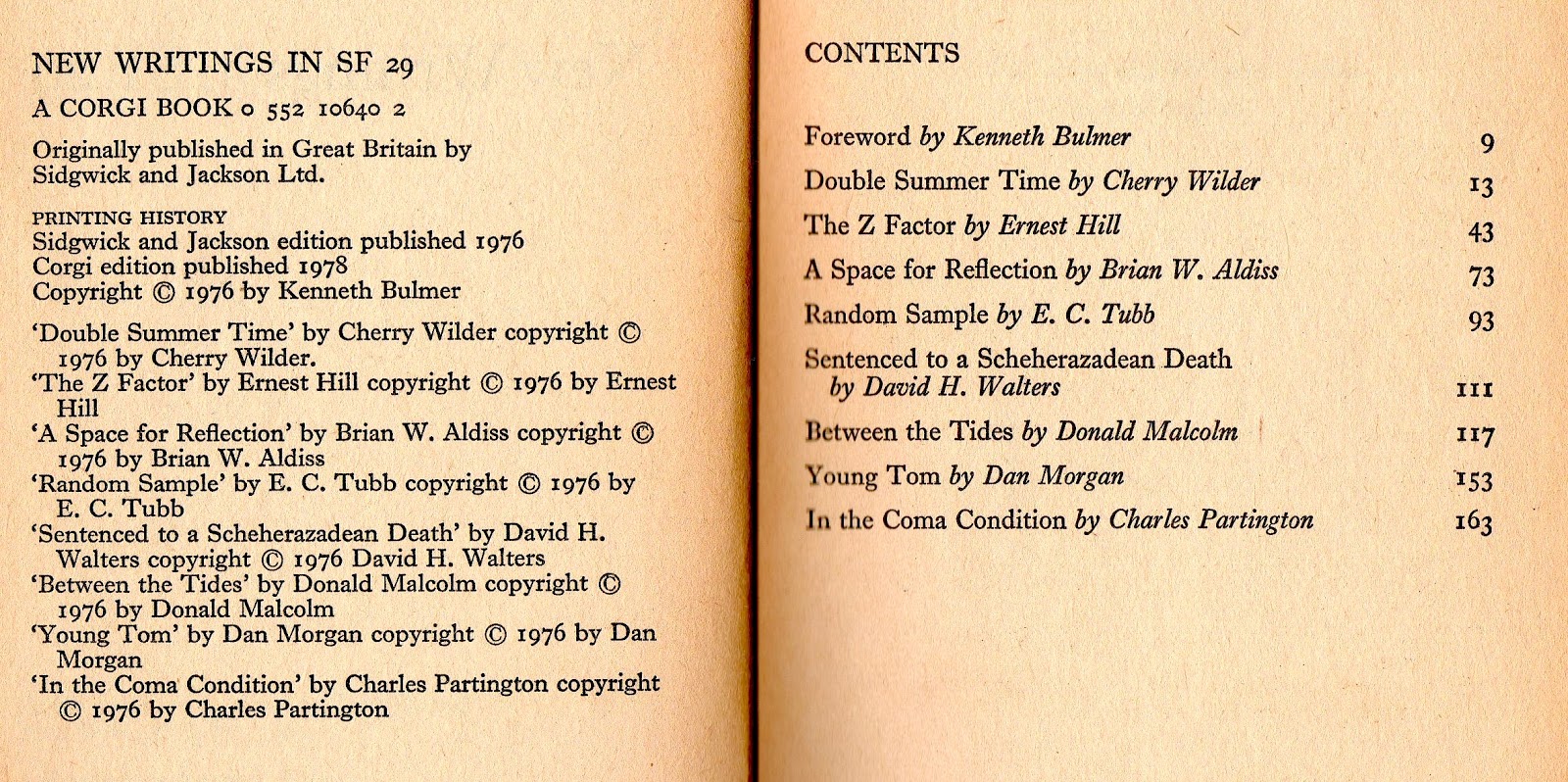
Cherry Wilder (‘Double Summer Time’), rambling overlong novelette, investigator Adamson is a NSO robot, Professor Latham investigates the bio-effects of meteorite-impact craters, Verity talks to a tree
Ernest Hill (‘The Z Factor’), his final published short story, a circular tale of Eddie Kale who has the alien Prior’s Z-chromosome, fights his way up from squalid south-bank London crime slums, through gladiatorial combat with robotic Warrior, into ‘Icarus II’ Karkov’s Law space-time ship to Barnard’s Star, and back into Australopithecus prehistory
Brian W Aldiss (‘A Space For Reflection’) Gordon Ivon Jefffris writes ‘The universe has a dark corner, the human soul, which is its reflection’, and travels the worlds of space seeking answers through fables and internal stories, relayed back to Birth Star superputer
EC Tubb (‘Random Sample’), anticipating the ‘Cube’ (1997) movies, four crew-members of starship ‘Prometheus’ find themselves in a white cube-room, subject to alien experiment
David H Walters (‘Sentenced To A Scheherazadean Death’), his only SF sale, dedicated to Christopher Priest, curiously – one long unbroken sentence-paragraph pre-execution plea
Donald Malcolm (‘Between The Tides’), Simde runs ice-threatened Hasub project to reach close-pass world of its binary sun, its Ewok-like people rich with cultural detail, HIV-overtones to its plant-symbiosis, internal language (cubs, food-plant, stopping = death) and sensitive moral equations
Dan Morgan (‘Young Tom’), black humour, killing Aunt Becky to gain her Life Credit for a child
Charles Partington (‘In The Coma Condition’), not the Saturn moon, Tethys is the experimental religious undersea city off the South American coast, unaffected by the fungal plague that extinguishes all surface life, Gestalt Behaviourist Massner haunted by Lynda Sagar, observes the descent into LSD empathic madness amplified by the Coma Colosseum
‘NEW WRITINGS IN SF no.30’ (Corgi Paperback, 1977) Cover-art by Angus McKie, and Bulmer ‘Foreword’ ‘providing a handbook to the as-yet uncharted futures that lie ahead of us all’ seemingly unaware there would be no more editions
Keith Roberts (‘The Shack At Great Cross Halt’), touching dialogue between ‘American Visitor’ coaxing ‘Rural’ girl who lives on motorway salvage, there’s background talk of the Sterling Crash, the First People’s War and a Trucker-led insurrection that seems doomed to failure, but what’s central is the growing trust between the two women
Martin I Ricketts (‘And The Moon Says Goodnight’), Earth’s stellar sector threatened by robotic Harkerbeast, genius Edgar Daniletti dies mistakenly believing his variable-star strategy has saved Earth
Brian W Aldiss (‘The Game With The Big Heavy Ball’), with breathtakingly surreal ‘Alice In Wonderland’ fractures and riddles, ‘I had thousands of golden centuries of childhood left to enjoy’
EC Tubb (‘Read Me This Riddle’), what Bulmer calls ‘Tall Tales of the Spaceways’, ‘there is a planet called Nyoka and on it can be found the Library guarded by a strange attendant and in it can be found all the hells and paradises imagined by Man. Worlds of the imagination which can be found and lived and known to the full as their creators intended.’ Explicit scenes of torture and degradation
Chris Morgan (‘My Sister Margarite’), in a world of failing magic and demons, Zachary invents the if-world – our world, and romances Pearl within it
Marie Jakober (‘Notes From The Android Underground’), as TVs ‘Humans’, life-like androids indistinguishable from people, must conceal themselves to survive
Ian Watson (‘The Roentgen Refugees’), mass-extinction of Third-World populations due to radiation from the Sirius nova, with satire-debate on apartheid and religious interpretations
Ritchie Smith (‘Amsterdam’), returning NASA astronaut Michael Sanger and artist Françoise Narcola travel lavishly around Europe in ornate prose rich with art-Lit cultural name-dropping wide enough to engulf Roy Harper and Colin Wilson, minimal SF, much pretentious dialogue striving for effect
‘THE BEST FROM NEW WRITINGS IN SF’ An Omnibus Selection Chosen from Volumes 1-4 edited by John Carnell (Dennis Dobson, September1971, Corgi paperback March 1972)
‘NEW WRITINGS IN SF SPECIAL 1’ edited by John Carnell and Kenneth Bulmer (Sidgwick & Jackson, 1975), Dave Sumner cover-art, omnibus collecting 21-23
‘NEW WRITINGS IN SF SPECIAL 2’ edited by Kenneth Bulmer (Sidgwick & Jackson, 1978), omnibus collecting 26 and 29 ‘
NEW WRITINGS IN SF SPECIAL 3’ edited by Kenneth Bulmer (Sidgwick & Jackson, August1978), omnibus collecting 27-28
See http://www.isfdb.org/cgi-bin/pe.cgi?8484

FEATURED WRITERS:
Brian W Aldiss – 1, 10, 22, 23, 24, 26, 27, 28, 29, 30
Isaac Asimov – 4 (review in Foreword of 24)
John Baxter – 3, 5, 6, 8, 10, 13
Barrington J Bayley – 23
Eddy C Bertin - 13
Sydney J Bounds – 13, 14, 16, 21, 22, 25
Damien Broderick – 1
Ken Bulmer – (fiction), 19 (Editorial) – 22, 23, 24, 25, 26, 27, 28, 29, 30
Ramsey Campbell - 26
John Carnell (Editorial) – 1, 2, 3, 4, 5, 6, 7, 8, 9, 10, 11, 12, 13, 14, 15, 16, 17, 18, 19, 20
Graham Charnock – 27
Arthur C Clarke – 22
David Coles – 19
Michael G(reatrex) Coney – 15, 16, 17, 19, 20, 21, 27
Paul Corey - 14
Les S Cornwell (translator) – 27
L Davison - 17
Thomas M Disch - 10
Dennis Etchison – 2, 4, 11
Bryn Fortey - 28
David Garnett (as David S Garnett) – 23, 24, 26
Joseph Green – 2, 5, 10, 15, 17, 19 (with James Webbert - 1)
‘Charles Grey’ – (see EC Tubb)
Steve Hall – 2
Lee Harding – 5, 11, 17, 18
HA Hargreaves (Dr Henry A) – 11, 17, 20, 21
Harry Harrison – 22
M John Harrison – 12, 13, 14
Ernest Hill – 6, 17, 29
Robert (P) Holdstock – 20, 28
James Inglis – 3
Marie Jokober – 30
Laurence James – 22, 26
Wolfgang Jeschke – 25 (translated from the German)
Vera Johnson – 27
Colin Kapp – 2, 4, 12, 10, 20, 21, 27 (‘Unorthodox Engineers’ tales – 3, 8, 16, 25)
‘John Kingston’ (see Keith Roberts)
John Keith – 26
Leroy Kettle - 28
Vincent King (pseudonym of Rex Thomas Vinson) – 9, 11, 13, 14, 15, 19
John Kippax – 22, 24
David (A) Kyle – 13, 18
GL Lack – 2, 10
Bob Van Laerhoven – 27
Grahame Leman –18, 20, 23, 28
David Langford – 27
Peter Linnett – 24, 27
Diane Lloyd – 21 (John Carnell tribute)
Manuel Van Loggem - 28
RW Mackelworth (Ronald Walter) – 5, 7, 8, 14, 17
Edward Mackin – 1
Donald Malcolm – 5, 18, 24, 25, 29
Douglas R Mason – 7, 9, 11, 16, 21 (& as ‘John Rankine’ – 1, 2, 7, 10, 11, 12)
Chris Morgan – 30
Dan Morgan – 3, 4, 20, 29
Gerald W Page – 8, 9
Charles ‘Chuck’ Partington – 23, 25, 29
Thomas Penman (with Ritchie Smith) – 26, 28
John T Phillifent (as ‘John Rackham’) – 2, 6, 8, 9, 11, 13,19, 22, 25, 27
Frederik Pohl – 3
Robert Presslie – 6,7
Christopher Priest – 19, 22, 15, 16, 26
‘John Rackham’ (see JT Phillifent)
‘John Rankine’ (see Douglas R Mason)
Martin Ricketts (as Martin I Ricketts) – 24, 25, 30
Keith Roberts – 3, 4, 6, 7, 8, 15, 21, 23, 30 and as ‘John Kingston’ – 3 and as David Stringer – 4, 5
Peter Roberts – 25 (as translator)
Angela Rogers - 28
David Rome – 12, 13
Eric Frank Russell – 9
Domingo Santos – 14 (in translation)
James H Schmitz – 3
Arthur Sellings – 9, 12, (14 as translator), 15 (with obituary notice)
Ritchie Smith – 30, (plus 26, 28 with Thomas Penman)
William Spencer – 2, 6, 9, 18
Michael Stall – 23, 25, 28
‘David Stringer’ (see Keith Roberts)
William F Temple – 7
William Tenn – 4
EC Tubb – 6, 22, 23, 28, 29, 30 (& as ‘Charles Grey’ - 23)
David H Walters – 29
Ian Watson – 26, 30
WT Webb – 11
James Webbert (with Joseph Green) – 1
Keith Wells – 25, 27
Robert (Frank Charles) Wells – 18
James White – (‘Sector General’ tales – 7, 12, 14, 16 & 18 collected into fix-up novel ‘Major Operation’ 1971) 21, 22 (collected into his ‘Futures Past’ 1982)
Cherry Wilder (aka of Cherry Barbara Grimm née Lockett) – 24, 26, 29
Eric C Williams – 5
Jack Wodhams – 11
Donald A Wollheim - 22