Saturday, 21 March 2020

Movie: 'UP THE JUNCTION'


‘UP THE JUNCTION’: 
DOWN AND OUT FROM 
CHELSEA TO BATTERSEA 


Review of: 
‘UP THE JUNCTION’ 
 A BHE Production/ Paramount, 1968. 
Director: Peter Collinson. With Dennis Waterman, 
Suzy Kendall, Adrienne Posta and Maureen Lipman 
(DVD, 2008, Paramount Pictures DVD)


‘There’s nothing new about today, only what the papers say…’ 
 (“Up The Junction” by Manfred Mann)


Dennis Waterman. He’s forever with us. The loveable-rascal child-star of BBC-TV’s adaptation of Richmal Crompton’s ‘Just William’ from 26th May 1962, he could later be seen as the dashing young hero opposite Christopher Lee in Hammer Horror’s ‘Scars Of Dracula’ (1970), valiantly dueling the vampire Count on the battlements of Castle Dracula, before Lee is struck by lightning and plummets to his fiery death. But he became even more high-profile as DS George Carter, tough side-kick foil for John Thaw’s no-nonsense Detective Inspector ‘Jack’ Regan in hard-hitting cop-drama ‘The Sweeeny’ (from January 1975), which spun-off into two big-screen movies in 1977 and 1978. The universally-popular ‘Minder’ softened his persona, reaching new heights of popularity as gullible easy-going Terry McCann to George Cole’s inept devious con-man ‘Arthur Daley’ (from 29th October 1979). He even got to ‘write da feem toon, sing da feem toon’, and that theme-song – “I Could Be So Good For You” saw him cavorting on ‘Top Of The Pops’ as it peaked at no.3 in November 1980. Since then he’s been ageing comfortably into the role of retired cop ‘Gerry Standing’ in ‘New Tricks’ with James Bolam and Amanda Redman (from 27 March 2003), taking the Waterman screen-life all the way from schoolboy to senior citizen. He’s likeable, and people like Dennis Waterman in an easy undemanding reliable kind of way. He knows how to work to camera, because it’s something he’s always done. It’s his day-job.


That he could have been something more is hinted at in ‘Up The Junction’. Here, for once, he’s given the opportunity of stepping outside of character, into something potentially different. But this film is more than that. It’s also the nexus of a number of other career-trajectories threading through the sixties. Manfred Mann wrote the score. With Manfred’s beatnik-jazz guise and Mike Hugg’s compositional abilities (later utilised for the ‘Whatever Happened To The Likely Lads’ TV-theme), they were always more musicianly-competent than their run of hits and chart-contemporaries would suggest. Now, as the siren blasts, and the factory-slappers pour out through the gates the Manfred’s acoustic strum feeds in behind them – ‘through the factory-gates they swarm, overalls like uniforms’, climbing for long-shots over Battersea Bridge towards the Power Station. Vocalist Mike D’Abo sets the scene with lyrics telling of people ‘drifting in the human stream… conditioned to the daily grind’. Although – unusually for Manfred’s men, it didn’t chart, the single edit of the theme-song (Fontana 267-810TF) is one of their finest records. And the album, with its sixties Pop-Art design is now highly-collectible.


While the Nell Dunn novel on which the screenplay is based, is part of the upsurge of angry Working Class writing that was busy upsetting the cosy literary-complacency of the bookish establishment. After all, the ‘Junction’ is both Clapham Junction rail-station, and a more dubious slang reference to the crotch. Although born to privileged upper-class Chelsea parents and educated at a convent, Dunn had dropped out at age fourteen. In 1959 – like Polly Dean (Suzy Kendall) in her story, she’d moved to more exuberant Battersea, worked in a sweet factory, and become part of the vibrantly turbulent community she found there. Here, the DVD-jacket calls twenty-one-year-old Polly a ‘well-heeled party girl who, bored with her affluent Chelsea lifestyle, moves to the industrialised and considerably less well to-do area of Battersea’. So the film dramatises her real-life transition. From the big white house beyond the gravel drive behind the black gates. To the chauffeur, and the Rolls taking her just across the river, to ‘a different world entirely’ as the estate agent muses. It’s a ‘different world, love, that’s all’ repeats Peter later, in case the emphasis was missed the first time round. Why she’s switching lives is never adequately spelled out, beyond glimpses gleaned from her comments. ‘I know what money does to people. I know what it’s like to be rich. It destroys you. It makes you false and useless, and I don’t want to be any part of it.’ Her old life was too safe and controlled? Too hypocritical and smugly complacent? Too artificial?

  
Opposite the rail embankment the ‘ever-so well-spoken’ Polly applies for a job. Figgins, the foreman, is Michael Robbins – ‘Arthur’ from the ‘On The Buses’ sit-com. ‘I’ve come to enquire after work’ she enunciates politely. Only to be corrected, ‘a job’. Soon she’s packing ‘Pringles’ chocolates six-to-the-box. The girls wear headscarves and blue overalls. They banter raucous-gossip about one girl who’s ‘been a scrubber all her life, that one’. There’s a Monkees-poster on the wall. And they smoke. Edie coughing phlegm into a crumpled handkerchief over the production-line. And they’re almost poisoned by a full pack of fags found immersed at the bottom of a tea-urn. Health and Safety legislation was less stringent in those days. At break-time, apprentices play football in the yard beside the bike-sheds as the girls watch and snigger. Polly observes it all in strange wonderment, as if they’re exhibits in a wildlife documentary.


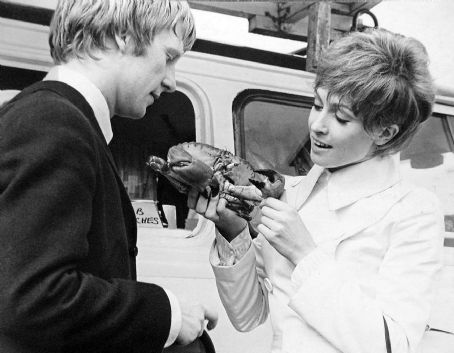
Next day, in her dark trouser-suit and carrying a red suitcase, Polly comes looking for digs in an area where signs say ‘No Colored’s’. With a cheap apartment rented she spots Dennis Waterman – as ‘Pete’, driving a green VW van. He works at ‘The Curio’, a second-hand junk-shop owned by Charlie (Alfie Bass). She doesn’t want antique furniture, she wants ‘ordinary and plain’ from his Steptoe-and-Son yard outside. £4. 10s for a sofa, a free kitten, and a lift in his van. He’s nervous as he humps her stuff into her flat. She’s out of his class, literally. She tries to tip him. Instead, he asks her out. Pete is a working-class Mod with aspirations. He is what I was at the time. I recognise his every symptom. I recognise the factory and the women who work there. For me, it was a print factory in Hull. But the reality is instantly convincing. A strange lost world, but it’s one that I was a part of. I can vouch for its authenticity. I taste it still.


It’s their first date together that sets up their opposing contradiction. Polly gets her long hair cut into a bob. Buys the bright-orange miniskirt and dangling pink earrings that she wears on the cover of the soundtrack album. He turns up in a white turtle-neck sweater, riding a Mod scooter. She doesn’t want to go to his preferred choice, the West End or Kensington. Why can’t they just walk? So they walk. Fires burn in the slum clearance rubble. Tower-blocks rear behind. A Police siren phases by. A dog barks. She’s entranced by the romance of watching twilight over the rail sidings. He sees it differently. ‘Poxy little houses. Some Mum in bed. Steel rods in her hair and false teeth in her glass. Her Old Man snoring, he’s been out on the booze, every time a train goes by it rattles the house. The Old Man starts coughing. Out of bed and spit it in the pot. A kid’ll scream further down the road. Up in the morning at six, go to work, day in and day out.’ It’s a soliloquy of some poetic power. She sees it differently, to her it is ‘more real, more natural’, a place where you are ‘free to be yourself.’ But no, not to him, ‘freedom? You get more freedom in Wandsworth Jail’ he retorts. Later they witness a street-brawl with factory-girl Sylv and ‘my ponce of a husband’, with Mum and the cops wading in. Embittered, Pete tells her ‘seen enough? You wanted too see life, well that’s it, you’ve seen it.’ Like the Rolling Stones’ socially-aware lyric to “Play With Fire”, ‘well, you’ve got your diamonds and you've got your pretty clothes, and the chauffeur drives your car, you let everybody know, but don’t play with me, ‘cause you’re playing with fire…’


The second strand of the film is Polly’s arm-in-arm friendship with two unlikely sisters, blonde Rube (Adrienne Posta), and dark-haired Sylvie McCarthy (Maureen Lipman). She’s there with them in the smoky saloon bar where Rube banters the pick-up routine with Terry. ‘What’ya doing tomorrow?’ ‘Having a bath.’ ‘Is it your birthday then?’ Outside she straddles the back of his big Triumph motorcycle, asking him ‘are you safe?’ ‘Only when I’m driving’ he leers The dialogue catches the exact sniff of grit-truth. As she’s dropped off outside their terraced house she sniggers to Sylv ‘do you know? I’ve got a feeling that Terry can do anything he likes with me.’ When Rube passes out at work Polly takes her home. Inevitably, she’s ‘up the spout’, but ‘I’ll get rid of it. I know someone up Wimbledon way.’ Before legal terminations on the NHS the only alternative was back-street abortion. This film illustrates its full horrors. The wonderfully-grotesque Hylda Baker is gin-swigging ‘Winnie’, who does abortions as a ‘sideline’ above her hardware store. She charges three-months-gone Rube £4, cash.


As her new friend endures the horrific ordeal, Polly waits outside. She wanders in the park where lovers stroll, doting fathers with kids watch the swans glide, as the Manfred’s play a pastoral “This Day” over the soundtrack. It’s a family idyll to contrast the squalor of Rube’s situation. When she finally emerges, eye-shadow smeared with tears, she’s unable to walk. So Polly calls Peter. ‘What am I, ambulance or something?’ he snipes and tries to warn Polly off getting involved. But she sticks with Rube as an enraged Terry gatecrashes their terraced house protesting ‘I don’t want no kid of mine going down the drain!’ There’s a screaming match between mother and Sylv, ‘Stupid cow’, ‘You dirty bastard’, as Rube howls out her agony. As an immersion in ‘reality’ it surely exceeds Polly’s worst expectations, she’s truly living the nasty brutish and short side of her proletarian idyll, but there’s more to come.


Once the incident has passed, a reconciled Terry and Rube get engaged. In the middle of their celebration party Rube decides she wants to go bowling, and they set off in a convoy of cars and motorbikes. No helmet, Terry is hit by a truck at a crossroad. It’s Peter who has the sense to ask for a mirror to check his breathing. It’s too late, he’s dead. And it’s Peter who comforts a distraught Polly, in bed.


For the film’s final section Peter turns up in a silver sports car to take Polly for a posh weekend in Brighton. ‘For you, Princess, the best.’ Any other girl from the manor would be well-impressed. Not Polly. Posh is exactly what she doesn’t want. Posh is what she’s escaping from. She’s bored by the upmarket hotel he’s booked them into, and its sniffily disapproving receptionist. She’d prefer a cheap B&B with a fat landlady, and a plate of cockles. Again, their contrasting attitudes are thrown into sharper relief. He proposes marriage. Despite her supposed ‘clever and classless and free’ modernity, her response, ‘you’ll have to get a better job. One to support us both’ betrays her conventional attitudes. As husband, he must also be provider.


His response is equally revealing. ‘Everyone in Battersea knows what you are. They all know you’re a rich girl.’ So has he simply got her marked as a meal-ticket out to the ‘Room At The Top’? ‘You think living in a slum and working in a factory is good for you? You’re mad. They all want what you got.’ No, not exactly. From their first meeting he’s been fixated by her, she makes him more than a little nervous. But part of that attraction is that she represents something better, something elevated from every other aspect of his dead-end life. He’s not only drawn to her, but to everything she represents. A motivational tangle he’s probably unable to resolve himself. While, despite his upwardly-mobile pretensions, his gender expectations remain as dully conventional as hers. He still expects her to get up and prepare a full fry-up breakfast for him as he lies in bed reading a ‘Giggle’ comic-book.


In a neat summing-up finale he’s pulled up for speeding by the cops. He’s stolen the car he’d intended to impress her with. In a court hearing the contemptuous judge sentences him to six months. Naturally the court official is a family friend of Polly’s ‘Daddy’, who allows her to visit him in the cell. On her way out of the courtroom she passes a giggly Rube and Sylv. ‘That’s the thing, you see’ moralises Rube, ‘what you don’t get caught for you’re entitled to.’ And the camera pans out over the river, just as the film began, leaving an open ambiguity. Will Polly return to her safe Chelsea life, sadder but wiser? Is her adventure in slumming over? Or will she be there waiting for him on Pete’s release? For a moment, it’s almost possible to glimpse his easy character-evolution into ‘Minder’s Terry McCann, also an ex-con fresh from the nick. Her future is a matter of choice. His is now more fixed than ever.


Nell Dunn’s path is clearer. She used this source period drawn from her own life to fuel the raunchy and sympathetic female-focused series of short stories that became the book, that became the film. The stories – some of them trailored in the ‘New Statesman’, pass on their authentically gritty power to, first a TV production (a Ken Loach/Tony Garnett BBC ‘Wednesday Play’ broadcast 3 November 1965), then this movie. Yet the film’s reception was not universally positive. Critic Alexander Walker was less than impressed. To him, ‘this story of the Deb girl who settles into a sleazy room to taste the uncorrupted sweetness of slum life’ is ‘all too pat in its parade of slumland London’ (in ‘Hollywood, England’, Harrap Books, 1974). And yes, there is an anthropological aspect to Polly’s exploration of lower-class life, as though she’s a tourist stepping down into a strange culture of quaint and curious people, only to find that she’s ‘using other people’s squalid lives to sustain her own class rebellion’. But, within a context of fluid social mobility in which the earthy realities of Working Class life portrayed by Angry Young Northern writers and personified by the eruption of Beat Groups, ‘Up The Junction’ is honestly autobiographical – if inevitably viewed through celluloid’s distorting lens. While the narrative device of using Polly’s trip through the underclass seems contrived, it throws the contrast into a sharper relief. If the film lacks the monochromatic harder edge of Karel Reisz’ ‘Saturday Night And Sunday Morning’ (1960) from Alan Sillitoe’s novel, revealing to Alexander Walker ‘how swiftly social reality turns into social cliché, unless there is insight and sympathy to refresh it,’ that’s because time had moved on, into the late-sixties, benefiting from London’s newly-swinging status. Reality itself was becoming more porous.

Later, although writing predominantly for the stage, Nell Dunn followed ‘Up The Junction’ with Ken Loach’s equally forceful ‘Poor Cow’ (1967) with Carol White and Terence Stamp. Her subsequent theatre work includes ‘Steaming’ (1981), which ran on Broadway and was revived in the West End during the nineties, while ‘Cancer Tales’ (2003) was a series of monologues and dialogues written in response to her father’s death. Meanwhile, ‘Up The Junction’ features a score of supporting actors with their own vital contributions – comedian Hylda Baker, Alfie Bass, Liz Fraser, as well as dolly-birds Suzy Kendall and Adrienne Posta. Briefly married to Dudley Moore, Suzy Kendall was ‘Gillian’, one of the sassy underperforming schoolkids in teacher Sidney Poitier’s classroom, alongside Lulu and Judy Geeson, in ‘To Sir, With Love’ (1967), tackling racial and social issues in a touchingly humorous way. The seventies were less kind to her, until she (again alongside Liz Fraser and Adrienne Posta) appeared in drab sex-comedy ‘Adventures Of A Private Eye’ (1977). While Adrienne, who also cut a series of Pop singles through the sixties, finally charted as a session-singer on Jonathan King’s 1971 hit “Johnny Reggae” as the Piglets. She also rejoined Dennis Waterman as ‘Jenny’ in the ‘Minder’ episode “All About Scoring, Innit?” (broadcast 20th November 1980). Because Dennis Waterman, he’s forever with us. 


‘DON’T GET CAUGHT WAS 
WHAT SHE WASN’T TAUGHT’


‘UP THE JUNCTION’ (A BHE Production/ Crasto distributed by Paramount Pictures, 25 January 1968) Director: Peter Collinson. Producers: John Brabourne and Anthony Havelock-Allan. Screenplay by Roger Smith based on the book ‘Up The Junction’ by Nell Dunn. With Dennis Waterman (at Pete), Suzy Kendall (as Polly), Adrienne Posta (as Rube), Maureen Lipman (as Sylvie), Liz Fraser (as Mrs McCarthy), Susan George (as Joyce), Alfie Bass (as Charlie), Linda Cole (as Pauline), Doreen Herrington (as Rita), Jessie Robins (as Lil), Hylda Baker (as Winnie), Queenie Watts (as Mrs Hardy), Billy Murray (as Ray), Michael Robbins (as Figgins), Mike Reid (as uncredited Policeman outside Court). Music by Mike Hugg and Manfred Mann, LP ‘Manfred Mann Go Up The Junction’ (Fontana TL/STL 546023, February 1968) produced by Shel Shalmy with thirteen original tracks. Group in the Pub doing “I Need Your Love” are the Delecardos. 114-minutes (DVD, 2008, Paramount Pictures DVD) 

The June 1979 no.2 hit single “Up The Junction” by Squeeze (A&M 7444) – from the group’s second album ‘Cool For Cats’, has no direct connection to the film, but writers Glen Tilbrook and Chris Difford acknowledge its influence on the song’s title and lyrical themes 

Featured on website: 
‘VIDEOVISTA’ (UK - February 2013)


Thursday, 19 March 2020

Band Interview: PARTY DAY


PARTY DAY: 
PEOPLE WHO LIVE 
IN GLASSHOUSES 


PARTY DAY were a band from Wombwell, Barnsley. 
I interviewed them twice, just as they were issuing their 
highly-rated album ‘Glasshouse’ in 1985 


Originally we were just post-war. Then we were post-Imperial, post-Industrial, post-Beatles, post-Punk, post-Marxist, post-Feminist, and even post-Modern – the general accumulative impression being that somewhere along the line we’ve missed out, we’ve come along too late, it’s all happened. So what can a poor boy do except play in a Rock ‘n’ Roll band?

Among the glut of north-east England guitar-led bands-to-watch who successfully escape any revivalist tags yet synthesise various post-styles into an acceptably eighties melange – bands such as Leitmotif, Sinister Cleaners, or Cold Dance – Party Day are the ones most currently odds-on, the ones most rapidly emerging into the fast lane. A hint of Gothic drama, a touch of thrash-Punk energy, a modicum of Power-Pop tune-flair, all nailed down into a tight three-against-the-world bass-drums-lead format. Last year vocalist Martin Steele was advocating (to ‘ZigZag’ magazine) a ‘gradualist’ policy to marketing Barnsley’s finest, and thus far – from intensive gigging, through a series of home-made singles and compilation slots, they’ve built a following on that step-by-step principle. The next step – as they say, is… love! And their debut album ‘Glasshouse’, forms their most stunning statement to date. There’s no polemics – people who live in ‘glasshouses’ shouldn’t…!, there’s no Leaders or state-of-the-nation’s on the next big thing either. But what they do do, they do searingly well.

Live: against an aerosol-spray backdrop like a series of chromatic explosions, Martin – tall and blonde with hair shapelessly plumed, stands in owl-eye granny shades, swapping vocals for alternate numbers with slight dark pogoing bassist Carl Firth. Party Day are more bounce to the ounce than page three of the ‘Scum’, more fun to the tonne than your statistically regular Indie band – so fierce they blister the speakers. They remind you what grabbed you about guitar-based Rock in the first place, and they ram it home with lethal contagion. It’s traditional instrumentation guillotined to a 1976 knife-edge. Appropriately the house p.a. rests on crates stencilled ‘EXPLOSIVE CARTRIDGES’, which seems to sum up their set.

Strange days indeed…

Apres la gig – or post-Gig, we’re slouched around the one illuminated Common Room in the otherwise eerily dead Student’s Union building, there’s a partly-dazed Party Day – Martin, Carl, and drummer Michael Baker, coming down from the high-octane burn of gig adrenalin, a fanzine writer from ‘Whippings And Apologies’ in sharp fifties quiff razored to a precision peak… and me.

I compliment the trio on the LP track “Athena”, its sinuous guitar-build treated with found-tape (from a radio talking heads show with Robert Robinson?) documenting a ‘pure DH Lawrence’ story of a girl who becomes pregnant by the sun. Done live – bereft of such studio manipulation, the energy-levels are intimidating…

‘Energy?’ from Carl. ‘We’re right out of that now, we’re knackered!’

‘It’s a fairly recent song’ concurs Martin more seriously. ‘But I can’t for the life of me remember how we got it together. I write all the material, I tell him what to do on drums, and him what to do on bass.’ Carl and Michael furiously shake their heads behind him. ‘No’ – back on the level, ‘the writing’s done by three people, we bounce ideas off each other. We throw a lot of songs away. We work loads of songs out, and we’ll play one a couple of times and think ‘no, that’s not working,’ and we won’t do it again. But then we’ll hit on something and we know THAT’S what we’re going to be playing. It just falls into place.’

“Athena”? ‘It’s a deep song’ adds Michael. ‘But we’ve got more commercial songs than that.’

‘You can’t expect people listening to records, and buying records, to be naïve about what they wanna hear’ argues Martin. ‘They KNOW what they like. And yes, “Athena” is fairly complicated, but you can’t put people down by thinking that that’s not what they want. That probably IS what people want. They want music with something about it, not all this Disco stuff. Not that there’s aught wrong with SOME Disco, there’s some really good Disco records about, but having said that…’


--- 0 --- 

Once the Party Day line-up firmed – unlike Danse Society who set up their stall in Sheffield, Party Day stuck around their native West Yorkshire post-Mining town of Barnsley to carve out a solid local reputation. They created venues – like the ‘White Heart’, where none previously existed. ‘They weren’t gonna put bands on, but we pestered them, and we became the first band to play there. Since then they’ve had a flood of bands.’

‘I thought I were going to be a Bobby (Policeman), but I didn’t grow enough. So I had to become a bass guitarist instead’ travelogues Carl. ‘We began with another guitarist (Gregory Firth) who used to do the major part of the work, with Martin just filling in on guitar.’

‘But when he quit I was left to do ALL the guitar AND vocals, which is… well, I just thought, I’m sick of this singing lark – ‘cos I’m basically introvert,’ again, Martin’s laconic Party Day humour. But whatever the motivation, vocals are now effectively split down the centre, the two voices pitched against each other, adding contrast and power, a technique used to breath-catching effect on album cuts “Firehorse” and “Atoms”.

Party Day are ‘the bastard child’ of an early grouping known as Further Experiments, who ‘after nine months, denounced their original path to success,’ leaving only a five-track tape to mark their passing (‘…More Fun In Colour’). The transition occurred in May 1981, ‘basically we just took the name ‘Party Day’ from a song’ explains Carl. The first evidence of Party Day’s presence came on a brace of cassettes – early material, such as the percussive “Them” laced with synths, but the distinctive structural sound already established, a long instrumental drive-in, often working up from solitary bass figures, gathering momentum, power, and intensity towards the vocals which, mixed back and faintly echoed, are cleanly separated and word-perfect. Early live material includes “Washing Line” and “Springboard”, “Bleed Me” and “Sisters”, as well as “Rabbit Pie’ – a song allegedly based lyrically on the wartime favourite ‘Run Rabbit Run’ – ‘so don’t let your life stand still/ or you too could end up in a rabbit pie.’


Post-cassette, the fast-paced single “Row The Boat Ashore” – plus their meaty beaty big and brash contribution to the Leeds-based ‘Giraffe In Flames’ compilation, extended that base, up to and including the launch of their debut album. While the only classic Party Day song NOT included on the LP is – oddly enough, the title song! But they’re saving the visionary-anthemic “Glasshouse” for a soon-come twelve-inch single courtesy Rouska Records, which will emerge post-album.

So what’s the next step? A support spot on a national tour?

‘Thing is’ explains Martin, ‘if you want to support a major band you send off a demo tape. They hear our tape and they think ‘no way, we’re not having them in, ‘cos they’d blow us off-stage!’ So we never get to support any major bands. No, we’ve played with Attila The Stockbroker, we played support to the Cult in Leeds, and with Danse Society once at Sheffield’s ‘Marples’. I was really impressed with them that night. Other big names we’ve been associated with include Newtown Neurotics. But I doubt if we’ll ever get to the stage of supporting a really major band because it depends a lot who that band is. I mean – XTC used to be big, we’d have done well supporting them. We’d have banged down the XTC crowd. They’d have liked us. But all this pretentious Sex Gang Children rubbish, they’re just after the image side of it. The skull and cross-bones side of it…’

So why the absence of colour about Party Day garb? Isn’t that image?

‘Naw. We were at a funeral before we came here. We wear what we want. Black’s alright, in’it? Black just suits anybody. It’s nothing Gothic or owt like that. It’s better than gold lamé suits, that’s all. But we wanna concentrate more on us image, ‘cos we ain’t got one!’

I thought it came across pretty strongly tonight.

‘What, this black stuff?’ he reacts in mock-astonishment. ‘In that case we’ll wear it all the time! But no, we haven’t got that sort of BANG straightforward ‘did you SEE that band last night? Did you SEE what he was doing?’ Sure if you get in early on any sort of bandwagon you’re made for a while, but it soon fizzles out once you’ve ridden that wave. And that image you project, that’ll stick with you to the death. A lot of bands can’t live those images down – like the ‘Bat-Cave’ bands, like Specimen and Alien Sex Fiend. They’ll be out as quick as they came in. We’d soon get bored with all that anyway.’

Party Day don’t toe anyone’s Party Line, they just – as The Man says, Party Party!!!

It’s unfortunate that change seems to be in the air, just as the album’s on the brink of shoving them out to their widest audience yet. A rift with long-time manager Steve Drury, plus rumours of realignments within the group itself – centred on Martin, complicate the equation. But hopefully we’ll soon be into a post-shuffle period with Party Day in a clearer definition to fulfil the rich promise that ‘Glasshouse’ makes.

Hopefully we’ll soon also be in a post-Margaret Thatcher post-Ronald Reagan period too, then we can start thinking more of the future and less about the cults and ikons of the past. But until then you could do a lot worse than listen to Party Day.


PARTY DAY: 
MORE FUN, LESS COLOUR 

‘They hold their guitars like loaded AK47s. They throb’ 
Seething ‘Susan’ Wells in ‘New Musical Express’ 
(3 March 1984)


SINGLES 

‘SANS CULLOTTES’ (1983 cassette, ‘Scented Tapes: The Smell Of Success’ FX 001) with ‘Values’, ‘Party Day’, ‘Them’, ‘Sadness To Serve’

‘PARTY DAY’ (1983 cassette, ‘Superman And Wonders’ FX 003) with ‘Glasshouse’, ‘Opium Gathering’ and ‘Tin Sky’


“Row The Boat Ashore” c/w “Poison” (July 1983, Party Day Records FX 301) reviewed in ‘ZigZag’ as ‘their simpering and delightful sound is a thing of beauty’ (July 1983)

“Spider” c/w “Flies” (April 1984, Party Day Records FX 302) reviewed as ‘excellent punk junk howl’ (‘Sounds’, 19 May 1984) www.youtube.com/watch?v=zR2Qh64AAgk

‘GLASSHOUSE’ EP (October 1985, Rouska Records Come 1T, 12” vinyl) includes “Glasshouse”, “My Heroine”, “Let Us Shine”, Smile”


ALBUMS 


‘GLASSHOUSE’ (1985, Party Day Records FXLP 401) with side one: ‘Rabbit Pie’, ‘Firehorse’, ‘Carousel’, ‘Atoms’. Side two: ‘Boredom’, ‘Grace’, ‘Row The Boat Ashore’, ‘Athena’. Engineer, Neil Ferguson, at Woodlands Studio, Castleford. After the album’s release Martin Steele quit due to ‘poor health’ and was replaced by Dean Peckett (who died 3 January 2016) https://www.youtube.com/watch?v=5ROvp67Qf1E

‘SIMPLICITY’ (1986, Party Day Records PDLP 501) with side one: ‘She May Be Blind’, ‘Sovereign’, ‘Stay In My Heart’, ‘Laughter’, ‘Simplicity’. Side two ‘The Other Side’, ‘Precious One’, ‘Career’, ‘A Passing Pain’, ‘Glorious Days’, ‘Untitled’ reviewed as ‘the attractive, though slightly overwrought black sheep, ‘Glorious Days’, which could have brought a lump to Mario Lanza’s trousers’ (Mick Mercer in ‘Melody Maker’, 12 July 1986). Paul Nash (guitar, vocals) and Shaun Crowcroft (bass) join in 1986 replacing Carl Firth, but Party Day split in 1988

‘PORKTASTIC’ (recorded in 1987, self-released 2016, MP3 only) with ‘Aching’, ‘Deal’, ‘The Chain’, ‘And I Held Her Hand’, ‘Hymn’, ‘Take It Easy’, ‘Surge’, ‘Let’s Spend The Night Together’, ‘Born Yesterday’, ‘Let It Show’ plus bonus tracks ‘Big Surge’ and ‘Milky Way’ https://www.discogs.com/Party-Day-Porktastic/release/10878457 


COMPILATIONS 

“Party Day” on ‘Real Time 5’ (March 1983, Unlikely Records 5, cassette)

“Rabbit Pie” on ‘Giraffe In Flames’ (January 1984, Aaz records 001, vinyl LP) plus tracks by Nick Toczek, The Chorus, Sinister Cleaners etc https://www.youtube.com/watch?v=17lRkHnQQhk

“Rabbit Pie” on ‘Band-It No.14’ (March 1984, German cassette magazine no.14)

“Athena” on ‘Four Your Ears Only’ (Summer 1984, Belgium Play It Again Sam BIAS 02, vinyl 12” EP) plus tracks by Red Guitars, Luddites and Red Lorry Yellow Lorry

“Opium Gathering” on ‘Raw Red Heat’ (Autumn 1984, Flame Tapes 1, cassette)

“Spider” on ‘Raging Sun’ (1985, Rouska Records RANT 01, vinyl LP, also cassette RUSK 006)

“Borderline” on ‘Bites And Stabs’ (1985, Torment Records TOR 001, vinyl LP)

“Let Us Shine” on ‘Torn In Two’ (1986, Torment Records TOR 002 compilation LP)

“Let Us Shine” on ‘Zarah Leander’s Greatest Hits’ (1987, Rouska Records CONCORD 18, CD)

“Atoms” on ‘Strobelights Vol.3’ (2006, Strobelight Records STROB 020, compilation CD)

“Atoms” on ‘Return Of The Batcave Vol.1’ (2008, internet only, CD)

www.party-day.co.uk
https://www.facebook.com/Party-Day-358138204248257/ 


PARTY DAY: 
THE PARTY LINE 


First time I saw Party Day.

An audience that shrieks with chic in a concrete tomb beneath the vast ‘Clockwork Orange’ multiplex of the Leeds ‘Merrion Centre’. Amps switched up to infinity, a positive-thrash power-trio roaring (geographically) outtta Danse Society territory. I’d heard their tapes, but live there’s a hard sharp attacking edge that C30 chrome-dioxide can’t trap. Like the result of twisted eugenics there’s lots of familiar reference-points finger-printing their contagious stand-outs, “Athena”, through “Opium Gathering”, and into the riffing “Tin Sky”, but they come out laundered oddly fresh.

A six-month later, after a single in a Dayglo bag promoted through a concentrated swamp-operation gig schedule, I see them a second time, churning into a high-sweat situation in a glass ‘n’ concrete ‘Beckett’s Park’ Students Union Hall. They start out by verbally taunting the ‘lazy’ audience, deliberately provoking adversarial response, until they get all the attention-fix they need. What was once promise is now parallel bars of spiral spinal craggy jagged energy rush. What Bart Bartie calls ‘sheet metal and hysterical pagan’ music (in ‘NME’).

‘There’s a lot to be said for guitar, bass and drums’ drawls heavy-built guitarist Martin Steele. ‘People just kinda latched onto synths. We’ve tried synths, but they won’t fit in for us. You can do owt on a guitar – as you’ve just witnessed!’

‘With just three members in the group the ideas are kept more together’ agrees bassist Carl Firth. ‘Whereas if there’s more people involved…’

‘…your ideas get watered down.’

Drummer Michael Baker, crop-headed and unshaven, comes in – ‘it’s tighter and quicker’, with an admirably concise summation.

‘We wanna get away from that thrash-Punk thing though’ adds Martin in thick slow seams of Barnsley accent. ‘We’ve had a bit of constructive criticism over it. Some of our songs are fairly melodic and I think we ought to develop that more. There’s nowt wrong with a melody when all’s said and done. It can be weird. It can be whatever you want.’

The single – combining “Row The Boat Ashore” with “Poison” (Party Day Records), shows this development already, but for what it’s worth, a track called “Athena” – even now emerging on the Belgium compilation EP ‘Four Your Ears Only’ (Play It Again Sam label), sounds a stone classic to these jaded ears. When they do it live its chorus-chant is instantly memorable, yet its after-burn hints at more subtle energies.

Cabaret Voltaire once defined Sheffield for me as a ‘negative influence’, being a recession-blitzed steel town where nothing ever happens it provided a vacuum that they had to fill. But ‘there’s plenty to do in Barnsley’ asserts Martin, in the kind of dead-pan Party Day send-up line I’m now getting attuned to. ‘You can go and watch a good game of football. Or get pissed. It depends.’ But he did neither. ‘I knew when I was about six that I was gonna form a group. That was my ambition.’ And through various evolutionary personnel shifts, tonight is the logical end-product of that ambition. Party Day is a name lifted from an early song, just as the name ‘Joy Division’ was taken from a song, it’s superficially upbeat, masking a menacing nihilism. The name is ‘a bit cynical’ admits Martin. ‘Nothing is as it appears. There’s a lot of underlying nastiness in a lot of our things. It’s sinister.’

‘We don’t want to get to the top too quick, or get noticed too quick. You’ve got to build a steady following if you wanna get anywhere permanent. So we’ll just keep going. I reckon we’ll become a sort of Pink Floyd-Hawkwind band – in a different context. You don’t know any of the people out of Hawkwind, but you know the name. We’re a wholemeal band. Natural ingredients…’

So where does “Opium Gathering” come in? Is that a natural ingredient?

Martin picks up on the line mischievously. ‘I wrote that. Me and Michael. My half is about going to bed with somebody…’ A calculated pause. ‘… I don’t know what his half is about!’


Published in:
‘ZIGZAG Vol.1 no.9’
(UK – July 1984)


Sunday, 23 February 2020

Poem: 'ESCAPE FROM QUASAR 7'


ESCAPE FROM QUASAR 7: 
IT’S NO FUN TO BE A DHARMA 
BUM IN YORKSHIRE ‘86 


A girl in a denim jacket,
orange flame crawling her temples,
sits opposite me in the Fast Food alcove.
Eats chips with a plastic fork
from a polystyrene tray.
She dips her head and moans
just audibly above the ambient soundtrack,
hands cupping her face,
and as she leans back
I see her marble-white eyes
are spidered with fissures.
Her eyes are hatching,
are eggs cracking open
with squirming violent
gouges of colour inside.
Then, first one butterfly,
then several
slip quivering from
the splintering sockets,
vermillion, magenta, turquoise,
emerald, purple, maroon,
until two torrents of gaudy wings
erupt from her face in shimmering tides
to fill the alcove and spill
into the area beyond.
Customers look away, embarrassed,
read Kindles and iPads more intently,
eat a little faster,
while she bleeds her beauty around them,
her face and shoulders lose definition,
their outline trembles until,
with nothing left to give,
she crumples into a deflated thing,
opposite me in the Fast Food alcove…

And
as no-one is watching,
I lean over and
sneak three chips
from her tray


Published in:
‘ESPECIALLY YELLOW no.4’ (UK – February 1985)
‘SMOKE no.25’ (UK – March 1987)
‘OPEN TWENTY-FOUR HOURS no.6’ (USA – June 1989)
‘THE THIRD ALTERNATIVE no.1’ (UK – January 1994)
And in collection:
‘POWER LINES’ (UK – Unibird Publications – October 1988)


Saturday, 22 February 2020

BIX BEIDERBECKE: A CRASH COURSE IN BIX-OLOGY


BIX BEIDERBECKE: 
A CRASH-COURSE 
IN BIX-OLOGY 

 An exploration of the Bix Beiderbecke story 
conducted loosely around the book: 
‘BIX: MAN AND LEGEND’ 
by RICHARD M SUDHALTER, 
 PHILIP R EVANS and WILLIAM DEAN-MYATT 
(Quartet Books, 1974 
ISBN-13 978-0704311886)


What was the twentieth-century’s greatest adventure? Was it really the Moon landing? Or was it the slow seismic integration of black and white musics by gradual inexorable quantum jumps that touched every life, while it enriched and revitalised world culture with new creative possibilities. Seeing the Kenny Ball and Acker Bilk budget-deletions in the local Oxfam shop miscellaneous box and the tenth-rate ‘Dixieland’ novelty bands in 1920s nostalgia TV-shows it’s difficult to appreciate Jazz as the apocalyptical subversive force spewing across the unprepared face of turn-of-the-century America disturbing, confronting and unsettling society on every level. But just as Rock music staked out the second half of the twentieth-century, so Jazz dominated its first fifty years. Making a mockery of racial separateness, with an irresistible dancebeat. Kid Ory, Robert Johnson, Charlie Parker, Bessie Smith, Billie Holiday, Miles Davis, Chuck Berry, Fats Domino, Roland Kirk, John Coltrane, John Lee Hooker, Jimi Hendrix.

Bix Beiderbecke was there, the Jazzer with the enjoyably alliterative name – a mild, un-flamboyant self-taught white musician. Myth loves the doomed young demon-haunted martyr. And to Jazz, Bix is both its James Dean and its Buddy Holly. Benny Green observed that ‘sanity long ago fled in wild disorder from the task of interpreting his career, but about the end of his career there is little dispute’ – after transforming the possibilities of future-Jazz, Bix would be dead of alcoholic excess aged just twenty-eight.

When playwright Alan Plater scripted the hugely-enjoyable comedy-drama ‘The Beiderbecke Affair’ for ITV-television in January 1985, with Geordie actor James Bolam as a jazz-loving woodwork teacher working in and around Leeds in Yorkshire, with an opening theme and soundtrack of Bix Beiderbecke-style Jazz played by Frank Ricotti and Kenny Baker, there was much water-cooler speculation concerning even the veracity of Bix’s existence. Was he real… or an Alan Plater fabrication, contrived from strands of music mythology?


Not only was he real, but Bix is an integral part of Jazz history that began on the bluffs and levies of Davenport in Iowa, with a third-generation German-American youth watching the paddle-steamers, listening to embryonic Jazz drifting through the cool twilight air over quiescent Mississippi water, just as – half a century later, the Memphis poor-white Elvis Aaron Presley would twiddle radio dials to black R&B stations for his cultural cross-over. Except that Leon Bismark ‘Bix’ Beiderbecke was from prosperous Lutheran stock, nurtured on German military bands and such classical Romantic composers as Richard Wagner. Born 10 March 1903, he decisively rejected the given name derived from Iron Chancellor Otto von Bismarck, preferring his abbreviated nickname.

An upstart protégé from the outset he’d rather boogie-woogie than study parentally-approved ‘serious music’, weaving intuitive improvisations around set lessons, while able to memorise complete piano scores after a single hearing – complete with the tutor’s ‘clams’ or occasional bum notes. Later he taught himself cornet by playing along to Nick ‘DJ’ LaRocca on older brother Burnie’s Original Dixieland ‘Jassband’ recording of “Tiger Rag” c/w “Skeleton Jangle” (Victor, 1918). Inspired amateurism colluded with a concerted and solitary self-discipline to give Bix his unique Conn Victor Bb cornet style. Technically he ‘played all wrong’. Musician Joe Gustat commented ‘your fingering is all backwards – I’m not sure I even understand how you get some of those notes to come out in tune.’ Yet the style that would give him legendary status would also provide an important demarcation from ‘serious music’ – and hence the respectability that Bix would later need.

He hung around High School Bands and riverboat musicians, reputedly running into a teenage Louis Armstrong, the future King Oliver protégé, the two developing a mutual respect. Bix pestered pro bands and visiting Chicago musicians to sit-in and learn from their horn-players. He worked around Davenport with New Orleans cornet-player Emmett Louis Hardy, filching ideas. Plagued by his non-acceptance from the local 67 chapter of the American Federation Of Musicians the young German with the battered horn carried in a brown paper bag played dances and outings with a clutch of bizarrely-named ensembles – Neal Buckley’s Novelty Orchestra, the Plantation Jazz Orchestra and ultimately the Bix Beiderbecke Five. He was a good athlete, a life-long baseball fan, and an immaculate dresser, ‘clear-eyed, hair parted just off the middle in the fashion of the day… a combination of elements sketched into his face – seriousness and refinement, with white middle-class good manners, youth and romanticism.’


Boarding School incarceration at Lake Forest Academy from September 1921 took Bix inadvertently into the Chicago gestation years of hard Jazz and Al Capone’s prohibition gangland. Stealing out from nocturnal dormitories, then via the North Shore Electric Rail to sit in with bands. He structured intuitively, playing with obsessive persistence and dedication. He met the young Hoagy Carmichael who was to base his “Stardust” composition on a Bix improvisation. Carmichael later wrote in his autobiography ‘The Stardust Road’ (1946) that ‘Bix’s breaks were not as wild as Armstrong’s but they were hot and he selected each note with musical care… he didn’t blow them – he hit them like a mallet hits a chime.’ Marshall Stearns, Jazz authority and author of ‘The Story Of Jazz’ (1960, Mentor) confirms the comparison – ‘later horns would be more wild and dramatic than Armstrong’s, but none could be more controlled and tasteful than Beiderbecke’s.’

Bix skipped classes and got drunk, resulting in growing academic and parental disapproval. Ultimately, stoned on 85% proof ‘Ed Pinauds Face Lotion’ he led the morning service rendition of “Rock Of Ages” in syncopated Dixieland style – and was expelled. He retreated into Chicago for jam sessions and drinking binges, garnering an enviable reputation in both areas of achievement, before being hauled home by his father. He made an effort to conform to his parent’s wishes, working for a period as weighing clerk and bill-collector for his father’s East Davenport Coal And Lumber Company – all the time playing locally and on the riverboats, ‘beginning to punctuate his choruses with unusual intervals and excursions into the sixth and ninth voice of chords in ways unheard-of among jazzmen in the 1920s.’ The wild trips also continued – he played Syracuse, impressing Eddie Condon, he rode to New York slurping up the sounds while seeking out his life-long Sicilian-American hero, ‘DJ’ LaRocca.


When at last granted a union card, despite his inability to read music, he joined the now-legendary Wolverines shortly after their formation. Taking its name from Jelly Roll Morton’s “Wolverine Blues”, they were the first white Jazz band to be made up wholly of non-New Orleans musicians, accelerating the proliferating spread of Jazz while expanding its vocabulary. They played energetic catchy non-intellectual Jazz, gaudy and naïve. But they were to provide Bix’s first step into history, the first of three bands that would ignite the mythology. Playing free-jamming Dixieland at a gangster-frequented gambling and bootleg-booze joint – where they served illicit whiskey in coffee cups, Bix moved into a YMCA in Hamilton a few miles down the road from Chicago. As the seven-piece band’s reputation spread there were after-hours cutting sessions with visiting players, including the seventeen-year-old cornetist Wild Bill Davison. While Bix took the opportunity to check out visiting musicians. In 1923 he went to the Lincoln Gardens with Hoagy Carmichael to hear King Oliver (by now with Louis Armstrong). Carmichael wrote ‘Bix was on his feet, his eyes popping.’ Eventually a New Year battle between rival gangland factions, to which the Wolverines provide an aural backdrop, closed the ‘Stockton Club’. They moved on, driving their phaetons into Cincinnati playing dime-a-dance ballrooms and the Doyle’s Dancing Academy.


The Wolverines got to cut their first record in wintry 18 February 1924, on a 78rpm shellac single combining the good-time ensemble playing of “Jazz Me Blues” b/w “Fidgity Feet” for the Starr Piano Company’s Gennett label (1924, Gennett 5408). Despite such positive developments they hit hard times for a while, but hit pay-dirt playing the Rainbow Casino and the Indiana University campus where they provoked ovations. Bix hung out with Hoagy, they listened to Stravinsky and Ravel together. Bix improving his not-inconsiderable keyboard skills by absorbing Debussy. Bix’s classical allegiances lay in the direction of the impressionists and the modern tonal composers. Bix and Hoagy talked philosophy and books, read PG Wodehouse novels from which Bix picked up the mock-English accent he adopted when the mood moved him. 

Thirteen more recordings for Gennett followed. With a second single consisting of Carmichael’s first composition “Riverboat Shuffle” (May 1924, Gennett 5454) – renamed, at Bix’s suggestion, from his original ‘Free Wheeling’ title, and Charlie Davis’ “Copenhagen” (Gennett 5453) which was named – not after the Danish city, but after a brand of chewing tobacco! They also did “Tiger Rag”, a side that indicates Bix’s phenomenal progression, using notes and figure-constructions that were increasingly innovative. The Wolverines played odd vaudeville gigs, attracting the attention of Red Nichols who lifted Bix’s “Jazz Me Blues” cornet solo for his Pop hit “You’ll Never Get To Heaven With Those Eyes”. Bix also jammed on piano with Mezz Mezzrow’s houseband. 

Like Mezzrow, Louis Armstrong and the Wolverine’s drummer – Vic Berton, Bix smoked dope at the time. ‘Gage’ as it was known, was smuggled up the Mississippi by musicians and vagrant workers to sell in speakeasies around the riverfront for a dime a joint. There were also female camp followers. Bix dated Ruth Shaffner steadily, and there was some talk of marriage when she became pregnant. Instead, the pregnancy was terminated. Some proto-groupies accompanied the band on their hair-raising four-day cross-country trek to New York to fill out engagements that took Manhattan by storm. The Wolverines played straight tight hot Jazz, spurning the novelty commercial affectations that were the Big Apple’s norm, with Bix emphasising melody, while – unlike Armstrong, rarely straying into upper register. The essence of Jazz has always been in small-group line-ups, where soloists have space to both complement and compete. Bix played ‘with all fingers up, and leaned over at the floor at about a forty-five degree angle. They’d take about ten ‘last’ choruses on each tune, standing around the drummer and playing at him. It was frantic.’ 

--- 0 --- 

With no Social Media or TV, with both radio and the record industry in their infancy, the viral contagion of Jazz spread geographically, north up the river to Chicago, hopping east and west on the railroads and freeways to New York and Los Angeles, spawning new Jazz-centres with their own regional flavour. Yet, as JE Berendt notes – reporting a Californian musician, ‘the coloured men have ideas. But if you see who’s got the famous names, they’re all white.’ Music is the leveller. For a real musician, race or social status means nothing. Either you can play… or you can’t. If you can cut it, you get respect. Bix could play in a uniquely idiosyncratic way that demanded attention. A musician later commented that he could play anything that he could think. Louis Armstrong, by contrast – who was revolutionising black Jazz at the same time, as part of the Fletcher Henderson band a few city-blocks away from the Wolverines, had fought his way up from America’s worst social ghetto, the incredible poverty of New Orleans, and the Blues was etched across every note he played. They were travelling two parallel but intersecting evolutions, happening simultaneously. 

Later recordings, such as the 1928 Frankie Trumbauer Orchestra credit for “Crying All Day” – selected as the theme of the TV ‘The Beiderbecke Affair’, bears witness that Bix’s approach was that of a classicist in the European tradition within the Jazz genre. He was well-distanced from the Blues. His love of Jazz, and his contribution to both black and white streams of the music cannot be understated. Yet he was a white middle-class kid who showed little interest in tracing Jazz back to its black roots. Maybe if he’d lived longer? Yet even at this stage in his career – playing at his hardest, roughest and most intuitive, there was an oddly Scott Fitzgerald charisma about Bix. 

Then Bix got an offer, and started the second phase of his career. On 10 October 1924 he quit the Wolverines, a band he’d already outgrown. They would continue without him. Meanwhile he cut two sides with Miff Mole and Frank ‘Tram’ Trumbauer as part of the one-off Sioux City Six group – “Flock O’Blues” c/w “I’m Glad” (1924, Gennett 5569), then headed for Detroit and the big-time Jean Goldkette Orchestra. For Bix, a major step into ‘professional’ music. There were initial troubles with Bix’s new band at record dates and radio broadcasts, caused by his inability to read music. He’s said to have had a Western novel on his music stand instead! The Goldkette band relied heavily on scores that left precise spaces for its soloists – including Tommy Dorsey and Joe Venuti, to play hot unscripted. Improvisation was where he came into his own, but Bix was technically unprepared for ensemble discipline. So he was laid off for a year to brush up on his reading chores.


During the free downtime he guested on a Marion McKay single – for which he collected a $30 session fee, and also recorded sides with Tommy Dorsey – as a drunken Bix Beiderbecke Rhythm Jugglers, recording Bix’s composition “Davenport Blues” (as Genett 5654). A future standard, it would yield countless covers, from Gil Evans, Bobby Hackett and Ry Cooder, to Alex Welsh in the UK. Unsubstantiated stories persist that he also recorded with Red Nichols during this period. He studied music at the University Of Iowa, as per Goldkette’s instructions, but was expelled following a brawl. Instead he skulked around the nation’s Jazz centres high on bathtub booze and chords until 25 September when he opened at the St Louis Arcadia Ballroom as part of a pick-up Frankie Trumbauer Orchestra, with Pee Wee Russell. Bix traded intense licks with ‘Tram’s’ C-melody sax, evolving chase-sequences of startling empathy, with each soloist striving to outdo the other. Eventually – in the spring of 1926, Bix, Trumbauer and Russell were grafted back into the twelve-piece Jean Goldkette Victor Recording Orchestra to play a club on Lake Hudson and do radio broadcasts. 

As Goldkette was an absentee bandleader, Tram acted as musical director, while William Challis – later to transcribe Bix’s “In A Mist”, worked on arrangements. At the time, as listed by the thorough appendices in Sudhalter’s book, the band played concert numbers, symphonic dance arrangements, hot tunes and medleys of old dance tunes, plus Pop songs such as “Five Foot Two Eyes Of Blue” – it was, after all, the golden age of the ‘Vo-doe-de-o, vo-doe-doe-de-o-doe’ trio harmonies, all punctuated by piano, sax, trumpet and banjo solos. Much later (June 1975) Bill Challis was to re-arrange another Goldkette number, “Sunny Disposition” – for Manhattan Transfer. For Bix it was an uneasy environment in which to operate, yet one way or another it was a period into which he was able to insinuate some of his best work. At the club, Mezz Mezzrow and Benny Goodman, escaping from Chicago, sat in at weekends. During a later tour of the eastern seaboard, a ‘Roseland Ballroom’ gig confronted the Goldkette Orchestra with the all-black Fletcher Henderson outfit – which sported the legendary Coleman Hawkins. In the ensuing ‘Battle Of The Bands’, the white college-looking kids vindicated themselves, and set New York on its ear. Again JE Berendt commented on the racial demarcation of Jazz – ‘we’ve now had Jazz for fifty years, and in all those fifty years there has been not a single white man, perhaps leaving aside Bix, who has had an idea.’ 

There were recording sessions for Victor that resulted in “Proud Of A Baby Like You” (Victor 20469, 1927), and the Goldkette band’s biggest selling title “I’m Gonna Meet My Sweetie Now” (Victor 20675, 1927) which goes some way to proving Berendt’s assertion. There were also extra-curricular activities involving Bix sitting in with Duke Ellington at the Cotton Club during a drunken odyssey. Tram had been approached by OKeh records, and in February he headed a scratch-band featuring Bix alongside Jimmy Dorsey’s clarinet to record “Trumbology” and “Singing The Blues” for them, issued as by the Frank Trumbauer Orchestra. Bix’s beautifully intense, brooding solo on the latter title carefully builds to a typical tumbling mid-point break – making the slow-tempo ballad swing, followed by a surprise sound detonation. It’s one of his finest moments, and possibly the most plagiarised and imitated solo in Jazz history, to the extent that Beat Poet LeRoi Jones (Amiri Baraka) writes that – ‘like ‘Hamlet’’, “Singing The Blues” is full of quotations (in ‘Blues People: Negro Music In White America’, 1966, MacGibbon and Kee). Fletcher Henderson paid it the tribute of recording it twice. Francis Newton (Eric Hobsbawn) later described the sides as ‘chamber music Jazz’, and discovered in Bix’s solos an ‘astonishing combination of melodious sweetness, drive, spontaneous sophisticated Jazz sense’ and ‘a constant, veiled melancholy, even in his most joyous solos’ that ‘can still move us’ (in ‘The Jazz Scene’, 1960, Penguin Books). 


We – the listeners, develop baffles of incomprehension decade-upon-decade as new musics distance and veneer older music-forms, refocusing ears, until it’s virtually impossible to listen without preconceptions. This music was happening a hundred years ago. A long time. Yet this was Bix at his creative peak, clean, well-defined white solos that remain valid, much imitated and influential. The raw rough energy of Jazz had yet to undergo the intellectualisation of the BeBop revolution, but within its limitations Bix’s pure cornet was a sophisticating element. Among the music of its time, Bix is still accessible. Listen to the clips on YouTube. It’s impossible not to stylishly tap your toe. 

The Goldkette band toured non-stop, with Bix recording more sides under both guises. A Trumbauer release of “Ostrich Walk” was a Bix-Challis arrangement of LaRocca’s old Original Dixieland Jazz Band number. Tram, Bix and (Eddie) Lang also made trio recordings together. But not much later the Goldkette band broke up – largely due to financial mismanagement. They left “Clementine (From New Orleans)” (Victor 25283), perhaps the Orchestra’s best recording, featuring a long knife-edged Bix solo. 

Bix, Tram, guitarist Eddie Lang, violinist Joe Venuti, and some of Bill Challis’ arrangements were carried over into a brief, and economically-disastrous band – saxophonist Adrian Rollini’s New Yorkers. But more recordings followed under various mastheads, the Frankie Trumbauer Orchestra, the Broadway Bellhops – Pop records with vocals by Irving Kaufman, the Willard Ribison Orchestra, Bix Beiderbecke And His Gang – dipping into the Original Dixieland Jazz Band repertoire again for “At The Jazz Band Ball”, and the beautiful Claude Debussy-esque piano exercise “In A Mist”, written by Bix and going out in his own name. Where some music of the period now sounds quaint and twee, “In A Mist” retains its ability to transcend time, and still speaks directly, both loose yet jaunty, it’s a smooth fragmentation of notes that anticipates Thelonious Monk.


--- 0 --- 

To end this freelancing period Bix and Tram finally accept a long-held invitation to join Bill Challis in the hugely popular twenty-seven piece Paul Whiteman Orchestra. As part of the Whiteman line-up Bix received an astronomical $200 a week, and played alongside both Tommy and Jimmy Dorsey, Hoagy Carmichael, Bing Crosby and Ed Lang. Although this proved to be Bix’s greatest period of mass acceptance, many consider that it was creatively an ‘artistic defection.’ Benny Green records it as the ‘one blot on his copybook, the sole act for which posterity finds it difficult to forgive him.’ In his excellent book ‘The Reluctant Art’ (MacGibbon, 1962), Benny notes that ‘there were huge blanks in his musical education, and he evidently became increasingly aware of them. He must also have realised the comic ineptitude of many of the musicians with whom he worked.’ 

As with fifties Rock ‘n’ Roll, the entertainment industry had yet to come to terms with the Jazz phenomenon, it still retained its adolescent sweat, its exploitable novelty value. Self-misnamed the ‘King Of Jazz’, there was a vaudevillian – occasionally Wild West Show aspect to the Paul Whiteman band. They wore uniforms, an ethos that extended into the music itself. Yet it was within its jazz-influenced syncopated dance music that Bix took token hot solos to display his skill. Jazz writer Marshall Stearns wrote that ‘Jazz-loving record buyers wore out the grooves occupying a fraction of an inch on a Whiteman recording, concentrating on a few well-chosen notes by Bix. Their judgement appears sound today.’ Much as, decades later, fans would drop the stylus precisely at Eric Clapton solos on Delaney And Bonnie tracks, or on Cream’s “Badge”, or for Jeff Beck solos on Yardbirds singles. The records the Jazzers listened to – for which Bix got $67.50 a side, included “Mary” – the earliest Bix Whiteman classic, Gershwin’s “Concerto In F”, Rodgers And Hart’s “You Took Advantage Of Me” – with exciting Bix-Tram chase choruses, and “I Can’t Give You Anything But Love” with vocalist Jack Fulton – all for Victor. One of the better sides from this period was a perfect version of “There Ain’t No Sweet Man Worth The Salt Of My Tears”, with the twenty-four-year-old Bing Crosby’s vocals interrupted by a jaggedy Bix cornet-break that pours out at the listener as if snatched from some other era entirely, like a smack in the mind. 

Then came the pretentious and overblown “Grand Fantasia From Wagneriana”, “Tchaikowskiana”, Grofé’s “Metropolis” and many more, issued through Columbia. During one live broadcast the eccentric Joe Venuti reputedly vented his disapproval of his employer’s violin playing by snatching Whiteman’s instrument in mid-solo, chewing it up and spitting the pieces at Whiteman’s feet! For Bix, an important part of his Whiteman stint had been that it brought a respectability from which his unorthodox technique had previously barred him. Although there was inevitable musical dissatisfaction with the band’s imposed limitations. 


One escape-route from Bix’s impasse was the inevitable after-hours jams with a range of musicians, moonlighting with Eddie Condon, Gene Krupa, Joe Sullivan and pianist Earl ‘Fatha’ Hines. Louis Armstrong came around backstage to rap. Bix also met Maurice Ravel – they spoke engrossed in a speakeasy. Bix even renewed his acquaintance with his early idol, the then-fading LaRocca in New Orleans. Another escape-route out from under the Whiteman yoke was splinter line-ups for further recordings. There were Trumbauer releases and records under Bix’s own name for OKeh, including Rodgers And Hart’s “Thou Swell”. Yet another escape route – of course, was booze. 

The musical triple-life, accentuated by the pace of touring he’d already began to dread, was telling on Beiderbecke. He took part in CBS networked radio broadcasts sponsored by ‘Old Gold’ cigarettes – a brand Bix hated, then he was involved in an epic cross-continent train-tour that wound up in Los Angeles for the filming of Whiteman’s projected ‘King Of Jazz’ movie (1930 for Universal, produced by Carl Laemmle Jr). Bix was there playing at celebrity parties for Whiteman that were attended by guesting Hollywood ‘A’-listers Charlie Chaplin, Douglas Fairbanks, Mary Pickford and Buster Keaton, but mostly he hid out in a crumbling Laurel Canyon hacienda, drinking. Boozing heavily, he was there instead of filming, until, by his brief hospitalisation with pneumonia in 1930, he was hopelessly addicted. There’s a story that at one point he collapsed onstage in mid-chorus, and that Benny Goodman retrieved the instrument and completed the passage for him. Weakened by illness he had a breakdown in a Cleveland hotel that seems to have been an acute attack of delirium tremens brought on by attempted self-withdrawal. He was also badly injured, probably by a broken bottle in the groin, in a badly-documented and not-satisfactorily explained fracas. Following the breakdown he was invalidated out of the Orchestra, and attended a sanatorium to dry out. He convalesced with his parents back home in Davenport. The retreat becoming to Bix what Woodstock would later become to a methedrine-crazed Bob Dylan.


Gingerly and nervously, as the Stock Market crashed and the bottom was dropping out of the entertainment business, Bix took faltering steps back into active Jazz. He played on the New York Radio ‘Camel Pleasure Hour’, jammed with James ‘Bubber’ Miley, Benny Goodman and Gene Krupa and did sessions. He played with Trumbauer on the ‘Tram’ composition “Loved One”, and played unsatisfactory sessions in September as Bix Beiderbecke And His Orchestra, with Goodman, Jimmy Dorsey, Eddie Lang, Joe Venuti and Gene Krupa. For his final recording session – 15 September 1930, with a Hoagy Carmichael Orchestra that featured Eddie Lang, Joe Venuti, Jimmy Dosey (clarinet) and Charles Winters (double bass), Bix played on the original version of Hoagy’s new song and future-standard “Georgia On My Mind” (issued as Victor 23013). He also published, but did not record, his own sheet-music compositions “Flashes” and “In The Dark”… but inevitably got drawn back to the booze. Whiteman held his chair vacant, but the prospect of tour-fatigue and its possible consequences terrified Bix. He visited the New York Bellevue Morgue to ‘look at the stiffs’ – an incident that Jack Teagarden suggests as a premonition of his increasingly fatalistic view of his drinking. 

After deliberating with the idea of forming his own band, Bix fluffed an opportunity set up for him by Challis to join the cooperative Casa Loma Band. The failure spun him into prolonged binges with Eddie Condon. Withdrawn into a dingy New York apartment, cold and with a sickly pallor, drinking three milk-bottles-full of gin a day, Bix died after a final nightmare seizure 6 August 1931. The cause of death was specified as pneumonia, but rumour blamed wholly or partly his alcoholism, via the inhalation of vomit. A phase of the twentieth-century’s greatest adventure died with him. 

According to LeRoi Jones (Amiri Baraka), Bix’s emotional core was his conscious or unconscious disapproval and rejection of the tenets of his own white middle-class German-American culture. In doing so, he became ‘the first white musician who brought to the Jazz he created any of the ultimate concern negro musicians brought to it as a casual attitude of their culture.’ Marshall Stearns agrees, in that ‘although he tried, Bix couldn’t play the New Orleans negro style with any conviction.’ Instead, he played a more cerebral white classical Jazz, accelerating the slow seismic integration of black and white musics by establishing a splinter tradition that would later number Stan Kenton and Stan Getz. To Benny Green ‘Bix was the first Jazz musician who felt obliged to attempt a widening of the harmonic scope of Jazz by grafting onto it some of the elementary movements of modern harmony, the first improviser to try to take the patterns beyond the primitive shapes of New Orleans and give them a tint of the impressionist composers of Europe.’


Although largely unrecognised at the time, outside of the tight world of Jazz, the Bix story instantly assumed its own momentum. Because myth loves the doomed young demon-haunted martyr. He was ‘Rick Martin’ ‘The Young Man With A Horn’ – the title of a 1938 novel amplified around the Bix legend by Dorothy Baker (filmed in 1950 with Kirk Douglas, Doris Day and Lauren Bacall). His life was, according to the sleeve notes of the ‘Memorial Album’ on US Columbia, ‘the great romantic legend of America Jazz’. He was Jazz’s number one saint, Jazz’s Keats, Rupert Brooke, and – perhaps, its’ Jimi Hendrix too. 

Bunny Berigan, Bobby Hackett and Ruby Braff have drawn on the Bix legacy, while both Lester Young and Charlie Parker confessed Bix derivations. Richard Sudhalter, who has devoted ‘the best years of his adult life’ to researching Bix, helped draw together the ‘New Paul Whiteman Orchestra’ in order to show what Bix’s work would have sounded like in context. Featured in an excellent BBC2-TV documentary in October 1975, the Orchestra went on to play selected London dates. Just as, into the present century, a group of jazzers led by Tom Pletcher, calling themselves ‘Sons Of Bix’, play and record in the Beiderbecke tradition. Sudhalter’s book, written in coordination with Philip R Evans and William Dean-Myatt tells the Bix story documented in obsessive and hypnotic detail. Expertly researched from then-living sources, with full chronological and discographical tables, with period photographs and technical notes, the book is invaluable. The results of their dedicated application should not be missed.


‘BIX AND TRAM – 1928’ by Bix Beiderbecke With The Frankie Trambauer Orchestra (Parlophone PMC 71000) with ‘There’ll Come A Time’, ‘Jubilee’, ‘Mississippi Mud’, ‘Our Bungalow Of Dreams’, ‘Lila’, ‘Borneo’, ‘My Pet’, ‘Bless You Sister’, ‘Dusky Stevedore’, ‘Take Your Tomorrow’, ‘Love Affairs’, ‘Love Nest’, ‘Japanese Sandman’, ‘High Upon A Hilltop’, ‘Sentimental Baby’

Published in:
‘LUDDS MILL no.14’ 
(UK – January 1978)


Friday, 21 February 2020

Book Review: 'A Perfect Vacuum' by Stanislaw Lem


A GENUINE 
BOOK REVIEW OF 
A FICTIONAL BOOK 

Book Review of: 
‘A PERFECT VACUUM’ 
 by STANISLAW LEM 
(Translated by Michael Kandel) 
(Mandarin Books, 1991, £4.99, 
ISBN 0-7493-0538-X)


While in dispute with a Music Paper over unpaid-for published material I revenged myself by fabricating an interview with a fictitious group from Hull, which subsequently appeared in said Music Paper. So far as I know – only me, and now you, are aware of this scam. Here, Polish fantasist Stanislaw Lem plays a similar game. He invents non-existent books by reviewing them. The first tome he conjures up is a rewrite of Robinson Crusoe, a castaway who creates or hallucinates a Butler and a three-legged girlfriend. Then there’s a ‘Ulysses’ retread that nicks the Persian ‘Gilgamesh’ legend for its basic structure, rather than James Joyce’s original use of Homer. Later there’s a Nazi-on-the-run “Gruppenführer Louis XVI” who founds his own feudal ‘Kingdom’ in lost Argentine Aztec ruins – and other stories in other guises, such as Marcel Coscat or Alfred Zellermann, Solange Marriot or Kuno Mlatje. Simon Merrill is an invented American SF author who writes “Sexplosion’ – a randy future of push-button clitters, phallophones, flagellashes, sadomobiles and sodomy sofas supplied by General Sexotics.

But such jests aside it’s not laugh-a-minute stuff. It’s not intended to be. Indeed, Lem invests it all with more than a little profundity, ‘I believe that behind these texts there hides a certain gravity. The universe as a game of ?’ It’s more a sophisticated spoof of erudition and sly wit. A procession of prose items itemising the minutia of literary in-jokes and trends, semantics and linguistics, dealing with the impasse of modern literature or esoteric works of pseudo-academia – ‘the theory of empirical probability’ or the hypothesis ‘that human communities produce culture through mistakes, false steps, failures, blunders, errors and misunderstandings.’ There’s a kind of synthesis of all these styles in “The New Cosmology”, which postulates that the laws of physics as we now understand them are imposed on the universe by previous Galactic Civilisations who ‘engineered’ reality from its original chaos of conflicting cosmologies into an evolving symmetry.


It all impresses with its slick intelligence and appropriation of various stances – and why not? For much the same reason I enjoy Anthony Burgess smart reviewing in the ‘Observer’ of books I’m never likely to read. But soft – Kurt Vonnegut played this game, he introduced ‘Kilgore Trout’ into his novels. ‘Trout’, a failed hack writer was responsible for a series of trash-SF pulps, capsule plot-rundowns of which Vonnegut proceeds to supply – much as Lem does here. Then Philip Jose Farmer multiplies the joke level by actually writing a book AS Kilgore Trout (‘Venus On The Half-Shell’, 1975), blurring the fact-fantasy interface deliciously.

‘A Perfect Vacuum’, the follow-up to a similar collection called ‘One Human Minute’ (1986), will have limited appeal – but has much the same effect. You start by reading the blurbs for other Mandarin paperbacks in the run-out pages of this volume, and wonder whether they, too, are inventions. Did Lem REALLY write Space Opera about Pirx The Pilot? Apparently he did. Then you begin to ask yourself did I ever REALLY read an amazing book by Stanislaw Lem called ‘Solaris’ (1961, English translation 1970) – or did I just read a review of it somewhere? Until eventually you find yourself wondering if any of the other books in this ‘Strange Adventures’ magazine-column exist, or are they just the manic delusions of flash reviewers with a grudge?


Thursday, 20 February 2020

CD Review: 'LEADBELLY: THE DEFINITIVE'


THE DEFINITIVE BLUES 


Album Review of: 
‘LEADBELLY: THE DEFINITIVE’  
by LEADBELLY 
(Snapper Music Complete Blues: The Works. 
 2008, 3-CD Box Set. SBLUECD 506X)


Remember that bit on MTV Unplugged where Curt Cobain plays “Where Did You Sleep Last Night” and calls its originator ‘my favourite performer… our favourite performer’? Various versions of the same song had already turned up elsewhere as “In The Pines”, or “Black Girl” – it goes way back, but it began with Huddie William Ledbetter, known as ‘Leadbelly’, or sometimes ‘Lead Belly’. A 1976 bio-movie claims ‘they chased him down with dogs, chained him in iron, beat him with rawhide, slammed him in the sweatbox, they tried to bury Leadbelly, but Leadbelly wouldn’t lie down’ (Roger E Mosley played Huddie). Which pretty much shorthands his life.

A Louisiana-born Texan he grew up in shit-storms of brutalising poverty, an itinerant brawler and trouble-man, a field-worker who claims he picked 1,000 pounds of cotton a day, a steel-driving railroad track-liner, a hot-tempered hard-drinking rambler, he fused authentic chain-gang grunts and plantation-hollers into slave-era primordial folk-blues of unearthly power. Brilliantly bawdy and dangerously disreputable, fuelled on booze and wickedness, his abrasive voice still stands big and ballsy in all its raw unproduced power. And Nirvana came a long way down the covers history. Lonnie Donegan unleashed the Skiffle craze with his “Rock Island Line” then followed it later with “Pick A Bale Of Cotton”, the Animals got “House Of The Rising Sun” from an earlier Bob Dylan version of Huddie’s song, while names as diverse as Harry Belafonte (“Sylvie”), the Beach Boys (“Cotton Fields”), Van Morrison and the Grateful Dead all benefit from his repertoire.


Huddie was adept at rearranging folk melodies, and others have done the same to his archive – Led Zeppelin took their “Gallows Pole” from his “Gallis Pole” and the Rolling Stones reconfigure his “The Bourgeois Blues” into “When The Whip Comes Down”. Call that continuity, call it theft, but Leadbelly survives. This three-CD box-set preserves no less than seventy-five vintage tracks, and that so many of them are familiar – if only through other hands, only enforces the power of his legacy. His vocal mannerisms and humorous asides were meticulously mimicked by tyro folkie Robert Zimmerman from these same cuts. They are punctuated by intriguing fragments of studio dialogue and the kind of bragging autobiographical talk-in he used when playing live, which provide startlingly tactile windows into lost time.

He learned his craft scuffing with ‘my friend’ Blind Lemon Jefferson, adopting bass figurations from barrelhouse boogie-woogie, his low tunings combining with heavy strings to produce his percussive playing-style, adding knife-slide techniques, playing straight and honest on his big Stella twelve-string guitar, while cunningly avoiding chord-shapes he found too difficult. He spent time in ‘Sugarland’ penitentiary for the homicide of a family member in a brawl in 1918, and wrote “Midnight Special” as his ticket out. He absconded to live on the run, only to get hauled back to Angola State for a third jail-spell in 1930 where he was ‘discovered’ by folklorists John and Alan Lomax who taped him for twelve albums-worth of ‘Library Of Congress’ recordings. They petitioned for his release, and he recorded “Goodnight, Irene” around this time. Taken up in New York by the Lomax’s during the 1940s – as chauffeur as well as performer, he began hanging with leftie folkies Woody Guthrie, Josh White, Sonny Terry & Brownie McGhee, and a young Pete Seeger. Leadbelly died 6 December 1949 following a pioneering European tour, he was aged – probably 61, his life details remain unclear. He never made much money while he lived, spending hand-to-mouth what he had, but six months after he died Pete Seeger’s Weavers sold two-million copies of “Goodnight, Irene”.


Published in:
‘ROCK ‘N’ REEL Vol.2 No.11 (Sept/Oct)’ 
(UK – August 2008)