Tuesday, 25 January 2022

SF Books: Gollancz Gold


           GOLLANCZ GOLD:

DREAMS & NIGHTMARES

FROM YESTERDAY’S FUTURES 


Book Reviews of: 
‘THE SIRENS OF TITAN’ 
by KURT VONNEGUT JRN
 
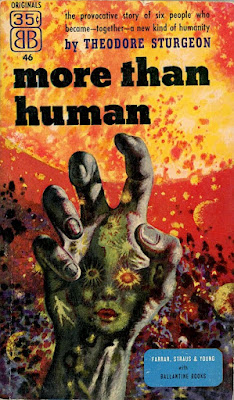
‘MORE THAN HUMAN’ 
by THEODORE STURGEON
 
‘A TIME OF CHANGES’ 
by ROBERT SILVERBERG 

‘NOVA’ 
by SAMUEL R DELANY 
 (‘Gollancz SF Masterworks’ launched 27 March 1986, £2.95)


Bored rebellious teenage girl forms erotic liaison with scaly alien, then flaunts the relationship to provoke and outrage the locals. When they refuse to be shocked, when they even bless the mismatched union, she loses interest in the affair and dumps hapless alien. Despite appearances there’s nothing essentially Science Fictional about this Robert Silverberg storyline – from his ‘Majipoor Chronicles’ series, there’s no reason why the same narrative effect couldn’t equally be achieved by switching the locale to crossing ethnic and cultural lines in Bradford, or Brixton, or even a Belfast Catholic-Protestant tryst. There might even be credibility-points to gain by tackling ‘issues of relevant social concern’ head-on. So why deliberately distance the tale with extraterrestrial imagery? The theme becomes SF through its manipulation of a kind of magical surrealism, the literary ‘code’ of a pretend world, an intriguingly bizarre alien biology, the exotic ‘Travellers Tales’ sense of wonder at haunting strangeness. 

But WHY Science Fiction? With Earth pretty much mapped into domesticity our collective hunger for Folk myths must be projected upwards and outwards, play-acting fables in imaginary space-time continuums. SF has been around a long while. The ‘Gollancz Classic SF’ paperback series was launched to ‘celebrate twenty-five years at the forefront of Science Fiction publishing.’ It’s also an opportunity to take a full body-scan of the literature, monitoring the vigour and health of its state of the art.


I grew up on the stuff. For my adolescent fix it was enough merely to hunt down the shelves of my local library for those distinctive near-luminous yellow Gollancz spines that crammed my head on the evolving fantasies of Frederik Pohl, Clifford D Simak, James Blish, Robert Silverberg, Theodore Sturgeon, Robert A Heinlein et al; writers whose (literally) fabulous, (literally) incredible visions are etched so indelibly deep into perceptions of the Solar System – and beyond, that even the most determinedly persistent Voyager probe can’t touch, never mind eradicate them! There never were any ‘Sirens Of Titan’ – look at the fly-by photos! – but the book still suspends your disbelief with the sheer absurd beauty of its invention. 

There’s two ways writers can use this conceptual memory bank, this data gene-pool of ideas, this twenty-year-plus accumulation of tantalising symbols. You can celebrate them – and choosing the classics from the Gollancz back-catalogue is like having to select just twelve tracks for a ‘Best Of Motown’ album. What to choose? What to leave out? Or you can ditch them entirely and reinvent the genre by going back to first principles. In an interview in ‘Words’ magazine JG Ballard advocates stripping this whole escapist cotton-candy fantasia down to its constituent atoms. He attacks the whole superstructure of artificial futures so painstakingly assembled by generations of poorly-paid Pulp hacks. This entire map of hyper-drive eternities, he argues, should be trashed back to the basis of the human vs technology interface. Ballard himself replaces it with more contemporary metaphor-symbols of concrete islands, media satire, autowrecks and urban desolation – which is fine manifesto-wise, but ignores the hypnotic lure of the traditional fictional multiverse, the ‘Billion Year Spree’ that is celebrated through the Gollancz Classics series.


The earliest reissue is Theodore Sturgeon’s ‘More Than Human’ from November 1953, a time when the genre was still considered a disreputable under-the-counter purchase targeted at acne-cratered adolescents, a furtive activity akin to masturbation. It’s an Earthbound next-stage-in-evolution novel, developed from a novella called “Baby Is Three” expanded by the addition of “The Fabulous Idiot” and “Morality”, concerning five misfit individuals; two black girls with speech impediments, the introspective daughter of a sex-worker, a mongoloid baby and an idiot-savant with unsuspected depths, who ‘blesh’ together to form a gestalt entity of unpredictable power. It’s a fine understated work by a writer who died in May 1985 aged sixty-seven, a writer whose skill did much to open the scope of, and legitimise his chosen genre. Kurt Vonnegut readily acknowledges the pioneering role that Sturgeon played. ‘It’s a tradition in Science Fiction to go as fast as possible; that grew out of the fact that people were being paid by the word when they began, quarter of a cent a word, you know?’ he explained. But ‘Ted Sturgeon for instance – if he could have spent more time on his books, he would have had those books accepted as mainstream’ (interview in ‘Space Voyager no.7’). 

Samuel R Delany paid Sturgeon his dues too, in the form of a eulogy spoken by Lump, a ‘linguistic’ from the short novel ‘Empire Star’ (1966), ‘there was one ancient Science Fiction writer, Theodore Sturgeon, who would break me up every time I read him. He seemed to have seen every flash of light on a window, every leaf shadow on a screen door that I had ever seen, done everything I had ever done from playing the guitar to laying over for a couple of weeks on a boat in Arkansas Pass, Texas.’ 

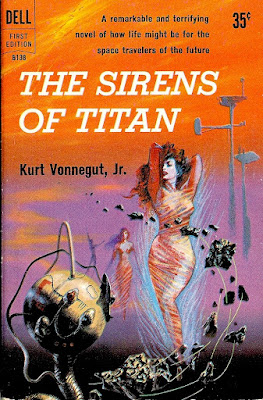
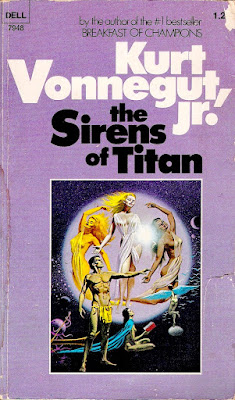
But perhaps more than anyone else, it was Vonnegut who benefitted from this increasing sophistication and the eventual critical acceptance of SF, although he never underestimated the value of traditional Space-Fiction paraphernalia. His second novel – ‘The Sirens Of Titan’ from 1959, is a manic romp through the full widescreen pantheon of Pulp myth, a conscious ransacking of its every ludicrous invention, an affectionate piss-take, and a deliciously absurd concoction. Vonnegut’s protagonist, Malachi ‘Unk’ Constant, becomes involved in a well-intentioned but disastrous Martian invasion of Earth, gets trapped on Mercury with friendly luminous triangles called Harmoniums, and eventually winds up on Titan with a Tralfamadorian robot called Salo who is marooned in the Solar System midway in a journey across the galaxy to deliver a message that reads – simply, ‘Greetings’. It’s less Science Fiction, and more a careful send-up of the genre set neither in a recognisable Solar System or even an internally rational universe. He realised that SF was an entire alternative reality in which a wealth of interchangeable story components could be unquestioningly accepted, things that don’t exist, have never and probably never will exist outside fiction – Faster-Than-Light travel, telepathy, androids, laser swords, time travel, force-fields. Taken collectively they form a ‘code’, a complex web of off-the-peg myth symbols of remarkable potency.


Around the time that ‘More Than Human’ was shiny new, Robert Silverberg was poised to launch his own Pulp hack phase. Then, several phases on, he was mixing and matching genre-styles and story-ingredients with a juggler’s dexterity. ‘A Time For Changes’ (1971), originally serialised in ‘Galaxy’ and winner of a 1971 Nebula award, is far from his best novel – my vote would go to his ‘Nightwings’ (1969), but it is a highly readable example of his Majipoor-style neo-feudalism. It concerns the forbidden history of one Kinnall Darwal, prince of Salla, whose Borthan morality is eroded by ‘soul-sharing’ hallucinogens provided by a visiting Earthman. The narcotic counters the strict social taboos against the use of the ‘first person,’ and by becoming its ‘pusher’, the story becomes an LSD fable that runs its course when Kinnall’s bond-sister Halum suicides after a soul-sharing session, and Kinnall himself is hunted, presumably to death, as a result. 

While Samuel ‘Chip’ Delany’s New Wave epic ‘Nova’ (1968) takes the reader not only forward into the internal rivalries of the galactic empire of the thirty-first-century, but also through the heart of an imploding sun with Lorq Von Ray’s grail-quest for the elusive Illyrion. A dense, rich work of some lyrical complexity it demonstrates just how far the genre has evolved, while remaining true to its well-used and oft-abused basic tenets. And, these four reissues taken collectively, display the breadth of diversity that exists within that definition, as well as its inter-relationships. ‘In a sense’ Delany explained, ‘ ‘Nova’ is a specialised kind of thing, because it’s a pastiche of a very classical type of Science Fiction novel… everyone has gotten this idea that I was going to do New and Different Things – and then what I essentially tried to do was write the perfect ‘Planet Stories’ novel’ (in ‘Science Fiction Monthly’ Vol.2 no.3). 

Full circle…? 

But if fiction is ‘things that never happened to people who never existed,’ then SF, no matter how sophisticated, just fast-forwards the tense into futures imperfect. So can it REALLY be taken seriously as literature? Science Fiction is a serious literature of dreams, and a serious flirtation with nightmare. That’s at least as serious as Sigmund Freud, or Salvador Dalí! It was Theodore Sturgeon himself who first formulated the equation that ninety-percent of everything is crap, it’s the remaining ten percent that provides the justification. The dictum passed into SF lore – and beyond, as ‘Sturgeon’s Law’. Gollancz Classics re-presents that justifying percent in attractive new editions. Although it still falls short of explaining WHY SF? The spaceship as phallic symbol? The future as political metaphor for now? The likes of Silverberg’s scaly alien romance universalises and codifies syndromes that no amount of gritty accurate localising could do. All this and more is probably true. And sure, it’s escapist as hell too. It’s a fix like any other kind of addiction, one I still can’t clean out of my head. You can rationalise it, intellectualise it with all manner of smart-ass sophistry as technological poetry and speculative prose, but its lure remains the romance of the Traveller’s Tale. JG Ballard is correct too. Art must continually reinvent itself, for without action there can be no reaction. Without vocabulary there can be no fables. 

If ‘Gollancz Classics’ exist to indoctrinate SF virgins into a sense of wonder, with a new compendium of Folk myths, then I’m grateful for the opportunity of buying in for a second time round. It’s still my favourite waste of time!

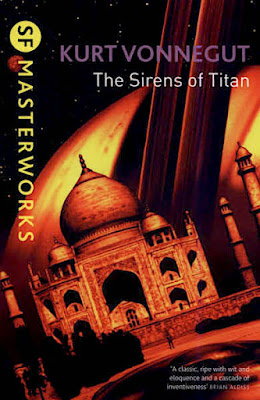
SF Books: Kurt Vonnegut's 'Sirens Of Titan'


NOT VONNEGUT’S 

MOON OF SATURN 


Book Review of: 
‘THE SIRENS OF TITAN’ 
by KURT VONNEGUT JR 
(Gollancz Classic SF, 1986, £2.95)


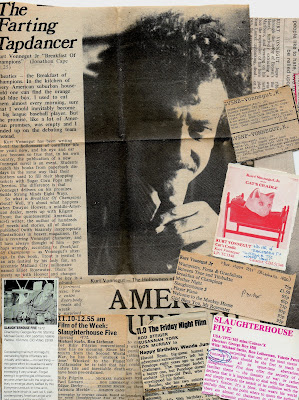
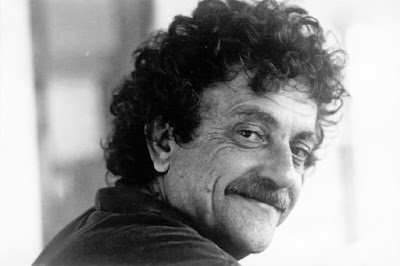
Vonnegut was a big dead. Lecture tours, interviews and full-spread feature reviews in the heavy’s Lit Sections – the full ‘serious contemporary writer’ scam. While this timely reissue was part of a process through which the Gollancz SF imprint was deluging itself in twenty-five-year anniversary self-congratulation, leaving the impartial reviewer conscience-bound to wonder whether the whole circus measures up. Whether perhaps – like the fourteenth volume of ‘The Book Of Bokonin’, these literary achievements don’t add up to the single word ‘nothing’? 

‘The Sirens Of Titan’ – first unleashed in 1959, is a central dogma in the Vonnegut canon. Devotees will already know that it’s a veritable fountainhead of Vonnegutian profundity, breeding all manner of mythos-components and traceable in-references. Take one at random: ‘The Sirens Of Titan’ has the city of Ilium destroyed by a Martian invasion. The previous novel, ‘Player Piano’ (1952), was set in Ilium, a fictional eastern suburb of New York State. Literary critic Peter J Reed speculates that the Ilium preoccupation could derive from the great man’s period of employment at General Electric in Schenectady N.Y (in ‘Kurt Vonnegut Jr’ by Peter J Reed, Warner Paperback Library ‘Writers For The Seventies’ series), his contention is reinforced by the fact that General Electric becomes the first employers of Howard Campbell in Vonnegut’s later ‘Mother Night’ (1962). The Ilium Works also figure in a 1955 ‘Esquire’ short story “Deer In The Works”, a Kafkaesque exercise in which a prospective PR man becomes lost in the incomprehensible labyrinths of its industrial complex. Jonah in ‘Cat’s Cradle’ (1963) spends time in Ilium researching Dr Felix Hoenikker who worked most of his life there for the General Forge & Foundry Company and… there’s more! The central character from ‘Slaughterhouse Five’ (1969), Billy Pilgrim, passes through the city while returning from fire-bombed Dresden. It’s also perhaps worth noting that Ilium is Troy in Homeric legend. 


Vonnegut’s novels contain a tangle of such tertiary threads. None of his characters are exact stereotypes or exactly predictable. None of his affirmations or condemnations are made without escape-clause qualifications. Hence attempted unravelment becomes an intoxicatingly addictive game. The American National Education TV Network took a sword to this symbolist Gordian Knot with a film, screened by BBC’s ‘Second House’ in February 1973. It used ‘The Sirens Of Titan’ central gimmick – the Chrono Synclastic Infundibula, as a focal point through which a jumbled juxtaposition of Vonnegut themes and ideas could be channelled. It’s an amusingly self-indulgent pastiche essay in which astronaut Stoney Stevenson is launched from Cape Kennedy into the Chrono Syn… etc – a CSI, to be vomited back at intervals into excerpts from Vonnegut’s various novels and short stories throughout the film’s seventy-five-minute duration. The central core of ‘The Sirens Of Titan’ is also fleshed out by encounters with Bokonin – ‘Cat’s Cradle’s Rastafarian-like oracle, and is entertaining while also being thought-provoking. George Roy Hill’s movie version of ‘Slaughterhouse Five’ (1972) does a similar meltdown job by transforming the planet Tralfamadore into a moon of Saturn – hence becoming Titan. An inaccurate, but intriguing bit of literary scene-shifting. 

Is this getting too complicated? 

Happily, a straight plot rundown of the novel provides little elucidation. According to Peter J Reed the metamorphosed Paul (‘Player Piano’) Proteus becomes Malachi ‘Unk’ Constant; the basic Proteus archetype thus assumes the role of central protagonist of ‘The Sirens Of Titan’. To back up the assertion he points out that both characters feel vaguely dissatisfied with their lives. That, partly through resistance to manipulation by others, and partly out of loyalty to a friend, both undergo a considerable change of values. Both emerge somewhat battered, rather disillusioned but with some beliefs to affirm, and stronger more honest men. In ‘The Sirens Of Titan’ the resistance to manipulation of Reed’s speculation manifests itself through Constant’s loss of wealth. A deliberate attempt on his part to avoid a prediction made by Winston Rumfoord who is trapped, as ‘wave phenomenon’, in a kink in space-time (a CSI). Rumfoord materialises in the real universe at regular intervals. In much the same way that the selectively-bred Rumfoord dynasty turn up with a certain regularity throughout the Vonnegut mythos. The Rumfoord estate appears as an incidental location in ‘God Bless You Mr Rosewater’ (1965), Bertram Copeland and Lance Rumfoord both appear in ‘Slaughterhouse Five’, while Bokonin – as Lionel Boyd Johnson, works as a carpenter and gardener for the Rumfoord’s in ‘Cat’s Cradle’, and almost sails around the world with Remington Rumfoord IV. 


In the meantime – irrevocably, the ‘The Sirens Of Titan’ prediction comes true, as a result of which Constant enters Rumfoord’s Martian army controlled and brainwashed by antennae implanted into the skull. Constant, or Unk as he’s known while part of the army, avoids the Martian’s benevolent but bungled invasion of Earth by travelling to Mercury where he meets and befriends glowing triangles called Harmoniums. Eventually Constant ends up on Titan – as predicted, where his wife dies, his son goes off to live with the moon’s giant Bluebirds, and he meets a friendly robot called Salo. The robot comes from the four-million-years-old Tralfamadorian machine-civilisation, and has been marooned in the solar system for millennia midway across the galaxy on a journey to deliver a message. The message consists of the single word ‘Greetings’! 

In the novel Vonnegut’s side-issues include a religion to whom Constant – The Space Wanderer, becomes a temporary messiah. Converts are made equal by carrying weights and marring the unfair advantage of beauty, a concept salvaged from an earlier short story called “Harrison Bergeron”. Another interesting subplot is the almost casual observation that the Tralfamadorians have regularly intervened in human history, directing the construction of Stonehenge, the Great Wall of China, the Golden House of Nero, the Kremlin and the Palace of the League of Nations – all as messages of reassurance to Salo. The Tralfamadorians are another of Vonnegut’s leitmotifs; the cerebrally time-travelling hero of ‘Slaughterouse Five’ journeys to their planet in a Flying Saucer to be ‘mated’ in a Geodesic Dome with kidnapped movie star Montana Wildhack. The alien’s philosophy is expounded at some length; the conjecture that all of time coexists and each moment is hence eternal, that life is predetermined and hence free will is negated. They know that their experiments with Saucer fuel will ultimately lead to the destruction of the universe, but accept this future as unchangeable. 

To Brian Aldiss ‘The Sirens Of Titan’ is ‘a cascade of absurd invention, its hither-thither technique a sophisticated pinch from the widescreen baroque school’ (from ‘Billion Year Spree’, 1973). To ‘The Observer’ review section it’s ‘whizzing with meteorites of wit and invention in a space version of the Bluebird parable, as a soul comes home to roost through the multiverse’ (November 1975). To Reed the novel is something altogether more unwieldy. Unlike Aldiss he misses, or at least fails to communicate Vonnegut’s essential humour. A humour that’s bizarre, surreal, almost existential, but also ludicrously funny in its intrinsic absurdity. Anyone who can conjure up a religion called The Church of God the Utterly Indifferent – ‘take care of the people and god almighty will take care of himself’, and invent the First Church of Barnhouse by deifying a short stout scientist (in the 1950 short story “The Barnhouse Effect”), then create something called a Chrono Synclastic Infundibulum (in fun – ?) has got to be kidding. At least on one level. 


‘The Sirens Of Titan’ is now being marketed as ‘Classic’ Science Fiction. But it’s also an affectionate satire of the genre, a cut-up collage of SF ideas. ‘Billion Year Spree’ opines ‘Vonnegut harps on SF, its themes and characteristics, while denying that he writes anything of the kind,’ an opinion confirmed when Vonnegut told a ‘Radio Times’ interviewer ‘I do not write SF. All science is fiction. I try to expose it as magic. But because people tend to impose themselves on one another by violence, I try jokes instead. The strongest influence on my life has been Laurel & Hardy – especially Stan Laurel.’ For those in doubt, Laurel is the thinner member of the comic duo. 

Vonnegut’s issues, like his characters and his humour, are rough-edged and humanly idiosyncratic. Life’s absurd, without meaning or compassion – but it’s still possible to say ‘as stupid and vicious as men are, this is a lovely day.’ Vonnegut’s novels reflect the drunken homely chaotic humour of the rambling never-quite-concluded raconteur routine. They’re narrated, often in the first person, as episodic conversational anecdotes with bawdy illustrations – using Norman Mailer’s ‘fuggin’ expletive, along with often deliberately infantile wordplay, not just ‘the top’ but ‘the teeny-weeny bowl at the tippy-tippy top,’ not just ‘cradle’ but ‘cray-dul’. There’s comic observation such as the ‘policemen in yellow rain-capes at every intersection contradicting with their white-gloved hands what the Stop-&-Go signs said.’ 

If the novels can be said to have objective meaning with a capital ‘M’, then it must be in the structuralist sense that readers invest them with meaning. Vonnegut’s philosophy is haphazardly cracker-barrel. A persona he extends to robots, computers and the other diverse mishmash components of his novels. He is, according to Martin Amis in ‘The Observer’, ‘as soft as a sneaker full of slime’ and ‘if the sentimentality were not there, probably nothing else would be.’ But undoubtedly Vonnegut’s an intriguing figure, and probably even an important one in as much as he predates much of Science Fiction’s New Wave, and there is depth – on a considerably more intuitive level than his disciples acknowledge. ‘The purpose of human life, no matter who is controlling it, is to love whoever is around to be loved’ advises ‘The Sirens Of Titan’, ‘the worst thing that could possibly happen to anybody would be not to be used by anything or anybody.’ These observations probably contain as much depth and simple truth as any of his devotees philosophical artifice. That is what made Vonnegut a big deal.


Monday, 24 January 2022

Movie... 'XX: FOUR DEADLY TALES'


‘XX’: FOUR DEADLY TALES
 
 BY FOUR KILLER WOMEN 


Review of: ‘XX’ 
With Natalie Brown, Melanie Lynskey, Breeda Wool, Christina Kirk 
Director: Roxanne Benjamin, Karyn Kusama, Annie Erin ‘St Vincent’ 
Clark, Jovanka Vuckovic and animator Sofia Carrillo. 
Original Release: Magnet Releasing/ XYZ Films, January 2017.
80-minutes. DVD, Soda Pictures, May 2017 


The big lipstick kiss-print on the DVD cover-art, which also forms a skull, neatly catches the tone. Less triple-X status, more a defiant gesture. Although surely a female-centric project such as this is already as much an anachronism as a crusading quartet by Gay directors or black directors? At the risk of sounding tokenist, we already have movie-activists Diablo Cody (‘Jennifer’s Body’, 2009), Drew Barrymore (‘Charlie’s Angels’, 2000), Megan Ellison (‘Zero Dark Thirty’, 2012), Karen Rosenfelt (‘The Twilight Saga: Breaking Dawn 2’, 2012), Nina Jacobson (‘The Hunger Games’, 2012), as well as Kathryn Bigelow, Gale Anne Hurd, Sofia Coppola, Emma Thomas and on. But glass ceilings are there to be shattered, and every splinter counts. 

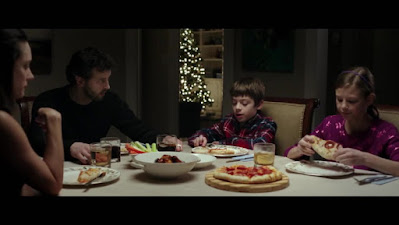
This is an anthology, or portmanteau movie of four twenty-minute segments. Arty ‘Twilight Zone’ short story episodes with no obvious theme, linked only by spooked nursery inter-titles of decapitated dolls, butterfly animations, a pincushion with human teeth, and a haunted doll’s house. Cine-literate Jovanka Vuckovic’s “The Box” quotes from George A Romero’s ‘Night Of The Living Dead’ (1968), but its ambiguity has an inexorably clinical momentum sprung from a seemingly random incident on the 3:55 subway back to the suburbs. Little Danny (Peter DaCunha) asks the stranger with the lazy eye what he has in the red gift box tied up in a red ribbon. After glimpsing inside, he loses his appetite. No breakfast, no evening meal. Is he sneaking junk-food from the school cafeteria? No, despite the delectable culinary food-porn on offer, despite Daddy Robert (Jonathan Watton)’s ultimatum, he refuses. After five days without food they take him to the Doctor who explains ‘if you don’t eat, you’ll die.’ ‘So?’ says Danny. Mom Susan (Natalie Brown) resumes secret smoking, Dad’s under pressure. Danny whispers the secret of the box to sister Jenny (Peyton Kennedy), then to Daddy, who both also stop eating. On Xmas Day nobody’s new clothes fit, they’re all too skinny. With the three in terminal intensive care Mom starts haunting the subway hunting the man with the red box. She’s hungry. Zero resolution.


Despite Annie Clark’s primary genre being experimental Rock under her St Vincent persona – collaborating with Sufjan Stevens and David Byrne across five albums, her one-woman segment “The Birthday Party” is a contrasting black comedy, albeit Mom-themed and with a twittering electro-score. Subtitled ‘The memory Lucy suppressed from her seventh birthday…’ it has moments recalling the Fawlty Towers episode ‘The Kipper And The Corpse’, as effectively-frazzled Mom Mary (Melanie Lynskey) strives to conceal Daddy David’s corpse from creepy Nanny Carla (Sheila Vand), so as not to embarrass her daughter (Sanai Victoria)’s birthday event. With dead-Daddy finally revealed as the funky-Panda head sitting at the table. Cue kiddy-screams, and long-term trauma. 

From domestic interiors to ‘so fucking epic’ vast desert exterior, Roxanne Benjamin’s “Don’t Fall” moves into more gut-wrenching traditional Horror Channel group-jeopardy splatter-core. Four slackers who’s ‘internal compass has failed me never’ go off-trail in a Camper-van, and find pre-Native American rock-art in the form of a horned beast territorial marker. ‘Maybe it’s cursed?’ Yup, it’s cursed. Gretchen (Breeda Wool)’s toxic graze turns shock-mutational in a convincingly nasty slasher killing spree. Her physical contortions recall Andy Serkis at his most grotesque. Until the rock-art has a new set of blood-red additional images. 

Finally, Karyn Kusama has the strongest resumé, directing femme-actioneer ‘Aeon Flux’ (2005), and ‘The Invitation’ (2016) as well as cheer-leader flesh-eating romp ‘Jennifer’s Body’. In “Her Only Living Son” single-Mom Cora (Christina Kirk) wears a cross on a chain, while bratty tousle-haired son Andy (Kyle Allen), is a troubled prodigy who also tears classmate Stacy’s fingernails off, spatters bloodstains across the bathroom, and has hairy horned toes. Everyone, including the mailman, seems in on the secret that this episode envisages the outcome of Roman Polanski’s ‘Rosemary’s Baby’ (1968), with Andy’s real father – Satan, soon coming to claim him. Which force will triumph, Mom’s love or Andy’s dreams of ‘empires of misery’? With the same kind of maternal self-immolation as the vivid dream sequence in “The Box” where the family carve and devour Mom as she’s sprawled on the dinner-table, making the ultimate sacrifice for their appetites, Mother and Son crush each other to death in a killer embrace. A closure probably dictated more by time-constraints than by reasoned plotting. 

By necessity sharp and razored to the bone, as a show-reel, this impressive and disturbingly varied female-centric quartet of miniatures should lead to follow-on mainstream commissions very soon.


‘XX: FOUR DEADLY TALES’ 

‘XX’ Original Release: Magnet Releasing/ XYZ Films, January 2017. ‘The Box’ (Scythia Films) director/screenplay Jovanka Vuckovic from story by Jack Ketchum, produced by Daniel Bekerman, with Natalie Brown (as Susan Jacobs), Jonathan Watton (as Robert Jacobs), Peter DaCunha (as son Danny), Peyton Kennedy (as daughter Jenny). ‘The Birthday Cake’ (Willowbrook Regent) writer/producer/director and music Annie Erin ‘St Vincent’ Clark (Roxanne Benjamin) with with Melanie Lynskey (as Mom Mary), Seth Duhame (as David), Sanai Victoria (as daughter Lucy), Sheila Vand (as Nanny Carla). ‘Don’t Fall’ (Willowbrook Regent) writer/director Roxanne Benjamin, produced by Chris Harding, with Casey Adams (as Paul), Breeda Wool (as Gretchen), Angela Trimbur (as Jess), Morgan Krantz (as Jay) Music by the Gifted. ‘Her Only Living Son’ (Snowfort Pictures) writer/director Karyn Kusama, produced by Travis Stevens, with Christina Kirk (as Cora), Kyle Allen (as Andy), Mike Doyle (as Chet), Brenda Wehie (as Principal Jenks). 
Stop-motion animator Sofia Carrillo. 80-minutes. 
DVD, Soda Pictures, May 2017 with Bonus Features, interviews, Trailer, Behind The Scenes 

Featured online at: 
‘VIDEOVISTA’ 
(2 May 2017)


Thursday, 30 December 2021

Poem: 'A GROOVY APOCALYPSE'


A GROOVY APOCALYPSE/ 

THE TRANSFINITE CHOICE 


time freezes 
this brush of memory chills me, 
lavender fire outflows from ice 
a gateway through glaciers into 
the wall of nameless mountains, 
your name is the soft sigh I exhale, 
we shunt upwards into cloud 
halfway as high as Iapetus 
dancing in serpents of blue light, 
a mesa of methane storms, 
we sleep a thousand years, 
butterfly skeletons are 
snowflakes in terrible winds, 
nineteen rivers flow into 
a black sea too vast to envisage 
through a forest rimed with icicles, 
frozen music melts into shrill mornings 
as ice-flowers unfurl amid blue frost, 
time freezes, yet this brush of 
memory still chills me...


THE HOLLIES: New Book


On track… THE HOLLIES: 

EVERY ALBUM, EVERY SONG


‘The road is long, with many a winding turn, that leads us to who knows where? Who knows where?’ 

 Everyone loved The Hollies. They were the ‘group’s group’. Never confrontational or rebellious, always smartly suited, always smiling. With an unbroken run of immaculate Pop singles which, while they seldom had that must-buy factor of the latest Rolling Stones or Beatles record, were hallmarked by tight harmonies and unfailing chart sensibility. Throughout the sixties and well into the seventies, everyone had – own up, at least one or two Hollies singles in their collection. No-one begrudged The Hollies their hits. 

When ‘He Ain’t Heavy, He’s My Brother’ and ‘Long Cool Woman In A Black Dress’ became global million-sellers, The Hollies were inducted into The Rock ‘n‘ Roll Hall Of Fame. Graham Nash – by then deep into his second career as part of Crosby, Stills, Nash & Young, was reunited with other members of the outfit, all on stage together in the March 2010 ceremony. 

 
This book tells the full story, from the band’s origins in Manchester, through the full arc of hits, and the albums – track-by-track, into the twenty-first century, then… now… always. 

Sonicbond publishing: 

ISBN 978-1-78952-159-7 
UK £14.99 USA $21.95 
Available from Amazon


‘The road is long, with many a winding turn, that leads us to who knows where? Who knows where?’ 

Everyone loved The Hollies. They were the ‘group’s group’. Never confrontational or rebellious, always smartly suited, always smiling. With an unbroken run of immaculate Pop singles which, while they seldom had that must-buy factor of the latest Rolling Stones or Beatles record, were hallmarked by tight harmonies and unfailing chart sensibility. Throughout the sixties and well into the seventies, everyone had – own up, at least one or two Hollies singles in their collection. When Tony Hicks mouths ‘Hello Mum’ as the Top Of The Pops cameras pan past him, even normally-disapproving parents were charmed. No-one begrudged The Hollies their hits. 

When ‘He Ain’t Heavy, He’s My Brother’ and ‘Long Cool Woman In A Black Dress’ became global million-sellers, The Hollies were inducted into The Rock ‘n‘ Roll Hall Of Fame. Graham Nash – by then deep into his second career as part of Crosby, Stills, Nash & Young, was reunited with other members of the outfit, Allan Clarke, Bernard ‘Bernie’ Calvert, Eric Haydock, and Terry Sylvester – although significantly without either Bobby Elliott or Tony Hicks, all on stage together in the March 2010 ceremony. 


Rock History tells how the origins of The Hollies can be traced back to post-war Manchester, with two gawky five-year-old pupils at Ordsall Board Primary School. Born within two months of each other, Allan Clarke (born 5 April 1942 in Salford, one of six children) and Graham Nash (2 February 1942), started out as schoolfriends. Hanging out together as fourteen-year-olds they bought their first guitars inspired by the Skiffle fad. Although born in Blackpool, Graham spent much of his childhood within 1 Skinner Street, Salford, a now-demolished back-to-back Coronation Street terraced-house with outside lav. ‘I have so many great memories of growing up in Salford’ he told me. ‘And first being turned on to the magic of music in Salford. I didn’t leave Salford until I was eighteen. So I have lots of great memories of the struggles and the joys and the heartaches of doing something that was different from anything any of your family had done. Nobody in my family had been in a band before. Ever.’ 

When his parents gifted him with a Dansette record-player as a reward for passing his eleven-plus exam, Graham’s first purchase was Gene Vincent’s ‘Be-Bop-A-Lula’ on a big old 78rpm disc, ‘I wanted that, and from that moment wanted nothing else.’ Meanwhile, Allan failed that same exam, but ‘I was working six days a week and getting £1-19s-11d’ he recalls amiably, ‘then going out at weekends and getting five quid for singing four songs.’ For the two friends were by then serving their musical apprenticeship together by playing local dates on the Manchester club circuit as The Two Teens. Then they were The Ricky & Dane Young duo, and briefly, they were also The Guytones – a play on the name of their Japanese guitars. Caught up in the generational energy-wave of Rock ‘n’ Roll, they were performing Lonnie Donegan, Everly Brothers and early-Cliff Richard covers, so hungry to play they’d have done it for free, but enjoying the as-yet-slight financial rewards too.


Competing in a pre-X-Factor talent contest, they played the Art Deco HippodromeTheatre on Wednesday 19 November 1958, in competition with Liverpool’s Johnny & The Moondogs. ‘Johnny’ – Lennon later went on to greater things. Allan and Graham became half of The Fourtones, then through a torturous process, pacted eventually with Eric Haydock (born Eric John Haddock, 3 February 1943 in Stockport) and drummer Donald Rathbone (born October 1942 in Wilmslow), as The Deltas, until – with Fender guitarist Vic Steele (born 8 May 1945), they finally evolved into The Hollies. It was for a December 1962 gig at the ‘2Js’ that The Deltas rebranded themselves with a name not entirely unconnected with their taste for the songs of another formative influence – ‘Buddy Holly didn’t swivel his hips or grease his hair, he wore glasses, he was one of us’ (Allan). 

Thereby hangs a tale. Along with Buddy Holly, The Everly Brothers were vocal models for the burgeoning Hollies sound. A vital influence, there’s an argument that Everly harmonies also template those of Simon & Garfunkel, Status Quo and many others. And before The Hollies even got together, Graham and Allan managed to see the brothers when they played the Manchester Free Trade Hall, Wednesday 13 February 1977, as part of a U.K. tour. They even waited outside their Hotel at 2:30am to catch a glimpse of the duo. ‘We idolised them’ Allan tells me. ‘We tried to work out where they’d be staying. We decided it must be the Grand, which was the poshest place to stay (Graham recalls it was the Midland Hotel). So we went there and hung around on the pavement outside. Eventually they came out and chatted to us. They must have stopped talking with us for about twenty-five minutes.’ Graham takes up the tale, ‘they came out of a Night Club, slightly inebriated, and instead of patting us on the head and signing an autograph, they talked to me and Allan for twenty-eight minutes… it changed my life.’ Sure it did, six years later Don & Phil came calling, and the two Manchester graduates wound up writing eight of the twelve tracks for the Ev’s May 1966 album Two Yanks In London. Phil Everly was also the first artist to record Albert Hammond’s ‘The Air That I Breathe’, which The Hollies lift for their own no.2 hit in 1974.


Manchester has an important niche in Pop history. There was a healthy club scene, with the Twisted Wheel, the 2Js (later the Oasis) and the Bodega. In that first wave of Beat Groups, as well as The Hollies there was Freddie & The Dreamers (with former-Fourtone Derek Quinn) and Herman’s Hermits. Later there were the Factory years of Joy Division and New Order, plus The Smiths, then The Stone Roses and the Madchester exploits of Happy Monday, before the all-conquering 1990s BritPop of Oasis. 

The Hollies started out as very much part of the Beat Boom’s first wave, when even the idea of the Beat-Group as a self-contained writing-singing-playing musical unit was still a novelty. There had been The Crickets, The Shadows, Johnny Kidd & The Pirates, but it was the advent of The Beatles that normalized the idea that a group could be a magical auditory Lego as unique as a retinal-print, each member an integral component playing interactionally, to create a whole greater than the sum of its parts. But before they broke into chart-dom they were sitting up there in Manchester, reading the Music Press – just as I was, and imagining themselves on its pages. ‘That’s what you did. You imagined yourself on those pages’ Graham told me. ‘Yeah, every time you’d get Disc or New Musical Express, you could picture that’s what you could do. And you dreamed and you’d pull yourself towards that dream, and it happened with me. I was fortunate to have it all come true...’


The face of music was about to undergo a seismic lurch, and there was an urgent need to be a part of that newness. 1962 closed with business as usual – Elvis Presley enjoyed a run at no.1 with ‘Return To Sender’, but way down beneath him the world was shifting, as The Beatles made their very modest chart debut with ‘Love Me Do’ up to a high of no.17 (27 December). Into the New Year, there was ‘Please Please Me’, and nothing would ever be the same again. For British teens, 1963 was when everything changed. Throughout that year the Beat Boom was strictly a local U.K. phenomenon. This was a special time. It would never come again. For U.S. teens that firebreak in history didn’t happen until The Beatles appeared on The Ed Sullivan Show with ‘I Want To Hold Your Hand’ in 1964. 


But first, the relentlessly London-based music industry was shocked out of its complacency, sending talent-scouts and A&R men scuttling up to the sudden Pop gold-mines of the dark industrial north-west of England in search of the next Fab Four. Things were starting to fall into place. Tommy Sanderson worked at music-publishers Francis Day & Hunter, he had his ear to the ground. He was given a nudge by a Manchester radio producer. As a result, as early as January 1963 he and Parlophone’s staff producer Ron Richards – George Martin’s primary assistant, headhunted The Hollies when they played a lunchtime stint at The Cavern Club. ‘Everytime we played there it seemed we would have something stolen’ laughs Bobby Elliott, ‘one time we had a Vox amp stolen. Given the fact that there was only one exit to the club, it amazes me how they even got the stuff out!’


Ron Richards was so impressed with what he saw that he invited The Hollies to audition in London. Guitarist Vic Steele didn’t want to risk turning professional, so group manager Allan Cheetham invited Tony Hicks (born 16 December 1943, in Nelson) to audition instead. Tony had started out playing with local group Les Skiflettes, who graduate into Ricky Shaw & The Dolphins when Tony was still just fourteen. They had ‘three Truvoice amps and wore pale blue jackets and black trousers, white shirts and red ties. Cliff Richard & The Shadows were obviously an inluence, as was Eddie Cochran’ (according to Bobby Elliott’s autobiography). By the time Bobby joined on drums (30 September 1961), with Bernie Calvert on bass they were simply called The Dolphins. Bobby recalls those memories in his 2010 song ‘Then, Now, Always (Dolphin Days)’, as sung by Tony ‘we sure knew how to cut it, back in Dolphin days.’ So why did Tony quit The Dolphins? Because The Hollies had the major-label contract. That was the lure. 

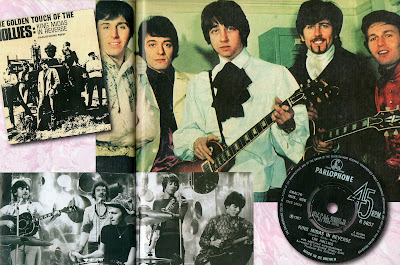
Destined to be the longest-serving band member, Tony joined The Hollies line-up in time for their EMI Studio test recordings. They were signed by The Beatles label – Parlophone, and assigned Ron Richards as producer. Born Ronald Richard Pratley (22 January 1929) Ron had worked his way up through the industry as a Tin Pan Alley song-plugger for Chappell Music, EMI promotions manager and then assistant to George Martin. When he discovered singer Jerry Lordan and produced his 1960 hit singles ‘I’ll Stay Single’ (no.26) and ‘Who Could Be Bluer’ (no.17) he’d begun forging his own distinctive path. Although he continued working with George Martin on Beatles sessions, he retained The Hollies as his own personal project. It was under Ron’s production guidance, that The Hollies first enter the charts the week ‘From Me To You’ was no.1. Their Famous Five Adventure was under way. 

‘It’s been a long strange trip,’ Graham tells me, ‘remind me to tell you some time…’


Tuesday, 28 December 2021

THE HOLLIES: GRAHAM NASH


THE HOLLIES: 
‘FOR CERTAIN BECAUSE’ 
IN CONVERSATION 
WITH 
 GRAHAM NASH 

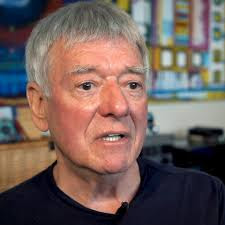
According to Graham Nash the Hollies were ‘a great little band’. 
He tells their story to Andrew Darlington 


Interview: ALLAN CLARKE


RESURGENCE...

Album Review of: 
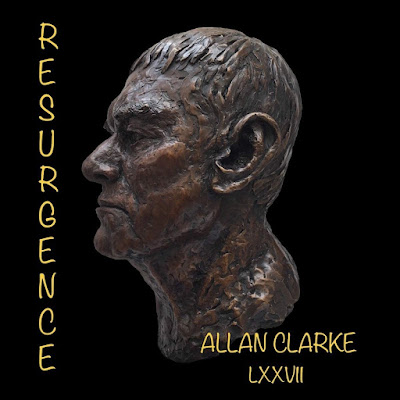
‘RESURGENCE’ 
by ALLAN CLARKE 

resurgence /rɪˈsəːdʒ(ə)ns/ 
resurgence; plural noun: resurgences an 
increase or revival after a period of 
little activity, popularity, or occurrence. 

 His real name is Harold. The title of his first solo LP, in 1972, told us so. But forty-seven years later the voice of the Hollies is back, and as distinctive as ever. There’s a strong Classic Rock spine, name-checking one of the Hollies biggest US hits with “Long Cool Woman’s Back In Town”, Allan’s voice slightly-echoed as his cutting harmonica works that same lethal femme fatale strut – ‘sometimes the right way is the wrong way to go.’ An obvious focal point, “Hearts Of Stone” – co-written with Carla Olson, also takes its fang-and-claw riff from the same source, eighties-style soft-Rock leaning heavy on the bass. But there’s more than just that, Allan’s “The Door Is Slowly Closing” has an unobtrusive ‘Om’ meditative chant to counterpoint a slinky southern ‘Black Velvet’ feel, giving its restless lyrics an edge, ‘nowhere to run, nowhere to hide.’ And a slow-paced acoustic interplay on a premature burial image for “I’m Only Sleeping”. Then gnawing electro-pulse with guitar slap-back on “I Don’t Know The Reason”, its lyric ‘they say Rock ‘n’ Roll is over’ answered by a stinging guitar solo as if to prove the doom-sayers wrong. ‘It’s the start of a new day, I’m going to jump and hope to fly, I’d be a fool if I didn’t try.’ Allan Clarke, for certain because… 

Published in: 
‘R’N’R’ Vol.2 Issue 78’ 
(November/ December 2019) 
(UK – November 2019)


ALLAN CLARKE:
 
BACK IN TOWN

 
Allan Clarke, the voice of the Hollies, is back, 
with his first new album of the century. Which makes for a 
good opportunity to look back – and to look forward too…


‘For many years, people would ask ‘why don’t you go back to singing?’ Well, what I couldn’t do was perform Hollies songs anymore. But what I should have said was, there may come a time when I’ll be able to sing again, because I’ll be doing songs I’ve written myself. Because, well, I never stopped writing, I never did. I jot lyrics down. Writing songs was always there, on the back-burner.’ His neatly-combed short iron-grey hair is combed into a fringe across his forehead, a slightly pained expression on his face to denote his seriousness. But when he grins, it’s that same ‘Top Of The Pops’ smile from all those hit records. 

The cover-art for ‘Resurgence’, his first new album of the century, carries the enigmatic subtitle LXXVII, Latin for his age, seventy-seven. And the lyric for “I Don’t Know The Reason” observes darkly ‘I can’t hear the sound of music, there’s no dancers on the floor, they say Rock ‘n’ Roll is over…’ ‘But it’s not’ he counters emphatically. ‘It never went away. That was just a one-liner I came up with. I’m still a Rock ‘n’ Roller. The real thing, the 1950s Rock ‘n’ Roll. It never died.’ And the nakedly candid lyric for the closing track “I’m Coming Home” seems to be about returning, not to a physical destination, but to music itself, ‘doing something I left behind.’ ‘That’s right,’ he says, ‘those are words that were actually spoken to me, they came up in conversation while we were talking during a break when I was doing the album ‘I believed it when they told me, that I hadn’t passed my prime, didn’t think that this could happen, all good things can take their time, well – it showed me there could be a future …’ And subconsciously, seeing as it was one of the last songs I did for the album, I thought why not give it a go?’ 

There’s one obvious name-check on the album glancing back to the Hollies massive US hit, with “Long Cool Woman’s Back In Town”. ‘I was working on a different song when I wrote that lyric. It wasn’t meant to turn out that way. But The Long Cool Woman just emerged and took over. So I took the idea, and developed it, and I made the story up. It seemed she’d left the DA man, and I took the story from there, seeing what came next.’ While “Hearts Of Stone” seems to hark back to the same mood. ‘Again, it’s a Rock ‘n’ Roll song. My grandson plays on that track’ he adds as a casual aside. 

The Hollies were always about harmonies. Sure, once Graham Nash quit the line-up in order to hang out with his California pals, Allan became more of the group’s central focus, on later and even bigger hits – such as “He’s Not Heavy, He’s My Brother”, but we’re still used to hearing him as part of a band. Which is probably unfair. ‘Resurgence’ is his eighth solo album. ‘Originally, I was trying to get away from the Hollies sound, to do something different, which is difficult as I’m the lead singer’ he admits ruefully. 


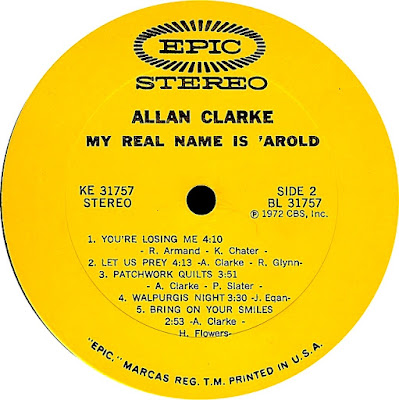
The first solo shot, in its Hipgnosis sleeve-design, was ‘My Real Name Is ‘Arold’ in 1972, with Gerry Rafferty’s charming “Mary Skeffington”, but seven Allan-originals, including “Bring On Your Smiles” co-penned with Herbie Flowers. It was ‘me stripping myself bare of the past.’ Followed by the all-original gatefold vinyl ‘Headroom’ a year later, revisiting the Hollies “Would You Believe” in spirit. The 1974 ‘Allan Clarke’ consists of artfully selected covers – including songs by Lindsay Buckingham, Randy Newman, and an impressive “If I Were A Priest” from a tyro Bruce Springsteen demo, following it with “Blinded By The Light” (and a powerful bonus October 1975 single track “Born To Run”) for ‘I’ve Got Time’ (1976). Meanwhile, as part of his on-off dual-career he also recorded Bruce’s “Fourth Of July, Asbury Park (Sandy)” for the Hollies 1975 ‘Another Night’ album. Springsteen was gracious enough to say ‘thank you’. 

Allan contributes guest-vocals on The Alan Parsons Project ‘I, Robot’ concept extravaganza, then returned to originals for his solo ‘I Wasn’t Born Yesterday’ (1978), and most of his Elektra debut ‘Legendary Heroes’ (1980, retitled ‘The Only One’ for UK release), in collaboration with co-writer Gary Benson. Yet ‘Reasons To Believe’ in 1990, not the Tim Hardin song, became his final shot… until now. 

He says ‘what I couldn’t do was perform Hollies songs anymore.’ But why not? Paul McCartney still sings old Beatles songs. The Rolling Stones still do “Satisfaction”. ‘They’re lucky’ he chuckles. ‘They can still do that. I can’t. When I recorded those hits with the Hollies, they were really high songs. But later, my register changed. I didn’t really want to stop, but at the same time it got to the point where I was getting a bit fed up. Along with not being able to sing the high notes, not being able to perform in the way that I wanted to, that felt to me like I was letting people down. I was going on stage and singing, and it didn’t feel comfortable, it no longer felt right for me to be doing those songs that way. There is a time for everyone to say ‘that’s it’!’


--- 0 --- 

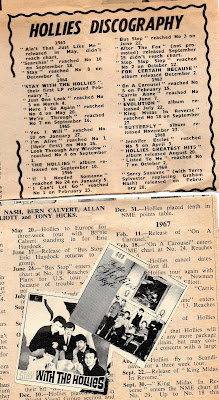
There was never a Big Bang moment for the Hollies, more a kind of gradual evolution with each single charting a little higher – “(Ain’t That) Just Like Me” (no.25), and another Coasters cover with “Searchin’” (no.12), Maurice Williams And The Zodiacs “Stay” (no.8), Doris Troy’s “Just One Look” (no.2), until their first no.1 (Clint Ballard Jrn’s “I’m Alive”) which seemed almost natural and inevitable. ‘Well, we were always Top Twenty’ he says defensively, ‘we had around eighteen Top Ten and thirty Top Forty hits.’ And he was always writing, from the very start, although fans might not have seen through the ‘L Ransford’ guise he – along with Graham Nash and guitarist Tony Hicks assume for songwriting duties. ‘That was only at the very beginning’ he avers. ‘The record company said that Clarke-Nash-Hicks was too long, and we had to come up with another name. So ‘L Ransford’ was one of Graham’s ideas. It was the name of his grandfather, or something. I always thought the B-sides we wrote together were good enough to be singles in their own right, but our producer – Ron Richards, thought better of it. He preferred to go with covers or songs by other writers. Although we wrote “We’re Through”, “On A Carousel”, “Carrie Anne”, “Jennifer Eccles” and all the others.’ And 1966 album ‘For Certain Because’ became their first to feature all original compositions. 

And soon there were covers of Hollies songs. “Tell It To My Face” by ‘98.6’ star Keith. “Pay You Back With Interest” for Dana Gillespie. And “I’ve Got A Way Of My Own” was recorded by the Electric Prunes, has Allan heard that one? ‘No, I don’t think I have. The Electric Prunes? What a great name. Was it a single?’ While “Have You Ever Loved Somebody” was the subject of a chart battle between two rival versions, by Paul & Barry Ryan, and by the Searchers. ‘I started writing that song as I was going into Abbey Road’ he recalls. ‘I thought the Searchers did a very good version of it. And there was another version, by the Everly Brothers…’


Thereby hangs a tale. Along with Buddy Holly, the Everly Brothers had been vocal models for the Hollies sound. Before the group had even got together, childhood friends Nash and Clarke went to see the Brothers play in Manchester. ‘We idolised them, we really did. We tried to work out where they’d be staying. We decided it must be the Midland Hotel, which was the poshest place to stay. So we went there and hung around on the pavement outside. Eventually they came out and chatted to us. They must have stopped talking with us for about twenty-five minutes.’ Years later – July 1966, the Everly’s decided to take advantage of the British Invasion by recording an album, ‘Two Yanks In England’, in London’s Pye studios, with the Hollies, and using no less than eight Hollies songs! ‘That was wonderful, that was one of the biggest things that I ever did. I’ll always remember that. There was one time we were together in the vocal booth and Don turns to me and says ‘how do I sing this, Al?’ (Alan assumes an appropriate, and uncannily accurate Everly accent). 

And even later, there’s another connection. “The Air That I Breathe” became the Hollies final huge hit record in 1974, an Albert Hammond song they’d originally heard on the Phil Everly album ‘Star Spangled Springer’ (1973). ‘Ron Richards secretary, Shirley, heard it, and she drew our attention to it. She said we should do it. And she was right. It became our last really big record. We carried on working. We kept trying different things. But that was our last really big record.’ 

When I talked to Graham Nash some time ago he spoke with great respect and affection about his Hollies years, and he told me ‘Allan and I are the same person in a lot of ways, but he’s the me that didn’t leave for the States, and I’m the me that did.’ I quote this back to Allan now. ‘Did he really say that? That’s interesting. I’ll have to ask him about that the next time I see him. We are still friends. In fact, I had lunch with him just three days ago…’


--- 0 --- 

Allan quit music in 1999 when his wife – Jennifer, was given a second cancer diagnosis, and he decided that spending time with her took priority. ‘It’s quite scary when those things happen. We’ve been married fifty-five years now and Jeni getting cancer was one of the reasons I left the group. It was like ‘Bam!!!’ We decided we didn’t want to be apart for any length of time and instead see which way it goes. So then, when you’ve got into a life away from the business and you’re involved with your kids helping to bring up two grandchildren that are now men, in that twenty years that I wasn’t in music, the thinking was that I needed to be within the family to be a guiding figure or whatever. I got a better relationship with them for being there. Rather than being on the road. Thankfully, Jeni is still with me and it worked out OK.’ I fact, they’re still living together – not in Manchester, but in Buckinghamshire. ‘I’ve been living my life for the last twenty years, and enjoying it. The last twenty years of my life have been the happiest I’ve ever been. I am in a very good place. I’ve got a great family and have got great grandchildren. Life’s been good and I hope it carries on being as good to me. Let’s say this – I don’t worry, I do fine, but I wouldn’t put myself in the Paul McCartney bracket.’ 

The lead-off single is “Journey Of Regret”, with curling steel guitar, solid ridges of guitar and a catchy ‘Oh-Oh-Oh’ chorus. Regrets…? I have a few. But then again, too few to mention. ‘That’s just notifications of the time when I was writing. I just got to thinking of one-liners, and the first thing that came to me was ‘blistering sands are shifting across an ice-cold moon’, and I thought ‘that feels pretty nice’. It’s sorta, it grows… you have a picture of things happening through lyrics, and that is what… I painted this picture, which means this man standing in a desert singing when the moon is bright-white. So these are one-liners that have happened within my own life situations that I either did, or didn’t do. And each time that I didn’t do that there was a regret about not doing that. So I’ve felt that my life has been full of regrets, because I do go back in life and say ‘I wish I hadn’t done that’ or ‘I should have done that.’ And that’s what this song – I feel, means. I’ve been on a journey of regrets. Not that my whole life has been a regret, but there’s been many regrets in my life. These are just a few of them.’ 

‘I wrote all the songs, five of them with Denis Haines. He’d played keyboards with the Hollies from around 1983, I’d worked with him in the past so I knew how great he was at arranging demos, so I invited him to my home and played him some of these tunes and he said he liked them, but still wanted to make them a little bit better.’ And ‘I mean, I was waiting for my wife, I think she’d gone to do some shopping and I usually take a book with me, and one of those books was one of my favourite books, which was all about mythology. And by the time she’d done, I had the idea for the song...’ There’s wailing harmonica on “I’ll Just Keep On Walking”, and a lyric that runs ‘I tried reading all the books that profess to know the truth, always seem to miss their point of view.’ And “Hearts Of Stone” – written with Carla Olson (Allan plays guest harmonica on her Textones track “Twenty Miles South Of Wrong” on the 2018 ‘Old Stone Gang’ album). In a 2014 ‘Strange Brew’ interview he’d teased about the collaboration ‘at the moment I’ve got somebody doing a song that I wrote called ‘A Love That Never Blooms’. I sent the lyrics to this particular person that I like and she’s putting music to it. So I’m just waiting to see how that turns out and get back into doing a few more lyrics and maybe doing a few vocals here and there. Maybe I could sing in a lower voice?’


Unfazed by the transformation of the music industry by new technology that’s happened since his previous album, Allan secured a new record deal after teaching himself how to use GarageBand on his computer. ‘I said to my son Toby – who’s been involved musically in the family since the year he was born ‘I’ve got a song I’ve done on guitar, but I don’t know what to do with it, what do you suggest?’ He said ‘you should learn to use GarageBand’ and he showed me how. Once I managed to learn GarageBand, I realized I could probably do more. So I started writing more lyrics, and as I wrote lyrics, I began putting tunes to them. So I’m piecing songs together, at my own pace. I was quite pleased with the way things were going. I put some lead guitar on a couple of them. Then I’m playing bass. I’m playing harmonica. If you’ve got your own time and there’s no-one with a stopwatch, it can be very relaxing. I wasn’t thinking that this would turn into an album in any way, shape or form. It was not my idea to turn it into an album. Not at that point. I was just writing, and playing for myself. But when Hartwig Masuch, CEO of BMG heard about it and wanted to release it, well, you don’t argue. And streaming, downloading and Spotify, I’m pretty much up with that. To me, as long as they’re listening to the music it doesn’t matter in which way they happen to be listening to it.’ 

The Hollies still perform, ‘yes, they’re still doing it. I have to smile and giggle, by the way, because there’s barely an original player left in the band. I don’t even know who is in the Hollies these days. But I’m never going out on tour or anything like that… I did that for over forty years. And though I miss it… slightly, I wouldn’t want to go out and do the tours that I did with The Hollies. I wouldn’t want to be a part of that sort of circus again. I’m not really ready for that yet. But I’ve had lots of offers by lots of people, so who knows?’ 

Manchester was always a hub for new music. Was there any feeling of kinship with later Manchester bands – the Smiths, the Stone Roses, Oasis? ‘Don’t forget that by the time they came in, I was living in a different world’ he explains carefully. ‘But my son Toby did take me to see a Smiths gig, and it was very good. And afterwards, we went backstage to say ‘hello’. They were friendly and made us very welcome. Although they probably thought I was just some kind of old fogey. But my son was pleased. He was into the Happy Mondays too, and the Stone Roses.’ 

Resurgence? ‘It’s the start of a new day, I’m going to jump and hope to fly, I’d be a fool if I didn’t try.’ ‘Yes, it’s given me a new lease of life in doing something I thought I’d never do again.’ And he grins that same ‘Top Of The Pops’ smile from all those hit records. 

Published in: 
‘R’N’R’ Vol.2 Issue 78’ 
(November/ December 2019) 
(UK – November 2019)