Friday, 25 February 2022

Interview: SUZI QUATRO


SUZI QUATRO: 

NO CONTROL, THE REAL SUZI Q 


Suzi Quatro has a new album – ‘No Control’, 
 and a stadium tour with David Essex. 
 But she’s not about to take that 
 ‘I’m A Celebrity Get Me Out Of Here’ 
 reality-TV route just yet… 


Everyone knows Suzi Q. 

She gets recognised on the street. ‘Oh yes. That happens all the time. But funnily enough I had to decide when this all started, and I made up my mind, was I going to hide behind sunglasses all my life, or was I going to be normal? So, I don’t wear those sunglasses, and mostly it’s fine. Of course there are jerks. There are always jerks. But it’s just how you treat it.’ 

There were wild women in Rock before Suzi Q. Brenda Lee and Wanda Jackson. Honey Lantree was drummer with the Honeycombs and Megan Davies played bass with the Applejacks. After Suzi there was Gaye Advert and a deluge of Riot Grrrls. But there’s never been anyone quite like Suzi Q. 

She has two homes. One in Hamburg. But today ‘I’m at my home in Essex’ doing a mind-numbing series of non-stop interviews. And she’s not wearing the all-over black leather? She laughs, ‘No. I’m sorry to ruin your fantasy.’ 

Is putting on that leather stage-outfit a way of assuming the ‘Suzi Quatro’ persona, as David Bowie used to become Ziggy Stardust on stage? ‘For me, I can only speak for me. There is a separation. If you read my book ‘Unzipped’ (2007), I write it in two voices. But nothing is manufactured, they’re both me. Both are totally me. Nothing about me is phony. I pride myself on being a real person. It depends to a degree on what I’m wearing. When I’m playing live I like to go watch the other bands from the side of the stage. Then I go and put on a little make-up. I’m not really a make-up girl. But then I’m ready to be ‘Suzi Quatro’.’ 

Doesn’t it get hot inside all that leather? ‘It is really hot. But it’s a timeless image. I chose it, it suits me and I’m happy with it. I’m comfortable in my skin, leather though it may be. I’m sixty-four, I’m still up there shaking my ass, in a leather suit, how ridiculous is that, when you think about it?’


Her ‘No Control’ tour bears all the hallmarks of a Seventies Golden Oldies package, with David Essex, Les McKeown’s Bay City Rollers, and Suzi’s former chart-mates Smokie. Do those nostalgia-audiences accept the new songs, or do they just want the old hits? ‘Well, this is my second time headlining an arena tour. We had such a good time last time. There has to be space for four acts. So I’ll do the single off the album – “No Soul/ No Control”, and a few others. But you will get to hear your favourites.’ 

After all, there’s shared history at work here. Surely she must have met David Essex backstage at ‘Top Of The Pops’? ‘Yes. Many times. We did a TV show together in Spain too. He’s a good guy.’ And she had “Stumblin’ In” – a big duo hit with Chris Norman, who was then lead voice with Smokie. ‘There have been line-up changes with Smokie, of course. But this Smokie has been together for twenty years. And they’re good.’ 

She talks quickfire fast and confidently, but on-message too. ‘I’m a communicator, that’s actually who I am. I don’t do smalltalk.’ When it seems I’m not enquiring enough about the new album, she prompts me. There’s nice Punk lettering on the ‘No Control’ cover-art. But it’s unmistakably Suzi from the Power-Pop title-song guitar play-in, the defiant ‘you can’t take away my soul’ chanted over crashing pile-driver drums. ‘The message is ‘don’t let go of yourself for anyone’, this is my personal mantra, all you have in this world – is you.’ 

‘Yes, this album is me’ she insists. ‘It’s true to what I am, and true to my story. It’s good if it feels uncomfortable, that means that it’s truthful. It’s now. I’ve gone around the block, and I’ve come home again. I’m back now. I’ve gone full circle. This is me now, this album has a contemporary sound, wouldn’t you agree?’ 

I hedge. It’s difficult to say what ‘contemporary’ consists of. I’d hazard more at timeless. She seems happy with that. 

The album was largely written with son Richard Tuckey, while sitting on the garden patio with acoustic guitars during the long balmy English summer of 2018, with an iPad recording app and lots of song-lyrics on paper. ‘It was just strange. It was an accident’ she ponders, as though she’s still working it out herself. ‘This album happened by accident. My son Richard plays, and he’s a fine musician. We were just in the RAK London Studios with KT Tunstall, working towards maybe an EP of duets, and Richard was playing session guitar and overdubs. Richard and I had often talked about working together, but it never seemed like the right time. Then I was sitting on the patio and he said ‘I want to write some songs with you’, and I said ‘OK Richard’. The time was right. He played me what was to become “Don’t Do Me Wrong”, and I thought ‘I can work with this.’ I didn’t know where it was going, but it was happening. Next thing we’re making an album, and it’s like… it was flying. I’m not that clever, although I’m clever. I’ve not tried to recreate anything. Oh no no, it’s now. I didn’t want to plan it. I didn’t want to overthink it. It’s just like, whatever it is, there’s a connection, he pushed the ‘Suzie Quatro’ button. Whatever that is, he pushed that button. I can’t explain it any better than that. Whatever the song is, it is. Each song has its own character. It’s a very honest album.’ 

There’s boogie-romp and quivering reverb on “Going Home” where she’s staring at the ceiling asking ‘how can you lay by my side, you always withdraw and hide.’ While “Strings” has the classic anthemic chorus – E, F, F-sharp, with a horn arrangement from long-term collaborator Ray Beavis, and words about the ties that hold us all together, less cosmic string-theory as the relationships that bind us, and maybe the guitar strings of the songs we sing. “Love Isn’t Fair” – one of two solo Suzi compositions, is chiming steel-band swaying sing-along catchy-Pop, with lilting horns and rim-shot drums, as she protests at the unfairness of amour… M-mmmm. ‘I wanted to create a Blondie (“The Tide Is High”) meets Mavericks, and I think I accomplished that.’ And the killer head-banging hard-riff of “Macho Man”, strutting and swaggering ‘down where the feelings go’.’ 

With forthright candour, she once told German Teenage magazine ‘Bravo’ how she plays bass guitar because the sound and vibrations go just where she needs them. Right between her legs. Down where the feelings go… 



--- 0 --- 

Some found it strange that when she presented her Radio Two series it focused not on her seventies chart heyday – but was a more 1950s-based ‘Rockin’ With Suzi Q’. But that’s entirely consistent. Just – genealogy roots-wise, DON’T EVER ask Suzi about her misleading old Wiki entry, as I naively do. She doesn’t like it. In fact, she HATES it! Yes, her mother was Hungarian, but it was when her Italian paternal grandfather arrived at Ellis Island as an immigrant, that the official takes one look at the name ‘Quatrocchi’ on the papers, and says ‘no way, you’re Quatro’. So she was always Quatro and ‘it’s going into four generations now.’ Susan Kay Quatro was born 3 June 1950 in a Detroit the way it was before ‘Robocop’ (1987) and Eminem’s dour ‘Eight Mile’ (2002), when Motown rhythms made it the ‘Sound Of Young America’. The fourth of five children in a musical family, she made her show-biz debut as an eight-year-old playing bongos with her father’s moderately-successful jazz combo – The Art Quatro Band. At fourteen she was a TV go-go dancer as Suzi Soul. But as in her poem “Self Discovery” – yes, she writes poetry too, ‘that’s what your soul keeps screaming, there’s got to be more.’ That’s when the sisters saw the Beatles on the ‘Ed Sullivan Show’, and at fifteen they formed mini-skirted five-piece girl-group Suzi Soul & The Pleasure-Seekers with sisters Arlene, Patti and later, little-sister Nancy. Her father gifted her a Fender Precision bass – ‘the Rolls Royce of basses,’ which decided her future. 

Is Suzi still a pleasure-seeker? ‘A hedonist? Nope. I never was. No, it was just a name for a band. And it was great training. A nine-year apprenticeship.’ 

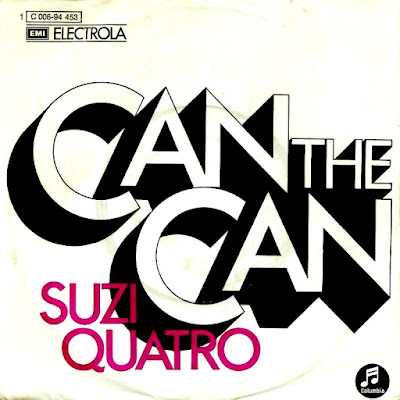
The Pleasure-Seekers release two singles – including Suzi’s composition “Brain Confusion”, and “What A Way To Die” which later features in revenge sexploitation-movie ‘Blood Orgy Of The Leather Girls’ (1988), and they play dates clear across from Las Vegas to Vietnam. In late-1970 veteran-hitmaker Mickie Most heard her playing with the group – by then renamed Cradle, when he was in Detroit recording Jeff Beck at Motown. He saw potential and promptly snatched her across to the UK. PJ Proby had come to England to find that breakthrough success. Jimi Hendrix had come to England to do the same. Now it was Suzi’s turn. She toured downbill with Thin Lizzy and Slade, and released some singles, including 1972’s “Rolling Stone”, co-written with Errol Brown, and Pete Frampton playing session guitar. Until in early-1973 she was teamed with the Chinnichap hit-machine. The Nicky Chinn-Mike Chapman duo – responsible for Sweet, Mud, New World, Arrows and the Knack, who were to the seventies what Howard-Blaikley had been to the sixties, and what Stock-Aitken-Waterman would be the eighties. They wrote and produced the thumping “Can The Can” – which got to no.1 in May 1973, between Wizzard and 10cc, on Most’s RAK label. ‘Put your man in the can, honey, get him while you can’ is maybe an early lyric-shot for BeyoncĂ©’s “Single Ladies (Put A Ring On It)”?


Although she slots seamlessly into the Chinnichap stable, the songs they write are carefully crafted around her persona, but did she have any input into their writing? Were the songs pre-discussed with Nicky and Mike? ‘It was an incestuous relationship’ she explains. ‘I mean that figuratively. I was here, and we did the tour with Slade. And we were getting good responses. But nothing was really happening. I did what I did. I was doing all my own songs. Then one night Mickie (Most) asked if it was alright to bring these two guys around to see me play. So they came and they saw me. They went away and wrote “Can The Can” based around what they’d seen me do on stage. They wrote it for me’ she asserts firmly. ‘They didn’t offer those songs to anyone else. And it worked fine for me. I’m quite a prolific writer. I wrote ‘B’-sides, album tracks, and some ‘A’-sides too (sometimes with future first husband Len Tuckey). In fact, it got confusing at times. We were in the studio recording “Mama’s Boy”, and I turned to Mike (Chapman) who was producing and I said ‘you’ve given me no breathing space on this one.’ And he said ‘Suzi, this is one of yours.’ And it was.’ 

Her image arcs back to Emma Peel and forward to Joan Jett, suited and booted, her diminutive five-foot figure in leather jump-suit, playing bass in a group of heavy guys – Len Tuckey (lead), Alistair Mackenzie (keyboards), and Dave Neal (drums). Kicking ass, beating the guys at their own hard-rocking game. And it made her a ‘Top Of The Pops’ fixture, “48 Crash” (no.3, July 1973) with lyrics variously ascribed to middle-age male impotence or the 1948 Stock Market crash – but what exactly does ‘forty-eight crash is a silk sash bash’ mean? and “Daytona Demon” (no.14, October 1973), until “Devil Gate Drive” returns her to no.1, (February 1974) with its Pepsi ‘Come Alive’ riff, dislodging Mud’s “Tiger Feet” from the top slot. It occurred to me that her teenage hang-out in Detroit – the ‘Hideout Club’ must have been a kind of prototype ‘Welcome To The Dive’ where ‘your Mama don’t know where your sister done go’? ‘It was. And every teenager had one. That place where you go that your parents don’t approve.’ 

She tours the USA through three months of 1975 with Alice Cooper, and returns with a vengeance with the softer melodic “If You Can’t Give Me Love” (no.4, March 1978), with the lyric ‘I know you’re the king of this discothèque thing’ to catch the tone of the changing times. And a duet with Chinn-Chapman stable-mate Chris Norman of Smokie – “Stumblin’ In” (no.41, November 1978), which goes gold when it climbs to no.4 on the US Billboard chart. Her exposure as ‘Leather Toscadero’ opposite the Fonz in TVs ‘Happy Days’ must have helped. She can also be glimpsed as a nurse in ‘Absolutely Fabulous’ (1994) and in ‘Midsomer Murders’ (2007) as electrocuted Rock Diva ‘Mimi Clifton’. And for completists, she’s the voice of ‘Rio Rogers’ in ‘Bob The Builder: Built To Be Wild’ (2006 DVD). As well as stage musical work. 

By the time “She’s In Love With You” becomes her final major hit, a no.11 in October 1979, she’s a bona fide legend. Everyone knows Suzi Q. But for her inclusion on the Ferry Aid charity hit “Let It Be” (March 1987), and a fun Reg Presley duet on “Wild Thing” in 1986. But the hits are just part of the story. There are fifteen studio albums too. Alongside various Greatest Hits compilations, and her ‘Annie Get Your Gun’ (1986) stage-show soundtrack, there’s a trilogy of strong current work, ‘Back To The Drive’ (2006), ‘In The Spotlight’ (2011), and ‘QSP’ (2016) uniting Suzi with Sweet-guitarist Andy Scott and Slade-drummer Don Powell. Showcasing new original Suzi songs.



In a recent Radio Two interview Graham Gouldman claimed that you can no longer write love songs as you age… ‘I don’t agree with that at all’ she explodes vehemently. ‘I know Graham, and maybe incidents in his life have caused him to think that way. But sure you can still write love songs. You can even write them from a better perspective. I’m a romantic, I’m not even a hopeless romantic, I’m a HOPEFUL romantic. I will always believe in the power of love.’ Suzi writes love poems in her ‘Through My Eyes’ (2016) collection. Rhyming verse in “A Mother”, and the mysteries of love in “Common Denominator”. ‘I am a poetic person. I do seem to think in poetic phrases. I am a published poet. Although I usually treat things separately, songs and poems. But every once in a while I’m talking with a songwriter, and he says ‘I’ll write that down, that’s good’.’ 

“Easy Pickings” on the new ‘No Control’ album contrasts the artificiality of the ‘Talent/Reality Shows of Today’ – ‘where mediocrity lies’, with the true honest rural roots of guitar-picking in the Kentucky hills. Based around a riff she’s been toying with for a decade, which found its perfect home. So I guess that means Suzi won’t be doing the ‘I’m A Celebrity Get Me Big Brother House’ any time soon…? ‘They’ve asked me to do that show maybe ten times. And ‘Strictly Come Dancing’. But I turn them down. I will not be a hypocrite. We all watch reality TV. They make for good television. We sit down and watch our Saturday night reality shows. Of course we do. We all do it. But it’s not had a good effect on music. It’s all about fame and money. This is not the way stars are found. Who won last year’s ‘X-Factor’? We don’t know, neither of us. That answers my question. You should come to it with heart. I would not be doing this fifty-five years if I was in it for the fame and money. That should not be your motivation. When I wake up to the reality of the day, I’d still be doing this. I’d still be playing. In fact, I still do that. I go to pubs and get up and jam.’ 

“Bass Line” is the ‘story of my life’ – ‘follow the bass-line, straight down that fret line, follow that bass line.’ “I Can Teach You To Fly” has an upbeat sixties counter-melody vibe, its Turtles positivism grounded by the horns. While “Going Down Blues” seems to be a backatcha attack on a tell-all confessions-biog. ‘You picked up on that? You’ve impressed me’ she grins brightly. ‘I’m not the kind of writer who writes fiction. That song is about somebody, yes. But no. It’s a private thing. You’ve got someone in your life whose done that to you, haven’t you? I can tell.’ While “Don’t Do Me Wrong” is the first song Suzi and Richard wrote together… a unique partnership, as far as I know. Frank and Nancy Sinatra recorded “Something Stupid” together – a father-daughter relationship, but they didn’t write it. I can’t think of another mother-son writing partnership, unless ‘R’N’R’ readers can put me straight…? 

But as in Suzi’s poem… ‘a five-minute conversation you wish was twenty,’ a half-hour conversation you wish was more… 

Meantime, for Suzi, ‘I’m just out flying high.’ 


Published in: 
‘R’N’R: ROCK ‘N’ REEL’ Vol.2 Issue 76 
July-August (UK – July 2019)


DVD: 'Suzi Quatro: Trailblazer. Inspiration. Survivor'


SUZI Q!
 
DVD Review of: 
‘SUZI Q: TRAILBLAZER. 
INSPIRATION. SURVIVOR’ 
by SUZI QUATRO 
(2020, Acme Film Company) 
 

Dale Hawkins did the original Rockabilly ‘Susie Q’, which the Rolling Stones and Creedence Clearwater Revival later revived. Growing up in motorcity Detroit young Susan Kay Quatro was probably familiar with the song. Always a solid bundle of rocking energies, it was brother Michael who set up her audition for Mickie Most at Motown’s Studio A. Signed to Rak Records she was supplied with suitably nonsense hits written and produced by the Mike Chapman-Nicky Chinn team, to become inescapably part of the 1970s chart machine. She wore ‘Barbarella’ leather because she’s an Elvis fan, but the ‘Top Of The Pops’ image tells only part of the tale. Tributes from Alice Cooper, Joan Jett, Deborah Harry, Wendy James and others testify to her influence – as leading the first female-fronted Rock band, and her enduring presence persists. Wielding a bass-guitar that weighs more than she does, the trade-off for a life lived on the road since age fourteen is family and marital issues. Divorce from solid husband-partner Len Tuckey – former guitarist with Nashville Teens (from 1969-1973), and problematic sister-moments, including with Patti who went on to join Fanny. Here, she sets out to redress the balance. Don’t underestimate her. Watch the DVD story. As her 2019 ‘No Control’ album indicates, Suzi Q was always a Rocker at heart, and is at her best writing her own material. All she demanded was that the world ‘let me be who I am.’ She would accept no compromise on that. 

(The DVD bonus features include an interview with Liam – not Gallagher, but director Liam Firmager) 


Published in: 
‘RNR Vol.2 Issue.80 March-April’ 
(UK – March 2020)


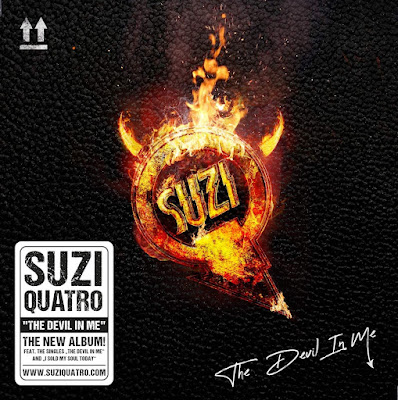
CD: Suzi Quatro 'The Devil In Me'


SHE’S GOT THE DEVIL IN HER HEART 

Album Review of: 
‘THE DEVIL IN ME’ 
by SUZI QUATRO 
(2021, Steamhammer/ SPV) 


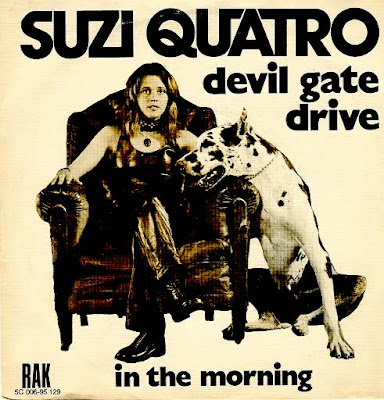
Hey, you all want to go down to Devil Gate Drive? Well, come on!… but if you’d prefer to stay home and just listen to Suzi, this is a great place to go too. There’s a thump-thump-thump drum-track, attack-dog metal guitar riffs that snap and snarl, and twelve new songs written with son Richard Tuckey that she inhabits as skintight as her old leather jumpsuit. Her voice might be huskier, but only to a degree. ‘Hey Queenie’ references Chuck Berry, edged with Jez Davies keyboard runs, and there are Cherie Currie Runaway harmonies on ‘Betty Who?’ – yet there’s no ‘I’ in Suzi, she does not do that confessional thing, there’s little that’s personal or autobiographical, no diary entries about what it’s like being Suzi Quatro in 2021. ‘My Heart And Soul’ has the tasteful string arrangement of a pleading Darlene Love girl group with an unseasonal Xmas plea. There’s vampish bump and grind too. But it’s in the hard Lock-Down Blues of ‘Get Outta Jail’, with Suzi trapped in twilight zone isolation that you glimpse her urgent need to play ‘one more gig to satisfy, one more gig before I die.’ She’s the Motor City Rocker. Rocking is what she does. 


Published in: 
‘RNR vol.2 Issue.87 (May-June)’ 
(UK – May 2021)


Thursday, 24 February 2022

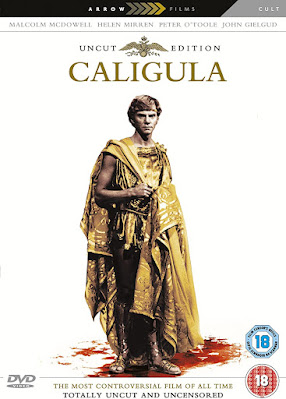
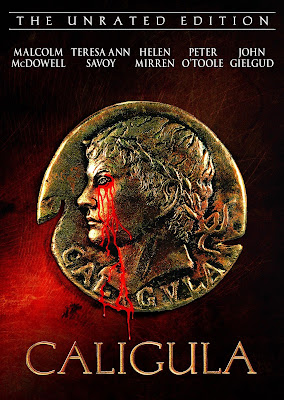
Cult Movie: 'CALIGULA'


‘CALIGULA: 

IMPERIAL EDITION’ 


Review of: 
‘CALIGULA’ 
with Malcolm McDowell, Helen Mirren, 
Peter O’Toole, John Gielgud 
(DVD September 2008 Arrow Films) 


The past is another planet. Those who watched BBC-TV’s ‘Rome’ saw character motivations and loyalties that were comfortingly familiar to us all, fused with grotesque levels of barbarity and repellant alien strangeness to recoil from. We think we know Pagan Rome. We don’t. When it comes to fantasy empires nothing that Michael Moorcock, Robert Silverberg or Robert E Howard could contrive comes close to this stuff. Robert Graves’ ‘I Claudius’ illustrates exactly how emperors exert apparently limitless power without restraint, consequence or conscience, but equally, how they do so at the whim of the Praetorian Guard who can dispatch them, and their entire family in a coup the moment they prove inconvenient. And in an age of epic excess, Caligula’s rule has become a byword for gargantuan perversities. 

He was an ‘extraordinary’ man according to Gore Vidal, ‘some think the most wicked young man who ever lived.’ He’s also one who’s story has been retold in the guise of multiple interpretations all the way through to MegaCity One’s insane ‘Judge Cal’ in ‘2000AD’ magazine. Through Graves’ eyes Caligula’s horrific debauches seem to be more a way of testing out those constraints, taunting Rome’s endurance recklessly. His ‘expedition’ to Britain results in his soldiers attacking papyrus reeds on the shores of a nearby lake, then triumphantly returning with the spoils of looted sea-shells. A jape that mocks the military, the credulity of the populace, and the pretensions of Imperial Rome itself – forcing limits to the tipping point that would provoke response, inviting lethal retribution. Although most of this is conjecture, the movie follows what is generally assumed to be known. Caligula succeeded his mentor, Tiberius, on the former emperor’s assassination, inheriting the city, the empire – the world. Ancient historian Suetonius who documents his perversities suggests Caligula may have murdered him. In this version, when Caligula loses his nerve, Macro does it for him. In a scene perhaps intended to echo one in ‘The Fall Of The Roman Empire’ (1964) Macro holds his hand in a naked flame to prove his loyalty to the new emperor, which doesn’t stop Caligula having him executed soon after in a giant mechanical contrivance for lopping off and harvesting heads.


Tacitus adds detail. But the writings that survive were not subject to the rigorous objectivity we expect from modern historians, they all had their own axes to grind. The bare truth is, Caligula – nicknamed ‘Little Boots’, ruled from 37-to-41AD, starting off well until a near-fatal midpoint illness – possibly the result of poisoning, which knocks him off-course. His sister-lover Drusilla is the only thing he really cares for, and her death shoves him further into ultimate madness. Deep in decadence he instigates the ‘Imperial Brothel’ staffed by Senator’s wives, each five-gold-piece they earn goes to balance the civic budget. He makes his horse – Incitatus, a consul. Until his bloody assassination becomes inevitable, with Caligula’s expression fixed somewhere between exultation and amused vindication as it happens. To Gore Vidal, he ‘plunges into death’ as ‘the last great trip.’ His killers kick a severed head aside contemptuously, as Incitatus rears and canters away, a symbolism probably intended to represent Caligula’s untamed spirit escaping. He’s immediately succeeded by his stuttering club-footed uncle Claw-Claw-Claudius. 

Following this time-line – as related in the generous bonus-DVD of extras, ‘Caligula’ started out from a script by Gore Vidal, who had already done uncredited script-work for ‘Ben Hur’ (1959). Later the movie became Bob Guccione’s prestige project, with the ‘modern publishing emperor’ bringing in Italian director Tinto Brass, banked by the overflowing ‘Penthouse’ coffers, with the bought-in power of ‘A’-list stars, the louche access to thirteen attractively bare ‘Penthouse Pets’ (including ‘Pets Of The Month’ Lori Wagner and Jane Hargrave), complete with the historical subject-matter to justify it all. In protest at the Tinto Brass ‘Hollywood-on-the-Tiber’ excess, Vidal subsequently insisted his name be deleted from the credits. Ponderous Prokiev and weighty Katchaturian set the portentous tone, undermined only slightly by such gaffes as the geographically exact modern European map on the palace wall. 

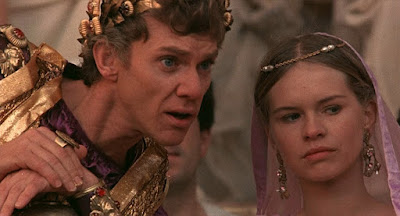
Malcolm McDowell is at his most malevolently cherubic as Caligula, using the evil charm he perfected in ‘If’ (1968) and ‘Clockwork Orange’ (1971), and is still capable of unleashing in ‘Star Trek: Generations’ (1994) or NBC-TVs ‘Heroes’ (2007-2008). At one point his Caligula casually continues his conversation as he breaks off to urinate into the drapes. Peter O’Toole invests the vile syphilitic Tiberius with a sense of sinister reality, with his Capri grotto of speaking-statues, freaks and sexual gymnasts. And John Gielgud is Nerva, the patrician old pragmatic with republican sympathies. Long-suppressed, the film has been derided as up-market art-porn, opulent sleaze, big-budget smut. What Helen Mirren calls ‘art and genitals’. And yes, it’s all that, the elaborately-staged sex and orgy scenes are unexpurgated, explicit. The violence is stomach-churning. But there’s a palpable air of madness, which to Guccioni is merely part of its ‘historical accuracy’ – not pornography but what he insists is ‘pagan-ography’, and hey, that’s the way it was. The past is another planet.


‘CALIGULA: UNCUT…’ 

‘Caligula’ 1979, Director: Giovanni Tinto Brass. Producer: Bob Guccioni & Franco Rossellini. Original script: Gore Vidal (uncredited). Visual Effects: Franco Celli & Marcello Coccia. (4-DVD Box-set September 2008 Arrow Films) With Malcolm McDowell (Caligula), Helen Mirren (Caesonia), Peter O’Toole (Tiberius), John Gielgud (Nerva), Therese Ann Savoy (Drusilla), John Steiner (Longinus), Guido Mannari (Macro), Paolo Bonacelli (Chaerea), Giancarlo Badessi (Claudius), Adriana Asti (Ennia), John Gielgud (Nerva), Leopoldo Trieste (Charicles), Bruno Brive (Gemellus), Mirella Dangelo (Livia), Helen Mirren (Caesonia), Richard Parets (Mnester), Paula Mitchell (Singer/ Subura), Osiride Pevarello (Giant), Donato Placido (Proculus), Anneka DeLorenzo (Messalina), Lori Wagner (Agrippina), and Teresa Ann Savoy. Music: Paul Clemente with Aram Khachaturian & Serge Prokofiev. 4-DVD set includes Full Uncut Version (2:36), Theatrical Version (1:42), Alternate Version (2:33), + bonus-disc with ‘The Making Of…’, ‘Conversation With Lori Wagner’, ‘Tinto Brass: The Orgy Of Power’ etc 

Featured on Website: 
‘VIDEOVISTA (Nov)’ UK – November 2008)


Monday, 31 January 2022

Poem: Low Walls


LOW WALLS 


why do low walls fascinate? 
why do they always seduce your attention 
and lure you with their teasing challenge? 
but they always do, and always have, 
when I see a low wall, I just have to 
climb up and walk along it, 
there’s simply no other option, 
I’m helpless against its invitation, 
so you climb and you teeter along its length, extending 
your arms at either side like an agile tightrope-walker, 
pretending it’s scary, pretending you’re about to fall 
and plummet to some terrible mangling doom, 
even though its barely knee-high from the street, 
the tops of some low walls, like the ornamental 
walls around municipal flowerbeds, are raised into a 
central ridge which makes them even more precarious, 
and hence more of a challenge to your nimble skills, 
some have hazardous mossy patches or even ivy 
growing across them which you must carefully navigate... 
until you finally reach the end of the wall, and 
have to descend down to dull pavement-level again, 
until the next wall... 


Published in: 
‘GARGOYLE no.74’ 
(Paycock Press, Richard Peabody) 
(USA – December 2021)

Thursday, 27 January 2022

Classic Poem: Alfred Lord Tennyson's 'The Lady Of Shalott'


‘HALF-SICK OF SHADOWS’:
 
THE LADY OF SHALOTT 


Alfred Lord Tennyson’s “The Lady Of Shalott” 
was my Mother’s favourite poem. Perhaps she 
empathised with the predicament of a woman 
confined, able to view the passing carnival of 
life only through a lens? Is it a Feminist poem, 
a poem of female empowerment? 
Or just a romantic medieval fantasy? 
Andrew Darlington re-reads the poem… 


The first thing you notice about the Alfred Lord Tennyson poem “The Lady Of Shalott” is that it is written in a rhyming narrative form. Sometimes the simplest most obvious observations can be the most telling. The poem consists of a story. It tells a tale. Unlike the self-focused confessional poems with which we surround ourselves today, Tennyson himself is not a presence. Whatever it says about the twenty-four-year-old poet must remain informed guesswork for literary academics, to be intuited in tangential ways. And it rhymes. Not the rhyming-dictionary doggerel of Rap, where line-endings plunder thesaurus variations to exhaustion point. In fact, the rhyme is so virtually invisible it must be tracked to even appreciate its flow. The other thing about the poem is that it is beautiful. It needs no other justification.


Although Lord Byron and Percy Bysshe Shelley were early models, Tennyson was more cautiously gradualist than revolutionary. During a time of political turmoil he debated radical issues as part of the Trinity College Apostles undergrad group, showing support for the 1832 Reform Bill which extended democratic entitlements. With close friend Arthur Hallam – whose early death in 1933 inspired his “In Memoriam”, he took up the cause of Spanish revolutionaries and travelled to the Pyrenees in an unsuccessful mission to aid them, although the trip would yield the poem “Mariana In The South”. Even as a student, others were more impressed by Tennyson’s commanding physical presence and youthful literary achievements than by his degree of social involvements. Readers today, if they know him at all, are familiar with the bardic bearded image of the older Tennyson, by which time his views had become more conservative and patriotic. 

His father – the Reverend George Clayton Tennyson, was a comfortably middle-class country clergyman, yet Alfred never harboured traditional religious views, and wrote ‘there lives more faith in honest doubt, believe me, than in half the creeds’ (in “In Memoriam”). Respected by Samuel Taylor Coleridge, his debut collection, ‘Poems, Chiefly Lyrical’ (1830) was nevertheless criticised for being cloyingly sentimental. It includes “Claribel”, the doomy narrative “Mariana” and the mythic Nordic “The Kraken”. Later, after his father’s death, Tennyson quit Cambridge without taking his degree, to live with his family in his father’s rectory. It was there he wrote the first version of “The Lady Of Shalott”, which was included in his poorly-received second volume ‘Poems’ (1833). 

In an era of increasingly dirty industrial urbanisation there was a contrastingly strong escapist vision at large in the polluted air, a yearning towards some lost idyll of romantic chivalry that, in reality, had never existed. Folklore carved it out of the barbarism of post-Roman Britain and reinterpreted it through lavish literary invention. It was a gothic revival drawn – like a sword from a stone, by the 1816 republication of Malory’s 1634 ‘Le Mort d’Arthur’. “The Lady Of Shalott” itself is based loosely around Arthurian myths and legends. Here is a rich source material that Tennyson would continue to delve into in poems about ‘Galahad’ and ‘Sir Launcelot And Queen Guinevere’, as well as his epic cycle ‘Idylls Of The King’ (published 1859-1885). It paints visual imagery so strong that it urges painterly representation. To see William Holman Hunt’s 1888-1905 “The Lady Of Shalott” painting, as part of the Tate Britain Pre-Raphaelite exhibition, is truly breathtaking. The rich depth of colour, the storm of auburn hair in a wild haloing mane above her are employed in order to represent the freedom her ensorcellment denies. 

This was my Mother’s favourite poem. She loved this poem. Perhaps she empathised with the predicament of a woman confined to her chamber, able to view the passing carnival of life only through a lens? So is it a Feminist poem, a poem of female empowerment? Is the Lady’s imprisonment a metaphor for the general repression of female aspirations that were particularly acute during the period in which the poem was written? And why is she supernaturally imprisoned in the tower in the first place, bewitched into weaving her ‘magic web of colours gay’? What occult power has she offended? The reader is not informed. ‘She knows not what the curse may be.’ Perhaps there is no message, other than the ones the reader chooses to impose?


The poem was revised for an 1842 edition – edited down from twenty to nineteen stanzas, and although this is the version most popularly read now, both texts have a unique flavour. The original makes greater use of an arcane and mannered vocabulary, as if to evoke a sense of deliberate antiquity. The latter has a more liquid flow. The ‘yellowleavèd waterlily, the greensheathèd daffoilly, tremble in the water chilly’ in the first version becomes ‘up and down the people go, gazing where the lilies blow, round an island there below, the island of Shalott’ in the second. The reaper ‘reaping late and early… piling the sheaves in furrows airy’ who whispers ‘tis the fairy Lady of Shalott,’ becomes ‘the heavy barges trail’d, by slow horses… skimming down to Camelot’ in the second. Both establish the rural image setting for the silent isle with its ‘four grey walls and four gray towers’ which ‘overlook a space of flowers’ – intact in both revisions, in which the Lady is ‘imbowered’. It is magical in every sense of that much-abused overused word. It is lavish and ornate, a poem written in light, because that is where its energies lie. It is romantic in the true sense of it being a romance, a flight of fancy, rich with imagery, ‘below the starry clusters bright, some bearded meteor, trailing light.’ 

Unnamed in the poem, the Lady is supposedly adapted from the Elayne of Ascolat who died of unrequited love for Lancelot of the Lake, as told by various thirteenth-century French and Italian romances, including ‘La Damigella Di Scalot’ as well as in Sir Tomas Malory’s work. Yet Tennyson weaves a sorcery of his own magical elements into the tale. She sits alone endlessly weaving at her loom, confined to her tower, watching the outside procession only as ‘shadows of the world’ that go by in her mirror. She weaves tapestries of a world she sees only in reflection, and delights in creating her solitary art. Until she sees bold Lancelot reflected in her lens, his ‘bridle glitter’d free, like to some branch of stars we see, hung in the golden galaxy,’ with his helmet and helmet-feather ‘burn’d like one burning flame together,’ his saddle-leather shining as though ‘thick-jewell’d’. Orphaned child of royalty, raised by the same water-spirits who will later retrieve Excalibur, Lancelot – the grail-quester whose adulterous love for Guinevere will eventually bring the entire Camelot idyll crashing down, is the epitome of the chivalrous ideal. And the flash of his visage on her crystal mirror, singing ‘Tirra lirra’ as he rides, is the trigger that releases her. 

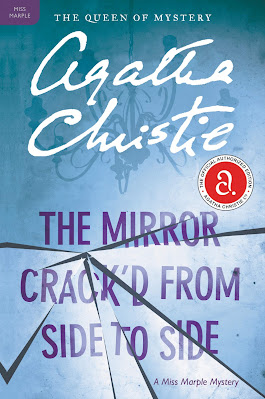
She is essentially a passive presence. Her one act of willed self-determination is the one that also destroys her. And yet she’s aware of the consequences of her defiance. The poem’s most oftly quoted line ‘the mirror crack’d from side to side’ – picked up by Agatha Christie to title her 1962 Miss Marple novel, is the warning that tells her ‘the curse is come upon me.’ Yet the curse has not been randomly invoked, she has consciously taken the decision that will trigger it. ‘She left the web, she left the loom, she made three paces thro’ the room.’ She has summoned that fate down upon herself. So is it a Feminist poem, a poem of female empowerment? In the sense that to choose to die in freedom is preferable to live on enduring enslavement. To act for the moment, irrespective of the price to be paid. 


Unlike the self-focused confessional poems with which we surround ourselves today, this poem consists of a story, it tells a tale. That renders it open to interpretation. Some have seen it as a metaphor for the essential isolation and solitary nature of the artist, distanced from the world. Another sees it as an allegory for the process of growing up, exchanging the world of illusion for the harder realities of adulthood, for a life that consists of fancy must be corrosive, even in the comfort of dreams. They must be cast away, despite the penalty to be paid. This was my Mother’s favourite poem. She loved this poem. She saw the message in a more literal way. A woman lives her life within the limits decided for her, imposed upon her by social pressures. If she breaks the rules, she pays a terrible price. I don’t know for sure. I don’t know how far she rationalised it. But she had transgressed the rules by birthing an illegitimate child – me, it was her one act of willed self-determination. And on a day-to-day basis she struggled through the repercussions. She sat alone as I slept. She read this poem. 

She read the lines that describe the Lady’s limited moments of willed liberation as ‘down she came and found a boat, beneath a willow left afloat, and round the prow she wrote, The Lady Of Shalott.’ She climbs into the boat robed in white. Singing her last song she leaves her island of isolation. The slow current carries her down towards the distant fairy-tale spires of ‘tower’d Camelot.’ As she glides, the curse takes hold and her blood freezes. Her eyes darken, her gleaming shape floats by trees and buildings, dead-pale on her death-barge. Until, out upon the wharfs of Camelot, her body is discovered. Death has a Gothic romantic appeal, emphasised as the final drama of a doomed love. In this fully-rounded narrative poem it also serves the logical purpose of drawing the tale to a satisfying conclusion. There’s an argument that at the time the poem was conceived, death was more a fellow-travelling part of life than it is now. That we are more distanced, more desensitised to its absolute finality. But death is always a traumatic irruption into life, no matter how impervious we feel ourselves to be. No-one is immune. 

In Camelot, as the knights cross themselves for fear, Lancelot, the Lady’s unrequited love, crouches beside her and muses ‘she has a lovely face; god in his mercy lend her grace, The Lady Of Shalott,’ bringing the poem to a tragic close. Yet the poem goes on. The Lady ghost-walks across time into our present dilemmas. 

It is beautiful. It need be no more. That is all the justification it needs.


Tuesday, 25 January 2022

SF Books: Gollancz Gold


           GOLLANCZ GOLD:

DREAMS & NIGHTMARES

FROM YESTERDAY’S FUTURES 


Book Reviews of: 
‘THE SIRENS OF TITAN’ 
by KURT VONNEGUT JRN
 
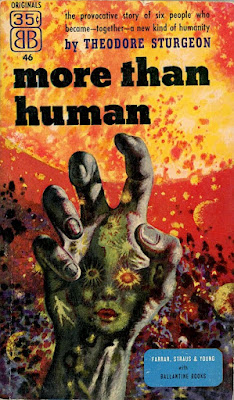
‘MORE THAN HUMAN’ 
by THEODORE STURGEON
 
‘A TIME OF CHANGES’ 
by ROBERT SILVERBERG 

‘NOVA’ 
by SAMUEL R DELANY 
 (‘Gollancz SF Masterworks’ launched 27 March 1986, £2.95)


Bored rebellious teenage girl forms erotic liaison with scaly alien, then flaunts the relationship to provoke and outrage the locals. When they refuse to be shocked, when they even bless the mismatched union, she loses interest in the affair and dumps hapless alien. Despite appearances there’s nothing essentially Science Fictional about this Robert Silverberg storyline – from his ‘Majipoor Chronicles’ series, there’s no reason why the same narrative effect couldn’t equally be achieved by switching the locale to crossing ethnic and cultural lines in Bradford, or Brixton, or even a Belfast Catholic-Protestant tryst. There might even be credibility-points to gain by tackling ‘issues of relevant social concern’ head-on. So why deliberately distance the tale with extraterrestrial imagery? The theme becomes SF through its manipulation of a kind of magical surrealism, the literary ‘code’ of a pretend world, an intriguingly bizarre alien biology, the exotic ‘Travellers Tales’ sense of wonder at haunting strangeness. 

But WHY Science Fiction? With Earth pretty much mapped into domesticity our collective hunger for Folk myths must be projected upwards and outwards, play-acting fables in imaginary space-time continuums. SF has been around a long while. The ‘Gollancz Classic SF’ paperback series was launched to ‘celebrate twenty-five years at the forefront of Science Fiction publishing.’ It’s also an opportunity to take a full body-scan of the literature, monitoring the vigour and health of its state of the art.


I grew up on the stuff. For my adolescent fix it was enough merely to hunt down the shelves of my local library for those distinctive near-luminous yellow Gollancz spines that crammed my head on the evolving fantasies of Frederik Pohl, Clifford D Simak, James Blish, Robert Silverberg, Theodore Sturgeon, Robert A Heinlein et al; writers whose (literally) fabulous, (literally) incredible visions are etched so indelibly deep into perceptions of the Solar System – and beyond, that even the most determinedly persistent Voyager probe can’t touch, never mind eradicate them! There never were any ‘Sirens Of Titan’ – look at the fly-by photos! – but the book still suspends your disbelief with the sheer absurd beauty of its invention. 

There’s two ways writers can use this conceptual memory bank, this data gene-pool of ideas, this twenty-year-plus accumulation of tantalising symbols. You can celebrate them – and choosing the classics from the Gollancz back-catalogue is like having to select just twelve tracks for a ‘Best Of Motown’ album. What to choose? What to leave out? Or you can ditch them entirely and reinvent the genre by going back to first principles. In an interview in ‘Words’ magazine JG Ballard advocates stripping this whole escapist cotton-candy fantasia down to its constituent atoms. He attacks the whole superstructure of artificial futures so painstakingly assembled by generations of poorly-paid Pulp hacks. This entire map of hyper-drive eternities, he argues, should be trashed back to the basis of the human vs technology interface. Ballard himself replaces it with more contemporary metaphor-symbols of concrete islands, media satire, autowrecks and urban desolation – which is fine manifesto-wise, but ignores the hypnotic lure of the traditional fictional multiverse, the ‘Billion Year Spree’ that is celebrated through the Gollancz Classics series.


The earliest reissue is Theodore Sturgeon’s ‘More Than Human’ from November 1953, a time when the genre was still considered a disreputable under-the-counter purchase targeted at acne-cratered adolescents, a furtive activity akin to masturbation. It’s an Earthbound next-stage-in-evolution novel, developed from a novella called “Baby Is Three” expanded by the addition of “The Fabulous Idiot” and “Morality”, concerning five misfit individuals; two black girls with speech impediments, the introspective daughter of a sex-worker, a mongoloid baby and an idiot-savant with unsuspected depths, who ‘blesh’ together to form a gestalt entity of unpredictable power. It’s a fine understated work by a writer who died in May 1985 aged sixty-seven, a writer whose skill did much to open the scope of, and legitimise his chosen genre. Kurt Vonnegut readily acknowledges the pioneering role that Sturgeon played. ‘It’s a tradition in Science Fiction to go as fast as possible; that grew out of the fact that people were being paid by the word when they began, quarter of a cent a word, you know?’ he explained. But ‘Ted Sturgeon for instance – if he could have spent more time on his books, he would have had those books accepted as mainstream’ (interview in ‘Space Voyager no.7’). 

Samuel R Delany paid Sturgeon his dues too, in the form of a eulogy spoken by Lump, a ‘linguistic’ from the short novel ‘Empire Star’ (1966), ‘there was one ancient Science Fiction writer, Theodore Sturgeon, who would break me up every time I read him. He seemed to have seen every flash of light on a window, every leaf shadow on a screen door that I had ever seen, done everything I had ever done from playing the guitar to laying over for a couple of weeks on a boat in Arkansas Pass, Texas.’ 

But perhaps more than anyone else, it was Vonnegut who benefitted from this increasing sophistication and the eventual critical acceptance of SF, although he never underestimated the value of traditional Space-Fiction paraphernalia. His second novel – ‘The Sirens Of Titan’ from 1959, is a manic romp through the full widescreen pantheon of Pulp myth, a conscious ransacking of its every ludicrous invention, an affectionate piss-take, and a deliciously absurd concoction. Vonnegut’s protagonist, Malachi ‘Unk’ Constant, becomes involved in a well-intentioned but disastrous Martian invasion of Earth, gets trapped on Mercury with friendly luminous triangles called Harmoniums, and eventually winds up on Titan with a Tralfamadorian robot called Salo who is marooned in the Solar System midway in a journey across the galaxy to deliver a message that reads – simply, ‘Greetings’. It’s less Science Fiction, and more a careful send-up of the genre set neither in a recognisable Solar System or even an internally rational universe. He realised that SF was an entire alternative reality in which a wealth of interchangeable story components could be unquestioningly accepted, things that don’t exist, have never and probably never will exist outside fiction – Faster-Than-Light travel, telepathy, androids, laser swords, time travel, force-fields. Taken collectively they form a ‘code’, a complex web of off-the-peg myth symbols of remarkable potency.


Around the time that ‘More Than Human’ was shiny new, Robert Silverberg was poised to launch his own Pulp hack phase. Then, several phases on, he was mixing and matching genre-styles and story-ingredients with a juggler’s dexterity. ‘A Time For Changes’ (1971), originally serialised in ‘Galaxy’ and winner of a 1971 Nebula award, is far from his best novel – my vote would go to his ‘Nightwings’ (1969), but it is a highly readable example of his Majipoor-style neo-feudalism. It concerns the forbidden history of one Kinnall Darwal, prince of Salla, whose Borthan morality is eroded by ‘soul-sharing’ hallucinogens provided by a visiting Earthman. The narcotic counters the strict social taboos against the use of the ‘first person,’ and by becoming its ‘pusher’, the story becomes an LSD fable that runs its course when Kinnall’s bond-sister Halum suicides after a soul-sharing session, and Kinnall himself is hunted, presumably to death, as a result. 

While Samuel ‘Chip’ Delany’s New Wave epic ‘Nova’ (1968) takes the reader not only forward into the internal rivalries of the galactic empire of the thirty-first-century, but also through the heart of an imploding sun with Lorq Von Ray’s grail-quest for the elusive Illyrion. A dense, rich work of some lyrical complexity it demonstrates just how far the genre has evolved, while remaining true to its well-used and oft-abused basic tenets. And, these four reissues taken collectively, display the breadth of diversity that exists within that definition, as well as its inter-relationships. ‘In a sense’ Delany explained, ‘ ‘Nova’ is a specialised kind of thing, because it’s a pastiche of a very classical type of Science Fiction novel… everyone has gotten this idea that I was going to do New and Different Things – and then what I essentially tried to do was write the perfect ‘Planet Stories’ novel’ (in ‘Science Fiction Monthly’ Vol.2 no.3). 

Full circle…? 

But if fiction is ‘things that never happened to people who never existed,’ then SF, no matter how sophisticated, just fast-forwards the tense into futures imperfect. So can it REALLY be taken seriously as literature? Science Fiction is a serious literature of dreams, and a serious flirtation with nightmare. That’s at least as serious as Sigmund Freud, or Salvador DalĂ­! It was Theodore Sturgeon himself who first formulated the equation that ninety-percent of everything is crap, it’s the remaining ten percent that provides the justification. The dictum passed into SF lore – and beyond, as ‘Sturgeon’s Law’. Gollancz Classics re-presents that justifying percent in attractive new editions. Although it still falls short of explaining WHY SF? The spaceship as phallic symbol? The future as political metaphor for now? The likes of Silverberg’s scaly alien romance universalises and codifies syndromes that no amount of gritty accurate localising could do. All this and more is probably true. And sure, it’s escapist as hell too. It’s a fix like any other kind of addiction, one I still can’t clean out of my head. You can rationalise it, intellectualise it with all manner of smart-ass sophistry as technological poetry and speculative prose, but its lure remains the romance of the Traveller’s Tale. JG Ballard is correct too. Art must continually reinvent itself, for without action there can be no reaction. Without vocabulary there can be no fables. 

If ‘Gollancz Classics’ exist to indoctrinate SF virgins into a sense of wonder, with a new compendium of Folk myths, then I’m grateful for the opportunity of buying in for a second time round. It’s still my favourite waste of time!