Friday, 28 October 2022

Peter Green: Man Of The World (DVD)


‘MAN OF THE WORLD’: 
THE PETER GREEN STORY 


DVD Review of: 
THE PETER GREEN STORY: 
MAN OF THE WORLD 
A Dougie Dudgeon and Henry Hadaway film 
Scanbox Entertainment (2018, Wienerworld) 


Where is Peter Green now? 

‘It was an incredibly short run’ says Mick Fleetwood, ‘and yet we’re still talking about it, nearly forty years or so later.’ And he’s correct. Peter Green was with Fleetwood Mac two years and eight months. In the vast cosmic scheme of things, that’s not long. Yet that’s where the kernel of the legend exists. This valuable documentary, directed by Steven Graham for the BBC, thoroughly details that arc of years, across a generous 150-minutes. It takes a bemused Peter Greenbaum wandering back to where it began, all the way to ‘my very first memories’ of Flat 18, Antenor House, off Old Bethnal Green Road E2 6QS, ‘coming across this road here, and then up there.’ Shuffling along the pavement, beside black railings and neatly-spaced saplings, indicating up at the white first-floor balcony of his childhood flat. He’s a survivor, who’s been to hell and back. Yet, ‘It’s nice to revisit yourself’ he adds brightly. 

Brothers Mike and Len Green take up the story of Peter’s first guitar. Born 29 October 1946, he honed his skills through skiffle and the Blues, his debut single came as a twenty-year-old part of Peter B’s Looners, a four-piece led by Peter Bardens. An organ-led shuffle-instrumental version of Jimmy Soul’s risqué calypso, “If You Wanna Be Happy” c/w “Jodrell Blues” (1966, Columbia DB7862), it makes an inauspicious start for Peter Green, despite the stinging guitar solo on the B-side. Yet, produced by impresario Rik Gunnell, Mick Fleetwood also happens to be there on drums, billed according to his previous group as ‘ex-Bo Street Runners’. 


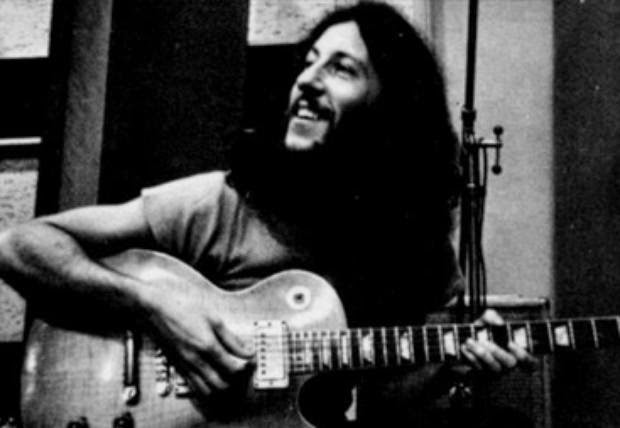
Then Peter was playing with the Bluesbreakers at ‘The Flamingo’. John Mayall explains how ‘Peter in his prime in the sixties was just without equal, he was a force to be reckoned with.’ Replacing Eric Clapton in the line-up was a poison chalice, which he accepted decisively by not replicating what ‘Slowhand’ had done – avoiding playing the hard fast virtuoso style, but taking his Les Paul down other routes. For the ‘A Hard Road’ (Decca, February 1967) album – with drummer Aynsley Dunbar and John McVie on bass, Peter sings lead on “You Don’t Love Me” and his own “The Same Way”, but it’s the haunting instrumental “The Supernatural” that stands out, playing what journalist Keith Altham defines as ‘ethnic Blues’, a spirit that underpins it all. Many years later, after the maelstrom that swept him away, Peter would play “The Supernatural” again, with the Splinter Group. And it still sounds magical. 

‘There’s no word for it’ Peter struggles to explain to me, ‘I copy them (the Blues Masters) as best as I can. I’m Jewish. So I’ve got a little trapdoor there. The old Hebrew Testament thing, right back to Moses. It could be worse, couldn’t it?’ 

Soon Mick Fleetwood replaced the ‘too technical’ Dunbar, and the core of Fleetwood Mac was in place, initially freelancing without Mayall on dates with bluesman Eddie Boyd. Jeremy Spencer gets recruited into Peter Green’s new venture from the Midlands-based Levi Set, following just the exchange of names ‘Elmore James, BB King’. Encouraged by Mike Vernon, their debut album together – issued in February 1968, is a ‘plug-in and play’ exercise according to Mick Fleetwood, cut at the New Bond Street CBS studios with Vernon producing. Apparently the name Fleetwood Mac was Peter’s deliberate legacy to his friends, in anticipation of further adventures – although he could never have imagined how those further adventures were to play out, and he was outraged when Blue Horizon choose to promote the record as ‘Peter Green’s Fleetwood Mac’. It was preceded by debut single – Jeremy Spencer’s “I Believe My Time Ain’t Long” c/w Peter’s “Rambling Pony” (November 1967, Blue Horizon 3051), followed by the startling classic “Black Magic Woman” (c/w “The Sun Is Shining”, March 1968, Blue Horizon 57-3138). With the song’s background story narrated here by celibate girlfriend Sandra Elsen. It climbs to no.37 in the UK chart, but soon gets taken up as a key recording by Santana. 


Blue Horizon had a community feel to it, and as part of the label house band both Peter and Mick sit in on sessions for Duster Bennett’s first LP ‘Smiling Like I’m Happy’ (1968), and Peter helps out on the Brunning Sunflower Blues Band’s ‘Trackside Blues’ (1969). Studio jams and back-up sessions from this phase continue to be released under various guises for a number of years, from ‘Blues Jam At Chess’ (1969) with Muddy Waters and Howlin’ Wolf, to ‘The Complete Blue Horizon Sessions 1967-1969’ (1999) 6CD box-set with previously-unreleased outtakes, studio talk and alternate takes. 

Always a self-deprecating man of fragile sensitivities – the lines ‘I can’t sing, I ain’t pretty and my legs are thin’ reflects Peter’s own sense of bewilderment and lack of self-worth, he was already caught up in destructive contradictions. Always prone to reflective moments, even in the studio recording of the straight-Blues ‘Mr Wonderful’ (August 1968), amid the band’s bawdy excesses. “Rattlesnake Shake” on ‘Then Play On’ (September 1969) is Peter’s ribald commentary on Mick Fleetwood’s masturbation habit. Yet he’s deeply troubled by white-liberal guilt over the band’s accumulating wealth, when contrasted with TV images of the Biafran famine. Seeing real human beings starve to death on-screen, with the same sense of moral outrage that would later power Bob Geldof to kick-start Band Aid. Resolving not only to channel his royalties into charity, but to persuade other members of Fleetwood Mac to do the same. Suggestions not always sympathetically received. 

Those anti-materialist tendencies were exacerbated by meeting Jerry Garcia during the band’s first American trip, as well as the Grateful Dead’s chemist LSD-guru Stanley Owsley. Initially suspicious, Jeremy Spencer was the first to sample the new lysergic-acid wonder-drug, then Peter drank laced kool-aid. The textbook version is that he was unaware the drink was spiked. The way he tells it now, with an amused twinkle, he was more than a willing accomplice to the pretence. ‘I didn’t talk to god’ relates Mick Fleetwood, ‘just felt a bit strange’. They play ‘The Warehouse’ in New Orleans with the Dead, all stoned. ‘I did feel a bit… effervescent’ recalls Peter, about LSD. The tour climaxes into acid-horror in the Frisco Gorham Hotel after jamming with the Grateful Dead at the Fillmore. Mick hallucinating every band member as skeletons as they sit around the floor holding hands, phoning Owsley to talk them down, in vain. It was ‘horrible’ concludes Mick.


The continuing John Mayall kudos had Fleetwood Mac rated as the most authentic Blues outfit around, with ‘Mr Wonderful’ rarely straying from the Elmore James blueprint despite a ‘dirtier, gutsier’ horn-section and Christine Perfect (soon to be McVie) on piano, but by 1969 their restless creativity was taking them way beyond such genre restrictions. Blues was the spine, and would continue to be, underpinning diverse new bands and evolutions across the seventies. But it was already becoming porous, flexible, open to positive mutations in the light of new lifestyles. The single “Need Your Love So Bad” (c/w “No Place To Go”, Blue Horizon 57-3157), a cover of Little Willie John’s 1956 original, antagonises purists with sweeping strings offsetting Peter’s raw pleading vocal lines. Yet it climbs to no.31 on the chart, and is successfully reissued a number of times, collected onto the compilation ‘The Pious Bird Of Good Omen’ (August 1969), alongside both sides of the earlier singles, plus two tracks from Eddie Boyd’s ‘7936 South Rhodes’ (Blue Horizon, 1968) album on which the Mac play back-up. A re-jigged version of this album becomes ‘English Rose’ for the US Epic label, with a fright-wig cover-art photo of Mick Fleetwood in drag. He’d already appeared naked but for battered hat and strategically-positioned shrubbery on the ‘Mr Wonderful’ gatefold cover! 

Danny Kirwan was brought in (from Boilerhouse) as third guitar in time for what Peter calls the ‘Santo and Johnny’ sound of the next single, “Albatross”. Peter plays his Stratocaster lap-style, plucking the title from Samuel Taylor Coleridge’s “The Rime Of The Ancient Mariner”, months before Procol Harum use the epic poem as the base for their “A Salty Dog”. Although the label was initially dubious, an appearance on the ‘Simon Dee’ TV-show shoves it into the charts, and all the way up to no.1. There were two charts in general use. In ‘Record Mirror’ it was no.1 for the single week 29 January 1969 – but would return on re-issue to no.2 in 1975! In ‘New Musical Express’ it nudges Marmalade’s Beatles-cover “Ob-La-Di, Ob-La-Da” from top slot and stays there three weeks until 8 February, when it’s dislodged by Move’s “Blackberry Way”. 

Then the achingly-heartfelt “Man Of The World” single was ‘the first cry for help that we heard from Peter Green’ opines Altham, direct-to-camera. ‘Almost like a suicide note’ agrees a pensive Jeremy Spencer. The voice, ‘I’m not saying that I’m a good man, oh, but I would be if I could,’ is painfully autobiographical. Issued through a one-off deal with Andrew Loog Oldham’s Immediate records, it peaks at no.2 – just below the Beatles “Get Back” (24 May 1969). Although it’s stop-start loud-soft structure makes it impossible to dance to, I recall playing it in a sense of awed wonder to other students at the Hull College Of Technology, frustrated that they can’t see how starkly revelatory it is, the chillingly confessional line ‘I just wish that I had never been born’ is still spine-tingling. 


The single also spells goodbye to nurturing producer Mike Vernon. Leading to the Mac’s third studio album, ‘Then Play On’, arriving through a lucrative up-deal with Reprise. A stunning, complex, astonishing, conflicted, beautifully baffling, exquisitely problematic album, unlike anything they’d previously released, and nothing like anything that ever came after, anywhere in the vinyl cosmos. The soft-loud dynamic of their no.1 single “Oh Well” – both sides of which are included, is something of a touchstone, although the fourteen original (and four bonus CD) tracks range much further. The 54-minute playing time allows jamming-space, but Peter’s spiritually charged improvisations are always immaculately interplayed and never self-indulgent. A vital element of the album’s incandescence is its unstable fragility. It was Peter’s ‘last calling card’ according to Fleetwood. With his traumatic state of disintegrating mental health even more scarily explicit on “The Green Manalishi”, which not only reveals ‘the Brian Wilson side of Peter Green’ in its overdub builds, but shows him on the tipping-point of cataclysmic implosion. Jeremy Spencer was equally messed-up and soon to flee, alongside troubled Danny Kirwan’s first album contributions to the Mac canon, this line-up wouldn’t survive a moment longer. Leaving all these doors of potential wide open. This is one of the most breathtakingly mystifying albums of the decade. 

Meanwhile, “Oh Well” completes a trilogy of Top Three singles, with Peter playing a Michigan guitar. It reaches no.1 for the single week of 15 November 1969, if only in the ‘New Musical Express’ chart – replacing the Archies cartoon-comical Bubble-Pop “Sugar Sugar”. Now, Peter dismisses the vocal lead-in verses, in preference to the more reflective instrumental passages following the mid-point storm (reminiscent of Love’s “Seven And Seven Is”). 

By now there were strange scenes during a German tour involving a Munich cult, ‘weirding out big time’ according to Jeremy Spencer. Precipitating the crash into Peter’s dark years. ‘That was the fork in the road’ according to John McVie. ‘I had an ultimate respect for Peter’ adds Fleetwood wistfully, ‘and we had so much fun.’ Without Peter ‘we were all… lost’ admits Mick. Although soon after, Jeremy quit too – ‘I heard the voice of the lord say ‘go’’ and he went. In the sad burned-out come-down from the hippie loss of innocence there were any number of phony opportunistic cults on hand to offer spiritual solace, and Jeremy was seduced away by the Children Of God religious sect. Loyally, Peter returns to play the rest of the US dates, climaxing in an amazing version of “Black Magic Woman” at the Fillmore East in New York, which Clifford Adams recalls with a sense of wonder. 


Now Peter was ‘exorcising the demons within him’ (according to Fleetwood) on an intense instrumental solo album called ‘The End Of The Game’ (Reprise, December 1970). Leading only to further mental collapses. ‘A lot of strange experiences inside my head’ he comments, straining to make sense of it all. Retreating into a kind of Syd Barrett ‘Twilight Zone’ of legendary limbo. As, after a confused directionless period, the rest of Fleetwood Mac hook up with Stevie Nicks and Lindsay Buckingham to go mega-global, Peter was sedated in psycho-house mental institutions, undergoing electro-convulsive therapy in a living nightmare, with myths and rumours multiplying. He was working as a hospital porter, or a gravedigger. He threatened his accountant with an air-rifle. He spent time in prison. ‘I was quite happy in prison’ he comments, totally without guile. 

Interviewing Peter Green, sitting at a table in his back garden, was both the strangest and most touching experiences of my journalistic career. Afterwards, he shows me his guitar collection, lifting them down from the wall and passing them across to me, asking ‘Do you play?’ And I have to admit, no. Which is the closest I’ve ever got to jamming with a guitar hero. 

By turn poignant, candid, always informative, with mesmerising electrifyingly evocative black-and-white clips, this DVD constitutes the definitive story. Noel Gallagher adds respectful comment, across the arc of those forty years. 

‘I can outplay Sooty’ says Peter now with typically self-deprecating humour, ‘but that’s it, don’t put Sweep on that xylophone whatever you do.’ He was brought back into playing and recording through the recuperative process of the Splinter Group, with a supportive Nigel Watson – and initially drummer Cozy Powell. His ‘Me And The Devil Blues’ (Snapper 1998, 2001) remains a classic interpretation of the Robert Johnson catalogue, and one of eleven albums taking him from the late nineties into the new millennium. Although some unspecified altercation led to Peter leaving in 2004, he re-emerged in 2009 touring as Peter Green And Friends – around the time this DVD was compiled. ‘Whatever I’m expecting, it never arrives,’ he muses. Then, more brightly ‘It’s nice to revisit yourself.’ 

So, where is Peter Green now?
 

Bringins Multimedia Ltd 2007 
Bonus DVD features: 
‘Peter Takes Us Through His Guitar Collection’ 
‘Clifford Adams Reads Out Peter Green’s Letter From Hawaii’ 
‘Jeremy Spencer, Mick Fleetwood as John McVie Reminisce About The Old Days’ 
‘Rick Veto Tells How He Saw Fleetwood Mac For The First Time’ 

Published in: 
‘R’N’R: ROCK ‘N’ REEL Vol.2 Issue.67’ 
(UK – January 2018) 
Expanded version featured online at: 
‘IT: INTERNATIONAL TIMES’ (14 March 2018) 


Peter Green: The Splintered Years


PETER GREEN, 
THE SPLINTERED YEARS 
 

‘TIME TRADERS’ and 
‘REACHING THE COLD 100’ 
by PETER GREEN SPLINTER GROUP 
(2014, Eagle Records EDG1015262) 

‘Time Traders’ is from 2001, ‘Reaching the Cold 100’ from a few years later – in 2003, now repackaged together into a neat slipcase 2CD edition. They are made up of thirteen tracks each, consisting of songs written by Splinter Group member Nigel Watson (rhythm guitar), Roger Cotton (keyboards), and Pete Stroud (bass). Drummer Larry Tolfree is content to hold down the steady backbeat. Peter Green – credited by his birth-name Peter Greenbaum, gets just one writer credit, for the instrumental “Underway”, and that a retread of a track from Fleetwood Mac’s ‘Then Play On’ album, albeit with a guesting Snowy White helping out. “Uganda Woman” another track with Peter’s strong input, had previously been a 1972 B-side. This nevertheless marks the albums out from Peter’s more regular fare of Blues standards, and particularly the Robert Johnson catalogue. ‘Reaching The Cold 100’, the Group’s eighth and final album together, includes “Legal Fee Blues” perhaps hinting at symptoms of the group’s litigious demise. Whatever its internal politics, the Splinter Group proved vital as a support vehicle enabling Peter to resume live working and recording. We should be grateful for that, and it leaves some fine material here to enjoy. 

Published in: 
‘R2: ROCK ‘N’ REEL Vol.2 No.44’ 
(UK – March 2014) 


‘PETER GREEN SPLINTER GROUP: 
ME AND THE DEVIL’ 
(2008, Snapper SBLUECD 501X) 

Robert Johnson exists in the twilight zone where truth spirals into haunted myth, hard facts are uncertain and legends shadow in the details. As such it’s entirely appropriate that Peter Green, a musician with more than his own share of tales to tell, used the Johnson songbook as part of his route-map back into Blues prominence. This 3CD set invites direct comparison between the full existing Robert Johnson catalogue, with the Splinter Group’s versions of exactly the same twenty-nine songs. It does considerable merit to both. There was Blues before Robert Johnson, but after him it could never be the same again. He invested it with a literacy and stripped-down poetry that remain spine-chillingly effective even across the decades since. “Ramblin’ On My Mind”, “Hell Hound On My Trail”, “Cross Road Blues” and “Me And The Devil Blues” stand as the cornerstones of the entire Sixties British Blues revival, covered and reinterpreted by everyone from Cream and Dylan, to Led Zep and the Stones, but seldom has the harrowing soul of the songs been as well captured as it is by Peter Green, less by meticulous replication, as through bone-weary empathy. 

Published in: 
‘ROCK ‘N’ REEL Vol.2 No.12’ 
(UK – November 2008)


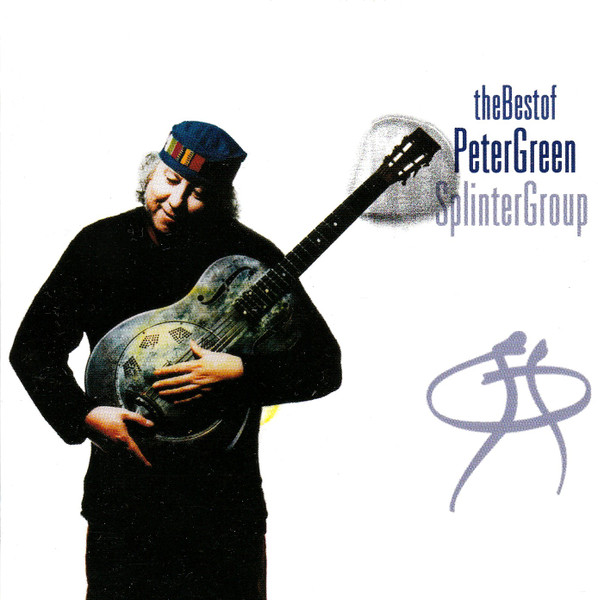
‘THE VERY BEST OF 
PETER GREEN SPLINTER GROUP’ 
by PETER GREEN SPLINTER GROUP 
(2012, Madfish SMACD987) 

Even if his adventures, and misadventures of the late-Sixties had never happened, Peter Green would still have written himself into Brit-Blues credibility with his series of eight Splinter Group albums and tours from 1997 through to 2003. As the curator of the Robert Johnson legacy he brings more than mere note-by-note replication to those seminal originals, he reinterprets them through his own bone-weary experience and battered soul, into contemporary demon-haunted relevance, singing and playing harp on “Steady Rollin’ Man”. This two-disc selection also includes two revisions of Peter’s tortured Fleetwood Mac originals – an abrasive rasp-voiced “The Green Manalishi” done live at his ‘Ronnie Scotts’ Soho Session, and an effectively understated instrumental “Man Of The World” that burnishes its sensitive beauty, plus the smoky Santana-esque samba “The Supernatural” from his John Mayall period. Plus Freddie King’s “The Stumble” with its long Peter Green association. New composition “Hiding In Shadows” even evokes the memory of “Albatross”. Guesting contributers include Paul Rodgers on “Sweet Home Chicago”, and Dr John, plus Otis Rush and the late Hubert Sumlin. There’s some gospel-flavouring from the Street Angels, and Peter’s “Underway” features some classy Snowy White guitar interplay. But Peter Green remains the solid centre of this fine album.  


‘BLUES DON’T CHANGE’ 
by PETER GREEN SPLINTER GROUP 
(2012, Eagle Records ER202622) 

Begun as part of Peter’s rehabilitation following his long post-Fleetwood Mac lost years, the Splinter Group is now very much a respected integral part of the Blues scene. Although recorded in 2001, this album was only previously available at gigs or through the ‘Splinter Group’ website. So this is its first proper release, and it’s worth the wait. The eleven tracks don’t stray too far from standard Blues repertoire – “Little Red Rooster”, “Crawlin’ King Snake” and a spooky “Honey Bee”, but done with such easy authority they emerge renewed as part of a living tradition. Peter started out with the Blues, it’s embedded in his DNA, with the sympathetic supporting structure provided by Nigel Watson (bass), drummer Larry Tolfree, Roger Cotton adding keyboards and the second guitar of Pete Stroud. There’s no striving for histrionics. It flows natural. Peter’s lived-in rasp says all that needs saying about living the Blues life. With minimal rehearsal, done ‘live’ and pretty-much spontaneous in the studio, drawing from their touring set, this is an object lesson in Blues, the genre that ever-evolves, and yet, essentially don’t change… 

Published in: 
‘R2 (ROCK ‘N’ REEL) Vol.2 No.35’ 
(UK – September 2012) 


‘ALONE WITH THE BLUES’ 
by PETER GREEN & 
THE ORIGINAL FLEETWOOD MAC 
(2015, Metro Select METRSL118) 

The music industry has not always treated Peter Green kindly. His natural unworldly quality has left him vulnerable to abuse and misuse from numerous unscrupulous agencies throughout his explosive rise, long decline and painful climb back into visibility. But his ability has never been in doubt. This 2CD 34-track anthology is no exception. Blues is Peter’s lodestone, the single constant that defines each life and career-phase. And although the track provenance is not always obvious, without scrupulous reference to Joel McIver’s liner-notes, it runs from early Brit-Blues “Long Grey Mare” lifted from Fleetwood Mac’s 1968 debut LP, woozy live versions of “Black Magic Woman” and no.1 single “Oh Well”, before sampling “Ride With Your Daddy Tonight” – his harmonica-driven contribution to the 1969 Brunning Sunflower Blues Band album ‘Trackside Blues’, plus session-outtake “Uranus”. The second phase is inaugurated by tracks from the 1979 ‘In The Skies’ set, with Snowy White and Peter Bardens on hand, through his neglected solo albums up to ‘A Case For The Blues’ (1985) with Vincent Crane and Ray Dorset. Stopping short of his relaunch with Splinter Group this set revisits familiar material, mixing it with lesser-known and rare tracks. Throughout, Peter’s ability has never been in doubt, no matter what company he’s found himself in. 

Published in: 
‘R2: ROCK ‘N’ REEL Vol.2 no.54’ 
(UK – November 2015)


Thursday, 29 September 2022

Poem: SHELF-LIFE


SHELF LIFE 
(For Stephen Singleton 
circa Vice Versa-Neutron Records)


This is 
post-modernist po/ 
etry designed for use in 
hypermarkets, offices, 
telephone answering services, 
air-terminals, in-car systems, 
and pedestrian precincts. 
Functional poetry with 
stylistic malleability, 
angle-poise connotations and 
audio-visual connectivity. 
Conceptual poetry that 
is its own medium, 
modified and attuned to taste. 
This is post-modernist po/ 
etry with the appliance 
of science. 
Ideologically unsound sound 
for limited attention spans. 
Post-modernism is a 
synthesis placed at the 
correct cultural nexus, and has 
interchangeable/ mix and match 
influence components. 
It is shrink-wrapped 
and date-stamped for 
an ideal shelf life 
of three and a half minutes. 
This is post-modernist 
environment-specific poetry 
for subliminal subversion. 
Soundtrack jingles for discord 
imprinted on/ symptoms of 
rapid eye movement. 
Retinal shadow-shows in 
hygienic cellophane packs, 
ready for use. 
This is post-modern po/ 
etry with a disposable 
bio-degradable 
shelf-life 
of the next 
three and a half minutes…


Published in: 
‘TEMPUS FUGIT no.8’ (Belgium – December 1988) 
‘WORKING TITLES no.2’ (UK – February 1990) 
plus my collection: 
‘POWER LINES’ 
(Unibird Publications) (UK – October 1988) 
on cassette: 
‘ULISES DOG NR.9’ (C60 Vec Audio) 
(Netherlands – July 1981) 
‘L.P.G no.2’ (UK – July 1981) 
my own cassette: 
‘SLITS IN AEROSOL GREEN’ (Eight Miles Higher) 
(UK – January 1981) 
and on: 
‘DIAL-A-POEM’ telephone service 
(8 August 1980, Liverpool) 
‘G.A.S. POETRY, ART AND MUSIC’ 
edited by Belinda Subraman 
(YouTube, 6 June 2020)


Wednesday, 28 September 2022

SHEFFIELD ELECTRO - THE BE-BOP OF ROCK


SHEFFIELD ELECTRO -

THE BE-BOP OF ROCK:
 
THE BIRTH OF A NEW COOL 


‘None of The Human League have any orthodox musical 
 training, but prefer to regard composition as an extension of 
 logic, inspiration and luck. Therefore, unlike conventional 
 musicians their influences are not so obvious’ 
(Fast Product Press Pack, June 1978)


Rock ‘n’ Roll was never intended to be about virtuosity. It was more a DIY Folk music. 

Skiffle was a 1950s fad championed by Lonnie Donegan, which ignited a thousand ad-hoc austerity groups repurposing household items – a washboard, an old tea-chest impaled with a broom-handle and tension-strung to create a stand-up bass, and maybe a couple of battered acoustic guitars played with more energy than technique. Two decades later Sheffield created a new kind of Electronic Skiffle. 

Why Sheffield? 

The M1 slip-road 34 takes you into the small South Yorkshire industrial city, but with a greater music tradition than that description would imply. We could start with Wurlitzer organist Reginald Dixon, famous for his radio broadcasts from the Blackpool Tower Ballroom. But we probably won’t. Instead we’ll begin in the Beat Boom era with Dave Berry, his distinctive creepy stage persona and hits that included ‘The Crying Game’, his cover of Bobby Goldsboro’s ‘Little Things’ and the Ray Davies-penned ‘This Strange Effect’. Dave was born in Woodhouse, to the south-east of Sheffield in February 1941. Then there’s Joe Cocker who took the Woodstock Festival by storm with his anguished take on Ringo’s modest singalong ‘With A Little Help From My Friends’. He was born at 38 Tasker Road in the Crookes suburb of Sheffield in May 1944. Tony Christie might have been born in nearby Conisbrough, but his long association with the steel city includes his 2008 ‘Made In Sheffield’ album, produced by Richard Hawley with contributions from Alex Turner and Jarvis Cocker.


Of course there’s Def Leppard, jazz guitarist Derek Bailey, singer Paul Carrack, jazz drummer Tony Oxley, Pulp, Arctic Monkeys and beyond. But this book is largely centred around the cluster of electro-musicians who were feeling their way through the 1970s, to upsurge into the 1980s as the ‘soundtrack for the second industrial revolution: 45 and 33-&-a-third rpm.’ 

The first time I visited Sheffield, where now there is the labyrinthine Meadowhall temple to opulent consumerism, there were still foundries you could smell in the air and that shook the street beneath your feet, ‘like a metronome, like a heartbeat for the whole city’ according to Ian Craig Marsh. ‘We all come from pretty strong working-class backgrounds’ Ian told me, ‘my Dad’s a bricklayer and my Mum used to work at Bassett’s Liquorice Allsorts Factory. My Grandfather got burned clear down his right side when he was splashed with molten steel at a steel works!’ De-industrialisation left abandoned factory units to colonise as rehearsal rooms and studio space for insurrectionary anti-musicians who ‘discarded natural sound source in favour of synthetic instrumentation because of its convenience, mobility and vast source of, as yet, untapped potential’ (the Vice Versa manifesto). 


And there was cheap front-room technology easily adaptable, Skiffle-style, sufficient to bend to purpose. Original – in the sense of not using drums, which were just too tedious to learn, and guitars which were considered obsolete. ‘We wanted to sound like a proper Pop group, but we were not prepared to put in the five or six years that it would have taken to learn a traditional instrument’ explained Philip Oakey. The non-Sheffield Nick Rhodes of Duran Duran described his discovery of synths as ‘this is a new planet that I could live on.’ And yes, that’s how it was. 

It was a time of dense-black Xeroxed fanzines, Sheffield had its own ‘GunRubber’ produced since February 1977 by Paul Bower and Adi Newton, as well as ‘Modern Drugs’ from Martin Fry, ‘NMX’ from Martin Russian and the photocopied ‘Steve’s Paper’ from Stephen Singleton, all documenting the burgeoning local music scene, centred around Cabaret Voltaire and The Future. And the cassette-underground where, for the first time, bands and musicians as well as poets could use their bedrooms to home-record their own experimental sounds, then cheaply reproduce and circulate limited edition C30s or C60s among a proto-internet of linked like-minded activists. It was ignited by the Punk energy and ethos that anyone could get up and do it. It was new. It was exciting, combining the dissident samizdat self-publishing spirit of insurgency with mischievously incendiary early-Dada art-confrontational energies supercharged by the relentlessly dark cut-up strategies of Beat-Generation writer William S. Burroughs and his SF New Wave disciple J.G. Ballard. Each bubblepack package that arrived in the morning mail was ripped open up to reveal new bulletins from the innovative edge of luring and sometimes-scary tomorrows. ‘NME’ carried its own weekly review-column with the addesses of more DIY weirdnesses a mere postal order away.


The first experimental synthesizer system had been devised in 1955 by RCA, but it was a certain Dr Robert Moog who gave his name to the cheaper more marketable modular version that began to infiltrate awareness during the late-sixties, as demonstrated on the first entirely-synthesized ‘Switched On Bach’ (1968) album by Walter – later Wendy Carlos, followed by ‘The Well-Tempered Synthesizer’ a year later. Martyn Ware recalled hearing Carlos on the Clockwork Orange (1971) soundtrack. Heaven 17 would take their name from the same movie.


Bands such as The Byrds, The Pink Floyd, The Moody Blues and others began to dabble in the effects that electronics could produce, with Terry Riley, Tonto’s Expanding Headband and The United States Of America taking it incrementally further, nodding to John Cage as a kind of spiritual godfather. The cosmic synth genre was an extension of the psychedelic ‘music to take trips by’ drug culture, an avant-garde trance deployment of otherworldly textures. Then, incorporated into banks of keyboards, the synthesizer became an exotic embellishment to the assault arsenal employed by virtuoso Prog-Rock musicians. Synths were bulky, heavy, fragile and temperamental, utilising voltage-controlled oscillators and related devices that respond to room-humidity and temperature. Heat changes from the lighting-rig could affect tunings. A Moog required a two-hour warming-up period. 


While in Germany Tangerine Dream, Neu and Kraftwerk were not only adapting and developing their own rhythmic variations but were inventing new ones through the use of sequencers. Kraftwerk – ‘the most important group of the century’ according to Philip Oakey, compressed eccentrically catchy musical ideas into the appropriately stimulating shape of wires, programmes, images, trackers, scanners, impulses and screens. 

Championed by DJ John Peel, Tangerine Dream grew out of the Berlin Zodiak Free Arts Lab, where they evolved the hypnotic pulsations of their LP ‘Phaedra’ (1974), a first charting album for them as well as for Virgin Records. Abstract solo albums by Klaus Schulze and Tangerine Dream’s Edgar Froese dissolved into sound-pixels which absorbed the listener into a Rorschach eyelid-movie of aural fantasia. The 1976 success of ‘Oxygène’ took Jean-Michel Jarre as close as Space music could get to conventional Pop, with brisk programmed percussion and melodic synth-lines that made it both accessible and relentlessly catchy. Yet it was closer to soporific mood-music, conjuring an aid-to-getting-high mindscreen for recumbent sofa-surfers. To gonzo journalist Lester Bangs ‘the men at the keyboards send out sonar blips through the congealing air… three technological monoliths emitting urps, hissings, pings and swooshings in the dark’ (in his ‘Psychotic Reactions And Carburetor Dung’, Serpents Tail, 1987).


In Sheffield it was different. ‘We didn’t need to spend a lot of money to be creative’ said Martyn. The Sheffield answer was to leap obliquely into exploratory voyages to uncharted areas of electronic experiment, sidestepping both conventional musical standards and accepted modes of Rock celebrity. It was innovation inspired by the can-do attitude of Punk, and the art-school Bowie cool. On one side of town was Cabaret Voltaire, on the other there was The Future, a ‘more adventurous but less commercial’ version of The Human League which cannibalised Ian Craig Marsh and Martyn Ware alongside Adi Newton – who operated tape machine-loops and treatments and was destined to form the excellent but much undervalued Clock DVA. 

If there was a pre-existing language, Kraftwerk had utilized tape-loops, while Holger Czukay used random bursts of short-wave radio interference for his work with Can. Cabaret Voltaire began in trainee telephone-engineer Chris Watson’s attic, inspired by a brief eighty-page book called ‘Composing With Tape Recorders: Musique Concrète For Beginners’ by Terence Dwyer (1971, Oxford University Press). So first Chris – then Chris in cahoots with Richard H Kirk, played collage sound-games with reel-to-reel tape recorders, speeded-up, slowed-down, spliced and looped, adding a Farfisa drum-machine with rudimentary mail-order ring-modulator signal processing patched together by Chris – no keyboard, just knobs to twiddle and tweak. ‘I was never a musician’ Chris explained, ‘I had no interest in playing a musical instrument. I had no interest in that sort of discipline. I just wanted to make some noise… we didn’t really know what we were doing, but we knew we wanted to do it!’ 


Later the acquisition of an EMS Synthi AKS titled no less than three tracks on their ‘Methodology ’74-’78: Attic Tapes’ (Industrial Records, 1980, expanded for Mute Records, 2002). Where Cabaret Voltaire are concerned, definition remained nebulous. How to classify a 01:10-minute ‘Jet Passing Over’ which is simply a doubled electronic sound-replication of aeroplane jets in the sky, phasey, like a radio tuning itself in and out of focus? Or ‘Jack Stereo Unit’ which is a confusion of conflicting speech, ‘Treated Guitar’ is splodge-sounds, at least the 01:47 ‘Sad Synth’ recognizably utilizes a synthesizer, while the 39-second ‘Space Patrol’ uses cheap TV Sci-Fi effects in the way that The Future would. These were what Chris Watson described as the ‘new-found freedoms.’


Adding Stephen Mallinder’s bass guitar, their first gig was a ‘Science For People’ Student Disco at the University Upper Refectory on Tuesday 13 May 1975, percussion consisted of a tape-loop recording of a steam-hammer – recorded by Chris in Belgium, while Richard improvised on clarinet while bedecked in flashing Xmas-tree lights. Needless to say, reception was not even mixed – it was hostile, resulting in Mallinder’s trip to the A&E department as a consequence of a fracas with the unruly and unappreciative audience. But if there has to be a date for the Big Bang ignition of Sheffield Electro, this is it. The E=MC2 moment. Martyn Ware and Ian Craig Marsh were taking note.


Lest we forget, there was still a Soviet Union and a Cold War going on, the world seemed breathlessly paused on the brink of mutual assured destruction. But if the crack of doom wasn’t to be heard on some hydrogen jukebox, it just might uncoil from that next C60 in the mail. 

What semantic references, mythological splendours and glittering epithets can be attached to The Human League? Their career was lived forwards, but must be understood backwards, from today back to then. An exercise in de-structuring images and image-making. But all that’s really essential to know is that The Human League brought Pop from the age of the Flintstones to the age of the Jetsons virtually overnight. This is my chance to set history straight, for they were as original as the solar system. 

Sheffield is a small city, and isolated from what was happening in London. In the same way that Liverpool had been isolated from the fads and fashions of the Southern-based music biz in 1963… and by the end of the 1970s simple Casio synths were as cheap and easily-available as guitars...


This is the ‘Introduction’ of my book:
‘ON TRACK... HUMAN LEAGUE &
THE SHEFFIELD ELECTRO SCENE,
EVERY ALBUM, EVERY SONG’

(SonicBond Publishing, 2022)

Monday, 26 September 2022

Songs From The Movie: 'ELECTRIC DREAMS'


ELECTRIC DREAMS

 
Electric Dreams (Soundtrack) 
by Various Artists 
Released: July 1984 
Virgin Records V2318, Epic SE 39600 
Running time: 34:25 USA and Europe CD, 
cassette and LP edited version, 50:28 Europe CD, 
cassette and LP extended edition (as duration in brackets) 
Highest UK chart position: 46 


The Science Fiction had always been there. The high-profile visuals were an obvious add-on. So involvement with a movie was inevitable. Released 20 July 1984 by Virgin Films, ‘Electric Dreams’ was a light fluffy romantic Sci-Fi comedy featuring bespectacled Lenny Von Dohlen as young work-obsessed architect ‘Miles’, and Virginia Madsen as cello-player ‘Madeline’ who moved into the upstairs flat, plus Maxwell Caulfield (as Bill) and a computer called ‘Edgar’ voiced by Bud Cort. Bip-bip-bip-PRINT, it develops into a fairy-tale love-triangle between man, woman and computer. After all, computers were new – weren’t they? They were what was happening, albeit years after William Gibson had coined the term ‘cyberspace’ in his 1982 short story ‘Burning Chrome’. ‘Back in the old days before computers roamed the Earth, people used to learn things by reading words on a page’ recalled an Apple Macintosh Performa advert from 1994. 

The first feature film by Pop-promo director Steve Barron, it was not a great movie, but it has goodies on offer. The video effects that reveal Edgar’s cybernetic thought processes, the champagne poured into Edgar when he overloads – and the fascinating visual effects that ensue as the bubbly soaks into his printed circuits and chips, and the film was rescued by the way the strong soundtrack is woven into the story. It performed even better when it transferred to VHS home-video aided by public familiarity with the songs! Steve Barron went on to direct ‘Teenage Mutant Ninja Turtles’ (1990). 


‘Together In Electric Dreams’ 
by Philip Oakey & Giorgio Moroder 
(Philip Oakey & Giorgio Moroder) 
3:52 on US edition (5:18 European edition) 
Written primarily by German disco-supremo Moroder with no particular vocalist in mind, it was the film director Steve Barron – who’d shot the high-gloss video for ‘Don’t You Want Me’, who suggested Oakey. And no-one refuses a collaboration invitation from the man who’d masterminded Donna Summer’s ‘Love To Love You Baby’. Not Oakey, that’s for sure. ‘All we ever wanted was to sound like Donna Summer. She was our ideal’ he told ‘Sounds’ (10 August 1985). After the first recording Moroder told Philip that the first take was ‘good enough, as first time is always best.’ However, Oakey, who’d considered it just a rehearsal run-through, insisted on doing a second take. Although Moroder agreed, Oakey subsequently said he believes Moroder still used the first take. Synths fall like silver around a perfect Dance-Pop confection, with Philip’s voice matched to Moroder’s song-construction in a marriage made in electric heaven. Philip even wears a ‘You Have Been Judged’ Judge Dredd ‘2000AD’ T-shirt in the mini-movie promo-video, as if further proof were needed. 

Issued as a spin-off single following the perceived failure of Human League’s ‘Life On Your Own’, this peaked at number 3 on the UK chart 27 October 1984 (Virgin VS 713) – although it got no higher than number 4 on the rival NME chart, beneath Wham!’s definitive anthem ‘Freedom’. The success of ‘Electric Dreams’ encouraged Virgin to chance a third track from ‘Hysteria’, hence ‘Louise’. 


‘Video’ 
by Jeff Lynne (Jeff Lynne) 3:24 (4:53) 
Jeff Lynne started out with the Birmingham sixties no-hoper group The Idle Race, before joining Roy Wood in the The Move with whom he hatched the blueprint for The Electric Light Orchestra. He took time out – before joining The Traveling Wilburys supergroup, for this catchy excursion into programmed drumbeats, about ‘the satellites that search the night that twinkle like a star’ and slyly sneaks the ‘together in electric dreams’ line into the lyric. 

‘The Dream’ by Culture Club 
(George O’Dowd, Mikey Craig, Roy Hay, Jon Moss) 
2:28 (3:16) 
When The Human League headed what was termed ‘the second British invasion’ of the American charts, the flamboyant Boy George with Culture Club was just as high-profile. This brief track finds them in a slower, sensitive and more decorative mood with an Alice-In-Wonderland lyric. It was later remastered as a bonus track on the 2003 CD edition of the Culture Club album ‘Waking Up With The House On Fire’ (Virgin, October 1984). 

‘The Duel’ by Giorgio Moroder 
(Giorgio Moroder based on ‘Minuet In G Major’ by 
Christian Petzold, formerly attributed to Johann Sebastian Bach) 
3:47 (5:40) 
In the movie, cellist Madeline is rehearsing this piece in her apartment when she’s overheard through the ventilation grille by computer ‘Edgar’, which then improvises its own electric variation. Madeline assumes that she’s playing this duet with Miles Harding, who – due to a mixture of bumble and dishonesty, does not disabuse her, and passes off a love song devised by computer. 
The same tune was lifted for The Toys 1965 hit single ‘A Lover’s Concerto’. 

‘Now You’re Mine’ by Helen Terry 
(Helen St John, Rusty Lemonade) 4:05 (5:20) 
The excoriating voice you hear on Culture Club’s hit ‘Church Of The Poison Mind’ belongs to Helen Terry, an immensely powerful vocalist in the Alison Moyet mould, who wrote the sixties Girl-Group styled ‘Now You’re Mine’ with the pseudonymous Giorgio Moroder, who supplied the eighties add-ons. It also cunningly incorporates the line ‘before my world was feeling the power of the special touch that all electric dreams are made of.’ Although this track was later added as a bonus to the ‘Special Edition’ of her only album ‘Blue Notes’ (1986) she subsequently preferred to play a backroom role within the media industry. 

‘Love Is Love’ by Culture Club 
(George O’Dowd, Mikey Craig, Roy Hay, Jon Moss) 
3:50 (5:53) 
Given the big power-ballad treatment with sweet wah-wah embellishments, the positive message of a non-gender-specific all-embracing force of universal love resonates above and beyond the limitations of the song’s uncomplicated structure, Boy George’s voice – as ever, pours as nourishingly unique and precious as royal jelly.


‘Chase Runner’ by Heaven 17 
(Ian Craig Marsh, Martyn Ware, Glenn Gregory) 
3:00 (4:53 for extended edition) 
This is a movie that inadvertently reunites the two separate feuding strands of The Human League Mark 1 onto the same soundtrack album, although the Heaven 17 contingent contribute a high-energy track that is restyled as ‘Counterforce II’ on the B-side of their ‘Sunset Now’ single. It’s an instrumental that actually sounds like the theme-tune for an action movie incorporating high-speed car chase samples, with the thin-pitched whistleable tune gliding and curling over choppy percussive rhythms. 

‘Let It Run’ by Jeff Lynne 
(Jeff Lynne) 3:22 (5:37) 
With a slow gradual fade-in leading into thrashing guitars and rocking keyboards, this is a Jeff Lynne track with the most obvious Electric Light Orchestra sound, betraying more than a passing resemblance to their ‘Don’t Bring Me Down’ hit, although there are spliced-in breaks for a manic Caribbean skank followed by a solid Rock guitar solo – if this is the Rockism that Human League were kicking against, with lyric name-checks for ‘Johnny B Goode’ and ‘Long Tall Sally’, it still makes you get up and boogie. 


‘Madeline’s Theme’ by Giorgio Moroder 
(Giorgio Moroder) 2:17 (2:48) 
A companion-piece to ‘The Duel’ this sensitive and touching instrumental takes the synthesizer into territory where it had rarely ventured before, using the cello-setting as key to a simulated string quartet, back to Bach for its bitter-sweet computer-expression of what this thing called love is all about, as soft as a teardrop falling on a silicon chip.


‘Electric Dreams’ by P.P. Arnold 
(George O’Dowd and Roy Hay) 4:20 (6:50) 
Pat ‘P.P.’ Arnold first came to London with Ike & Tina Turner’s touring band, as part of the Ikettes. She hooked up with Andrew Loog Oldham who produced her version of the Cat Steven’s song ‘The First Cut Is The Deepest’ which became an instant hit single for the Immediate label. She duetted with the Small Faces on their magnificent ‘Tin Soldier’ hit, and went on to enjoy a high-profile voice-for-hire career as a solo artist, a studio voice and a collaborator on multiple projects. 

Written by the Culture Club duo of Boy George and Roy Hay, here she emotes ‘tell me boy, do you have room in your heart, for the computer boom?’ with full Soul-deep emotional intensity, as Peter Frampton donates a stinging guitar solo. Pat Arnold went further Electro when she returned to the charts as vocalist on the Beatmasters number 14 hit ‘Burn It Up’ (October 1988), and up to number 6 in 1992 with techno duo Altern-8’s ‘Evapor 8’. P.P. Arnold can do no wrong.


This is a chapter editorially deleted from my book
as being outside the core scope of the subject, from:
‘ON TRACK... HUMAN LEAGUE
& THE SHEFFIELD ELECTRO SCENE, 
EVERY ALBUM, EVERY SONG’
(SonicBond Publishing, 2022)

Saturday, 24 September 2022

Sci-Fi Horror Movie: 'DOOMSDAY'


‘DOOMSDAY’:
 
ANATOMY OF CATASTROPHE 


Review of: 
‘DOOMSDAY’ (2008), Universal Pictures 
Produced by Benedict Carver & Steven Paul 
Directed and written by Neil Marshall. 
With Rhona Mitra, Bob Hoskins, Adrian Lester, 
David O’Hara, Malcolm McDowell


It begins ‘like so many epidemics before…’ with cells dividing. ‘It doesn’t hate or even care, it just happens.’ 

In the future Glasgow of 3 April 2008. ‘The Scotland’ newspaper headlines blare ‘Mystery Virus Kills Hundreds In Days’. 

We’ve been here before. SF has inflicted exterminating plagues on humans since its very earliest manifestations. There’s a convincing argument that Mary Shelley invented the genre with her ‘Frankenstein, or The Modern Prometheus’ (1818), she followed it with ‘The Last Man’ (1826) in which, first late-twenty-first century Europe, then the world is ravaged to near-extinction by a mysterious plague. Movies have dealt with contagions and epidemics more frequently than you’d imagine. ‘World War Z’ (2013) uses the zombie metaphor in which Jerusalem is quarantined within its walls, and yet is overrun. Just as the jaded aristocrats of Roger Corman’s Edgar Allan Poe-derived ‘The Masque Of The Red Death’ (1964) cavort within the illusory safety of their stronghold amid a plague-stricken countryside. Then the mid-credits graphic sequence in ‘The Rise Of The Planet Of The Apes’ (2011) shows how the ‘Simian Flu’ pandemic travels and branches around the globe in a matter of hours. On an increasingly integrated planet with mass migrations happening on a daily basis this is less a probability simulation as it is a real-life projection. 

This is more real than you’d think. In living memory society has withstood the assault of HIV (Aids), Ebola, the SARS virus, Influenza A H1N1-2009, as well as the Corona virus Covid-19. In some ways, terrible as they have been, governments have managed them through persuasion, consensus and information rather than imposed repressions. There have been voluntary, rather that totalitarian Lockdowns, despite whatever the Conspiracy Theorists might claim. Although critically mauled as derivative and commercially underperforming at the box-office, ‘Doomsday’ effectively captures the madness and skin-crawling desperation of Britain collapsing into chaotic disorder as the horrifically grim ‘Reaper virus’ rips unchecked through the populace. 

The writer-director Neil Marshall had already made his big-screen directorial debut in a spectacular fashion with ‘Dog Soldiers’ (2002), a highly visceral nerve-scraping group-jeopardy movie in which a squad of soldiers led by Sergeant Harry G Wells (HG Wells!, played by Sean Pertwee) are under constant attack in the Scottish Highlands from a werewolf pack. Pertwee, with Emma Cleasby, Chris Robson, Craig Conway and Darren Morfitt will all transition into the ‘Doomsday’ cast. Another unorthodox horror venture – ‘The Descent’ (2005) takes a group of six women into a cave system where they struggle to survive against troglodyte flesh-eating Crawlers. Craig Conway and MyAnna Buring (who is Sam) will be carried over into the next project, which is ‘Doomsday’.


The England-Scotland border is closed soon after the outbreak begins, 9:17pm 20 June. The national separation the SNP agitate for is achieved overnight, although hardly in a way Nicola Sturgeon would have wanted. The 1707 Act of Union is severed, with Scotland placed under quarantine. Trump’s Shining Wall is erected along the contours defined by Roman Emperor Hadrian two thousand years earlier, but this is a thirty-foot high armour-plated monolithic structure with lethal automated defences, stretching from sea to shining sea. During the film’s opening sequence, fleeing victims are machine-gunned, a soldier is mob-attacked in a retaliatory riot. A mother (Emma Cleasby) shields her wounded daughter (Christine Tomlinson) behind their abandoned car, then forces the child onto a military helicopter as it lifts off towards England, as the gates close – on someone’s hand!, and primal savagery consumes north of the wall. 

The second sequence leaps forward to London, 2035, which is NOW! 

The girl has become Eden Sinclair of the Department of Domestic Security, who uses the pop-out electronic-eye implant that is the legacy of her escape from Scotland, in a bloody shoot-out to bust a people-trafficking gang. But she also has the buff envelope her mother gave her, bearing her distant home address. She’s convincingly played by Rhona Mitra with all the female-centric resourcefulness shown by the cast of ‘The Descent’. Rhona had already played support parts in movies such as ‘Hollow Man’ (2000), a spin on ‘The Invisible Man’ theme in which she’s raped by an invisible Kevin Bacon. And she’s Rachel Talbot in ‘Skinwalkers’ (2006), a widowed mother in the midst of a werewolf community. She easily and confidently assumes the action role of the team-leader with an electric eye, all of which naturally leads to her role in ‘Underworld: Rise Of The Lycans’ (2009) as vampiric Sonja. Eden’s movie mentor is Bill Nelson (Bob Hoskins very much playing Bob Hoskins), who is summoned to a National Emergency briefing with a ‘bloody hell, George, what’s got your knickers in a twist?’


An isolated pariah state, England teeters on the brink of economic and social collapse, and when diseased derelicts are discovered in the Whitechapel ‘Urban Containment Facility’, vacillating Prime Minister John Hatcher (Alexander Siddig, ‘Dr Julian Bashir’ of ‘Star Trek: Deep Space Nine’) is forced to consider the contingency plan of diverting a Climate Change canal-system to flood inner London. The conniving manipulating Michael Canaris (David O’Hara) prompts him, ‘we are at war, Prime Minister.’ It’s similar terrain to Danny Boyle’s ‘28 Days Later’ (2002) in which the ‘Rage’ virus is unleashed when an infected chimpanzee is liberated from a Cambridge laboratory by Animal Rights activists. But even more resembling its sequel – ‘28 Weeks Later’ (2007) in which NATO forces set up an Isle of Dogs ‘Safe Zone’ with a defensive exclusion perimeter guarded by lethal force. But it’s not difficult to draw parallels with the found-footage movie ‘Quarantine’ (2008), with mutated rabies – and its sequels, or ‘Contagion’ (2011) with its ‘Mev-1’ virus. All play on the jittery flesh-horror fear of infection. 

Hatcher is offered a lifeline when satellite pictures show people on the streets of Glasgow. If there are survivors, there must be a degree of immunity, and a possible cure? The Bob Hoskins character tasks Eden with heading a secret mission into Scotland, to seek out researcher Dr Marcus Kane (Malcolm McDowell), who was working to devise a cure before the north-south divide quarantine was imposed. ‘If it’s there, I’ll find it’ she says. She’s helicoptered to the security wall where two armoured cars are ready equipped for the trip, she’s told that ‘they move like shit off a shovel!’ The gates are unsealed, then soldered shut again once they’ve passed through into the desolation of wrecked cars beyond, with skeletal passengers. Glasgow is darkly overgrown, and St Andrew’s Hospital is littered with skulls.


They emerge from the car wearing biohazard suits, and she uses her detachable eye to look inside, hunting ‘evidence of Kane’s work.’ Meanwhile an ailing girl is given sanctuary in the second armoured car, but as the car is attacked by a hail of Molotov cocktails the girl ‘recovers’ and slits the driver’s throat. And Eden’s team come under sustained attack from hordes of Scots barbarians – a cross between Punk Braveheart and Mad Max, answering with bursts of machinegun fire as they retreat. Escaping in the second car the girl driver is hit in the throat by a crossbow bolt and the car overturns. Under relentless attack Eden escapes on foot, but is surrounded. 

She’s tortured in a cell, suspended from the ceiling while brutally pummelled by the Punk-Mohican’d Sol (Craig Conway) and tormented by the tattooed Viper (Lee-Anne Liebenberg). A gimp is chained in the corner. A hideous array of torture devices are wheeled into the cell. He bites her face. ‘If Kane is alive, I need to find him’ she tells him by way of explanation. He has other plans, ‘you are our passport to the Promised Land’ he gloats, seeing her as an escape route into forbidden England. Dr Talbot (Sean Pertwee), the team’s medical scientist, has also been captured. Only Sergeant Norton (Adrian Lester) and Dr Stirling (Darren Morfitt) are still at liberty.

 
The movie centrepiece is the grotesque cannibalistic orgy, off-the-scale ultraviolence, a flame-thrower Rock show Disco spectacular, a pole-dancing motorcycle Hieronymus Bosch vision of hell. ‘The wind of change is blowing a hurricane’ Sol yells through the amp-system to a soundtrack of Adam & The Ants (“Dog Eat Dog”), Fine Young Cannibals (sic), and a grotesque tartan can-can Bad Manners. ‘This is OUR city’ he rabble-rouses as the unfortunate Dr Talbot is suspended over a vat labelled ‘RARE, MED, KRISPY’ and lowered into the sea of flames that Viper ignites as dishes are thrown out to the mob and Sol crown-surfs. Viper beheads Talbot’s crisped corpse and carves it into edible portions. 

While Eden contrives to escape, pausing at the next cell where a woman pleads that she is Kane’s daughter, ‘I can help you find him.’ Sol, it turns out, is also Kane’s insurgent son. Viper blocks their way out, Eden fights with a calculated desperation, and beheads her. Together the two fugitives head through the streets towards the rail-station, while Sol leads a Mad Max techno-savagery pursuit, riding motorcycles with skeletons strapped to the front, and a coach graffitied ‘Out Of Fucking Service’. Norton and Stirling have a steam-locomotive readied on Platform Four where it says ‘Welcome To Glasgow. 

The next sequence takes the fugitive group out across wild Scottish countryside, leaving the train and walking strung-out beneath broken powerlines. They reach, and pass through the ‘Ben Crannich Archive’, which is a subterranean Fall-Out shelter stronghold, and out the other side into an idyllic glen, only to be confronted by the bizarre visitation of a medieval knight on horseback. This is Kane’s executioner. Eden demands ‘we want to see Kane,’ and allows the party to be rounded up and taken cross-country roped behind horses, past a row of impaled corpses to an ancient castle – once a tourist attraction complete with ‘Gift Shop’, now the seat of Kane’s own private fiefdom, ‘out of sight, out of mind.’ Kane is the brooding Malcolm McDowell at his most malignant, the beautifully insolent ‘Michael Travis’ of ‘If’ (1968), and the evil Droog antihero of Stanley Kubrick’s ‘A Clockwork Orange’ (1971). When he returned as the more adult ‘Tolian Soran’ in ‘Star Trek Generations’ (1994) he carries over the same charismatic malevolence that he invests in the Kane character. He tells them ‘there is no cure. There never was.’ That the survivors prevailed not through science, but by natural selection. ‘In the land of the infected, the immune is king.’ And he has no sympathy for what is happening south of the wall, ‘they started this fire. They can burn in it!’ 

‘Same shit. Different era’ Eden tells Kane defiantly, as they are imprisoned.


A flashback to London shows the worsening ‘Hot Zone’ crisis, as barbarism breaks out live from Dean Street, and Tower Bridge is barricaded. When an infected victim breaks into the Prime Minister’s compound, Hoskins shoots him, but Siddig’s PM John Hatcher, spattered by tainted blood, retires to his office and shoots himself in the head before the symptoms have time to erupt. 

Meanwhile, Eden is released into an arena combat zone against the knight. As, drowned by the sound of cheering jeering crowds, the others escape. After prolonged uneven combat she seizes an axe from a guard and kills the knight by bloodily stoving his head in. They reach the horses and make good their escape as a disconsolate Shakespearian McDowell watches from the battlements. Heading back through the archive Eden finds a radio to alert London, and they also – testing the limits of credulity, locate a fully-functional Bentley Continental GT sealed into a packing case. But Norton (Adrian Lester) is peppered with arrows by Kane’s vengeful pursuers as he fights a rear-guard action. 

In London, Hoskins picks up her mobile call. ‘Trace the source’ says Michael Canaris, assuming the powers of the conveniently deceased Prime Minister. 

Again, there are Mad Max overtones as the Bentley is pursued by the full Glasgow wrecking crew in a Police Car labelled ‘Bastard’ and Venom’s severed head impaled beside Sol, all choreographed to Frankie Goes To Hollywood’s “Two Tribes (Carnage Mix)”. There are hair-raising chase sequences, and ferocious eye-gauging combat as Sol leaps into the high-speed fleeing car. The gimp crashes and burns. Sol is killed as they smash through the coach… and the rescue helicopter touches down to retrieve them.


There is no cure to the ‘Reaper virus’, but Michael Canaris indicates Cally, Kane’s fugitive daughter, and says ‘we can use her blood to make a vaccine,’ with all manner of implications of unpleasant medical procedures. Eden opts to stay in Scotland, and accelerates the Bentley back to use the address on the buff envelope to locate her family home, and photos of her mother. 

Hoskins is there too, ‘I used to be a policeman, once.’ She gives him a disc of evidence to incriminate Canaris, recorded from her pop-out electronic-eye implant during their meeting. Later, the disc is shown being screened on TV, presumably destroying his fascistic leadership. 

‘Drive careful. Be lucky’ Hoskins tells Eden as he leaves her in Glasgow. 

The movie closes as she confronts the mob, and provocatively tosses Sol’s head at them. ‘If you’re hungry, try a piece of your friend.’ In the combative struggle, this is her gambit as their next leader 

Yes, it’s a flawed and derivative movie, but its’ insane ride does exert a grotesque fascination that captures something of the madness and skin-crawling panic of civilisation collapsing into chaotic disorder as lethal virus rips unchecked through the populace. And yes, we wore our Covid-masks and observed social distancing, and yes, people died and we feel their loss, but it could be said that – as a global society, we’ve been fortunate… so far! 


SURVIVE THIS! 

‘DOOMSDAY’ (2008), Universal Pictures through Rogue Pictures, Crystal Sky Pictures, Intrepid Pictures, Scion Films. Produced by Benedict Carver & Steven Paul. Directed and written by Neil Marshall. With Rhona Mitra (as Eden Sinclair), Bob Hoskins (as Bill Nelson), David O’Hara (as Michael Canaris), Malcolm McDowell (as Marcus Kane), Alexander Siddig (as PM John Hatcher), Adrian Lester (as Sergeant Norton), Craig Conway (as Sol), Lee-Anne Liebenberg (as Viper), Chris Robson (as Miller, part of Eden’s team), Leslie Simpson (as ‘Les Simpson’, Carpenter, part of Eden’s team), Sean Pertwee (Dr Talbot, the team’s medical scientist), Darren Morfitt (as Dr Stirling, the team’s medical scientist), MyAnna Buring (as Cally, Kane’s daughter), Emma Cleasby (Eden’s mother in the opening sequence), Christine Tomlinson (young Eden in the opening sequence). 108-minutes. 
Universal DVD 825-403-2-11, with bonus features ‘Anatomy Of Catastrophe: Civilization On The Brink’ (127:24), ‘The Visual Effects & Wizardry Of Doomsday’ (8:26), ‘Devices Of Death: Guns, Gargets & Vehicle’s Of Destruction’ (20:24), Feature commentaries with Neil Marshall, Sean Pertwee, Darren Morfitt, Rick Warden (who plays Chandler), and Les Simpson.