Tuesday, 25 November 2014

BILL NELSON: Album History


‘WOW! IT’S SCOOTERCAR SEXKITTEN…!’ 

 Album review of: 
‘AFTER THE SATELLITE SINGS’ 
by BILL NELSON 
(1995, Resurgence RES-114-CD) 

Everything But The Girl go Jungle, so why not Bill Nelson? After all, he’s been here already. He was low-fi hi-tech as long ago as “Do You Dream In Colour”, Indie before there was a name for it.

Trouble is, he plays a fantasi-Cola of three impossible styles before breakfast, programmes plastic tape-recorder and wind-up gramophone, then takes a song idea on a trip around the studio like a ‘dog on an infinite leash.’ For Bill, it’s all just sonic food for inspired noise. Which all makes ‘After The Satellite Sings’ probably too dense for dance. Virtuosity isn’t cool. All you need, after all, is three chords and the truth. And Bill Nelson flaunts his guitar skills in fluid witty snatches, a soft Bo Diddley shuffle feeds onto “Skull Baby Cluster”, a brief Eddie Cochran jolt for “Wow! It’s Scootercar Sexkitten”, then a metal screech play-in to the inspired “Ordinary Idiots”. They all blend in with fleeting Be-Bop horns and jazzy fingering on the exquisite “Flipside” The ambient spaciness of “V-Ghost” follows as a casually immaculate afterthought.

Nelson’s Art-On-Your-Sleeve lyrics, which provide walk-on’s for Jean Cocteau, Jack Kerouac and William Blake are also suspect, right? Oasis thefts from John Lennon or Burt Bacharach, or Blur’s Kinks-Smallfaces lifts are alright. But record buyers and dancers can’t possibly relate to strange French movies, Beat Generation novelists or loopy nineteenth-century visionaries, can they? Isn’t such a limiting attitude even more patronizing?

This album is a Sunburst Finish of avant-Jungle with lyrics like fibre-optic scans of his intestines. If you say David Bowie, then it’s way beyond Bowie’s latest. It draws and blends from each phase of Nelson’s complex career structure, while accelerating the BPM. He adds guitar blasts from Be-Bop Deluxe to manic samples that recall his experimental Red Noise phase, and dedicates it all ‘to the Angelic Presence of Jack Kerouac’ – ‘wither thou goest America, in thy shiny car in the night…’ He feeds on massive reserves of word-power with richly compacted lyrics that have a fastidiously mannered playfulness, a texture and structure, a clarity and precision entirely their own.

Bill Nelson still dreams in colour, dreams of “Beautiful Nudes”, “Phantom Sedan” or “Dreamster 2LR”. And if this kind of virtuosity and intelligence is suspect, then that’s everyone’s loss.


BILL NELSON: 
VINYL FILE – THE FIRST DECADE 

1948 – Bill Nelson, born 18 December in Wakefield, West Yorkshire. A Sagittarius like Jimi Hendrix

1964 – studies at Wakefield College of Art, during various adventures in the Yorkshire landscape including a Rock band called Global Village, plus Gentle Revolution – a multi-media group with movies, actors, mime and masks. Reviews the Who album ‘Who’s Next’ for the ‘Styng’ counterculture newspaper


1970 – features on the album ‘A-Austr: Musics’ from Holyground two-track Indie studios with Mike Levon, who wrote half the songs with Brian Calvert, Chris Coombs wrote the others

1971 – appears on the single ‘Yesterday’ written by Chris Coombs, which is played by John Peel on BBC Radio One. Also on LP ‘Astral Navigations’ with Mike Levon, Chris Coombs and Brian Calvert


1971 – November releases debut solo album ‘Northern Dream’ (Smile LAF 2182) privately recorded at Holyground, an initial 250-pressing financed by Wakefield’s ‘Record Bar’. Simple arrangements lit up by incisive guitar, and lots of first-person pronouns. Side one: ‘Photograph (A Beginning)’, ‘Everyone’s Hero’, ‘House Of Sand’, ‘End Of The Seasons’, ‘Rejoice’, ‘Loves A Way’, ‘Northern Dreamer (1957)’. Side two: ‘Bloo Blooz’, ‘Sad Feeling’, ‘See It Through’, ‘Smiles’, ‘Chymepeace (An Ending)’. Friends Leom Arthur and Gareth Eilledge contribute bass, and Richard Brown on drums. Reissued 2011 as Cocteau COCD 1001, through Cherry Red

1973 – Be-Bop Deluxe ‘Teenage Archangel’ c/w ‘Jets At Dawn’ (Smile LAFS 001.A). First group line-up assembled from friends, rather than according to musical proficiency, with Bob Bryan (later of Rudi And The Zips) on bass, Ian Parkin on guitar, and Nicholas Chatterton-Drew (later of Barnsley band Biffo) on drums. Managed by Betty Bromby – charging £11.50 per gig! Single is done in Roxy/Bowie clothing with 6:50-minute B-side, well-crafted guitar and lyrics. Management switches to Mike Dolan as reputation snowballs


1974 – Be-Bop Deluxe sign to EMI late-1973 in the London ‘Marquee’, and release debut album, ‘Axe Victim’ (Harvest SHVL 813, June) – subtitled ‘Some Rock ‘n’ Roll Madness’ with sleeve epigram by Jean Cocteau, includes both sides of single ‘Jet Silver And The Dolls Of Venus’ c/w ‘Third Floor Heaven’ (June) plus ‘Axe Victim’, Love Is Swift Arrows’, ‘Rocket Cathedrals’ (written by Robert Bryan), ‘Jets At Dawn’, ‘No Trains To Heaven’, ‘Darkness (L’Immortaliste)’ about novelist Andre Gide, ‘Night Creatures’ about a Gay actor, and ‘Adventures In A Yorkshire Landscape’. Lyrical sophistication evident in Rock eulogy ‘be careful, I’m an axe victim, hung up on those silver strings, like wings, like time machines, like voices on the wind’. Produced by Ian McLintoch, with Jenny Haan on guest vocals. Launched by epic tour with Cockney Rebel

1975 – album ‘Futurama’ (Harvest SHSP 4045, July). A line-up purge – Bill recruits Milton Reame-James (keyboards) and Paul Jeffries (bass) snatched from Cockney Rebel as tour terminates (August 1974), and drummer Simon Fox from Hackensack. The two ex-Rebels promptly split (to form new Wave band Chartreuse with ex-Strider vocalist Bob Elliot and issue May 1977 single reviving Kinks ‘You Really Got Me’). Bowler-hatted New Zealander Charlie Tumahai slots into the then three-piece Be-Bop Deluxe to record second LP at Rockfield Studios with Roy Thomas-Baker (known for his work with Queen), with a sometimes impenetrable sound complemented by the overall lyrical-sleeve concept allegedly lifted from Harlan Ellison’s SF novel ‘Repent Harlequin! Said The Tick-Tock Man’. Includes later-single ‘Maid In Heaven’, ‘Jean Cocteau’, ‘Stage Whispers’ (‘I’m waiting in the wings, with all the strings and things, that help me make the music’), ‘Love With The Madman’, ‘Sound Track’, ‘Music In Dreamland’, ‘Between Two Worlds’, ‘Swan Song’ and ‘Sister Seagull’. Yorkshire links retained by inclusion of Grimethorpe Colliery Band – previously used on Roy Harper’s ‘When An Old Cricketer Leaves The Crease’

1976 – album ‘Sunburst Finish’ (Harvest SHSP 4053, February) reaches no.17 in January, on chart for twelve weeks. Engineered by Bill Nelson and John Leckie, with Bill’s brother Ian Nelson adding alto sax and Andrew Powell’s orchestral arrangement. Includes ‘Fair Exchange’ (‘give me your body, love, and I’ll give you my mind’), ‘Heavenly Homes’, ‘Ships In The Night’, ‘Crying To The Sky’, ‘Sleep That Burns’, ‘Beauty Secrets’, ‘Life In The Air-Age’, ‘Like An Old Blues’, ‘Crystal Gazing’ and ‘Blazing Apostles’. On the sleeve a naked girl brandishes a flaming guitar, ‘Melody Maker’ calls the vinyl ‘a finely balanced work with some startling guitar runs.’ A US tour with Lynyrd Skynyrd and Pure Prairie League get it chart ratings there too, but elements of disillusionment surface. Bill tells ‘NME’ ‘music doesn’t stand on its own two feet any more. It leans heavily on the media. On the advertising media and all the people who go with it’ (7 February 1976)


1976 – February single ‘Ships In The Night’ (Harvest HAR 5140). Andy ‘Mumbles’ Clarke (keyboards) completes line-up with Nelson, Fox and Tumahai in time to be voted ‘New Musical Express’ ‘Most Promising UK New Name’ – prediction fulfilled when it reaches no.23 in February, on chart eight weeks

1976 – August, ‘Kiss Of Light’ c/w ‘Shine’ (Harvest HAR 5110), despite a blitz of press, and Bill informing ‘NME’ of his intended experiments with Environmental Guitar, this single bombs. The 7:30-minute Latin Funk flip credited to Funky Phaser And His Unearthly Merchandise


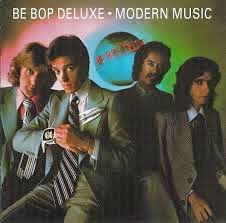
1976 – September album ‘Modern Music’ (Harvest SHSP 4058) reaches no.12 in September, on chart six weeks. Tumahai’s work-permit trouble restricts UK touring, they record at Abbey Road. The resulting black bands get mixed critical reception, fading in with radio-tuning through cuts from their earlier albums, then running through ‘Bird Charmer’s Destiny’, ‘Forbidden Lovers’ and ‘Dancing In The Moonlight (All Alone)’, closing with acoustic strummed ‘Make The Music Magic’. Nelson and Leckie’s spacily-produced second-side suite forms surreal impressions of their US tour – when Bill reported America is ‘five years behind the time’ (NME, 5 February 1977), ‘Honeymoon On Mars’, ‘Lost In The Neon World’, ‘Dance Of Uncle Sam’s Humanoids’ and ‘Gold At The End Of My Rainbow’

1976 – October EP ‘Hot Valves’ (Harvest HAR 5117) old tracks includes ‘Maid In Heaven’, ‘Blazing Apostles’, ‘Jet Silver And The Dolls Of Venus’ and ‘Bring Back The Spark’ reaches no.36 in November, on chart five weeks. Yorkshire rhythm guitarist Mike Close temporarily augments Be-Bop Deluxe for UK promo tour, and three-month US slog with Angel. ‘You get trapped by your own success, no matter how meagre it might be, it traps you’ (‘NME’, 5 February 1977)


1977 – July album ‘Live! In The Air Age’ (Harvest SHVL 816) reaches no.10 in August, on chart five weeks. Bill now married to Jan and living in Selby. Be-Bop Deluxe’s slick professionalism becomes increasingly devalued as New Wave erupts. Hard-core fans pack out winter 1976 tour to see movie-clip backdrops of seagulls, ‘Astounding’ and ‘Amazing’ SF magazine covers. Issued as renewed pressure on Tumahai forces studio relocation to the South of France. This LP continues SF preoccupation with a still from Fritz Lang’s ‘Metropolis’, and takes live tour tapes ‘from the nervous white light of the stage to the calm persistence of plastic.’ Reproduces cuts from ‘Futurama’ (‘Maid In Heaven’ and ‘Sister Seagull’) and seven from ‘Sunburst Finish’ plus new ‘Piece Of Mine’ and previously-unrecorded 1972 ‘Mill Street Junction’. Also features bonus EP with 9:30-minute live version of uncollected ‘Shine’. Produced by Bill, stand-out tracks ‘Ships In The Night’ and ‘Blazing Apostles’

1977 – September ‘Japan’ (HAR 5135), escaping formula this single uses oriental effects

1978 – January ‘Panic In The World’ (Harvest), then May ‘Electrical Language’

1978 – February album ‘Drastic Plastic’ (Harvest SHSP 4091) reaches no.22 in February, on chart five weeks. Simpler production, approach and ads promoting it as ‘synthetic songs for the video generation’. Moderne sleeve shows the band with TV sets for heads. It programmes the two 1978 singles plus ‘New Precision’, ‘New Mysteries’, ‘Surreal Estate’, ‘Love In Flames’, ‘Dangerous Stranger’, ‘Superenigmatix (Lethal Appliance For The Home With Everything)’, ‘Visions Of Endless Hopes’, ‘Possession’, and ‘Island Of The Dead’. A tour with John Cooper-Clarke results in Bill co-producing and playing in the Bard’s first album in July

1978 – September ‘The Best And The Rest Of…’ (Harvest SHDW 410) Be-Bop Deluxe announce split with £40,000 debt, and Bill complaining of the ‘limitations of a rigid structure. 2LP-set with one album of the ‘best’, the other of new studio material (‘Shine’, ‘Lights’ and instrumental ‘Blimps’). Subsequently Andy Clarke goes into TV-jingles, Fox joins Canadian band Blazer-Blazer. Tumahai first joins Hollywood Killers (August 1979), then joins ex-Wings Jimmy McCulloch and Miller Anderson in Dukes for single ‘Hearts In Trouble’ (Warner K 17453)


1979 – January first from Red Noise, ‘Furniture Music’ c/w ‘Acquitted By Mirrors’ and ‘Wonder Toys That Last For Ever’ (HAR 5176). Bill launches new assault as ‘more a project than a band’, using Andy Clarke (keyboards), Ian Nelson (sax), Rick Ford (bass) and Fairport Convention’s drummer Dave Mattacks for these initial sessions

1979 – February album as by Red Noise, ‘Sound On Sound’ (Harvest SHSP 4095), produced by Nelson and Leckie. Liberated from expectations imposed by Be-Bop Deluxe these twelve relentlessly modernistic and experimental tracks utilise dissonance, violent time-changes and bleep-and-fart electro-effects, with ‘Don’t Touch Me, I’m Electric’, ‘Substitute Flesh’, ‘For Young Moderns’, ‘Atom Age’, ‘Radar in My Heart’, and ‘A Better Home In The Phantom Zone’. It repositions Bill into Eno, John Foxx and Tubeway Army zone, with promo photos revealing Devo/industrial bleak uniformed anonymity. For the tour Steve Peer substitutes for Mattacks

1979 – April ‘Revolt Into Style’ c/w ‘Out Of Touch’ (HAR 5183), top-side lifted from Red Noise album, makes literary links to poet Thom Gunn and jazz singer George Melly. Flip cut live at De Montfort Hall, Leicester. Around this time Bill and brother Ian discard group structure, to record hours of free-form music that will make up the basis for ‘Sounding The Ritual Echo’. Label refuses to release such ‘uncommercial’ material, so Bill produces the single ‘Could This Be Heaven’ for Original Mirrors (Mercury), and works with Arista band News. At Rockfield Studios he also produces the Skids ‘Masquerade’ single and April ‘Days In Europa’ album


1980 – releases May solo EP ‘Do You Dream In Colour?’ (Cocteau COQ1) with ‘Ideal Homes’, ‘Instantly Yours’ and ‘Atom Man Loves Radium Girl’, which reaches no.52 on the UK singles chart with minimal promotion. Still deadlocked with label he forms his own Cocteau Records (74/78 Seymour Place, London W1) in old Holyground/ Smile spirit. Contagious melodies and jerky freeze-frame aurals recorded at Rack Studios and Rockfield. Bill tours ‘Souvenirs Of Impossible Events’ with guitar-sax improvisations over pre-taped backgrounds

1980 – single ‘Rooms With Brittle Views’ c/w ‘Dada Guitare’ (Les Disques Du Crépuscule TWI 013), continuing his return to critical favour this imported continental single reaches no.1 on ‘Melody Maker’ Indie Top Ten 7 March 1981

1981 – May single ‘Banal’ c/w ‘Mr Magnetism Himself’ (Mercury). But first – more production work, ‘It’s Not Me (Talking)’ single by A Flock Of Seagulls (Cocteau), ‘A Certain Bridge’ by Last Man In Europe (Cocteau) and ‘Losing You’ c/w ‘You Don’t Turn Me On’ for Wakefield band Stranger Than Fiction (Ambergris). By May there’s a new label, and new manager – Mercury and Mark Rie respectively. ‘Banal’ cut near Bill’s Selby home on the Rolling Stones Mobile, its title sniping at Harvest official’s suggested ingredient for hits. Flip recorded with Ian at Rockfield, plus 12” tracks ‘Turn To Fiction’ and ‘Hers Is A Lush Situation’

1981 – May Bill Nelson album ‘Quit Dreaming And Get On The Beam’ (Mercury 6359-055) includes ‘Living In My Limousine’, ‘Do You Dream In Colour’, ‘A Kind Of Living’, ‘Youth Of Nation On Fire’, straight into BBC album chart at no.7, vindicating Bill’s determination to control his own musical destiny in defiance of style or hype. ‘Melody Maker’ calls it ‘snapshots of a moving mind… a democratic craziness… where chords are discarded in favour of a trellis-work of lines and figures’ 

1981 – album ‘Sounding The Ritual Echo (Atmospheres For Dreaming)’, originally an instrumental bonus LP to ‘Quit Dreaming’ issued two years after its inception, reissued in 1989 as Cocteau JCS 12, with Dave Mattacks (drums), Ian Nelson (sax), Rick Ford (bass), Andrew Clark (keyboards)

1981 – June double-single and 7-inch ‘Youth Of Nation On Fire’ (Mercury WILL22) with ‘Be My Dynamo’, ‘Rooms With Brittle Views’ and ‘All My Wives Were Iron’. Launched on brief promo tour including the Leeds Warehouse


1981 – August single ‘Living In My Limousine (Remix)’ (Mercury WILL 312) with ‘White Sounds’, ‘Birds Of Tin’ and ‘Love In The Abstract’. With Bill Nelson now established as an idiosyncratic and always-interesting figure out on the perimeter of contemporary music, he continues strictly on his own terms…

1983 – invited by Gary Numan to produce his album ‘Warriors’ (Beggars Banquet). Bill also plays guitar and keyboard on track ‘Poetry And Power’

1990 – creates the Populuxe label, and releases solo material

1995 – album ‘After The Satellite Sings’ (Resurgence RES-114-CD) Resurgence from PO Box 5, Derwentside, Co Durham DH9 7HR

2002 – released ‘Three White Roses And A Bud’, with Fila Brazillia and Harold Budd

2006 – Universal Music (UK) reissue three re-mastered albums with bonus tracks

2013 – plays a fundraiser concert at Wakefield’s ‘The Hepworth Gallery’ in aid of the Unity Works project

2014 – honoured by his home-town with a star on its ‘Walk Of Stars’


Sunday, 23 November 2014

ARTHUR CONAN DOYLE: His Science Fiction, Fantasy & Horror


‘OUR EYES HAVE 
 SEEN GREAT WONDERS’:

THE LOST WORLDS OF 
 ARTHUR CONAN DOYLE


The Science Fiction, Horror and Fantasy of 
ARTHUR CONAN DOYLE 

 ‘It is imperative that now, at once, while these 
stupendous events are still clear in my mind, 
I should set them down with that 
exactness of detail which time may blur…’ 
                                   (“The Poison Belt”)


The original lure of Science Fiction was the fantastic journey, which grew out of the traveller’s tale. The voyage into uncharted here-there-be-dragons. Exotic lands. Bizarre fauna. Unknown civilisations. Homer could populate the Aegean with mythic phantasmagoria and retain the suggestion of credibility. Marco Polo and Hernán Cortéz could penetrate alienness as fully awesome as any fictional terra incognita. Gulliver could sail to fantasias when there were still islands to discover as unsuspected as the moons of Mars. But world globalisation meant the fantasy option had to be marginalised to greater and greater remoteness if it intended to carry some shred of plausibility, its realms shoved into, and secreted in crevices and niches of increasing inaccessibility – until aerial reconnaissance and geo-sats filled in even those gaps, and fantasists had to nudge their Dragon Isles out beyond the stratosphere, racing the reach of telescopes to other worlds, stars, galaxies. And further…

But therein lies the sub-genre ‘Lost World’. Between Lemuel Gulliver and Yuri Gagarin it was just conceivable that the world held secrets of fabulous mystery. H Rider Haggard found his lost worlds in Africa. Arthur Conan Doyle discovered his – what Arthur C Clarke calls ‘my candidate for the perfect specimen of its genre’, with an expedition to an inaccessible South American plateau. And his adventure stands, even though whatever vestige of what-if has gone with much of the Amazon basin rainforest.

‘The big blank spaces on the map are all filled in’ he has Mr McArdle – news editor of ‘The Daily Gazette’, say at one point, ‘there’s no room for romance anymore.’ He’s wrong. By dispatching reporter Edward D Malone to interview Professor Challenger, he initiates the process of its disproof. ‘The Lost World’ was originally serialised in ‘The Strand’ magazine from April-November 1912, with spot-art by Harry Rountree. Then collected into book form by Hodder & Stoughton. Conan Doyle was fifty-three, and Science Fiction as a genre did not exist. Yet this amazing book contains all the traits that most identify the attractions of big-screen SF.

Malone joins Challenger’s expedition in its hazardous ascent leading to them becoming stranded in the strange domain, they discover living dinosaurs, and are taken prisoner by primitive ape-like Doda tribesmen. Here lies all the ‘Ripping Yarns’ urgency of wide-eyed breathless heroics welded to a near-sublime sense of wonder and limitless possibility. ‘Apparently the age of romance was not dead’ Doyle writes, ‘and there was common ground upon which the wildest imaginings of the novelist could meet the actual scientific investigations of the searcher for truth.’ Later, with the help of the expedition’s fire-arms a human tribe living on the plateau’s far side – the Accala, defeat the Doda, and the team are shown a tunnel-system that returns them to the world below.


In the novel’s Professor George Edward Challenger, Doyle creates the most gigantically memorable character of his long writing career – even if the monumental ubiquity of Sherlock Holmes DOES dominate his literary and popular reputation in a way that eclipses all else. Remove Holmes from the equation and Doyle’s fame would still be secure. ‘The Lost World’ was an immediate bestseller that rapidly graduated onto celluloid – first into a 1925 silent film, and again in 1960 in colour by Irwin Allen. A 1992 remake with John Rhys-Davies as Challenger and David Warner as Summerlee adds photographer Jenny to the team and transposes the Lost World to Africa. Then yet another film – in 1998, transposes the Lost World to a Mongolian plateau! And all the while, the book remain in print and continues to sell, while Challenger himself survived into further exploits which regularly see reprint – ‘The Complete Professor Challenger Stories’ in 1976, ‘The Poison Belt’ (1982), ‘The Adventures Of Professor Challenger’ (1985), and in 1990 ‘When The World Screamed And Other Stories’.

They alone would ensure Doyle’s high profile. Then there’s his other ‘Scientific Romances’, Horror and Fantasy…

In “When The World Screamed” (‘Liberty’ magazine, 1928) Challenger sinks an eight-mile-deep shaft into Hengist Down to pierce the glutinous living core of the planet itself. Here, he’s described as a monstrous egoist, ‘a primitive caveman in a lounge suit… some people are born out of their proper century, but he is born out of his millennium.’ ‘The Lost World’ is more explicit. Professor Challenger, born 1863, educated at Edinburgh University, is ‘a stunted Hercules whose tremendous vitality had all run to depth, breadth and brain.’ He’s a genius, but one characterised by ‘insufferable rudeness and impossible behavior, a full-charged battery of force and vitality.’ Through this pugilistic and challenging persona, Doyle out-Hoyle’s gratuitously contentious astrophysicist Fred Hoyle. He even anticipates him by suggesting ‘had the germ of it (life) arrived from outside upon a meteor? It was hardly conceivable.’ Challenger is ‘a frontiersman from the extreme edge of the knowable,’ but it’s on the South American expedition with Malone, Lord John Roxton, and Professor Summerlee that the fiction REALLY ignites. The bickering professors are drawn larger than life into huge caricatures, which gives them their contagiously infectious life.


But while Challenger may be Doyle’s most complete creation it’s the power of the tale that gives him fascination. Doyle’s style is unobtrusive, there’s carefully described flora and geology sufficiently detailed to suspend disbelief in the most sceptical reader, there’s magical evocations of the lake and its inhabitants during Malone’s solo nocturnal venture into the centre of the strange isolated plateau, the swamp of the pterodactyls, the glade of the iguanodons, yet there’s no phrase wasted on unnecessary introspection or artful artifice. The narrative is related through Ed Malone’s bulletins, ‘what I am writing is destined to immortality as a classic of true adventure.’

He’s not wrong… from bulletin one, through to the final scene of a pterodactyl loosed from Queens Hall over the roofs of London, it never lets up. Conan Doyle used what he termed ‘the universal pass-key of imagination,’ and with it he unlocked realms of wonder.

--- 0 --- 
‘…a dreadful thing has happened to us. 
Who could have forseen it? I cannot forsee any 
end to our troubles. It may be that we are condemned
 to spend our whole lives in this strange, inaccessible place. 
I am still so confused that I can hardly think clearly 
of the facts of the present or of the chances of the future. 
To my astounded senses the one seems most
terrible and the other as black as night…’ 
                                   (‘The Lost World’

Echoing Ed Malone – Celtic temperament, Irish ancestry, Arthur Ignatius Conan Doyle, born 22 May 1859, was Scots by place of birth – Edinburgh, but Irish by parentage. He had a strong-willed Catholic mother, and an artistic father with a history of epilepsy complicated by alcoholism, who was eventually confined to a Yorkshire asylum. Five years after Doyle’s birth Jules Verne was finding his own prehistoric ‘Lost World’ in ‘A Journey To The Centre Of The Earth’ (1864), a book popular at a time when the young Doyle was enduring education at the bleak Jesuit Stonyhurst Academy, while finding after-hours escape in Walter Scott’s ‘Waverley’ novels. It was followed by a more agreeable – but equally Jesuit spell at Feldkirch in Austria, where the young Doyle’s reading taste graduated to Edgar Allan Poe.

Resembling his creation, Professor Challenger, Conan Doyle served time at Edinburgh University, studying medicine. It’s speculated that ‘Sherlock Holmes’ was there too! Doyle met a Professor Joseph Bell at Edinburgh Infirmary, whose precise analytical methods supposedly provided the germ of the Great Detective’s technique. Doyle may also have found early models for the combative Challenger in a fusion of stentorian lecturer Professor Rutherford, and a fellow student George Turnavine Budd. The volatile and extravagantly eccentric Budd is also fictionally recreated in the epistolary novel ‘The Stark Munro Letters’ (1895), which semi-autobiographically relates details of their eventful shared medical practice in Plymouth. Budd was, to Doyle’s biographer Ivor Brown, ‘both physically and temperamentally freakish… a gift to the future novelist.’ He ‘did not live very long and a post-mortem revealed an abnormality of the brain’ which Brown infers was both source of his alarming genius, and of his outrageously unpredictable social behaviour. Both were traits to be transferred to Challenger.


As academic adventurer, Professor Challenger can be seen as the direct link between H Rider Haggard’s ‘Allen Quatermain’, and George Lucas-Steven Spielberg’s ‘Indiana Jones’, and hence becomes a timeless creation. Conversely, there remain many of Doyle’s sensibilities that are difficult for the modern reader to reconcile. After a brief medical apprenticeship in Birmingham, Doyle sailed as medical officer on an Arctic whaler, instinctively disliking the April seal-cull for the fur-trade he witnessed there. Whereas Lord John Roxton is presented as a wholly heroic figure largely on his prowess as hunter, ‘his eager hunter’s soul shining from his fierce eyes.’ On first sighting fresh iguanodon dinosaur prints in the mud of the Lost World, instead of fear or scientific curiosity ‘Lord John looked eagerly round him and slipped two cartridges into his elephant gun’!

By August 1885 Doyle had split acrimoniously with Budd – ripping his brass nameplate from the door with his bare hands. He sailed from Liverpool to Sierra Leone, then – while scrimping a medical practice in Portsmouth, he married, and began writing in earnest. This is the period of his first flirtations with ‘fantastic’ fictions. He had serious literary ambitions that manifested themselves in his novels. ‘Micah Clarke’ came first from Longmans in February 1889, after a number of rejections. An historical tale it sides with the West Country commoners in their insurrection against James II. It was followed by ‘The White Company’ (1891), a chivalrous mediaeval romance, written during his last unprofitable years as a general practitioner.

But all the while he was producing ‘less respectable’ material for a wide variety of periodicals to supplement his income. His first published short stories appeared anonymously, which means that such tales have subsequently been frequently misattributed, incorrectly pirated, suppressed or simply lost in ephemeral journals long extinct. But “The Mystery Of Sasassa Valley” graced the ‘mustard-coloured’ pages of the 6 September 1879 issue of the Edinburgh-based ‘Chambers Journal’, uncredited. It was his second fiction submission, but first acceptance. The story is set in South Africa – ‘this abominable country’, and has its fantasy appeal invested in a ‘haunted valley’ avoided by ‘Kaffirs’. His character sees ‘what the niggers talk about’, a ‘frightful fiend’ with ‘a strange lurid glare, flickering and oscillating.’ However – after a false start or so, a diversion or two, the Sasassa Demon is discovered to be merely a huge diamond reflecting light! Doyle was paid three-guineas for the tale, conditional on his use of the expletive ‘damn’ being deleted by the editor.

It’s more likely that his use of other words would offend the sensitivities of modern readers, although there’s no evidence to suggest that ‘nigger’ and ‘kaffir’ betray anything more than the vocabulary of his time. Doyle considered himself to be socially liberal, and even stood as Liberal-Unionist and Tariff Reform candidate in the 1900 and 1906 elections. Although the use of the word ‘nigger’ occurs in as late a story as “The Poison Belt” (1913) – ‘a sick nigger in Sumatra’, there’s no evidence of any genuine feelings of racism.

In ‘The Lost World’ itself, the expedition’s mighty porter Zambo is ‘a black Hercules, as willing as any horse,’ and even though the qualities we are expected to admire in him – extreme loyalty and tenacious obedience, are just as applicable to a large and friendly dog, the character is respectfully drawn. Doyle’s vehemence is reserved for Gomez, a ‘villainous’ and ‘notorious’ half-breed. While in life Doyle vindicates himself of all such accusations by vigorously campaigning against Belgian racial atrocity in the Congo, and by opposing the pervasive xenophobia of the time by later staking his time, wealth and reputation in the defence of two men he felt to be unjustly imprisoned – a German Jew, and George Edalji, a Parsee. He also displayed unwavering support for the personal integrity of Irish Nationalist Roger Casement, loyal even through a period of Gay-smear stories deliberately disseminated by British authorities.

Conan Doyle’s biographer Owen Dudley Edwards claims to find traces of Roger Casement in the personality of Lord John Roxton…


--- 0 --- 
‘…had Caesar remained faithful as a General 
of the Republic and refused to cross the Rubicon, 
would not the whole story of Imperial Rome 
have been different? Had Washington persuaded 
his fellow-countrymen to wait patiently 
until a Liberal majority in the British Parliament 
righted their wrongs – would not Britain 
and all her Dominions now be an annexe of 
the great central power of America? If Napoleon 
had made peace before entering upon the 
Russian campaign… and so on’ 
                     (“The Death Voyage”) 

But meanwhile, his fiction continued to be ‘scattered around amid the pages of ‘London Society’, ‘All The Year Round’, ‘Temple Bar’, ‘The Boy’s Own Paper’ and other journals’, as he confides to his autobiography ‘Memories And Adventures’ (1924). The extremely odd “An American’s Tale” in the 1879 Xmas ‘London Society’ is a Western in which are ‘heard the fearfulest screams in the stillness of the night,’ and a would-be ambusher is consumed by a giant Venus Fly-Trap with ‘leaves eight and ten feet long and thorns or teeth a foot or more… for all the world like some great sea squid with its beak.’ The victim of this proto-Triffid is ‘torn and crushed into pulp by the great jagged teeth of the man-eating plant.’

Conan Doyle also wrote about the occult (“Selecting A Ghost” in ‘London Society’), the perverse – involving the macabre destruction of a singer’s vocal chords (“The Retirement Of Signor Lambert” in ‘Pearson’s Magazine’, 1898), and the scientific curio (“The Voice Of Science” in ‘The Strand’, 1891). The latter involves the new technology of the phonograph as a comic romantic device, while taking side-swipes at the then-raging Darwin vs Creationist dispute. But there’s little here that would genuinely qualify as proto-science fiction. There IS a form of telepathic vampirism in an 1894 novelette ‘The Parasite’ – in which crippled psychic Miss Penclosa toys with sceptical young physiologist Austin Gilroy. In “The Los Amigos Fiasco” (1892) there’s an electric chair overdose, and a dust-to-gold and back again alchemy in “The Doings Of Raffles Haw” (1891). While Conan Doyle’s 1883 ‘Temple Bar’ short story “The Captain Of ‘The Pole Star’” draws on his Arctic experience as well as – perhaps, on Poe’s “The Narrative Of A Gordon Pym”, so successfully that it ‘struck a powerfully spectral note’ according to no less an authority than HP Lovecraft in his essay ‘Supernatural Horror In Literature’ (1927).

In “A Pastoral Horror” (‘People’, 21 December 1890) a series of murders in the Tyrolese Alps allows Doyle to employ fantastic phrases such as ‘ghastly pallor’, this ‘awful demon who haunts us’, and later ‘the vampire who haunts us… something almost supernatural in the malignity of this unknown fiend.’ But he defuses such horrific expectations when the villain turns out to be merely a homicidal mania possessing the eloquent priest Father Verhagen. With some irony, the priest is identified when he raises his hand to bless the congregation – thus revealing wrist-wounds inflicted by the near-victim of the previous night’s attack! While “Our Midnight Visitor” (‘Temple Bar’, February 1891) is Scottish Gothic set amid the vividly documented bleakness of Uffa, which just might be a conflation of real Scots islands Ulva and Staffa. The tale is awash with dialect conversation postulating ghostly visitation – ‘a wraith or bogle’, who turns out to be merely a French diamond thief. But the narrator strikes a genuinely macabre note as he describes Achille Wolff and his father drowning – ‘revolving in each other’s embrace until they were nothing but a dark loom.’ The fictional Uffa crops up later in the Sherlock Holmes exploit “The Five Orange Pips” (‘The Strand’, November 1891).


In his biography ‘Conan Doyle: A Biographical Solution’ (1977), Ronald Pearsall suggests that Doyle is an unconvincing writer of Horror stories because he doesn’t understand the psychology of fear. A large, physically active man, Doyle could understand adventure and heroism – he boxed, a pupil of Scottish champion Charlie Ball, and he was also an enthusiastic cricketer who once ‘bowled out’ the great WG Grace. He even played as goalkeeper for Portsmouth FA in 1887. He volunteered for active service during the Boer War despite already being in his forties, and ran a frontline hospital after being turned down. But he was a man who had little empathy with either passive introspection or fear.

Instead, he ‘learned’ the techniques of the genre from others, from EA Poe in particular. A later story – “The Leather Funnel” (1902), is a dream of a torture chamber vault that recaptures Poe’s morbid fascinations exactly. Another story, “The Ring Of Thoth” (1890), recalls Poe’s “Some Words With A Mummy” (April 1845). There are more overt cross-over’s. The creation of Sherlock Holmes himself was to some extent based on Poe’s sleuth C Auguste Dupin of “Murders In The Rue Morgue” (in ‘Graham’s Magazine’, April 1841). Doyle seems to admit as much in “The Fate Of The Evangeline” (from the Xmas 1885 ‘Boy’s Own Paper’), a bizarrely convoluted tale of maritime romance, a lover’s self-imposed exile on the Scottish island Ardvoe, and the lost and haunted ship of the title. In the story Conan Doyle uses the device of reproducing spoof newspaper reports – as he would later do in ‘The Lost World’, and goes so far as to quote his mentor – Poe, directly, to the effect that ‘those simple rules as to the analysis of evidence laid down by Auguste Dupin. ‘Eliminate the impossible’ he remarks in one of Poe’s immortal stories, ‘and what is left, however improbable, must be the truth’.’ Holmes himself discusses Dupin’s shortcomings in “A Study In Scarlet” (1887), while Doyle continued to champion Poe over his own creation as late as his American lecture tour of 1894, and in his book of literary criticism ‘Through The Magic Door’ (1907).

In the meantime, among the plethora of hackwork from Conan Doyle’s dog-days was one that would prove singularly significant. The copyright to “A Study In Scarlet” was sold to the 1887 ‘Beeton’s Christmas Annual’ for £25, when Doyle was just twenty-eight. It was the first of four long stories and fifty shorts to feature Sherlock Holmes. The character was soon enjoying serialisation in Greenhough Smith’s ‘The Strand’ with classic illustrations by Sidney Paget. And Holmes was to guarantee Doyle’s financial independence for the years to come.


--- 0 --- 
‘My copy of ‘The Lost World’ (John Murray, 1914) 
has as its frontpiece a photograph showing 
Challenger and the other members of the party to 
that great adventure. The Professor himself, with 
his huge beard and bushy eyebrows, looks very much 
like one of our distant ancestors… The model is 
Doyle himself, heavily disguised, and I 
suspect that the irascible scientist was 
much nearer to his heart than his more 
famous creation, Sherlock Holmes’ 
      (Arthur C Clarke in ‘Astounding Days’, 1990) 

Conan Doyle was dismissive of academic attempts to ‘prove’ Holmes was based on the real-life character of Dr Joseph Bell. According to a newsreel interview Doyle considered such a connection ‘a monstrous growth from a comparatively small seed.’ No doubt he’d show equal contempt for efforts to reduce Professor Challenger down to a similar combination of personal memories. Like Holmes, Challenger – with his ‘Assyrian luxuriance of beard’, is the hugely accomplished product of a rare and prolific imagination. And if he rapidly tires of Holmes – ‘that pale, clear-cut face and loose-limbed figure was taking up an undue share of my imagination’ (‘The Casebook Of Sherlock Holmes’, 1927), Challenger’s roots were a mature and developing enthusiasm.

More specifically, Doyle’s enthusiasm for archaeology came late in his life, after he’d moved to Crowborough on the Sussex Downs. By now he was wealthy and famous, an avuncular paunchy figure, faintly benign and moustachioed in the HG Wells style. He began collecting flints and axe-heads, acquired a large plaster-cast of a prehistoric footprint, and was drawn into the Piltdown Man controversy. ‘The Lost World’ was a direct result of this interest, the first draft of which he scribbled onto the cover of an archaeological journal. And although it was preceded by a series of impressions and tales ranging over the spectrum of antiquity – Greece, Byzantium, and Rome (collected into ‘The Last Galley’, 1911), ‘The Lost World’ was by far its most incandescent manifestation.


A chapter heading – ‘Tomorrow We Disappear Into The Unknown’, sets the tone as the ill-matched expedition follow clues found in a notebook left by American artist-explorer Maple White. What they discover as ‘Maple White Land’ – the Lost World, is meticulously detailed. As large as an English county, they are able to circumnavigate the entire plateau in just six days. It is ‘an oval contour, with a breadth of about thirty miles and a width of twenty.’ Its general shape is that of a ‘shallow funnel, all the sides sloping down to a considerable lake at the centre.’ The geology is described in a convincing fashion, and there’s even speculation concerning the natural balance of fauna – why the carnivores haven’t multiplied unchecked so wiping out their prey.

Subsequent Lost Worlds – and there were still plenty to come, would seldom seem as plausible. Hyatt Verrill’s 1926 ‘Bridge Of Light’ ran in ‘Amazing Stories’ magazine, and also located its Lost World in South America. In 1940 Abraham Merritt’s hero of ‘The Snake Mother’ (published in ‘Fantastic Novels’ magazine) discovers another lost civilisation in an isolated valley in the Peruvian mountains, while LP Sherman’s ‘The Throwback’ (in ‘Fantastic Novels’, 1949) takes place in a forbidden Sierra Madre valley inhabited by monsters from the ‘Secondary Era’.

Victor Rousseau’s ‘The Beetle Horde’ (in ‘Astounding Tales’ no.1, January 1930) posits a ‘Submundia’, a hidden world beneath the South Pole where the titular beetles rule a race of degenerated troglodyte humans. James Hilton’s ‘Lost Horizon’ (1933) and Dennis Wheatley’s ‘The Man Who Missed The War’ (1945) also qualify for inclusion, but the greatest uncoverer of Lost Worlds must surely be Edgar Rice Burroughs. His stories set in Pellucidar ‘at the Earth’s core’ rival his two ‘The Land That Time Forgot’ novels as probably the finest examples of his work, while in his Tarzan sagas his protagonists continue to stumble across forgotten African civilisations with predictable regularity long after such possibilities had become absurd. Even the original ‘King Kong’ (1933) movie has more than a passing similarity to Conan Doyle’s novel – and shares Willis O’Brian, its special effects designer from the 1925 ‘The Lost World’ movie. Yet the most deliberate attempt to recast the theme into an acceptably contemporary way must be Michael Crichton’s techno-thriller ‘Jurassic Park’ (1990) in which an island of dinosaurs are recreated from DNA. As if to make the debt even more obvious, it’s Steven Spielberg-directed movie sequel is even called ‘The Lost World: Jurassic Park’ (1997).


Even Conan Doyle himself would make one more foray into the Lost World sub-genre…

Ivor Brown calls this late phase of Conan Doyle’s career proof of his ‘man-boyishness’, a kind of wilful refusal to age gracefully. More likely, he saw himself denied the literary respectability he’d earlier craved and attempted to achieve through his historical novels. The vast and continuing cult popularity of Sherlock Holmes restricted his reputation to what he considered ‘the lower stratum of literary achievement’. So he decided instead to enjoy that celebrity through a series of playful fantasies. 

Easily the most impressive of these shorts is “The Horror Of The Heights” (1913), an almost Lovecraftian title which opens with the chilling line ‘there are jungles of the upper air, and there are worse things than tigers which inhabit them.’ The narrative purports to include the incomplete ‘manuscript known as the Joyce-Armstrong fragment’, detailing the experiences of an aeronaut who ascends to 41,000-feet to discover this weird aerial realm. ‘Conceive a jellyfish such as sails in our summer seas, bell-shaped and of enormous size – far larger, I should judge, than the dome of St Pauls. It was a light pink colour veined with a delicate green, but the whole huge fabric so tenuous that it was but a fairy outline against the dark blue sky. It pulsed with a delicate and regular rhythm. From it there depended two long, drooping, green tentacles which swayed slowly backwards and forwards. This gorgeous vision passed gently with noiseless dignity over my head, as light and fragile as a soap-bubble.’ Soon, the aeronaut is attacked by less attractive denizens of the sky – ‘threatening and loathsome’ with ‘goggling eyes… cold and merciless in their viscid hatred.’ The details of the ascent, the technical descriptions of the biplane’s operation and the problems encountered in its manoeuvre are authentically described, as the biology and appearance of his unearthly creatures are both stunningly imaginative and of an order of literacy only occasionally achieved by SF-to-come for many decades.

It, too, spawned its imitators. Arthur C Clarke comments on the similarities – too close to be coincidence, between it and SP Meek’s “Beyond The Heaviside Layer”, a short story in ‘Astounding’ dated July 1930. Not only did Conan Doyle do it first, declares Clarke, but his story was written ‘only ten years after the first heavier-than-air machine had staggered off the ground.’

A second story – “The Terror Of Blue John Gap” (‘The Strand’, September 1910) tells of a ‘monstrous inchoate creature’ living beneath the ‘hollow’ countryside of Derbyshire – a beast not dissimilar to Bram Stoker’s ‘White Worm’. Doyle conjures up ‘a creature as no nightmare had ever brought to my imagination.’ He even hints at a full subterranean realm of such beings from which the monster originated. These tales, and some further Challenger exploits, show Conan Doyle’s SF at its most sophisticated, competing directly with HG Wells.


“The Poison Belt” bears the distinction of republication in Britain’s first-ever SF periodical – ‘Scoops’ in 5 May 1934, a weekly billed as ‘Stories Of The Wonder-World Of Tomorrow’, although the story had originally seen print just one year after ‘The Lost World’. Brian Aldiss dismisses “The Poison Belt” as ‘a tepid performance, much under Wells influence’, or – to David Kyle, it was an ‘almost the-end-of-the-world story again reflecting Poe.’ The Earth drifts through a ‘poison belt’ of cosmic gas that at first appears to destroy all terrestrial animal life. Challenger, Malone, and the rest of the ‘Lost World’ crew escape its toxic influence by using air canisters, only to emerge into an aftermath of vast desolation. This is fictional territory to be revisited later by ‘School Of Cosy Disaster’ novelists such as John Wyndham and John Christopher. To Aldiss it’s ‘a picturesque deserted London that we shall meet again in ‘The Day Of The Triffids’ (1951).’ Although the dreadful power of the story is somewhat mitigated when people begin to revive from what is not death, but merely a comatose state. Then – following “When The World Screamed” (1928), there’s “The Disintegration Machine” (‘The Strand’, January 1929), a light comic squib concerning Theodore Nemor, a Latvian scientist, and his odd invention. After both Malone and Challenger are disintegrated and reassembled, they dupe Nemor himself into the device and – fearing its use as a weapon of war, fail to restore him…

It might be kinder to leave Arthur Conan Doyle there. For what follows is a slow decline. The horrific scale of World War I casualties – including the death of his own son, brother and two nephews, affected his vision. A younger Doyle – after seeing military action against the Boers in Bloemfontein, had eulogised ‘wonderful is the atmosphere of war’, lamenting a pacified future ‘when the millennium comes the world will gain much, but it will lose its greatest thrill.’ While his swaggering Napoleonic comic ‘swashbucklers’ featuring Brigadier Gerard, delight in bloodshed. Now there’s a change in tone – ‘look how everything has been turned to evil. We got the knowledge of airships. We bomb cities with them. We learn how to sail under the sea. We murder seamen with our new knowledge. We gain command over chemicals. We turn them into explosives or poison gas. It goes from worse to worse…’ (‘The Land Of Mist’, 1926).


Bookending the war, his short story “Danger” (‘The Strand’, 1914) had predicted submarine warfare in a fictional siege of England by ‘Norland’, just one month before European hostilities broke out. Until his “The Death Voyage” (‘The Strand’, 1929) is a speculative ‘alternative history’ postulating an imperial melodrama around the events during the war’s final hours. As the German war machine disintegrates the Kaiser is carried across Europe in the refrigerator car of a sealed train to lead his fleet into a ‘death voyage’ against overwhelming odds. Doyle’s attitude is respectful to this ‘great adventure of the supreme sacrifice,’ this ‘armageddon of the sea.’

But the key story of this late phase is the fantasy novel ‘The Land Of Mist’ (1926), a hideously inept propaganda text for Doyle’s new-found interest in Spiritualism, thinly disguised as fiction. ‘Post-war conditions and new world problems had left their mark’ says Edward Malone, and perhaps – charitably, the same can be said for Conan Doyle. He’d long since abandoned Catholicism in favour of a healthy agnosticism, but now dabbled in Buddhism and Theosophy, hypnotism and Oriental mysticism. He also delved into FWH Myers’ study of psychic research ‘Human Personality And Its Survival Of Bodily Death’ (1903) in an attempt to give meaning to, and find some explanation for the Great War’s carnage.

It was a thread of interest that could be traced back as far as a séance he’d sceptically sat in on in Southsea, accompanying the eccentric astronomer Alfred Wilkes Drayson. A 1900 short story – “Playing With Fire” (‘The Strand’) also deals playfully with psychic chicanery, one which conjures up a unicorn! But certainly after 1920 he devoted his time, cash, and still not-inconsiderable energies to promoting the pseudo-sciences. He wrote books on the suspect topic, including a well-researched two-volume ‘History Of Spiritualism’ (1926), and even ‘The Coming Of The Fairies’ (1921) in which he credulously affirms faked evidence for the existence of the ‘Cottingley Fairies’. 

‘The Land Of Mist’ uses the ‘Lost World’ personnel to give voice to Doyle’s own experiences of seeing and smelling ectoplasmic manifestations. An annotated index of sources follows the story, intended to strengthen its ‘authenticity’. Lord Roxton is seduced by the concept following a spirit visitation by the then-deceased Professor Summerlee, ‘having exhausted the sporting adventures of this terrestrial globe, he is now turning to those of the dim, dark and dubious regions of psychic research.’ Challenger is initially fiercely hostile, snorting ‘like an angry buffalo’ at the very mention of visiting a Spiritualist – ‘next week the lunatic asylum, I presume?’ Perhaps Conan Doyle should have taken heed of Challenger’s commendable contempt – ‘there seems to me to be absolutely no limit to the inanity and credulity of the human race.’ Instead, he contrives the Professor’s unlikely conversion, and then abandons him as a new apostle of the pseudoscience. 

It’s a sad and undignified end to the career of such a contagiously powerful creation. 

Certainly, whatever rationalist bias energised his earlier flights of imagination completely desert this later Conan Doyle. His last book, and final ‘Lost World’ is ‘The Maracot Deep’ (1929), published the year before his death. To Ivor Brown this is ‘a descent into nonsense as well as into the Atlantic.’ Maracot himself – a kind of fusion of Doyle’s two most successful characters, Challenger and Holmes, discovers Atlantis, battles the forces of evil on the ocean bed, and utilises psychic forces to destroy the monstrous ‘Lord Of The Dark Face’ who menaces the subaquatic civilisation in a totally unconvincing denouement. 

But at his best, during his finest years, Conan Doyle’s forays into Science Fiction stand up well to comparison with those of his contemporaries – including HG Wells. “The Horror Of The Height” in particular, while ‘The Lost World’ rightly remains a classic of the genre. It’s a fantasy as rich as ‘the wild dream of an opium smoker, a vision of delirium…’ 

‘Evolution’ writes Doyle through the mouthpiece of Challenger’s colleague Mr Waldron, ‘was not a spent force, but one still working, and even greater achievements were in store.’ In that phrase lies all the promised wonder and anticipation of the most visionary Science Fiction. 


Research texts used for this article include: 

‘CONAN DOYLE: A BIOGRAPHICAL SOLUTION’ by Ronald Pearsall (Weidenfeld and Nicholson, 1977) 

‘MEMORIES AND ADVENTURES’ by Arthur Conan Doyle (Oxford Press, 1989) 

‘CONAN DOYLE: A BIOGRAPHY’ by Ivor Brown (Hamish Hamilton, 1972) 

‘THE UNKNOWN CONAN DOYLE: UNCOLLECTED STORIES’ edited by John Michael Gibson and Richard Lancelyn Green (Secker and Warburg, 1982) 

‘A PICTORIAL HISTORY OF SCIENCE FICTION’ by David Kyle (Hamlyn, 1976) 

‘THE QUEST FOR SHERLOCK HOLMES’ by Owen Dudley Edwards (Mainstream Publications, 1983) 

‘BILLION YEAR SPREE’ by Brian Aldiss (Corgi, 1973)

Friday, 21 November 2014

NEIL SEDAKA Live in Bradford in 1995


CLASSICAL GAS: 
NEIL SEDAKA 
 MEETS LUDWIG 
VAN BEETHOVEN 


1950’s Teen Idol NEIL SEDAKA is back in the charts with his 
 heavily TV-advertised new album ‘Classically Sedaka’ (1995), 
 new settings of Classical Themes. And his promotional tour – 
 with full orchestra, opens at Bradford’s St George’s Hall. 
ANDREW DARLINGTON was there, 
 before, during and after the event… 


‘I hang around the gold-painted pillars, watching the Dodgem Cars weave 
 and impact, their tall poles sparking as they thrip across the grid. 
 Watching the attendant ride the cars with easy loping leaps from 
 one to the other, the girls shrieking as he leans over them. 
 Talking at them. The words lost by the slightly out-of-phase 
 treble-drenched records, Neil Sedaka’s “Oh Carol”, Del Shannon’s 
 “Runaway”, Connie Francis’ “Stupid Cupid”. I love those singles, 
 but they come vividly alive in new more raucous ways, the 
 bass-lines thrumming up through buckboards with the 
 reverberation of the cars…’    (memories of ‘Hull Fair’)


Mid-point in the second half there’s a serio-comic interlude. Neil Sedaka, son of a New York Taxi Driver, plays “Breaking Up Is Hard To Do” in the manner of various classical composers. It’s the kind of routine Victor Borge might once have done, instantly striking responsive sparks off his audience, while also betraying a knowing familiarity with technique and style. He does Beethoven. And if Ludwig Van had known his way around his ‘come-a come-a come dooby-doo down-downs’ he might just have written this way. Then Mozart. Yeah – Rock Me Amadeus. And Claude Debussy, with the liquid lines of the 1962 hit single still detectable there inside its smoky impressionistic swirls.

‘My father worked so hard to put me through Music School’ he confides. ‘I’m so grateful for that.’

Neil wears a burgundy suit with scrupulously shiny patent leather shoes. A quietly striped tie. And his hair, oddly peaked at the front, fringes away raggedly over his collar at the back. An almost impossibly dapper Bank Manager. Even as a 195’s Pop Star he was never actually the stuff of teen-dream pin-ups despite promo attempts at drastic monochrome profiles in ‘Mirabelle’ and ‘Roxy’ – the ‘Smash Hits’ of their day. The album sleeve of his ‘The Tra-La Days Are Over’ (1973) cleverly juxtaposes the two, with his mature self leaning against a huge blow-up of an old publicity mug-shot of himself. And tonight we get both.

He does a ludicrously dumpy little shuffling dance, then jokes about his lack of stature as he screws his piano stool furiously higher. ‘I’m getting shorter and shorter. The people in the front row can’t even see me,’ But when he opens with ‘come and get your memories, you’re not too far from yesterday’ (“Tin Pan Alley”) none of that matters. “Oh Carol”, “I Go Ape”, “Calendar Girl” or “Little Devil” magic up enough memories and yesterdays for this audience without any other visible means of support.


Yet his current album, and the motivation for this high-profile tour – is ‘Classically Sedaka’, a set of songs built around the kind of tunes you hum along with to ‘Classic FM’, two Tchaikovsky’s, Chopin, Verdi, two Beethoven’s, and more of the like. To this end he’s accompanied by enough strings to rot your teeth in a full orchestra conducted by the reassuringly solid figure of Dick Palombi. The live stand-out is “Turning Back The Hands Of Time”, a tribute to his father written around Puccini’s “Nessun Dorma”. And it all ties in. The ‘Music School’ his father drove Brooklyn Cabs to put him through – with the bonus of a recommendation from Arthur Rubenstein, was New York’s prestigious Julliard School of Music. And ‘when I thought of doing a new album I asked myself ‘what can I do that takes me back to my Classical Music roots?’’ he explains in the CD insert. ‘My passion has always been Classical Music’ he adds now. ‘Many people are intimidated by it. Particularly by Opera when it’s sung in a language that they don’t understand.’

The answer – for Neil, was to wrap Pop lyrics around Classical themes. ‘This was a difficult task’ he insists. ‘These pieces were my favourites as a music student. So it was a difficult task. I had a great responsibility, having to marry those marvellous pieces with lyrics that would match the artistic level of the melodies…’

Neil Sedaka’s is an odd story. He is primarily a songwriter. His first hit came with a song called “Stupid Cupid” recorded by Connie Francis. He’d met his collaborator Howie Greenfield on 11 October 1952, a date he considers sufficiently significant to mention tonight. In fact it marks this concert as practically his forty-third anniversary as a songwriter! And between 1958 and 1963 – he tells us smugly, he sold forty-million records. ‘I was lucky to be in at the very beginning of Rock ‘n’ Roll. With Roy Orbison. Buddy Holly. And the great Elvis.’ He briefly illustrates the point by pounding the keyboard with one scrupulously shiny patent leather shoe. But unlike other writers-turned-stars who neglected the former for the glittering lure of the latter, to their eventual detriment – like Gene Pitney, who began by writing “He’s A Rebel” for the Crystals, or Leo Sayer writing “Giving It All Away” for Roger Daltrey, Sedaka never lost his ability to craft perfect Pop. “Calendar Girl” hit no.8 in February 1961, a catchy piece of ephemeral chart fluff with its soaring falsetto carrying the simplest of lyrical ideas – the months of the year, each one tagged to a fairly obvious pay-off line. January ‘you start the year off fine.’ February ‘you’re my little Valentine.’ Yet its irresistibly contagious progression transforms it into a formula that even Stevie Wonder considered worthy of resurrecting twenty-five years later for “I Just Called To Say I Love You”.

And when Sedaka’s first run of hits stopped abruptly with the arrival of Beatlemania, he was able to resume writing hits for other artists such as Andy Williams, Tom Jones, the Fifth Dimension, Tony Christie, ‘the great Elvis’, and… Mae West! Faded Teen Idols seldom get a second chance. For which we should perhaps be grateful. But Neil Sedaka was different. ‘Songs are like my children in many ways’ he claims. ‘They live and breathe. And some of them are neglected children. Ideas come from Movies. Plays. Books you read. People you meet. It’s a very great fortunate gift.’ And he was able to use his ‘neglected’ ‘ten years out of work’ to mature his gift and write himself through the bad times in personal terms he’d never before attempted.


 Superficially a love song of gentle regret “Our Last Song Together” actually marks an affectionate but decisive break with long-time writing partner Howie Greenfield, ‘nostalgia just gets in the way… it’s time to turn the page.’ “I’m A Song, Sing Me”, on first hearing a celebration of the power of music, is also a deeply anguished cry of loss and confusion, ‘let me fill the air, the way I used to do… tell me, what did I do wrong?’ Until “Standing On The Inside” documents his triumphant return to chartdom – ‘every waking moment I just wanna sing the news… I’ve kicked away them Blues.’ More, and bigger hits were to follow. “Laughter In The Rain”, with a sax solo from Earl Seymour that’s just about the bee’s knees, gets one of the biggest receptions of the concert’s first half.

But now he’s ‘reinventing the Neil Sedaka career’ yet again. Maturing, as his audience matures, yet carrying a unifying continuity with him to validate and give it all meaning.

‘Classically Sedaka’ takes its starting point from an earlier pre-Rock ‘n’ Roll example of the Pop-over into Classics project, when lyricist Joseph McCarthy put words to Chopin’s “Fantasie Impromptu”, and thus created the Great American Songbook standard “I’m Always Chasing Rainbows”. Sedaka’s neat precise piano interprets its wistful mood carefully. Then Neil’s words to Verdi’s exuberant “Sempre Libera” makes it “Santiago”, a bustling upbeat number, even if the thematic connection between Italian Opera and this fluent South American travelogue escapes me. On the album he also does Debussy’s “Clair De Lune” as a straight but beautifully reflective instrumental, before moving on to Beethoven’s delicate “Für Elise” which becomes “Honey Of My Life” done with only touching piano accompaniment.

Sometimes he has the look of a wealthy Bistro owner greeting valued diners. And nostalgia remains an important element in his show. He packs those superior Juke-Box Oldies in early. They provide the momentum that carries the audience through his newer adventures. But he works with unrelenting energy, and never undersells. That’s an essential part of his continuing appeal. Of course, it’s easy to snipe. The quasi-Classical hybrid has been done before, and seldom with credible results. ELP inflicted their preposterous electro-pomp on Mussorgsky. Argentine composer Waldo de los Rios charted with a speeded-up dance-beat “Mozart 40” (no.5 in April 1971). While, once he’d discovered the sales power of Classics with “O Solo Mio” (“It’s Now Or Never”) ‘the great Elvis’ followed it with a series of Operatic re-treads of diminishing artistic and commercial returns.

But seldom has it been done with such a knowing familiarity of style and technique as it is tonight.

‘I do hope Chopin, Beethoven, and the rest would be pleased with my work’ Neil Sedaka adds.

They might. They just might.

Friday, 31 October 2014

Poem: 'Bourbon Street Blues'


BOURBON STREET BLUES 
(MONDAY, 22 SEPTEMBER 2014) 


‘Out of luck, stuck in a rut,
I’m in need, of someone’s good deed’
sat sidewalk-hunched, eyes downcast
beneath Bourbon street-sign
with her poem on carton-cardboard,
the craziness cascading by her

I feel a momentary pang

but steal her poem anyway…


Featured on web-page:
‘PRESSURE POINT PRESENTS’ (September 2014)

Thursday, 30 October 2014

ELVIS PRESLEY: 'Sailing To Graceland'


ELVIS PRESLEY:
SAILING TO GRACELAND 

 by ANDREW DARLINGTON


There’s a squirrel on the Graceland lawn. The squirrel doesn’t know it’s on the Graceland lawn. The squirrel knows nothing about the King of Rock ‘n’ Roll, his amazing life and stupid death. The squirrel just enjoys the shade the trees cast across the lawn. Graceland is a pleasant place to live. It’s easy to see why Elvis valued this place. Why he returned here from the madness of the world whenever he got the chance.


On the way here we talk about Justin Bieber and Britney Spears. They went into overnight fame and wealth, and couldn’t deal with it. They lost the plot. Elvis Presley came from dirt-poor country-boy to become more globally famous and vastly wealthy than just about anyone else. He bought ‘Graceland’ in early 1957 and it’s reassuring evidence that, despite career blips and the kind of excess we’re all familiar with, he never quite blew it. There’s no massive 1950’s tasteless splurges of bling or monumental ostentation. Even what later became known as the Jungle Room – where ‘there’s a pretty little thing, waiting for the King’, is more cool and elegant. Graceland is the kind of place you’d move into, if you had the budget.


When he bought the place, it was pretty-much an empty shell. It was decorated and redesigned according to his dictates. Later, no doubt, Priscilla had a say in its décor too. Yet it reflects his taste. Although originally in a wooded area outside the city, the Memphis sprawl has extended to surround it, with the renamed ‘Elvis Presley Boulevard’ lined with souvenir shops and malls. Shuttle coaches take visitors ‘poor boys and pilgrims’ from one side of the boulevard, where the booking, frisking and queuing takes place, across to and up the drive to Graceland itself. It feels hot and irritable standing in line. There’s no opportunity to grab a photo at the famous music-notes gates. Instead they will snap you in front of mock-up gates, and sell you the photo in a presentation folder as you leave. They are not cheap. Nothing here is cheap. But as you queue for the next shuttle in the sullen Tennessee heat with the endless Elvis soundtrack playing from speakers around you, they issue you with iPads that will talk you through each room, with click-on video-clips, audio-grabs and fact-sidebars. iPads don’t come cheap either.


Never quite understood the line in the Marc Cohn song about ‘do I really feel the way I feel’, now I’m here, now I’m “Walking In Memphis” myself, I know exactly what he means.

Pop isn’t rational. There’s no verifiable reason for liking or not liking. Perhaps it’s just that, like sex, the first cut is the deepest? Some great writer-producer teams have attempted to reduce the formula down to an equation. Some have created Hit Machines as a result. But there’s always going to be that inexplicable quality about music which is more mystical than it is logical. There are immensely talented artists you can respect, and yet not love. Neil Young is a creative giant. The intensity of some of his songs – “A Man Needs A Maid”, can near reduce me to tears. Yet listen to a full Neil Young album, and the high whine starts to grate before the wind-down groove.


When it comes to creative intelligence Elvis Presley was never in the same league. But he has the voice. Even working with the most appallingly inept material, he could midas it into gold. At his very worst – and I’m thinking the 1964 ‘Kissin’ Cousins’ LP, the soundtrack album of the embarrassingly inept movie, side one track six, “Tender Feeling” is a barrel-scraping exercise in songwriting, tacking on hasty new lyrics to the old “Shenandoah” tune, yet the vocal interpretation salvages it with some dignity, so it’s a delight to listen. Was Elvis smart? He was what we’d now call trailer-trash sharp, dirt-po’white, he couldn’t articulate what he did, or why it proved so seismic. His was animal-intuition. He worked the song, until it felt ‘right’. There’s a TV-clip of Richard Madeley interviewing Shakin’ Stevens. When he’s asked a question he clearly doesn’t understand, Shakin’ playfully pounces on Madeley and gets him in a headlock. I suspect that in this sense, Shakin’ is a fairly accurate Elvis impersonator. When Elvis does a press-conference, and is asked if beneath the fame and celebrity he’s still the same ole country boy, he simply stands up and indicates his massive blingy jewelled belt, which says it all.


The first vinyl 45rpm record I ever owned was Elvis’ “The Girl Of My Best Friend”, on the black RCA label, with its silver lettering. I’d just turned thirteen, and I was entranced. Even when I hear that song now – shuffled unexpectedly on my iPod between the Ramones and Prodigy, I still love it, from the Jordanaires opening ‘aah-aah aah-aah-aah’ into the honeyed-smooth first line. As a track (side one, track three) on his first post-Army LP ‘Elvis Is Back’ (April 1960) – what many consider to be his greatest album, it wasn’t even intended to be a single. In the USA it wasn’t. The American follow-up to his lubriciously suggestive hit “Stuck On You” was “It’s Now Or Never” c/w “A Mess Of Blues”, but when copyright complications due to its “O Solo Mio” origins held up the song’s UK release, there was a commercial vacuum that needed filling. Hence “A Mess Of Blues” was promoted from ‘B’-side status while “The Girl Of My Best Friend” was lifted from the album to accompany it. Marketed as a double-‘A’ (RCA 1194) it hit no.2 in September 1960 (beneath the Shadows “Apache”) – appropriately close to my birthday. I’d heard it on the BBC Light Programme, the ‘bumper-bundle’ most-requested record of the week on Brian Matthew’s ‘Saturday Club’.


So I bought it. I still have it, although I also have subsequent CD and mp3 versions too. It was what critics of the time termed a rocka-ballad, written by Sam Bobrick and Beverly Ross, first recorded in 1959 for Warner Bros by Charlie Blackwell. But listen to Blackwell’s original vinyl, and it’s an awkward charmless thing. Then check out the various Elvis outtakes on YouTube as he fumbles through different takes, moulding the contours of the simple song into an irresistible Pop gem. How did he work the alchemy? By intuition? Until it sounds somehow right? A thing of instinct?

Elvis sound-alike Ral Donner took the song into the US charts, to no.19 as an ‘Elvis Is Back’ cover. Johnny Burnette, and much later Bryan Ferry also reworked it. But at a concise 2:27-minutes, Elvis’ assured vocal control takes it up several notches. It consists of fairly routine love-triangle subject-matter, recycling ‘the way she walks’, with ‘the way she talks’ – a rhyme used so frequently in Pop it’s almost a joke. Elvis gives its triteness an achingly empathic sincerity. He’s caught up in a romantic dilemma, ‘I want to tell her how I love her so’, but he’s wary that ‘what if she got real mad and told him so?’, then he ‘could never face either one again.’ So he watches ‘the way they kiss’ and ‘their happiness’, with a jealously-pained secret that can never speak its name. Will his aching heart ever end? Even its title is a little grammatically clunky, cut-up and reshuffled more efficiently by Cars into “My Best Friend’s Girlfriend”. Whoever said Pop was rational?

Many years later, reissued as an ‘A’-side in its own right, in a chart full of Abba, Demis Roussos and Tina Charles, it reached no.9 in October 1976. Odd to think it might also have been the first vinyl 45rpm purchase for fans of that generation too.


RCA Victor Studio B in Nashville is where Elvis recorded it. Although signed to other labels Roy Orbison and the Everly Brothers also booked studio time here. While Gentleman Jim Reeves did most of his recordings here. Floyd Cramer’s original piano is there, in the corner of the studio. The one he played on Presley sessions for “Mess Of Blues” and ‘Elvis Is Back’. Elvis installed his own mood-lighting. It’s still in place. He would use red lighting for up-tempo sessions. Blue lighting for slow ballads. But neither worked when he was trying out for the first takes of “Are You Lonesome Tonight”. Until he decides to fade the lighting way down, and record the song in intimate darkness. Here, now, they fade the lights down to darkness, and fade the track in, Elvis’ voice resonates spookily, here, where he stood to record it. It’s impossible not feel a chill of frisson. This is a moment of extreme dislocating weirdness. I’m not afraid to admit it had me choking up.


We pass Chet Atkins Place on the way here, but when I want to re-find it for a photo I lose my way. There’s Roy Acuff Place too in a tight ‘Music City’ block off the long Broadway which eventually counts down to the music bars and country stores sloping towards the Cumberland Riverfront. Studio B was constructed as a result of Chet’s urging, in 1957, partly to facilitate the demands of Elvis’ burgeoning career. It wasn’t called Studio B then, not until a larger studio complex was built on 17th Street, which became Studio A. It’s Studio B that remains legendary.

It started with Elvis. It must end with Elvis.


He drove golf-carts across these Graceland lawns where squirrels now enjoy the shade of the trees. He rode horses around the paddocks outside the back. And stroll around the side, by the surprisingly modest swimming pool, there’s the meditation garden where Elvis would come when he wanted peace and quiet. So pause, deliberately, take it all in, condense this moment down for future reference. The formation of Presley graves are here. Four of them. Parents Vernon and Gladys. Elvis himself. And grandmother Minnie Mae Presley, who outlived them all, and died in May 1980. There’s also a plaque for Elvis’ stillborn twin, Jessie Garon.

Standing here now, about as close to Elvis Presley as I’m ever likely to get, is an undeniably disquieting experience. I didn’t expect to feel this way. I couldn’t quite anticipate how I’d feel. But yes, he reaches out and touches me…


The ‘Girl Of My Best Friend’ section published in:
‘R2: ROCK ‘N’ REEL’ (Vol.2 Issue 41 – September 2013)

Live In Nashville: VINCE GILL at the 'Grand Ole Opry'


Gig Review of: 
VINCE GILL 
at ‘The Grand Ole Opry’, Nashville 

It’s Vince Gill they aspire to. Those scuffing on the street-corners of Nashville’s Broadway, setting up their equipment and hefting their battered guitars, busking their new songs at folks checking out the bars and the boot stores. It’s Vince Gill in his big Stetson and his confident stage presence here at the Opry that they want to be. Since he first surfaced with Pure Prairie League in the 1970’s he’s done everything that Alt. Americana is supposed to do, done the collaborations, the albums, the divorce. He’s a big solid guy who reaches out and fills the venue with his easy personality, the regular strengths that also contain the vulnerable sensitivities that the genre wallows in. He opens with “Take Your Memory With You When You Go”, the hit from his 1991 ‘Pocket Of Gold’ album. With its sighing steel guitars and an irresistibly sing-along chorus tinged with regret, it’s made up of just about every classic ingredient a country song should have. Then, slowing it down with “Look At Us” – from the same album, she’s still pretty as a picture, he’s still crazy over her, it gets an immediate roar of recognition. He talks about anniversaries and ‘the miracle of long-term love.’ Who could resist? Here is all the narrative, the reassuring certainty, the confirmation of traditional values the audience craves. In times of uncertainty and shifting definitions, in a hundred years from now, he asserts without a doubt, heterosexual monogamy will still stand. He dedicates the song to Charlie Daniels. Tommy White, a legend in his own right, plays steel guitar. Tommy was one of the Band Of Brothers who played on Vince’s “Whenever You Come Around” when Willie Nelson recorded it. Then Vince talks about George Hamilton IV, who recently passed. The ‘Grand Ole Opry’ respects its precedents, its traditions, its heroes. He closes with “Go To Him”. While on the street-corners of Nashville’s Broadway, they all aspire to be Vince Gill.