Saturday, 20 June 2020

Movie and Novel: 'MIDNIGHT COWBOY'


‘JOE BUCK RIDES AGAIN’ 


Looking Back At: 
‘MIDNIGHT COWBOY’ 
(1969) with Dustin Hoffman, Jon Voight and Sylvia Miles. 
DVD Twentieth Century Fox (2000)


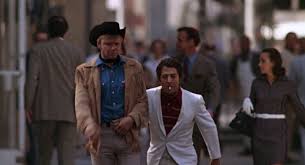
Coming directly off the back of his overnight breakthrough success as Benjamin Braddock in ‘The Graduate’ (1967), Dustin Hoffman could take his pick of ego-flattering star roles. That he chose to become the decidedly downbeat Ratso Rizzo supporting the untried Jon Voight is evidence he valued the art of movies above mere celebrity. And it was a great role.

Movies, in cahoots with the related art-forms of novels, poetry, painting and music had been defining and taking the pulse of the times by pushing at, testing and extending the limits of what’s possible, gradually breaking free from the repressive constraints of the 1950s, one increment at a time. As social change accelerated towards decade’s end, it was articulating the contentious ongoing dialogue over gender politics, racial equality, censorship, and the spreading recreational use of narcotics. ‘Midnight Cowboy’ coming in 1969, is very much part of that process, advancing what it was permissible to portray onscreen, but doing so with a strong human storyline, and two unforgettably beat-up characters.


From the opening shots of Joe Buck in the shower, there are near-pubic glimpses as he stoops to retrieve the white cake of soap. He’s singing ‘Get along little doggies, New York will be your new home,’ instantly setting the plot. In the original novel, James Leo Herlihy describes Joe as ‘a beautiful strange animal’ and a ‘sweet, dark, dangerous devil.’ He’s big and dumb, but also likeably vulnerable, arrogant to the point of narcissism, but also endearingly gullible. ‘No great shakes as a thinker’, he has no talent, other than his physique, and no future other than washing dishes at the small-town Texas ‘Sunshine Cafeteria’ (‘Miller’s Restaurant’ in the film). So he gets decked out in his finest new threads, ‘he developed a habit of hooking his thumbs into his back pockets as if his trousers were a low-slung gun belt,’ and hops the National Coach from the Houston bus depot – where the jukebox is playing Kay Starr’s “Wheel Of Fortune”, heading north for New York to start a new life as an in-demand gigolo. In green shirt, fringed buckskin jacket, cowboy boots, black-and-white horsehide suitcase, transistor radio, and chewing gum, ‘he was ready.’

The opening movie sequence, from the ‘Big Tex Drive-In’, tracks the novel’s first chapter in closely-observed detail. Impatient voices call ‘Where’s Joe Buck?’ Then he’s telling the nameless ‘coloured man’ – Ralph in the movie, who facially resembles John Lee Hooker, ‘a lot of rich women back there, Ralph, begging for it, paying for it too.’ New York men are all tootie-frooties, aren’t they? They’re all ‘faggots’ in the novel. But fiction is different to celluloid. The novel then diverges into back-story, documenting how loner Joe was raised by ‘various blondes’ and detailing his sexual initiation with promiscuous Anastasia ‘Annie’ Pratt (Jennifer Salt). All abbreviated to spliced-in flashbacks on the movie-coach, a blur of travel-dreams, as passengers come and go, a girl with the ‘Wonder Woman no.178’ comicbook, an Old Timer chewing tobacco, an awkward Old Lady in Dame Edna spectacles, a Nun. The landscape and radio-bursts of ads and evangelists fade into and out of focus. ‘Crazy Anne Loves Joe Buck’ is graffiti’d on the spindly-tall Martian war-machine of a glimpsed Water Tower. A presage to the later gothic black-and-white nightmare of violent gang-rape which tore Joe and Annie apart.

The previously untested Jon Voight completely inhabits the person of Joe Buck. Born 29 December 1938 in New York’s Yonkers, he’d done TV bit parts in cult crime series ‘Naked City’ (“Alive And Still A Second Lieutenant”, 6 March 1963), ‘The Defenders’ (“The Brother Killers” with Peter Fonda, 25 May 1963) and ‘NYPD’ (“The Bombers” 12 December 1967) as well as three different character roles in popular TV Western ‘Gunsmoke’ with James Arness as Marshal Matt Dillon. But director John Schlesinger was supernaturally right to take a chance and cast him on what was essentially a gritty character-driven narrative of low-life deviancy.


I first saw the movie at the ABC-Regal in Hull, having just turned twenty, and it seemed to touch every nexus of change going on around me. The seedy underbelly of the clamouring counter-culture where sky-shooting ambition collides with Desolation Row come-down, tantalizing tastes of narcotic and forbidden erotic worlds, sealed by an unlikely friendship between misfit outsiders. All motivated by that urgent need to escape the stultifying small-town boredom and break on through to the roaring energy of the greater world beyond the horizon, with its luring promises of agony or ecstasy.

Joe was ‘wondering what to do about his predicament and not quite certain just what the predicament was.’ Like many of us were doing. The novel’s early detours chart the long build-up – all unexpressed pauses and aching waits, until Joe finally hooks up with smooth-talking Perry, who takes him to Juanita and Tombaby Barefoot’s cat-house. The dialogue is richly comic and cruelly barbed. Joe has interrupted sex with Dolores that is brought to an abrupt end when he realizes they’re being observed. Yet it’s Juanita who ‘put this entire goddam New York notion in his head in the first place,’ when she says ‘its all fags there, fags and money and hungry women. Young stud like this in the stable, I’d clean up good.’ Joe is naive, an innocent, as Perry says, despite having ‘fucked aplenty’, he’s a virgin. Everyone around him has agendas, scams, traumas, hang-ups, paranoias, he simply drifts, a pinball bounced from one situation to the next. He’s confused by the strange drifts of conversations, and never quite sure what is expected of him, despite being always eager to please. ‘Now at the age of twenty-five, with his head full of grief and worry, Joe felt the need to do some thinking. But he was unused to having any wide variety of thoughts in his head, and there seemed to be severe limits as well to his imagination. There was nothing wrong with these faculties in him, but they were untrained and did not serve him well in emergencies.’


Although John Barry’s plaintive instrumental with Toots Thielemans’ keening harmonica is the official theme tune, Nilsson’s “Everybody’s Talking” – played over the first sequences, became the hit single most associated with the movie, the lyric ‘everybody’s talking at me, I don’t hear a word they’re saying, only the echoes of my mind. People stopping, staring, I can’t see their faces, only the shadows of their eyes’ catches the aimless footloose spirit of the screenplay. It became to ‘Midnight Cowboy’ what Simon And Garfunkel’s “Mrs Robinson” had been to ‘The Graduate’. As a songwriter himself it was to Harry Nilsson’s intense chagrin that his two biggest commercial hits were written by other people. Fred Neil wrote “Everybody’s Talking” which reached no.6 in the USA but peaked at a UK no.23 in October 1969, followed by “Without You” – a no.1 in March 1972, penned by Badfinger members Pete Ham and Tom Evans. Yet the ‘Midnight Cowboy’ soundtrack is vitally time-fixing. Elephants Memory were a Greenwich Village band best remembered for backing Yoko And John Lennon on their ‘Some Time In New York City’ (1972, Apple) double-album. The Groop were a LA-based soft-harmony psychedelic band, their “A Famous Myth” – which plays in the background when Joe first encounters Ratzo, opens their only album ‘The Groop’ (1969, Bell).


It’s only by page seventy-seven of the July 1969 Dell paperback edition of ‘Midnight Cowboy’ – with its ‘Now An Explosive Movie’ tie-in cover-art, that gum-chewing Joe even arrives in New York. In the movie he catches radio-burst identifications from Ron Lundy’s WABC show, which tells him so. And once there he sets up in the cheap Times Square Hotel where the bellhop patiently waits for a tip… just as I recall from my first time in Manhattan. And Joe begins to put his plan into action, finding a pick-up point where rich ladies can ‘place a bid on his wares’, although ‘his project was a delicate thing at best.’ He traipses aimlessly wide-eyed wondering through the sidewalk human mass gawping at sophisticated inaccessible women on Park Avenue and Thirty-Ninth Street, making clumsy approaches, and standing perplexed outside Tiffany And Co over an ignored man lying face-down on the paving.

He lucks-out by blundering his pick-up line at a blonde exercising her white French poodle – so small ‘it looked like a windup toy,’ on Lexington Avenue in the Thirties. The movie dialogue is book-lifted word-for word – he asks directions to the Statue of Liberty? ‘It’s up in Central Park taking a leak, if you hurry up you’ll catch the Supper Show’ she smart-asses. But she nevertheless leads him up to her One-Fourteen penthouse. She – Cass Trehune (Sylvia Miles), talks to a guy called Morey on the phone – a husband, but maybe not hers, lining up a date, as Joe licks her ear, then she un-pops the studs down his shirt and unbuckles his pants, murmuring ‘beautiful Baby’ at what she discovers there.

Cinephile John Schlesinger drip-feeds movie references. From the skewed lettering for John Wayne’s ‘The Alamo’ (1960) on the Rio movie theatre marquee Joe passes on his way to the coach, to the Paul Newman (‘Hud’, 1963) poster on Joe’s NY wall, as he investigates the pay-TV slot. Now, as Cass and Joe roll naked on the bed they repeatedly hit the remote, strobing a rapid-fire of TV-channels, a Game Show, Humphrey Bogart, a fire-breathing Monster Movie, ‘Jolly Green Giant’, Bette Davis, a ‘Super Bleach’-ad, Al Jolson, fleeting flickers so fast you need freeze-frame and rewind to track them… until a One-Arm Bandit clicks into a Jackpot line-up of three Cowgirls, and gushes pay-out. A playful play on coy cinematographic shorthand for orgasm.


When Joe guilelessly raises the subject of payment – giving her the ‘full benefit of the sweet crooked smile,’ she’s affronted, protesting and crying. She has no money, so he ends up paying her $20 for her taxi. This isn’t working out the way he’d anticipated. Then he encounters Ratso – Enrico Salvatore Rizzo, in ‘Everetts’ on Broadway, near Fortieth Street. In the book he’s a ‘dirty, curly-hair little blond runt.’ Hoffman plays him slightly older, and dark-haired, although that’s in keeping with the Italian ethnicity. ‘Terrific shoit’ he compliments Joe on his cowboy get-up, spinning a fractured line, spotting a mark, a scam-target. What Joe needs is a manager he suggests, a middleman. ‘You really know the ropes’ agrees a suckered Joe.

As they walk – ‘dragging my bum leg around’, Ratso routinely checks the Central Park phone-booths for lost change. As a result of childhood illness, his walk ‘had a kind of rolling motion to it like the progress of a lopsided wheel’, a ‘kind of crazy-wheel rhythm that rolled him towards his objective.’ They pass a protest demonstration – waving placards that proclaim generic ‘Liberate Freedom’ and ‘End Madness Now’. ‘Go to woik’ protests Ratso back at them. Crossing the road – step-drag, step-drag, step-drag, Ratso aggressively bangs the bonnet of an intrusive yellow cab, ‘I’m walkin’ here’ he complains in an apparently improvised incident filmed live on the street, that enters movie history. ‘Up yours’ yells the cabbie. The streetwise Ratso confides to Joe ‘that ain’t a bad way to pick up insurance,’ anticipating the Claims-Lawyer industry. In his ‘gravelly whisper’ of ‘a voice like rocks being dragged across an unpaved road.’

Getting $20 ‘expenses’ in advance, Ratso sets a trusting Joe up with a fake introduction to a supposed pimp-connection called Mr O’Daniel (John McGiver) in Room 901 along a corridor haunted by jazz trumpet rehearsals. In the novel it’s Room 3-17 of the Times Square Palace Hotel. ‘I ain’t a for-real Cowboy’ admits an amiably baffled Joe, ‘but I am one hell of a stud.’ Their disjointed interview circles, is Joe troubled and confused?, led astray by boy’s comics?, until O’Daniel – revealed as an unhinged religious fanatic, exhorts him onto his knees and opens up a flashing Jesus in his own toilet shrine, and Joe gets the hell out.


Broke busted disgusted Joe pursues Ratso through subway trains in a flashing black-and-white collage. He cruises nighttime Times Square as John Barry’s mournful theme plays, hunching his radio, night and day splicing in memory-sequences with insane TV-audience laughter from the ‘Midnite Show’, ‘Take it easy, but take it!’, and ‘Huberts Museum’, as glimpses of more trash film-references flick by in the background, Nick Adams ‘Frankenstein Conquers The World’ (1965, MGM/UA Toho), De Sade’s soft-core ‘Justine’ (1967) – proclaimed as ‘the erotic excess of evil’, and ‘Tarzan And The Valley Of Gold’ (1966), marking Mike Henry’s debut as the Jungle-swinging Ape-man (with a Fritz Leiber novelisation). The innovative camerawork dices and fractures strict continuity into collage, enlivened with voice-over radio-burst ads, commentary and jingles. There ain’t no heart in this city, no streets paved with gold. Just garish flash and squalor. As intoxicating as it is shallow.


After three weeks of drifting and sleeping rough Joe meets Ratso again at the Eight Street ‘Nedicks’ – ‘WORLD’S BEST COFFEE’, a Greenwich Village coffee house. With Ratso protesting ‘don’t hit me, I’m a cripple!’ Ratso lives in a series of ‘X-flats’, tenement buildings vacated due for demolition – ‘got my own private entrance here.’ They form a strange alliance, what Herlihy calls ‘a marriage of two shades of despair,’ in a place where ‘hustle’s the name of the game’, living on their wits – or rather, on Ratso’s Bronx street-wise cunning, scams and petty-theft from a Puerto Rican block in the West Twenties. Ratso has a poster of Florida on his wall, his dream destination. A ‘Real Florida Orange Juice’ radio jingle plays. And there’s a fantasy Florida sequence with a suntanned Ratso running around limp-free along the white beach where, as Paul Simon wrote, ‘the New York City winters aren’t bleeding me.’

There is some disjunction with the novel. Joe joins the rent-boys on the corner of Eighth Avenue and Forty-Second Street in order to raise cash to redeem his black-and-white horsehair suitcase, telling himself ‘you know what you gotta do, Cowboy.’ The fat bespectacled frightened college student (Bob Balaban) gives him oral sex on a Hell’s Kitchen tenement roof – not, as in the film, in the movie theatre as George Pal’s black-and-white cheap-SFX ‘Conquest Of Space’ (1955) plays, ‘Spacecraft to Earth Control, we have a malfunction of our instruments,’ in a whirl of memory and orbital separation. Outer space as shorthand for desperate isolation and loss. At the time, before the Stonewall fightback and the hazy aspirations of Gay Liberation, such sex was considered shameful and frequently illegal, so it was self-suppressed, to become a source of inner guilt, hidden and denied, or a snatched luring desire that was at once repellant and disgusting. As with Joe’s later hook-up with ‘Towny’ P Locke, who whimpers ‘I loathe life, I loathe every moment of it.’ We are wiser now.


The dysfunctional duo move restlessly through ‘this topsy-turvy daylight of neon and electricity, a kind of light that penetrated the first layer of skin, even cosmetics, illuminating only the troubled colours under the surface: weary blue, sick green, narcotic gray, sleepless white, dead purple.’ Joe – open, guileless, damaged. Ratso – devious, furtive, hurt. Joe pawns his radio, eyes a ‘Dishwasher Wanted’ sign in an eaterie window, and gets thrown out of the ‘Hotel Berkley’ for soliciting after hijacking a ‘Perfect Gentleman Escort Agency’ appointment. He even sells to the ‘Blood Bank: Donors Paid’ to raise cash. Until Joe gets invited to Hansel and Gretel MacAlbertson’s Loft Party one flat up from the corner of Broadway and Harmony in snowfall. They initially select him at random simply as a visual curio to provide an amusing ingredient for their art-bohemian happening. The movie updates it into a more freak-out psychedelic be-in, with stoned fetishistic film, art wall-prints, a fluid light-show and trippy music. It’s a Warhol scene, with Factory Superstars Ultra Violet, Paul Jabara, International Velvet and Paul Morrissey glimpsed among the hedonists.

Once there, as Ratso picks pockets and steals food, Joe swallow a brown ‘Bomber’ capsule – not Dexedrine, so that he’s numb to the smart swinger morality being discussed around him – ‘what’s an affair but marriage sans mumbo-jumbo?’ in the novel, ‘death is like heroin, it’s nothing, it’s like nothing, it’s like death’ onscreen. A woman referred to only as ‘the woman in the orange dress’ is amused and titillated by the idea of her buying sex from Joe, as a kind of feminist gesture of total freedom. In the movie she is Shirley (Brenda Vaccaro), and instead of the bomber, Joe smokes a joint assuming it to be a cigarette, not understanding the pass-around convention. Again, the movie dialogue is lifted direct when Joe is unable to sexually perform and she teases him with images of ‘a bugler without a horn or a policeman without a stick, etc etc etc,’ which incenses him, provokes him into a furious raw ‘alley-cat’ animal sex response, with Scribbage cubes stuck into his bare back as they writhe together.


His performance not only leads to a $20 payment, but she’s networking other potential assignations for him to follow. But, just at the point where it seems his Midnight Cowboy stud-dream is about to become a reality, Ratso is rapidly sickening in the freezing winter X-flat, bedridden and feverish. He’s ‘falling down a lot’, but refuses medical help – ‘don’t be so stoopid!’ Instead, in a desperate bid to raise the coach-fare in order to chase the sun down to idyllic Florida, Joe allows himself to be picked-up by a mother-fixated middle-aged man at a shooting gallery in an amusement arcade. Passing ‘Colony Records’ they arrive back in the dreary ‘Europa’ hotel-room, but the man – Townsend ‘Towny’ P Locke (Bernard Hughes), is torn and conflicted by the horrible squalid beauty of ‘his special appetites’. Haunted by a last-minute wave of guilt, he attempts to back out. ‘You’re a nice person, Joe. I should never have asked you up here. You’re a lovely person really.’ Each character is fully fleshed out, and allowed their own voice. Each character has a life. Yet, driven to desperation, Joe brutally beats and robs him. There are Gay Physique magazines in his drawer, his false teeth fall out of his bloodied mouth, ‘I deserve this. I brought this on myself, I know I did’ he sobs in wretched misery, as Joe forces the hotel telephone receiver into his open mouth. Does Joe kill him? It’s left deliberately vague. But it enables Joe to buy National bus tickets so he and Ratso can hop a southbound coach.

During the trip, Ratso’s health deteriorates further, Joe ‘looked at Ratso’s damp, wasted, bone-coloured face, and the eyes sitting too deep in their sockets’ as he becomes sweat-drenched and incontinent – ‘my leg hurts, my butt hurts, my chest hurts, my face hurts, and like that’s not enough, so I piss all over myself’ he confesses. ‘You just had you a little rest-stop wasn’t on the schedule’ jokes Joe. At a stop in Raleigh, North Carolina, Joe buys new clothing for Ratso and himself, symbolically discarding his cowboy outfit into a trashcan outside the Great Southern Hotel. On the bus, Joe tells Ratso that once in Florida he plans to ‘get some sort of job, you know, ‘cos hell, I ain’t no kind-of hustler.’ When Ratso fails to respond, Joe realizes that he’s dead. The driver tells Joe to close Ratso’s eyelids, saying there’s nothing more to do but continue to Miami. Joe, with tears welling in his eyes, sits dazed and confused with – for the first time, his comforting arm around Ratso – no, Rico, as other passengers gawp. It’s a movie moment of intense tear-jerking pathos and compassion. There are certain films with such raw emotional power that they have the ability to touch your inner sensitivity and make you choke up. This is one such moment.


Although born in working-class Detroit (27 February 1927), New York City was a familiar location for writer James Leo Herlihy. As was Florida’s Key West. A close association with Tennessee Williams encouraged his explorative ways of dealing with Gay subculture and taboo-busting subjects. Prior to ‘Midnight Cowboy’ (1965) he’d written ‘All Fall Down’ (1960) – which was also filmed, and ‘The Season Of The Witch’ (1971). Although Beat Generation writing demands the autobiographical authenticity of experience, there’s a Jack Kerouac quality to ‘you will find in the eyes and demeanor of these persons a kind of restless sadness that is probably incurable; they seem to be suffering some nameless common loss, as if something of worth has been snatched from them with such shocking irrevocability that they have forgotten even what it was.’ Herlihy wrote plays and acted, published short fiction too, before taking his own life 21 October 1993. ‘Midnight Cowboy’ remains his most powerful statement.

Joe Buck and Ratso Rizzo are two lost souls equally adrift, two inadequates in uneasy alliance, who seem to embody some kind of fugitive truth about human nature. They’re still out there, haunting the unforgiving New York sidewalks. They remain one of the great pairings of movie history. In one of my all-time favourite films.


‘WHATEVER YOU HEAR ABOUT 
‘MIDNIGHT COWBOY’ IS TRUE’ 

‘MIDNIGHT COWBOY’ (25 September 1969 (UK), United Artists entertainment from Transamerica Corp) Producer: Jerome Hellman and Kenneth Utt. Director: John Schlesinger. Adapted from his novel ‘Midnight Cowboy’ (1965, Dell Publishing) by James Leo Herlihy, with Waldo Salt. With Dustin Hoffman (as Ratso Rizzo), Jon Voight (as Joe Buck), Sylvia Miles (as Cass), John McGiver (as Mr O’Daniel), Brenda Vaccaro (as Shirley), Ruth White (as Sally Buck), Barnard Hughes (as Towny), Jennifer Salt (as Annie). Music by Harry Nilsson (Fred Neil’s song ‘Everybody’s Talkin’), The Groop (‘A Famous Myth’ and ‘Tears And Joys’ written by Jeffrey Comanor), Elephant’s Memory (‘Jungle Jim At The Zoo’ and ‘Old Man Willow’), Lesley Miller (Warren Zevon’s ‘He Quit Me’, recorded as ‘She Quit Me’ on Zevon’s debut LP ‘Wanted Dead Or Alive’), Jon Voight (‘The Last Round-Up’) and John Barry. 113-minutes DVD Twentieth Century Fox (February 2000) ‘Midnight Cowboy’ reissued as tie-in paperback by Dell, July 1969


Tuesday, 16 June 2020

Children's Classic: Charley Kingsley's 'The Water Babies'


CHARLES KINGSLEY: 
‘THE WATER BABIES’ 


Literary styles and attitudes change, 
especially within the genre of children’s books. 
Although Charles Kingsley intended his 
‘The Water Babies’ to be a crusade 
 against child-labour it has recently 
 fallen out of critical favour. 
Which is reason enough to re-explore its appeal… 


 ‘Come read me my riddle, each good little man; 
if you cannot read it, no grown-up folk can’ 

Oceans cover seventy-percent of the Earth’s surface, it is what makes our Blue Planet blue. While robot-probes and orbital telescopes reach across space to other worlds and far suns, there are greater mysteries and a stranger diversity of life-forms in the as-yet un-glimpsed depths of the seas. Mythic voyages form the earliest epic fictions, while Jules Verne takes his explorers down beneath the waves, opening up new submarine realms for fantasy. In a different and more modest way, Charles Kingsley took his protagonist beneath that same event horizon into translucent underwater worlds, ‘there are land-babies – then why not water-babies?’

It opens as almost a Victorian cliché. The waif working impossible hours in textile mills, the children working down the coal mines, the chimney-sweep ‘climbing boys’ small enough to be forced up chimneys. Charles Dickens drew reformist attention to the degradations of poverty. Charles Kingsley too, if in a more cautious fashion. He was a Christian Socialist and Christian Darwinist. I’ve never quite understood what that means. Yet it seems his Socialism was based in a kind of logical unease that saw the coexisting extremes of wealth and poverty as incongruous in a rational and ordered society. A revulsion at bad Landlords, squalid sanitation and the Game Laws, which he denounced. He saw such inequality as a discrepancy in god’s eternal plan. To those who argue that – based in analysis and veracity, science is incompatible with faith, apparently that is not so. His brand of ‘muscular’ faith provides a bridge. He corresponded with Charles Darwin, who used a letter from this Anglican prelate in the second edition of ‘On The Origin Of The Species’ (1859). Rabid Creationists still hold a grudge against Kingsley for that.


Yet ‘The Water Babies: A Fairy Tale For A Land Baby’ is a magical and beguiling story. ‘There must be fairies; for this is a fairy-tale: and how can one have a fairy-tale if there are no fairies?’ The degree to which it’s also a moral fable or metaphor is still up for debate. As well as the accusation that some of its content is no longer acceptable to twenty-first-century attitudes. Like all good tales ‘The Water Babies’ begins ‘once upon a time’ until it eventually closes with ‘that is the end of my story.’ Between the two, it tells of ten-year-old Tom from a great mining town in the north country. As for Tom’s parents, ‘one was dead, the other was in Botany Bay’ (transportation was a penalty for poaching under the 1816 Game Laws). Instead, Thomas Grimes is his master. He rides a donkey and smokes a long pipe. For Tom, ‘as for chimney-sweeping, and being hungry, and being beaten, he took all that for the way of the world, like the rain and snow and thunder.’ He doesn’t recognise the crucified figure of Christ he sees in the white bedroom, which seems unlikely. Kingsley insists the boy had never been inside a church. He’d never heard of god, except as an oath. As though the intention is to create Tom as an innocent, untouched by theology in any form. A tabula rasa. If the boy finds it amusing to throw stones under horse’s hooves, just as it amuses him to tease water-anemones as a water-baby, it is because all he’s known is cruelty. And after all, a boy’s naughtiness is surely ‘only a proof that we are all originally descended from beasts of prey.’ Already Tom ‘had been in prison once or twice himself’ and ‘in a policeman’s hands many a time.’

The chimney-sweeping duo are summoned to work at Sir John Harthover’s Hall. A journey that takes them ‘past the closed window-shutters, and the winking, weary policeman, and the roofs all shining grey in the grey dawn,’ through the black dusty pitmen’s village between black slag walls and the thumping of the pit-engine – ‘I’d be ashamed to want washing every week or so, like any smutty collier lad’ grumbles Grimes. They pass through the turnpike, and out into a countryside that Tom has never seen before. As they travel, a barefoot Irishwoman joins them – wearing a ‘crimson-madder petticoat’ that indicates ‘sure she came from Galway’. She prefers young Tom’s company to that of Grimes. Which the older man resents. She will continue as a shadowy presence throughout Tom’s subsequent escapades, a guardian angel, spirit guide or mother-deity. She tells him of the sea until ‘he longed to go and see the sea and bathe in it.’ As he will. 

Fiction fabricates, that is its function. It condenses and compresses some incidents and locations, and expands others, as required by the needs of the tale. Born 12 June 1819 in Holne, Devon, the son of a clergyman, Kingsley’s family moved several times during his childhood, before settling in the London borough of Chelsea. Although he originally intended studying law, Kingsley decided to follow his father’s example and was ordained in 1842. His first parish was Eversley in Hampshire, for which he retained an affection throughout his life.


His first successful novel – the swashbuckling adventure ‘Westward Ho!’ appeared in 1855, a fictionalised version of a real-life exploit by Elizabethan privateer ‘Amyas Leigh’ against the dastardly Catholic Spanish in Venezuela. But prior to that he’d written a reformist didactic work called ‘Yeast: A Problem’ (1848) serialised in ‘Fraser’s Magazine’ until the publisher, panicked by its radicalism, brought it to a premature close. He responded by editing the Chartist newspaper ‘Politics For The People’. He also had non-fiction work published for children – ‘Glaucus, Or The Wonders Of The Shore’ (1855), which details the natural wildlife treasures to be found on the seashore, a knowing awareness he would integrate into ‘The Water Babies’. A subsequent book – ‘The Heroes: Greek Fairy Tales’ (1856), retells classical myths and legends, and was dedicated to his three eldest children, Rose, Maurice and Mary. Yet he had another child, Grenville Arthur. Shouldn’t he have a book-dedication too?

In her account of his life, ‘Charles Kingsley: His Letters And Memories Of His Life’ (1877) Kingsley’s widow Frances ‘Fanny’ Eliza Grenfell describes how she chides him over breakfast about his omission in neglecting to dedicate a book to infant Grenville. He promptly locks himself away in his study, emerging barely a half-hour later with the longhand draft of the opening chapter of what would become his most celebrated work. What he describes as his ‘Tomfooleries’.


It’s known that at some time in the 1850s Kingsley stayed in a Yorkshire manufacturing village with a social reformist Quaker family named Forster. The village was most likely Keighley. While there, Kingsley’s biographer tells us that ‘he fished, and climbed the limestone crags, filling his mind with landscape notes for a story he had in mind.’ It was probably while he was staying there that Kingsley wrote a poem he was to publish in the early part of his subsequent story, when he describes Tom’s life as Grimes’ apprentice:

‘Dank and foul, dank and foul,
by the smoky town in its murky cowl;
foul and dank, foul and dank,
by wharf and sewer and slimy bank;
darker and darker the further I go,
baser and baser the richer I grow,
who dare sport with the sin defiled?’

On their way to sweep the chimneys in his fictionalised version of Malham Tarn House, it’s likely to have been along the Keighley-Kendal turnpike that Tom heard ‘between black slag walls, the groaning and thumping of the pit-engine in the next field.’ Or perhaps the location was Ingleton, also a coal-mining village on the turnpike, and within easy reach of roads leading to Malham Moor? There are suggestions that the waterfalls and limestone crags of Gordale Scar were also used as locations for the story.


Using an informal conversational writing style, with anecdotes and rambling asides aimed directly at the reader, alongside meandering digressions that give animals brief walk-on talking roles in thumbnail character-sketches, he also inserts topical references that must surely have gone above the heads of his target audience – but would be recognised by the parent reading the bedtime tale to the child, in an early example of cross-generational marketing. Arriving at the imposing gates of the estate, Kingsley satirically references the Game Laws again, commenting through the narrative ‘a (game)keeper is only a poacher turned outside in, and a poacher a keeper turned inside out’. Tom himself is more easily impressed, ‘I wish I were a keeper, to live in such a beautiful place, and wear green velveteens, and have a real dog-whistle at my button.’

But Tom is there at Harthover’s Hall to work. Forced up into the ‘pitchy darkness’ of the complex system of chimneys, he loses his way, and accidentally descends into the bedroom of the sleeping Miss Ellie, the little lady in white, ‘the most beautiful little girl that Tom had ever seen.’ There’s an intense visionary quality about this confrontation between two worlds. The product of two social classes. As he sees his own reflection in the mirror, a ‘little black ape’ ragged with ‘bleared eyes and grinning white teeth,’ Tom ‘for the first time in his life, found out that he was dirty.’ Disturbed by the ‘stout old nurse’ he escapes through the open window, pursued in comic cavalcade by the under-gardener, the dairymaid, the groom, the keeper, the Irishwoman, the old steward – and Grimes. The writing is concise, but rich with detail. He eludes them out onto Harthover Fell, and then down Lewthwaite Crag to Vendale which lies so deep in the valley ‘that the bad bogies can hardly find it out.’ Making effective use of internal rhyme Tom goes ‘bump, stump, jump down the steep’, down by ‘stock and stone, sedge and ledge, bush and rush’.


In 1845 Kingsley was appointed Canon of St Alkelda’s Church in Middleham, where he frequently went fishing on the river Cover, for he was a very keen angler, especially for the ‘wild brown trout which inhabit our northern rivers.’ Many years later he was to recall his memories of this ‘delicious glen in Coverdale’ in an essay entitled “Chalk Stream Studies”, where he describes ‘wading up beneath the ash-fringed crags of limestone, out of which the great ring-ouzel hopped down to feed upon the strand, or flower banks where golden globe flower, blue geranium and giant campanula bloomed beneath the white tassels of bird cherry.’ It’s by such a riverside that Tom hears the luring sound of church-bells in his head, but it is only the fever. He longs to be clean, so he strips off his ragged dirty clothes – ‘I will be a fish; I will swim in the water; I must be clean.’ Cleanliness, according to the adage, is next to godliness. He enters the clear limestone water, and falls fast asleep.

‘Ah, now comes the most wonderful part of this wonderful story’ he gushes. In a passage that bears all the rich elaboration of a Pre-Raphaelite painting, the Irishwoman is revealed to be the queen of the fairies. And it is the fairies that take Tom away. This is the point where the story leaves quasi-realism and enters fantasy. This is the stepping through the wardrobe into Narnia moment. A third of the way into the tale, this is the over-the-rainbow into Oz moment. Essentially, Tom dies. He drowns. Indeed, the ‘land-world’ he’s left behind him carries on with that assumption. Yet, when a penitent Sir John finds a black thing in the water, and determines it to be Tom’s drowned body ‘they were utterly mistaken.’ For he awakes swimming in the stream, barely four inches long (‘that I may be accurate – 3.87902 inches long’), with the gills ‘of a sucking eft.’ In this book, no-one dies. Death is not final, merely a transition from one form to another. After all – the narrator argues, dragonflies alter form, evolving from one stage to the other. As a pupae is released, so the ‘real’ Tom is released from his dirt, husk and shell. It’s less a Christian idea, as a version of the Hindu rebirth cycle. The amphibious Tom at first has no memory of his past life.


There’s an internal dialogue, a question-and-answer between writer and reader, on the limits of knowing, what is and what might be. Just because something is unseen does not mean it doesn’t exist. Which naturally is an argument that can be employed to justify the reality of most anything within the range of cryptozoology. ‘Wise men of old said that everything on earth had its double in the water’ he argues, ‘there are land-babies – then why not water-babies? Are there not water-rats, water-flies, water-crickets, water-crabs, water-tortoises, water-scorpions, water-tigers, and water-hogs, water-cats and water-dogs, sea-lions and sea-bears, sea-horses and sea-elephants, sea-mice and sea-urchins, sea-razors and sea-pens, sea-combs and sea-fans; and of plants, are there not water-grass, and water-crowfoot, water-milfoil, and so on, without end?’ Then, like a conjuror lifting the illusion, this nevertheless teasingly playful game of possibilities is deftly defused – ‘am I in earnest? Oh dear no. Don’t you know that this is a fairy-tale, and all fun and pretence; and that you are not to believe one word of it, even if it is true?’

Kingsley wrote the rest of ‘The Water-Babies’ while holidaying at Inveraray, in Argyll on the western shore of Loch Fyne, with chapters appearing as serial instalments in ‘MacMillan’s Magazine’, a monthly periodical founded by the publishers MacMillan And Co, in the same way that Arthur Conan Doyle’s tales appeared in ‘The Strand’ or HG Wells stories debuted in ‘The New Review’ or ‘Pall Mall Budget’ magazines. Kingsley tells how – through the summer months of his new body-form, Tom befriends a short-sighted dragonfly and they sit on a water-lily leaf together, until an otter rekindles his interest in the sea, and a thunderstorm washes him away in its torrent. He’s carried through a world rich with wildlife that Kingsley details in knowingly affection terms, gently chiding academics who ‘are forced to call everything by long names now, because they have used up all the short ones.’ He travels as far as the salt-sea which ‘as some wise men tell us, is the mother of all living things.’


Two events provide continuity by arcing back to his human life. An encounter with salmon poachers in a fight with gamekeepers results in Tom’s next sight of a drowned Grimes. Then – on the shoreline itself, the ‘little white lady, Ellie’ vacations with Professor Ptthmllnsprts. Catching sight of him, and trying to catch the elusive water-baby she slips on the rocks, falls and strikes her head. After she’s taken home unconscious, the fairies come flying in at the window to bring her ‘such a pretty pair of wings’ enabling her to fly away. In other words, she dies too. Torn by contradictions over what he’s seen, the Professor lapses into a madness that is subjected to a wild phantasmagoria of exotic cures – listed across pages, after which ‘he became ever after a sadder and wiser man.’

Meanwhile, lonely and seeking companions, Tom rescues a lobster friend from a fisherman’s pot, after which he realises that other water-babies have been there around him all the time, tending to the eco-needs of the shoreline. Lost and abused, mistreated and malnourished, the thousands of children who die of neglect or brutality, by the hand of cruel parents or wicked masters, they are reborn as water-babies who gather around St Brendan’s Isle, a mythic westward fairy island built on ribboned pillars which might once have been Atlantis, ‘whether men can see it or not.’ Yet there are still rules. When Tom teases sea-anemones by putting stones in their mouths, he’s rewarded by the formidable Mrs Bedonebyasyoudid with a stone popped in his own mouth while other water-babies are gifted with sweet-treats. But Tom’s naughtiness persists. When he tracks down her cabinet of sea-bullseyes and sea-lollipops he can’t help gorging himself on them, until there’s none left. He’s not directly punished, because ‘people’s souls make their bodies,’ instead his guilt causes an inner aversion to the sweets, while his outer body develops ugly prickles.


Alongside the persisting horrors of child-abuse, exploitation and child-labour, the issue of child discipline is a continuing debate and an ongoing social experiment. From the ‘spare the rod, spoil the child’ zeal for chastening corporal punishment, it gradually evolves into our own more humanitarian ethos of caring indulgence. Yet there must be some kind of behavioural framework in place as a preparation for adult life, even if it’s simply a mutual understanding and tolerance for others. And Kingsley’s ‘Mrs Bedonebyasyoudid’ – balanced by her loving sister ‘Mrs Doasyouwouldbedoneby’, seems a useful place to open the debate. ‘As old as Eternity, and yet as young as Time’ the stern fairy had a range of talents, not least being that she had ‘found out photography… more than 13,598,000-years before anybody was born’ and has a most wonderful waterproof book of colour images of the past. 

Tom is schooled in goodness for seven years, by a beautiful tutor he eventually recognises as the ‘little white lady, Ellie’, who recognises him as the ‘very same little chimney-sweep who came into my bedroom.’ The only thing that marrs Tom’s new idyll is the mystery of where Ellie goes on Sundays. There will be new adventures when he’s deprived of her company – his tears raise the level of the sea by .3954620819-of-an-inch. Much classic fiction – from the tales of brave Odysseus on, consist of the epic journey, and now Tom must travel nine-hundred and ninety-nine million miles to the Other-End-Of-Nowhere, taking in new rambling asides and meandering digressions, such as the devolutionary fable of the Doasyoulikes who lived ‘where the flapdoodle grows wild’ and who feast on ready-roasted pigs who run around saying ‘come and eat me’. Tom travels north by the great codbank of the Orkneys and Shetland on a quest to seek the Shiny Wall, meeting eccentric characters who tell their own internal stories, the King of the Herrings and the old Gairfowl on Allonestone. He’s led by migrating petrels north-east, sees the Singing Lady’s baby rescued by the fairies as a gallant ocean-steamer sinks beneath the waves, and Tom is joined in his quest by the ship’s transfigured water-dog. From the Norwegian volcanic Jan Mayen’s island they ride on the back of a mollymock who happens to be the spirit of Henrick Hudson – lost discoverer of Hudson’s Bay, until they reach the Ship’s Graveyard locked in giant icebergs, a realm recalling Coleridge’s “The Rime Of The Ancient Mariner”.


There are some quite nasty tales along the way, a lady-crow pecked to death by her fellows for refusing to steal grouse-eggs, they in turn punished by Mrs Bedonebyasyoudid by being fed a dead dog filled with strychnine, killing all 123 of them! Reading this passage in a fairy-tale to a sleepy child is likely to bring the parent to a shocked pause. And the puffins who kill young rabbits in order to lay their eggs in the burrows – ‘a rough practice’ comments Kingsley, ‘but a man must see to his own family.’ Mrs Bedonebyasyoudid also punishes adult abusers, insensitive doctors (‘first she pulled all their teeth out’!), foolish parents ‘who fetch the rod when they ought to fetch a new toy, and send to the dark cupboard instead of to the doctor,’ careless nurserymaids and cruel schoolmasters. Hers is a vindictive Old Testament ‘eye-for-an-eye’ kind of justice, vicious-but-fair.


Swimming through the darkness beneath the Shiny Wall for seven days and seven nights, Tom emerges into the ice-fairies Peacepool where the ‘white marble lady sitting on a white marble throne’ is Mother Carey who presides over the creation of life itself. Yet his fantastic journey is not yet over, Tom must walk backwards guided by his water-dog, down through a waterspout into further bizarre realms displaying both Kingsley’s sense of surreal absurdity as well as his didactic humour, poking fun at dusty academics too busy categorising the world to see its beauty, and Professors who consider they know everything while understanding and appreciating nothing. An island where ‘stupid books lie in heaps’, through the ‘sea of slops’ to the Island of Polupragmosyne where ploughs draw horses, bulls keep china-shops and monkeys shave cats, and then to Captain Gulliver’s Isle of Laputa now renamed the Isle of Tomtoddies, all Heads and no Bodies, peopled by turnips! It is a wealth of ludicrous invention, ‘innumerable adventures, each more wonderful than the last,’ seeded with slyly improving lessons about the consequences of mental laziness and physical indolence.

The diverse strands come together when Tom is reunited with Grimes – stuck fast in a chimney, in a prison patrolled by animated truncheons. And it’s by taking the more difficult path, and seeking reconciliation with his former Master, and by attempting to assist him, that Tom is vindicated, and restored to his human form. Ellie is there too, but although Tom grows into a ‘great man of science’, unlike the conventional storybook happy ending, they do not marry. ‘What a silly notion!’ jibes the narrator. ‘Don’t you know that no-one ever marries in a fairy-tale, under the rank of a prince of princess?’


An immediate success on its 1863 book publication, by taking his protagonist beneath the event horizon into translucent underwater worlds, Charles Kingsley had created a fairy-tale mythology – with ‘The Water Babies’, in many respects as richly original as Lewis Carroll’s ‘Alice’s Adventures In Wonderland’ (1865) or JM Barrie’s ‘Peter Pan’ (1911 novel). Jessie Willcox Smith catches its bitter-sweet nuances perfectly with her twelve distinctive colour plates crafted for the 1916 Hodder and Stoughton edition, but the story of Tom has been beautifully illustrated through various publishers, by Linley Sambourne in 1885, with thirty-two tipped-in plates by Warwick Goble in 1909, and through eight lavish colour plates from W Heath Robinson plus black-and-white line-art for the 1915 Constable edition. Through to the quaint Elisa Trimby art illuminating the abridged 1984 Puffin Books paperback. As a child I enjoyed the twenty-four colour plates painted by Harry G Theaker inserted between the thick pages of Ward, Lock And Co’s hardback ‘Sunshine Series’, with the liquid aquatic shimmers and lavish curls of hair and sea-plants caught in rippling contours of tide across the tint-framed pages. As Pink Floyd’s Syd Barrett remembers from the childhood fairy-tales his mother read to him, ‘you only have to read the lines, they’re scribbly-black and everything shines.’

There was also a loose movie adaptation of ‘The Water Babies’ (1978, MGM), uniting animated sequences with the acting talents of James Mason, Bernard Cribbins and Billie Whitelaw, for which the plot was tamed, simplified and sanitized in order to conform to more current social morès. For literary styles and moral attitudes shift, especially within the genre of books aimed at children. Although Charles Kingsley intended ‘The Water Babies’ to crusade against the evils of child-abuse, the book has fallen out of critical favour in recent decades, partly due to its insensitive racial caricatures of – especially, Irish people. Yet surely that’s no reason to throw the water-baby out with the bathwater? It retains a beguiling charm and visual poetry that makes it unique. Which is reason enough to re-explore its appeal…

In 1860, Charles Kingsley was appointed Professor Of Modern History at Cambridge University, later becoming Canon of Chester and then Westminster. He died at Eversley in 1875. His story remains, and deserves attention.


Sunday, 31 May 2020

Poem: A CANOPY OF STARS


A CANOPY OF STARS 


this is a curious year
who knows how it will end?
every year is a curious year
no-one ever knows how they will end,
this will be a pivotal year of change
every year is a turning point into new strangeness,
after this year, nothing will ever be the same,
every year shifts lives into new shapes,
this is a chance for new beginnings,
we can change for the better,
we always could, we still can,
my melancholy returns,
this time it has goose-bumps


Rock Pioneer: WANDA JACKSON


‘SOME PEOPLE LIKE TO ROCK! 
SOME PEOPLE LIKE TO ROLL!! 
BUT MOVIN’ AND A-GROOVIN’ 
GONNA SATISFY MY SOUL…!!!’ 


Album Review of: 
‘THE PARTY AIN’T OVER’ 
by WANDA JACKSON 
 Produced by Jack White 
(Nonesuch TMR031, January 2011)


Bob Dylan’s track “Thunder On The Mountain” on his ‘Modern Times’ (2006) album includes the enigmatic reference to ‘thinkin’ ‘bout Alicia Keys’. Why Alicia Keys? What was it about her that drew Dylan’s attention? Had he happened by chance to hear her on the radio, or had her name been nudged into his attention by a third party? Maybe he felt the song needed a contemporary reference, and it was quite by chance that he selected Alicia Keys instead of, say Boyoncé or Rihanna. Maybe Alicia’s name just fitted the rhyme scheme? Whatever, when Wanda Jackson reinterprets the song for this album she alters the reference to a more logical Jerry Lee Lewis. Wanda knew Jerry Lee. ‘When he was born in Ferriday, I was living down the line,’ she sings truthfully. She’d toured with the Killer. When she reconfigures the lyric it becomes autobiographical in a way that the Dylan original is not.


Now, when Rock has more past than it has future, most record-buyers know Wanda Jackson for her hit “Let’s Have A Party”, which reached a UK no.32 in September 1960 (no.37 in US Billboard that same October). The song, written by Jessie Mae Robinson, was lifted from the soundtrack of Elvis Presley’s second movie, ‘Lovin’ You’, and is referenced in the title of this current album. As a kid I misheard her sing the lyric ‘send to the store’ as ‘sin to the soul’, and although wrong in the literal sense, the way she belts out the line suggests that in another sense, I was absolutely right. For a couple of years she was ‘Queen Of Rockabilly’, although prior to that and across the period afterwards, she worked in country music with considerable success. Born Wanda Jean Goodman* in Maud, Oklahoma (20 October 1937) she started young, joined radio station KLPR after winning a talent competition, scored a Decca contract and sang with Hank Thompson’s western-swing band.

But it was when she switched labels in 1956 that Ken Nelson, producer at Capitol, saw in her energetic vocal wildness a female version of their star Rocker Gene Vincent. For her Capitol sessions she even recorded with Bluecaps guitarist Roy Clark, as well as with boogie-pianist Merril E Moore, Merle Travis, and a young Buck Owens playing rhythm. She subsequently achieved a primitive ‘Sun’-records echo on “Honey Bop”, inserted odd tempo-changes from Country dirge to jumpy Rocker into “I Gotta Know”, and cut the proto-Feminist “Hot Dog, That Made Him Mad” – offering advice on how to deal with your errant man. To promote her subsequent hits “Mean Mean Man” (a gender-switched re-write of “Mean Woman Blues”), “In The Middle Of A Heartache” and “Fujiyama Mama” she toured with other early Rockers, including Elvis, who dated her and encouraged her Rock ‘n’ Roll ambitions. So much so that journalist Mat Snow considered Wanda ‘had moments when she was not only Queen of Rock ‘n’ Roll – but King too!’ (in ‘NME’ 10 May 1986). Maybe it was the onset of Brenda Lee, with a similar raw-power vocal attack, but served by better songwriters, that prompted Wanda’s return to Country. Whatever, the sides she cut with Capitol, including her album ‘Rockin’ With Wanda’ (1960) only increased in value to avid collectors across the decades since.


It would be interesting to have sat in with Wanda and Jack White when the song-selection for ‘The Party Ain’t Over’ was being planned. Did Wanda draw up her own list? Did Jack White have his own programme of songs in preparation? Did one choice predominate over the other, or did they compare and contrast, working on the track listing together, arguing the final selection out by compromise and trading titles one against the other? When Wanda appeared on the Jools Holland New Year ‘Hootenanny’ it would have been helpful if there’d been at least a brief interview, sufficient to iron out such details. But there wasn’t. In her white fringed top, black stretch-slacks and boots she allowed the songs to stand, opening with “Rip It Up”. The ‘Bumps’ Blackwell and John Marascalco song was most perfectly recorded by Little Richard – but also by Bill Haley, Elvis, the Everly Brothers and later by John Lennon. She treats it to the same curiously clipped diction she uses for the whole album. Whether an evolving style-affectation, or something that advancing years has invested, it works to staccato effect on this classic Rocker.

The White Stripes have an authenticity that few Rock bands have achieved in decades. Jack White did this by, rather than learning from his immediate contemporaries, rehearsing Rock, Blues and Americana by studying bands who had copied bands who copied bands all the way back to the originals, Eric Clapton or the Stones – with each generation-copy losing some of the original sharpness like copying and recopying video-tapes, Jack White took his inputs direct from their root sources. He knows his music, and once he’d achieved sufficient visibility he furthered that by seeking out and working with surviving practitioners. Much as Rick Rubin championed and resuscitated the moribund career of Johnny Cash. This elevates his credibility, certainly. But there’s something else that suggests it’s an exercise in genuine dues-paying.


The progenitor prototype for the Wanda Jackson project was self-evidently Jack’s Grammy-winning collaboration with Loretta Lynn on the 2004 album ‘Van Lear Rose’. Unlike the Lynn project, which was worked up from newly-written songs, Wanda ranges far and wide for material. And faced with two options for the album, either recreating the simple Rockabilly sounds of the fifties, or slotting her raw vocal style into current technology, he chooses neither. Cut at Jack’s analogue Third Man Studios in Nashville, the third way is to step sideways into a timeless arrangement of near-Burlesque horn-flourishes which work best on the jaunty Caribbean sway of “Rum And Coca Cola” – about local island-girls dubiously ‘working for the Yankee dollar’, which picked up heavy Radio Two airplay as a result. Another focal point is Wanda’s interpretation of Amy Winehouse’s “You Know I’m No Good”, with Jack White’s dirty raunch back-up erupting into a swaggering Dixieland break. The years of weary experience Wanda draws into the lyric gives it an unexpected dimension distanced from the more fecund Winehouse original.

Elsewhere she delves back to 1930 for Jimmie Rodgers’ “Blue Yodel no.6”, then adds electro-quivers to Johnny Kidd And The Pirates “Shakin’ All Over”, going from Ray Charles’ “Busted” to Eddie Cochran’s early flat-out Rocker “Nervous Breakdown” – not only a dry-run for the three CF-and-G riff-chords of “C’Mon Everybody” but the ‘no more cruisin’ for a week or two, no more runnin’ round with the usual crew’ lyric too. There’s also Jessie Stone’s “Like A Baby”, maybe most familiar as one of the King’s most powerful Blues-performances on the ‘Elvis Is Back’ (1960) album. But the question of song selection is brought most perfectly into focus by Kitty Wells’ “Dust On The Bible” (also done by Hank Williams) about the dire consequences of neglecting the gospels. What Jack White might consider quaintly ironic, there’s just a sneaking suspicion that Wanda – who drifted into the dubious Christian-Rock zone in the seventies, might actually take these lyrics seriously. Perhaps, for her, the opportunity to chide a corrupt world about the need for godliness, is her motivation for participating in the project at all? While, returning to the Dylan song, although she cuts and rearranges the lyrics of “Thunder On The Mountain” to her evident satisfaction, the line ‘for the love of god, you ought to take pity on yourself’ is left intact.


*There’s some variation to these details across a range of sources. The born ‘Wanda Goodman’ is as it appears in ‘The Encyclopedia Of Rock Vol.1’ by Phil Hardy and Dave Laing (Panther 1976)

This review first featured on website:
‘SOUNDCHECKS’ (UK – January 2011)


Book Review: CHARLES FORT


POLITICS OF 
THE IMAGINATION 


Book Review of: 
‘POLITICS OF THE IMAGINATION: 
 THE LIFE, WORK AND 
IDEAS OF CHARLES FORT’ 
by COLIN BENNETT 
(Headpress/ Critical Vision
£12.99/ $17.95, ISBN 1900486202) 


In 1951 John Wyndham wrote a short story referring to ‘a fellow called Fort who was the arch collector of the improbable’. Jimmy, his character from “Pawley’s Peepholes” (‘Science Fantasy’ no.3) ‘revered this Fort as the savant of the era’. Other, less generous writers, have called that same Fort a crank. Or the World’s first UFO-ologist. Damon Knight calls him ‘The Prophet of the Unexplained’, while to Frederick Clouser he is the ‘Apostle of the Impossible’. Nevertheless, Wyndham’s Jimmy explains, ‘...this Fort guy’s method was to labour mightily with scissors and paste, present the resulting collation, and leave it to a largely indifferent world to judge whether nearly everybody wasn’t wrong about most everything.’ Colin Bennet, and John Keel who contributes a well-informed Foreword, are far from indifferent about that legacy, and are more than convinced that Fort was onto something.

In fact the real-life Charles Hoy Fort (1874 to 1932), after a failed attempt at writing novels, spent twenty-six years – the best part of half his lifetime researching and cut-and-pasting odd stories from newspapers, technical magazines and specialist journals from the N.Y. Public Library to the British Museum. He amassed some 40,000 clippings in the process, divided into 1,300 sections written in pencil on minute scraps of paper in a stenographic language of his own invention. An archive documenting such meteorological, astronomical, human and animal phenomena as lost planets, Flat-Earthism, lights in the sky, spontaneous human combustion, coloured rain, falls of frogs, teleportation, sea serpents, vanishing ships, vanishing people, poltergeists and much much more (just as the ‘Fortean Times’ continues to do today - in his name). From this huge miscellanea Fort compiled just four data-crammed books of apparently unrelated yet obsessively-documented ideas – ‘The Book Of The Damned’ (1919), ‘New Lands’ (1923), ‘Lo’ (1931), and his take on ESP-potential in ‘Wild Talent’ (1932), each of them largely arranged in a Ripley’s ‘Believe It Or Not’-style.


But to Colin Bennett, in his authoritative overview, the iconoclastic Charles Fort is more than just an endearing and occasionally provocative eccentric. He’s a virtual Hacker subverting the global edifice of the scientific consensus. He’s a man boldly margin-walking the periphery of the known, gnawing at the interface into inexplicable otherness, opening up the ‘cracks and fissures in the mundane world’. He’s an ‘Anti-Scientist’, even though Fort himself thought of his mission as primarily attacking the dogmatisation of the ‘Scientific Priestcraft’ – ‘scientific absolutism’, rather than science itself. And - oddly, this book offers more analysis, and draws more conclusions about our bland assumptions about the nature of reality and the limits of knowing than Fort ever did. ‘Science’ – it accuses, ‘is as much about active concealment as discovery’. It is a form of ‘imagination control’. Whereas Fort’s extreme scepticism consciensciously led to him doubting even his own conclusions.

To me it seems obvious that the logical analytical scientific process has taken us higher and further in two short centuries than the irrational-superstitious intuitive-religious impulses took us over the previous dark ten thousand. We live longer and healthier, travel faster, use neural cyber-systems that interconnect the planet into a single electro-organism – produce books like this one. All this, through science, allied to technology. But science is procedure based on methodical investigation, tested through meticulous replication, developed, modified or rejected through the accumulation of additional evidence. It is not a faith. Sure, the ‘disinterested objectivity’ of science is compromised by – and subject to, market interests, corporate investment, military-industrial sponsorship – a tool of globalisation and probable instigator of eco-catastrophe, while rigidly enforcing its own orthodoxy against inconveniently non-conforming ideas. But to reject it is to deny our species’ greatest adventure.

This book points out that ‘Fort warns us that the idea of ‘fact’ itself is a late and rather callow arrival on the historical scene’, and that ‘the factual is a limiting psychological device’. And if science’s theoretical edge occasionally seems to be advancing into the ‘Alice In Wonderland’ conundrums of Black Hole physical, the Heisenberg dance of sub-atomic particles, and the post Big-Bang nano-seconds of Super-String theory where all reason appears to break down into quantum absurdity – well, perhaps there are limits. As the moralist warns the Movie ‘Mad Scientist’, there may well be areas where science can’t go. Perhaps, despite the best applications of research-and-development we’ll never accelerate Captain Kirk-style beyond light speed? Or find a cure for HIV. Or perhaps we will. That’s what’s cool about science too. It offers us the potential to evolve. What Byrd Roger McGuinn derides as this ‘scientific delirium madness’ has got us this far. That’s no small achievement.

Meanwhile, Charles Fort’s ‘Lo’ got itself experimentally serialised in eight parts - from April to November 1934 in John W. Campbell Jrn’s ‘Astounding Stories’. From there the ideas were swiftly assimilated and creatively pilfered by Sci-Fi writers – Damon Knight, Edmond Hamilton, Eric Frank Russell’s ‘Sinister Barrier’ (drawing on Fort’s ‘we are property’ idea of Earth as an ‘asylum-world’ for galactic delinquents)... and at least one John Wyndham short story. Unfortunately it also became first-base for more commercially astute wilful absurdists such as Erich Von Daniken and an entire flotilla of New Age Mystics, phoney mediums and neon anti-rationalist Life-Style Gurus. Colin Bennet’s valuable and well-written book performs the vital service of rescuing what is worthy about Charles Fort, circumventing all that nonsense-accumulation, and taking it all back to its origins for reappraisal. So that we are free to question science. Point out its contradictions. Its inadequacies. The nagging ‘X-Filed’ inconsistencies that don’t quite fit and are consequently airbrushed out. But then… but then, just perhaps they should be part of science too, and investigated through scientific processes? But even if John Wyndham’s ‘arch-collector of the improbable’ only makes us ‘realise that despite the protestations of science and all commonsense, we still in a world of incredible magic,’ that’s still a perception well worth making.


For further details contact:
HEADPRESS www.headpress.com 


This review published in:
‘BUSSWARBLE no.75’ (June 2003 – Australia)
‘THIS WAY UP no.8’ (Nov 2003 – UK)
‘CHAOTIC ORDER no.16’ (December 2003 – UK)
+ on Web-site www.combat-diaries.thewhyfiles.co.uk (Nov 2003)


Book Review: PAUL ROBESON


PAUL ROBESON: 
HERE I STAND 


Book Review of: 
‘EVERYTHING MAN: 
THE FORM AND FUNCTION 
OF PAUL ROBESON’ 
by SHANA L REDMOND 
(DUKE UNIVERSITY PRESS) 
ISBN 978-1478-006619 Softback. 180pp


When Lenny Henry played ‘Othello’ he was doing what had already been done by Paul Robeson, with Peggy Ashcroft in 1930… although before him, there had been black actor Ira Aldridge. Robeson was a powerful part of the continuity of equality and the struggle against intolerance. Not only with rhetoric, but through an assertion of his own artistic integrity. As a bass baritone his legacy of recordings, Spirituals and Folk Songs, are still there to be heard and streamed. When Bruce Springsteen does “No More Auction Block”, he’s following Odetta, and before her, Paul Robeson’s deep resonant recording. When Joan Baez sings – and Bob Dylan adapts the labour-song “Joe Hill”, they follow Paul Robeson’s movingly intense version. While, although not the first version of the ‘Show Boat’ song “Ol’ Man River” – there had been a 1928 hit version by the Paul Whiteman Orchestra with Bing Crosby vocals and a concise Bix Beiderbecke cornet solo, Robeson’s is the definitive one, revised in performance across his forty-year career. Yet the aching work-song lyrics are by Jerome Kern set to an Oscar Hammerstein melody, in much the same way that the very white Leiber and Stoller wrote hits for the Coasters, or Phil Spector did his best work with the Crystals or Ike And Tina Turner. The politics of race is never simple.


Robeson’s profile in movies such as Korda’s ‘Sanders Of The River’ (1935) gave him a visibility he used effectively on behalf of left-wing causes. Yet – a generation from ‘auction block’ slavery, his anger against injustice never lay along strictly racial lines, his sympathy was with the dispossessed, the unemployed underclass, with Australian aboriginals as well as his curious affinity with striking Welsh miners, which was reciprocated clear down to the tribute-song the Manic Street Preacher’s dedicated to him.

Among the anomalies of twentieth-century American history is the Prohibition era, which unwittingly enabled the growth of organised crime, establishing the distribution-network that allowed the so-called ‘War on Drugs’ to flourish. The other is the ‘Red Scare’ paranoia of McCarthyism, which victimised and penalised those with suspected left-wing sympathies – which blacklisted Paul Robeson and persecuted him by denying him a passport and the right to travel. At a post-war time when the USA was involved in an ideological Cold War with the Soviet Union, he was called before the ‘House Un-American Activities Committee’ in May 1956, where he not only offered an eloquent defence but used the hearing as a platform from which to articulate his position, ‘because my father was a slave, and my people died to build this country.’ Protesting that, as if standing up against official inaction over lynching’s, and campaigning for civil rights was in some way ‘un-American’. If his support for Stalin was ill-advised, it was an illusion he shared with many other to the left-liberal end of the spectrum.

This book is less a crash-course item-by-item retelling of his eventful life – as though Wikipedia exists for such details, on the assumption that Robeson’s life and significance is still familiar. Which is not necessarily the case, even with the twenty-first-century Americans to whom socialism is such anathema that even President Obama’s very modest attempts at a health-care system were resisted by precisely the people it would have benefitted. That – born 9 April 1898, Paul Robeson was the son of a runaway slave who nevertheless became only the third African-American student to graduate from Rutgers University in 1919. He continued to Columbia University Law School before venturing into a luminous career as an actor, artist and activist. With the restoration of his passport, he embarked on a successful 1958 Come-Back World tour finding himself the inspiration for a whole new generation. Including Harry Belafonte, staunch supporter of the Civil Rights movement and one of Martin Luther King’s confidants, to whom Robeson was both friend and mentor.

This book is more an examination of his ideas, and the long-term effects of his art. Shana L Redmond is an academic in African American studies, and her book carries all the contextual expertise and weighty significance you’d expect from such qualifications. Robeson – what she calls ‘a shape-shifting scientist possessed of innumerable talents and visions’ was a man whose sympathies lay with the common people of the Earth. At a time of migration and rising right-wing sentiment his message of the international solidarity of peoples is more essential than ever. Yet this book reclaims Paul Robeson for academe.