Monday, 25 April 2022

HG Wells: Concerning The Origins Of The Genre


HG WELLS:
 
CONCERNING THE
 
ORIGINS OF THE GENRE


HG Wells is the Elvis Presley of Science Fiction. As with Elvis, disconnected elements of the genre he’s most directly identified with had been around for some time. But like Elvis, Herbert George became the first creative genius to define the nature of the species. Speculative themes had already been fictionally raised and explored by Mary Shelley, Edgar Allen Poe, Jules Verne and other lesser-known pioneering names such as Bulwer Lytton and Colonel George Tomkyns Chesney, but it was Wells who set out and established all the major templates that SF was to follow through the twentieth-century, and beyond. Time-travel with ‘The Time Machine’ (1895). Vivisection in ‘The Island Of Doctor Moreau’ (1896). Invisibility with ‘The Invisible Man’ (1897). Invasion from another planet with ‘War Of The Worlds’ (1898). Travel to other worlds with ‘First Men In The Moon’ (1901). Strange inventions with “The New Accelerator” (first in ‘The Strand Magazine’ December 1901). A parallel Earth in ‘A Modern Utopia’ (1905). Future war and the rise of scientific utopia with ‘The Shape Of Things To Come’ (1933). And more. Each of which has spun off a cross-media industry of franchises in its own right. The patent on any one of these themes would guarantee him a place in literary history. The scattergun of ideas gives him even greater unique distinction.


For much of the early part of the twentieth-century Science Fiction was regarded as time-wasting trash-literature, in exactly the same way that fifties Rock ‘n’ Roll was condemned as bastard adolescent noise without redeeming musical content. Yet HG Wells ascended – as though powered by his own anti-gravity Cavorite, from his humble origins as a discontented apprentice draper and teacher, to become the leading light of popular intellectuals, and a national figure. Jules Verne felt himself challenged by, and maybe a little jealous of the sudden prominence of his younger cross-channel rival. He was quick to accuse Wells of violating scientific principles through the use of time-travel and anti-gravity. Of course, Verne was wrong, or at least outmoded. Wells was equally quick to disclaim any connection with the French writer, protesting that he was working more in the English tradition of satirist Jonathan Swift. It was in neither of their interests to admit a connection that was everywhere obvious to others. Yet, when Wells’ Cavor explains the air-lock principle of his lunar-bound sphere, Mr Bedford exclaims ‘like Jules Verne’s apparatus in ‘A Trip To The Moon’?’


Born in Bromley in 1866 to a domestic housekeeper mother and a gardener-cum-failed-shopkeeper-cum-pro cricketer father, Wells’ dumpy avuncular figure and stubby moustache were as familiar in their time as any current celebrity, if with far greater justification. Determinedly hunting respectability, he extended out from the ‘scientific romances’ that brought him early notoriety, into enduring fame. His non-SF novels, particularly the groundbreaking proto-Feminist ‘Ann Veronica’ (1909), and ‘The History Of Mr Polly’ (1910) which retains its humour and period charm, still stand up to TV-adaptation as perceptive insights into lower-middle-class Edwardian life and morĂ©s. And his epic three-volume ‘The Outline Of History’ (1920) is probably the first mass-popularisation of its kind to venture out beyond the then-accepted anglocentric syllabus to truly embrace post-imperial world culture. It was here I first learned, for example, the story of Ashoka, the enlightened Buddhist emperor of India, never mentioned throughout my State education. It sometimes seemed that Wells was an indulgent favourite uncle with a mischievous twinkle, even if he tended to over-lecture a bit in his later years, as a didactic proponent of Fabian Socialism and World Government. But by then, his name was household shorthand. Despite his persistent poor health he lived long enough for his high reedy voice to be heard broadcast on radio, and to appear in grainy newsreel film. Where many of his celebrated contemporaries, lauded as significant literary figures of their time, have since been forgotten and languish in neglect, his work still retains a resounding charge. 


And it’s the tight nucleus of his genre work that forms his most vital legacy. Remade in new media, and republished in new editions, that’s where Wells retains his current relevance. To Sam Moskowitz writing clunkily mid-point through the century, Wells was already ‘a brilliant first-magnitude fixed star in the firmament of masters of the scientific fantasy’ (‘Science Fantasy no.37’, November 1959). While editor-activist John Carnell enthuses that the ‘periods in the human Time Scale have always fascinated me,’ with that ‘far-off future imaginatively kindled when I first read HG Wells’ ‘The Time Machine’ more than forty years ago’ (in his foreword to ‘New Writings In SF no.11’ (1967). 

Since then, his books have been critically re-evaluated, and deconstructed to prove that, for example, ‘War Of The Worlds’ carries a powerful anti-colonial moral. That the invading technically-invincible Martians represent rapacious western imperial expansion across the Third World. And even though Wells himself draws that exact parallel in ‘The Eve Of The War’ chapter, it’s not necessary to know that to get off on the adventure. Just as it’s by no means a prerequisite to enjoying ‘The Time Machine’ to know that the future splitting-off of the human race into Eloi and Morlock sub-species represents the class struggle between the idle social elite and the hidden toiling masses. These aspects may, or may not have been conscious ingredients of what he was writing, evolved from the issues that excited him and the political activisms he was caught up in. Or they may be embellishments amplified by enthusiasts and academics hunting mitigating social relevance. In the postmodern sense they can even be both. But ultimately, they’re not moral warning. Sometimes it’s essential to go back to the original tales without preconceptions. And just enjoy them.


In ‘The War Of The Worlds’ the invasion of Earth is seen through the familiar perspective of the complacent English Home Counties, specifically Woking, where Wells lived while writing the novel. On the eve of the war he strolls through the town with his wife. It was starlight, and he points out the signs of the zodiac to her. It’s a passage that seemed so impressively cool the first time I read it that I tried the same technique later with girlfriends, somewhat encumbered by the fact that Orion was the only constellation I could identify. Yet within the first twenty pages the gentle tone of the tale changes from carnival curiosity about the strange projectile on the heath, with press speculations about how visiting Martians would be incapacitated by Earth’s greater gravity and denser atmosphere, to sheer terror as the invaders deploy their lethal heat-ray. ‘Those who have never seen a living Martian can scarcely imagine the strange horror of their appearance’ he narrates. During the earliest phase of the American pulp-magazine explosion, before the term Science Fiction had even been coined, Hugo Gernsback’s pioneering ‘Amazing Stories’ re-ran HG Wells tales as ‘scientifiction’, resulting in some gloriously garish exploitational 1927 covers of sinister Martian tripod war-machines death-raying blazing cities as terrified people flee. Certainly the geeky readers of such issues cared little for buried sub-textual patterns.


The perhaps over-celebrated notoriety of Orson Welles’ radiocast ‘War Of The Worlds’ (October 1938) which famously caused genuine panic among unsuspecting listeners in those more-gullible less media-literate days, suggests a degree of credibility our more cynical times can scarcely be accused of. Wells himself didn’t much care for what he called the ‘unwarranted liberties’ Welles had inflicted on his work. So perhaps it’s best not to speculate on what he’d have thought of the Jeff Wayne stage musical! Yet, with Wells safely dead, two movie adaptations – by George Pal (1952), and the hyper-kinetic Steven Spielberg reinvention (2005) with Tom Cruise and Dakota Fanning, renewed the franchise with lucrative box-office returns. Although the atmospheric use of Chesley Bonestell’s Martian landscape-artwork adds authenticity to the first, it also moves the invasion site from Woking to California. And the war-machines that menacingly rise from the projectile-crater are manta-ray shapes supported by invisible magnetic legs, updated with protective force-field domes that render them invulnerable even to a desperate A-bomb strike. Yet the unsettling electronic thrum they emit is genuinely spooky and there’s an escalating tension that survives repeated viewing. The second film reinstates the tripods and the infestation of Red Weed from the source novel, takes in influences from Welles, and even from George Pal too with the questing Martian metallic tentacle tipped by its television-eye probe, while relocating the action yet again, to New York. Speilberg’s rehash even messes up the provenance. The aliens are no longer from Mars, but from some unidentified trans-solar world. Roland Emmerich’s visually spectacular ‘Independence Day’ (1983) adopts the same angle, yet neatly references Wells by switching his Martian-killing microbes into the computer-virus that exterminates the new alien invaders. But despite the superficial changes, they all rely on the rich imagery of the source text, a theme that has been recycled so many times since, in tedious repetition, by so many lesser hands, that the fact of Wells own originality is sometimes eclipsed. But Wells did it first. Before him, no-one had written about an invasion from space. No-one. 


There were, incidentally, other Martians in Wells’ fiction. In “The Star” (1897), one of some seventy SF-themed short stories, Martian astronomers coolly and dispassionately observe planetary devastation inflicted upon Earth. At a time before the discovery of Pluto, and well before Pluto’s relegation to dwarf-planet status, a dark extra-solar wandering body explosively impacts with Neptune to create a strange new star, which plunges in towards the sun, disturbing the orbit of Jupiter and wreaking armageddon-style havoc on Earth. The 1933 novel ‘When Worlds Collide’ by SF writers Philip Wylie & Edwin Balmer (made into a 1951 film), owes an obvious debt to this casual throw-away tale. As do other subsequent global disaster films. 

Within fiction itself, Wells’ texts draw a clear and direct line through the work of other writers, from John Wyndham, Brian Aldiss, Christopher Priest, and Stephen Baxter. The genetic link may be stylistic. But it can also be more direct. Aldiss wrote ‘Moreau’s Other Island’ (1980, Jonathan Cape) consciously utilising Wells’ literary-DNA. In Wells’ novel ‘The Island Of Dr Moreau’ the shipwrecked Edward Prendick is rescued by a flaxen-haired man known only as Montgomery, who takes him to a remote Pacific island where Dr Moreau carves grotesque human-animal hybrids from living tissue. Moreau’s surgical modifications and glandular injections have populated the island with a bizarre menagerie of mutations ‘civilised’ by their chanted laws. In Wells bestiary it seems that Moreau’s creations are being forced towards the human state from which the Morlocks are descending. Eventually the Dr is ripped apart by the Puma Man, one of his own creations, after which a drunken Montgomery is also killed by the Beast-Folk. With Prendick stranded alone on the island, the Beast-Folk begin to devolve, reverting to their basic beast-natures. But although Prendick is rescued, his reintegration into society is flawed by his persistent vision of the people around him as ‘animals half-wrought into the outward image of human souls’ who will, presently begin to revert, ‘to show this bestial mark, then that… I feel as though the animal was surging up through them, that presently the degradation of the islanders will be played over again on a larger scale.’ He even suspects himself. Is he really a reasoning human being, or just an animal tormented by some strange disorder of the brain? It’s an image, and a suspicion that stays with you long after you’ve turned the final page. Suddenly, there are Naked Apes in the shopping mall, the supermarket, the fast-food bar. All can be seen as ‘patient creatures waiting for prey’. To Brian Aldiss ‘this is the final triumph of ‘Moreau’… (that) the stubborn beast flesh, the beast mentality, is everywhere manifest’ (in ‘Billion Year Spree’, 1973). It’s as eloquently imagined an allegorical comment on the savagery lurking forever beneath the surface of civilisation as ‘Four legs good, two legs bad.’ And a post-Darwinian forced-evolution take on the Frankenstein theme, as vitally current as today’s GM gene-manipulation hysteria.


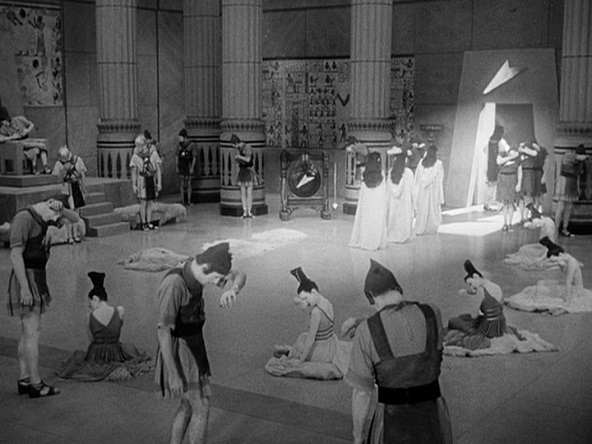
Again, movies invested the theme with periodic updates. Philip Wylie also wrote the screenplay for the 1933 Wells-sourced ‘The Invisible Man’. He then adapted the first version of Moreau into ‘Island Of Lost Souls’ (1933). Charles Laughton was cast as a sadistic whip-wielding Moreau, ably supported by Bela Lugosi and Leila Hyams in a studio-set jungle island. Yet his ‘House of Pain’ is one of cine-world’s most unwholesome mad laboratories, where the Puma Man is transgendered into a sexed-up Panther-woman. Again, Wells was less than pleased with the result, and can’t have been too distressed when the British Board of Censorship refused to grant the film a certificate on the grounds of its sex, horror, and cruelty. Burt Lancaster next inherited the Moreau mantle for a 1977 version under the original Wells’ title, in a cast that included Richard Basehart, and the Beast-Folk upgraded as humanimals. More recently, Marlon Brando became Moreau in 1996, with Val Kilmer, an airplane crash and DNA injections replacing crude vivisection. 


Meanwhile, Brian Aldiss is a superb writer with a particularly well-informed sense of genre history who has elsewhere integrated Mary Shelley and Dracula into his fiction. His ‘Moreau’s Other Island’ is more a parallel history, or a sequel, with Calvert Madle Roberts the sole survivor of Space-Shuttle ‘Leda’ returning from a Moon-base as global war breaks out. He reaches the island of Mortimer Dart, a deformed thalidomide victim who styles himself the ‘Einstein of revolutionary biology’. In this novel Moreau was a real person – in fact the genuine McMoreau even sued Wells for defamation! And Roberts finds himself trapped on the island where the descendents of his Beast-Folk still live, subservient to their new master. While closely tracking the contours of Wells tale, it assumes added dimensions of its own. A cunning elision of literary games and sharply original insight. Yet it also proves the remarkable durability of the original theme. Wells final ‘note’ that, ‘strange as it may seem to the unscientific reader, there can be no denying that, whatever amount of credibility attaches to the detail of this story, the manufacture of monsters – and perhaps even quasi-human monsters – is within the possibilities of vivisection’. A chilling possibility far closer now than it was then.


In his homage ‘The Space Machine’ (1976) Chris Priest attempts to fuse ‘The Time Machine’ with ‘War Of The Worlds’, so that his ‘chronic argonauts’ Amelia and Edward Turnbull’s temporal shift conforms to the movement of bodies within the solar system, something that most time-travel fiction ignores, so that they find himself on Mars in time to become involved in Wells’ 1893 invasion. More successfully Stephen Baxter’s wonderful ‘The Time Ships’ (1995), authorised by the Wells’ estate, takes the pulse of Wells brief novella and extends it across millennia, while staying true to the style and continuum of its progenitor. 

There have been two movies generated from ‘The Time Machine’, the first – again, from George Pal (1960) starred Rod Taylor and Yvette Mimieux, the second – directed by Simon Wells in 2002, featured Guy Pearce and Samantha Mumba (as his Eloi companion Weena). The former, despite lacking access to CGI technology, conjures some brilliantly innovative speed-sequences of the accelerating centuries. Including the rapid-flick of changing fashions worn by the manikin in the store-front window. The Time Traveller also stops off to witness the outbreak of nuclear war in August 1966. The latter, despite its CGI, is a less credible attempt to reintegrate material from Wells’ seminal “The Chronic Argonauts” (in the April, May & June 1888 issues of ‘The Science Schools Journal’) with the novel that followed. This time he introduces the linking-motif of the holographic librarian, and stops off to witness the disintegration of the Moon. Yet neither can capture the vivid scope of Wells’ fiction as his unnamed protagonist jaunts through time ‘still gaining velocity’ from his workshop in Richmond to the decadent and degenerating 802,701AD. Then, fleeing the Morlocks, he hurtles uncontrollably on to 30,000,000, to discover a world lit by a bloated motionless sun fixed upon the horizon beside a tideless sea in chill thinning air. He time-jumps further, ‘drawn on by the mystery of the Earth’s fate’, and a ‘sense of abominable desolation’ to the frigid beauty of an eclipse at the bleak end of time. These evocative passages filled me with awe and wonder when I first read them as a schoolboy, and they retain their jarring intensity through each subsequent reading across the years since. It remains one of the most powerfully affecting sequences in the entire history of SF. Theoretical Physics still argues the existence of tachyons that may reverse the flow of time. But although the novel uses what Verne dismissed as the pseudo-science device of time-travel, which ensures the events depicted could never be related in any other literary genre, it’s always the consummate word-mastery and skilful storytelling that comes first. 


There’s an assumption that the futures Wells projects are pessimistic. That’s not how I read them. There’s certainly a corrosion of his energetic positivism in later life, assailed by advancing years, ill-health and his disappointment with the way the world was heading, culminating in ‘Mind At The End Of Its Tether’ (1945). But back in 1895 it’s his vibrant sense of the precarious nature of life that rings through most clearly, by reflecting the arbitrary and amoral forces that shape it. In ‘War Of The Worlds’ it was not human ingenuity or heroism that defeats the alien ‘intellects vast and cool and unsympathetic’, it was their incidental vulnerability to terrestrial microbes, to ‘the transient creatures that swarm and multiply in a drop of water’, an idea Wells seeds in the novel’s first paragraph. The human race is entirely incidental to the outcome.


The racial bifurcation in ‘The Time Machine’ reflects the same existential chance logic. Yet, coming just thirty-three years after the world-shifting publication of Charles Darwin’s ‘Origin Of The Species’ (1859), it’s basic assumption confronts head-on those who persisted in the notion that humans were uniquely divinely created to have dominion over the world, that conversely they were just another species of ‘beasts of the field’ subject to the same changes and, in the long-term, extinction as any other animal. For us, the passage of time has blunted just how dangerously extremist that fictional assumption was. Rationally, it’s unreasonable to expect evolutionary changes not to occur over vast epochs of time. And these will be similarly random, determined by unpredictable factors, and not necessarily beneficial. There’s an argument that consciousness and science will ultimately exert their own control to edit blind evolutionary forces, but that could prove dangerously hubristic, with unexpected side-effects. After Wells, Olaf Stapledon plotted an equally diverse future of extravagant bio-changes in ‘Last And First Men’ (1930), and Stephen Baxter’s ‘Evolution’ (2002) does the same by encompassing a vista of 565-million years. But again, Wells did it first. And his final vision of the dying Earth? Astronomers predict the cooling sun, and the heat-death of the universe. That’s not pessimism, it just is. It was Wells distinction to be the first with the imaginative courage to dare visualise it. The bottom line is, HG Wells wrote exhilarating adventure, addictive and intellectually energetic, full of unexpected turns and startling revelations. True now as it was then.


When it comes to future-war, Bert Smallways gets accidentally involved in Prince Karl Albert’s massive airship raid on New York, leading to global catastrophe in ‘War In The Air’ (1908). And at the dawn of SF-movies HG Wells adapted his own novel into a screenplay for the great British director Alexander Korda, to produce the uncompromisingly ambitious ‘Things To Come’ (1936). Projecting the future from 1936 to the year 2036, and set in ‘Everytown’, it shows an endless European war precipitating a collapse of civilisation, illuminated in then-big-budget black-and-white footage described by Frederik Pohl as ‘almost a documentary’. By 1970 impoverished dictators have carved out petty realms in the rubble, and tribal leader The Boss (Ralph Richardson) is amazed to witness the arrival of a futuristic armada of massive double-hulled propeller-powered aircraft. Led by John Cabal (Raymond Massey), they are representatives of the ‘Wings Over The World’ reconstruction organisation based in Basra, southern Iraq. With blunt symbolism, they initiate the rise of an idealistic new science-based culture, the triumph of World Government and the forces of progress as a controversial Moon-gun project launches a young couple into space in defiance of the protests of conservative opposition. Massey delivers a final idealistically inspiring speech posing a future that offers ‘all the universe, or nothing. Which shall it be?’ If it looks ‘pretty quaint now’ as Pohl points out, ‘so will ‘Star Wars’ in another forty years.’ But like others of his generation, Pohl admits that ‘every frame is engraved on my mind’ (in ‘The Way The Future Was’, 1979), and its vision of the soaring futuristic architecture of towering cities, of clothing and technology of imagined tomorrows cast a ubiquitous influence on the imaginings of fantasists and comic-book artists to come. 


‘The First Men In The Moon’ has had a less distinguished history of transfer to other media. There have been ‘Classics Illustrated’ comic-book translations into picture-strip form. And a mildly entertaining, tongue-in-tongue big-budget movie (1964) which is largely judged a failure despite the talents of writer Nigel Kneale – who introduces ‘Katherine Callender’ (actress Martha Hyer) as love-interest, and genius stop-motion effects-animator Ray Harryhausen to visualise Moon Cows and the Prime Lunar. Although carrying a dedication to actor Lionel Jeffries – its ‘Professor Joseph Cavor’, the Mark Gatiss TV (2010) interpretation is an altogether more satisfying proposition. Yes, the pacing is leisurely, but within its ninety-minute duration it’s seething with incident. It is very much a dialogue between Professor Cavor (Mark Gatiss) and excitable businessman Mr Bedford (played by Rory Kinnear) who seizes upon the commercial potential of the invention of a gravity-opaque material. But it’s that quality that perfectly suits the introspective melancholy mood of the film, and marks it out as distinctive. 

Like the Time Traveller, Cavor is an eccentric back-room scientist who stumbles across his remarkable breakthrough using only the resources of his own intellect. Although this is a less fashionable approach to driving innovation than it is in today’s more massive corporate business environment, that surely does not entirely disqualify the concept of the lone pioneering genius? Verne had fired his lunar-nauts from a giant cannon, but would not allow his characters to land on the moon, because once there he couldn’t then contrive a way of getting them off and back home again. Wells quasi-scientific Cavorite might repeal the laws of physics, but it neatly gets around that problem.


Perhaps the major flaw in the novel’s filmability is that once on the moon the duo not only discover a tenuous, yet breathable atmosphere, but also a complex subterranean civilisation too. Neither of which, if scarcely feasible then, are feasible now. Edgar Rice Burroughs wrote his own fictions about a hidden lunar inner-world accessed by travelling through crater-openings in the moon’s surface, but, entrancing story-teller that he was, no-one ever suggested that ERB allowed science or rationality to limit his imagination. There was fiction clear into the fifties which conjectured some form of life on the Moon, although the passing of each year meant this was increasingly disreputable. Until the Moon landing in 1969 flipped decades of inaccurate speculation over onto the TV-news. The existence of life on Mars, once more-or-less taken for granted, went through its own long-drawn-out retraction in an exact ratio to the increasing sophistication of astronomical science. Researchers are now looking to find evidence of, less the lost civilisations of ERB’s Barsoom, and instead, just maybe, the brief existence of viral micro-organisms billions of years in the past. Yet there were still movies themed around native Martian life-forms into the nineties. Around the time Ben Bova’s novels were reinvestigating Mars, and finding dead Martians, however unlikely the possibility. But the Moon remains beyond the pale of serious speculations. After all, astronauts have been there. We know. Which presents a problem when dramatising the Wells novel. 


The ingenious solution provided by Mark Gatiss was to meet the conundrum head-on. To use Neil Armstrong’s ‘small step’ to kick off the narrative, with an ageing Bedford relating the story of his youthful exploit to a fascinated young boy in a tent-show. Yes, the Edwardian expedition had taken place according to Wells’ novel, clear down to their capture by the insectoid Selenites and their interrogation by the Grand Lunar. But in an inventive denouement it was Cavor himself, anticipating the terrible conflict ahead as the two races come into confrontation, who uses Cavorite to blast a puncture-hole in the lunar caverns and evacuate the sparse atmosphere into space. A possibility he’d already posited in an earlier sequence in his laboratory on Earth. The result is, there was an atmosphere and Selenites then, but there is no atmosphere or Selenites now because his actions have made it so. As a result, Wells’ fiction stands, with only marginal fine-tuning. Yet, cheekily, the closing footage of astronauts cavorting on the dusty surface of the Sea of Tranquillity, hints at a lone Selenite observing them from behind a rocky outcrop! 


Much SF from earlier decades has since been superseded by events and scientific discovery. Yet it’s still read and enjoyed, even if it’s necessary to shunt the events portrayed off into some kind of parallel universe where things are different. Precisely because HG Wells preferred the ‘imaginative jump’ to a technical explanation, because he seldom relied upon pseudo-science-fictional gimmicks since tested and found wanting, and based his enduring appeal on story-telling skills, his tales remain immensely readable. Wells’ biographer Lovat Dickson praises ‘the sweep and force of (his) descriptive writing, which rises at points to wonderful heights. There are moments of unsurpassable majesty – the death of the world in ‘The Time Machine’, the howling in the twilight on Primrose Hill of the last Martian left alive in devastated London, the death of the Invisible Man, the lunar landscapes of ‘The First Men In The Moon’, the chanting of the beasts in ‘The Island Of Dr Moreau’. Moments, in fact, when the language becomes an incantation, and one is aware of surrendering to some emotion not ordinarily felt in reading. Language alone could not do this, it is the accompaniment to the theme. But it lifts the imagination to a level at which the reader not only surrenders disbelief, but positively wills belief’ (‘HG Wells: His Turbulent Life And Times’, Penguin Books 1969).


HG Wells was the originator. To Brian Aldiss he was the ‘Shakespeare of Science Fiction’, the primal ignition-point from whom all else flows. When he died, in 1946 at the age of eighty, all of his major works were still in print, and would remain so, while his literary standing would only increase as SF became a respectable subject for academic study. It’s possible to argue his enduring significance purely from the point of view of his influence. How much media has been spun off, for example, from the single concept of invisibility? The Wells tale of the overreaching scientist who suffers from both the effects, and the side-effects of his discovery. There have been movies of the story. Then TV series. And movies developing the idea of induced-invisibility in a multitude of directions. But despite the deluge, it’s still more than possible to be drawn into Wells’ original novella and read it with a sense of suspenseful enjoyment. And that’s the real value of HG Wells’ legacy. 

See also:
and

Featured on the website: 
THIS WAY UP (2 March)’ 
(UK – March 2011)


Sunday, 24 April 2022

Lost Sci-Fi Movie: 'The Mole People'


‘I AM A MOLE, &
 
I LIVE IN A HOLE…’ 


Review of: 
‘THE MOLE PEOPLE’ 
(Universal International, 1956) Director: Virgil W Vogel. 
Writer: LĂ¡szlĂ³ Görög. With John Agar, Cynthia Patrick, 
Hugh Beaumont & Alan Napier with Dr Frank C Baxter 
as himself (DVD, Silversun Media Group, 2011)


There’s an entire sub-genre of Science Fiction dealing with subterranean adventure, which extends all the way from Jules Verne’s ‘Journey To The Centre Of The Earth’ (1846), through Edgar Rice Burroughs’ fantastic exploits set in the vast Hollow Earth interior-realm of ‘Pellucidar’ and John Wyndham’s ‘The Secret People’ (1935) trapped in a system of caverns beneath the Sahara, into – in movie terms at least, the plunge into the caving splatter-shocker ‘The Descent’ (2005). Among my own favourites is the wonderful “Tumithak Of The Corridors” by Charles R Tanner, a story from ‘Amazing Stories’ January 1932, in which our courageous young hero ventures upwards through endless tunnels from his Lost World towards a devastated planetary surface he’s never seen. 

Oddly, there’s also a considerable body of fringe theoretical work that strives to validate such fiction. In fact a certain Dr Frank C Baxter, supposedly a Professor of English at the University of Southern California, is dragged onto the set of ‘The Mole People’ to contribute a pre-credit framing sequence outlining the historical evidence for such unorthodox ideas. There’s subsequently been much film-buff fun derived from debating whether the Doctor is a studio invention, or a genuine academic hoodwinked, or bribed into delivering his to-camera seminary. The consensus seems to be he was genuine, if deluded. But as he tells us, there’s generations of cranks and weirdoes from Dante, to people with names like John Cleves Symmes Jr or Cyrus Reed Teed who’ve imagined the world to be constructed like some kind of Russian Doll made up of a system of concentric spheres, each inhabited by races of people who consider theirs to be the true ‘surface’. Others, including prominent Nazis, have mounted Arctic expeditions hunting the polar openings to a hidden inner Hollow World. So does all this learned dissertation add credence to ‘The Mole People’? Naw, it’s still just enjoyable hokum! 


As Forrest J Ackerman wrote on the occasion of its original release, this is a film ‘about an underground movement. It takes place in a subterranean city of lost Sumerians, unfortunately found by a hero-scientist, and abounds with mutants, despots, high priests, sacrificial maidens and all the ingredients that made great serials…’ (in ‘Nebula no.19’, December 1956). He’s right, retro-devotees of the old ‘Flash Gordon’ cine-matinee cliff-hangers will get off on this. The credits-list even dramatically ascends from a seething volcanic crater. There’s an Indiana Jones opener with archaeologists somewhere in a mountainous Himalayan dig unearthing a stone tablet bearing cuneiform script, then an engraved oil-lamp inscribed with pictograms of the ‘Sumerian version of the Ark’. Once deciphered the tablet shatters in a convenient earth-tremor. There’s some talk about the Epic of Gilgamesh, tied in with the 5,000-year-old ‘great flood level’ left by Noah’s inundation. Enough people back then still took that Old Testicle hoopla seriously, enough people maybe to get them onside by drawing that into the film’s mythic stew? But when the character says ‘there must be some rational scientific explanation to this’, there’s the memory of Dr Baxter in his book-lined study chiding ‘this is science fiction of course, it’s a fiction, it’s a fable beyond fiction’. 

Following the directions they’ve found, Doctors Roger Bentley (John Agar) and Jud Bellamin (Hugh Beaumont) lead their expedition in a 20,000ft ascent above the snowline towards the distant mountain summit. Firstly an avalanche reveals a human hand in the snow, then they find the ruins of a temple on the plateau. Dr Paul Stuart (Phil Chambers) disappears down a rift, and when the duo descend to rescue him, a further rockfall traps them all. Exploring their new domain they discover they’re not in a natural cavern, it’s been excavated, while strange eyes peer out at them and a deformed hand gropes through a hole in the tunnel wall. Inevitably they find themselves wandering into a vast illuminated cavern with background matte paintings representing the lost city, and suddenly hey, ‘we’re in 3,000BC’. 


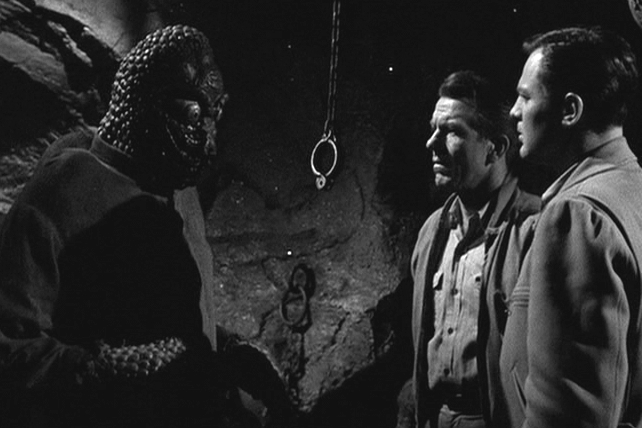
There are people here, of a kind. As they try to sleep, something nasty scrabbles its way up out of the shingle, hoods them with its mole-hands, and drags them down into a cave of misshapen skeletons. These are the buggy-eyed warty-domed ‘beasts of the dark’. Then there’s the city’s pale albino’s who control the mole-people with whips. Oddly, there are Egyptian wall-murals too, a fantasy exotic dancer, and three sacrificial maidens who walk naked into the execution chamber to be microwaved to a crisp, to appease Ishtar’s anger. The subterranean’s enlarged pupils are super-sensitive to light, making Bentley’s torch both an effective weapon, and ‘the fire of Ishtar’ that provides proof of their supposed divinity. As a result they become royal guests, feasting on fungus, cave rat and fish, while the malevolently-suspicious Ming-like High Priest Elinu (Alan Napier), in his fringed helmet and three prongs of wispy beard, fears they’re undermining his power, and schemes to steal the magic torch.


It’s sharp black-&-white film-stock, and although the cast lacks charisma, there’s sparse sharp humour too. As they explore, hunting for an exit to the outer world, the weakened Stuart, in his stylish leather jacket, is killed. He’s laid ‘to rest where he always lived, in the world of the past!’ Then the surviving duo banter ‘why don’t we give up and apply for Sumerian citizenship?’ the other responds ‘I don’t like mushrooms!’ They speculate that the city must have been constructed on a rigid volcanic crust, which then collapsed down into the mountain’s interior. But all the while their democratic all-American values are destabilising a social structure that’s remained intact for five millennia.


Roger saves serving-girl Adad from a beating. Given to him as a slave she protests ‘free, what is free?’ Then he saves a starving mole-man from a beating, hence encouraging a revolt. Finally Elinu drugs them, steals the torch, and casts them into the execution chamber. Adad leads the freed mole-men to storm the temple where the priest confidently brandishes the stolen torch – only to find it no longer works, the batteries are dead, and they tear him to pieces with their mole-talons. Meanwhile, the duo learn the ‘burning light’ of execution is merely a shaft of natural light from the outside which the subterranean’s pigmentation-lack renders them fatally vulnerable to. But to them – and Adad who is an immune throwback, it provides an escape-climb to freedom. They reach the surface in the nick of time before an earthquake destroys the lost world. Pointlessly it kills Adad too, to little narrative purpose. And only the two archaeologists walk away. 

For Universal studios, who’d dominated Horror movies through the 1930’s with BĂ©la Lugosi and Boris Karloff, ‘The Mole People’ was a late attempt to revive their fortunes by jumping the 1950’s SF bandwagon. As such it’s a perfect little Lost Worlds film, an engagingly cranky little curio of interest only to devotees who like that sort of thing. In 1968 a record called “We Are The Moles” by the Moles attracted some attention, largely because it was rumored to be by the Beatles under an assumed alias. It wasn’t. It was by Simon Dupree & The Big Sound, under an assumed alias.


‘TERRIFYING MONSTERS FROM A LOST AGE…! 

‘THE MOLE PEOPLE’ (Universal International, 1956) 
Producer: William Alland. Director: Virgil W Vogel. Writer: LĂ¡szlĂ³ Görög. With John Agar (as Dr Roger Bentley), Cynthia Patrick (as Adad), Hugh Beaumont (as Dr Jud Bellamin), Alan Napier (Elinu, the High Priest), Nestor Paiva (Prof Etienne Lafarge), Phil Chambers (Dr Paul Stuart), Rodd Redwing (Nazar), Robin Hughes (First Officer), Dr Frank C Baxter (who appears as himself), plus Bob Herron, Robert F Hoy, Eddie Parker & Joe Rubino as ‘Mole People’. Music by Heinz Roemheld, Hans J Salter & Herman Stein (DVD, Silversun Media Group, 2011)
 

Featured on website: 
‘VIDEOVISTA (Feb)’ 
(UK – February 2011)


Tuesday, 29 March 2022

Poem: 'A Taste For Butterflies'


A TASTE FOR BUTTERFLIES/ 
THE WORLD IS FULL OF MATCHING PAIRS 


I’m thinking of you skinny-dipping in your pool 
airplane lights rippling the reflected stars above 
the big dipper trickling water 
across the northwestern sky, 
cascading stardust into your pool as you bathe 
chasing little bits of stardust across your body 
kissing the starbursts springing over your skin 

I message you this memory, 
for love knows no gravity, 
love has its hemispheres, 
when you read AnaĂ¯s Nin 
it leaves unsettling emptiness, 
you paint in your studio 
in mystical languages 
that tease my senses, 
we live in hope 
beyond our means, 
you message intimate photos 
of your body to my laptop… 

we meet for coffee 
with serious amorous intent 
I’m at your tender mercies, 
but you don’t have 
to be too tender, for 
we cut into now, and 
our tomorrow bleeds away, 
then we go to bed together 
you in Seattle 
me in Yorkshire…


Monday, 28 March 2022

Retro Pop: Brian Hyland & Johnny Tillotson


BRIAN HYLAND: 
 
SEALED WITH 

A TEENAGE KISS 


“Sealed With A Kiss” and “Poetry In Motion” were two 
career-defining hits on the cusp of the fifties into the sixties, 
and Brian Hyland and Johnny Tillotson both have tales to tell…


What I’ve never been able to understand is how the Boy Band – whose sole function is surely to be visually appealing, have turned out to be such unattractive examples of masculine youth. When it comes to good-looking pin-up faux-Boyfriends aimed at impressionable pubertal girls, the 1950s when Rock first got Rolling, beats them hands down. Ricky Nelson was pretty to the max, Bobby Vee had that cute smile, even a moody young Cliff Richard had charisma, before we even get to the searing sexuality of Elvis Presley himself! Then there was Brian Hyland, even younger and prettier than the rest. 

He began with a novelty hit record. It must seem an irresistible opportunity to break on through to instant fame and to reach a wider audience. Yet the downside of the equation is that the follow-up seldom happens. In most cases, a novelty is – almost by definition, a brief one-off fad that is impossible to replicate. Brian Hyland is one of the few who pulled off that unlikely comeback achievement. Born 12 November 1943, in New York’s Queens district, he sang in the choir of the Roman Catholic Church at Woodhaven, Long Island, and also sang with the Del-Fi’s, a Doo-Wop harmony group of school-friends. A disc cut privately by the group and sent to music companies, resulted in Brian being singled out by David Kapp and signed to Kapp records as a solo artist, issuing his debut single – “Rosemary”, in late 1959. 

The Brill Building writing team of Paul Vance and Lee Pockriss tried him out with the slight catchy novelty song “Four Little Heels (The Clickety-Clack Song)” which made sufficient waves to indicate potential. Brian was only fifteen when his recording of the team’s song “Itsy Bitsy Teeny Weeny Yellow Polka Dot Bikini” on the Leader label went into the US Hot Hundred. It topped the Billboard chart, and entered Britain’s ‘New Musical Express’ chart at no.29 (9 July 1960), climbing to no.10 by 13 August in a list topped by Cliff Richard’s lip-curling Rocker “Please Don’t Tease” and the Shadow’s “Apache”. It did marginally better over on the rival ‘Record Mirror’ chart where it peaked at a no.8. Its success meant that “Four Little Heels” was re-promoted and made a fleeting appearance, up to no.34 (20 October 1960). 

The 1950s was a strangely insular period for post-war Britain, an inwardness reflected in the tightly restricted horizons offered by home-grown Pop music. Its American equivalent seemed a distant and more exotic world. When Perry Como sang about the Moon hitting your eye like a big pizza pie – on “That’s Amore”, the general reaction was to ask what, exactly, is a pizza pie? Jerry Keller’s “Here Comes Summer” consists of trips to drive-in movies, while not only did British kids not have drive-in movies, but there might possibly be just one family car, driven by Dad. And when Jerry Keller kisses his girl it makes his flat-top curl. What the hell does that mean? We now know it means a kind of crop-headed high-school hairstyle. Back then it was simply a code for that jukebox soda-Pop life-style that we could only imagine. The bikini we could understand. We’d seen the photos in magazines. In fact the situation envisaged by the song could easily have been a saucy Bamforth seaside postcard, with the embarrassed semi-immersed girl in her scanty two-piece swimsuit ogled by a red-nosed oldster in a flat-cap berated by his harridan wife, as the seagull loops above. Except that on the surviving TV-clips Brian looks as cute and vulnerable as she did, and his innocent non-threatening delivery neatly robs the song of any suggestive content. His sympathies lie with her. There’s no faint trace-elements of nudge-nudge lewd innuendo. 


The song’s appeal was international, making it a hit in Ireland, Israel, Norway, Sweden and across South America. But there was a suspicion that the lyric, about the shy young girl embarrassed by wearing her skimpy swimwear, was something time-locked back in the more modest 1950s. Haven’t costumes got even skimpier and attitudes more blatant? Yet it returned to the chart, and finally hit the UK no.1 spot in November 1990, through the guise of Bombalurina, produced by Andrew Lloyd Webber, and widely assumed to be sung by children’s TV-star Timmy Mallett, although he later admitted that it was not his voice, as he was unable to hit the high notes. 

But meanwhile, because Brian’s debut hit had been a gimmicky record in the style of Paul Evans’ more knowing “Seven Little Girls (Sitting In The Back Seat)” – also by Lee Pockriss, but with co-writer Bob Hilliard, it was inevitably followed by the similarly odd “Lop-Sided, Overloaded And It Wiggled When I Rode It”, a paean to ‘our wacky little car’ which basically rewrites the ‘Bikini’ format with added comedy sound-effects. But Brian returned from a three-week Tokyo engagement to sign with ABC-Paramount who were more open to expanding his range, and “Let Me Belong To You” was more successful a year later, Brian’s first venture into big romance-balladry. ‘Make me your slave’ he utters unconvincingly at the midpoint, ‘tie me down and make me behave’ as Stan Applebaum’s orchestra and chorus soar to power-crescendos that recall some of Brenda Lee’s emotion-overload hits. 

Yet Brian had to wait until 1962 when he scored two straight Top Ten hits for ABC Records, “Ginny Come Lately” and “Sealed With A Kiss” – both controlled exercises in teen angst. With UK distribution switched from London-American to HMV, first, there’s a twist on the Johnny-come-lately idea, the New Girl At School theme, an acoustic guitar figure, gently-brushed percussion, an uncluttered production with unobtrusive strings and backing vocals, but a line about her ‘soft soft silhouette’ that could set adolescent pulses racing. And oh, the delicious agonies of teenage yearning that she evokes, she only had to smile, a little smile, nothing more than look at him, she only had to smile and in a little while he was dreaming recklessly. Written by the Gary Geld and lyricist Peter Udell team, there’s a tremulous naivety to the way he sings that makes it come totally real, there’s no postmodern awareness, no hint of insincerity to betray his feelings. 

From the same songwriting duo “Sealed With A Kiss” takes the hopeless romance of “Ginny Come Lately” a step further, with soft harmonica, muted dual-tracking, and just the correct edge of restrained passion in his voice. A sparse production of a simple melodic refrain, yet instantly unforgettably memorable. The season is over, school is done, they’re heading away for the long vacation from the parental home, but it’s gonna be a cold, lonely summer… will their romance survive their enforced months of separation, with only the words in his love-letters to fill the emptiness and take her heart away? ‘I’ll see you in the sunlight, I’ll hear your voice everywhere, I’ll run to tenderly hold you, but darling, you won’t be there.’ As far as he’s concerned, it might as well rain until September. Will their pledge to meet in the Fall be fulfilled, or will there be new distractions, new soft soft silhouettes to lure his attentions?


Sometimes, to create enduring memories, Pop music doesn’t need to make statements or define a generation. It just needs to be charming. The single entered the ‘New Musical Express’ chart at no.27 (11 August 1962), climbed to no.14, then no.8 and no.6 to peak at no.5 (8 September) as Frank Ifield’s yodelling “I Remember You” topped the chart. “Warmed Over Kisses” followed it into the chart at no.30 (3 November 1962), a few places below Johnny Tillotson’s “Send Me The Pillow You Dream On”, the week after the Beatles made their chart debut with “Love Me Do”. With a Country-style piano run “Warmed Over Kisses” is the third in a Geld-Udell trilogy of appealing singles as he anticipates that his girl is about to leave him for a new boy, ‘I see I gotta be headed for pain, I see a broken heart wearin’ my name…’ The song was later effectively revived by Dave Edmunds. But meanwhile, in early 1963, Brian toured the UK as part of a package-show with Little Eva and the Brook Brothers. 

This tight little handful of hits – an arc of songs tracking love from first anticipations, through enforced separation towards the final parting, proved to be the high point of Brian’s career. Other artists had more hits. Other Teen Heart-throbs had moodier more charismatic image. But when it came to sixties nostalgia, and the endless procession of hits compilations that resulted, Brian Hyland was always there. Looking back with the benefit of hindsight it seems to have been a kinder less hectic era, when issues were simpler and more clearly defined. If Rock was a revolution, it was only in the sense that kids demanded a change, they got it, and it was here to stay. But when it comes to the lure of fame and fortune, competition is always going to be intense. 

In Britain the recording scene was locked into a monopoly of labels, EMI, Decca and maybe Philips. If you weren’t signed to one of these dominant majors, your career didn’t stand a chance. There was no independent sector that would take a chance with a new unknown. In the States it was different, there was a mass of little regional labels all hunting that one hit record ahead of the trend curve that would break-out nationally and elevate them into big-time players. And if naĂ¯ve young singers were exploited by ruthless industry forces, naĂ¯ve young singers have always been exploited, and their naĂ¯vetĂ© will always be taken advantage of. Same as it ever was. Same as it ever was. Some singers luck into levels of fame that their abilities perhaps never justify, through a combination of being in the right place at the right time, with a song that gets exactly the right promotional airtime boost or lucky TV spot. Other more able talents languish. Which is why archivists and vinyl junkies keep rediscovering neglected gems of Rockabilly, Northern Soul or Freakbeat. Or just sweet Soda-pop Pop to soundtrack nostalgia TV-movies.


In a time of Pin-up picture-romance magazines with titles like ‘Roxy’, ‘Valentine’, ‘Mirabelle’, and most opaque of all, ‘Boyfriend’, these pretty Pop Stars were surrogate boyfriends targeted at the adolescent dreams of teenage girls, a rehearsal for – or an alternative until the real thing comes along. While the boys at school or in the office might have acne or poor personal hygiene problems, Bobby Vee, Ricky Nelson, Billy Fury – Brian Hyland or Johnny Tillotson were never less than photogenically pristine. In a few years time it would be Paul McCartney or Billy J Kramer on the fan-mag covers, then Donny Osmond and David Essex, before descending to Westlife and Boyzone. But for those few early-sixties years these were the Boyfriends of choice with songs of sweet innocence perfectly matched to the time. 

‘Those early days made me very paranoid’ Brian told journalist Michael Watts, ‘I had a million-selling record and I wasn’t ready for it. I was just thrown out onto gigs. I was sixteen and doing shows for maybe ten and twenty-thousand people. I hadn’t worked to attain it. I guess, unlike most people, I’ve never really had the time in my life between sixteen and twenty-one when you can be really loose. I was always being told, hide that cigarette, hide that drink. And all around were older people – promotion men, managers etc’ (‘Melody Maker’ March 1971). Yet in his home country Brian continued recording with ABC, Philips and Dot – on which he had a Top Twenty hit with the bright bubble-Pop Snuff Garrett-produced and Leon Russell-arranged “The Joker Went Wild” in 1966. 

Then Brian moved to California, signed to the Liberty-subsidiary Uni, and came under the production supervision of Del Shannon who he’d first met when they toured together in 1961, but whose own hit-making career was in decline. They began to write and record together, and it was with Del producing that Brian had his final hit, “Gypsy Woman” in 1970. A slick effortless trip around the Curtis Mayfield song – ‘she danced around and around to a guitar melody,’ enhanced by Romany violins, electric piano and near-falsetto passages. After his teen-idol phase, although still only in his late-twenties, this was evidence of a more mature Brian Hyland. Then “Sealed With A Kiss” became a UK Top Ten hit all over again in Britain when it was reissued in 1975, and Brian flew in for a ‘Top Of The Pops’ appearance – sealed with a royalty cheque!, causing comment by sporting a seriously off-trend pony-tail! While the song proved its longevity by charting yet again for Jason Donovan.

Johnny Tillotson

 
Time changes everything into its opposite, youth into age, innocence into experience, certainty into uncertainty. Only the hits remain unchanged, although they’re seen through an increasingly distorting lens. Johnny Tillotson’s “Poetry In Motion” knocked Cliff Richard off the no.1 spot (with “I Love You”), to reign for the two weeks of 12th and 19th January 1961, before in turn being deposed by Elvis Presley (“Are You Lonesome Tonight?”). Johnny’s only substantial UK hit, it was nevertheless all he needs to become indelibly part of the Pop landscape. If the title wasn’t necessarily freshly-minted, it passed into common currency with renewed power. ‘P-P-P-P-Poetry In Motion’ bounces with contagious energies, as he celebrates his girl’s ‘gentle sway… no wave out on the ocean, could ever move that way.’ When little literary magazines and Bardic verse-readings playfully adopt ‘Poetry In Motion’ as a titular flag of convenience, following the Love-Story-In-Pictures adaptation, it is to this bright uncomplicated hymn to the joys of love that they’re cocking their hats. ‘She doesn’t need improvement, there’s nothing I would change’ he sings in high clear articulation and total conviction, ‘she’s much too nice to re-arr-range.’ Written by the New York duo of Paul Kauffman with Mike Anthony, and issued here on the distinctive black-&-silver London label, the record was instantly everywhere. 

Unlike Brian Hyland, Johnny was originally seen as a Country singer who claimed Hank Williams as his greatest influence. He was born in Jacksonville, Florida on 20 April 1939, and was talent-spotted at the Nashville ‘Pet Milk’ talent show, from where the baby-faced teenager was astutely signed to Archie Bleyer’s Cadence Records which was then enjoying huge success with the Everly Brothers, as well as The Chordettes and Andy Williams. His debut hit, “Poetry In Motion” was recorded twice, first unsatisfactorily in New York, then a second time in Nashville where studio sessions with Floyd Cramer’s piano and Boots Randolph’s sax, deliver pristine Teen-vinyl. 


Between 1958 and 1966 Johnny was rarely out of the US Pop charts, enjoying some twenty-five Hot Hundred records including “Without You” (no.7), “It Keeps Right On A-Hurtin’” (no.3), the syrupy “Send Me The Pillow You Dream On” (no.17) and – in a curious twist, a cover of Kenny Lynch’s UK hit “You Can Never Stop Me Loving You” (no.24). Some of his hits ventured into a strong backbeat, but he was never less than parentally-approved, and clear-voiced with no rough edges. When the Everly Brothers quit Cadence for the newly-launched Warner Brothers records, Bleyer wound up his label, with Andy Williams acquiring many of the masters. While Johnny Tillotson simply re-signed to MGM, and soon returned to the Top Ten with the saccharin “Talk Back Trembling Lips”. And it was melancholic Country songs that would guarantee him a loyal audience long after his Pop career declined, as ‘Melody Maker’ phrased it, ‘Remember Johnny? Gather round all ye lovers of olde Pop and drift in mists of sentiment with the ballad ‘n’ country voice of Tillotson’ (January 1967). 

Sometimes, to create enduring memories, Pop music just needs to be charming. “Sealed With A Kiss” and “Poetry In Motion” need nothing more.


BRIAN HYLAND UK HITS 

7 July 1960 – ‘Itsy Bitsy Teeny Weeny Yellow Polka Dot Bikini’ c/w ‘Don’t Dilly Dally, Sally’ (London HLR 9161) hits no.8, on the chart for 13 weeks. US no.1 on Billboard chart (Leader 805) 

20 October 1960 – ‘Four Little Heels’ c/w ‘That’s How Much’ (London HLR 9203) hits no.29, on the chart for six weeks. 

November 1960 – ‘Lop-Sided Over-Loaded (And It Wiggles When We Rode It)’ c/w ‘I Gotta Go (‘Cause I Love You)’ (US Kapp K-363X) issues in UK as London 9262. The B-side written by John D Loudermilk. 

4 September 1961 – ‘Let Me Belong To You’ c/w ‘Let It Die’ (ABC-Paramount 10236), no.20 on US Billboard chart. 

10 May 1962 – ‘Ginny Come Lately’ c/w ‘I Should Be Getting’ Better’ (HMV POP 10130) hits no.5, on the chart for 15 weeks. No.21 on US Billboard chart (ABC-Paramount 10294) 

2 August 1962 – ‘Sealed With A Kiss’ c/w ‘Summer Job’ (HMV POP 1015) hits no.3, on the chart for 15 weeks. No.3 on US Billboard chart (ABC-Paramount 10336) 

8 November 1962 – ‘Warmed Over Kisses’ (HMV POP 1079) hits no.28, on the chart for 6 weeks. No.25 on US Billboard chart (ABC-Para 10359) 

6 August 1966 – ‘The Joker Went Wild’ c/w ‘I Can Hear The Rain’ (US, Philips 40377) US no.20, issued in the UK as Philips BF 1508.


26 November 1966 – ‘Run, Run, Look And See’ (US, Philips 40405) US no.25, issued in the UK as Philips BF 1528. 

1966 – LP ‘The Joker Went Wild/ Run Run Look And See’ (Philips BL 7762) which includes ‘Just Out Of Reach’, ‘Yesterday I Had A Girl’, ‘Lavender Blue (Dilly Dilly)’ and the Beatles ‘Norwegian Wood’. ‘Record Mirror’ calls it ‘a bunch of clean-limbed songs… but Pop music here has changed since this type of sound sold well.’ 

March 1967 – ‘Hung Up In Your Eyes’ c/w ‘Why Mine’ (Philips BF 1555), both sides written by Crickets Glen Hardin and Sonny Curtis, ‘Why Mine’ with Snuff ‘TL’ Garrett. 

May 1967 – ‘Holiday For Clowns’ c/w ‘Yesterday I Had A Girl’ (Philips BF 1569. 

August 1967 – ‘Get The Message’ c/w ‘Kinda Groovy’ (Philips BF 1601) 

February 1969 – ‘Tragedy’ c/w ‘You’d Better Stop, And Think It Over’ (Dot 119) 

May 1969 – ‘A Million To One’c/w ‘It Could All Begin Again (In You)’ (Dot 124) 

August 1969 – ‘Stay And Love Me All Summer’ c/w ‘Rainy April Morning’ (UK Dot 128), flip-side written by Brian Hyland. 

10 April 1971 – ‘Gypsy Woman’ c/w ‘You And Me’ (Uni UN 530) hits no.42, on the chart for 5 weeks, US no.3 (UNI 55240). A Curtis Mayfield song, produced by Del Shannon. 

1972 – ‘Only Wanna Make You Happy’ c/w ‘When You’re Lovin’ Me’ (UNI 545), produced by Bobby Hart with Brian Hyland, ‘Melody Maker’ says that ‘I guess Brian sounds as young as ever.’ 

28 June 1975 – ‘Sealed With A Kiss’ (ABC 4059) hits no.7, on the chart for 11 weeks.


JOHNNY TILLOTSON UK HITS 

1 December 1960 – ‘Poetry In Motion’ (London HLA 9231) hits no.1, on the chart for 15 weeks. When it was included on the November 1972 ‘The Best Of Johnny Tillotson’ (MGM) collection the ‘Melody Maker’ reviewer (MO) said ‘I can remember pressing my ears up to the radio, tuned to Luxembourg, at age ten or so in order to catch each fading second of ‘Poetry In Motion’.’ 

2 February 1961 – ‘Jimmy’s Girl’ (London HLA 9275) hits no.43, on the chart for 2 weeks 

12 June 1962 – ‘It Keeps Right On A-Hurtin’’ (London HLA 9550) hits no.31, on the chart for 10 weeks 

4 October 1962 – ‘Send Me The Pillow You Dream On’ (London HLA 9598) hits no.21, on the chart for 10 weeks, in competition with a cover version by Marty Wilde. 

27 December 1962 – ‘I Can’t Help It’ (London HLA 9642) hits no.41, on the chart for 6 weeks 

9 May 1963 – ‘Out Of My Mind’ (London HLA 9695) hits no.34, on the chart for 5 weeks 

1966 – ‘No Love At All’ c/w ‘What Am I Gonna Do’ (MGM) ‘NME’ says ‘a plaintive country-type ballad, sung by Johnny in heartfelt, sob-in-the-throat style, against a background of cascading strings, whispering girls and a slowly plodding beat.’ Co-composed by Tillotson with his wife Lucille Cosanza. The title-song of a January 1967 LP (MGM C8025). 

January 1967 – ‘Tommy Jones’ c/w ‘Strange Things Happen’ (US MGM K13684) 

March 1968 – ‘Cabaret’ c/w ‘If I Were A Rich Man’ (MGM1393), ‘Record Mirror’ says ‘Johnny takes this much-recorded show hit at breakneck speed, I liked it, but I feel it’s in the field a bit late.’ 

14 April 1979 – ‘Poetry In Motion’ (Lightning LIG 9016), a reissue that hits no.67, on the chart for 2 weeks


Sunday, 27 March 2022

SF Classic: 'The Genocides' by Thomas M Disch


THOMAS M DISCH:
 
‘THE GENOCIDES’ 

 
Review of: 
‘THE GENOCIDES’ 
 by THOMAS M DISCH 
(Berkley Medallion, December 1965 
Panther UK paperback, 1968 ISBN 0-586-02420-4)


It opens in the simple rural community of New Tassel, a ramshackle settlement of two-hundred-and forty-seven folk living on the northern shore of Lake Superior as the lake itself recedes to uncover new fertile arable land. With stern ‘strong-willed bigot’ father Anderson, and his two sons, Neil who is lumbering, mean and brutish, and younger more rebellious half-brother Buddy. Among the simple hardworking folk, the ‘Prodigal’ Buddy is the only one to have ventured into the cities of the greater world beyond, to University where the streets were swift-flowing rivers of light… before the fall. Now there are no more cities. There is only the endless green of the alien plant growths that have smothered the planet, stifling all rival forms of life. ‘They had come of a sudden in April of ’72, a billion spores… and within days every inch of ground, farmland and desert, jungle and tundra, was covered with a carpet of richest green.’ 

Neil is married to Buddy’s flirtatious former-girlfriend Greta, who gets wistfully nostalgic for the world they’ve lost. Buddy is married to mousey pregnant Maryann, survivor of a massacred Marauders party up from Minneapolis. The Anderson’s continue much as they always have done, simply adapting their methods by tapping bucketfuls of oozing honey-like sap from the towering smooth-skinned plants that soar to six-hundred feet, and using the sap to fertilise their patient rows of maize in plots hacked out of the growth. Until the next stage of the global take-over begins with the arrival of the ‘incinerators’, signalled when escaping cattle are reduced to ash, along with pursuing younger Anderson son, Jimmie. This levelling of ‘remaining artifacts’ (Disch’s spelling) prefigures the final ‘Good-Bye Western Civilisation’ phase. 

Life on Earth is a precarious thing. Humans have enjoyed ten-thousand years of relative stability. There’s a playful frisson to conjecturing that this condition will not continue indefinitely. The cover-art for the 1979 Panther paperback edition announces ‘The Genocides’ as ‘The Best Post-Disaster Yarn Since ‘The Day Of The Triffids’,’ evoking certain obvious parallels. There’s a suspicious familiarity that the scenario encroaches other post-apocalypse novels, particularly George R Stewart’s 1949 ‘Earth Abides’, even as it assumes elements of Wyndham’s ‘School of Cosy Disaster’ SF. As the ever-perceptive Brian Aldiss points out, although ‘Disch is an American. ‘The Genocides’ is curiously English. It is another story of a dwindling community which has survived a catastrophe, although Disch handles it in his own way’ (in ‘SF Impulse’ no.11). Yet there are other even more precise precedents. There’s a suspiciously similar plot to ‘Earth Our New Eden’ by veteran writer FG Rayer in ‘Authentic Science Fiction no.20’ (15 April 1952), where the Earth is seeded by alien plants, producing a ‘Green Twilight’. ‘The tops of the plants spread like giant ferns, each interlacing with its neighbours. Behind the precipice of alien growth, away to his right, the sun was outlined as a dull red orb. The patchy cloud above was ruby tinted, fading away to purple and black in the east. The whole made a scene so strange, so terrifying, that Peter felt his limbs grow cold’. The machines stop, with ‘Earth rapidly becoming uninhabitable for men’. 

As Rayer’s protagonists struggle to survive in this re-made world of final blackout they encounter images that eerily anticipate Disch. ‘Never since prehistoric times had there been such plants on the Earth, he thought, amazed. Now, once again, was an abundance of such vegetation as had existed when the great coal-beds of the planet had been laid down. He might have imagined himself plunged back millions of years into prehistory, but for one thing – the plants were alien...’


Born in Iowa in 1940 Thomas Michael Disch grew up in Minnesota, and was educated at New York University. He became a freelance writer in 1964 after working for a year in advertising, to be soon marked out as ‘a noted arrival in the SF field of the 1960s,’ according to Brian Ash (in ‘Who’s Who In Science Fiction’, Sphere, 1976). ‘The Genocides’ was Disch’s first novel, preceded by a series of impressively powerful short stories that gained him a strong reputation as an innovator. Yet strangely, for a supposedly New Wave classic, Disch also employs strong religious overtones, as early as the title-page quote from the biblical book of Jeremiah 8.20. ‘Anderson knew that the same angry and jealous God who had once before visited a flood upon an earth that was corrupt had created the Plants and sown them. He never argued about it.’ Perhaps this attitude is intended to reflect the unsophisticated morality of stoic rural people? 

The novel only becomes ‘New Wave’ when that religiosity is turned around, so that it’s viewed not only as a conscious part of the post-apocalypse genre tradition, but also as a knowing satire of them. Disch shifts the narrative focus, with each of the core figures given voice at different times. There are even brief sequences seen from the alien perspective; a date for the Estimated Completion Of Project (2 February 1980), and an instruction for the entire incineration of surviving terrestrial life-forms by 4 July 1979, exterminating human ‘indigenous mammals’ in the ‘Duluth-Superior artifact’. That the aliens are clearly working to a schedule not too far removed from human corporate mentality, with reports of ‘mechanical failures’ sent to the ‘Office of Supplies’ complete with appendaged carbons! could be seen as detracting from the existential crisis afflicting the planet. Might it not have been better to leave the alien thought-processes impenetrable, as FG Rayer had done, with the effect of his story heightened by the imprecisely-glimpsed but never-quite-seen extraterrestrial denizens of the alien jungle that Earth has become? But that is clearly not Disch’s intention. That their completion date coincides with ‘Independence Day’ – the movie had yet to happen, is further evidence of a satiric agenda. 

When the community share a grotesque family Thanksgiving meal that consists of nine-inch-long sausages recycling the human remains of slaughtered scavengers, there’s the moral justification of the ‘Donner party’ and the wreck of the ‘Medusa’ where survivors had also descended to cannibalism, with the implied ritual bonding of collective complicity in the murders that eating represents. But surely there’s also the darkest most repellent of back humour in there too? In balance there’s also a clear understanding of the interactivity of the natural world and its food-chain, as the extreme monoculture of alien plants smother all else, the world’s rich biodiversity goes into a freefall towards extinction, and even the soil, deprived of nutrition, turns to gritty dust that blows away. While colder winters result from climate-change induced by loss of carbon dioxide as the plants alter the balance of the atmosphere.


Meanwhile – switching focus, Jackie Whythe and mining-engineer ‘Jerry’ Jeremiah Orville watch as ‘incendiary mechanisms’ burn Duluth to the ground. Initially intoxicated by a strange sense of elation as he’s liberated from his formerly paunchy dead-end life-prospects, Jerry ‘learned to be as unscrupulous as the heroes in the pulp adventure magazines he’d read as a boy – sometimes as unscrupulous as the villains.’ After surviving in the safe-deposit vault of the First American National Bank with a store of scavenged cans and jars, they escape on bicycles, only to be stopped by former-nurse Alice Nemeron – ‘if you get sick, I can tell you the name of what you’ve got.’ They join her band of ‘Wolves’ travelling northeast on Route 61, until they’re overwhelmed by the Anderson Clan. When only Jerry and Alice survive, he pledges vengeance. 

In the grip of freezing snowbound winter New Tassel’s final cow dies giving birth, and then three spherical incendiaries reduce their sheltering common-room to ash, leaving them refugees. When the child Blossom leads them to a cave on the lakeshore that she remembers from a childhood incident, they huddle inside. It’s there that Jerry investigates some plant-roots that have grown down through the cave-roof and discovers not only that they’re hollow but that they’re interconnected into an endless network of navigable passages, with fruiting tubers large enough to provide a sanctuary rich with edible fibres, where they become drunk on an orgy of oxygen. The thirty-one survivors are reduced to ‘the puppets of necessity,’ little more than termites, ‘they were worms, crawling through an apple.’


Disch’s prose-style is highly readable, as he delineates the group’s internal rivalries, the strongly-sketched characters all the more believable for their flaws. Orville’s informed resourcefulness, backed up by Buddy’s support, erodes Anderson’s strict Bible-sanctioned authority, as they encounter hordes of rats driven to equally extreme measures. There’s a rebellion, and a breakaway group led by Greta. Then the crisis is tipped further into critical when an already ageing Anderson is gangrenously infected by a rat-bite, Neil suffocates him before he can nominate Orville as his successor, then has witness Alice thrown down a deep root-tunnel to die. Anderson’s death robs Orville of his long-delayed revenge, and he’s tormented by Jackie Whythe’s accusing ghost images. Yet Buddy and Orville form an uneasy temporary alliance with Neil and Blossom, until Neil is destroyed in madness. There’s implied incest, corpse desecration and the grotesque obesity into which Greta has devolved, as the plant-sap goes into spate and on the surface far above them the harvest is being prepared. They eventually return to the scorched-earth surface where a new crop of plants is already germinating. 

As Disch explained to Charles Platt, ‘it was always aesthetically unsatisfying to see some giant juggernaut alien force finally take a quiet pratfall at the end of an alien-invasion novel. It seemed to me to be perfectly natural to say, let’s be honest, the real interest in this kind of story is to see some devastating cataclysm wipe mankind out. There’s a grandeur in that idea that all the other people threw away and trivialised. My point was simply to write a book where you don’t spoil that beauty and pleasure at the end’ (in ‘Who Writes Science Fiction?’, 1980, Savoy Books). For the epilogue is called ‘The Extinction Of The Species’. There’s no upbeat ending. This is the New Wave shock. Earlier eco-disaster novels closed on a note of new hope, the dawn of new beginnings. Even for JG Ballard his characters transfigure into an acceptance of an Earth that’s undergone metamorphosis into surrealism. 

Not for Disch. Not for ‘The Genocides’. There’s no meaning, no salvation. Even the novel’s title is inaccurate – although an obvious genocide occurs, it is less a targeted focused genocide, more an irritable brushing aside. The implications are disturbing. Unlike Anderson’s belief in divine purpose and destiny, life on this planet happened as the result of a random accident of no great significance, and it can be snuffed out in a way that is equally random and insignificant. ‘It wounded his pride to think that his race, his species, his world was being defeated with such apparent ease. What was worse, what he could not endure was the suspicion that it all meant nothing, that the process of their annihilation was something quite mechanical: that mankind’s destroyers were not, in other words, fighting a war but merely spraying the garden…’ 

Although there would be further well-received novels, Thomas M Disch was never an easy fit within the SF genre, utilising its tropes instead for intellectual literary games. Readers were quick to spot that he marched to a different drum from the writers they were familiar with, and while celebrated by the ‘New Worlds’ coterie, others failed to warm to the high chill factor of his new realism. ‘Acerbic yet jolly, terse yet lushly Victorian, sardonic yet unwillingly romantic, ruthlessly modern yet operatic’ according to his entry in ‘The Ultimate Encyclopedia Of Science Fiction’ (1997, Carlton Books) edited by David Pringle, Disch proved himself to be ‘a deep well of many waters.’


THOMAS M DISCH 
2 February 1940 – 4 July 2008 

1962 – “The Double-Timer” (‘Fantastic Stories Of Imagination’, Vol.11 no.10, October 1962), collected into ‘Fundamental Disch’ (Bantam Books, 1980). 

1963 – “The Demi-Urge” (‘Amazing Stories’, Vol.37 no.6, June 1963). 

1963 – “Final Audit” (‘Fantastic Stories Of Imagination’, Vol.12 no.7, July 1963). 

1963 – “Utopia? Never!” (‘Amazing Stories’ Vol.37 no.8, August 1963) edited by Cele Goldsmith. 

1964 – “Minnesota Gothic” as by ‘Dobbin Thorpe’ (‘Fantastic Stories Of Imagination’, Vol.13 no.1, January 1964), with artwork by Lutjens. Plus short story “A Thesis On Social Forms And Social Controls In The USA” as by Thomas M Disch. 

1964 – “Death Before Dishonour” as by ‘Dobbin Thorpe’ (‘Fantastic Stories Of Imagination’, Vol.13 no.2, February 1964) also edited by Cele Goldsmith. 

1964 – “Now Is Forever” as by ‘Dobbin Thorpe’ (‘Amazing Stories’ Vol.38 no.3, March 1964) with Virgil Finlay artwork. 

1964 – “Genetic Coda” (‘Fantastic Stories Of Imagination’, Vol.13 no.6, June 1964). 

1964 – “Descending” (‘Fantastic Stories Of Imagination’, Vol.13 no.7, July 1964), collected into Judith Merril’s ‘Tenth Annual Edition: The Year’s Best SF’. 

1964 – “Nada” (‘The Magazine Of Fantasy & Science Fiction’, No.159, August 1964) collected into the fourteenth ‘Best From Fantasy & Science Fiction’ anthology. 

1964 – “Dangerous Flags” (‘Fantastic Stories Of Imagination’, Vol.13 no.8, August 1964).


1965 – ‘THE GENOCIDES’ (US) 

1965 – “102 H-Bombs” (‘Fantastic Stories Of Imagination’ Vol.14 no.3’). 

1965 – “White Fang Goes Dingo” (‘If’ no.89, April 1965) novelette later expanded into ‘Mankind Under The Leash’. 

1966 – “The Roaches” (‘SF Impulse no.9’, November 1966), plain Marcia Kenwell moves from Minnesota to find her own way in Manhattan but finds only ‘dull jobs at mediocre wages’ and cheap apartments with dread cockroaches she battles against. But when the insanitary Shchapoli trio move into the next room, she discovers she can will the bugs to obey her, and uses them to drive the three out. She is now mistress of every cockroach in the city. This story is advertised on the ‘In Our Next Issue’ page 159 of ‘SF Impulse no.8’ 

1966 – ‘MANKIND UNDER THE LEASH’ (US), ‘humiliations render people into pets’ (‘The Ultimate Encyclopedia Of Science Fiction’, 1997, Carlton Books). Also known as ‘The Puppies Of Terra’. Humankind is enslaved by aliens, who like our looks and the way we dance, until the hero – a wimp with brains, decides to drive away the new masters by annoying them, the way a dog might annoy its owner. They eventually leave because ‘they couldn’t stand the barking.’ 

1966 – ‘THE HOUSE THAT FEAR BUILT’ (Paperback Library) collaboration with John Sladek as by ‘Cassandra Knye’. 

1966 – ‘ONE HUNDRED AND TWO H-BOMBS’ (UK, Compact) short story collection, later revised as ‘White Fang Goes Dingo And Other Funny SF Stories’. 

1966 – “Three Points On The Demographic Curve” (‘SF Impulse no.10’, December 1966), vast time-spanning mini-epic ‘in a tone of wry humour’, in a ‘Make Room Make Room’ Malthus-overcrowded 2440, Investigator Darien Milkthirst tracks down mass child kidnappings to Prosper Ashfield – Last Man On Earth, from the future, who is trying to repopulate a lifeless Earth. When the stolen children lack motivation he sells them to Elijah Grasp in 1790 as factory child-labour, kicking off the Industrial Revolution. As his robots work, Ashfield places himself in stasis until the solar system’s bleak end. Plus ‘Hell Revisited’ Disch’s interview with Kingsley Amis, six years after the publication of ‘New Maps Of Hell’, Amis expresses his disappointment with the subsequent work of Pohl, Bradbury, Sheckley, Clarke and Blish. ‘Perhaps it’s the curse of ambitious science fiction that it goes outside the field of science fiction altogether and becomes something pretentious, fantastic and certainly obscure.’ 

1967 – Brian Aldiss reviews ‘The Genocides’ in ‘SF Impulse no.11’ (January 1967), ‘a new writer has come along, to delight us with an unadulterated shot of pure bracing gloom.’ 

1967 – “The Number You Have Reached” (‘SF Impulse no.12’, February 1967, with Keith Roberts art), astronaut Justin Holt returns from Mars to find he’s ‘the last man on earth’ in a winter city after neutron bomb war, everyone is dead although buildings remain intact, with bodies automatically removed by cleansing, except a woman keeps phoning him. Is she real? Or will admitting her reality be to accept his own madness? Keith Roberts editorial calls the story ‘a suave and polished account of a man’s obsessive fantasy. Or is it fantasy? One is never quite sure; and Thomas M Disch is far too skilled a writer to give too much away.’ 

1967 – ‘ECHO ROUND HIS BONES’ (US) an unexpected ‘echo effect’ produced by matter transmission, delves into the shadow existence of artificial, accidental doppelgangers. 

1967 – “The Affluence Of Edwin Lollard” (‘New Writings In SF no.10’, Dobson Books 1967, Corgi Paperback) edited by John Carnell, the consumer-satire of a man charged with ‘criminal poverty’, quoting George Bernard Shaw as source. 


1968 – ‘CAMP CONCENTRATION’ (US), a wicked book, one of ‘The Peaks Of Disch’s SF Career’, and a ‘New Wave bombshell’, intelligence in selected prisoners in a military Concentration Camp is temporarily enhanced, at the eventual cost of their lives, the diary of a character who is locked up and given a drug to heighten his intelligence; an unfortunate side-effect of the drug is that it induces death within a matter of months.’ To ‘Science Fiction: The Illustrated Encyclopedia’ (1995, Dorling Kindersley) edited by John Clute, ‘the analogy with syphilis is explicit – syphilis has very often been (wrongly) treated by writers as a disease that first inspires, then kills.’ 

1968 – ‘BLACK ALICE’ (US, Doubleday) a contemporary mystery-suspense novel written jointly with John T Sladek as ‘Thom Demijohn’. The UK cover-blurb on the Panther edition is ‘Heiresses aren’t usually found in whorehouses. That was the beauty of the plan.’ 

1968 – ‘UNDER COMPULSION’ (UK) short story collection. 

1969 – ‘THE PRISONER’ (US, Ace), novelisation of the cult Patrick McGoohan TV series, aka ‘The Prisoner: I Am Not A Number’. 

1971 – “Angouleme” (‘New Worlds no.1’, Sphere paperback edition) ‘The Science Fiction Quarterly’ edited by Michael Moorcock, art by ‘Glyn Jones’. Densely-written highly imagist story that approaches prose-poetry in its intensity. Angouleme is the name given to New York harbour by Florentine-born navigator Giovanni Verrazzano in April 1524. Samuel Delany devotes his critical work ‘The American Shore’ subtitled ‘Meditations On A Tale Of Science Fiction By Thomas M Disch: Angouleme’ to his analysis of this story. Pre-teen Alexandrians led by Little Mister Kissy Lips, with Sniffles, MaryJane, Celeste DiCecca and Amparo (of course) gather by the Verrazzano statue to debate and discuss who they should murder, deliberately referencing Raskolnikov from Dostoevsky’s ‘Crime & Punishment’ (as Raskalnikov). There are other arty references as they dance to Terry Riley’s day-long ‘Orfeo’. As others fall away there is only Little Mister Kissy Lips who follows homeless Alyona Ivanovna with his father’s French duelling pistol, and faces him. Does he shoot him? The ending is ambiguous. Whether this story can even he classified as SF is equally ambiguous. 

1971 – “Feathers From The Wings Of An Angel” (‘New Worlds no.2’, Sphere paperback edition) edited by Michael Moorcock, art by Claire Murrell. An experiment in overwrought melodrama, an exercise in Victorian sentimentality, a blind girl child, a dying mother, and Tom Wilson a man of ‘careworn aspect’. Through what seems an act of divine intervention his life-story wins a $10,000 ‘Life Magazine’ competition, which arrives too late to save the mother. ‘It cannot be that the earth is man’s only abiding place! It cannot be that our life is a mere bubble cast up by eternity to float a moment on its waves and then sink back into nothingness!’ 

1971 – ‘WHITE FANG GOES DINGO AND OTHER’ (UK, Arrow) short story collection, with the novelette magazine origins of ‘Mankind Under The Leash’, reconfigured collection from ‘102 H-Bombs’. 

1972 – “The Wonderful World Of Griswald Tractors” (‘New Worlds no.3’, Sphere paperback edition) edited by Michael Moorcock. Absurdist compressed four-page novel of wild invention. Chiropractor and dabbler in hypnosis Selbst has guillotined himself, or was he murdered? The Society for the Legalization of Death becomes a successful business specialising in exotic suicides and games of chance. Hired thugs (Puerto Ricans) set Colin against his father Nathan in gladiatorial contest, as Brooklyn burns. They escape by Staten Island ferry to ghostly abandoned suburb on Long Island. 

1972 – “334” (‘New Worlds no.4’, Sphere paperback edition) edited by Michael Moorcock, art by RG Jones. Running from p.58 to p.155 in Six Parts divided into forty-three sequences dated from ‘The Teevee’ (2021) to Mrs Hanson In Room 7 (2026), Amparo from ‘Angouleme’ joined by a new cast of odd characters. 


1972 – ‘334’ (UK, MacGibbon & Kee), a completely linked set of vignettes depicting an oppressive view of a dying culture in an over-populated future. There is no hero. M John Harrison reviews it in ‘New Worlds 6’, pointing out that excerpts had already appeared in NWQ, ‘the novel presents a detailed picture of a New York in the near future, describing the lives and ambitions of a group of people’ living in a vast and decaying apartment building (334 East 11th Street)… ‘if ‘334’ hadn’t been published as SF Disch would have been in line for the Booker Prize at very least and would certainly have received the serious critical attention his work must eventually get. Perhaps he is wasting his time working within the terms of SF’? The address, when written 3-3-4, represents an arithmetical pattern that governs characters, sequences and geography. The novel lives and breathes its author’s love-hate understanding with New York. 

1973 – “The Assassination Of The Mayor” (‘New Worlds no.5’, Sphere paperback edition) edited by Michael Moorcock. Twenty-two line poem written in the same compressed-novel style as his recent fiction, ‘dreadful garbage trucks that grew louder every day…’ 

1973 – ‘GETTING INTO DEATH: THE BEST SHORT STORIES OF THOMAS M DISCH’ (UK) 

1973 – ‘THE RUINS OF EARTH’ (UK) anthology edited by Thomas M Disch, reviewed in ‘New Worlds 6’ by M John Harrison, who says ‘the theme of the book is The Environment and what it does to us, what we do to it… Disch is an editor with exceptional intelligence and taste… and has combined SF and non-SF to make a particularly coherent statement on the theme.’ 

1974 – “Pyramids For Minnesota” (‘Harper’s Magazine’ January 1974), later included in the Disch-edited ‘The New Improved Sun’ (Harper & Row, September 1975). 

1974 – ‘BAD MOON RISING’ (UK) anthology edited by Thomas M Disch. 

1974 – “The Santa Claus Compromise” (‘Crawdaddy’, December 1974), selected by editors Brian Aldiss & Harry Harrison for ‘The Year’s Best Science Fiction no.9’ (Futura, 1976). 

1975 – “The Apartment Next To The War” (‘Science Fiction Monthly’, Vol.2 no.6, June 1975). 

1975 – ‘CLARA REEVE’ (Knopf) an enormously complicated Gothic tale, published as by ‘Leonie Hargrave’. 

1975 – “At The Pleasure Centre” (‘Science Fiction Monthly’, Vol.2 no.11, November 1975), New English Library colour tabloid edited by Julie Davis. 

1976 – “The Black Cat” (‘Shenandoah’, Summer 1976), later collected into ‘The Man Who Had No Idea’. 

1976 – “The Eternal Invalid: A Celebration Of Life With The Author Of Rash” (‘New Worlds no.10’) Corgi anthology edition edited by Hilary Bailey, a spoof interview with the morbid GG Allbard on his sickbed at his Ealing flat, 13 March 1975, ‘within five minutes I was having a bowel movement in rhymed couplets!’, the interviewer is seldom allowed space to speak, as he talks of ‘a literature of extremity’ in which ‘hospitals are the cathedrals of the twentieth century.’ 

1977 – “How To Fly” (‘Bananas’, Summer 1977), later collected into ‘The Man Who Had No Idea’. 

1977 – “Planet Of The Rapes” (‘Penthouse’, Vol.12 no.9), published in the UK edition of ‘Penthouse’, later collected into ‘The Shape Of Sex To Come’ edited by Douglas Hill (Pan Books, 1978). 

1978 – “Concepts” (‘The Magazine Of Fantasy & SF’ no.331, December 1978), edited by Edward L Ferman, novelette later collected into ‘The Man Who Had No Idea’. 

1979 – ‘ON WINGS OF SONG’ (Gollancz), set in a New York on the brink of disintegration, the central character longs for success in opera, his eventual triumph is deeply ambiguous. The ‘Science Fiction: The Illustrated Encyclopedia’ (1995, Dorling Kindersley) suggests ‘in this novel, Disch may have been making a veiled statement about his own SF career; since its publication, he has concentrated in other genres.’ 

1980 – ‘WHO WRITES SCIENCE FICTION?’ by Charles Platt (Savoy Books, 1980), ‘An Amazing Journey Into The Minds Of Thirty Top Science Fiction Writers’, Platt interviews Disch in his eleventh-floor apartment in a sixteen-storey ex-office building in New York’s Chelsea area close by Union Square, ‘a writer who is known in the science-fiction field for his almost elitist, civilized sensibilities.’ 

1980 – “The Vengeance Of Hera Or, Monogamy Triumphant” short story in anthology ‘Edges’ (Pocket Books, November 1980) edited by Virginia Kidd & Ursula K LeGuin, later collected into ‘The Man Who Had No Idea’. 

1982 – “Cantata ’82: An Ode To The Death Of Philip K Dick” (‘Interzone no.2’, Summer, June 1982) poem by Thomas M Disch. 

1982 – review of Thomas M Disch’s collection ‘The Man Who Had No Idea’ (Gollancz, April 1982) in ‘Interzone no.3’, Autumn, September 1982, originally published as a short story in ‘The Magazine Of Fantasy & SF’ (no.329, October 1978), in a world where licenses are required in order to participate in conversations, Barry Riordan risks failing his exam because he cannot think of anything original. 

1984 – “Canned Goods” (‘Interzone no.9’, Autumn 1984), an ‘all-star’ line-up, after an unspecified economic crash Mr Weyman barters artwork with art-dealer Shroder – for food, Motherwell is devalued, with a brief gag about trading Warhol for a can of Campbell’s Tomato Soup. 

1986 – “Hard Work Or, The Secrets Of Success” (‘Interzone no.17’, Autumn 1986). 

1988 – Gregory Feeley interviews Thomas M Disch in ‘Interzone no.24’ (Summer 1988). 

1988 – “The Village Alien” (‘Interzone no.25’, September/October 1988), reprinted from ‘The Nation’, Disch investigates the ‘True Story’ of real-life author Whitley Strieber’s ‘Communion: Encounters With The Unknown’, superficially convinced of his claims of alien abduction and anal-probe, even though it was expanded from short-story “Pain” (published in Dennis Etchison’s anthology ‘Cutting Edge’, 1986). There’s an exchange of phone calls, then Disch recounts his own alien abduction via a shrink-blaster into the Frisbee-sized saucer of the alien Winipi who warn him of Xlom money-making plans to take control of Earth, and that Strieber has already been transformed! 

1990 – “Celebrity Love” (‘Interzone no.35’, May 1990) Thomas M Disch short story. 

1992 – Book review of Thomas M Disch (‘The M.D.’) (in ‘Interzone no.60’, June 1992). A horror fantasy that unflinchingly plumbs the dark underside of the human condition, it features a doctor given a magic staff (or caduceus) by the Devil, he makes a terrifying mess of the wishes granted him by this tool. To ‘Science Fiction: The Illustrated Encyclopedia’ (1995, Dorling Kindersley) edited by John Clute ‘it is a harsh message, but a necessary lesson: Disch’s entire career, in a nutshell.’ 

1994 – “The Man Who Read A Book” (‘Interzone no.87’, September 1994), barely a whisper of SF, more a cynical humorous spoof on the declining book trade. People don’t read books anymore, instead they devise devious scams to make money out of naĂ¯vetĂ©. Responding to an ad for publisher’s readers Jerome Bagley reviews ‘A Collector’s Guide To Plastic Purses’, then meets aspirant novelist Lucius Swindling and agrees to read his manuscript ‘The Last Of The Leather Stockings’, plagiarizes it into ‘I Iced Madame Bovary’ in order to get various Literary Grants.