Tuesday, 13 August 2019

Two Interviews: RED GUITARS


RED GUITARS: 
 MORE HICKS 
FROM THE STICKS 


A band from Hull, Red Guitars had an Indie hit with 
 ‘Good Technology’ in 1983. I take a trip into my own past 
 to interview their main-man, Jeremy Kidd… 


‘We’ve got photographs of men on the moon
We’ve got water that is good for us
We’ve got coffee that’s instantaneous
We’ve got buildings that are very tall
We’ve got cigarettes that are low in tar
We’ve got policemen can tell us who we are
We can reproduce a work of art
We’ve got missiles can tear the world apart
Good, good, good, good, good, good technology’


Meanwhile, I’m still here thinking…

Tales unravel in slow loping polymers of speech punctuated by long thoughtful pauses. Me and Jerry Kidd are sat upstairs in his terraced house in Hull, talking through more songs about Facts and Technology. More Hicks From The Sticks. The curtains flag listlessly behind him, around a half-open window that looks out across Tunis Street at another row of terraced houses. He taps a box of matches up and down. We drink ‘coffee that is instantaneous’. While kids chant somewhere downstairs.

Jerry Kidd crosses his t’s and dots his I’s. He explains Red Guitars in meticulous detail, yet attempts to veer into matters not strictly related to the band, and it quickly comes clear that he’s intent on retaining something private for himself. The battered Jack Kerouac paperbacks on the shelf? A vague ‘naw’. They’re remnants of what he calls his ‘American Phase’. He prefers Thomas Pynchon now anyway. The albums downstairs – Duane Allman, Byrds, even Grateful Dead – are THEY influences? Another generalized negative. ‘The records I’ve got are mostly eight years old, because I can’t afford to buy them anymore, you know? They go back to a long time ago. I used to listen to loads of American music, but I don’t think it’s particularly an influence…’

And meanwhile, back at the plot…

‘We’ve had a lot of comparisons with all kinds of different bands. Talking Heads and U2. Comsat Angels. I fact – even bands that don’t feature guitars at all, which kinda makes the whole list seem a bit pointless really.’ The ghost of a grin. ‘But it’s quite good not to fit readily into a category. We’re not bothered too much – on the whole the comparisons are usually with bands we like, even if we don’t think we sound anything like them.’ Comparisons are odious. Comparisons are a neat journalistic device for short-handing bands. Sure, U2 – the basin-cut kid who brings in the coffee even looks like the boy on the U2 album sleeve! But that’s unfair. Better by far to listen.


Red Guitars self-drove their “Good Technology” single clear up the Indie charts powered on little sparks of clean sound bursting like phosphorous grenades around the bleak ponderous industrials and more-obscure-than-thou’s. It has a twisted humour and an accumulative energy that should’ve taken it to no.1, and then into minus figures. Then “Fact” slammed in second, just as distinctively rigged out in its clear ringing startles of guitar and inexorable hook. And now the current single, “Steeltown”… they got songs that stay played, and then some… You might have seen them at ICA’s ‘Big Brother’ Rock Week, on tour with the Smiths, or perhaps on ‘The Tube’?

Jerry dips his head to light a hand-rolled cigarette. Then resumes. ‘For me, the influence for being in a band was Punk. Because I used to listen to all those American bands in the early seventies. I had the attitude ‘wouldn’t it be great to do that?’, but you have to BE somebody special to be in a band. Then, quite fortuitously, through a series of accidents, I found myself singing with a band, just for fun. It became apparent that it wasn’t quite as I’d imagined it. Obviously the Punk spirit of ‘just going out and doing it’ encouraged a lot of people to play. But there’s a lot of other influences in there as well. I write most of the lyrics, and little bits of tunes here and there, but most of the music is supplied by the guitar player – Hal Lewis. Hal was brought up in South Africa, and quite a lot of the stuff we play has a vague kind of African feel – without being, or attempting to appear to be, specifically African. It just has that really nice lilting melodic feel.’ (Traits betrayed on their song “Marimba Jive”.) ‘But he’s obviously got other, more traditional Rock influences too.’

Alongside Hallam ‘Hal’ Lewis and Jeremy ‘Jerry’ Kidd there’s Red Guitarist John Rowley, Red bassist Louise (Lou Howard) Barlow, and Red drummer Matt Higgins. Jerry’s personal genealogy goes back to New Zealand, although I can’t detect any Maori in Red Guitars! The band’s evolution, more provincially, comes up through a confusion of Hull line-ups – including the short-lived Carnage In Poland. Geographical isolation can be an advantage. Hull lies a long M62 drive east clear off the map. Some people don’t even consider it part of the UK. Nissan – after some consideration, gave Humberside a miss, and built their shiny new factory in Northumberland. But that very cultural isolation pressure-cooks the local Muso Mafioso into an incestuously tight hepcat clique. I grew up in Hull. We start name-trading and turn in a respectable number of mutuals. As the interview winds down the vocalist from another band, the Luddites, drops in casual-like for a chat.

And being hicks from the sticks, away from the A-and-R stomping grounds, allows a band time to develop, batten onto and define its identity. Red Guitars value their independence – and their musical interdependence. ‘Everybody in the band contributes their part’ Jerry emphasizes. ‘We don’t insist that the drummer plays a particular pattern, although maybe we’ll suggest things to him – and likewise he’ll suggest things to us. The standard format for a song is that I’ll maybe write a lyric. And Hal has got loads and loads of tunes and bits and pieces on tape that he’ll play from time to time. What often happens is that I might spark off a melody line and get a line of lyric or a phrase. Something that seems to fit. And that’s the germination of the song. That’s where it starts. Then it grows through a process of playing it, seeing what it sounds like. We work very hard to get the right kind of final format.’ Their song “Check It Out” describes the process – ‘I just wait for that certain chord, the chord is blue, it swings, it Rocks – and when it comes, I BELT IT!’


The craft and attention to detail in their songs is obvious to anyone with ears. Songs like “Slow To Fade” and “Sting In The Tail” which they perform as part of a ‘Kid Jensen’ radio session. Or their standout single “Steeltown” which I first saw them do on ‘Old Grey White Test’. The lyrics there seem to refer more to the MacGregor-blitzed Sheffield industrial wind-down than the gently decaying trawlers of the Humber estuary – ‘the steel town is closing down, all the mills are rusting./ Everybody’s got a new car, with the redundancy money.’ The bitterly ironic humour emphasized by stretching the word re-dun-dance-sea across five gloriously extended syllables.

‘“Steeltown”? That’s been knocking around for about eighteen months’ he explains. ‘We played it for a while and it wasn’t working properly live. That’s always a telling sign, y’know? If you get to that point in the set and everybody thinks ‘Oh Christ, we’ve gotta do this one,’ you know it’s not quite working. But – it’s like the thing about the sculptor with the lump of stone. Somewhere inside that stone is a sculpture waiting to come out. And we knew there was a good song there somewhere. We just had to find it. It’s taken us a long time. A hell of a lot of work went into it. But we did it, and it turned out really well. We’ve got a lot of things we don’t play yet, and we may never do. Quite often we’ll have a riff which works well, but we don’t ever air them until they become songs. That’s the important thing. We try to keep our eyes very clearly on that, ‘cos otherwise it just doesn’t add up to anything…’

And Red Guitars most definitely add up to something. Something positive.

And meanwhile, I’m still here thinking…

‘We’ve got trains that run underground
Aeroplanes that fly very fast
We’ve got music that is popular
We’ve got machines that sound like orchestras
We’ve got ability to transplant a heart
We’ve got freezers full of body parts
We’ve got computers that can find us friends
We know roughly when the world will end
Good, good, good, good, good, good technology…’
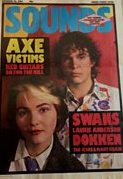

GUITAR TECHNOLOGY 

1983 – ‘Good Technology’ c/w ‘Heart Beat Go (Love Dub)’ (Self Drive Records SD 006), reaches no.8 on Indie chart, the video – performed in a scrap-yard (the obsolescence of new technology) screened on Channel Four’s ‘The Tube’, a 1984 12” reissue edition (SD008) has ‘Good Technology’ c/w ‘Fact’ + ‘Paris France’ reaches no.4 ‘We’ve got sounds that can tear us inside out, sometimes I wonder what it is all about. There’s lots of leisure time to sit and work it out, there’s a TV show I’ve got to see, Good, good, good, good, good, good technology, Good technology…’

1983 – ‘Fact!’ c/w ‘Dive (Live)’ (Self Drive Records SD007) Reaches no.7 on Indie chart. At the time of this interview the address was: ‘Self Drive Music’, 40 Tunis Street, Hull HU5 1EZ (Tel: 0482-48557) + 11 Albany Street, Spring Bank, Hull

June 1984 – ‘Steeltown’ c/w ‘Within 4 Walls’ (Self Drive Records SCAR 010). Reaches no.2 on Indie chart. A ‘Steeltown’ John Peel Session version included on 1986 twelve-inch EP ‘Four Your Ears Only’ (PIAS Recordings)

1984 – ‘Marimba Jive’ (Lewis, Jeremy Kidd) c/w ‘Heartbeat Go!’ (Hallam Lewis) (Self Drive Records SCAR 14). Reaches no.1 on Indie chart

November 1984 – ‘SLOW TO FADE’ (Self Drive Records SCAR LP1) with side one: ‘Remote Control’, ‘Dive’, ‘Astronomy’, ‘Cloak And Dagger’, ‘Crocodile Tears’, plus side two: ‘Shaken Not Stirred’, ‘Sting In The Tale’, ‘Marimba Jive’, ‘Slow To Fade’. Recorded at Fairview Studios in Hull, with all tracks written by Kidd-Lewis, except ‘Crocodile Tears’ by Kidd and ‘Heartbeat Go!’ credited to Red Guitars, it reaches no.3 on Indie chart. An October 2002 Cherry Red rerelease includes bonus tracks ‘Good Technology’, ‘Fact’, ‘Paris France’, ‘Steeltown’, ‘Within Four Walls’ and ‘Heartbeat Go!’ Jeremy Kidd quits two months after the album’s release, and releases solo single “Petals And Ashes (A Song For Emma Goldman)” c/w “Crocodile Tears” in 1985 on Self Drive Records

1985 – ‘Be With Me’ c/w ‘Things I Want’ (One Way Records OW1) ‘A’-side produced by Ian Broudie, with Robert Holmes vocals. Reaches no.1 on Indie chart

1986 – ‘America And Me’ c/w ‘Marianne’ (Virgin VS 858)

1986 – ‘Blue Caravan’ c/w ‘Suspicion And Fear’ (Virgin VS899)

1986 – ‘National Avenue (Sunday Afternoon)’ c/w ‘King And Country’ (Virgin VS 832)


RED GUITARS: 
 FACTS ABOUT TECHNOLOGY 


‘Beautiful boys with bright red guitars 
in the spaces between the stars’ 
(“Mrs Albion You’ve Got A Lovely Daughter” 
by Adrian Henri, 1967) 

When he wrote those lines, poet Adrian Henri’s target was Liverpool musicians, not those from Hull. But although both cities are gradually decaying ports with declining maritime industries, the similarities end there. Some people still consider Hull to be the Land That Time Forgot. Until now, many years later, Humberside is getting its revenge – and it’s become the new home for those bright Red Guitars.

Jeremy Kidd has short uncombed hair that erupts in an unexpected spray of rats-tails over his collar. He hand-rolls cigarettes with the same exaggerated care that he’s now reciting the story of the group he fronts – Red Guitars. A slow factual narrative with artfully selected words falling exactly into place. There’s no attempted hype. No outlandish brags. He informs me that “Good Technology” – their debut single, got to no.5 on the Indie list. Most bands would’ve said no.1, what the hell? But not Jerry Kidd. He’s not playing routine promo games. He’s for real.

‘We’ve been together about two years, something like that.’ Then, ‘or is it just a year? No, it’s two years, although we didn’t really do much for the first year, we used to play a lot around here. We established a following in Hull – people used to have a good time when they came to see us. So we thought, rather than just kind-of doing a demo we’d try and get the money together and put a single out ourselves. The result was “Good Technology”… er, do you want me to keep talking? You can ask questions later. I can at least fill you in on roughly what’s going on. The story thus far…’

There are five Red Guitars. There’s Hallam Lewis in red berry and lead guitar, and Lou Barlow in dark wings of hair and bass. While John Rowley holds down that much-neglected role of rhythm guitar, against Matt Higgins sharp articulate drums. Collectively they spearhead that new generation of bands restating the importance of ‘real instruments’. The novelty phase of synth ‘n’ Revox has devolved into a new conformity, reaching a point where clean uncluttered guitar lines kick out against its fussy pretentions with renewed power, clarity and directness.

‘‘We’ve got machines that sound like orchestras’’ Kidd sings in deadpan derision. Then… ‘WE’VE got sounds that can tear us inside out!’ And they carry that directness clear through every aspect of the group. There’s precious little style-selling or danger-mouth sloganeering. They’ve opted out of the style wars. On stage their power is understated. Kidd doesn’t move much, preferring to hang folded in around the mic. The excitement – in songs like “Paris France” or instrumentals such as the Afro-tinged “Heartbeat Go!”, comes more from the controlled use of sonic dynamic. The way it builds gradually and inexorably to towers of power, the way it then fragments around frenetic guitar clusters in sparkling bursts of incandescence. Their debut album – ‘Slow To Fade’ (November 1984) is riddled with such streaks of the unique.

Yet, more concerned with superficials, the Press slagged off their killer set at the ‘Leeds Futurama’ for their ‘visual confusion of styles’. Kidd bestows one of his infrequent laughs at the put-down. ‘A couple of hippie-looking guitarists and a singer with a Mick Ronson 1973 haircut, yeah’ he quotes. ‘But I mean, maybe that’s not quite the priority with us that it is to some bands. At the moment we do tend to come across as though we’re all playing in different bands, and just happened to get together on the night. Our playing’s getting stronger and stronger through playing live. THAT’S what we see as the most important thing. We want to look reasonably RIGHT, we want to put a fairly coherent kind of image together, but I don’t think it’s crucial to our band. That’s something that’ll come together. When people want to come to see you play – that’s what we see as the most important thing. And the songs that we write – THAT’S our strength really! There’s been some good songs around this year, which is very encouraging. There are people out there writing really strong songs. There’s never THAT many about, but now there’s a few, and at least WE’RE trying…’


Yes – despite such emphasis on song, ‘I didn’t write “Good Technology”. It was written by a friend of ours called Stuart Ross who lives in Hull. He used to play bass with Wreckless Eric, who was up here at Art College for a bit! But we always thought it was a very strong, very unusual kind of song. When we first used to play it, it ran to something like seven minutes long, and we spent ages trying to chop it down. It just has this kind of monotonous driving beat, the bottom line of it is very repetitive – and it just BUILDS. It can be quite uplifting when it works properly. We thought people were going to NOTICE it, they were going to LISTEN. They might not necessarily LIKE it, but they were going to NOTICE it. And that’s proved to be the case… it’s been a good move. We’re now in a position to do other material and at least get a listening. That song won us that right.’

“Fact” came second, equally successful, and in some ways even a superior record. Jerry and Hal wrote it, and what it misses out in “Good Technology”s pressure-shaped insistence, it compensates in lyrical and melodic change-ringing. ‘Lyrics are important – especially to me, ‘cos I write them! But we write reasonably good songs, and that means managing to achieve a balance between melody and lyric. I wouldn’t like to isolate the two and separate them – because they work together. The overall shape and form is crucial in the end. To make a statement like ‘take the profit out of war/ we don’t need it anymore’ (in “Fact”) is just what it says it is, nothing more and nothing less. It’s a very bald, straightforward statement, in certain respects – very important, in other respects kind of banal and naïve. Because the verse parts, they’re much more obscure, cloudy and confused (‘for those of us with dented pride, who never reached the top/ I never lost my fear of flying’), it tends to balance out the forthrightness of the chorus. In the context of the overall lyric it achieves something of what I wanted to say. I don’t think you can take one without the other.’

The ponderous but inspired “Steeltown” – introduced by Mark Ellen when they perform it on ‘Old Grey Whistle Test’, came up for grabs as their third 45rpm, and – with the next single, “Marimba Jive” at Indie no.1, it proves that Red Guitars are far from a two-song band. They have a reservoir of material to draw from, each song distinctively different and as carefully constructed. ‘We do cover quite a broad spectrum of stuff’ he agrees. ‘Again, that just means people will probably have difficulty categorizing us, which – obviously people like to do, y’know? It’d be quite convenient if we could think of a genre-label for ourselves, but we’ve always had trouble with that.’

The ‘Humberside Sound’? Which leads us neatly back to image. Partly thanks to a Channel Four ‘The Tube’ TV mini-feature they’re inexorably linked in people’s minds as ‘RED GUITARS: A BAND FROM HULL’. ‘That’s good in some ways, and bad in other ways’ he admits. ‘But in the end it doesn’t make any difference at all. Since “Good Technology” we’ve had a few vague enquiries from major labels, quite a lot of offers from other small labels, all of which we turn down. All of those people want you to sign contracts for three years. But we certainly have no intention of rushing off down to London or anything. Simply because, as soon as you get among people who’ve spent years involved with the record industry – they start telling you things. And because they’re professionals you naturally listen. And it takes you two or three weeks to realize they’re talking absolute crap! So while we’re sitting up here in Hull, at least we know what WE want to do. And in the end – so far, that’s always proved to be the correct thing to do at every stage.’

The question about the ‘Humberside Sound’ follows naturally. But he’s not impressed. ‘It’s good fun, but it doesn’t mean anything’ he says. ‘I don’t suppose anybody takes it seriously.’

Which is where I start quoting Liverpool poetry at him, about ‘beautiful boys with bright red guitars’ Jerry? But no. ‘I missed that. Who’s that by? Adrian Henri? That’s interesting…’


Tuesday, 30 July 2019

Poem: "POEMS ARE MY HEALING FORCE"


POEMS ARE 
MY HEALING FORCE 


Notre Dame burns, Trump builds a shining wall
I write a poem
Twin Towers fall,
a terrorist bomb takes Manchester Arena
I write a poem
my head takes me on horror-trips
to places I never want to go
I write a poem
my brother dies and I’m haunted by guilt
the pain of things I didn’t do
I write a poem
the global population exceeds 7-billion
the Higgs Boson ignites,
the Endeavour Rover glitches on Mars
I write a poem
the white rhino goes functionally extinct,
my laptop crashes and loses my poems
I write new poems
right-wing anti-migrant parties
make electoral gains across Europe,
Brexit erodes sanity
I write a poem,
for everything we lose
at least we have poems,
while we have poems
we have hope


Featured online at:
IT: INTERNATIONAL TIMES
http://internationaltimes.it/poems-are-my-healing-force/


Monday, 29 July 2019

MICHAEL MOORCOCK: DANCERS AT THE END OF TIME


MICHAEL MOORCOCK: 
TERMINAL CHOREOGRAPHY 

 My original overview of Michael Moorcock’s 
 ‘Dancers At The End Of Time’ stories 
 as it appeared in ‘Vector’ May 1978… 
only slightly tweaked


On their first meeting Brian Aldiss perceived that the seventeen-year-old Michael Moorcock ‘assumed dandified airs, as much to amuse himself’ as for the benefit of others (in ‘The Shape Of Further Things’, Corgi). This assumption of airs has since become a familiar component of the Moorcock persona, but has never seemed as dandified as it appears in his story-cycle, ‘The Dancers At The End Of Time’. The Dancers are ‘a people possessing limitless power and using it for nothing but their own amusement, like gods at play’ (from “Pale Roses”). The cycle is an affectation of vast invention, a series of largely dilettante poses and skilful sophistry, an absurd comic extravaganza set amid, and eventually beyond the ultimate decadence of world’s end.

If Moorcock’s fantasia can be interpreted in autobiographical terms then this mid-phase of his writing reflects a sense of wellbeing, a mellowing, and a maturity that nevertheless provides just as distinctive a set of motifs as the brittle frustrations and violence that surfaced through the dark malevolence of the Elric stories and the other early tales. And as if to counter the implied superficiality of the Aldiss observation he has one character quip that ‘it is sometimes the case that the greater the extravagant outer show the greater has been the plunge by the showman into the depths of his own private conscience; consequently the greater the effort to hide the fact’ (also from “Pale Roses”). In keeping with this credo ‘The Dancers At The End Of Time’ is a game of wit and occasional self-indulgence. And – unlike the Elric stories, deaths are exceptionally rare. Dafnish Armatuce and her son Snuffles die, but then, as he is merely her parasitic appendage, perhaps he doesn’t count. And two of the Lat brigand musicians are eaten by Eurypterid water scorpions, but as they’re not exactly human perhaps they don’t count either!

'Pale Roses'
The universe is drawing to a close, ‘entropy in king, and the universe has begun collapsing upon itself,’ the race faces extinction, yet seldom is there any attempt to seriously portray a worlds-end society millions of years hence as Brian Aldiss does in ‘Hothouse’ (1962) or his short story “Old Hundredth” (‘New Worlds’ no.100, November 1960), or as Olaf Stapledon does in ‘Last And First Men’ (1930), or even as Jack Vance does in his picaresque mythologies from ‘The Dying Earth’ (1950 on). But that’s not Moorcock’s intention. Instead his decorously fantastic characters merely fritter away their immortalities and their limitless power in games and parties. They use power-rings that originally absorbed the energy of whole suns, and which is now stored in the ‘rotted’ sentient cities of antiquity – one of which, significantly, is called Tanelorn. 

They use their power to create living dinosaurs made of edible jelly, to create entire continents complete with miniature wildlife, blazing cities made of water, or whole worlds within which they act out the entire military history of the Earth. They alter their bodies, alter their sex, become beasts, collect Space and Time Travellers in menageries, hold endless parties of polite sophisticated and bizarre excess. Perceptively, a writer in the ‘Glimpse’ fanzine points out that ‘this decadent life-style is the ultimate expression of the creed of aestheticism popular among the intellectuals of the late nineteenth-century – the idea that the only undeniable reality in human existence is the response of the brain to the impressions it receives from the senses.’


A short story – “Waiting For The End Of Time” had appeared as early as 1970 in the highly-collectable ‘Vision Of Tomorrow’ magazine, and although not strictly a part of the ‘Dancers’ cycle, it seems to contain germination points for the idea. Set on the far planet Tanet-tur-Tac among various evolved post-human species, the story features two pale-skinned hermaphrodite beings with limitless powers who attempt to come to terms with the contraction and imminent death of the galaxy. The two characters, called ‘Suron-riel-J’ryec’ and ‘Mis’rn-bur-Sen’ – anagrams of ‘Jerry Cornelius’ and Miss Brunner respectively, await the final implosion of worlds into the Mass by falling asleep, in which ‘time was a meaningless idea, just as death meant nothing and identity meant little.’ Although the story lacks the wit and sophistication of the later cycle it does provide the introduction of the concept of a cyclic universe. Moorcock was to reiterate the idea in ‘The End Of All Songs’ (1976) when it is suggests that the escaping Jherek Carnelian and Mrs Amelia Underwood could have travelled forwards in time – not backwards, into Earth’s prehistory.

The cast of the ‘End Of Time’ proper is extravagant. There is the Duke Of Queens, named after the legendary area of New York. He lives in an inverted palace, and is led to believe that he has killed the masked and suicidal Lord Shark The Unknown in a duel (in “White Stars”). There is Mistress Christia The Everlasting Concubine who chooses ‘to reflect with consummate artistry the desires of her lovers of the day,’ even to the extent of becoming the guiltless child Catherine Gratitude from whom Werther de Goethe learns of guilt and sin (in “Pale Roses”). De Goethe himself is one of the few natural-born denizens of the End Of Time, and flaunts the Romantic sense of unfulfilment that his name implies, through a created environment of storms and bare rock. ‘The Last Romantic’ he is the ‘solitary seeker after truth in a world no longer differentiating between the degrees of reality.’ Life, he opines paradoxically, ‘has no meaning without misery’ – in an age when there is no misery. 

Then there’s My Lady Charlotina Of Beneath Lake Billy The Kid, whose menagerie initially holds the doom-prophesying alien Yusharip. The alien was stolen and bartered for Mrs Amelia Underwood, and later travels the universe with Mrs Underwood’s original captor, the gloomy giant Lord Mongrove. For Mongrove the eventual death of the universe merely provides a vindication of his pessimistic life-philosophy. There’s also Argonheart Po, Bishop Castle, Gaf The Horse In Tears, Li Pao the ex-Chairman of the Twenty-Seventh-Century Chinese People’s Republic, Abu Thaleb The Commissar Of Bengal, Captain Oliphaunt, Korghon Of Soth, and O’Kala Incarnadine – who assumes the form of a bear, a gorilla, a goat, a sea-lion or a rhinoceros.


As the list suggests, and as Moorcock admits, there is an effect of ‘sensation piled on sensation, but rooted in nothing’ (in ‘An Alien Heat’, 1972). They ‘play mindless games, without purpose or meaning, while the universe dies’ around them. The most effective sequences consist of the introduction of elements foreign to the age. In “Constant Fire” Moorcock regurgitates the strutting egotistical Fireclown Emmanuel Bloom, the Messianic custodian of the Holy Grail, from his 1965 novel ‘The Winds Of Limbo’ – a title which occurs, obliquely, in the trilogy. “Ancient Shadows” brings two austere time-travellers, Dafnish Armatuce and her son – the sixty-year-old child Snuffles into the hedonistic ‘rotting paradise’ to provide some of the cycle’s most traumatic moments. For the first time Moorcock calls the postulates of the ‘End Of Time’ into question. For the first time he seems to be peeling back the layers of ‘dandified airs’. Hinting that by this device – the irreconcilable clash of contradictory ethics, the mythos can be used for a more serious purpose. Similarly, in the taut and well-written “Pale Roses” the element of long-extinct virginal purity is recreated for an ultimately trivial – if dramatically effective, purpose.

Then, of course, there is the unique temporal journeyings of Jherek Carnelian. This surreal odyssey begins in ‘An Alien Heat’, the novel which Moorcock himself chooses to recommend because ‘it has probably the broadest appeal and is the funniest and probably the most humane’ of all his work (in a ‘Club International’ interview). Carnelian is the natural-born son of ‘the most artificial of all creatures’ – The Iron Orchid (in “Pale Roses”), who often wears a profusity of breasts. Carnelian is also the latest incarnation in the name-alike ‘Champion Eternal’ karma, heir to Jehama Colyrahlias, Jerry Cornell, Jhary-a-Conel, Jermays The Crooked, (James Colvin?) and inevitably – from Moorcock’s ‘novels of inhumanity’ – Jerry Cornelius. Jherek, incidentally, gets a mention outside the ‘End Of Time’ stories, in ‘The Champion Of Garathorm’ (Dell, 1976).

Carnelian is an eternal naïve existing in a state beyond knowledge of death or fear, beyond good or evil. A perverse amoral Eloi, essentially benevolent and well-meaning in a universe where such concepts have become all-pervading. In Aldiss’ phrase he not only assumes, but embodies ‘dandified airs’. He observes all with the same bemused amused ambivalence. Faced with the end of time he asks ‘why would you wish to save the universe?’ with a genuine degree of perplexity at the absurdity of the suggestion. He meets, liberates, and attempts to woo Mrs Amelia Underwood, an involuntary time-traveller from 1896 who he merely concedes to be ‘the most beautiful human being, apart from himself.’ Although the chaste romance begins as an affectation, it becomes an obsession, and when she’s snatched back to the time of her origin he makes the first of two forays into the past in attempts to recover her. Carnelian acquires a convenient Time Machine from Brannart Morphail, a club-footed hunchback scientist. Morphail belongs to My Lady Charlotina’s menagerie, is an expert in Time Machines and has ‘always affected a somewhat proprietorial attitude towards Time.’

'Ancient Shadows'

The machine Carnelian uses ‘was a sphere full of milky fluid in which the traveller floated encased in a rubber suit, breathing through a mask attached to a hose leading into the wall of the machine.’ It is remarkably similar to the device used by Karl Glogauer in ‘Behold The Man’ (1969), which was also a ‘sphere full of milky fluid in which the traveller floats enclosed in a rubber suit, breathing through a mask attached to a hose leading into the wall of the machine.’ Glogauer, the erstwhile Christ-figure and refugee from ‘Breakfast In The Ruins’ (1972) later makes a guest appearance in the trilogy’s third volume, as Sergeant Glogauer of the Lower Devonian Guild Of Temporal Adventurers. But in the meantime Carnelian is running amok in Victorian London, gets naively caught up in criminal activity, is brought to trial, sentenced and executed – only to reawaken at the End Of Time, while encountering further references to related Moorcockiana. In “Dead Singers” Jerry Cornelius rides a bicycle which is a time machine. In ‘The Hollow Lands’ (1975), during his second trip to 1896, Carnelian rides a bicycle he believes to be a Time Machine!

A large portion of the humour is based around similar misinterpretations of the past by the people of the future. Billy The Kid was thought to have been a ‘legendary American explorer, astronaut and bon-vivant, who had been crucified around the year 2000 because it was discovered that he possessed the hindquarters of a goat.’ Carnelian has ‘a toy fish-tank, capable of firing real fish.’ The people of the End Of Time throw a Ball – within a ball that was ‘inclined to roll a bit’. Moorcock also makes numerous satiric references to the movie industry. There’s a legend that ‘Casablanca Bogart wielded his magic spade, Sam, in his epic fight with that ferocious bird the malted falcon.’ There is ‘Mutinous Caine… cast out of Hollywood for the killing of his sister, the Blue Angel.’ Whereas Pecking Pa VIII – last ruler of the age of Tyrant Producers was the coordinator of whole civilisations-as-movies. Producer of epochs known as ‘The Four Loves Of Captain Marvel’, ‘Young Adolf Hitler’ and ‘a remake about the birth of Christ’ in which ‘Pecking Pa played Herod himself.’ Yet, considering the immensity of elapsed time, and of human history that has supposedly passed, the End Of Time seems to have a remarkable predilection for the couple of centuries around our own!

'Pale Roses'
 But then the fin de siècle late 1800s has long been another of Moorcock’s ‘assumed airs’, from the affectionately recounted anarchist passages in ‘Breakfast In The Ruins’ to the elaborate Jules Verne pastiche of ‘Warlord Of The Air’ (Ace Books, 1971) – the hero of which, Captain Oswald Bastable, also appears in the Devonian, to flirt with Mrs Underwood. In Oswald’s other starring-role novel, ‘The Land Leviathan’ (Doubleday, 1974), Moorcock nods in HG Wells’ direction, and on his second time-trip – in ‘The Hollow Lands’, Carnelian meets and discusses time machines with that same Mr Wells. He finds the writer to be ‘a narrow-faced, slight man with a scrubby moustache and startlingly bright pale blue eyes.’ During a train journey Wells tells Carnelian ‘people often ask me where I get my incredible ideas. They think I’m deliberately sensational. They don’t seem to realise that the ideas seem very ordinary to me.’ Gauche and innocently eager to please, the time-travelling Jherek replies ‘oh, they seem exceptionally ordinary to me.’ During the conversation it’s hauntingly possible to recall the jerky film footage of the real Wells, and rehear the writer’s distinctively high-pitched voice uttering the sentences. 

'Constant Fire'

The sensation is just as tantalisingly tactile when Carnelian meets George Bernard Shaw – with whom perhaps he should have discussed ‘Back To Methuselah’ or ‘Man And Superman’? Shaw is observed correcting proofs, ‘a red-bearded sardonic-looking man with eyes almost as arresting as Mr Wells, dressed in a suit of tweed which seemed far too heavy for the weather.’ Erotic autobiographer Frank Harris is also there, and is instrumental in setting up the novel’s climax. A scene in which temporal disruption upsets a garish night at the Café Royale, with nasty triple-eyed Lat aliens, coquettes, pursuing police intent on arrests, and guests from the End Of Time materialising amid the plush elegance. It is one of the most comically effective moments in the whole trilogy, and is one which leads directly to Jherek Carnelian and his lost love Mrs Amelia Underwood being cast back – or forward, in time to the desolation of the Lower Devonian era where the second part of the trilogy abandons them.

In ‘The End Of All Songs’ it appears that time is cyclic – but it is also spiral. In fact any theory about its nature ‘seems to apply in societies which accept the theory.’ They seek refuge in the Lost Cities from which their power-rings derive energy, only to discover that the apocalypse has begun, the sun has died, and doom is impending. Throughout the stories there’s talk about megaflow and the Chronon Theory which harks back to Moorcock’s ‘Pepin Hunchback’ stories (collected into ‘The Time Dweller’ anthology), and which plugs the entire phantasmagoria into the Multiverse superstructure. A Multiverse which – unlike Time, is conceded to be finite, through concepts such as The Conjunction Of A Million Spheres. Moorcock writes that ‘there is a particular theory which suggests that with every one discovery we make about Time, we create two new mysteries. Time can never be codified, as Space can be, because our very thoughts, our information about it, our actions based on that information all contribute to extend the boundaries, to produce new anomalies, new aspects of Time’s nature.’ The multiverse mythologies overlap. Characters in “Pale Roses” speak of Eric Of Marylebone (Elric Of Melniboné), they use the ornithopter – a device used by the Dark Empire of the Hawkmoon stories, and as ‘The End Of All Songs’ (1976) opens on an increasingly thronged Lower Devonian beach, time travellers Una Persson and Miss Brunner appear, or are alluded to.

'End Of All Songs' from 'Vortex'

Mrs Persson features in the three novellas collected into ‘Legends From The End Of Time’ (1976). The stories are interposed by comments from Your Auditor who supposedly transcribed the texts from the tales of Mrs Una Persson – one of the Guild Of Temporal Adventurers. Thus the series of novellas ‘assume the character of legends rather than history’. The fourth of the stories – “Constant Fire”, features Doctor Volospion’s Menagerie Of Forgotten Faiths, and the lesbian Miss Mavis Ming from twenty-first-century Iowa. It is oral history as narrated by one of Mrs Persson’s colleagues, an anonymous ‘Chronic Outlaw’, in much the same way that Captain Bastable supposedly related ‘Warlord Of The Air’ to Moorcock’s grandfather in 1904. Mrs Persson previously featured in Moorcock’s 1975 novel ‘The Adventures Of Catherine Cornelius And Una Persson In The Twentieth Century’. In ‘The End Of All Songs’ she first helps to return Carnelian and Mrs Underwood to the relative stability of the End Of Time, and later follows them to watch Lord Jagged implement his time-recycling scheme to save the Earth as the universe ends and the revels are, temporarily disrupted. Miss Brunner has an equally complex history. In ‘The Final Programme’ (Avon, 1968, Allison and Busby, 1969) she and Jerry Cornelius are fused into the ‘perfect hermaphrodite being’ in the form of Cornelius Brunner, a character resurrected in the singular for ‘A Cure For Cancer’ (Allison and Busby, 1971) as Captain Brunner, and later into ‘The Lives And Times Of Jerry Cornelius’ collection (Allison and Busby, 1976).

'White Stars'
There’s one final cross-over that demands mention, Lord Jagged Of Canaria, the ‘fantastico in yellow’, the unique and ubiquitous manipulator of fates. Jagged is the only one of the Time’s-End denizens to appreciate the dilemma facing Dafnish Armatuce, and the only one to elicit her approval. Jagged hangs forever around the outer edges of Carnelian’s travels in time, gradually assuming an insidious presence until it finally becomes clear that he is not one of the natives of the End Of Time at all, but is from the twenty-first century, nearer the era of Mrs Underwood. He is also, in the face of general apathy, intent upon averting the inevitable death of the species, and of time itself. To further this dénouement he not only fathered Carnelian in the first place, but kidnaps his bride and – incognito, becomes Judge Jagger who sentences Carnelian to death in ‘An Alien Heat’, as well as the reporter Jackson who assists Carnelian’s escape in ‘The Hollow Lands’. He could also be behind the well-mannered junior army officer Michael Jagger of ‘Warlord Of The Air’. Lord Jagged’s ultimate fate and subsequent travels in time are not fully explored. But then, as Mrs Amelia Underwood explains to My Lady Charlotina towards the end of the trilogy ‘the tale is not yet finished, I regret. Many clues remain to be unravelled – threads are still to be woven together – there is no clearly seen pattern upon the fabric – and perhaps there never will be.’ As this contention suggests, even though she ultimately rejects the meaningless façade of the End Of Time for the harsher reality of dynasty-founding in the Devonian, Mrs Underwood adjusts better to the rigours and contradictions of time travel that does Jherek Carnelian. 

There are no neat conclusions to ‘The Dancers At The End Of Time’ mythology. But then, as Moorcock’s multiverse unfolds not in separate self-contained batches, but in interrelated sequences without apparent end, perhaps none were to be expected. But the mythos is a significant new phase in Moorcock’s development, and is technically his best, even behind the gaudy cavalcade of deliberately assumed inconsequence. Dazzlingly inventive and an endless delight. At one point, for example, as if addressing Moorcock directly, Carnelian suggests that ‘I was born so that you might be supplied with raw materials with which to exercise your own considerable literary gifts.’ Yet behind the playful self-indulgence the aesthetic credibility rating is definitely in the ascendant.


In keeping with the allusions to Mrs Underwood’s time, the titles of the stories are taken from period poems, from “Dregs” (‘The End Of All Songs’), “A Last Word” (‘The Hollow Lands’), and “Transition” (“Pale Roses”) written in 1899 by Ernest Dowson. Then there is “Constant Fire” from the poem “The Song Of Theodolinda” by George Meredith, while the title of ‘An Alien Heat’ comes from the 1896 poem “Hothouse Flowers” by Theodore Wratislaw. WB Yeats (“White Stars”), GW Russell (“Ancient Shadows”) and Alfred Austin poems are also quoted, as well as those from Ernest Wheldrake’s “Posthumous Poems” of 1881 which were ‘rediscovered’ by Moorcock.

But Moorcock’s own prose is seldom without its vivid poetic imagery. Evocatively he writes ‘she told him the story of Sir Parsifal as the gold, ebony and ruby locomotive puffed across the sky, trailing glorious clouds of blue and silver smoke behind it.’ Neither is the writing lacking in perceptive humour. Trapped by a policeman of ‘massive bovine dignity’ Carnelian fires a deceptor-gun, filling the room with naked female warriors of the late Cannibal Empire period, painted green and blue, decorated with small skulls and finger-bones, carrying clubs and spears. ‘I knew you was ruddy anarchists’ pronounces the policeman triumphantly.

In the late 1970s Michael Moorcock became one of the few writers who stood beyond genre, by evolving into a genre himself. People read Michael Moorcock who would claim neither to read Science Fiction or Fantasy. But these addictively readable stories deserve a wider-than-just-cult appreciation.


THE ‘DANCERS AT THE 
END OF TIME’ CYCLE 

(1) ‘AN ALIEN HEAT’ 1972, MacGibbon And Kee Ltd, Mayflower paperback (60p). ISBN 0-583-12106-3. 158pp

(2) ‘THE HOLLOW LANDS’ 1975, Hart Davis MacGibbon (£2.75), Mayflower paperback (60p). ISBN 0-246-10876. 180pp

(3) ‘LEGENDS FROM THE END OF TIME’ 1976, Harper And Row/ WH Allen (£3.50) A collection made up of ‘Pale Roses’, ‘White Stars’ and ‘Ancient Shadows’. 182pp

(4) ‘THE END OF ALL SONGS’ 1976, Mayflower (96p). ISBN 0-583-121055. 307pp. Serialised in ‘Vortex: The Science Fiction Fantasy’ magazine nos.1, 2 and 3 through 1977


Novellas:

(5) ‘PALE ROSES’ from ‘New Worlds no.7’ (1974, Sphere Books) illustrated by Jim Cawthorn, also in ‘Best Science Fiction Of The Year’ edited by Terry Carr (USA, Ballantine, 1975). Mistress Christia assumes the guise of Catherine in order to reconcile with Werther de Goethe after destroying his rainbow, and ‘In Which Werther Finds Redemption Of Sorts’

(6) ‘WHITE STARS’ from ‘New Worlds no.8’ (1975, Sphere Books) illustrated by Mal Dean. ‘A Stroll Across The Dark Continent’, and a duel between Lord Shark The Unknown and the Duke Of Queens over the destruction of a lichen experiment


(7) ‘ANCIENT SHADOWS’ from ‘New Worlds no.9’ (1975, Corgi Books) illustrated by Jim Cawthorn. ‘A Stranger At The End Of time’, Time Traveler Dafnish Armatuce and her son Snuffles arrive at the End Of Time, ‘In Which Snuffles Finds A Playmate’

(8) ‘CONSTANT FIRE’ from ‘New Worlds Quarterly no.10’ (1976, Corgi Books) illustrated by Jim Cawthorn. ‘In Which Miss Ming Experiences A Familiar Discomfort’ and ‘In Which Mr Emmanuel Bloom Returns To Claim His Kingdom’ – ‘In The Museum And The Menagerie Of Forgotten Faiths’

(9) ‘ELRIC AT THE END OF TIME’ from ‘Elsewhere’ edited by Terri Windling and Mark Alan Arnold (1981, Ace Books), collected into ‘The Mammoth Book Of Extreme Fantasy’ edited by Mike Ashley (Robinson, 2008) Mrs Una Persson departs the local 1936 Time Centre to investigate a disturbance in the temporal megaflow. While Elric is caught up ‘by his own monstrous magickings’ during a battle with Grrodd Ybene Eenr who employs ancient spells left by wizard Cran Liret – ‘The Thief Of Spells’ on Sorcerers Isle. Cast into inter-dimensional void he’s drawn by Stormbringer to the ‘End of Time’, where De Goethe and Duke Of Queens fabricate fabulous adventures of rescue and conquest for Elric, with Bird-Monsters and Pierrots (confused with Parrots). ‘Dastardly poltroons’ roars the Duke. Bringing the two realms into juxtaposition shows Elric’s doom-laden moods to be as much an assumed guise as the denizens of the End Of Time. ‘There were similarities between Jherek and Elric which she (Una) could only sense at present.’ Finally Lord Jagged – it is assumed to be Jagged, assumes the form of Lord Arioch, the Lord Of Hell, to guide Elric back home.‘You’re exaggerating’ says Una. ‘Why not? Everyone else is’ says Jagged


(10) ‘THE TRANSFORMATION OF MISS MAVIS MING’ (1977, WH Allen, ISBN 0-491-01718-9) aka ‘A MESSIAH AT THE END OF TIME’ novel (a rewrite of ‘Constant Fire’) in which Miss Mavis Ming, Doctor Volospion and the residents at the End of Time, meet Mr Emmanuel Bloom, also known as ‘The Fireclown’. The ending originally involved a scene where the main character, Mavis Ming, is whipped into submission by Bloom. Moorcock later revised this

(11) ‘SUMPTUOUS DRESS: A QUESTION OF SIZE AT THE END OF TIME’ from ‘Postscripts no.15’ (Summer 2008) edited by Peter Crowther and Nick Gevers (PS Publishing)

(12) ‘THE MURDERER’S SONG’ included in Michael Moorcock short-story collection ‘Jerry Cornelius: His Lives And His Times’ (Gollancz, 2014, ISBN 978-1473200722), also featured in ‘The New Nature Of The Catastrophe’ edited by Langdon Jones and Michael Moorcock (Millennium, 1993)


Other Sources:

THE SHAPE OF FURTHER THINGS’ by Brian Aldiss (1970, Faber And Faber, Corgi) ISBN 9780571247240

WAITING FOR THE END OF TIME’ first published as ‘The Last Vigil’ in ‘Vision Of Tomorrow’ no.11, August 1970, then featured in ‘Moorcock’s Book Of Martyrs’ by Michael Moorcock (Orbit/ Quartet, 1976 ISBN 0-7043-1265-4)

MICHAEL MOORCOCK INTERVIEWED’ an interview with Michael Moorcock in ‘Club International Vol.4 no.3’ (March 1975)

DEAD SINGERS’ featured in ‘The Lives And Times Of Jerry Cornelius’ by Michael Moorcock (Quartet)

THE TIME DWELLER’ by Michael Moorcock (Hart-Davis, 1969, US Berkley Medallion, 1971) and anthology made up of ‘The Time Dweller’ aka ‘Scar-Faced Brooder 1’ (‘New Worlds’ no.139, February 1964), ‘Escape From Evening’ aka ‘Scar-Faced Brooder 2’ (‘New Worlds’ no.148, March 1965), ‘The Deep Fix’ (‘Science Fantasy’ no.64, April 1964, as by James Colvin), ‘The Mountain’ (‘New Worlds’ no.147, February 1965, as by James Colvin), ‘The Pleasure Garden Of Felipe Sagittarius’ (‘New Worlds’ no.154, September 1965, as by James Colvin with James Cawthorn inner art), ‘Wolf’ (from ‘The Deep Fix’ as by James Colvin, Compact Books 1966), ‘The Golden Barge’ (‘New Worlds’ no.155, October 1965 as by William Barclay), ‘The Ruins’ (‘New Worlds’ no.161, April 1966, as by James Colvin with Harry Douthwaite inner art), ‘Consuming Passion’ (also in ‘New Worlds’ no.161, April 1966). 176pp

REBEL AT THE END OF TIME’ (PS Publishing, 2011), a spin-off prequel to ‘An Alien Heat’ written by Steve Aylett


Other Michael Moorcock features on
‘Eight Miles Higher’...
http://andrewdarlington.blogspot.com/2017/06/michael-moorcock-twilight-man.html
http://andrewdarlington.blogspot.com/2017/09/michael-moorcock-whispering-swarm.html


This feature first published in:
‘VECTOR no.88’ (UK – May 1978)

'Ancient Shadows'

Saturday, 27 July 2019

THE FALL INTERVIEW: Behind The Fall Guise


BEHIND THE FALL GUISE 

 Andrew Darlington in conversation with 
 Mark E Smith, Craig Scanlon and Brix Smith of THE FALL
 unedited at length, with repetitions and false starts intact…


What is this thing called Fall? Fall (Ger: Sturz. Fr: Chute. Sp: la Caida)

Is it Fall: as in verb – to fall (did he FALL or was he pushed? I’m not FALLing for this crock of crapola no more! FALLing in and out of love).

Or is it Fall: as in noun – The Fall. Fall from grace, vis. theology.

Does it matter?

‘…of course, you don’t actually REVIEW the Fall. You hover in the shadow of the aura and attempt to catch some of the sparks’ said ‘Melody Maker’ (6 March 1982).

These are sparks…

‘The longest-running Manchester Punk group, the Fall, refined their demented Rockabilly while singer Mark E Smith told his shaggy dog stories with a delivery that was part-Ranter, part stand-up Comedian’ begins Jon Savage (‘Observer’, 27 July 1986). Mark E takes up the tale, and continues to writer Barry McIlheny, dating it all from the pivotal first-ever Manchester Sex Pistols gig ten years earlier, ‘there were so few of us there that Malcolm McLaren said ‘hello’ to each of us as we went in. I remember seeing the Buzzcocks and thinking, bloody hell, I could do better than that. It’s a cliché now, but that honestly was the attitude at the time – anyone can do it. Up until I saw the Pistols doing stuff like “(I’m Not Your) Steppin’ Stone” and other garage songs, the idea of us playing in public was pure fantasy. Then suddenly we find ourselves second on the bill to people like the Drones! We were just happy to be playing… I look back on it all now with interest and find it funny that we’re still seen as the remnants of the great Manchester Punk scene when, in actual fact, we were always apart from most of them, and they had spiky hair while I was going about in my pullover and cords’ (in ‘Melody Maker’, 12 July 1986).

These are also sparks…


ANDREW DARLINGTON: After ten years of Indie cult success Fall finally go Top Twenty during May 1987 with a revamp of R Dean Taylor’s ‘Northern Soul’ classic “There’s A Ghost In My House”. Was Northern Soul an early influence on you?

MARK E SMITH (lead vocals): An influence on me? Yeah, I was well into it. I still am. But only ‘cos it was badly recorded, with bad bad songs and cheap guitars.

AD: Your 1981 single “Lie Dream Of A Casino Soul” references that scene too. (‘I’m a bit jagged right now, in a tongue-tired, wired state, cause Sunday morning dancing, I had an awake dream…’)

MES: Well, obviously.

AD: Fall’s origins lie in Manchester’s Punk scene where it was Buzzcocks, Penetration, Magazine, and Slaughter And The Dogs who grabbed most of the kudos. But it’s been Fall who’ve proved to be the longest runners. Mark’s the only constant figure in the line-up, but Craig goes back almost to the origins of the band too.

CRAIG SCANLON (lead/acoustic guitar): Pretty much, yes. I wasn’t in Fall from the VERY beginning. The band started in 1977 – I joined in 1979, but I’d been watching, more or less, since they started. Fall were never neglected, but they attracted a kind of elite audience. An audience who KNEW who the good acts were.


AD: Mark’s been quoted as saying Fall felt no sense of being part of a ‘Manchester scene’ with those other bands?

CS: No, there was no affinity with those bands. We were pretty aloof really. I got that impression even when I was just watching them from the audience. Fall were a kind of ALOOF band. We never got into that back-slapping kind of thing with the Buzzcocks.

AD: If you felt no regional affinity, did you feel affinity for other Indie bands operating in similar vaguely experimental musical zones? Cabaret Voltaire for example, who were also well into Northern Soul in their early days.

MES: You wouldn’t think so would yer? The Disco rubbish they turn out now! But I remember seeing Cabaret Voltaire – right? – in 1982, and it was like the best live show I’D EVER FUCKIN’ SEEN. It was INTIMIDATING, loud, and a real experiment on its own. That was before Chris (Watson) left y’know. He used to play keyboards with ‘em. He had a really good attitude to keyboards and tapes. His idea was – like, to make the keyboards not sound like anything on the Earth. He’s a really nice lad, Chris, works for Tyne Tees TV now. I think they miss him a lot, y’know.

AD: There was a great freedom of ideas and a sense of limitless possibilities back then. While one of the supposed socio-political aims of the Punk thing was to destroy the barriers between artist and audience. Did Fall share that idealism?


CS: I don’t know about breaking down the barriers between audience and band. What do you do? – buy them all a drink or something? Pat ‘em all on the back? It’s pretty condescending to try and do that. We don’t act like superstars. If someone wants to talk to us, if they’re interested in what we’ve got to say, then that’s fine – we want to talk to them. But surely it’s more condescending to go out and play the ‘Hero Of The Common Man’ bit.

AD: The Damned are a good example of a band evolving out of Punk attitudes into a mainstream Pop-Rock Band.

CS: Yeah. People say they broke down barriers. That they’re really close to their audience. But I’ve seen them. I’ve seen Dave Vanian at Clubs and he’s got a bodyguard and crowds of people there with him. He lives that more than anyone. Billy Idol too, he does that, doesn’t he? He knows he’s doing it, and enjoys doing it.

AD: Doesn’t a ten-year career-structure make that inevitable? The sheer fact that Fall’s been trading as a band for a decade and has an extensive back-catalogue of albums means that, like it or not, you’re now just as much a part of the current Establishment as Cabaret Voltaire – or the Damned.

BRIX SMITH (guitar/ vocals): NO – I would HATE to be like the Damned! They have enough money now that they don’t HAVE to do it. Probably. I’m not saying they’re rolling in money, but WE certainly aren’t in that position. That’s the difference, within us the real urge and need to play is still there. That’s what’ll keep us going.

AD: To what extent does Mark set the tone for the band? There’ve been many personnel changes but the sound’s remained remarkably consistent.

CS: The sound’s changed quite a lot, but it’s all from the one area. We all know what the Fall is, there is a common link. It’s just a good collection of people, a simple thing, although we don’t necessarily write consciously for ‘The Fall’.


AD: Marc Riley’s departure from Fall in October 1982, after the exquisite ‘Hex Enduction Hour’ LP (March 1982) and the near-bootleg ‘Room To Live’ (September 1982) mini-album is often seen as a watershed in the band’s history. People talk of the Marc Riley period as being more chaotic and unpredictable. Then the post-Riley period...?

CS: (l-o-n-g silence) I know. There’s no answer to that. There ARE little sections of people who… (sniff)…

BS: His days were numbered. Towards the end, Marc Riley’s days were numbered.

AD: The first post-Riley gig you played was here in Leeds (‘this little club in Leeds with about a hundred people (who) booed and everything’ Mark told ‘Soundmaker’, (16 April 1983)). Was that ‘The Warehouse’?

CS: The first one we did WAS ‘The Warehouse’ Club, yes.

BS: What was that like, Craig? Fun? Did YOU see it, Andy?

CS: It was good. It was really hard work, but really good.

AD: Are you pissed off with journalists asking questions about Marc Riley?

BS: It’s alright.

CS: No. We’re still talking about him.

AD: Do you have a favourite Fall album?

CS: Erm – I don’t. I mean, I only ever play whatever’s the latest one. It’s only historians who look back. The albums all stand up on their own thingy, y’know, but I’ve done it and I don’t really… know.

BS: I enjoyed that last one, and ‘Slates’ (a ten-inch EP from April 1981) for me personally. Everyone has a different one – there’s plenty to choose from!


AD: Reading back through reviews and press-cuttings there’s a curious lack of consensus about what constitutes GOOD Fall. I’d choose ‘Hex Enduction Hour’. Journalist Colin Irwin describes how Fall recorded its “Iceland” track during a tour in that country. ‘Iceland’s rich history of legends and folklore fired Smith’s already rampant imagination, and he’d jotted down a series of scattered thoughts, fantasies and genuine incidents surrounding the visit, while the rest of the band concocted a weirdly haunting tune in the studio. The track, opening with a cassette recording of the wind blowing outside Smith’s hotel window, was done first-take with the band and their leader having only the vaguest idea of what the other would be doing’ (‘Melody Maker’, 6 March 1982). That ‘inspired accident’ method of working seems to imply that you rely to a degree on intuition?

MES: Yes, sometimes. Not all the time. It’ll be about half ‘n’ half. Half of our stuff is very very worked on. But I like that ‘accidental’ aspect, I like that, yes. It’s not good to go into the studio with songs that you know backwards, y’know? – and just get ‘em down. I don’t want to do that because I just don’t want to be stale. I don’t want to go on tour and practice a load of songs and then go in the studio and just recreate them. You end up not even feeling what you’re singing.

CS: Yeah, well – the writer’ll obviously have some vague idea of what’s going to happen. But there is a common link that we all share, some kind of telepathic link. We all think as one at one point, y’know.

BS: I think that comes across live too. I think we’re a real sort of ‘supernatural’ band. Sort of, like in a magical way. In a sort of DARK way. Not like – (giggle) – the DEVIL or anything, but you know what I mean? There’s something really binding us together that you can’t see…

CS: We all play mistakes at the same time – in a line. (General laughter)

AD: Many bands now use the studio itself as a compositional tool, but Fall seem to be the antithesis of the Fairlight/ Trevor Horn syndrome. I get the impression that Fall are more a ‘live’ band, and in the studio you prefer to work in as close to a ‘live’ situation as possible.


BS: Yeah, that’s true. We don’t use the studio deliberately in that way. But a few things come out of it. Different sounds, you don’t KNOW you get them, but they just ‘appear’ on the tape. That happens, but we don’t lock ourselves in there for years and manipulate things. We usually get the rough sounds ready, then we go into the studio, do it, and then we come out.

CS: The LP ‘This Nation’s Saving Grace’ (October 1985) used the studio more in the sense that it was giving us ideas, getting a very simple song and making, like, an epic treatment for it.

AD: I find the eerie surrealistic track “Paintwork” the most intriguing title from that album (‘sometimes they say, Hey Mark, you’re spoiling all the paintwork’).

MES: (Bored) Really.

AD: I like the dislocation between its sections, layered like a painting, the tempo changes and splicing are not typical of regular Fall construction.

MES: Mmmm – huh. Yes, there’s a lot of savage edits.


AD: Did that track ‘evolve’ in the studio?

BS: Yeah, in a sense it did ‘evolve’ in that way. Well – Craig wrote it, then half of it was recorded in Simon’s studio, in his house (Simon Rogers: Bass/ DX7). But then we couldn’t recreate that sound in the studio properly with all the other instruments. So we just used part of the original tape, and then we put part of the recreation of it, and then… I don’t really know what happened! There’s, like, the weather on there or something, HaHaHa!

CS: That’s what I meant about the studio thing. It was basically a very simple song, something pretty crude to work with, but giving it the studio effects turned it into a very dreamy kind of thing. It’s a bit more ethereal.

AD: Was the technical side of that down to producer John Leckie?

MES: No – I did all that. Me and Simon did it all. We made it so it was dead sloppy, like. Well no – actually it isn’t SLOPPY, it’s GOOD. It’s strange the way we… I mean, we recorded it at three different times. But it’s all basically cassette stuff, you know. That sort of thing. There’s only like two bits of it that’s actually done in a studio. We were putting, like, cassettes of the same track over different versions of the same thing so they would clash, and things. I really enjoyed doing that one, I thought it was great. I’m DEAD phased that people like it, y’know? ‘Cos a lot of people have said that to me; that they think that’s the best track – which I’m DEAD pleased with. The way we record is very uncompromising, and you always suffer a lot if you work… like we always work. And YOU’D BE A-M-A-Z-E-D AT THE PREJUDICE YOU E-N-C-O-U-N-T-E-R! Even though the songs ‘ave been brilliant you always get them saying ‘it’s a brilliant song ‘cept it was recorded in a garage’. Like they’re trying to insinuate you’re sloppy or summat. When in fact I went out of my way to GET that sound. It’s the sound that we wanted. I ALWAYS wanted that sound, y’know? I didn’t want any smooth shit. I’m glad people like “Paintwork” – ‘cos that’s the way it should be done.

AD: Do you have tapes of failed Fall experiments?

MES: No, not really. My experiments never fail. No, I’m just saying, y’know… there’s a lot of groups who have an odd attitude to experimentation. They think that they’ll put brilliant improvisation on their record, so they just do it and it comes out like dosh. Like Public Image or something like that. You know what I’m saying? They think their every utterance is brilliant art. We’re very conscious of getting away from that. We can’t PLAN anything really. You can’t PLAN improvisation, which is what a lot of people TRY to do. You know what I mean?

AD: There’s a mystique to Fall that’s perhaps largely due to the – often inaudible, lyrics. There’s a lot suggested…

BS: Yeah, right, Mmmmm.

CS: Yes. It’s very difficult to explain it. But we DON’T insult your intelligence.

AD: How do you decide what is good Fall and what is bad Fall?

BS: It’s just a personal opinion. It’s just what we like, what’s right for us. I think most people who really like the Fall, like everything. People that really dislike it, hate it all.

AD: So how do you decide what goes onto the album and what stays on the shelf?

MES: It’s just what I like, what we like. What I and, say – what to the producer sounds good. What he picks that sounds good.


AD: Is the producer’s role important? You’ve used John Leckie on two albums, ‘This Nation’s Saving Grace’ and ‘Bend Sinister’ (September 1986). Does he function as a contributing member of the sessions?

MES: John Leckie’s VERY important. Yes. He has everything so LOUD. He used to work with Phil Spector, so he’s got a very good attitude… my sort of attitude. He has everything sort of SEMI-perfect, he wants it BIG, but he doesn’t want it smooth. I’m inclined to think the Fall miss out a bit on that. We never captured the big sound ALONG WITH the garage cheapness, like. I always thought that element of it was the best bit.

CS: John’s helpful to us. He’ll tell us if it’s bad.

BS: He doesn’t try to change the music though. He just gives suggestions. Tells us what he thinks, but we don’t always act on his suggestions. But he does tell us if we played it bad. He makes out he’s a perfectionist, and so if we play a little riff or something wrong, we just stay in there for three, four or five hours until it’s right. He’s the greatest. He’s really good.

CS: He’s more over the top than us really. So we just curb his excesses, ‘cos he’s full of ideas, sounds and that. He doesn’t try to take over though, he’s much too peaceful. He just meshes in with us, and lets us go, you know?

AD: Although traces of Rockabilly have been detectable in Fall records since the very beginning, the first cover version you did was the Gene Vincent song “Rollin’ Danny” as a 1985 single (adapting Gene’s opening riff with old Motown hit “Needle In The Haystack” by the Velvettes).

CS: Gene Vincent, he’s good. I’ve quite a few of his LP’s.

BS: Mark loves him. Mark chose that song.

MES: We only did that track as a… hobby, you know? I never thought it’d be a single. It wasn’t until it was mixed that I sorta thought it should be a single. We just did it to keep the voltage going. We weren’t even thinking of recording it. We went down there to record something like “Cruiser’s Creek” or “Couldn’t Get Ahead”, and just did that as well. It’s a song that’s very hard to do actually, come to think of it. We had to do all the backing vocals, and they’re REALLY intricate, y’know? ‘BOOP-BOOP-BOOP’ – really complicated. And the guitar solos on the original, they’re just like avant garde jazz! Pretty damn good.


AD: Brix, how did you come to cover the Old Strawberry Alarm Clock hit “Incense And Peppermint” – with your spin-off group Adult Net, a song from 1967? I remember it first time round!

BS: Do you? I was four years old, HaHaHa!

CS: How old was YOU, Andy?

BS: SHUDDUP Craig! But yeah – that wasn’t the Fall (HaHaHa). That’s completely different. Let’s not talk about Adult Net. No, that’s a completely different subject. We should talk about the Fall now. So go on, Andy, ask me more questions about the Fall.

AD: You’ve praised the ‘bad songs and cheap guitars’ of Northern Soul, and cited ‘garage-band cheapness’ as a desired sound quality. So is musicianship an important part of what Fall do?

BS: The thing that really KILLS me, the thing that really infuriates me, is that people say we can’t play our instruments. And that is COMPLETELY…

AD: I wasn’t inferring that.

BS: No, I’m not saying you are. I’m saying this myth is completely a myth. I mean, we may not play like orthodox perfectly classically – you know, like THEORY trained musicians, but we can play. And we can play anything we like. We can play with ANY band. And if we wanted to learn classical, we could do it. And Simon – he’s a professor of music (keyboard-player Simon Rogers entered the London Royal College Of Music in 1976, and became an associate ARCM after winning their 1980 guitar prize). So there you go – HaHaHa. But, um – anyways, I think what we do is just STRIP it down and just play what we feel.

CS: What we find is that Musician’s Musicians, in the real sense of the word, couldn’t really think of the stuff we write. Because, for them, the imagination’s been stifled.

AD: There was a review in ‘Melody Maker’ of ‘This Nation’s Saving Grace’ – your tenth album, saying you’d just remade Captain Beefheart’s classic LP ‘Safe As Milk’ ten times.

BS: That’s full of shit. We saw the ‘Melody Maker’ that week. Oh god – that guy just hates the Fall. I mean, if you hate the Fall you hate it. If you hate something you just don’t like it. What’s the point of reviewing something you don’t like and you know you’re going to hate?

CS: People who have an idea in their mind about something just won’t listen. They’ll just review the album by one or two tracks, or by reading other people’s reviews and interviews. That guy said we should shoot ourselves!


BS: No – he said HE would shoot HIMSELF if he ever saw us again. I’m gonna send him a gun!

AD: I thought what he wrote was rather harsh, but he obviously saw the Fall as a band who hadn’t achieved any real progression. Do you see there being progression yourself?

CS: Yes. Of course.

AD: But don’t you ever see Fall reaching a point where there’s no clear direction left forward?

BS: Oh no. ‘Cos each album… I mean, some people say everything of ours sounds the same, but it is NOT. Not to me. No, I think we just keep on changing. Like, on ‘Perverted By Language’ (December 1983, the first to feature Brix contributions) the song-structures were much tighter and more verse-chorus verse-chorus, a beginning and an end. While ‘This Nation’s Saving Grace’ went back to being a lot looser, a lot more – not really experimental, but it just evolved itself without having to be put into an… um… structure.

AD: We began by talking of the ‘career structure’ which took Damned from Punk’s idealism into becoming a mainstream Pop-Rock Band. And Cabaret Voltaire, you describe their current output as ‘Disco Rubbish’, yet their initial experiments in tape-splicing were really innovatory.

MES: They’re clever lads, yeah.

AD: But once they’d exhausted all the possibilities and permutations of that style they evolved to where they are now. They had to go somewhere, and they matured pretty convincingly.

MES: N-a-a-a-h. It’s a bit Art School. It’s very Sheffield in’it, let’s face it? Y’know, not to knob ‘em. The Cab’s will never admit to themselves that basically they never really got over the Human League becoming Pop Stars. They’ve always been, like, sort of trying to do that, and lying to everybody that they want to be Independent. THAT’S the honest brutal truth. I like Richard (Kirk) a lot. I think he’s a REALLY nice lad. But that’s always been the problem for me, with them. They can’t seem to make their minds up whether they want to be Experimentalists or, er, Pop Stars. You shouldn’t really have to think about something as basic as that, it’s a waste of time even bothering about it. But they’re real uptight about the fact that they shared a studio with the Human League. I mean – who are the fucking Human League? I mean, they’re a good Pop group. But the Cab’s had more promise. But they blew it ‘cos they wanna be… once any group goes to Virgin Records, man, they’re fucked! S’right. A sure sign of death. Always has been.

AD: But won’t there come a time when Fall exhaust the possible permutations of their style? Do you have any conscious goals left to achieve?

CS: Girls – or goals?

AD: Do you feel that Fall albums are evolving towards something?

CS: No. Not really.

BS: We consciously try and make our albums better than the last one. Or different, or whatever. But we don’t set out deliberately to…

CS: Not as far as making a ‘grand statement’ is concerned. ‘Cos we’re always doing that. We’re doing it every day. Every time we play we’re making a grand statement. But there’s no sort of long-term military goal. We try our hardest, which is important, ‘cos there’s so much dross around. It keeps you on the ball. All these bad things are just unhelpful.


Other Fall features:
http://andrewdarlington.blogspot.com/2018/02/interview-mark-e-smith-fall.html
http://andrewdarlington.blogspot.com/2018/02/cult-albums-two-by-fall.html
http://andrewdarlington.blogspot.com/2018/02/interview-brix-smith-fall-adult-net.html